
News & Announcements


News & Announcements
October 12, 2018
Finance your coding education with mobicred
There are many ways to finance a coding bootcamp. But you might want to try the new kid on the blog, mobicred; a simple credit facility for purchasing a HyperionDev online coding bootcamp.
Siphilile Magubane, 25, worked as a personal trainer before deciding he wanted to enter the lucrative field of coding. He knew he wanted to study part-time and online. “One of the biggest benefits of part-time, online learning relates to flexibility. I could still earn some money as a trainer while upskilling. It was just a matter of how best to finance my career transition. That’s when I heard about mobicred, a novel way to finance my bootcamp.” Read on to find out how to finance your coding education with mobicred, among other ways.
How can I finance my bootcamp?
There are many ways to finance a coding bootcamp, including:
- Plan and save: A Business Insider case study works out that if you forego your daily purchased coffee, you save in the region of $1000 per year.
- Try for a scholarship: Plenty of coding bootcamps offer scholarships on the basis of financial need or merit. Here’s a list from Course Report of scholarships on offer for bootcamps.
- Crowdfund: Digital Trends lists some of the best crowdfunding sites online including Indiegogo and GoFundMe.
- Apply for a student loan: After surveying reports from 73 qualifying coding schools, Course Report found that the average salary increase after a bootcamp was 50,5%, which equated to $23,724 extra per annum, so you should pay back your student loan fairly quickly.
- Opt for a different payment plan: Many bootcamps offer a variety of payment plans, from paying the full amount at a slightly discounted rate upfront to paying off the course over the duration of study. HyperionDev offers several payment plans, including a monthly option and a significant discount if you choose to pay upfront.
- Work sponsorships: If you’re planning on continuing your full-time employment during your online coding bootcamp, consider speaking to your employer – they may want to invest in the skillsets of their employees. Make sure you sell it to them by stating how your skills will benefit the company as a whole.
But there’s another way to pay for your bootcamp, mobicred – a simple credit facility for purchasing a HyperionDev online coding bootcamp. “We believe coding should be accessible to everyone, everywhere,” states Riaz Moola, HyperionDev’s Founder and CEO. And mobicred ensures this is the case.
mobicred: how does it work?
It’s simple to finance your coding education with mobicred. Here’s how it works.
- Apply once online.
- Accept the terms and conditions and get your credit limit.
- Buy your HyperionDev bootcamp. Click on the link found on the HyperionDev Tuition page to set up your mobicred account. Once your account has been set up and approved, simply choose the PayFast option on the checkout page and select the mobicred payment method. Enter your mobicred details and that’s it!
- Pay one single monthly instalment for the next 12 months.
- Securely manage your account online or via your phone.
So what are the application requirements for mobicred?
- A valid SA ID number.
- 18 years or older.
- A minimum monthly salary of R550.
- An existing and valid bank account in your name.
- A current and valid email address and mobile number.
- The submission of 3 months of your most recent bank statements or payslips.
Once mobicred has approved all your supporting documents, the good news is that it only takes up to one business day for your mobicred account to be approved.
And how is it all paid back? The credit amount shown for each product available for credit is based upon 12 monthly repayments. Interest is charged at 21% per year and excludes the set-up and service fees for mobicred.
With mobicred, you can change careers today. HyperionDev offers online coding bootcamps in Full Stack Web Development, Mobile Development or Software Engineering. Today is the day to sign up for the career you’ve always wanted.

News & Announcements
October 1, 2018
Remaining top tech events of 2018
Tech events are a great way to network and learn about the latest innovation. Check out these top tech events of 2018 all around the world.
Are you looking to wrap up 2018 with a bang? If you’re keen to expand your network, learn the latest tech trend or meet prospective clients or investors, a tech event might be just the spot for you. Basically, it’s an excellent way to give your career a boost and to become inspired by meeting like-minded people. Let’s have a look at the remaining Top Tech Events of 2018 – where they’re happening and what they’re about.
October: Top Tech Events of 2018
Geekwire Summit
Where and When? October 1-2, Seattle, Washington
What is this tech event about? This technology conference brings together more than 900 innovators, entrepreneurs, business executives, media and tech leaders to explore the future of the innovation economy. An immersive two-day conference, the Summit features on-stage Q&As, insightful talks, and interactive product demos by leaders in tech, science and business. GeekWire Summit speakers this year include the CEOs of Ring, Boeing, eBay, Redfin, Impinj, the Gates Foundation and many more.
MarTech
Where and When? October 1-3, Boston, Massachusetts
What is this tech event about? This Marketing Technology conference is aimed at marketing and tech savvy professions, including data scientists, digital strategists and growth hackers.
November: Top Tech Events of 2018
PASS Summit
Where and When? November 6-9, Seattle, Washington
What is this tech event about? The world’s largest community of technical data professionals come together for a week of learning, networking and career development. Developers, DBAs, Architects, BA/BI, IT Pros, DevOps, if you work with data, you’ll fit right in. Founding partner Microsoft is on-hand to answer technical questions, provide support, and detail all the latest technological advances.
WSJ Tech D.Live
Where and When? November 12-14, Long Beach, CA
What is this tech event about? This is the Wall Street Journal’s premier technology event. Engage with leaders in business and technology, senior WSJ editors and executives. As an attendee you can expect to participate in three days of smart debate, insightful discussion and meaningful networking.
TrustTech
Where and When? November 27-29, Cannes, French Riviera
What is this tech event about? Are you working in digital trust technologies? These include SSL certificate, internet security, blockchain, wallet, etc. If so, this event is for you. Meet up with industry professionals and hear about the latest innovations in banks, institutions and retail payment, as well as enterprise security and connected objects. There are also events about government, citizen industry and public security.
IoT Tech Expo
Where and When? November 28-29, Santa Clara Convention Centre, CA
What is this tech event about? With more than 500 speakers and 350+ exhibitors, this is the place to explore new innovations in the Internet of Things. You’ll cover topics like connected transportation with the help of IoT, smart cities with IoT, connected living, IoT in wearable devices, data security in IoT, smart buildings and infrastructure.
December: Top Tech Events of 2018
ICT 2018 Imagine Digital – Connect Europe
Where and When? December 4-6, Vienna, Austria
What is this tech event about? With more than 6000 conference participants from 91 countries worldwide, join one of the biggest ICT conferences in Europe. This research and innovation event will focus on the European Union’s priorities in the digital transformation of society and industry.
And early 2019:
CES 2019
Where and When? January 8-11, Las Vegas, Nevada
What is this tech event about? This is the launch spot for innovators and breakthrough technologies – it’s the global stage for next generation innovators to introduce their ideas to the marketplace. This event deals with consumer technologies.
Now that you know the Top Tech Events of 2018, maybe consider attending one of them. If you’re keen to brush up on your programming skills before hitting the world stage, check out HyperionDev’s online coding bootcamps in Full Stack Web Development, Mobile Development or Software Engineering. You’ll get your own personalised mentor to help you whenever you get stuck.
News & Announcements
August 29, 2018
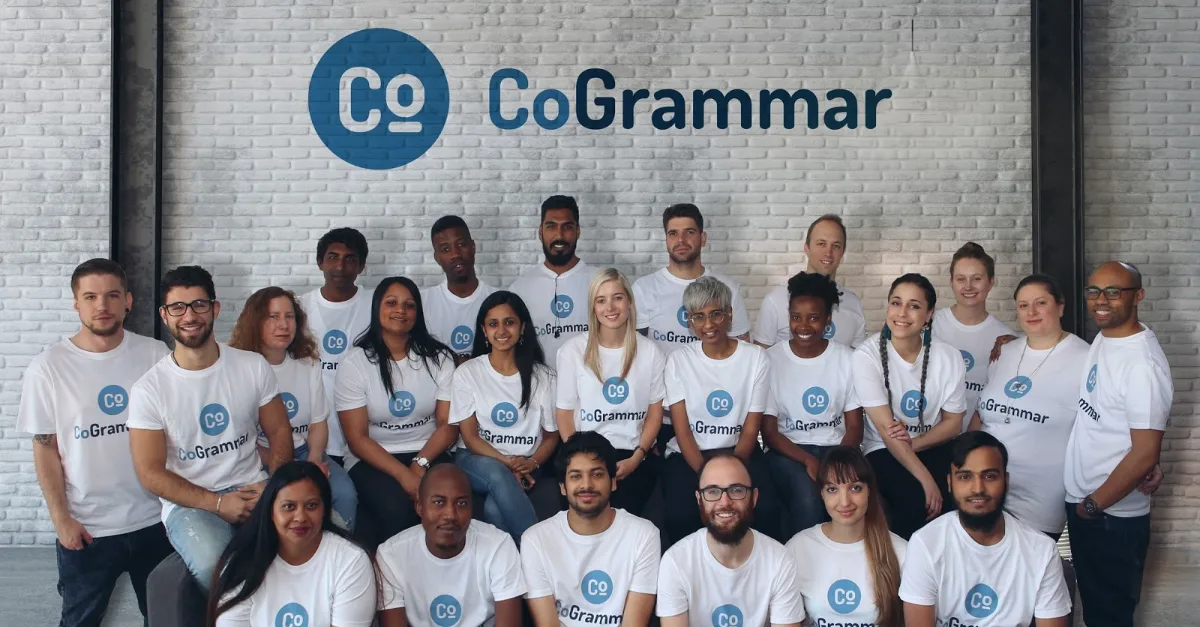
EdTech startup HyperionDev raises pre Series A funding round, rebrands as CoGrammar
UK and South African-based startup HyperionDev, known for building the largest online coding bootcamp in Africa and scaling it internationally to 40 countries…
UK and South African-based startup HyperionDev, known for building the
largest online coding bootcamp in Africa and scaling it internationally to 40
countries, has announced that it closed a pre Series A round of funding earlier in 2018 of an undisclosed amount.
Following part of this fundraise, the company has rebranded as CoGrammar
while retaining the name HyperionDev for its online coding bootcamp product. This product enables students to study online to change careers to software development in under six months.
The edtech startup – incubated by the London Co Investment Fund, University of Cambridge’s Social Ventures, and Edinburgh University’s Launch.ed programmes – has disclosed that it received investment offers from four UK and US-based venture capital funds in its last round of funding. However, the final investors in this round have chosen to remain private.
This new influx of capital has enabled CoGrammar to scale to a team of 40 –
growing its team to include top startup talent from the likes of GetSmarter,
which was acquired by 2U for USD $103 million – and launch a new product of Code Review as a service.
The round of funding comes after HyperionDev won first prize in Facebook’s Innovation Challenge, securing $230,000 in funding from Facebook in addition to several grants from Google and the Python Software Foundation.

Introducing CoGrammar: Code Review as a Service
The new stream of capital enabled the rebranding of HyperionDev into CoGrammar, along with a new code review service geared towards businesses and educational institutions.

According to Riaz Moola, CEO & Founder of HyperionDev., “We are grateful for the support of our new backers which have allowed us to set our sights on tackling a more ambitious vision – setting the global standard for code review.
CoGrammar enables education brands around the world to integrate on-demand mentorship and code review into their coding education programmes at an affordable cost, making effective software development education scalable.
CoGrammar enables education brands around the world to integrate on-demand mentorship and code review into their coding education programmes at an affordable cost, making effective software development education scalable.
We make this possible through a new career path – copywriter for code – which we’ve created in the African market. From September 2018, we’ll be accepting applications for our first cohort of CoGrammars.”
CoGrammar sources, trains, and seamlessly integrates expert code reviewers into coding bootcamp education programmes globally. Human review of code is essential to ensure aspiring developers understand how to write write code that isn’t just correct, but is fluent and at an industry quality level.
Coding education providers can integrate review of their students’ work via the CoGrammar API which integrates Artificial Intelligence and a team of expert code reviewers employed by the company to review code at rapid speeds.
The education market has seen an annual growth rate of 90% since 2013, and CoGrammar is poised to become the global engine for coding education and code review, supporting millions of aspiring developers in crossing the tech skills gap.
According to Amiya Sharma, Head of Mentorship, “CoGrammar has created a new full-time career of becoming an expert code reviewer. This is a future-proofed career path with tremendous potential as programming becomes critical in every aspect of life and work.

For identifying, sourcing, and training high-potential individuals for this unique opportunity, we are launching an online train-and-recruit program on the 10th of September, 2018. This would be a recurring programme where anyone can complete free online training on coding and code review best practices, and apply to become a code reviewer with CoGrammar.”
Amiya continues, “Our first batch of applications opens on 10th September and closes on 20th September 2018. Selected applicants will go through rigorous training to ensure they can review code at an industry-aligned standard for both students and businesses.
We’ve already integrated our code review technology and experts into some of the biggest providers of online coding education, such as HyperionDev, to reach thousands of aspiring developers around the world. We’re excited to welcome more code reviewers into our team to enhance our impact manifold.” Find out more about becoming a code reviewer at www.cogrammar.com.
Backstory
In 2016, HyperionDev won the Innovation Challenge at the internet.org competition run by Facebook, securing $230,000 in funding which allowed the company to grow substantially. This followed a funding award and partnership that HyperionDev secured with Google earlier that year, making it one of the few startups financially backed and supported by both Facebook and Google.
HyperionDev offers six-month part-time online coding bootcamps are built around the individual. The coding bootcamps are designed to offer quality content paired with personalised mentorship, powered by expert code review at affordable rates. HyperionDev’s 1-on-1 mentors review coding assignments and provide expert, detailed feedback that will improve the structure, efficiency and correctness of a student’s code.
HyperionDev began with a group of Computer Science university students, who set out to solve a pressing issue at their campus: a large number of their peers were dropping out of their Computer Science degrees due to a lack of practical coding knowledge. So, they built a website to pair struggling university students with online mentors. This micro situation on their campus presented a much larger problem at hand – the global tech skills gap.
After six years of being in the industry, HyperionDev has introduced a brand new look and feel. Find out more at www.hyperiondev.com.

Cyber Security
August 1, 2018
Bug Bounty Programs in 2018: How You Can Get Involved
There is a massive rise in bug bounty programs at large companies like Facebook and Apple. What exactly are bug bounty programs and how can you get involved in this lucrative endeavor?
‘We’re in the age of the hacker,’ states the website HackerOne, a bug bounty platform that connects businesses with cyber security researchers (or bug bounty hunters). The reason is simple: there’s a massive rise in bug bounty programs at large companies like Facebook and Apple, explains Wired. So what exactly are bug bounty programs and how can you get involved in this lucrative endeavour?
Bug Bounty Programs: What Are They?
Put simply, a bug bounty program is a deal offered by companies where hackers (or computer software programmers) can receive recognition and compensations for finding bugs in your code, especially those relating to exploits or vulnerabilities. However, it’s not always easy for big software companies to find and interact with hackers and that’s where a company like HackerOne gets involved; they are essentially a kind of middleman between companies and hackers.
The basic idea is ‘to put good-guy hackers on the company’s payroll so they can find problems before the bad guys do,’ explains Business Insider. The good-guy hackers are known as ethical hackers, or white hat hackers (also known as ‘security researchers’). It’s not that the the skill set is different from malicious or black hat hackers, but the goal differs: malicious hackers are in pursuit of evil goals such as spam or cyber attacks to steal personal information, whereas ethical hackers use their skills in a lawful way to try and find vulnerabilities that need to be fixed. And remember: the internet gets safer every time a vulnerability is found and implemented.
Bug Bounty Programs: What Can You Actually Earn?
Money is definitely a big motivator. Based on the 2018 Hacker Report, the largest documented survey with 1698 respondents from the ethical hacking community, the following reasons were put forward as motivators for hacking. You can see that money wasn’t actually the biggest motivator – ‘to learn tips and techniques’ was.
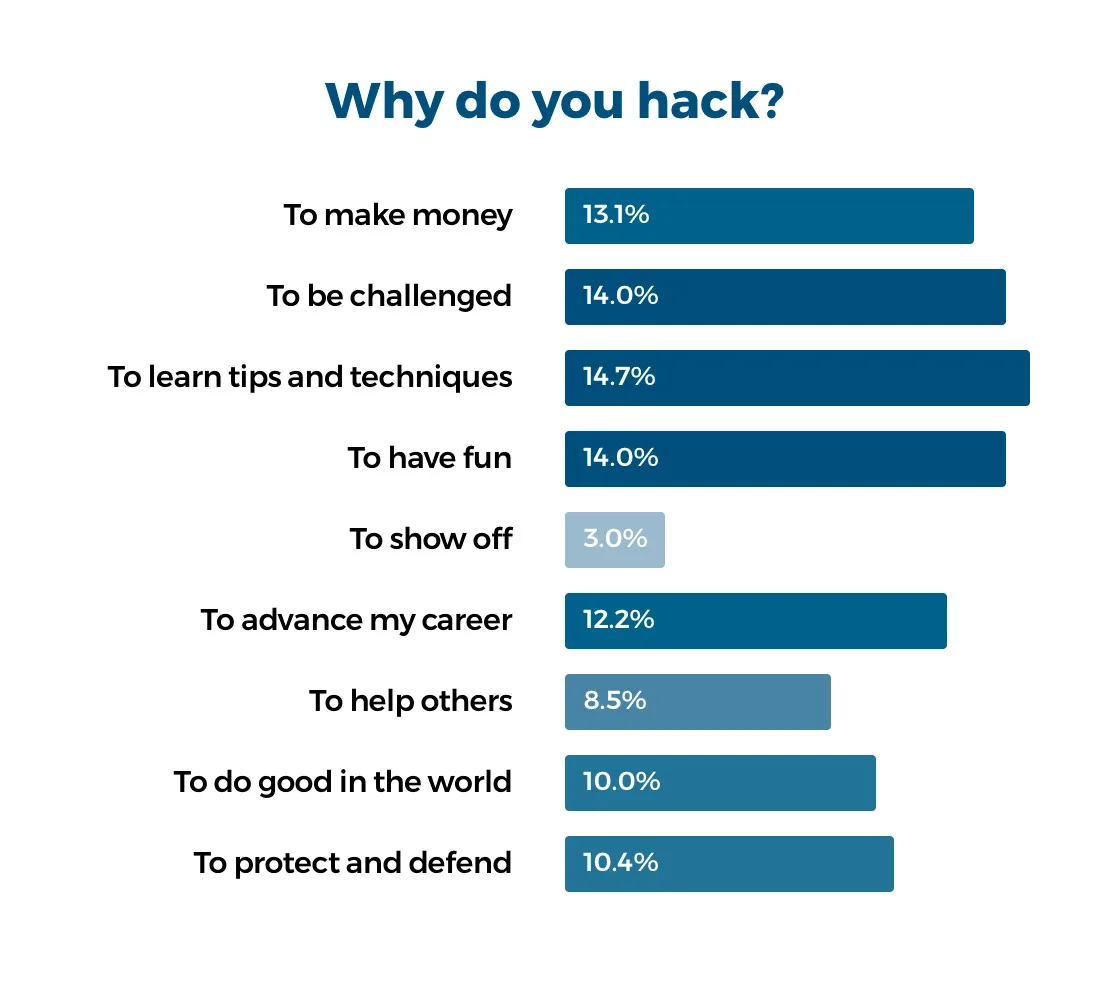
Image Source: https://www.hackerone.com/blog/2018-Hacker-Report
And what about the cash? How much can you make? It’s certainly possible, depending on which country you come from, to make more than you would as a software engineer. In the table below, the median annual wage for a software engineer was taken from PayScale for the different regions. You can see how much more bug bounty hunters are making: India shows the largest difference with researchers making an average of 16 times the median salary of software engineers in that country, whereas in Belgium hackers make an average of 2.7 times more than the median software engineer salary.
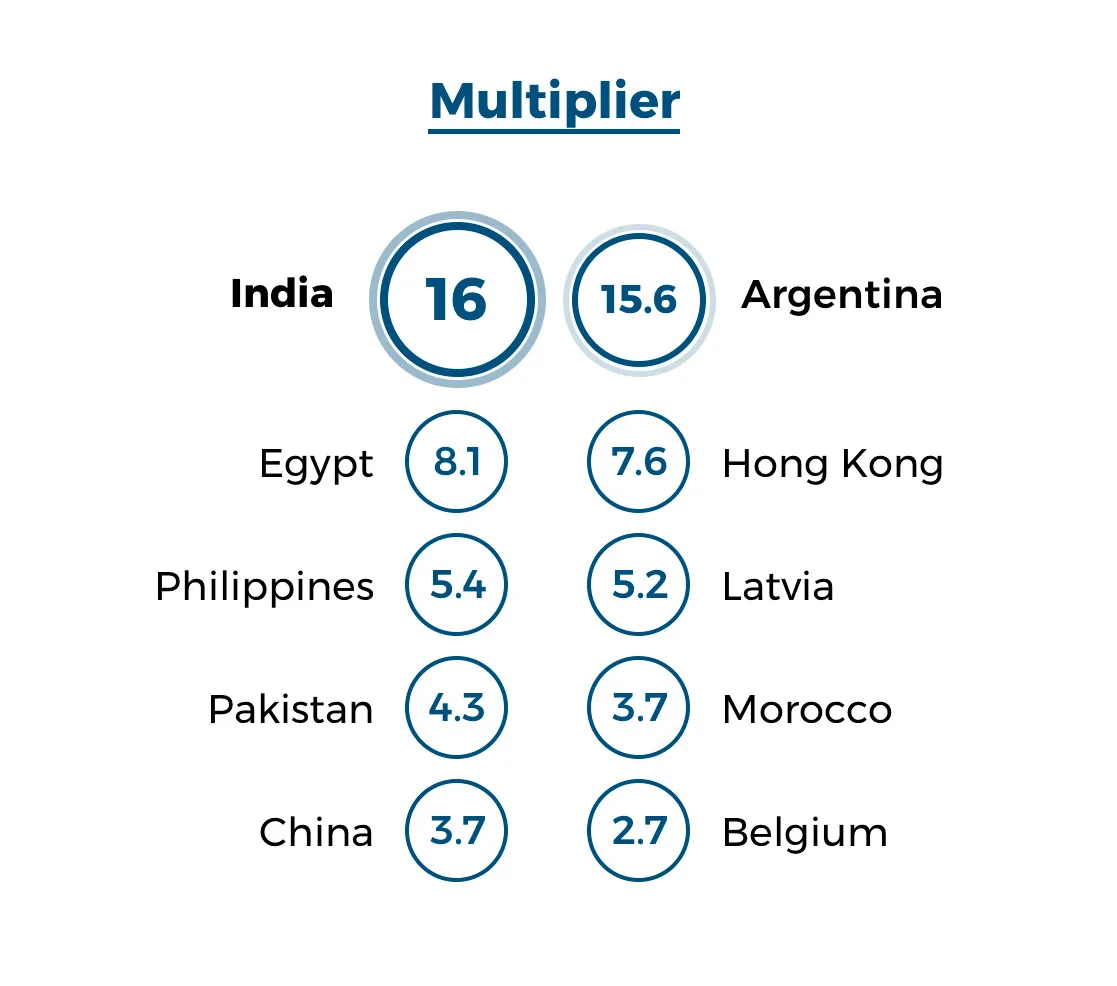
Image Source: https://www.hackerone.com/blog/2018-Hacker-Report
Rewards can range from $500 to $100 000 depending on the type of bug and the amount of time spent searching for it. One of the world’s largest bug bounty programmes is Trend Micro’s Zero Day Initiative (ZDI), states Computer Weekly, which is for Microsoft and Adobe. They have paid out over $15 million to researchers to date. Companies like Google and Apple can offer up to $200 000 as a reward for a single bug. Intel and Microsoft can offer up to $250 000. The average payout, however, is about $2000 for revealing a single security vulnerability.
So how can you get involved in a bug bounty program?
Bug Bounty Programs: Getting Involved
Here are some ideas from LifeHacker about how to become a bug bounty hunter:
- Learn coding – this seems pretty obvious, but you will need to start here. Consider an online bootcamp to acquire your skillset fast.
- Learn how web applications work. Think about looking over The Web Application Hacker’s Handbook.
- Get the right tools – e.g. Kali Linux (free), Burp Suite ($349 a year, but popular) and OWASP Zap (free alternative to Burp Suite).
- Practice finding bugs – look at Google Bughunter University (teaches you how to write vulnerability reports – a vital aspect of performing the work).
- Once you have the knowledge and the tools, check out a bug bounty board (it’s simpler than seeing out each individual company’s website) – e.g. Vulnerability Lab, Bugcrowd and Hacker One.
In closing, coding skills open up a world of opportunity, from traditional jobs in large companies to freelancing. Now you can add Bug Bounty Hunter to your skillset – there’s certainly good cash to be made, and you’ll have fun in the process, if you get involved in a bug bounty program. If you’re needing to update or learn coding, consider signing up for one of HyperionDev’s six month, online coding bootcamps in Full Stack Web Development, Mobile Development and Software Engineering. You could be the next Big Bug Hunter.

Software Engineering
July 19, 2018
Software Developers Harnessing the Power of Amazon’s Alexa
Alexa is widely known as a multi-talented lady with a can-do attitude, always at the ready to make life easier. Forward-thinking software engineers are using Amazon’s Alexa to change the way they code.
Alexa is widely known as a multi-talented lady with a can-do attitude, always at the ready to make life easier by taking on those mundane everyday tasks we don’t want to do ourselves. Now it looks like she’s set to expand her skill set and launch a career in software development.
Who is Alexa?
Well, not so much “who” as “what”. Alexa is a virtual assistant tool created by Amazon.com, to accompany the Amazon Echo smart speaker range. It’s a cloud-based voice interaction service that can take instructions and simulate conversations with the user. Alexa can set up to-do lists and alarms, update users on the weather, news, traffic and sports, play music and stream podcasts or audio books.
Alexa can even connect with and control numerous smart devices, acting like a home automation system. Users can install additional apps to extend Alexa’s functionality as well.
Click here to see some examples of Alexa in action.
How is Alexa Changing the way Developers Work?
More recently, some forward-thinking software engineers have been looking at ways to outsource some of their work to Alexa. The virtual assistant could help to increase productivity and workflow by handling simple programming tasks, while the human developers concentrate on more important and complex tasks.
Software engineers work with millions of lines of code per project, and switch between multiple editing tools, each with their own unique syntax and rules. Frustrated with this time-consuming process, a graduate student at the University of British Columbia started experimenting with Alexa as a tool to help streamline things.
“Devy” is the name of Alexa’s new alter-ego, created by UBC software engineer Nick Bradley, with assistance from computer science professors Reid Holmes and Thomas Fritz. Devy is a “Conversational Developer Assistant” (CDA) designed to speed up development workflow.
Bradley, Holmes and Fritz tested Alexa’s abilities to help with the coding process. Could they ask it to complete a development task, the same way they would ask it to play a song or look up a recipe? To do this, they needed to teach Alexa some new key phrases, map different commands, and build a system that could automate commonly used multi-step coding tasks. After testing from engineers at local software companies, they received a lot of positive feedback. The only major drawback seemed to be the use of voice commands, which proved distracting in an open office environment.
While there is still more research and work to be done, innovations like Devy could have far-reaching implications for the way we work. If a virtual assistant can successfully be programmed to make coding less labour-intensive, it could also be programmed to help people in a range of professions, like accounting, medicine and law.
This is an exciting time to be working in the world of software development. To join the ranks of software pioneers like Nick Bradley and his team, get started with an online developer bootcamp at HyperionDev.

News & Announcements
March 6, 2018
Applications for Injini’s Second Cohort Are Now Open
Are you an EdTech start-up in the African education space? If so, Injini, Africa's first EdTech incubator, in conjunction with CiTI is offering $50K.
Are you a tech start-up in the African education space? If so, here’s an exciting opportunity. Injini, Africa’s first EdTech incubator supported by the Cape Innovation and Technology Initiative (CiTi), is looking for start-ups ready to make an impact in African education using technology.
They will select eight companies from across the African continent to join their EdTech incubator programme in Cape Town from July to December, receiving $50k direct funding as well as five months of specialist mentoring, support, scale up and funding introductions.
Does Your Start-up Qualify?
Injini accepts a wide array of applicants, with previously funded start-ups ranging from e-book online stores to mobile apps focused on teaching Zulu and Xhosa.
The EdTech incubator is interested in companies and entrepreneurs that are:
- Working in any field of education, from numeracy to languages to vocational skills
- Working with any age of learners, from pre-school to adults
- At almost any stage of maturity, from new start-up to successful business ready to scale
The 5-month program, including follow-on support, builds on CiTi’s expertise in local business incubation with a strong emphasis on trialling ideas and measuring impact.
HyperionDev & Injini’s Collaboration in EdTech
HyperionDev, a leading worldwide educational provider, has built an online course platform that teaches students programming and tech skills. They have partnered with the world’s leading tech firms such as FaceBook and Google. HyperionDev is pleased to be working in partnership with Injini by offering mentor support and guidance to the eight selected start-ups.
“It’s great to be applying our knowledge and educational know-how to start-ups that are sure to make a difference in the African educational tech sector,” says Riaz Moola, HyperionDev’s co-founder.
In addition, four HyperionDev graduates have been placed with Injini start-ups: two as Full Stack Web Developers and two in Mobile Development. Says Sobane Motlomelo, Head of Student Success at HyperionDev: “We help match the relevant graduates to the right Injini roles based on their skill sets and the role specs. These internships really boost the abilities and competencies of our students and help them rapidly transition into full time roles right away!”
Injini applications are open now and close 3rd April. Apply today: www.injini.co.za/apply
News & Announcements
November 27, 2017
Partnership with Silicon Cape
Special Partner Discount Silicon Cape Members HyperionDev pleased to announce partnership with Silicon Cape on any of HyperionDev's courses.
Special Partner Discount for Silicon Cape Community Members
HyperionDev is very pleased to announce a partnership with Silicon Cape, a non-profit company committed to building and catalysing the technology ecosystem in the Western Cape.
HyperionDev will provide access to their mentor-led, industry-relevant online coding bootcamps in Full Stack Web Development, Mobile Development and Software Engineering to Silicon Cape community members. The EdTech company also offers a host of three-month short courses in a variety of computer languages including Python and Java. All the courses offer access to quality content and on-demand code review by an expert. Personalised mentorship means that you won’t feel stuck and your code will be reviewed for accuracy, style and efficiency.
Riaz Moola, Hyperion’s co-Founder and CEO, says about online bootcamps: ‘Often a student is unable to get ahead when stuck on a learning wall. Rereading the same passages endlessly or repeatedly watching the same videos won’t let the student overcome the learning block. But an expert mentor will give valuable feedback swiftly, helping the student.’
Hyperion launched in Durban in 2012, and is part of Google’s international project to improve computer science and training. ‘We have close ties with the Google Africa team,’ says Moola. Besides Google, HyperionDev was also won the Innovation Challenge Award from Facebook, making it the first South African startup financially backed and supported by both Facebook & Google.
Silicon Cape has grown to over 10 000 individual members, representing over 500 organisations with close ties with other professional bodies such as Wesgro, CITI an Global Entrepreneurship, the government of the Western Cape and the City of Cape Town.
To celebrate this partnership, HyperionDev is giving a 15% discount on any of their courses by using promo code SILICON. Valid from 1 November 2017 until 31st January 2018.

News & Announcements
November 15, 2017
Hyperion Development Secures $230,000 (R3.27 million) in Funding from Facebook
HyperionDev Innovation Challenge Award Winner from Facebook. HyperionDev has received funding from Facebook as the Innovation Challenge Award winner.
South African and UK-based startup HyperionDev, which runs the largest online course platform for programming and Computer Science education in Africa, was announced as the Innovation Challenge Award Winner in a recent press release from Facebook.
This builds on a funding award and partnership that Hyperion secured with Google earlier this year, making it the first South African startup financially backed and supported by both Facebook and Google.
The award, run through Facebook’s Internet.org initiative in Africa, aimed to identify “leading examples of … online services that provide real value in the categories of education and economic empowerment”. Hyperion won the top prize in the category of education, and was the only South African company selected by Facebook. Facebook’s Founder, Mark Zuckerberg, congratulated winners under the scheme in a recent Facebook post:
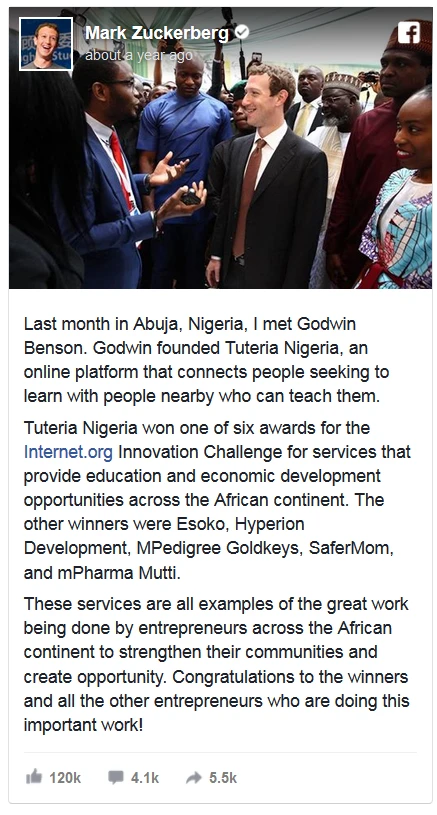
The organisation has rapidly grown to over 10,000 students from 20 countries, and offers a range of introductory and advanced courses in everything from web development to data science and mobile app development. Hyperion is already one of the largest trainers of popular programming languages such as Java and Python.
Riaz Moola, Hyperion’s Founder & Director, said that “The award will allow us to scale our offerings more rapidly and internationally, accelerating the growth of what is already a profitable and socially impactful business. We’re excited to work with Facebook and Internet.org to make software development education and careers open to all.”

For each course that HyperionDev sells, the company offers one low-income or unemployed youth in Africa a free course. This is critical in African economies such as South Africa, where youth unemployment stands at over 54%. Hyperion’s paid and free courses allow students to access high-paying careers in the field of software development through the Hyperion Careers platform, bypassing traditional university education.
Hyperion – which operates out of offices in Cape Town, Johannesburg, Durban, and Cambridge – also hopes to finalise additional grant funding from Google, CapaCiti, The South African Department of Science and Technology, and the TK Foundation to bring the total amount raised to R7 million.
To take a course with Hyperion and support education in Africa, visit www.hyperiondev.com.
Author: Riaz Moola
Date originally published: 18/10/16

News & Announcements
November 15, 2017
Dev Survey 2016: Mac OS X More Popular Than Linux?
Developer survey: Apple's Mac OS X emerges as more popular than Linux, according to 50 000 sample of developers from 173 countries.
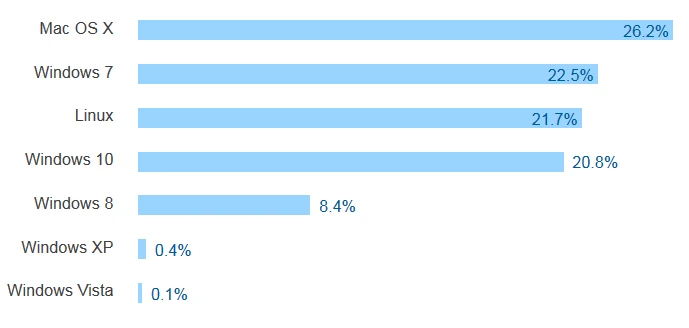
The most recent Stack Overflow Developer survey has just been released, and it has plenty of interesting stats for developers. Apart from the numbers pegging one programming language against another, the millenial argument of ‘which operating system is better’ has the opportunity to raise its head with what Stack Overflow has uncovered. The 50 000 strong sample size of developers from 173 countries around the world gives us a pretty good idea of what kinds of operating systems are most popular.

For the first time in the history of the survey, it appears that Apple’s Mac OS X operating system is used by more developers than all the varying flavours of Linux combined. What’s more, OS X is actually the most-used operating system by version versus the competition. We admit, OS X is actually an aggregate of OS X starting at version 10.5 to 10.11 and would best be compared to the past 3 versions of Windows together, but as Stack Overflow puts it – OS X trumps out Windows 7 (26,2% versus 22,5% respectively) in terms of use by developers.

Overall, Windows still holds top spot with 51,7% aggregated share, but Stack Overflow reckons that if the trends continue over the next year, by 2017 less than 50% of developers globally will be using Windows.
Check out this infographic from this survey data below or head to the developer survey 2016 for more interesting stats about the world’s software developers.
Let us know in the comments below – which OS do you use to code with and why?
Author: Matthew de Neef
Date originally published: 24/03/16

News & Announcements
November 15, 2017
Press Release: Hyperion Launches First Job Site for Software Developers in South Africa
Software Developers South Africa - the job search and candidate search experience is poorly developed for this market in South Africa
The South African market for software developers
Software developers are in high demand in South Africa, yet both the job search and candidate search experience are poorly developed for the South African market. General job search portals such as CareerJunction or Careers24 fail to fit the needs of employers and job-seekers, and both these parties often turn to sites like Facebook and even Gumtree in desperation. Recruiters struggle to find and attract developers in a consistent way.
The current job search experience
Programmers must separate real software development opportunities from IT roles such as ‘technician’ or ‘business development’ on sites like Careers24. It is also not possible to easily search for jobs by technology – developers may strongly prefer to work with a certain technology stack, and these sites to not allow users to easily search for jobs using terms like ‘Python’ or ‘C#’.
Another weakness of these sites is that they do not highlight the perks of a working environment of a particular company. In many cases, the company offering a job is hidden as these adverts are listed by recruiters, who purposefully hide this information. Developers are hence unable to find information on a company as a whole, the perks they offer (something a developer in SA is probably already enjoying in their current role), and what type of technologies the company works with as a whole. A tech startup in the Cape is a very different environment to an established financial institution, and top developers want to know who they are working for.
Other than job listing sites, a developer can turn to recruitment firms. Speaking from my own personal experience of looking for software-related jobs in both the UK and SA, this can be a perplexing experience. Having worked and spoken with a range of recruiters, it is clear that many struggle to understand the technologies in the market, and who can blame them in such a fast-paced field? They are also unsure how the roles they are hiring for relate to my past experience and future goals, or just what exactly the difference between, say, Java and Javascript is.

The search for developers
Software is a part of your business, no matter the industry you operate in. South African firms are increasingly seeking out developers who can work with the latest technologies – be it Django, Python, or AWS. Finding these developers can be a challenge when so few institutions in the country train Django developers, and when only a handful of students graduate from our universities each year with Computer Science or software development-related qualifications.
Finding, entering, or building developer communities in South Africa would be a full-time job, and something that is next to impossible for non-technical folk.

The solution
Hyperion Careers , launched in early 2016, is SA’s first dedicated job search and application website for software developers. Integrated into a community of over 8500 programmers in the country, it allows developers to search for jobs by specific technology and for companies and recruiters to list jobs in a way that gets the attention of top talent.
Hyperion Development,a Google-backed SA startup, is the company behind this Careers website and since 2012 has run online services and communities that have organically drawn thousands of developers into their network. The largest of these services is an online course platform that has allowed Hyperion to become the largest trainer of Python and Django in the region. Graduates from every Computer Science department in the country and hundreds of software developers already working in industry learn the latest technologies on Hyperion’s platform.
Founded by a technical team, Hyperion has seen impressive growth in their offerings in the last year and a recent partnership with Google is sure to see their reach into developer communities continue to grow at a rapid rate.
Interested in listing a job advert or using Hyperion Careers to find your next job? Check out careers.hyperiondev.com or drop our team an email on contact@hyperiondev.com
Author: Riaz Moola
Date originally published: 16/02/16

News & Announcements
November 15, 2017
Hyperion Takes Students from Aspiring Programmers to Fully-fledged Software Developers in South Africa
Hyperion software developers - aspiring software developers were trained on two of Hyperion's most popular online courses
Hyperion’s courses can change lives. This is exemplified by a recent partnerships between Hyperion and the Cape Innovation and Technology Initiative in a which a cohort of aspiring software developers based in Johannesburg and Cape Town were trained on two of Hyperion’s most popular online courses: The Certified Software Developer MicroDegree and the Full Stack Web Developer MicroDegree
Students registered for the programs from across South Africa, and the majority had no prior programming experience and have not worked as software developers in the field. The MicroDegree combination chosen allowed students to first gain a breath of knowledge in programming technologies through the Certified Software Developer content – delving into popular languages such as Java, Python, and C# – before then gaining depth in web development technologies through the Full Stack course in which students were taught how to craft both the front and back-end of complex web applications using Javascript, HTML, CSS powered by the Python Django web development framework.

The success of the trial program, funded by the South African Jobs Fund has strengthened the partnership between Hyperion and Citi, and a scaled-up version of the program is set to launch in 2017 with significantly larger student numbers supported from locations beyond Johannesburg and Cape Town.
Interested in shifting your career to software development? Browse Hyperion’s range of bootcamps including our Full Stack Web Developer bootcamp and our Software Engineering bootcamp.
Author: Riaz Moola
Date originally published: 19/09/16

News & Announcements
November 15, 2017
Hyperion Gains Support from the University of Cambridge
Hyperion Support University of Cambridge - Hyperion is now part of Cambridge's Social Ventures Programme, which is a part of a 12 month incubator programme.
Hyperion has become one of the first African social enterprises to be selected by the University of Cambridge Social Ventures Programme for a 12 month incubator programme. The Cambridge Social Ventures Programme seeks to “support a whole range of businesses that have positive social and environmental impacts.”

The programme further describes the impact that Hyperion as follows:
Across southern Africa, Hyperion is:
- Increasing accessibility to learning
- Improving career prospects for computer science students from disadvantaged backgrounds
- Improving national computer science education and standards

This established social enterprise has created a market for online computer science courses that enable undergraduates studying computer science to start from a more level playing field. The speed of its growth, coupled with its established USPs of ‘human tutors’ (when people register for a course they know they get support from a human tutor), and a delivery model that takes into account the limitations of bandwidth in the African market, protect that market share.
More information about Hyperion’s work with Cambridge Social Ventures can be read here:https://www.jbs.cam.ac.uk/entrepreneurship/programmes/cambridge-social-ventures/our-ventures/hyperion-development/.
Author: Riaz Moola
Date originally published: 26/05/16

News & Announcements
November 15, 2017
How Free Education is Possible in South Africa
Free Education South Africa - there are practical ways that technology can be leveraged to provide free education on a large scale.
The FeesMustFall movement is sweeping across South Africa for a second time, plunging campuses into chaos under the demand of free education for all. In South Africa – and other African countries – it is clear that education is a privilege, rather than a right, but there are practical ways that technology can be leveraged to provide free education on a large scale.
Social enterprises – broadly defined as organisations that seek to maximise social impact and not just generate profit – can apply powerful business models to balance the scales in education. A simple example of this is cross subsidization. This is the technique of charging higher prices to one group of consumers – or students – and using those funds to subsidize lower prices or even no prices for another group.
The extension of this to education is natural – charge fees to only the students that can afford them, and implement a business model such that a percentage of those fees could be used to support free education for students that cannot, whilst still keeping the education business sustainable. A modern day Robin Hood – borrow from the resourced to give to the poor, maximising social impact alongside revenue.

But how can we decide which group of consumers, or students, has to pay? In South Africa, a widely used framework called the Living Standards Measure (LSM) categorises people into 1 of 10 groups based on income, degree of urbanisation, and other factors to define how resourced a person is. The LSM of someone can map to whether they pay for education or not, or even how much they pay.
This model can be very successfully scaled when applied to online education. Hyperion Development, a South African based technology company, implements this exact model in the field of software development and Computer Science education. By selling online courses to high-income demographics, Hyperion has been able to provide free education in the field to 75% of all its students from across not just South Africa, but Africa.

Hyperion has been able to build a profitable business through this model, by also leveraging graduates of its free courses to become employees and drive forward the promote of free and paid courses through low-cost mechanisms. This model has recently earned the organisation recognition from Facebook as grand prize winners of a $230,000 grant from the Africa Innovation Challenge.
But the model can grow even further – education can be provided online to people in Europe, bringing sustainable income into Africa to fund free education locally. Maybe to scale free education at home, we should look at how we can leverage our resources here to build uniquely excellent services abroad? Maybe Africa can teach the world a lesson.
Author: Riaz Moola
Date originally published: 12/10/16

News & Announcements
November 15, 2017
Autodesk Competitor Steals Code, Blames Rogue Engineer
Autodesk competitor steals code - it appears that a software engineer from Chinese competitor firm ZWSoft had stolen Autodesk's code
Those End-User Licence Agreements on software exist for a reason: to prevent licenced code from unauthorised use. This was true for design software company Autodesk recently when it appeared that a software engineer from Chinese competitor firm ZWSoft had stolen their code. Both companies develop technical drawing, modelling and drafting tools used by civil and mechanical engineers as well as architects to model parts, structures and design building plans. It appeared that ZWCAD+ the software made by ZWSoft was partly developed using code stolen from Autodesk’s competing AutoCAD design software. The Chinese firm blamed the software engineer for acting on his own, saying that their top management didn’t know about the code pilfering during ZWCAD+’s development until it was discovered just recently.

Management Made Big Claims
Shortly before the code theft discovery, ZWSoft’s top brass stood up against the market-leading Autodesk during a copyright infringement lawsuit case, boldly claiming that all their software was open-sourced and licensed, and that the lawsuit was just for anti-competitive reasons. Thanks to the code theft revelation, ZWSoft have had to apologise and are placing blame squarely on one software engineer, suggesting that top management wasn’t aware of the events. Both ZWSoft and the offending engineer will have to pay dearly for their mistake as ZWCAD+, by Autodesk’s demand, will be removed from sale in all markets, whilst the engineer will likely lose his job.

Judging by the press statement, it seems that ZWCAD+ users will have to stop using the product, and downgrade to the Classic version of the software while they wait for ZWCAD 2017 to be released in autumn of 2016. Intellectual Property is still a big issue in today’s “copy-paste” world, and this situation proves that professional software development is just as vulnerable. Code licensing exists for a reason – intellectual property rights apply just as much to software as they do to anything else, and what someone would consider a “quick copy paste” could be violating agreements, which end up costing millions of Rands.
Let us know your thoughts in the comments section below, and follow the Hyperion Hub to keep up to date on everything software developers in South Africa should know.
Author: Matthew de Neef
Date originally published: 24/12/15

News & Announcements
November 15, 2017
VW Blames Software Engineers for Diesel Emissions Scandal, Not Execs
VW blames software engineers - 11 million Volkswagen diesel engines had code incorporated that allowed increased harmful gases emission ratings.
Deep inside the engine control units (ECUs) of roughly 11 million Volkswagen diesel engines across the world, certain code was executing, which helped the company cheat on their harmful gases emission ratings. It did this by activating the emission control device only if it detected the car was undergoing emissions testing. The Nitrate, or NOx (NO2 , NO3 etc) gas levels emitted by VW diesels’ engines were then assumed to be within what the government allowed as acceptable levels, and the cars were sold in US markets. Once the software detected that the emissions test was over, the emission control was disabled and 40 times more NOx was spewed into the air than before.
Playing the Blame Game
In the 2 months since the news of the so-called ‘defeat device’ broke, the public’s confidence in the venerable German manufacturer has plummeted, and someone has to take the blame for this. At a hearing recently, the US CEO for the car maker pointed that accusatory finger at “software engineers who put [the software] in for whatever reason.”
Pride and Corporate Underhandedness
The accusations seem like a last ditch effort to save face. Panel representatives dismissed the claims of the CEO during the hearing. According to them, VW was in the scheme from the beginning, and they claimed it wasn’t simply a rogue engineer acting on his own volition. Evidence from several decades of car innovation at VW actually seems to corroborate the idea that the software was developed out of necessity, such that the company could be the innovatory hero the market expected. Most of the affected cars in the EU and the US will be recalled to have the ECU code updated to remove the cheating software.
South African Standard
South African’s needn’t worry about the situation, since NOx emission level standards here are less strict than those of Europe and the US. This means that all affected VW engines here will pass South Africa’s NOx level regulation, and won’t need to be recalled. Regardless, the brand image of the German company won’t be the same as before.

Software and software testing clearly play a greater part in our lives today than ever before, now that it’s moved into the automotive realm. For everyone coding non-car related software though, there is still hope: if your company’s code testing methods on your software are a bit too strict for your liking, you could always apply the VW method!
What’s your view on unethical software practices in the industry? Comment with your views on this article in the comments section below, and follow Hyperion Hub developments in the future if you’d like to see more articles like these for the South African market.
Date originally published: 21/12/15

News & Announcements
November 15, 2017
Hyperion’s Founder Selected as one of the Top 200 Young South Africans by the Mail & Guardian
Riaz Moola Top 200 Young South Africans - Hyperion's Founder, Riaz Moola, has been selected in the Science and Technology Category by the Mail & Guardian.
Article, courtesy of Tiana Cline at the Mail and Guardian (http://200ysa.mg.co.za/riaz-<wbr/>moola/)
Hyperion’s Founder, Riaz Moola, has been selected as one of the Top 200 Young South African’s in 2016 under the Science and Technology Category by the Mail & Guardian. This award reflects the work of Hyperion’s entire team of employees – and the larger network of the Hyperion Community – in providing a successful and scaleable social impact in the space of science education in Sub-Saharan Africa.

The degree with the highest dropout rate in South Africa and across all universities nationally is computer science, with an average failure rate of 88%. Through Hyperion Development, Riaz Moola is on a mission to change that. “I’m most interested in the application of computer science to various industries. This is of course very popular as comp sci is the basis of the most famous firms and start-ups today: Apple, Google, Facebook, Uber, Airbnb etc.”
Moola’s previous work at Google as a product manager was using computer science (specifically artificial intelligence) to help build new products and features with this tech. “I worked in the Google Search team on ‘Ok Google’ (Google Voice Search), similar to Siri”.

These features have now been used by millions.” After studying at the University of KwaZulu-Natal, Moola noticed a high dropout rate of computer science. “I also noticed people at UKZN had bad internet access,” he explains.
“My entire idea was very simple — an online course where people could still take courses with limited internet access. I was inspired by course materials at Edinburgh on artificial intelligence, a subject not offered at UKZN. I created a simple online course with small files — rather than large videos offered by most Massive Open Online Course (Moocs) — in a new programming language (Python) teaching people some basics of AI. I went back to UKZN during a holiday and spoke to students in my previous classes, urging them to sign up for the course. Over 100 signed up in the first week. The course then spread organically to many other universities in Johannesburg, Cape Town etcetera. Eventually we had students from every tertiary institution in South Africa. We now have students from eight African countries and this is growing every day.”
A core tenet of open education is the development of non-traditional learning methods that reduce barriers to entry to education. “Many Mooc platforms claim to reduce these barriers, but no existing platform seeks to serve the unique limitations of millions of South Africans, many of whom would benefit most from the principles of open education,” says Moola. “Hyperion is filling this large gap in knowledge transfer using a scalable model.” Moola would like to grow Hyperion throughout the continent, and hopes to strengthen his relationship with Google and other tech firms like Facebook. “We must not forget Africa as a whole.”
Author: Riaz Moola
Date originally published: 19/09/16
News & Announcements
November 14, 2017
HyperionDev in Partnership with UKZN Extended Learning (UEL)
HyperionDEv is delighted to announce a partnership with UKZN Extended Learning (UEL). HyperionDev will provide computer and programming courses.
HyperionDev is delighted to announce a partnership with UKZN Extended Learning (UEL). HyperionDev will provide access to their mentor-led, industry-relevant online coding bootcamps in Full Stack Web Development, Mobile Development and Software Engineering. The EdTech company also offers a host of three-month short courses in a variety of computer languages. All the courses offer access to quality content and on-demand code review by an expert. Personalised mentorship means that you won’t feel stuck and your code will be reviewed for accuracy, style and efficiency.
Riaz Moola, Hyperion’s co-Founder and CEO, says about online bootcamps: ‘Often a student is unable to get ahead when stuck on a learning wall. Rereading the same passages endlessly or repeatedly watching the same videos won’t let the student overcome the learning block. But an expert mentor will give valuable feedback swiftly, helping the student.’
Hyperion launched in Durban in 2012, and is part of Google’s international project to improve computer science and training. ‘We have close ties with the Google Africa team,’ says Moola. Besides Google, HyperionDev was also won the Innovation Challenge Award from Facebook, making it the first South African startup financially backed and supported by both Facebook & Google.
Simon Tankard, UEL’s CEO notes the importance of technology for fast tracking the SA economy. He says: “Technology is the single most powerful resource to enable us to leapfrog the experience curve and to help fast track the development of our people and grow the economy in South Africa. We look forward to building the partnership with Hyperion and to supporting expertise development in Africa”.
To celebrate this union, HyperionDev is giving a 15% discount on any of their courses by using promo code UKZN.
Valid from 1 November 2017 until 31st January 2018.
Browse courses: www.hyperiondev.com/partners_special/ukzn

News & Announcements
October 25, 2017
Hyperion Selected to Attend Investec Silicon Valley Trip
Entrepreneurs South Africa, including Riaz Moola from HyperionDev, have been selected to participate in En-novate in Silicon Valley in 2016.
In today’s technology-focused industry, startups and established companies alike are increasingly looking to the mainstays in the technology industry for advice and inspiration. With this in mind, the Investec co-founded startup En-novate takes entrepreneurs from South Africa to other parts of the world to allow them to make global business interactions and to become more globally competitive. In 2016, En-novate is exposing a group of shortlisted startups to an experience in Silicon Valley, California in the United States.
This year HyperionDev was chosen by Investec as one of South Africa’s fastest-growing startups, and its director Riaz Moola was selected to be a part of the En-novate Young Entrepreneurs Silicon Valley trip. Getting a chance to attend the trip was highly difficult, with 10 startups applying for every one place on the trip, making the jostling for a position very competitive indeed. Being able to participate in this experience will be hugely eye-opening allowing entrepreneurs to learn about venture capital ecosystems, and how other startups have scaled up successfully.
Moola will also be part of the first-ever African delegation attending the Silicon Valley Open Doors Conference. This exclusive event allows startups to access Silicon Valley funding from some of the world’s top investors.
Other entrepreneurs selected include Lungisa Matshoba, co-founder of South African mobile-based credit card payment solution Yoco, Claudia Swartzberg, founder of TopDog, Africa’s largest EdTech company, and radio host and personality Gareth Cliff of CliffCentral.com.

The trip will include meeting with Silicon Valley’s top venture capitalist Bill Draper, visits to $2.9 billion-worth social giant Facebook, meetings at Google’s HQ, and a day with Vinny Lingham, one of South Africa’s most successful technology entrepreneurs. There will also be opportunities to engage with startup incubator Blackbox, Silicon Valley Bank, and Sequoia Capital, one of the world’s most prestigious venture capital firms, which has funded the likes of Apple, Google, WhatsApp, PayPal, LinkedIn and YouTube.
Keep up to date with the ongoing stories out of the En-novate Silicon Valley trip by following us on Twitter at @HypDev and searching #SATreps2016, or visit us on Facebook to learn more.
[Read why HyperionDev is the partner of choice for Injini, Africa’s Ed-Tech Incubator.]
News & Announcements
October 10, 2017
HyperionDev partner of choice for Injini
HyperionDev is excited to be part of Africa’s first EdTech incubator called Injini. Hyperion will play a pivotal role by providing mentor support for firms
Cape Town, South Africa
HyperionDev is very excited to be part of Africa’s first EdTech incubator called Injini. Hyperion will play a pivotal role by providing mentor support and guidance to the eight new startups, selected from across the African continent.
Injini will have its inaugural moment on Tuesday 10 October at 5.30pm at the Jameson Hall, University of Cape Town, where they will unveil its first ever cohort of startups that display innovations in the edtech sector.
In the historic hall that has hosted speeches by Nelson Mandela, Barack Obama and John F Kennedy, each of the 8 companies will give a lightning pitch on how their innovation will change African education.
The 8 companies are from 5 countries across Africa, with innovations ranging across technologies and stages of education, but united in their applicability to the most in need students, teachers and communities. There is more detail on them here
They include:
- A South Sudanese entrepreneur based in Juba who believes spreading reading via e-books and an online store can help heal a nation divided by civil war;
- A team of young South African engineers who have abandoned jobs at firms like Amazon to solve the higher education and youth unemployment crisis highlighted by #feesmustfall ;
- A Tanzanian team in their early 20s who have built an offline artificial intelligence search engine for students without internet access ;
- A Kenyan company with the first adaptive learning software for feature phones on the African continent.
The programme is a partnership between Jamie Martin – a former Special Adviser to UK Secretary of State for Education Michael Gove – and the Cape Innovation and Technology Initiative, the oldest technology incubator on the African continent.
Based in Cape Town, South Africa, it is open to EdTech entrepreneurs from across the African continent. At 6 months with follow on support it is longer than programmes in more developed markets, and builds on CiTi’s expertise in local business incubation. It places a strong emphasis on trialling ideas and measuring impact. It has established partners across South Africa, Africa and outside, ranging from government and business to education institutions and over 60 expert mentors and speakers.
Speaking ahead of Tuesday’s event, HyperionDev’s co-founder Riaz Moola said:
“Hyperion has built an online course platform that teaches students programming and tech skills in a novel way. Using our methodologies, we’re very proud to be offering mentor support and guidance to these eight startups via Injini, especially as we’ve harnessed the top technical educational talent from Africa and we work with a wide variety of the world’s leading tech firms to deliver quality content in software development. It’s great to be applying our knowledge and educational know-how to startups that are sure to make a difference in the African educational tech sector.”
The CEO of CiTi, Ian Merrington, added:
“CiTi, through its CapaCiTi programme, has been one of the most effective technology job creation and technology skills development programs on the continent. It has become abundantly clear to us that the skills requirements of Industry 4.0, will require a complete rethink of an already weak education system, if labour is to meet the demands of the new Tech driven economy. We believe that agile, tech savvy entrepreneurs are likely to be the best antidote to a stodgy outmoded education system and that our new EdTech Incubator is the key to unlocking and supporting these emerging solutions. Utilising technology to solve Africa’s education challenges may well become the catalyst to unlocking unprecedented economic growth on the African continent.”
Get your free ticket for the Launch of Injini on Tuesday 10th October 2017 at 17:30 here.
NOTES
HyperionDev courses: https://www.hyperiondev.com/courses/

News & Announcements
October 6, 2017
HyperionDev secures $230,000 in funding from Facebook
South African and UK-based edtech start-up secures $230,000 in funding from Facebook. HyperionDev recently won the Innovation Challenge Award, which was recently announced by Mark Zuckerberg.
South African and UK-based startup Hyperion Development, which runs the largest online course platform for programming and Computer Science education in Africa, was announced as the Innovation Challenge Award Winner in a recent press release from Facebook.
This builds on a funding award and partnership that HyperionDev secured with Google earlier this year, making it the first South African startup financially backed and supported by both Facebook & Google.
The award, run through Facebook’s Internet.org initiative in Africa, aimed to identify “leading examples of … online services that provide real value in the categories of education and economic empowerment”. Hyperion won the top prize in the category of education, and was the only South African company selected by Facebook. Facebook’s Founder, Mark Zuckerberg, congratulated winners under the scheme in a recent Facebook post:
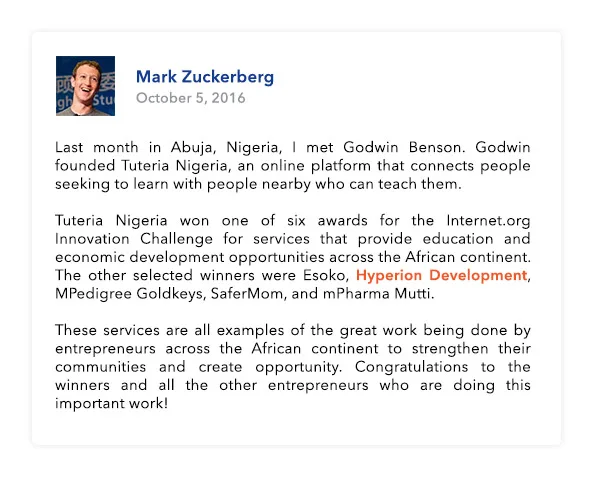
HyperionDev offers part-time, online courses in Software Development & Computer Science which pair students with 1-on-1 expert mentors and tutors from around the globe.
The organisation has rapidly grown to over 10,000 students from 20 countries, and offers a range of introductory and advanced courses in everything from web development to data science and mobile app development. HyperionDev is already one of the largest trainers of popular programming languages such as Java and Python.
Riaz Moola, HyperionDev’s Founder & Director, said that “The Innovation Challenge Award will allow us to scale our offerings more rapidly and internationally, accelerating the growth of what is already a profitable and socially impactful business. We’re excited to work with Facebook and Internet.org to make software development education and careers open to all.”
For each course that HyperionDev sells, the company offers one low-income or unemployed youth in Africa a free course. This is critical in African economies such as South Africa, where youth unemployment stands at over 54%. HyperionDev’s paid and free courses allow students to access high-paying careers in the field of software development through the HyperionDev Careers platform, bypassing traditional university education.
HyperionDev – which operates out of offices in Cape Town, Johannesburg, Durban, and Cambridge – also hopes to finalise additional grant funding from Google, CapaCiti, The South African Department of Science and Technology, and the TK Foundation to bring the total amount raised to R7 million.
To take a course with HyperionDev and support education in Africa, visit www.hyperiondev.com.
Still have questions?
Contact our Admissions Team, and a real person will get back to you.