
News & Announcements

News & Announcements
February 17, 2021
Own a piece of HyperionDev’s future | 2021 Crowdfund
Now is your chance to be a part of what we know is the tech education model for the future, and join us on our next phase of growth as we expand into international markets and build technology that enables humans to support one another in tech education in more sophisticated ways.
Now is your chance to be a part of what we know is the tech education model for the future, and join us on our next phase of growth as we expand into international markets and build technology that enables humans to support one another in tech education in more sophisticated ways.
We’re offering the public a time-limited opportunity to join leading investors in our mission of closing the tech skills gap in a way that recognises the potential of both people and tech in the online education space.
See Transcript:
You’ve heard the old joke. Teaching a developer is like growing mushrooms. You keep them in the dark and feed them bullsh*t.
There’s just one problem: developers are not mushrooms.
They’re not sheep. They’re not bots. They’re not bricks in the wall.
They’re people.
At HyperionDev we believe that the future of humans is technology, and that the future of technology is humans.
Since 2012 we’ve been teaching humans – not mushrooms – to code, using personal mentorship that’s affordable, accessible, and gives people what they need: real tech skills they can use to find work.
“Hi, my name is Riaz Moola. I’m the founder and CEO at HyperionDev. I started this company to find an effective way to teach people coding using a combination of humans that teach online and technology. Today we’ve grown into one of the largest providers of tech education, not just in Africa and the UK, but the world. We’re opening up this opportunity to let you invest in us and be a part of our journey.
Edtech is one of the world’s fastest growing industries, as millions of people and businesses come online and depend on technology to work, live, and stay connected. This growth in internet and tech use is so rapid that there’s a critical shortage of people with the skills to use them. To put it plainly, there’s a growing tech skills gap across the world, which we’re filling, one student at a time.
Our personally mentored bootcamps teach people the essential tech skills that our world and every industry rely on. They’re an affordable and accessible alternative to expensive and time-consuming traditional education, putting critical skills into the hands of people who need them in months, not years, and without a mountain of student debt.
Coding can be confusing. It’s even harder, when online portals and bot-led bootcamps reject your code for… er, we’re not sure why.
That’s where our beginner-friendly human mentorship model comes in.
A human mentor understands the challenges that new programmers face, they can explain confusing concepts, and they won’t reject your code because it doesn’t match a pre-programmed answer.
Our 1-on-1 mentorship has led to incredible student retention and lower dropout rates, so that students have a better chance at graduating as intended. The way we do things has helped thousands of students graduate as professional developers.
Our model is even designed for low-bandwidth or limited-access students, so that people can learn to code anywhere, even when reliable internet isn’t a thing. That makes our bootcamps easy to launch and scale anywhere in the world.
“With HyperionDev, your investment is based on real, natural growth and a track record of intercontinental recognition and financial backing.”
You want numbers? We’ve got numbers.
Since HyperionDev began, we have over a hundred thousand student registrations. We’ve received $300k in seed funding from Google and Facebook. What’s more, our revenue has grown 640% in just two years and we’ve hit profitability in 2020. Plus, we have achieved 254% active user growth during lockdown in the same year.
Our bootcamps aren’t just successful and financially sustainable. They’re also popular and well received by the people we teach.
This success is all thanks to our growing team of 72 passionate educators and experts.
“I’m Nico, Head of Education here at HyperionDev. My team is responsible for making sure that our content and teaching approaches are relevant, dynamic and aligned to industry standards. Our boot camps are a trusted way to get into the tech industry and we make sure that we teach our students only the tech skills that they really need in order to succeed.”
“Hey there, I’m Nizaam. I’m part of the mentorship team. I personally mentor students on how to code. Coding can be a very difficult and frustrating venture if you’ve never done it before. Everyone has a different way of learning – that’s why we’re here to help tailor this experience to everyone’s needs. It’s a human touch that just works.”
“I’m Julia and I’m part of the Career Services team at HyperionDev. For us, it’s not just about teaching students how to code – it’s so much more than that. We help them with support as mock interview training, career coaching and planning sessions – all with the aim of helping to connect them with the right opportunities or internships in the tech space.”
“Our mission is to close the growing tech skills gap. We’d like to offer you the opportunity to join leading investors to help HyperionDev achieve this goal.”
“We just started off as a community of students helping other students to achieve their goals and graduate with a computer science degree. Today we support more students in becoming developers than nearly all of these original computer science departments combined and have grown to one of the largest tech education providers, not just the UK and Africa, but the world.”
“We’ve grown revenue nearly 700% in just two years and reached profitability, proving that our model is scalable. Be a part of the next phase of our growth as we expand into international markets and build technology that enables humans to scale education.
Click here to see our pitch.

News & Announcements
January 27, 2021
Invest in HyperionDev & Support Social Impact in Tech
The HyperionDev investment campaign is your chance to be a part of HyperionDev’s profitable education model, and uplift hundreds of students with millions of rands in coding scholarships as we scale.
Today, I am very excited to announce that everyone will be able to own a piece of HyperionDev, thanks to our new public social impact investment campaign. For as little as R200 (£10), you’ll be able to invest in HyperionDev and own an equity stake in our education model, which has enjoyed phenomenal success in the past few years (and especially during the global lockdown).
With this investment, you’ll be a part of our next planned phase of growth, as we expand into international markets. What’s more, your investment will help to uplift hundreds of students, with up to R3.5 million (£175k) in full coding scholarships. That’s our commitment to helping our community as we bring our world-class online bootcamps to thousands more students.
Invest in HyperionDev as we take our edtech success to the global stage
The past few months have been challenging for many industries and businesses, but our success proves that we’re a pivotal part of the online education revolution that’s happening. Anyone who has watched schools, universities, and businesses deal with the global lockdown can see how integral online services and education have become to everything we do. HyperionDev has a tremendous market advantage, with our affordable, low-bandwidth, accessible bootcamps. As of January 2021, HyperionDev has grown more than 660%, surpassed 100,000 student registrations, and tripled user activity during lockdown. This year, we’ll help over 4,000 people graduate with job-ready tech skills. Through all this, we reached profitability – and all from less than R15 million (£550,000) in raised capital.
When you invest in HyperionDev, you’ll officially become a HyperionDev stakeholder. That means you’ll be a part of our growth as we scale our bootcamps into international markets, and bring our accessible, beginner-friendly online coding education to thousands of students across the globe.
Your investment will help us to positively impact thousands of lives with scholarships and tech skills
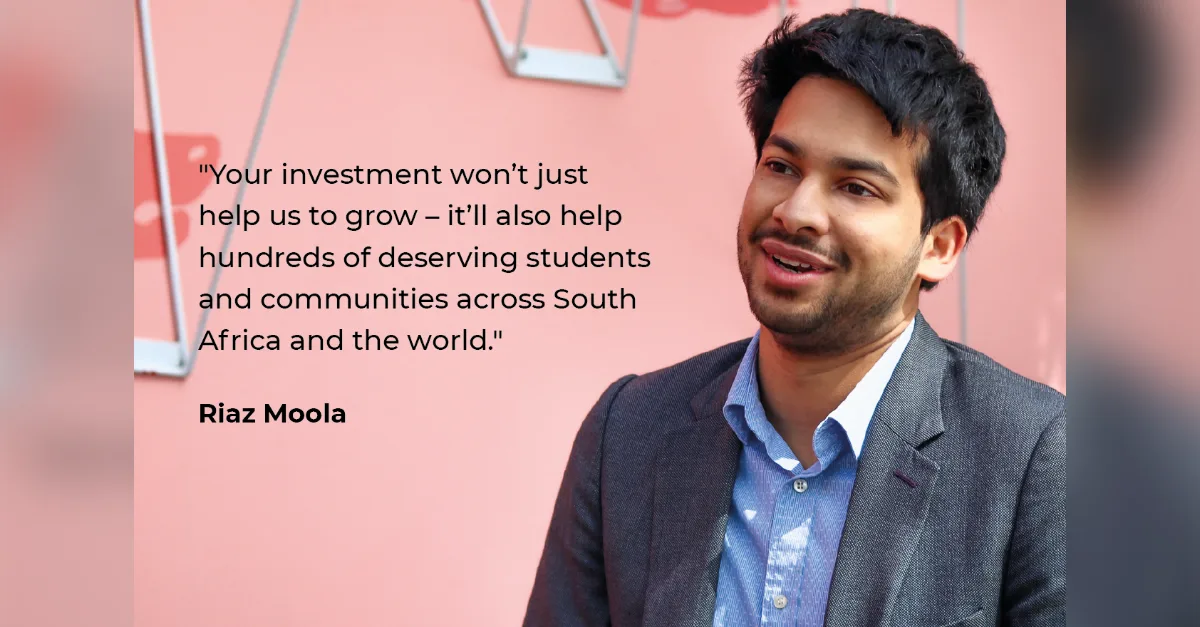
Your investment won’t just help us to grow – it’ll also help hundreds of deserving students and communities across South Africa and the world. This social impact investment campaign will award up to R 3.5 million in coding scholarships to deserving students, who have already started sharing their stories about how they’ll change the world with this opportunity. The more we raise through the crowdfund, the more we will be able to give back. We’ve already received dozens of inspiring and amazing entries from students looking to change the world and their lives through a coding bootcamp. You can see them on our scholarship page and see the lives that you’ll be directly changing forever when you invest in HyperionDev.
Our early investor allocation is filling up fast, but you can still get exclusive priority access
As part of our early investment drive, we allocated 1,000 investment spots to early interest parties. The response to this opportunity has been overwhelming, with over 600 registered investors signing up in just days after the initial outreach was started.
It’s not too late for you to be a part of this early allocation. Sign up now before these spots fill up, to be first in line.
I can’t wait for you to join us on our next phase of exciting growth.
Invest in HyperionDev now for as little as R200 (£10) at https://www.hyperiondev.com/invest/
*Investments of this nature carry risks to your capital. Please Invest Aware.
News & Announcements
January 7, 2021
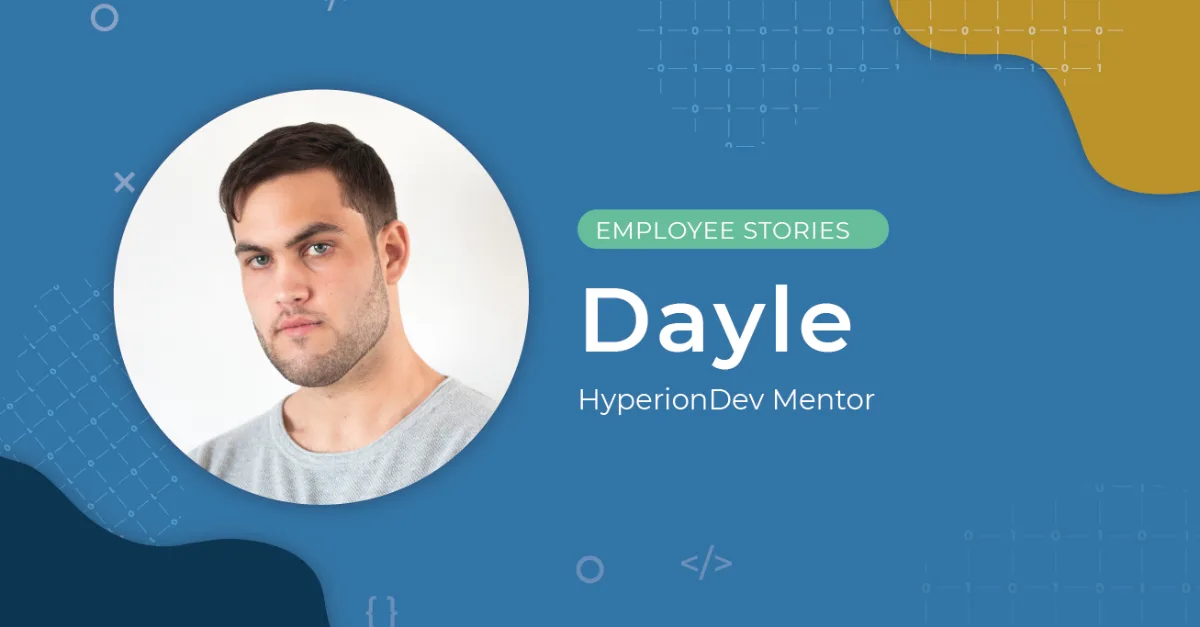
HyperionDev employee stories: Dayle Klinkhamer
This HyperionDev employee story shines a light on the newest member of our mentorship team: Dayle Klinkhamer. A graduate from HyperionDev’s software engineer bootcamp, Dayle’s familiarity with the program and fantastic work ethic help students overcome the challenge of learning to code and become job-ready developers.
Our bootcamps stand out because of the personal, expert mentorship that every student gets. Our mentors aren’t just better than bots at helping students to learn how to code; they also bring their personal experience and insights to help students understand why code is written a certain way, strengthen their coding skills, and learn industry-standard coding practices. More importantly, our mentors understand what it’s like to learn how to code as a total beginner. This experience helps them to guide new coders and present difficult concepts in easy-to-understand ways. In this HyperionDev employee story, we look at one of our newest team members, Dayle Kinkhamer, and his role in our mission-critical team of mentors.
Dayle Klinkhamer is the latest coding mentor to join our team, and he doesn’t just understand coding well – as a HyperionDev bootcamp graduate, he knows our bootcamps like the back of his hand. Mentors like Dayle make all the difference not just in our mission to close the growing global tech skills gap, but in being a friendly and helpful human face that helps people in their journey to learning to code and becoming job-ready developers.
What do you enjoy most about being a HyperionDev employee?
I am new to the company but was made to feel welcome instantly and I did not feel like I had to fight to be heard. Everyone seems to sit at an equal status level which is awesome!
What’s the heart and soul of your role at HyperionDev?
I want to use my skills I have learned in the tech space to help others in their journeys as I find this to be a rather fulfilling effort.
What motivates you to come in or log on in the mornings?
I know that I will have students waiting for me that need my assistance!
Tell us a bit about your professional development as a HyperionDev employee.
HyperionDev has offered me the opportunity to work for them as a full-time mentor while also giving me the chance to do additional courses allowing me to upskill while I work.
How do you ensure that you keep yourself upskilled & knowledgeable in your field of expertise?
I am fully immersed in the tech sphere and have been for as long as I can remember, it is easy to be in the know when you are passionate and surrounded by like minded people who are just as driven
Which of HyperionDev’s 4 core values resonates with you most & why?
I would have to say that the core value of ‘Problem Solving’ resonates with me the most. I have always had a curious mind and have always enjoyed a challenge and there is nothing quite like the thrill of that ‘A-ha!’ moment when you figured something out or you can see it working. It’s that, “wow look what I managed to do after all that struggling” feeling that makes it all worth it. So sharing that with others is amazing
What’s a fond memory you have of working at the company?
As I am new, I suppose it would have to be landing the job! However, I was also given the chance to take on a new project within the company shortly after joining.
What makes you feel PROUD to be a HyperionDev employee?
Every time I can see a student just grasped something new that I once struggled with.
At HyperionDev, we’re always looking for talented professionals to join our team. Whether you’re a specialist in project management, a gifted developer, or someone who can code and is passionate about tech education, there’s a place for you in our diverse and international team. As a HyperionDev employee, you’ll enjoy more than just fulfilling and challenging work with a fast-growing, internationally scaling start-up – we provide medical insurance, extensive remote working allowances, a generous leave policy, and real avenues for career growth, experimentation, and promotion.
Do you think you could be our next star HyperionDev employee? Visit our career page to see all our available positions and apply to join our team today!

News & Announcements
November 10, 2020
HyperionDev Black Friday deal | Get up to 40% off your coding bootcamp
Gain essential tech skills and get up to 40% off your HyperionDev coding bootcamp this Black Friday. Register now and start anytime until March 2021.
Behind every doctor’s appointment, banking transaction, and essential business is a developer.
The international demand for career professionals who can work with websites, software, and complex datasets is skyrocketing because of our world’s increasing reliance on remote teams and digital technology. There has never been a better time to learn essential skills in data, web development, or software engineering.
You can get up to 40% off your HyperionDev coding bootcamp this November in our HyperionDev Black Friday deal. Simply register for your bootcamp before 23:59 on 24 November 2020 and you can save up to 40% on the total cost of your bootcamp. Best of all, you can start any time you choose until March 2021.
Our MICT SETA accredited bootcamps teach job-ready skills in data science, web development, and software engineering without needing to pay hundreds of thousands of rands or study for years on end. With 1-on-1 mentorship, expert code review, and full career development support, you can graduate as a job-ready developer in as little as 3 months (with a portfolio of work to prove you have the skills). What’s more, you can start right away, with no need for a matric certificate or previous experience in computer programming.
Whether you’re a working professional looking to secure or upgrade their career, a parent who wants the best for their school leaver, or a Matric thinking about how they’ll land that high-paying job, our coding bootcamps are the ideal fasttrack for your career and education goals. Our HyperionDev Black Friday deal is your chance to secure your future and career security, at a fraction of the usual cost.
Sign up for your HyperionDev Black Friday discount here.
This HyperionDev Black Friday promotion only lasts until 23:59 on 24 November 2020, so hurry to get your discount while they’re available.
News & Announcements
October 1, 2020
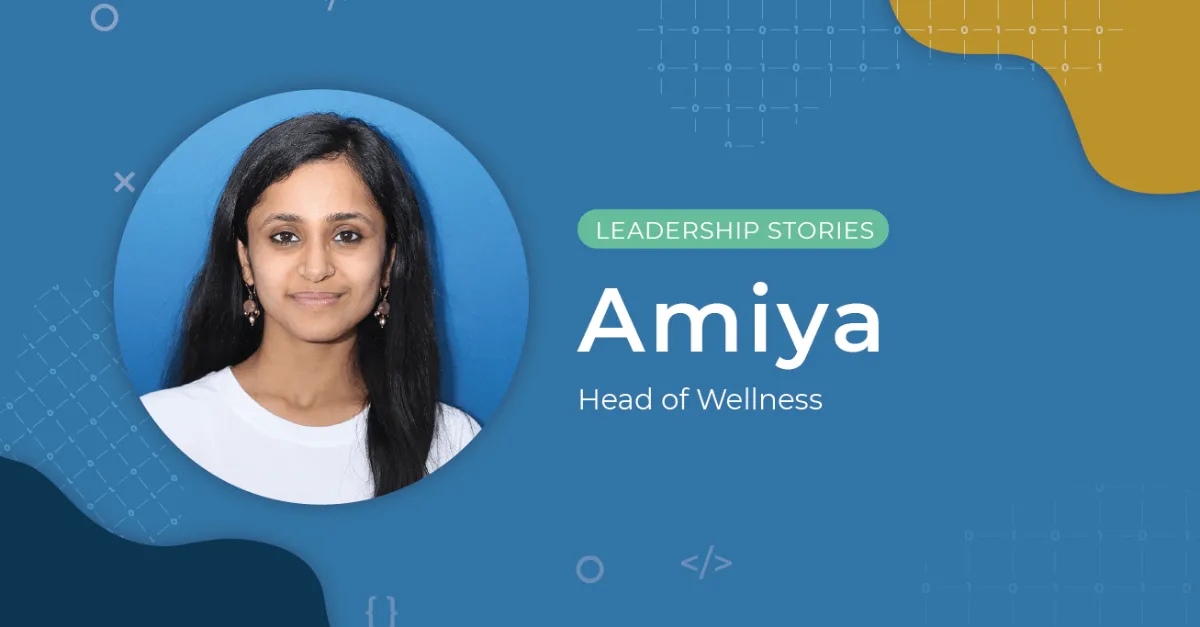
HyperionDev Leadership Stories: Amiya Sharma
Building one of Southern Africa’s largest EdTech providers needs more than just talent: it also requires a structure that recognises hard work and rewards it with key leadership positions. Today’s HyperionDev Leadership story features Amiya Sharma, our Head of Wellness & Finance.
Creating Southern Africa’s leading provider of tech education takes more than just having the most talented team out there. It also requires a mindset of growth, development, and leadership, so that the talent you have can continue growing to become widely-skilled and highly-experienced leaders. In this HyperionDev Leadership story, we look at Amiya Sharma, our Head of Wellness, whose years of experience and hard work have allowed her to rocket from one leadership role to next. Today, she oversees more than just the financial health of the company – she also also heads up the Talent and PeopleOps departments that make sure the company is able to attract, hire, engage and retain the best of talent.
Amiya has a Master’s in Economics from Delhi University and nearly a decade of experience in business process consultancy and project management. However, her interest in helping people – particularly the youth – through education pushed her to work in a range of positions in the social sector. Amiya joined us as a manager of sales and operations, before taking on the position of Head of Mentorship for HyperionDev bootcamps. She moved on to leading the delivery and management of our globally pioneering work in providing code-review-as-a-service, before taking up her current position as Head of Wellness.
How does your current role at HyperionDev fit with what you wanted to do before joining our team?
While I was consulting at PricewaterhouseCoopers (PwC), I made a conscious shift from management consulting to social impact consulting to align better with my broader sense of purpose. I moved into education, which has this real power to transform the lives of and opportunities for thousands of people and communities. I worked with bilateral and multilateral organisations to design and implement programs focused on skills-based education. Soon after this, I moved to Cape Town – and this was the starting point of my work with HyperionDev, as Riaz Moola and his HyperionDev team were then planning the launch of a similar program.
Why did you switch career streams to this new one?
Though I enjoyed my consulting days, as a consultant you’re usually ‘on the outside’. Even though you may be working on complex solutions or detailed plans for a client, your involvement stops at a certain stage or point in time, which can be immensely frustrating. Being ‘on the inside team’ of an ambitious, audacious, fast-growing business has been amazing: ever since I joined HyperionDev, I’ve headed up and moved through three different functions at the company, and currently I lead the Wellness division which consists of our finance, strategy, talent, and people operations functions.
What drew you to joining HyperionDev?
The purpose-driven mission, and the very ambitious and clearly talented team led by Riaz. I met with him a few times before I came onboard. He had a very compelling vision and I wanted to be a part of making it a reality.
What are your biggest achievements since you joined HyperionDev?
I’ve held different roles within the company since 2017, and whenever I headed up a new function, a big part of my job would be to bring more process and structure to it and set the team up for success. In the time that I’ve joined, our team has grown five-fold and the business has seen 12-15x growth, and to have been a core part of the team strategizing, planning and achieving this has been very exciting and personally fulfilling. We’ve navigated through many curveballs including COVID-19 quite well, and I believe that’s testament to our resilience, planning, and agility in decision-making, which makes me very proud!
How do you keep yourself up skilled and knowledgeable in your field of expertise?
I usually follow a couple of wide-umbrella podcasts, such as Conversations with Tyler, to get recommendations on more things to read, learn, or check out!
How would you describe the culture of HyperionDev?
I would describe HyperionDev and its culture with three words. The first is “innovative”: we believe in solving problems in new, better ways. The second is “progressive”, because we are always moving ahead, learning, and evolving to stay ahead of the curves of life and the tech industry. And finally, “challenging”, in a positive sense that we push ourselves and team members to do the best we can
In your own words, why should talented people come and work in your team?
There are so many reasons, but the main one I give is always from my own experiences: education and tech are rapidly growing sectors. There’s real opportunity in them for people who want to buckle down to do some good; and there’s some great rewards to be enjoyed from working hard.
Of our core values do most strongly identify with?
‘Progress Always’ is the one that resonates most with me. I value the idea of growth for individuals, communities, organisations. To be able to challenge yourself, objectively learn from it, reflect, grow, evolve… feels like the essence of ‘being’ for me.
Are you an A-player and a talented professional who cares about accessible tech education? Do you want to make a difference in the lives of people looking to uplift their lives through a tech education? If so, we’re looking for people like you to join the team leading Southern Africa’s largest provider of tech education. Our diverse, international team enjoys medical aid packages, remote working allowances, a generous leave policy, and real avenues for career growth and promotion.
Visit our career page to see all our available positions and apply to join our team today!

News & Announcements
September 17, 2020
Our biggest lessons from COVID-19 – Part 3: Adapt or go bust
The global pandemic and national lockdown have changed the way we learn, work, and live. In this final entry of our 3-part blog series, we reveal the last of our biggest lessons from COVID-19: that in the rapidly-changing business sphere, you need to adapt quickly to new business obstacles.
COVID-19 has been devastating, but it has also been a learning experience for our education system, businesses, and society. Below, our Head of Education, Nico Kruger, outlines the biggest lessons we’ve learned about the explosion of digital transformation, the importance of education models that aren’t locked in the past, and smarter, more agile strategies to keep business competitive.
In this final part of our series examining our biggest lessons from COVID-19, we reveal the third key lesson we’ve learned in the past 6 months: that business isn’t what it used to be. Times have changed, and the markets have been obliterated by global lockdowns; there simply isn’t the luxury to put off or downplay the importance of changing your business to be more agile, proactive, and in line with the modern, all-digital post-COVID world of work and play.
The devastating effect of the lockdown on business has been very clear
Cancellations, cutbacks, work hour reductions, partial pay, furloughs, and retrenchments are sweeping the economic landscape. With all these challenges threatening the livelihoods of thousands of career professionals, and so many companies embracing a ‘new normal’ of remote calls, zoom meetings, and digital services, many are considering switching careers to tech.
According to Statistics SA, the official unemployment rate increased from its already 11-year high to 30.1% in the first quarter of 2020. Rising unemployment has been a grave issue for over a decade, but with the devastating effect of COVID-19 and the restrictions introduced to curb its spread, it will only get worse. Between 1.5 million and 3 million jobs losses are thought to have been lost during our extended lockdown, a horrendous outcome that could increase our official unemployment rate to as high as 50%. While these numbers still aren’t 100% clear, the economic devastation is: the economy shrank 16.4% between Q1 and Q2 of 2020, a terrible blow that could end up cutting our economy in half if this pattern continues for the rest of the year.
In this meltdown, people are seeing their industries coming to a standstill, and making the big decision to switch to a whole new career path.
Since the lockdown began, we’ve been helping an increasing number of students navigate these changes. The industries they worked in were giants, which have for years been dependable jobs providers that were seemingly far too big and far too crucial to global trade and entertainment to fail. Take Bettina, for example, who worked in the film industry, or Natasha, who worked in the seemingly unstoppable Oil and Gas industry. These are just two people who understand that security and career growth have shifted from the old dominant industries, to the quickly expanding tech sector.
Tech has been a central part of stabilising business and society in the wake of COVID-19’s global shockwave. It is being increasingly recognised and embraced by job seekers as a way to cement vital and in-demand tech skills, as thousands of companies adopt rapid digital transformation to keep their services operating.
Business: innovate or die
As lockdown forced businesses to cease physical, brick-and-mortar activity, it was clear that businesses needed to adapt or die. Digital storefronts and online services, functional and reliable websites, remote work, online advertising are now mandatory tools for survival. In this new business environment, trained tech professionals, ICT resources, and digital skills development in the workforce are non-negotiables. Businesses should focus on removing barriers between their services and the customers’ wallets; and this means one thing: tech education.
“This is a time when it becomes clear to see which companies are truly agile and set up to be remote-first in this new future of work.”
For many businesses that were more traditional or had processes that weren’t set up to be remote, it has been tough. What we hear from friends, family and employees who work at certain businesses is that remote work has brought its own challenges for them such as the infrastructure needed for employees to go remote, or issues in translating old-school work processes to virtual workflows, or some traditional managers’ discomfort with remote work and hence their need to micromanage.
This is a time when it becomes clear to see which companies are truly agile and set up to be remote-first in this new future of work. I’m happy to share that, for our company, we actually saw an increase in the levels of happiness, satisfaction, and work-life balance reported by employees as part of our bi-weekly pulse surveys during the past five months, which have generally been stressful all around the world. I think that’s a reflection of how quickly we were able to adapt as a business and support our employees in working remotely through a variety of measures, from assistance with mobile data to virtual fitness sessions and support groups for people to share what was on their mind.
For both employers and job-seekers, the choice is simple: learn these important lessons from COVID-19 to secure your future, or go bust.
For us as an ed-tech provider, the new normal of digital services, remote work, and huge demand for software and technology systems have made coding skills more crucial than ever. Our specialised coding bootcamps teach people the skills they need to have to get working in the tech industry in less than 6 months. They get 1-on-1 mentorship and expert code review, with all the career support they need to get started in their tech career. Plus, we offer a free trial that offers all the beginner essentials to get future coders started.
And we’re looking for talented people who care about accessible tech education, and want to help people create better lives for themselves through rewarding tech careers. If you think you’d be a great fit in our home-grown start-up that’s making a global impact, please visit our careers page to see what opportunities await you at HyperionDev.

News & Announcements
September 16, 2020
Biggest COVID-19 Lessons – Part 2: Risk Awareness Matters
The global pandemic and national lockdown have changed the way we learn, work, and live. In part 2 of this 3-part blog series, we reveal another of our biggest lessons from COVID-19: that with changing times, you need to be hyper-aware of the risks in your current and future career plans.
COVID-19 has been devastating, but it has also been a learning experience for our education system, businesses, and society. Below, our Head of Education, Nico Kruger, outlines the biggest lessons we’ve learned about the explosion of digital transformation, the importance of education models that aren’t locked in the past, and smarter, more agile strategies to keep business competitive.
In this second entry of this three-part series of lessons from COVID-19, we reveal the next big lesson we’ve learned in the past 6 months: that with changing times come brand new risks. You need to be aware of these potential career pitfalls and manage them strategically if you want to continue on your successful career path.
The risks are unprecedented and multi-faceted, so why are we doing everything the same way?
“Prospective uni students are asking themselves how much time and money a four-year Zoom call is really worth.”
As southern Africa’s largest provider of accessible tech education, we’ve been at the forefront of the massive changes that the education system has faced. Before, universities and formal tertiary education institutions were seen as tickets to success, and many openly pushed back against the idea of online education and digitisation as irrelevant or wasteful. Now, with the new reality of online curricula, video lectures, and limited in-person lectures, universities are playing catch-up just to deliver a basic education service; and prospective uni students are asking themselves how much time and money a four-year Zoom call is really worth.
We’ve seen a significant increase in people approaching us because they want to get employable skills. The lesson is clear: people are shifting their expectations of educational offerings to having the option of doing courses online. And it’s not just us: in a recent survey, 2U found that 73% of respondents said the COVID-19 pandemic has made them more likely to consider online programs, and 20% of respondents said that, absent COVID-19, they would not have considered an online program.
Many experts think that the lessons from COVID-19 will be a huge force for change in universities – but we think students can’t afford to wait around for that to happen. We need to take a critical look at how we educate ourselves and our children, and consider that a new normal means embracing better-placed, more efficient alternatives to a years-long educational lock-in. Educational institutions need to be more agile and able to adapt when physical attendance is not an option.
In order to truly prepare for this brave new world we live in, we – as businesses, employees or job seekers – need to take a few lessons from COVID-19 to heart.
People are more aware of risk than ever before
With many once-giant industries being crippled by lockdown, people are considering their career paths and futures more carefully. For example, travel, tourism and hospitality were cornerstones of our economy; today, they’re shadows hanging on by the fingertips, waiting for international travel to return.The service industry and retail work have ground to a halt, with brick-and-mortar jobs just waiting for things to be normal enough to shoppers to come back.
“There’s one ever-present question: “What will happen to me and my career if another pandemic or disaster were to come along?”
People are learning some important lessons from COVID-19 in their career development: they’re figuring out which careers will offer real job security and growth. In the back of their minds, there’s one ever-present question: “What will happen to me and my career if another pandemic or disaster were to come along?”
I think it’s vital that people entering the job market ask themselves this. I am not saying that one should not go into industries that were severely affected by COVID-19, but one should know the risks and be able to adapt should we face another situation like this in future.
Working from home will simply be called ‘working’
“Securing remote opportunities is a good way to hedge the risks of the uncertain job market and gain relevant experience in a world that’s valuing tech skills and tech experience more and more”
Against this backdrop, and also keeping in mind the safety risk of going back to offices just yet, the appeal of remote work and remote-only opportunities has skyrocketed. Within our Education department, we have seen a fivefold increase in the number of people applying for our Code Reviewer roles, which are fully remote. Under the brand CoGrammar, we work with several US- and UK-based edtech companies where we technically assess and provide code reviews and helpful feedback to their students. For these positions, we look to sign contracts with technically skilled people who can review a variety of code ranging from Python to JavaScript to more advanced data science concepts, and this work that can be done on a freelance, part-time basis at different times of the day, including late at night when some of our code reviewers have technical calls with US-based students.
In that sense, securing remote opportunities is quite a good way to not only hedge the risks of the uncertain job market right now, but also gain very relevant experience in a world that’s valuing tech skills and tech experience more and more.
For both employers and job-seekers, the choice is simple: learn these important lessons from COVID-19 to secure your future, or go bust. In the next part of this series, we’ll examine the importance of businesses learning to adapt quickly to new challenges, or face permanent financial damage and even closure.
For us as an ed-tech provider, the new normal of digital services, remote work, and huge demand for software and technology systems have made coding skills more crucial than ever. Our specialised coding bootcamps teach people the skills they need to have to get working in the tech industry in less than 6 months. They get 1-on-1 mentorship and expert code review, with all the career support they need to get started in their tech career. Plus, we offer a free trial that offers all the beginner essentials to get future coders started.
And we’re looking for talented people who care about accessible tech education, and want to help people create better lives for themselves through rewarding tech careers. If you think you’d be a great fit in our home-grown start-up that’s making a global impact, please visit our careers page to see what opportunities await you at HyperionDev.
Continue reading the third part of this three-part series here.

News & Announcements
September 15, 2020
Biggest COVID-19 Lessons – Part 1: Go Online or Fall Behind
The global pandemic and national lockdown have changed the way we learn, work, and live. In part 1 of this 3-part blog series, we reveal the first of our biggest lessons from COVID-19: that a digital presence is non-negotiable.
COVID-19 has been devastating, but it has also been a learning experience for our education system, businesses, and society. Our Head of Education, Nico Kruger, outlines the biggest lessons we’ve learned about the explosion of digital transformation, the importance of education models that aren’t locked in the past, and smarter, more agile strategies to keep business competitive.
In this first part of this three-part series of lessons from COVID-19, we cover the first big lesson we’ve learned in the past 6 months: that whether you’re a business or a job seeker, you need to have a strong digital presence.
Get online. Now.
With lockdown and the cessation of non-essential business, industries of all kinds leapt at any available way to stay open. Remote work, video calls, digital services – all of these things which had been put on hold or called ‘ineffective’ for years before were suddenly the new heart of business. This digital transformation many had called for for decades went from nice-to-have to mandatory almost overnight.
Internet use surged with massive increases in traffic. At one point, the world’s largest streaming platforms deliberately throttled the quality of their video services to help internet infrastructure cope with the dramatic increase in use. Zoom became a household name almost overnight, in a gold rush that was so fast-paced that the share price of a lesser-known company called Zoom technologies (the wrong Zoom) rocketed up by over 1800%.
With the rapid online migration of business we are experiencing, software and web services are more crucial than ever before to the world economy. As an inevitable consequence, coding itself has become a highly sought-after skill, with demand for programmers skyrocketing. For us, as not just an online education provider but a coding education provider, this has resulted in greater interest from people from all walks of life who are now looking at learning software development skills. We have seen students, such as Bettina and Natasha and from various other sectors, pivot and look at the possibility of rather going into a tech direction in order to ensure that they change with the times.
Having an online presence is vital for job seekers too
“If you want to stand out from the crowded post-COVID-19 marketplace, you need to have a professional and job-relevant digital presence”
A strong digital presence is non-negotiable for job seekers too. Most employers, especially those in tech, will rely on your digital resume and online presence when evaluating you for a role. At HyperionDev, one of the ways we make our graduates career-ready – which I will emphasise for all job seekers – is to help them build a professional brand for themselves online. If you want to stand out from the crowded post-COVID-19 marketplace, you need to have a professional and job-relevant digital presence in the form of your LinkedIn profile or online resume and portfolio of work. If you work in tech, you especially need a Github portfolio to prove you have a track record of relevant skills.
“Recruiters hiring for companies look at a resume for an average of 7.4 seconds!”
As an article I was reading puts it, “as many as 77% of people you talk to are going to Google you to find out more information, and you need to make sure your personal brand reflects who you say you are, not who others say you are.” On your LinkedIn profile, add a professional profile pic, and add a ‘Headline’ (e.g. Software Engineer or ‘Aspiring Web Developer’) which appears next to your name in search results and provides the most relevant info about your experience and background at a single, quick glance. Add your skills to your LinkedIn profile, and ask your previous managers and colleagues – or even teachers or academic project partners if you don’t have much work experience – to provide endorsements and recommendations that recruiters can consider as informal references. Establish your technical and professional profile, so you control what appears in the search results for your name.
Make sure your CV matches your online persona
It is equally important to invest time in creating a resume that is easy to read yet conveys the most crucial information about your experience and qualifications. Recruiters hiring for companies look at a resume for an average of 7.4 seconds! It’s necessary that your resume stands out from others in those 7 seconds. Clearly highlight your education and list your professional experience in a concise manner indicating dates of employment, quantifying achievements where possible, and starting with the most recent ones first. Look out for specific skills and keywords in the job posting and customize your resume to highlight your skills which match them.
If you’re a job seeker, you must build and maintain your professional network. Find and reconnect with colleagues and classmates, find other professionals in the same industry using LinkedIn or Facebook groups, and share your professional thoughts and insights through Medium, LinkedIn or your own website/blog.
For both employers and job-seekers, the choice is simple: learn these important lessons from COVID-19 to secure your future, or go bust. In the next part of this series, we’ll examine the central place that risk awareness and mitigation is playing, for both employers and job seekers alike.
The new normal of digital services, remote work, and huge demand for software and technology systems have made coding skills more crucial than ever. Our specialised coding bootcamps teach people the skills they need to have to get working in the tech industry in less than 6 months. They get 1-on-1 mentorship and expert code review, with all the career support they need to get started in their tech career. Plus, we offer a free trial that offers all the beginner essentials to get future coders started.
At HyperionDev, we’re looking for talented people who care about accessible tech education, and want to help people create better lives for themselves through rewarding tech careers. If you think you’d be a great fit in our home-grown start-up that’s making a global impact, please visit our careers page to see what opportunities await you at HyperionDev.
Continue reading the second part of this three-part series here.
News & Announcements
September 14, 2020
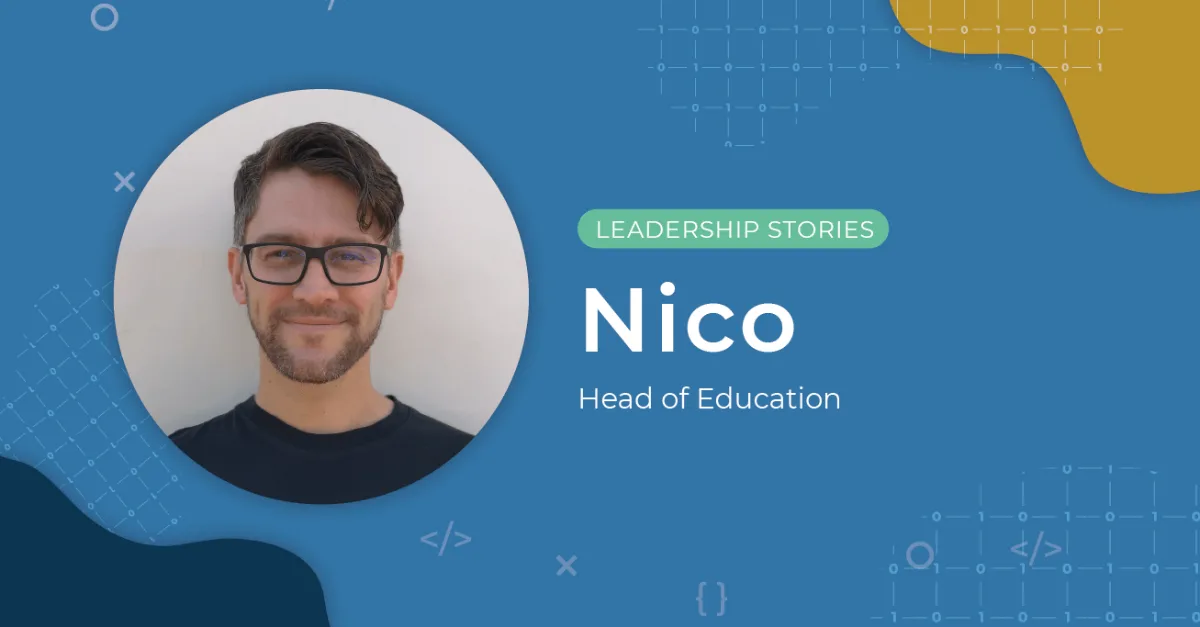
HyperionDev Leadership Stories: Nico Kruger
Building one of Southern Africa’s biggest EdTech providers needs more than just talent: it also requires nurturing that talent to excel into leadership positions. Today’s HyperionDev Leadership story features Nico Kruger, our Head of Education.
Building one of Southern Africa’s biggest EdTech providers is only possible with one thing: an unrivalled, world-class tech education. This education would be impossible without a course structure that teaches critical programming skills in a well-paced structure that makes sense to students and prepares them for a tech job in a time- and cost-effective way. That is where Head of Education Nicolaas Kruger comes in: his ability to keep our bootcamps effective, competitive, and delivering great value to students is why he has one of the most crucial roles in HyperionDev leadership.
Nico comes from an academic background in ICT and Computer Science, but has over a decade of experience in education, on all levels, from giving lectures himself, to managing programs, to designing whole curricula. As the Head of Education, Nico oversees the bootcamps we offer at HyperionDev, making sure the content taught is up to date, that mentorships are working, and that the course structure is working. It also involves being innovative and able to overcome challenges, like making sure a global pandemic does not disrupt our bootcamps for even a second.
What attracted you to HyperionDev?
A lot of my past experience has been with companies who are in their scale-up phase. HyperionDev is now at that point where the magic is going to happen and I want to be a part of this. The opportunity to head up this established tech education leader’s Education division and be a part of HyperionDev leadership was not something I was going to pass up. For me, it was a fantastic opportunity to grow my career, and put my years of education management experience to the test.
Tell us about your career development. What did the journey to HyperionDev look like?
I’ve worked in EdTech as a lecturer, management assistant, academic manager and course coordinator for the past 10 years now. It’s been a steady progression: each year I would take on a little more responsibility, and take on new challenges that pushed the limits of the position at the time. My current position in the HyperionDev leadership is really the result of a decade of focus on building my career in this direction, and being Head of Education is the pinnacle of my career (so far).
What are your biggest achievements since you joined HyperionDev?
The COVID-19 lockdown pretty much put a stop to South Africa’s economy, society and education. This was a tremendously challenging time, but it also saw two of my biggest accomplishments.
First, my team and I reacted quickly to the lockdown news, so that all students who were taking on-site bootcamps could learn online with as little disruption as possible. We pulled this off in less than 2 weeks. Being able to keep our bootcamps open, when everything else was closed, was a fantastic moment for me.
We were also able to design, build and roll out our first credit-bearing bootcamp during the national lockdown. Launching a brand-new 6-month bootcamp is hard enough, but launching an advanced program that teaches software development alongside web development – and which includes a guaranteed internship – was perhaps the highlight of my year.
Who do you consider to be important sources of inspiration?
For me, the people I look up to are those who are embracing new and disruptive ways of teaching students critical skills, and who are doing it with phenomenal results. I look up to people like Reaan Immelman (the Head of Education Delivery at ABSA), Sam and Rob Paddock (the founders at GetSmarter), and Amy Johnson, the Chief Academic Officer at Valenture Institute – I count myself very fortunate to have been able to work with these individuals. Lockdown showed us how crucial alternative models of education are for seamless, uninterrupted learning – and I’m constantly inspired by these industry figures who are at the forefront of making our disruptive models a part of the new normal.
How would you describe the culture of HyperionDev?
I love working with the various teams and departments. They’re a vibrant and forward-thinking group of people that are going to take the company and the industry to the next level.
What would you say is the most important value someone would need to work at HyperionDev?
I would say that Adaptability is key – We work in a fast paced ever changing environment that will challenge anyone that comes into the business. If you can keep up, you will flourish. That said, you are supported by an amazing team that will assist you in getting over the line.
In your own words, why should talented people come and work in your team?
As I mentioned before, HyperionDev is at that magical point where we are about to start rapid scaling. The challenges we will face will make careers and change both the tech industry and the way people think about education – it’s a phenomenal opportunity. Anyone who wants an extraordinary career can’t say no to that.
What do you do to de-stress after work?
Over the weekends, I like spending time with my family and from day-today, I enjoy reading and cooking.
Are you an A-player, or a talented professional who cares about accessible tech education? If so, we’re looking for people like you to join the team leading Southern Africa’s largest provider of tech education, and become a part of HyperionDev leadership. Our diverse, international team enjoys medical aid packages, remote working allowances, a generous leave policy, and real avenues for career growth and promotion.
Visit our career page to see all our available positions and apply to join our team today!
News & Announcements
September 7, 2020
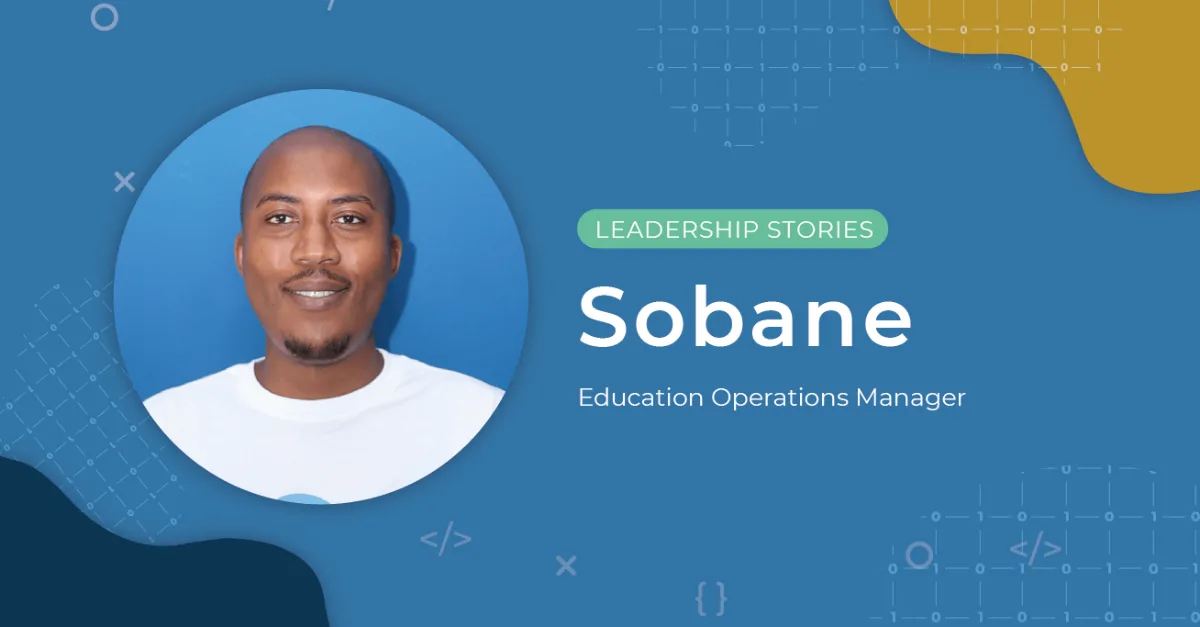
HyperionDev Employee Stories: Sobane Motlomelo
Building one of Southern Africa’s biggest EdTech providers requires nurturing that talent to excel into leadership positions. Today’s HyperionDev Employee story features Sobane Motlomelo, who started as a coding mentor and grew to become our Education Operations Manager.
Even the best education is nothing without an orderly, well-structured learning environment and system – and keeping our bootcamps at their world-class level requires a team of expert educators and operations specialists. In this HyperionDev Employee story, we look at Sobane Motlomelo, our Education Operations Manager, who has been with HyperionDev from its very start. From personal mentoring, to sales, to marketing, Sobane has been a part of many facets of HyperionDev’s inner workings – and his years of experience and passion are a vital part of keeping our bootcamps operating at peak success.
Sobane joined HyperionDev when it was started in 2012. As a final-year student studying Computer Science & Mathematics at the University of Cape Town, Sobane started as a mentor, helping hundreds of students with their roadblocks in programming. He excelled at it, and soon grew to lead a vast international network of volunteer coding tutors and mentors. Over the next few years as a HyperionDev employee, he would take charge of many different projects and departments, from marketing and community management to sales, and today serves as our shining example of the possibilities that lie where hard work and career development opportunities meet.
Tell us about your beginnings at HyperionDev
I consider myself very lucky: I’ve been a part of HyperionDev from its very beginning in 2012. I started out mentoring students (because of my background in Computer Sciences) but since then I have had a chance to experiment and grow across a range of teams. I’ve headed up Marketing, managed different local and international HyperionDev communities, overseen Developer Relations, led the Sales team, and worked at the helm of Customer Support. Now, I’m back in Education.
Each of these has been a wonderful experience with lots of lessons and challenges – but more importantly they were a lot of fun, and they contributed greatly toward my professional development. HyperionDev has helped me challenge and push myself beyond my comfort zone, and I’ve been able to develop a really wide, rich skill set – especially under the continued guidance and coaching from the CEO, Riaz Moola.
What does your job involve?
As Education Operations Manager, I make sure that the bootcamps are working efficiently and that students are learning. My role oversees a lot of interrelated elements: properly onboarding all bootcamp students, making sure our bootcamps and content are up to date with industry practices, monitoring students’ progress, and ensuring that each of our students receives excellent support and experience throughout their journey with us.
What motivates you to come in (or log on remotely) in the mornings?
I’ve always loved education and helping people. Being able to directly contribute to and impact someone’s life in such a meaningful way is greatly fulfilling. We cater to a wide range of demographics, and there’s nothing as heartwarming as witnessing students successfully graduate from our bootcamp and ultimately reaching their career goals. Every time I see a student graduate, I’m reminded why I love what I do.
What do you enjoy most about working as a HyperionDev Employee?
The diversity of the team makes work interesting and engaging; and working alongside some of the smartest people I’ve ever met has been nothing short of inspiring. The cross-team collaboration is amazing and everyone at HyperionDev is goal-driven.
What are your biggest achievements since you joined HyperionDev?
I’ve been here since the beginning, so there are definitely too many to list: but if I had to pick it would be our run of successes in 2016, when HyperionDev won first prize on the Africa Innovation Challenge run by Facebook’s Internet.org, and we got invited to attend Facebook’s Annual F8 Conference in Silicon Valley. I got to meet and network with a lot of incredibly hard-working, talented people – one of them being Mark Zuckerberg. There was also the time I got to travel to EdTechXAsia in Singapore alongside 10 other tech start-ups from South Africa. These are just a few of the incredible opportunities I’ve been afforded at HyperionDev, and they’ve been such an important part of my career development.
How do you ensure that you keep yourself upskilled and knowledgeable in your field of expertise?
I believe learning never stops, especially in the tech space. Because of this, I’m a very busy guy: I’ve always got my nose in the latest industry journals or publications, and I try to squeeze as many conferences, workshops, and EdTech events as I can into my calendar.
What would you say is the most important value someone would need to work as a HyperionDev Employee?
I’d have to say the HyperionDev core value of ‘Progress Always’. As a leader, I’m all about building up from above. I believe in continuous learning and improvement: always exploring new ideas and opportunities while excelling at your craft.
At HyperionDev, we’re always looking for talented professionals who care about making an impact through accessible tech education. If you have a passion for education, and want a fulfilling career that makes a daily difference in people’s lives, then we think you should join us. Our diverse, international team enjoys medical aid packages, remote working allowances, a generous leave policy, and – as Sobane’s eight-year journey proves – real avenues for career growth, experimentation, and promotion.
Do you think you could be our next star HyperionDev employee? Visit our career page to see all our available positions and apply to join our team today!
News & Announcements
August 27, 2020
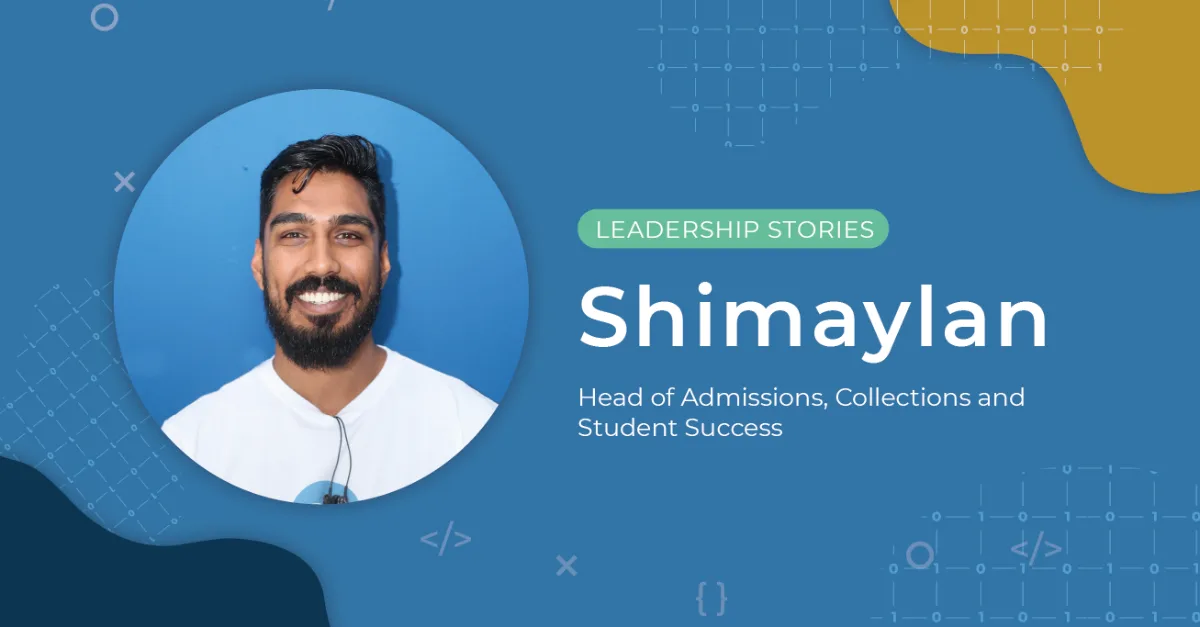
HyperionDev Leadership Stories: Shimaylan Singh
Building one of Southern Africa’s biggest EdTech providers needs more than just talent: it also requires nurturing that talent to excel into leadership positions. Today’s HyperionDev Leadership story features Shimaylan Singh, our Head of Admissions, Collections and Student Success.
Creating Southern Africa’s leading provider of tech education takes more than just having the most talented team out there. It also requires a mindset of growth, development, and leadership, so that the talent you have can continue excelling and striving for the next big thing. In this HyperionDev Leadership story, we look at Shimaylan Singh, our Head of Admissions, Collections and Student Success who joined HyperionDev in 2018 as a Management consultant, and rapidly grew to becoming an integral part of HyperionDev’s core leadership.
Shortly after completing his Bachelor of Commerce degree at the University of KwaZulu-Natal, Shimaylan moved into the sales industry and worked hard to grow into management roles. In the space of a few years, Shimaylan joined some of the most recognised tech companies around, like Yoco and GroupOn. Eventually, he was attracted by HyperionDev’s mission of enabling education that is an accessible alternative to traditional university degrees. Since coming on board in 2018 as a management consultant, Shimaylan has rocketed from achievement to achievement, helping us provide accessible tech skills education to thousands of students, and earning a place in the core HyperionDev leadership team.
What drew you to joining HyperionDev?
The mission and vision of the company addresses a very real and on-the-ground gap that speaks to a dreamer like me.
What are your biggest achievements since you joined HyperionDev?
I’ve been lucky enough to be involved in so much over the last 3 years, but I’d say my highlights would be successfully heading up various teams within HyperionDev. Leading my colleagues and department through some really significant moments like refreshing our brand image while launching our first onsite campuses in Johannesburg and Cape Town, growing and needing to move into new office spaces, defining and creating our Careers function, and launching HyperionDev’s latest Certified Full Stack Web & Software Engineer Bootcamp.
I’ve also been able to lead and even create the new Collections team in our strategic response to the negative impacts of COVID-19 and the national shutdown. I count the fact that hundreds of students can still learn how to code – even under the toughest lockdown in the world – as a huge success.
What would you say are your leadership qualities, and how do you keep yourself and your team motivated?
I think I am a natural leader and have decent business acumen. Caring deeply about the main purpose of the company is essential to great leadership. I come from a family of educators, so being in the education space is something that energizes me. Contributing the way that we do [to creating accessible tech education], and having good relationships with the people in my team keep me inspired and motivated.
Who do you consider to be important sources of inspiration?
I’m personally inspired by a wide range of people and professionals from all walks of life. The people I look up to are figures like Ronald Erasmus, Alan Watts, Andrew Yang, and Maya Angelou. I’m also constantly inspired by the people I work with, the other HyperionDev leadership, and the huge accomplishments they’ve brought to our team – like our Head of Wellness and Finance, Amiya Sharma. Seeing others excel really drives you to strive for better.
How would you describe the culture at HyperionDev?
I’d say it’s best described by our company value of Progress Always. We get things done, and work in a high performance environment of A-players. HyperionDev has a way of showing you your weaknesses, which motivates you to look at them and work on addressing them. It’s a culture of growth.
What would you say is the most important value someone would need to work at HyperionDev?
Definitely the core value of Problem Solving. It’s a growth-focused value that’s central to both your growth as an individual and the growth of the company. It drives self-fulfillment, serves the business mission, and creates more value than just the sum of the problems solved.
Are you an A-player, or a talented professional who cares about accessible tech education? If so, we’re looking for people like you to join the team leading Southern Africa’s largest provider of tech education. Our diverse, international team enjoys medical aid packages, remote working allowances, a generous leave policy, and real avenues for career growth and promotion.
Visit our career page to see all our available positions and apply to join our team today!

News & Announcements
April 9, 2020
The spread of COVID-19 shows the power and importance of tech
The financial and human toll of COVID-19 has been devastating and clear to see. But amid all this uncertainty and darkness, we have seen the power of digital technologies bring us all together, keep businesses functioning remotely, and take the fight directly to the disease.
As COVID-19 passes the 1,000,000 cases mark, the effects of the virus have been horrific and inescapable. Travel has been banned. Entire economies have been put on pause. Whole countries have gone into lockdown. In America alone, the number of unemployment claims rose by 3,000% in just a few days to a peak of 6.6 million claims. Closer to home, economists warn that South Africans should brace for job losses that could potentially surpass those seen during the last economic recession. But among all this, this disastrous period has revealed the importance of technology: not just of keeping us sane while we self-quarantine and pass these lockdown days, but in keeping us working and connected. Technology empowers businesses to function remotely; it keeps us connected to our loved ones, and it enables research into the spread and evolution of COVID-19 so that we are better equipped to fight it.
Online activity surges
As COVID-19 forces real-world activities to a standstill, internet use has skyrocketed. Forbes reports that total internet hits have surged between 50% and 70%, while streaming has also jumped by at least 12%. Telecom giant Verizon has reported voice usage increasing on its network by 25% in the space of a single week, and total web traffic up 22%. Similarly, Vodafone reported data traffic increases of 50% in some of its markets.
As internet use soars, traditional media is suffering a considerable decline. Technology research firm Omdia predicts nearly $11 billion in losses for the movie industry, alongside a 25% decline and a 15% drop in TV advertising.
Simply put, online technologies are filling in where traditional companies and brick-and-mortar establishments simply cannot. As Forbes noted,
The big winners will be the online companies, healthcare providers, supermarket chains—especially those with a robust online presence— pharmaceutical companies working on cures for diseases, technology companies and services, such as Zoom, that cater to people working from home.
It’s a simple fact: tech-focused jobs are becoming increasingly important in continuing the basic systems we’ve enjoyed for so long.
Technology and communities, coming together
It’s all too easy to get distracted by the fake news and online negativity as COVID-19 takes up more and more international headlines. But hidden behind the nonsense and clickbait are countless stories of people coming together with technology to help each other out in ways both big and small.
Businesses are converting their machinery to produce masks and other PPE. Factories have turned away from making perfumes and iPhones to manufacture hand sanitiser and masks. Alcohol distilleries and gin brewers are putting away the booze and instead crafting hand sanitiser.
That’s just on the business side; individuals across the world have also come together in a wonderful show of unity to fight COVID-19 and its far-reaching effects. People are refitting 3D-printers to produce protective gear for medical staff. Neighbours are working together online to buy groceries for at-risk individuals such as pensioners. Millions have come together in crowdfunding ventures to help those businesses and workers who would otherwise be totally doomed. Crowdfunding site GoFundMe reported on March 24 that over 35,000 coronavirus-related projects had been started with more than $60 million dollars raised to help those in need.
Technology helping win the war against COVID-19
Technology isn’t just keeping businesses remote and afloat. Aside from the power of applications like Zoom, cloud technologies, digital conferencing technology, and online storefronts, technology is also the primary means for mapping and combating the spread of coronavirus.
We wrote about this in our previous blog about HyperionDev’s origins and history in virology, computational biology, and the study of infectious diseases, but we’ll repeat it here: outside of wet labs, using data science and evolutionary mapping or models are the only ways to understand these illnesses and predict their growth and evolution.
Already there are innumerableapplications and websites, made both internationally and locally, that are helping us to track, understand, and predict the growth and spread of COVID-19. What’s more, it’s helping us to create strategies to halt its spread, treat the infected, and ‘flatten the curve’. COVID-19 is a complex issue, but the efforts of programmers and data scientists across the world have shown us the power of programming know-how and technology in tackling seemingly insurmountable challenges.
It might be too early to say how COVID-19 will develop over the new few weeks and months, and what far-reaching ramifications it will have on our societies, financial systems, and ways of life. However, what’s abundantly clear, even just days into the national shutdown, is that technology – whether it’s used to fight disease, entertain bored people at home, or keep businesses functioning in difficult times – will play a fundamental role in the world when the shutdown ends.
—-
Do you want to develop skills in data science to understand the frighteningly complex numbers coming out of COVID-19 news, or web development skills to make your own tracker, application, or public resources site? Perhaps you want to learn how to code so that you can get a job that keeps running, even when your physical offices have been shut down by exceptional circumstances? Right now is the time to learn how to code, and open up your career futures.
All of our bootcamps can all be taken online and part-time, so that you can learn even whenever and wherever you are. Sign up for your free trial in any one of our immersive coding bootcamps in Full Stack Web Development, Software Engineering or Data Science, and make your career quarantine-proof.

News & Announcements
April 2, 2020
Why COVID-19 takes me back to the early days of HyperionDev – a note from CEO, Riaz Moola
Perhaps you’ve heard the story of HyperionDev’s beginnings with just a laptop and a couch – but what many might not know is the company’s earliest work in bioinformatics and virology. In its early days, HyperionDev had a strong focus on computational biology, a field that is now more relevant than ever before.
The effects of COVID-19 have left the world reeling. Businesses have closed doors and people have retreated to their homes, as everyone comes together in an effort to flatten the curve and beat back the virus. Cut off from physical things, people and companies are turning at an unprecedented rate to digital services and operations. Working from home is the new norm. Internet usage has spiked. Colleges and universities have taken up remote learning not as an add-on, but a core part of their central education model. More than ever, we are all seeing quite clearly the power and importance of the internet and tech in society, work, and the virology to fight COVID-19.
The global pandemic has been disruptive, but it’s also been a reminder of why HyperionDev exists. The world of coding still has a tech skills gap that needs to be closed, and which is exacerbated by obstacles like these. People shouldn’t need to put aside hundreds of thousands of rands and years of their time to get the skills to start their tech career.
Personally, it’s been a reflective moment that draws me back to the earliest coding courses of HyperionDev, when my work was directly centred around computational biology and the study of the evolution of viruses and other facets of virology..
In fact, serious outbreaks and diseases played a role in creating HyperionDev in the first place.
A couch, a laptop… and a whole lot of virology
I’m sure everyone has read the story of HyperionDev’s humble beginnings: a ComSci major, a laptop, and a couch. But what doesn’t make a Destiny magazine profile or Venturebeat interview is the central place Computational Biology and the study of serious and infection diseases had in creating our education model.
In my uni days, I used to specialise quite deeply in some subfields of virology, especially the evolution of viruses and virus responses. Computational Biology (also known as bioinformatics) is a powerful tool for making an impact on preventing pandemics. In fact, outside of the higher risk wet laboratories used to study viruses, it is the only way you can actually understand a virus scientifically.
Toward the end of my studies, I completed two internships specializing in viruses and virus epidemic response, which introduced me to Python. While working at SACEMA (this is a website I actually built, and one they continue to use to this day!), the team asked me to teach Python to trainee biologists, who needed to learn programming so they could build algorithms and perform high-level data analysis in order to understand the evolutions of viruses. It made me realise just how important coding is for biologists, scientists and researchers, not just developers.
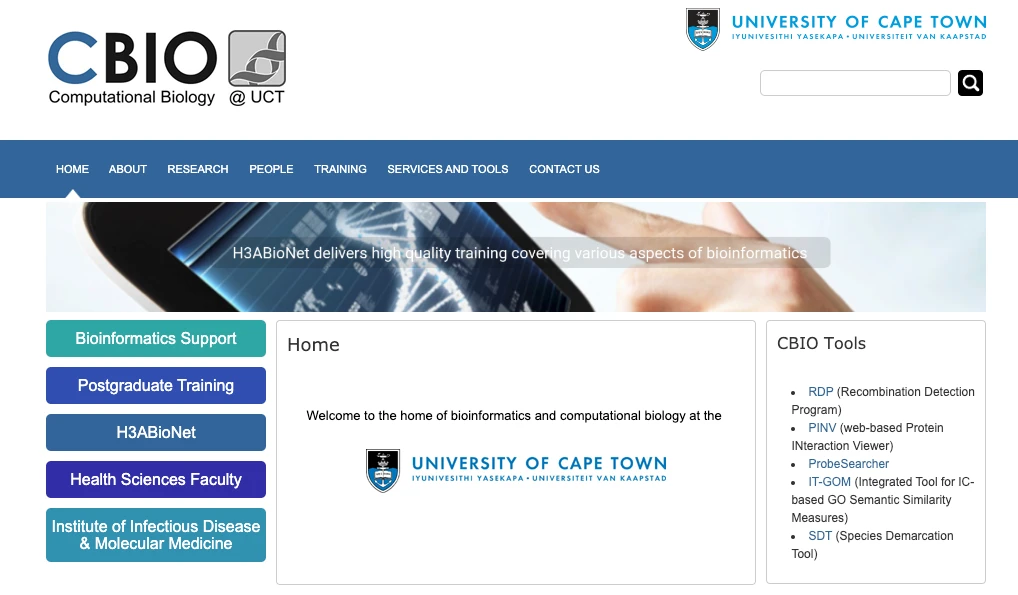
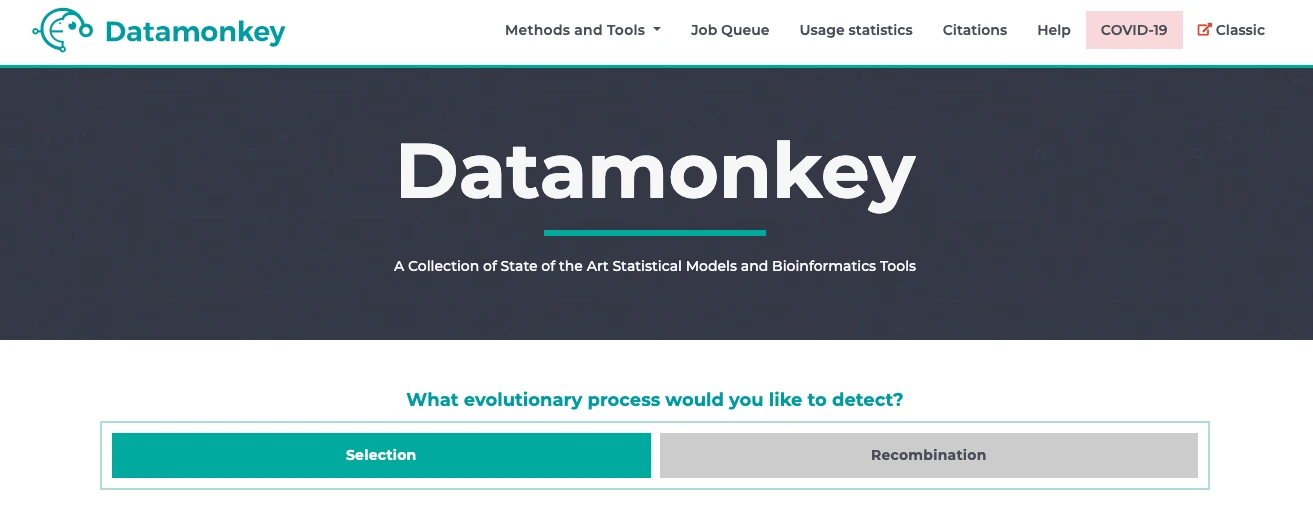
Later, I worked at CBIO, an epidemiology group that styled itself as the ‘home of bioinformatics and computational biology’ at the University of Cape Town. During my time there I worked on a number of projects all of which involved using computers and software to create models to analyse and map out large, hard-to-decipher datasets. It was an exciting time: we worked in a wave of new methods in virology and biology to use web servers, algorithms and machine learning to understand the evolution of viruses. Researchers would come up with new methods and publish research papers but then also build websites, like Data Monkey or HyPhy, where you could run their method on your dataset of genetic information to analyse or model its potential developments.
As I kept working in this field, I eventually got accepted to work with Andrew Rambaut at Edinburgh who is one of the leading figures of this branch. He headed a team who came up with a Java tool called BEAST, which is the method for understanding where any virus comes for or evolves. He is the author of one of the biggest and most important papers on nCOV right now, and his work uses that codebase to understand the origins of many diseases including COVID-19. BEAST is a jaw-dropping tool for understanding ‘evolution’ in all its varied forms: it’s used for all kinds of research, from understanding where a new species of crocodile comes from, or how languages evolve. Not too long ago, it was the main tool used to discover the main hypothesis on the specific origins of HIV.
The internet grew, and HyperionDev moved from labs to websites
The time I spent in computational biology was inspiring, and it stays with me to this day. In fact, when HyperionDev was first launched as an online course, it was specifically tailored to teach Python to people in biology and epidemiology who did not have any coding skills, so that they could build algorithms and models to understand the evolution of viruses.
Of course, programming soon began outgrowing the realm of pure academia: social media exploded onto the scene between 2006 and 2009, opening up a whole world of growth for coding. More people wanted to learn how to create websites, manipulate databases, and create applications — and so while we no longer offer an extremely niche bioinformatics and programming course (as we did until 2014), the last few years have taught us how crucial its core tenets are to understanding – and overcoming – new challenges. After all, the vigorous standards that you’d need to map serious viruses over time are the standards you need to create world-class websites and apps. That’s why our Software Engineering bootcamp still uses all of the core modules and course knowledge from those bioinformatics courses to this day.
Today, HyperionDev offers coding bootcamps in Data Science, Web Development and Software Engineering (all of them now online only for the time being, thanks to COVID-19). I can only hope that somewhere along the way, these bootcamps help someone to see the value and applicability of programming to solving some of the toughest challenges facing us these days. And for those who don’t go the route of bioinformatics, skills in programming are helping people to get jobs that aren’t shut down, even when the nation is.
Riaz Moola is the founder and CEO of HyperionDev.
HyperionDev exists with one goal: to close the global tech skills gap by giving people the skills they need to switch to a fulfilling career in tech. Tech careers remain one of the least-affected jobs a person can have, as the effects of COVID-19 force physical offices to shut down. HyperionDev works to get you a job that can’t be quarantined, through our specialised mentored online coding bootcamps, in Data Science, Software Engineering, and Full Stack Web Development.
You can try out any of these courses and learn the essentials of programming right now, for free, with our free trial. Sign up today.
News & Announcements
October 15, 2019
Find the best developer jobs out there with HyperionDev Careers
When it comes to developer jobs, tech companies look for the best candidates. HyperionDev Careers, our placement and career support service, will ensure you put your best foot forward by offering you a variety of services as you approach your bootcamp graduation.
So your HyperionDev bootcamp is done and dusted. Now what – how are you going to take that all-important next step: landing a job as a developer? With HyperionDev Careers, HyperionDev’s placement and career support service, it’s sorted. This division is dedicated to securing developer jobs for our graduates by connecting students with employers of their choice.
As with any traditional degree or diploma, a bootcamp certificate alone may not be sufficient to get you that developer job. Employers also look for the relevant skills, sound technical knowledge and a strong portfolio to close their tech skills gap and hire for the developer jobs that are needed. HyperionDev Careers’ mission is to ensure that as a developer candidate have the best possible career profile to catch the recruiter’s eye.
So how does ‘Careers’ boost your chances of landing that lucrative developer job? Here are some of the services we offer:
Connections
We’ll link you up with the employers of your choice, including our relevant contacts.
Technical interviews
The technical interview can be a minefield, because your technical knowledge is frequently tested. Don’t worry, we’ll show you how to ace that interview, because we understand the components of the tech interview, which could include quizzes, hypotheticals (‘What would you do if…?’), and likely tech interview questions. We’ll conduct mock technical interviews with you so you are best prepared for this challenging process.
Personality tests
We’ll conduct the relevant personality tests so that you learn to know yourself, particularly your strengths, in more detail. This will help greatly with job interviews.
The technical CV
The technical CV is a little different from a run-of-the-mill CV, because it emphasises your technical skills. We’ll show you how to put one together to optimally highlight specific tech qualifications or skills, and grab the attention of the hiring manager paging through a stack of CVs.
Some estimates claim that up to 85% of jobs are found via networking, states an article on PayScale. LinkedIn is a prime spot for networking, but you need to know how to do it most advantageously. We’ll show you how.
Assistance in building up and refining your GitHub profile
GitHub is a software development platform, where you can host and review code, manage projects, and build software alongside millions of other developers. It’s also one of the first things hiring managers look for when picking the best candidates for the job. We’ll help you build up and refine your GitHub profile, a vital asset in promoting your skills and knowledge.
Support
You’ll receive assistance from a dedicated team who are committed to supporting you from the day of your onboarding right through to your new career in tech.
During level 3 of your bootcamp, you will be invited to join the HyperionDev Careers community. When it comes to finding developer jobs, the stats look very promising for our HyperionDev graduates. According to our 2018 Graduate Outcomes Report, the following positive trends were noted:
- 95% of graduates reached their career outcomes. These outcomes include moving to a tech career, starting a business, upskilling in their current tech role, or using their new skills in a non-tech job.
- 61% of graduates switched to a career in tech.
- 72% switched to a new career within 3 months.
- Average salary increases post-graduation were estimated at R12k per month/ R144k per year.
To sum up, it’s much easier to land a tech job with dedicated professionals who know the industry supporting you. HyperionDev Careers serves precisely this function. If you’re keen to change careers or upskill, consider enrolling on a HyperionDev online bootcamp in Web Development, Data Science or Software Engineering. You can also trial one of these courses for free. If online learning is not for you, enrol in an immersive, face-to-face Web Developer or Software Engineering course in Cape Town or Johannesburg. Courses are offered part-time or full-time.
News & Announcements
September 27, 2019
#ChangeWithCode – Win a R45 000 Coding Scholarship
You can win a R45 000 HyperionDev coding scholarship with our #ChangeWithCode competition. All you need to do to change your life with a coding career is share your big tech idea on social media.
Self-driving cars, the blockchain, 3D printers: all these ideas started with a spark – perhaps an a-ha moment or a big plan scribbled on a small post-it note. Greatness often has humble beginnings. Now it’s your chance to share your revolutionary tech idea and win big in our #ChangeWithCode HyperionDev competition.
What do you need to do to win? It’s simple:
Step One: Post your idea for a game-changing game, website or application on any social media channel of your choice, including Facebook, Instagram, Twitter, and LinkedIn.
Step Two: Explain your idea any way you want. For example, you could draw something, shoot a video or outline your great idea in writing. Just make sure you communicate your idea as clearly as possible.
Step Three: Tag us in your creation with @HyperionDev, and remember to include the hashtag #ChangeWithCode.
And what is the prize? The best ideas stand a chance of winning one of three full HyperionDev Bootcamp Scholarships, valued up to R45 000. Scholarships are available for both online and on-site courses, which take place in Cape Town or Johannesburg.
If you’re keen to upskill or you just want to enter the in-demand field of tech, HyperionDev offers online bootcamps in Full Stack Web Development, Data Science or Software Engineering – no previous experience necessary! You can also trial one of these courses for free. And if online learning is not your thing, you could join a face-to-face Web Developer or Software Engineering course in Cape Town or Johannesburg.
Technology is a space that’s constantly on the move: something that appears impossible today might well be possible just around the corner. Be part of changing your life, career and even the world with our #ChangeWithCode competition. We want to hear from you today.
Terms and conditions:
- This competition is run and sponsored by HyperionDev. No other organisation or entity is involved in its running or sponsorship.
- Be sure to follow all entrance instructions, including use of our hashtag #ChangeWithCode and our and social media handle @HyperionDev.
- Competition is only open to single entrants.
- Prizes are non-transferrable and cannot be exchanged for their monetary value.
- Entrants must be 16 or older.
- Nominees and winners will be contacted via social media.
- Judges’ decision will be final and no correspondence will be entered into.
- No entries will be considered via email.
- Entries close 31 October.
- Nominees will be announced 8 November.
- Winners will be announced 15 November.
- HyperionDev reserve the right to adjust or end the competition at any time.
- By entering this competition you agree to abide by the terms and conditions set out by HyperionDev for this competition.
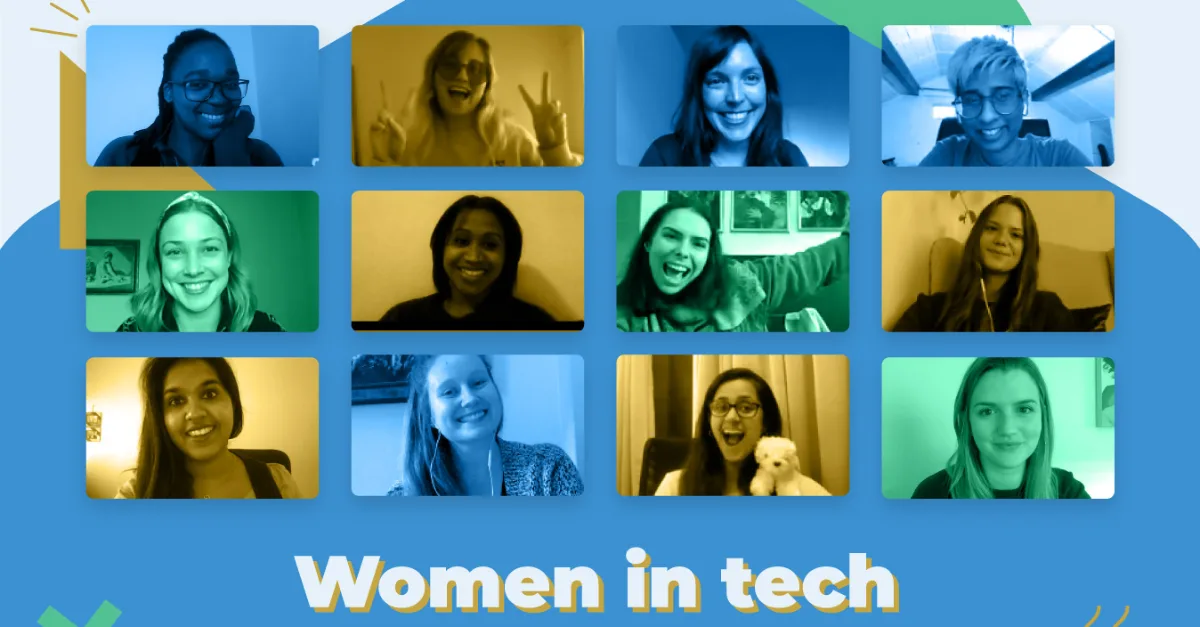
News & Announcements
September 12, 2019
Women in tech: what is it like?
Women in tech is an issue that requires a lot more work and visibility to make up for the clear disparities in the STEM fields.
Onalerona, one of our HyperionDev Software Engineers, was 14 years old when she knew she wanted to be a programmer. “My high school did a ‘test’ IT class”, she shares. “During that class, we had to code in Pascal and Delphi to create a program that had a button, and the button would turn the screen green when clicked. The program, in its entirety, was probably 6 lines of code. But the feeling I got when that screen changed colour – I’ve been hooked on the idea of being a programmer ever since.”
But why are there so few stories like Onalerona’s? We spoke to Onalerona as well as HyperionDev’s UX/UI designer, Marianne, about their experiences of being women in a tech field, as well as what they hope to see in the future, to get a better understanding of the issues that women in tech face.
Women in Tech: the stats
Despite the years of progress made towards gender parity, especially in the workplace, women still remain critically underrepresented in most STEM fields – across tertiary education institutions and the workforce.
A recent PwC #WomeninTech report found that at the top 10 global tech companies, only 19% of tech-related roles were held by women. What’s more, women made up a mere 28% of their senior leadership, relative to the 72% male leadership.
In South Africa specifically, the number of males graduating with STEM-related degrees far outweighs the number of women graduating with these degrees, especially when it comes to ICT and tech.
- Men outnumber women in maths and statistics degrees 4:5.
- Men outnumber women in ICT and technology degrees 2:5.
- Men outnumber women in engineering, manufacturing and construction degrees 3:10.
It’s clear that drastic change is needed on multiple levels. The PwC #WomeninTech report asserts that in order to alter the way in which we develop and deploy female tech talent, we need an ‘undoing and relearning of age-old thought processes and the formation of new norms and values – especially in the education system and labour market. Biases are ingrained in our cognitive processes and undoing them is difficult’.
The report outlines a number of the barriers that contribute to this issue:
- A lack of female representation in the workplace.
- A lack of representation in senior leadership roles.
- Gender-biased classrooms and educational settings.
- Gender-biased behavioural design from an early age.
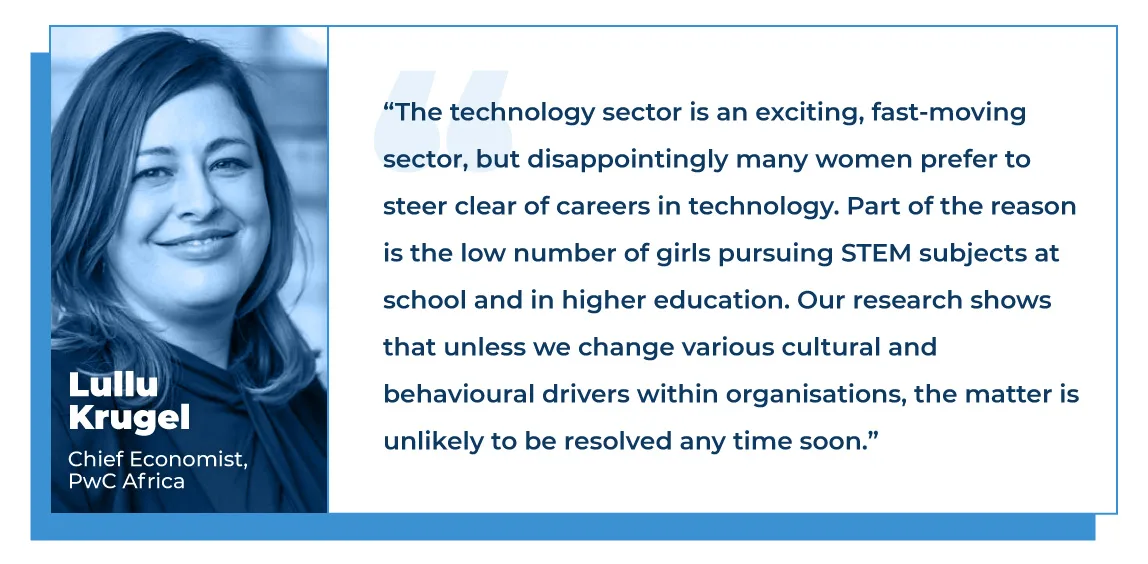
What it’s like for women in tech
Onalerona had always wanted to get into programming as a career. “Initially, it was the love for programming, but it has since evolved,” she told us. “While I was studying at the University of Cape Town, I started doing a lot of tech-related community work. I volunteered for Code4CT, which was a non profit organisation that taught high school girls how to code. I was also Chair for Women in Computer Science UCT.”
“I grew a passion for advocating for women in tech, and I feel my purpose to still be here is to expose as many tech opportunities to women, retention of women in tech, and aid where I can to make their tech journey a little bit better.”
Marianne, on the other hand, had spent years as a multidisciplinary designer, but had always felt drawn to the tech industry.
“Ironically I probably related more to the tech industry than the creative industry. I didn’t identify with the stereotype of an eccentric ‘creative’,” she shares.
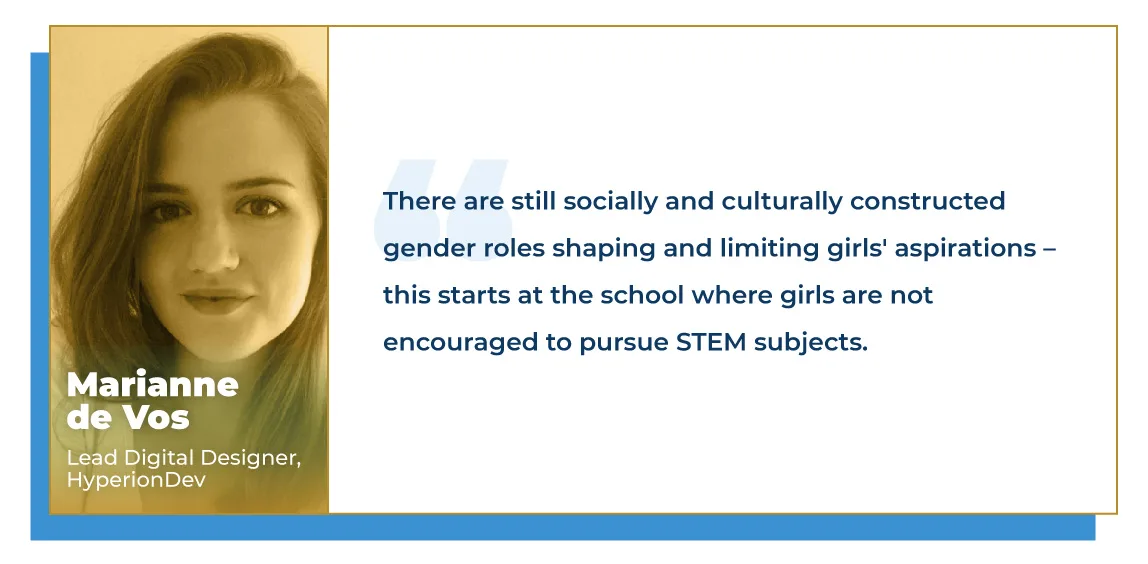
“Having worked in multiple design disciplines, I can see in retrospect that as soon as I designed my first unique web interface, it was all I wanted to do. I loved exploring the functionality needed and where the user interactions would work logically and creatively,” Marianne shares. “I grew more and more interested in satisfying user needs: creating functional products to be used daily, impacting user’s lives. That desire drove my career path to the tech industry pretty naturally.”
Many barriers still stand for women in tech
However, from both Onalerona’s and Marianne’s experiences it’s clear that there are many obstacles to surmount.
Marianne shares that, “It becomes apparent in more informal social settings that there are still fundamentally prejudiced nuances embedded in conversations around women in tech. The underrepresentation of women in tech then equates to a lack of female role models to inspire girls at an age where parental control, peer pressure and self-esteem can heavily influence their career decisions.”
For Onalerona, overcoming these hurdles was a matter of her passion for the industry and the work she does – although putting on a brave face and keeping at it isn’t always so easy.
“Representation matters a lot and makes a big difference. In my first year of studying, we had a huge and quite diverse computer science class. By my last exam in my third year, there were only 4 girls in the examination room. A lot of my female friends left computer science mostly because they felt as if they were struggling alone.”
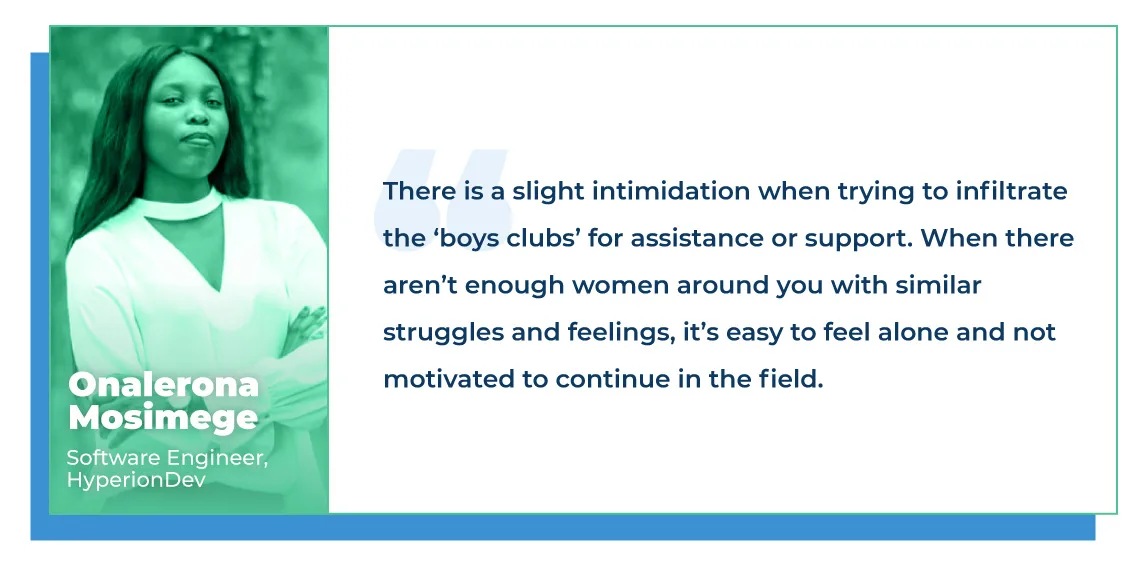
Fast forward to working in the industry, Onalerona is now committed to championing diversity and inclusion in the tech space in order to ensure that these issues are curbed and more women can be retained in the industry.
What can be done to improve the situation
While the issues women face in joining the tech industry might be numerous and powerful, they’re not impossible to overcome. There are a number of strategies that schools, businesses, and parents can take to support girls and women as they pursue their passion and interest in technology.
- Improve female representation in companies.
- Implement double-blind strategies to combat biases in hiring
- Create and support education initiatives, like scholarships, that support young women in tech
- Create an industry that listens to and addresses the problems women have in the tech sector
Our coding bootcamps and hiring strategies are designed to build people up into experienced and high-achieving tech professionals, no matter their background. Our online and on-site coding bootcamps teach job-ready tech skills to the people who need them, with no requirement for a high school diploma or any coding experience; and our team of expert A-players is always looking for passionate, dedicated, and hard-working women (and men!) to scale our bootcamps to be the best in the world.
Find your start into a rewarding and fulfilling tech career by clicking here, or find out how you can join our diverse, international team by clicking here.
News & Announcements
May 28, 2019
Meet the team: Thabang Bhili
Meet the team and find out about code reviewing and mentoring from HyperionDev’s team member Thabang Bhili, who is an on-site mentor for the Cape Town campus.
If you enrol on a HyperionDev Web Development or Software Engineering bootcamp at one of their on-site campuses, either in Cape Town or Johannesburg, you’ll have access to your own code reviewer and personalised 1-1 mentor. Let’s meet the team. Thabang Bhili does code reviewing and mentoring for HyperionDev’s on-site bootcamp in Cape Town; let’s find out what he does day-to-day.
Before becoming an on-site mentor and code reviewer for HyperionDev, Thabang graduated from the University of Cape Town with a double major in Computer Science and Business Computing. He then went on to do data analysis for research institutes, software engineering for two non-governmental organisations, as well as mentoring at the Community Development Forum. It was only after these job experiences that he became involved in code reviewing for the HyperionDev online bootcamps in Mobile Development and Software Engineering. What does code reviewing entail? A code reviewer needs to consider the following – code quality, code defects or errors and if there are new or better solutions to the problems at hand.
Professional code review and feedback is certainly part of Thabang’s day-to-day tasks, but it’s not all that he does. He says:
When it comes to mentoring, it’s very important to me that I understand a student’s goals and what he or she wants to achieve from the bootcamps. I find it very fulfilling to work collectively towards achieving those goals. Sharing knowledge and exchanging ideas is productive and mind broadening for both the mentor and the student.
So what kinds of students make good coders? According to Thabang, two things are particularly important.
Firstly, when it comes to learning, it’s integral to love what you do or at least to learn to love it. Secondly, temperament is integral: you need patience and the correct temperament to make the most of the less stimulating foundational work. Once that’s been mastered, you’ll have the ability and skill to think like a coder and, ultimately, to become a good coder. Learning the fundamentals is a key building block to more advanced concepts.
Thabang also points out that the students’ motivation levels tend to be very high on the HyperionDev on-site programs. This makes for an excellent class dynamic. But perhaps this has more to do with Thabang’s skills as a mentor. He says:
Of course ability is important, but to be a good coding mentor it’s necessary to understand people. Working with people comes naturally to me – perhaps because I have a history of working and leading in mass organisations. Some of my students even refer to me as their “friend”.That’s a consequence of the genuine connections we have created.
In his spare time, Thabang enjoys the good things in life like a good beer with friends over jazz or deep house. He enjoys playing chess, talking about ideas and participating in activist spaces.
HyperionDev offers both full-time and part-time on-site bootcamps. These programs merge a world-class mentor-led online learning environment with face-to-face classes. It’s the best of both worlds. You have access to the physical campus to attend group lectures, meet your programming colleagues and have in-person guidance and support; simultaneously, you have the opportunity to submit work through the online platform that will be graded by a professional code reviewer. And while you’re not on campus, you can enjoy the support of live chat, email, phone and video call. You’ll also receive post-bootcamp career support in the form of career coaching, intensive interview preparation and access to lucrative hiring networks. Says Thabang about the on-site experience.
Students have access to a mentor who exposes them to different programming paradigms and approaches. The goal is to get the mindset right, including thinking like a programmer in order to ultimately become one.
To find out more about HyperionDev’s on-site bootcamps in Software Engineering or Full Stack Web Development, schedule a call with a HyperionDev career consultant today.
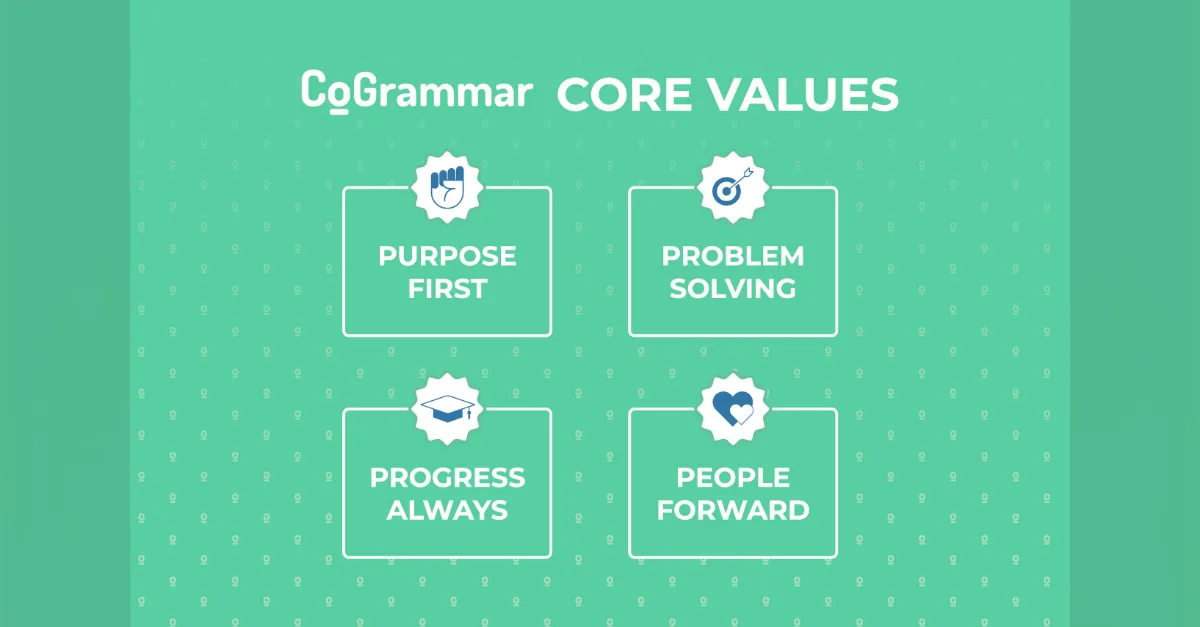
News & Announcements
April 5, 2019
4 Company Values of CoGrammar
Company values are integral in defining the heart of your organisation’s culture. What start-up company values does CoGrammar support? Here we list the 4 P’s, the defining company values of CoGrammar.
Company values are vital. A recent study found that over 50% of executives feel that corporate culture has a wide impact on an organisation, including productivity, creativity, profitability, firm value and growth. According to Forbes, company values fulfil the following functions:
- Determine how you hire: hiring the person who will best fit into your team is probably more important than technical expertise. Your company values help determine best fit – if ‘passion’ is a company value, for example, you can assess whether a new potential recruit possesses this quality before making any offers.
- Change behaviour: any corrective feedback given to employees is more effective if connected to how their behaviour is not reflecting company values.
- Set the heart of your culture: values are the fabric of the company’s culture, regardless of who currently runs the organisation. Like-minded people who share the same values are the best path to company success.
CoGrammar, integrates scaled and affordable human review of code into businesses around the world, and prides itself on embodying a unique company culture to close the global tech skills gap. The company currently helps some of the world’s most selective and rigorous coding education providers lower the cost of technical grading and mentorship in their tech courses. CoGrammar has powered coding education for over 2000 students to date to lower the cost of effective software development education that gets aspiring developers into fulfilling tech careers. What are the start-up company values of CoGrammar? Here are the four P’s, which have propelled the company into becoming one of the top EdTech startups in Europe, the Middle East and Africa.
Purpose First
This is at the heart of CoGrammar. Because our goal is to change lives, we put purpose first and build our integrity on that. What we do at CoGrammar is greater than each individual. In essence, we are building new roads to bring technology skills into the world.
Progress Always
We always progress towards mastery. The company is built around knowledge sharing with each other and our mentors. The company culture is one of learning, collaborating, improving and setting new standards. At CoGrammar, we write code right.
People Forward
We respect people and their potential. By people, we include our teams, our clients and our educators. When it comes to education, people are at the heart of what we do. We remain sensitive to their needs, hopes and desires. We prioritise the value in every person above technology, and we talk as much as we listen.
Problem-Solving
This value is about finding a way to do things, and not about “how it can’t be done”. It’s about not giving in or giving up, but about being entrepreneurial and innovative under pressure. We work towards solutions while maximising resources.
In conclusion, the start-up company values, or 4 Ps, help CoGrammar reach its objectives of supporting students from over 40 countries to reach their goals of acquiring fulfilling tech careers. States CoGrammar CEO Riaz Moola: “Bearing in mind that tech disproportionately contributes to a country’s economy, we have to look at ways of reducing barriers to entry. One way to do this is to embrace non-traditional education paths.” The company values of CoGrammar make massive strides in achieving just that.

News & Announcements
March 11, 2019
Meet the team: Lelethu Mkefa
Meet the team and find out about career consulting from HyperionDev’s team member Lelethu Mkefa, who speaks to us about his favorite and least favorite things about his job.
One of the goals at HyperionDev is to ensure you undergo career consulting before enrolling on a Software Engineering, Fullstack Web Developer or Data Science bootcamp. Remember, an online bootcamp entails a commitment of 10 hours per week over six months in order to change careers by the end of it so it needs to be the right decision. Let’s meet team member Lelethu Mkefa to find out what he does on a day-to-day basis as a career and course advisor.
You work as a career and course advisor currently. How do you assist students in making the correct decisions about their careers – what factors do you consider?
Career counselling is not an exact science, although it is a big responsibility. You’re advising someone to take a certain path which will define the next few years of that individual’s life. It’s not something to be taken lightly.
To start with, I rely on the student being as open as possible in telling me his or her story. I’m listening very carefully to what the student is saying. I’m looking for clues about what excites that person, their natural inclinations or abilities, as well as the type of work environment the individual prefers. For example, does this person enjoy interacting with people or is he or she more of an introvert?
Besides their abilities, there’s another vital side to the equation. Not only must I check the person’s expectations and understanding of his or her desired coding career, but also any previous knowledge and background. For example, a complete beginner will need a softer introduction to coding. In that case, I would advise web development, because it’s easier to pick up the basics, which sets the foundation for building more complex applications that require greater experience at a later stage. However, if the person is a novice but has a good technical or mathematical aptitude – for example, she wants to understand why a computer program works or to build new tools rather than just using existing tools – I would recommend software engineering or data science.
Lastly, how does the person want to spend his or her day? What kind of problems interest them? Someone who is interested in making sense of data is different from an individual who wants to build applications to help a business or user achieve goals. When it comes to career counselling, it’s very important to know the kinds of problems someone wants to spend his or her day solving.
At the simplest level, I help match people’s interests and inclinations with a coding course that can best achieve their goals.
According to your experience, what kind of people are best suited to make the switch to coding?
The profile of “the programmer” or “the developer” has changed since the “age of the geek”. To some extent, the software space still attracts the typical introvert, but companies need software professionals who can interact and engage with users and business stakeholders to deliver a product. A coding professional can come from a multitude of backgrounds while still contributing usefully to product development. Remember, many interrelated roles, from programmer to product manager to business analyst, require problem-solving skills for technology environments.
Our students come from all walks of life. Some are changing career paths, whereas others are looking to learn a new skill to advance their current career, while some are just starting out as high school graduates. There’s a place for all of them.
Can any person change career to tech?
Actually, I don’t think that’s the right question. The correct question is rather, “should everyone receive a coding education?” I’d have to say “absolutely”, because every job is affected by technology. Understanding fundamental computational problem-solving gained from computer science topics is an essential skill to ensure you remain relevant. Remember, automation is replacing jobs at a rapid rate. Have a look at www.willrobotstakemyjob.com to find out if you should be seriously considering updating your skills.
What are the best and worst parts of your job?
I love it when students genuinely feel supported and when they better understand something about themselves, and the career they’re researching. I suppose the worst part is when potential students aren’t able to break through their fear of making the change they know they need.
What do you like to do in your spare time?
I’m passionate about learning new skills, from design to coding. I’m a fan of doing DIY projects at home. I love watching Marvel cinematic movies and spending time with my family and friends.
How do you start your day at HyperionDev?
I’m first in office at 7am. I start with a strong cup of java, a cheese croissant and practice coding.
In conclusion, career consulting is taken seriously at HyperionDev. Potential students require professional assistance to ensure they make the best possible decisions about their future careers in tech, which is a vast and growing sector. To make the most of this service book a 1-on-1 call with a career consultant today.
News & Announcements
February 18, 2019
Meet the team: Melanie Willett
Meet the team. Our code reviewers and mentors are integral parts of the HyperionDev team. Find out about code review and mentorship from HyperionDev’s team member Melanie Willett.
Welcome to our ‘Meet the team’ series! When you enrol on a HyperionDev Software Engineering, Full stack Web Developer or Data Science bootcamp, an important part of the learning experience involves your relationship with your mentor, an integral team member of HyperionDev, from whom you receive regular code reviews. Here’s why learning through code review is smarter than other methods of learning programming:
- It’s true you can automate your code checking, but that’s a bit like conducting a spell check. You won’t write something world-class this way. Only through the human review of code will you become truly fluent as a developer.
- Many online programming courses have very high dropout rates, as students become frustrated with generic error messages. Daily and rapid code review via a person helps you overcome any stuckness by debugging your programs.
- Code review is a standard part of a developer’s day in the workplace. Be exposed to this kind of assessment from your first day of training.
Melanie Willett is an integral team member of HyperionDev. She works as a mentor and code developer. Prior to that, Melanie lectured in IT at the CTI Education Group, Nelson Mandela University and Northampton College. In this “meet the team” interview, she gives the inside scoop on the code review process and how mentoring works for her. So let’s see what she has to say.
Q: Melanie, how do you mentor students?
A: The mentorship role involves a lot of interaction with students. You need to be available to help students understand various coding concepts as well as be there to answer specific questions. I often have 1:1 syncs with students who then share their screen so we can look at specific examples of troublesome code. Sometimes I share my screen to show students relevant examples that could help them know how to modify their code.
Q: What do you want to know about students as their mentor?
A: During our initial 1:1 sync, I find out whether a student wants to become a full-time developer or is more interested in learning specific skills for a particular function – e.g. starting a new business. It’s important to understand each student’s current exposure and experience with coding and / or a specific development environment or language. It’s also an opportunity to respond to any concerns or questions the student might have.
Q: What happens during a code review?
A: Firstly, I check the code is correct, both the syntax and the logic. Remember, beginner coders often struggle to find and fix errors. Often helping them see how to use tools and logic to identify bugs and errors in the first few tasks makes the student confident to do this by him or herself efficiently later. Once the code is running correctly, I offer suggestions on how to make the code more efficient, easier to read and maintain, and more compatible with industry norms and standards.
A good code review has two main outcomes: (1) provides the opportunity to learn something (2) imparts confidence that the code is correct, efficient and adheres to industry standards.
Q: What are the difficulties of conducting a code review?
A: Even if you are an experienced developer, finding errors in code can be complicated. It takes time. Also, the world of programming changes quickly – for example, JavaScript gets updated fairly regularly. This means that sometimes there are a few different ways of writing code that does exactly the same thing. Knowing what is the most efficient and relevant (in terms of the industry standard) way of doing something is not always easy.
Q: What do you love about your job?
A: The best part of my job involves seeing someone achieve his or her goals. Hearing that a student did well in a job interview or that they have been able to create a website for their business is always wonderful! It is also always great to see students realise the potential of what they can do with their new skills and get excited by it. Students often tell me about something they’ve read or researched for themselves that excites them – this enthusiasm is contagious and very satisfying.
Q: What advice do you have for prospective coders?
A: Start making continuous learning a habit early on. Subscribe to YouTube channels, blogs etc that will help you know what is happening in your field. Set aside time in your schedule to read, discuss or learn a little every day. Technology changes quickly. If you develop the habit of setting aside some time to learn something every day (and learn to enjoy that time), it will make your life as a developer MUCH easier in the long run.
In conclusion, code reviewing at HyperionDev is an exciting career for those who enjoy mentoring and helping people become better programmers. In this ‘meet the team’ interview, Melanie proves this in her important responsibilities as a HyperionDev team member and mentor. If you’re keen to learn programming via this process, consider these bootcamps offered by HyperionDev: Full Stack Web Development, Data Science or Software Engineering.

News & Announcements
February 15, 2019
SONA reSONAting with HyperionDev
Ramaphosa’s 2019 SONA emphasised a number of tech goals for South Africa. HyperionDev, Africa’s leading provider in the EdTech space, outlines various lessons learnt in tech education.
Ramaphosa’s SONA was, according to TechCentral, “the most technology-focused speech ever delivered by a South African head of state”. The state-of-the-nation address proposed various interventions to develop the skills needed for the “fourth Industrial Revolution”. Among others, Ramaphosa wants to see:
- The creation of new jobs to absorb youth in productive economic activity, particularly in tech-related fields – e.g. coding and data analytics.
- The training of both educators and learners who are equipped to deal with emerging technologies, such as the Internet of Things, robotics, artificial intelligence, etc.
- The introduction of new technology subjects, including technical mathematics and technical sciences.
It’s no surprise Ramaphosa wants to focus on developing tech skills. There is high global demand for such skills and South Africa suffers from an alarming 2018 unemployment rate of 27,5%. With over 200 000 students reached, HyperionDev has dramatically shaped tech education in South Africa. Riaz Moola who started HyperionDev, a South African-based start-up offering Web Development, Software Engineering and Data Science bootcamps to both South Africans and the world, shares his lessons learnt as the largest provider of tech education in the country.
Tech disproportionately contributes to a country’s economy
“Bearing in mind that tech disproportionately contributes to a country’s economy,” says Moola, “we have to look at ways of reducing barriers to entry. One way to do this is to embrace non-traditional education paths.”
He explains that it’s no good just relying on traditional routes like universities or technikons to teach young South Africans in-demand tech skills. “My motivations for setting up HyperionDev stemmed directly from witnessing the depressing drop-out rates in South African universities in computer science degrees. With an average failure rate of 88%, I couldn’t see South Africa meeting its tech demands and I wanted to change that. My initial idea was a simple one: an online course where people with limited internet access, a reality in South Africa, could still become programmers.”
“To deal with uniquely African conditions, including low bandwidth, l developed a simple online course in Python to teach students the basics of artificial intelligence utilising small files – rather than the large videos offered by many massive open online courses (MOOCs).” And from there, HyperionDev grew to cover other educational streams such as Data Science, Web Development and Software Engineering. It’s currently the largest online coding bootcamp in Africa and has been scaled to over 40 countries internationally.
Direct link with employment
Any educational offering needs to link directly with an employer’s requirements. “We should align education with employment opportunities,” states Moola, “rather than focussing on specific skills or programming languages. Remember, the field of ‘coding’ is vast, so we need to see where the gaps exist. Our research – we’re always speaking to potential employers – shows the biggest gaps exist for Full Stack Web Developers, Backend Developers, Software Engineers and Devops Engineers. We then train accordingly.”
It seems to be working, because there’s a direct link between HyperionDev’s courses and student employment rates. “Our Graduate Outcomes Report shows that over 95% of our graduates reach their career outcomes and 72% switch into new tech jobs within 3 months of graduating.”
Prioritising accredited courses
Interestingly, one of Moola’s biggest challenges involves accreditation. Consumers and funders still prioritise accreditation, he explains. However “the South African National Qualifications Framework does not have unit standards for the majority of tech skills required by employers, partly because of how rapidly technology changes.”
Python, a very versatile programming language, illustrates this point. “When we first started HyperionDev, Python was not popular in South Africa. Now the demand from students and employers alike is massive. Python is used widely in Web Development and Software Engineering. We were able to meet that demand.” EdTech providers need to move quickly to mirror market requirements; lengthy and outdated accreditation procedures don’t always allow this to happen.
In closing, Moola is excited to be involved in his field. “EdTech goes hand in hand with non-traditional education models. Coding bootcamps are a powerful alternative, or sometimes even an addition, to universities.” Ramaphosa has hit the nail on the head with this year’s SONA speech: it’s the right time for South Africa to start skilling up in tech fields.
News & Announcements
January 11, 2019
Announcing the new Data Science Bootcamp from HyperionDev
The comprehensive, accredited Data Science Bootcamp from HyperionDev is a brand new addition to the choice of mentor-led online coding courses on offer.
The coding education specialists at HyperionDev are pleased to announce the launch of the Data Science Bootcamp, a brand new addition to the choice of mentor-led online coding courses on offer.
What is data science?
Data science, also called data-driven science, is a field that uses statistics and scientific systems to extract meaningful information from large amounts of complex data. By analysing this raw information, data scientists can provide businesses in many industries with valuable insights which will affect their future decision-making.
Demand for data scientists
As many businesses are becoming more data-driven, there is a high demand for qualified data scientists. There is also a skills gap in the market, which means there are many opportunities for newly qualified data scientists to fill the available roles.
The online 6-month bootcamp is designed to help you to fasttrack your way into a sought-after position as a data scientist.
The Data Science Bootcamp curriculum
HyperionDev has created a comprehensive course that will introduce learners to all the fundamentals of data science. The curriculum covers the following topics:
- Introduction to programming with Python
- Object oriented programming and functions
- Natural Language Processing
- Storing and querying relational data
- Data exploration, analytics and visualisation
- The fundamentals of machine learning and AI
- Post-bootcamp support including CV assistance and interview preparation
Why choose an online bootcamp?
Online bootcamps allow you a degree of flexibility that on-campus courses don’t. With HyperionDev, you can learn on the go, and complete the learning at your own pace.
The content covered in the bootcamp is up-to-date, relevant and industry-aligned, allowing you to step into the industry with confidence. With next-day code reviews and on-demand feedback, you’ll be able to learn and grow quickly, practising real-world data science as you go.
You’ll also benefit from personalised mentorship and career coaching as you work your way through the course. You’ll have one-on-one support and feedback from a full-time qualified coding mentor, an expert educator who will help to enrich your data science knowledge.
Your bootcamp experience doesn’t end with graduation. After completing the course, learners also get guidance on putting together CVs and preparing for job interviews in the tech industry. We also provide direct referrals to our hiring partners. With this added support, most graduates are able to start their new careers within 6 months of graduating.
Try a no-cost bootcamp trial
Before you commit to purchasing a course, you can complete the free bootcamp trial course at no cost. This will give you a feel for the bootcamp structure, before signing up for the full certified Data Science Bootcamp.
Next bootcamp begins 5 February
The next Data Science Bootcamp is scheduled to start on 5 February 2019, with a duration of 3 – 6 months depending on your learning preference. Sign up and make this the year you launch an exciting new career in the world of data.

Software Engineering
December 19, 2018
How tech is improving public transport
To beat worsening congestion, commuters have to increasingly rely on public transport. Luckily, tech is improving public transport via a variety of interventions and strategies - most of which rely upon the analysis of large amounts of data.
Guess the most congested city in the world? Mexico City. It has a congestion index of 66%, states the TomTom Index, which measures traffic congestion worldwide. Below is a table of the five most congested cities worldwide. Luckily, there are alternatives to get around the frustration of congestion starting with using public transport. In this piece we’ll look at ways in which tech is improving public transport.
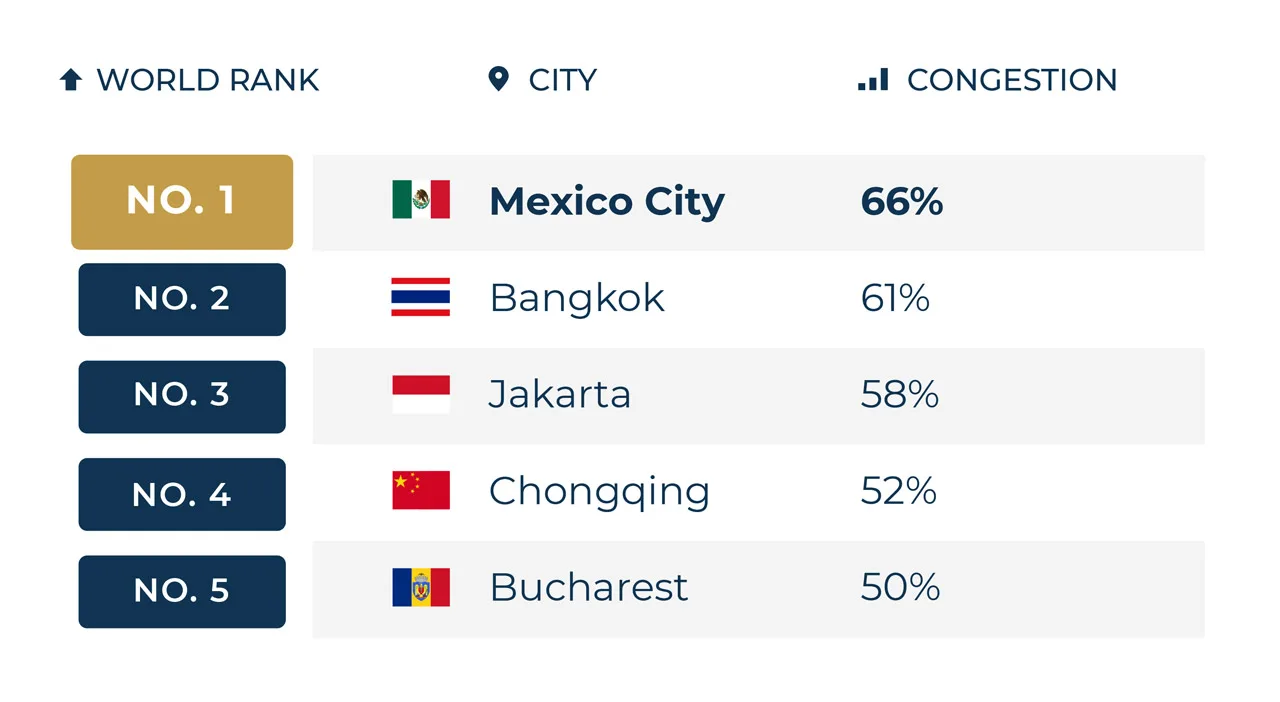
Image Source: https://www.tomtom.com/en_gb/trafficindex/
As urbanisation increases (the United Nations suggests that will increase to 70% within four decades), densely populated areas will face transportation issues, states Engineering.com. By 2035, the number of vehicles on the road worldwide is expected to triple. However, public transport, including walking and bicycling, can improve air quality and reduce CO2 emissions as well as save households an average of $6,251 per annum.
Driven by various technologies, the public transport system is on the brink of a technological revolution. These technologies include real-time information flow between commuters and transport providers, Artificial Intelligence (AI) and smart algorithms, which allow for the rapid processing of this information. Here are some specific ways tech is improving public transportation.
- Real Time Vehicle Tracking
Many people become frustrated because they don’t know when their public transport vehicle will arrive at their stop. Internet of Things (IoT) technology will allow providers to easily track the location of their vehicles by installing GPS systems on vehicles that are connected to the Internet. This internet data can be easily communicated to passengers’ devices.
- E-Tickets
The paper ticket has effectively disappeared in many countries. Apps that incorporate e-tickets can be very flexible, even allowing one person to send an unused travel ticket to a friend.
- Intelligent Transport Systems (ITS)
Real-time traffic and passenger information can be fed through intelligent transport systems which then automatically adjust traffic signal timings. This can greatly improve the capacity and speed of transport systems.
- On-demand public transportation systems
Imagine if you didn’t have to plan your journey around bus or train routes; instead, you could summon the bus to pick you up. This isn’t just a pipe dream; in fact, Singapore is introducing an on-demand bus service this year. Using a smartphone, a commuter will indicate where he wants to be picked up and dropped off within designated areas. The bus operators will aggregate these demands via algorithms to work out the number of buses to deploy and which routes to take. Empty routes will be avoided and commuters can expect much shorter waiting times.
- Open source transport apps
Open source transport apps provide visual displays that link together various types of transport – e.g. bike share systems or trams. An example of such an app is Transportr, which makes it easier for people round the globe to use public transport.
Many of the ways mentioned above rely on the processing of large amounts of data to develop relevant algorithms. This is really the work of Data Scientists. Basically, a Data Scientist analyses data for actionable insights on anything from product development to customer retention to new business opportunities. In 2018, the demand for Data Science talent in the US is projected to be 50-60% greater than the supply. This translates into a shortage of 140 000 to 190 000 people, as well as 1.5 million manager and analysts, states Medium.
In conclusion, there are many ways tech is improving public transport. If you’re interested in becoming a Data Scientist, you’ll want to start learning Python, R and SQL, analytical languages for Data Science. You could also consider enrolling on HyperionDev’s Data Science online bootcamp.

Software Engineering
October 25, 2018
A beginner’s guide to blockchain
Have you ever wondered what blockchain is and how it’s going to change the world? Find a quick and simple explanation of blockchain and some likely uses for this technology.
Everyone has heard of bitcoin, especially since its meteoric rise at the end of 2017, but possibly the most interesting thing about cryptocurrencies is the underlying technology, or blockchain, that makes bitcoin work. The central question is the following: is blockchain going to transform the world as we know it, or is it just a thrilling fad? Read this simple beginner’s guide to blockchain before deciding for yourself if a new order is about to be born.
What is the blockchain?
Basically, blockchain is a public ledger or record of transactions, financial or otherwise, developed by Satoshi Nakamoto in 2008. Adding to the mystery, nobody knows the identity of Satoshi Nakomoti – in fact, it’s quite possible that the pseudonym refers to a group of people and not a single person.
The blockchain is essentially “an incorruptible digital ledger of economic transactions that can be programmed to record not just financial transactions but virtually everything of value,” states the authors of the book Blockchain Revolution.
Here are some basic concepts for the beginner’s guide to the blockchain:
- The blockchain, at its simplest, is a spreadsheet that has been duplicated many, many times over a network of computers or nodes. This network is regularly updated when a transaction occurs; for this to happen, all the nodes have to check the validity of a transaction (this is done by something known as a ‘hash’, which is a string of numbers and letters). If a majority of nodes – remember, the nodes are computers keeping a copy of the digital ledger or blockchain – say the transaction is valid, then it is written into a block.
- The blocks are a growing list of ordered records. Each block has a timestamp as well as a link to a previous block. Users can only edit, via cryptography, the parts of the blockchain owned by them by having private keys that are used to write the file.
- The information held by the blockchain isn’t stored in one spot (i.e. it is hosted by millions of computers and is decentralised) – this makes it public and easily verifiable. Decentrailsation also means it operates on a user-to-user (or peer-to-peer) basis.
- If you want an analogy, states blockchain specialist William Mougayar, compare a Word document with a Google document. If you want to edit a communal Word document, you make your revisions before sending them on to the next person. Two people can’t collaborate on the same document simultaneously. Currently, this is how banks work: when a money transfer happens, the bank briefly locks access to make the changes to the database and then the reverse happens to update the other side. With Google docs (in this case, blockchain), both parties have access to the same document at the same time and the single version of the document is visible to both of them – it is a shared ledger. The document is, like the blockchain, also distributed – that means that sharing involves a number of people.
Who will use the blockchain?
In essence, a blockchain lets anyone send value anywhere in the world as long as the blockchain can be accessed, states Forbes. The private, cryptographically created key lets you access the parts of the blocks that belong to you.
Here are some uses:
- Medical records – Each entry, or block, which could include diagnoses or treatments, has a timestamp, date and time when the record was created. The doctor and the patient would each have their own private key to access the information; however, information could be shared with a third party – for example a hospital or a specialist – by sharing the private key.
- Financial transactions – With blockchain technology, payment, validation and settlement could take place in real time, even across borders, with substantially reduced transaction fees. Money transactions could also occur 24/7.
- Supply chain monitoring – Using the blockchain should help to spot inefficiencies in supply chains. In addition, businesses and even consumers could view their products from a quality-control perspective as they travelled from their point of origin to the retailer.
- Social networking – Currently, social networking sites are centralised and can be censored by this authority. Decentralised social media platforms – for example, Steemit – use blockchain technology to prevent this. They also offer financial rewards to their content creators.
These are just some of the uses for blockchain technology. There are many others including property and stock exchange transactions, authenticated voting, distributed cloud storage, etc.
We hope you found this beginner’s guide to blockchain useful and you now feel more confident about the role blockchain might play in the future. To become a blockchain developer, you’ll need to have an understanding of the fundamentals of programming as well as knowing a relevant computer language, such as JavaScript or C++. A good place to start is the HyperionDev Software Engineering Bootcamp, which is a six-month, online course.
Still have questions?
Contact our Admissions Team, and a real person will get back to you.