
Career Advice


Career Advice
Best Way to Study Online with Stellenbosch University: A Guide to University-Backed Online Learning
Looking to study online with Stellenbosch University? Explore HyperionDev’s university-backed online programmes, flexible study options, mentorship and career support. So, what is the best way to study online with Stellenbosch University?
If you want to study online with Stellenbosch University, you have more options than simply choosing a course and working through online lessons alone.
Through its partnership with HyperionDev, Stellenbosch University offers access to a range of online, career-focused programmes designed to help learners develop practical skills for today’s digital economy.
The programmes combine structured learning, hands-on projects, expert mentorship and career support, giving learners a more supported way to build skills while fitting their studies around work and other commitments.
So, what is the best way to study online with Stellenbosch University?
It starts with choosing a programme that matches your career goals, understanding how you learn best, and making use of the support available throughout the experience.
What can you study online with Stellenbosch University?
Stellenbosch University and HyperionDev offer a growing portfolio of online programmes covering areas such as software engineering, data science, artificial intelligence, cyber security, web development, digital marketing and other emerging and career-critical skills.
Online learning isn’t just for people who already know how to code.
You can choose a programme based on where you want your career to go, whether that means entering technology for the first time, developing an existing skill set or preparing for a new opportunity.
For example, the Software Engineering Bootcamp focuses on application development, object-oriented programming, Agile methods and computer science algorithms.
The Data Science pathway can help learners develop skills in areas such as Python, data analysis and machine learning.
For learners looking to explore newer areas of technology, programmes in artificial intelligence and Generative AI provide opportunities to develop skills relevant to an increasingly AI-driven workplace.
There are also shorter options for learners who want to develop specific skills without committing to a longer programme.
Why study online with Stellenbosch University?
One of the biggest advantages of online learning is flexibility.
Stellenbosch University and HyperionDev’s online programmes are designed to allow learners to study full-time or part-time, depending on the programme and their circumstances.
That makes online learning particularly useful if you are working, managing other responsibilities or looking to change careers without stepping away from your existing commitments.
But flexibility on its own does not guarantee a good learning experience.
A strong online programme needs structure, practical application and access to people who can help when you get stuck.
That is where the HyperionDev learning model comes in.
1. Learn through a structured curriculum
Online learning works best when you have a clear path to follow.
The programmes are structured to take learners from foundational concepts towards more advanced skills. This gives you a progression to work through rather than leaving you to decide what to learn next.
For someone new to a subject, this can make the experience considerably less overwhelming.
For someone with existing knowledge, the structure can provide a way to identify gaps and build greater depth.
2. Put your learning into practice
Reading about a skill is different from being able to use it.
The Stellenbosch University programmes incorporate practical, project-based learning so that learners can apply concepts as they progress.
Projects can also give you something tangible to show employers.
For someone hoping to move into a new career, having practical work to discuss in an interview or include in a portfolio can help demonstrate your abilities beyond a list of completed courses.
3. Get support from experienced mentors
One of the challenges of studying online is knowing what to do when you get stuck.
HyperionDev’s programmes provide access to one-to-one mentorship and personalised support from experienced professionals.
Mentorship can help you understand difficult concepts, receive feedback on your work and stay accountable as you progress.
This human element matters.
Online learning does not have to mean learning alone.
4. Build skills around your existing schedule
For many adult learners, the question is not whether they want to study. It is whether they can realistically fit studying into their lives.
Depending on the programme, you can choose a full-time or part-time study option to suit your schedule.
Part-time study can be particularly useful for working professionals who want to upskill or change direction while continuing with their current responsibilities.
Full-time study, meanwhile, can provide a more intensive route for learners who want to dedicate more time to developing their skills.
The important thing is to choose the format that you can realistically commit to.
How to make the most of online learning
Choosing the right programme is only the first step.
Your approach to studying can have a significant impact on how much you get from the experience.
Set a realistic weekly schedule
Treat your online studies like a real commitment.
Set aside specific times each week for lessons, projects, and revision. If you are studying part-time, consistency is often more useful than trying to complete large amounts of work in one sitting.
Work on the projects
Don’t rush through practical assignments simply to complete them.
Projects are an opportunity to test what you understand, identify gaps in your knowledge, and develop problem-solving skills.
Take the time to understand why something works rather than simply finding a way to make it work.
Ask for help
There is no advantage to struggling with the same problem for days when support is available.
Use mentorship and feedback opportunities to ask questions, understand mistakes and improve your work.
Learning how to ask for help is itself an important professional skill.
Keep your work organised
As you progress, keep track of the projects you complete and the skills you develop.
If your programme involves portfolio projects, make sure you understand what each project demonstrates and how you could explain your decisions to a prospective employer.
Your portfolio should tell a story about what you can do.
Think about your career from the beginning
Career preparation should not only start once your course ends.
Think about the types of roles you are interested in and the skills employers expect from those roles.
HyperionDev’s career support can help learners with areas such as CV preparation, interview coaching and job search strategy.
Starting early gives you more time to identify gaps and prepare.
Who is online study with Stellenbosch University suited to?
You do not necessarily need an existing technology background to start.
Several of the programmes state that no prior experience is required, making them accessible to beginners as well as people looking to build on existing knowledge.
Online study can be a good option if you are:
- Considering a career change
- Looking to move into technology
- Interested in artificial intelligence or emerging digital skills
- Looking to strengthen your existing technical capabilities
- Working while studying
- Returning to learning after a break
- Looking for a practical alternative to a longer traditional study route
- The right programme ultimately depends on your existing experience, goals, schedule and the type of career you want to pursue.
How long does it take to study online?
- Programme duration varies.
- Standard bootcamps generally take around three to six months, while immersive programmes can take six to twelve months. Shorter mini bootcamps are also available for learners looking to focus on specific skills.
- The amount of time you need to dedicate each week will depend on whether you study full-time or part-time.
- This gives learners greater choice when deciding how online education fits into their lives.
Do you receive a Stellenbosch University qualification?
- It is important to understand what the programme provides before enrolling.
- The programmes are offered by HyperionDev in partnership with Stellenbosch University. Successful learners may receive a certificate of completion issued in the name of HyperionDev and Stellenbosch University.
- However, these bootcamps are not formal, accredited Stellenbosch University programmes and the certificate does not provide entry into or recognition of learning for formal Stellenbosch University programmes.
- For learners comparing online education options, understanding the difference between a university-backed certificate and a formal university qualification is important.
Why the university partnership matters
- The partnership brings together university-backed learning and practical, career-focused skills.
- Stellenbosch University is a leading South African research institution, while HyperionDev brings an online learning model focused on practical skills, mentorship and career development.
- The result is an approach designed around the realities of modern professional learning.
- You are not simply accessing online content.
- You are following a structured learning pathway, applying your knowledge through projects, receiving feedback and developing skills that can support your next career move.
What happens after you finish?
- Completing a programme is an achievement, but it does not have to be the end of your learning.
- Your projects can contribute to a professional portfolio. Your new skills can strengthen your CV. And the knowledge you develop can become a foundation for further learning.
- HyperionDev also provides career support designed to help learners prepare for the next stage, including CV and portfolio support, interview preparation and job search guidance.
- For career changers in particular, this can help connect the learning experience with the practical realities of entering a new field.
Start your next step with university-backed online learning
- The best way to study online with Stellenbosch University is to choose a programme that fits your goals, create a study routine you can maintain and make full use of the practical and human support available to you.
- You do not need to have everything figured out before you start.
- You need a clear reason for learning, a willingness to practise and a programme that gives you the structure and support to keep progressing.
- With online programmes spanning technology, artificial intelligence, data, cyber security, digital marketing and other emerging skills, there are multiple ways to start building capabilities for the changing world of work.
- Your next career move could start with what you choose to learn today.

Career Advice
Making a Career Switch to Coding at 30 & Succeeding
Thinking of a career switch to coding at 30? Learn how to transition successfully with the right skills, bootcamps, and career support.
Why It’s Never Too Late to Learn Coding
Think 30 is too late to start coding? Think again. Thousands of career changers are proving that you don’t need a computer science degree—or to be fresh out of university—to succeed in tech.
With the global demand for tech skills on an upward trajectory, opportunities across various pathways within the technology sector are rapidly expanding. From software development and data science to cybersecurity and artificial intelligence, the need for specialised tech expertise is becoming crucial in a number of industries.
Whether you’re looking for a higher salary, job flexibility, or a more fulfilling profession, learning to code can help you achieve your goals.
Why More Professionals Are Learning to Code at 30+
Many professionals in their 30s are choosing to pivot into tech. Here’s why:
According to industry reports from the U.S. Bureau of Labor Statistics and World Economic Forum, software development roles are among the fastest-growing professions worldwide. Additionally, Forbes projects the tech industry to add 377,500 new computer and IT jobs annually from 2022 to 2032, with software development roles growing by 25%.
High Salaries and Career Growth
Tech jobs often offer competitive salaries and attractive benefits, making a career switch to coding a financially rewarding choice. In South Africa, software engineers, developers, and programmers earn an average salary of R354,370 per year, with experienced professionals earning up to R722,000 per year, according to Payscale.
Remote and Flexible Work Opportunities
Many tech roles offer remote work options, allowing for a better work- life balance. This flexibility appeals to those seeking greater autonomy and control over their schedules.
Diverse Career Paths
From front-end development to machine learning, coding opens doors to various career opportunities. Whether you’re interested in web development, cybersecurity, or artificial intelligence, there is a niche for everyone.
How to Learn Coding at 30 and Beyond
For those considering a tech career change over 30, the key is to approach learning strategically. Here’s how:
1. Choose the Right Programming Language
Beginners should start with beginner-friendly languages like:
- Python – Great for data science, web development, and machine learning.
- JavaScript – Essential for front-end and full-stack web development.
- Java – Widely used in enterprise applications and mobile development.
2. Enrol in a Coding Bootcamp
Structured learning is essential for success, and coding bootcamps provide the perfect environment. When choosing a bootcamp, prioritise:
- Mentorship from Industry Experts: One-on-one guidance ensures you understand coding fundamentals.
- Project-Based Learning: Gain hands-on experience by working on real-world projects.
- Career Support: Get help with CV building, interview preparation, and job placement assistance.
3. Build a Strong Portfolio
Employers want to see practical skills. Work on personal projects, contribute to open-source projects, and create a GitHub portfolio to showcase your work.
4. Network Within the Tech Community
Attend meetups, join online coding communities, and connect with professionals on LinkedIn. Networking can help you land job opportunities and stay updated on industry trends.
Overcoming Challenges of Switching to Coding at 30
Starting a new career later in life has its challenges, but they are manageable:
Managing Time Constraints
Balancing learning with a full-time job and family responsibilities requires time management and dedication. Consider part-time or flexible online bootcamps that fit learning into your schedule.
Overcoming Imposter Syndrome
Many career changers doubt their abilities. Remember, every developer was once a beginner. Seek mentorship, practice consistently, and celebrate small wins. Remember: skills and portfolio matter more than age in tech hiring.
Handling Financial Considerations
Some may worry about the financial impact of retraining, but many bootcamps offer part-time options and payment plans to ease the transition. Some employers also offer tuition reimbursement for upskilling.
Thriving in Tech After 30: Success Stories
Many individuals have successfully transitioned to tech after 30, proving that age is not a barrier to success. With determination, structured learning, and the right support, you can build a thriving career in coding. Take inspiration from one of our students who made the successful switch to coding after 30:
Our bootcamps boast a promising 88% tech transition rate, a testament to how effective dedicated, structured learning can be. To support this journey, we offer comprehensive post-course support, including CV building, interview preparation, and direct introductions to our network of hiring partners.
Start Your Coding Journey Today
There has never been a better time to switch to coding. With industry demand, high earning potential, and flexible career options, taking the leap into tech can be life changing.
Explore our tech Bootcamps and take the first step toward your new career!

Career Advice
Mastering Your Coding Interview with Confidence
Get ready for your coding interview with expert strategies, must-know questions, and proven tips to land your dream developer job.
Feeling the Pressure of Your Upcoming Coding Interview? Here’s How to Prepare Like a Pro.
Sweaty palms. Racing thoughts. The pressure of solving problems on the spot. Coding interviews can be nerve-wracking, whether you’re switching careers, applying for your first developer job, or trying to land a role at a top tech company. But don’t worry—strong preparation can turn anxiety into confidence.
We break down the best coding interview prep strategies so you can walk in ready to tackle any challenge. From essential problem-solving techniques to common interview questions, here’s everything you need to know to ace your interview and land the job.
Common Coding Interview Formats to Pass Technical Assessments
The structure of coding interviews can vary depending on the company and role, but they often follow a similar multi-stage process. Knowing what to expect at each phase can significantly improve your preparation and performance:
- {Phase 1} Technical Screening: This initial stage is usually conducted online or via phone and is designed to evaluate your technical skills and background.
- {Phase 2} Algorithm Challenges: These involve solving algorithm-based problems in a live coding session with an interviewer. You may be required to write code on a shared document or whiteboard.
- {Phase 3} System Design Interviews: For mid-to-senior-level roles, companies assess your ability to design scalable and efficient systems.
- {Phase 4} Behavioural Interviews: Soft skills are just as important as technical skills. You will be asked about past experiences, teamwork, problem-solving, and how you manage challenges.
Given the most common phases to a coding interview, below are some strategies to help you prepare for each phase.
Top Coding Interview Preparation Strategies to Land Your Next Job
1. Practice Real Coding Problems
To develop a structured approach to problem-solving, practice regularly, and focus on how different data structures work, their advantages, and their time complexities. This will help you write optimised solutions that perform efficiently under various constraints.
The best way to improve your problem-solving skills is by practicing real coding questions. Websites like LeetCode, HackerRank, and CodeSignal provide a vast collection of interview problems. Start with easy problems to build confidence, then progress to medium and hard ones. Track your performance over time and identify areas that need improvement.
2. Master Data Structures and Algorithms
A strong understanding of data structures and algorithms is essential for coding interviews. Interviewers want to see that you can efficiently manipulate arrays, link lists, and hash tables while applying sorting and searching techniques like quicksort, mergesort, and binary search. Additionally, knowledge of trees, graphs, and dynamic programming will help you tackle more complex problems.
Our Full Stack Web Developer Course helps learners develop strong algorithmic thinking skills, equipping them with the problem-solving abilities needed to tackle coding challenges with confidence.
3. Learn to Write Optimised Code
Writing code that works is not enough— ensure your solution is efficient. Interviewers will assess the time and space complexity of your code using Big-O notation. To improve, start by selecting the right data structures for each problem, as this can drastically impact performance. For example, hash tables offer faster lookups than arrays in some cases.
Additionally, avoid unnecessary loops and redundant operations that slow down execution. Refining recursive functions is also key to preventing excessive memory usage. Optimising them with techniques like memorisation can significantly enhance efficiency.
By consistently refining your approach and identifying inefficiencies in your code, you will demonstrate your ability to write high-performance applications that scale effectively.
4. Get Comfortable with Whiteboard Coding
Many companies conduct in-person or virtual whiteboard interviews, where you need to write code without an integrated development environment (IDE). This means you will not have access to syntax highlighting, auto-complete features, or debugging tools. Practicing in a whiteboard setting will help you improve your problem-solving approach and ensure you can communicate your thought process to interviewers.
By explaining your logic step-by-step while writing code, you highlight your ability to think critically and approach problems methodically. Additionally, practising whiteboard coding will help you develop a stronger recall of syntax and reduce dependency on IDE features. This is particularly important for technical assessments where accuracy and efficiency matter.
5. Brush Up on System Design (For mid-to-senior roles)
For senior developer or software engineering roles, system design questions are a key part of the interview process. These questions assess your ability to design scalable and efficient applications, requiring you to think about architecture, scalability, and real-world constraints.
Key areas to focus on include load balancing and caching mechanisms to optimise system performance, as well as microservices architecture and database sharding for handling large-scale applications. Understanding API design principles and cloud infrastructure is crucial, as modern applications often rely on distributed computing.
By studying real-world case studies and designing sample systems, you can build a solid foundation in system architecture, which will help you confidently tackle these questions in interviews.
Our Software Engineering Course introduces system design principles, providing a solid foundation for tackling complex coding challenges.
6. Prepare for Behavioural Questions
Technical skills alone will not get you hired. Employers want candidates who work well in a team, communicate effectively, and adapt to challenges.
One of the best tech interview tips is using the STAR method (Situation, Task, Action, Result) to structure your answers:
- Situation: Describe the context of your experience.
- Task: Explain the challenge you faced.
- Action: Detail the steps you took to resolve the issue.
- Result: Highlight the outcome and what you learned.
7. Take Mock Interviews
Simulating a real interview can boost confidence and highlight areas for improvement. Practice with a friend, mentor, or online platforms like Pramp or Interviewing.io. Mock interviews help you get comfortable with explaining your thought process and receiving feedback.
Common Coding Interview Questions or Tasks
Coding interviews often test your ability to think logically, write efficient code, and solve real-world problems under pressure. Here are some popular questions you might encounter:
Possible Algorithm and Data Structure Tasks
- Reverse a linked list – A classic problem that tests your understanding of pointers and how data structures connect.
- Find the longest palindrome in a string – This is a question that challenges your ability to manipulate strings and optimise for large inputs.
- Merge two sorted arrays – A test of your ability to efficiently combine datasets while maintaining order.
- Detect a cycle in a linked list – This problem evaluates whether you understand techniques like slow and fast pointers.
- Implement a binary search – A fundamental algorithm used to quickly find elements in sorted data.
System Design Questions
- How would you design a URL shortener like Bit.ly? – This tests your knowledge of databases, hashing, and handling high traffic.
- How would you build a scalable chat application? – You’ll need to think about real-time messaging, WebSockets, and load balancing.
- How would you design an e-commerce checkout system? – A question that challenges you to consider payment integration, transaction security, and database optimisation.
Behavioural Questions
- Tell me about a challenging coding problem you solved. – Interviewers want to see how you approach and break down complex issues.
- Describe a time you worked under a tight deadline. – This helps demonstrate your ability to stay focused and manage stress.
- How do you handle constructive criticism? – A way to showcase your ability to learn, adapt, and grow as a developer.
Tech Interview Tips for Success
Coding interviews can be nerve-wracking, but a little strategy goes a long way. Here are some simple ways to stay on track and make a great impression:
- Talk through your thinking – Don’t just write code—explain your thought process as you go. Interviewers want to see how you approach problems, not just the final answer.
- Ask questions first – Before diving in, clarify any edge cases or tricky parts. This helps avoid mistakes and shows that you think ahead.
- Start simple, then improve – It’s okay to begin with a basic solution (even if it’s not the most efficient). Once you have something working, you can optimise it.
- Keep your cool – If you get stuck, don’t panic! Break the problem into smaller steps and tackle it piece by piece. Staying calm and logical is just as important as finding the right answer.
- Write neat, readable code – Use clear variable names and organise your code so it’s easy to follow. Messy code can make even a good solution hard to understand.
Interview prep is tough, but you don’t have to do it alone! Our bootcamps prepare you to stand out in the competitive tech job market.
Transform your future with HyperionDev—join our industry-aligned bootcamps and start now!

Career Advice
Education That Empowers Women in Tech
Discover how education empowers women in tech, supports growth, and bridges the gender gap. Learn from inspiring journeys and join a HyperionDev Bootcamp!
In today’s fast-paced, technology-driven world, education is a critical factor for success, especially for women in tech. It opens up new opportunities, supports personal growth, and helps bridge the gender gap in the industry. Here we delve into the essential role of education and continuous learning for women in tech, highlighting the inspiring educational journeys of successful women who have made significant contributions to the tech world.
Why education matters in tech
Laying a strong foundation: Education is the bedrock of a successful tech career. It equips women with the fundamental knowledge and skills needed to excel, from understanding programming languages to mastering complex algorithms.
Adapting to industry changes: The tech industry is ever-evolving, and continuous learning is vital for staying current with the latest technologies and trends. This adaptability ensures that women maintain their competitive edge and remain valuable assets in the tech world.
Building confidence and competence: Education empowers women by boosting their confidence and competence. With a strong educational background, women are better prepared to take on challenging projects, lead teams, and drive innovation.
Challenging stereotypes and breaking barriers: Education plays a crucial role in dismantling stereotypes and barriers that women often face in tech. Women can challenge and change preconceived notions by excelling academically and professionally, paving the way for future generations.
Inspiring stories of educational journeys
Reshma Saujani – Founder of Girls Who Code: Reshma Saujani’s journey showcases the transformative power of education. After earning her Bachelor’s degree from the University of Illinois and a J.D. from Yale Law School, Saujani founded Girls Who Code in 2012. Her organisation has since empowered thousands of young women with essential coding skills .
Fei-Fei Li – AI visionary: Fei-Fei Li’s educational path took her from China to the United States, where she earned a Bachelor’s degree in Physics from Princeton University and a Ph.D. in Electrical Engineering from the California Institute of Technology. As a leading AI researcher and professor at Stanford University, Li has made significant contributions to the field of artificial intelligence and continues to advocate for inclusive and ethical AI development.
Kimberly Bryant – Founder of Black Girls Code: With a background in electrical engineering, Kimberly Bryant founded Black Girls Code to address the underrepresentation of African-American girls in tech. Her technical expertise and educational background have been instrumental in creating a successful nonprofit dedicated to increasing diversity in tech.
Susan Wojcicki – CEO of YouTube: Susan Wojcicki’s diverse educational background includes a Bachelor’s degree in History and Literature from Harvard University, an M.S. in Economics from the University of California, Santa Cruz, and an MBA from UCLA Anderson School of Management. Her education and business acumen have played a key role in her leadership at YouTube, where she has overseen substantial growth and innovation.
The importance of continuous learning
For women in tech, education is not confined to formal degrees. Continuous learning is essential for staying relevant and advancing in the industry. Here are some ways to embrace lifelong learning:
Online courses and certifications: Platforms like Coursera, edX, and Udacity offer a wide range of online courses and certifications in various tech fields. These resources provide flexible learning options for women looking to enhance their skills.
Workshops and bootcamps: Participating in workshops and bootcamps, such as those offered by HyperionDev, provides hands-on experience and intensive training in specific tech areas. These programmes are designed to equip participants with practical skills that can be immediately applied in the workplace.
Reading and research: Keeping up with industry trends and advancements through books, research papers, and tech blogs is crucial. Continuous reading and research help women stay informed and innovative.
Networking and mentorship: Engaging with professional networks and seeking mentorship from experienced industry professionals can provide valuable insights and guidance. Mentorship offers personalised support and encouragement, fostering professional growth.
Empowering the future of women in tech
Education is a powerful catalyst for empowering women in tech. By prioritising education and continuous learning, women can overcome barriers, drive innovation, and lead the way in the tech industry. The inspiring journeys of successful women in tech demonstrate that with the right knowledge and skills, the possibilities are limitless. At HyperionDev, we are committed to supporting women in their educational pursuits and helping them achieve their dreams in the tech world.
Join the ranks of empowered women in tech by enrolling in one of our Bootcamps at HyperionDev. Whether you’re starting out or looking to advance your career, our bootcamp offers the knowledge, skills, and support you need to succeed.
Career Advice
University vs Bootcamps: Which one is right for you?
Explore the differences between university education and bootcamps to find the best path for your tech career.
In today’s rapidly evolving job market, choosing between traditional university education and vocational bootcamps can be complex. Both pathways offer unique advantages and cater to different learning styles and career goals. According to the World Economic Forum, there is a growing need for reskilling, with 50% of all employees requiring new skills by 2025 due to increased technology adoption, particularly in areas like cloud computing and artificial intelligence. This blog explores the key differences between universities and bootcamps, helping you decide which path might be right for you.
The traditional university route: pros and cons
Pros:
- Comprehensive education: Universities offer a broad range of disciplines, fostering critical thinking, research skills, and theoretical knowledge.
- Networking opportunities: Universities provide ample opportunities for networking with peers, professors, and industry professionals.
- Prestige and credentials: A degree from a reputable university is often seen as a mark of prestige, opening doors to various career opportunities.
Cons:
- Time investment: University programmes typically take several years to complete, requiring a significant time commitment.
- High costs: University education can be expensive, with tuition, fees, and living expenses potentially leading to substantial student loan debt.
- Curriculum relevance: University curricula may not always align with the rapidly evolving demands of the job market, potentially leaving graduates with a gap between academic learning and real-world skills.
The bootcamp advantage: rapid, practical, and focused
Pros:
- Practical, job-ready skills: Bootcamps focus on hands-on, project-based learning, equipping students with skills directly applicable to the workplace.
- Time efficiency: Bootcamps are shorter in duration, allowing for quicker entry into the workforce – making them ideal for career changers.
- Industry-relevant curriculum: Curricula are constantly updated to reflect the latest industry demands, ensuring students learn the most relevant skills.
- Cost-effectiveness: Bootcamps are often more affordable than traditional university degrees.
- Job placement support: Many bootcamps offer robust career services, including resume workshops, mock interviews, and employer networking events, with high job placement rates.
Cons:
- Intensive pace: The accelerated nature of bootcamps can be demanding, requiring a strong commitment from students.
- Narrow focus: Bootcamps typically focus on specific skills and may not provide the broad academic experience that universities offer.
Making an informed decision
When deciding between a university education and a bootcamp, consider your unique motivations, aspirations, and circumstances. Here are a few key factors to help guide your decision:
Career goals
If you’re looking for a comprehensive education with a broad perspective on your field, a university degree might be the right choice. However, if you aim to gain specific, practical skills to quickly launch or advance your career, a bootcamp could be more suitable.
Learning style
Consider your preferred learning environment. Universities provide a structured academic setting, while bootcamps offer immersive, hands-on experiences focused on practical skills. Bootcamps also often allow for flexible learning with full-time and part-time offerings.
Financial Considerations
Evaluate the cost of each option, including tuition, fees, and potential student loan debt for universities versus the generally lower cost of bootcamps. Weigh these costs against the potential return on investment in terms of future earning potential and career advancement opportunities.
Why choose HyperionDev bootcamps?
At HyperionDev, we understand the importance of practical, high-quality education tailored to the needs of the modern job market. Our bootcamps offer:
- 1:1 Human-led code review and mentorship: Personalised guidance from experienced mentors ensures that you receive the support and expertise needed to succeed.
- Industry-relevant curriculum: Our programmes are constantly updated to reflect the latest industry demands, ensuring you learn the skills that employers are looking for.
- Career support: We offer a 90-day graduate programme that provides robust career services, including resume workshops, mock interviews, and networking events to help you secure employment.
- Affordability: Our bootcamps are designed to be accessible, offering a cost-effective alternative to traditional university education.
At HyperionDev, we believe in empowering individuals to reach their full potential and achieve their career aspirations through personalised, human-centric education.
Ready to take the next step in your career? Explore HyperionDev’s bootcamps and discover how we can help you achieve your goals.

Career Advice
The Most In-Demand Technology Jobs in 2023
If you are looking to meet your monetary goals for 2023 then read this to learn more about in-demand tech roles and how we can help you go from a beginner to expert in code in 6 months or less.
Why not start the new year with a new set of in-demand skills? Have you ever considered a career in tech? You may be unaware but IT and Technology remains one of the top employment sectors for earning potential in South Africa, a trend that is expected to continue in the coming years.
Did you know that there is a skills gap in the technology sector in South Africa? This means that in a country with the highest unemployment rate in the world; there is still plenty of opportunity and demand within the technology sector.
An even greater benefit to this is that with the high demand and the low skillset, salaries are being pushed up as employers attempt to attract great developers.
Now, you may be thinking, “but I could never learn to code!” Well, HyperionDev firmly believes that anyone can learn to code and with our online coding bootcamps, you can go from beginner to expert in six months or less and avoid the fees of a traditional degree.
These are just some of the many reasons why a career in the technology sector could offer you the job security you are looking for or the salary you’ve been dreaming of.
Let’s take a look at some of the most in-demand jobs in the South African technology sector to guide you on your way to your new career in code:
Cloud Computing ☁️
Average annual salary according to Payscale: R640 000
After the results of the Covid-19 pandemic, the work-from-home model has been embraced by companies worldwide. In a report conducted by Open Source Jobs companies have increased their use of cloud technologies by 61% in the last year. This has increased the need for collaborative tools hosted on the cloud such as Google Apps or Microsoft Teams. Not only do startup organisations need cloud computing skilled employees but many organisations that already exist require digital transformation which means upgrading to the latest technologies and running as much as possible in the cloud. Check out HyperionDev’s Full Stack Web & Software Engineer Bootcamp to learn more.
Python Developer 🐍
Average annual salary according to Payscale: R389k
Python is the most popular programming language among frontend, backend and full-stack developers in South Africa. The programming language fuels careers in Data Science and Software Engineering. Currently ranked first on the TIOBE index, Python’s versatility and ease of use enable it to keep up with market trends. Used in world-renowned platforms such as Google, Netflix, Spotify, Uber and Amazon, the demand for a role as a Python developer is not going anywhere. Python developers are often among the highest-paid software engineers. HyperionDev’s Software Engineering and Data Science bootcamps are a popular option for those looking to learn Python.
Software Engineer 👨🏽💻
Average annual salary according to Payscale: R371 699
As a result of the rapid digitisation of the world, the demand for software engineers remains constant throughout all industries. According to Engineering News, the need for software engineers will improve by 25-30% globally in years to come. In order for popular technologies to be powered such as Artificial Intelligence, cryptocurrency, smartphones and more, software engineering is needed to develop and maintain these technologies across all industries. Check out HyperionDev’s Software Engineering Bootcamp to learn more.
Data Scientist 📈
Average annual salary according to Payscale: from R428 554 to R449 030
The need for people with expertise in data analysis arises from companies using data for insights and commercialising it. Data-driven decisions and data management enable companies to make decisions based on solid evidence. Advancing technology and solving issues with an analytical approach have become crucial in a company’s metrics and how it reaches its audiences. Check out HyperionDev’s Data Scientist Bootcamp to learn more.
Full Stack Web Developer 👩💻
Average annual salary according to SalaryExpert: R730 841
In an industry where statistics show an ever-increasing demand, why not become a jack of all trades? A full-stack developer’s primary responsibilities are versatile and include designing user interactions on websites and developing servers and databases for website functionality. The need for this role stems from a developer’s ability to offer the full package. In an effort to use fewer resources, employers desire web developers with a broad range of skills and experience with different technologies needed to complete a project. The demand for this role is high as all skills required are crucial as often software products require a great deal of agility and flexibility. Check out HyperionDev’s Full Stack Web Developer Bootcamp to learn more.
___________________________________________________________________
As you can see the future of developers in South Africa is generally bright, with job roles expanding to meet individual needs rather than employers offering generic positions with fixed descriptions. If you are looking for a high-paying and stable career path then enrol in one of our online coding bootcamps, which start on the 5th of each month and take you from absolute beginner to job-ready in just 3 to 6 months.
Editor’s note: This post was originally published on 26 October 2017 and has been updated on 12 January 2023.
Career Advice
Bootcamp or University? Find Your Best Path to Programming
We compare the benefits of learning to code with a traditional university education and coding bootcamp. If you’re looking to start a career in tech, read this to determine your ideal path to programming.
While there’s no denying an all-round education obtained from a university is the perfect fit for some, many people don’t have the time and money to go this route when learning to code. This has created a clear demand for more affordable, accessible, and effective learning models – such as bootcamps – that provide focused, intensive courses dedicated to teaching practical, job-ready skills at a fraction of the time and cost.
But are bootcamps popular, and are as effective as traditional degrees? Stats from CourseReport show a 306% growth rate in online coding bootcamp enrolment, with an estimated 79% of graduates finding a job in their field. HyperionDev beats that record, with almost 80% of our graduates getting placed in the tech industry within 6 months of completing a course with us.
We take a look at the practical benefits of bootcamps and how the outcomes compare to a traditional university education.
1. Graduation time
Most people don’t have the time to dedicate to the three or four years required to graduate from university. Bootcamps, on the other hand, are intensive and often immersive training programmes designed to provide aspiring tech developers and professionals with the skills they need to code professionally and that forms the foundation to continue to learn as they work.
Globally, the standard bootcamp programme length is three months. However, whether you study full-time or part-time will determine the length, as will the amount of material learnt and the pace of instruction.
2. Tuition costs
Students can expect to pay R66,000 for their first year of a three-year BSc Computer Science degree at a leading SA university. Add to that annual residence fees that start at R52,000, and it’s clear this is not a path for all.
Coding bootcamps, on the other hand, are far more affordable than even the cheapest university, offering a range of payment plans, more accessible credit and lending, and they are more experimental with arrangements – such as income sharing agreements or free-until-you-work deferred payment systems – that would be far too risky for universities to adopt.
3. Self-study requirements
There are three ways to learn to code and become a developer. Get a university degree, self-study, or attend a coding bootcamp. All are perfectly good paths to a career in tech – and all of them require some self-driven study. University students need self-study to put what they’ve learnt into practice. Others will try to learn coding from scratch themselves, without any structural support. But coding is a highly technical job entailing complex data structures and algorithms – despite what self-taught coders on YouTube say.
Bootcamps are seen as a more structured version of self-teaching. There’s the benefit of a well-designed course with a clear goal combined with opportunities for students to learn from each other by, e.g. joining online communities and forums for coders where they can bounce questions and get advice on a variety of coding issues.
4. Learning outcomes
Ten years ago, you needed a Bachelor’s just to get a foot in the door. Today, with the sheer overwhelming number of graduates out there, a bachelor’s degree isn’t the distinguishing accomplishment it once was. Simply put, many companies are increasingly preferring work experience and industry knowledge over college or university degrees.
Bootcamp graduates finish with a portfolio, an online presence, industry-applicable skills, interview skills, and more, often giving them the edge over their university graduate peers.
As former President Obama said, “It turns out it doesn’t matter where you learned to code, it just matters how good you are at writing code.”
5. Earning potential
Bootcamps were created in response to a huge global demand for skilled developers. Formal education systems cannot keep pace with the changing nature of work, resulting in many employers not finding enough workers with the skills they need.
Going to university will cost you more than just the fees you need to pay; you’re also paying for the lost time you didn’t spend working and the lost opportunity from not having those work years on your CV.
Here’s what this might look like:
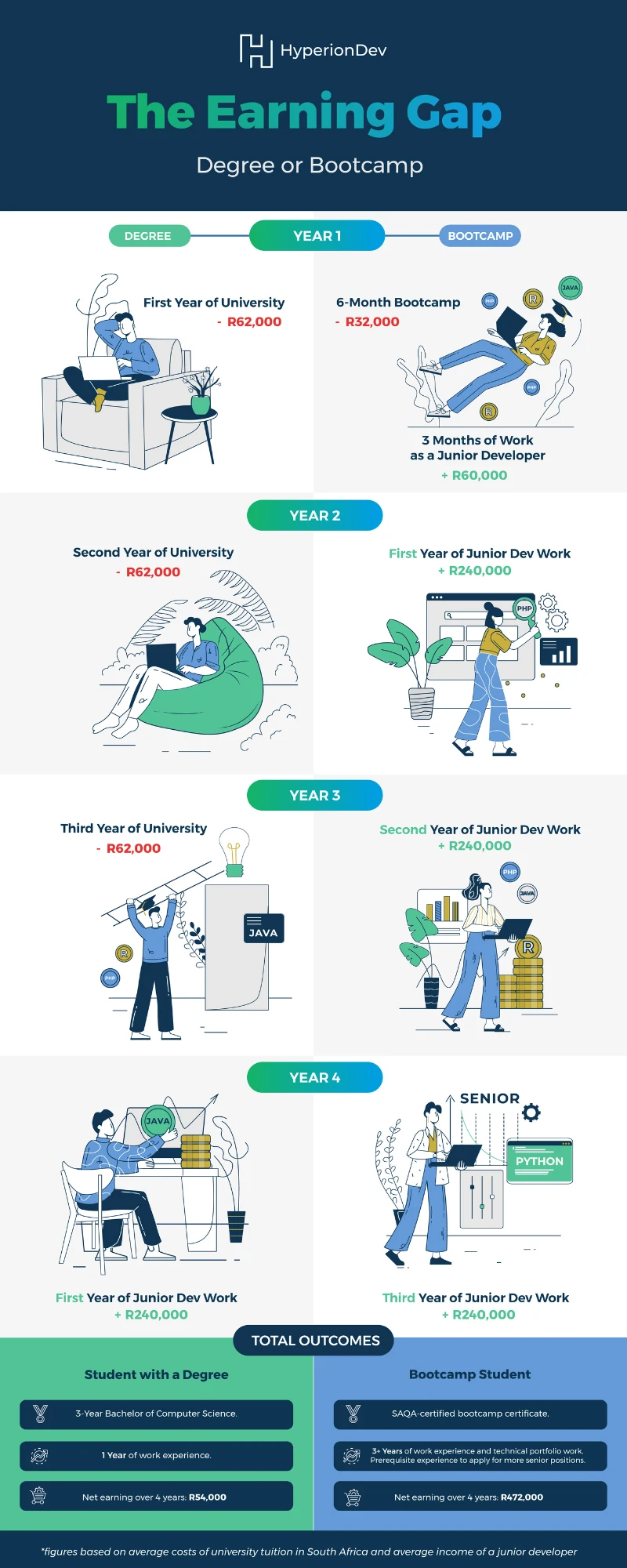
[Sources: Average Cost of University Tuition; Average Income of a Junior Developer]
In the world of work, a faster start to your career means greater opportunity and more time to earn, which directly equates to higher earning potential. Faster career progression and an early start to earning means bootcamps are the better choice for many.
6. Location flexibility
A PwC report, the Voice of the Student Survey, showed that almost half of all South African students (49%) prefer virtual learning, while 38% prefer hybrid learning formats, and 13% prefer in-person classes. Yet, the higher education industry significantly lags behind the corporate world when it comes to digitalisation.
Traditional university education often requires in-person attendance, whereas bootcamps often provide a choice. While most bootcamps feature a predominantly online learning focus, HyperionDev also offers in-person courses in Cape Town and Johannesburg, meaning you can learn from anywhere at a pace that suits you.
7. Personal mentorship
Most undergraduate degree programs will give you a weekly tutorial session and perhaps a course convenor you can chat with. One-on-one oversight is usually limited to the most advanced degrees or projects, for example, writing a thesis or dissertation.
On our bootcamps, you get 1-on-1 expert mentorship from day one. We believe that coding mentors are essential for your development and learning. Our mentors help you to learn coding best practices, give you constructive feedback, and allow for individual attention.
8. Specialisation
Beginners starting out on a computer science degree usually learn the basics of programming over a wide range of applications. But what if this doesn’t fit your tight work schedule, doesn’t interest you, or you don’t see it being useful in your future career?
On a coding bootcamp, you dive straight into your field of interest. You can focus entirely on learning the exact skills needed for your chosen career goal, be it software engineering, web development, or data science. Bootcamps are also practical, with capstone projects and code submissions rooted in real-world applications and business needs. Thanks to smaller classes and online learning, bootcamp students also tend to learn coveted soft skills such as teamwork, communication, and time management.
9. Learning requirements
Universities are great places to have an extensive and detailed exploration of subjects you’re passionate about. Unfortunately, there’s one problem: the credits system.
To obtain a degree requires you to meet a minimum number of credits for your program. Often this means you’re forced to take ‘arbitrary’ subjects just to meet your credits list. And while Organic Chemistry and Geometry are interesting, there’s no reason you should be forced to take one of them for a year just to get your degree in Computer Science.
Bootcamps, in comparison, stick to a specialisation and teach core values for the job: you don’t need to take unrelated subjects just to get enough credits to graduate.
10. Theory and practice
Deep diving into theoretical concepts is useful and informative, but if you want to switch careers and have limited time and money, you probably don’t have the luxury of spending four years doing exhaustive research. In this case, learning practical skills quickly – such as the ability to create working websites, programmes and data models – is far more valuable.
And that’s what bootcamps do best. They don’t require 4,000-word essays or 4-hour exams testing your memorisation skills; instead, they focus purely on job-relevant skills that you can use to find work and build real programs, websites, and applications.
Join the 4IR
The Covid-19 pandemic drove us all online, but the Fourth Industrial Revolution (4IR) will keep us there. Evolving technologies and trends such as AI and IoT are changing the way we work, live, and learn.
Coding bootcamps, along with the expansion of university-bootcamp partnerships, are at the core of this acceleration – quickly showing their power and value to a public that wants a risk-averse, job-ready translation to a tech career.
—————–
Our bootcamps provide personalised 1-on-1 mentorship in a tightly structured learning environment that teaches you everything you need to know to start creating the next big app, amazing websites, and powerful machine learning or data algorithms in less than six months.
Apply now to start your journey to learning how to code and get the inside edge on starting your tech career.
Editor’s note: This post was originally published on 02 September 2020 and has been updated on 03 November 2022.
Career Advice
The Easiest Programming Languages for Coding Beginners
Grasp one of the many programming languages popular in the tech world and kickstart your journey to a lucrative career by learning to code today.
With the high demands of the tech industry only expanding, one of the most effective things you can learn for a fruitful career is a programming language.
Today’s technological environment is jam-packed with complex computational paradigms that are daunting to beginners. But, of course, some languages are easier to learn than others. And, with a bit of time and practice, certain coding languages can start to feel like second nature.
Let’s take a look at some of the most accessible programming languages for beginner coders.
HTML
HTML is considered the simplest programming language to date and could be your best starting point when learning how to code. This language is most commonly used in web development and has a number of commands that are contained between brackets. The language’s function is based around structuring as it tells a website how to stylistically present information.
HTML is incredibly basic. While it still has a place, it’s hardly used as a primary coding language anymore. However, if you’re just getting started on your journey to code, this could be a great place to begin as you’ll receive direct and instant feedback, and a basic understanding of how coding languages work.
CSS
Coming in at a close second is CSS. If stylistic editing and front-end development are more in line with your career desires, then Cascading Style Sheets (CSS) is an ideal programming language for those who wish to learn to code.
From colour pallets and fonts to entire page layouts, CSS is used to sculpt and refine the visual aspect of a page. It also functions in conjunction with HTML to better grasp the screen display.
Python
While this programming language is still considered relatively basic, it is among the most popular to date. In 2021, the recognised job application site Indeed.com saw Python crop up in over 70,000 full-time job descriptions. In fact, this popular language is even used by mega-corporations like Google and Netflix.
With Python, you don’t need to use as many lines of code as other languages require for the expression of certain concepts. You can achieve more in less time since its function is straightforward, and the language itself consists of many well-known English words to keep you on the right path. And, to make this in-demand language all the more accessible to you, both our Software Engineering and Data Science bootcamps can help you learn Python in a matter of months.
JavaScript
Don’t confuse JavaScript for Java. Both are in hot demand, yet they are two distinct languages. Here’s the primary delineator between the two: JavaScript pertains to scripting needs, whereas Java pertains to programming needs. JavaScript crosses all platforms and isn’t too difficult to learn, making it one of the central pillars of the internet when it comes to programming languages.
Since it comes pre-built in all browsers, you don’t need to download anything to start figuring out how JavaScript works. Java primarily derives from “C-language” coding and has a level of flexibility to it. It can be harnessed and utilised for both front and back end development, making it versatile and useful in a multitude of landscapes. In the professional realm, JavaScript is one of the highest-paying programming languages to hone.
Java
Having circulated the world of programming since 1995, Java is a forefather to development while remaining a timeless tool in refining the web and expediting innovations in software. Video games, applications used on mobile devices, websites, and more are all programmed using Java.
Think of it as a C++ addendum. The language makes use of objects and classes to relay commands. For beginners, Java is ideal, as it’s been on the web for a long time.
You’re Almost There
Learning a coveted programming language is only the first part of the process. Once you’ve mastered one set of coding paradigms, you will want to put that knowledge to use and design an application or website. To achieve this, you’ll have to practically refine your newly developed code, put it through its paces, and ensure its effectiveness and functionality.
Interestingly enough, no matter the programming language you choose to learn first, it can be translated to another programming language. This just goes to show how exciting and expansive today’s web innovations are, and there is a wealth of lucrative opportunities for those willing to spend a little time and learn a coding language or two.
——————-
Our coding bootcamps are one of the most efficient ways you can upskill and learn to code. Whether you’re interested in web development or data science, our online courses could be the bridge that connects you to a prosperous career in tech. Discover HyperionDev’s online coding bootcamps to start your coding journey today.

Career Advice
Inspiring Female Tech Leaders in South Africa
Who are the top women in tech in South Africa? We profile three of South Africa’s most successful women in tech, how they got there, and how they’re using their skills to change our world one line of code at a time.
From the way we live, work, and innovate – science, technology, engineering, and mathematics (STEM) drive the economy and create our future. Yet, according to WomenInTech, in South Africa, women hold a mere 23% of all tech jobs in the country.
Luckily several initiatives are working towards closing the gap, and among them are educational institutions such as HyperionDev that actively encourage women to learn the magic of code so that they, too, can enter the lucrative and exciting world of technology.
To inspire more women to enter the world of IT, we profile three of South Africa’s most successful women in tech today, how they are using their skills to change our world, and their top life lessons.
Dr Mmaki Jantjies
Capetonian Dr Mmaki Jantjies is on a mission to disrupt the South African educational system. A computer scientist with a passion for how technological innovations can improve society, she has a CV the length of the Hubble space telescope’s code – and the experience to execute it!
After completing her Honours in informatics at the University of Pretoria, she moved to the UK where she studied for her Master’s degree in computing at Oxford Brookes University, followed by her PhD in computer science at the University of Warwick. She is a research member at the United Nations University that merges ICT with global sustainable development goals.
How she’s making a difference
Dr Jantjies holds the prestigious Group Executive of Innovation and Transformation role at TELKOM and is an Associate Professor in Information Systems at the University of the Western Cape (UWC). Here her research focuses on developing mobile learning software systems in STEM subjects that will be accessible in all South African languages.
Concerned with how few women have access to careers in tech in SA, she encourages her students to join the Mozilla and UN Women technology clubs for young girls. In these tech clubs, young girls from Cape Town township high schools can learn ICT skills and are encouraged to take the leap into a career in tech.
Casting her net wider to help women across Africa, she co-founded Peo ya Phetogo (PYP), a non-profit dedicated to digital skills development among our youth, schools, teachers and communities.
Life lesson
“Being able to impact society through education and research on technology is the most fulfilling experience as you always see the impact of the change you bring in your greater society.” (Interview for STEM mentor article at UWC)
Lindiwe Matlali
Gauteng native Lindiwe Matlali is a multiple tech industry and business leader award-winner who holds a number of board memberships and has been – and still is – involved in both grass-roots and government-level initiatives that aim to inspire Africa’s next generation of innovators and entrepreneurs.
She started out by studying BCom economics and statistics at UCT. After a decade of working, she completed a course in executive education and data analysis with Harvard Business School. She is currently studying towards her Masters in Technology Management from Columbia University in New York, as well as a Graduate Certificate in Entrepreneurship and Innovation at Stanford University.
She has won multiple awards, among them Excellence in STEM from the Charlotte Maxeke Institute, Social Innovator of the Year by the Schwab Foundation, and was named one of the Mail & Guardian 50 Powerful Women in SA in 2021.
How she’s making a difference
Her exposure to some of the world’s leading educational institutions has led to an exciting position with the Presidential Commission on the Fourth Industrial Revolution (4IR), which aims to help the government seize opportunities presented by the digital industrial revolution.
The venture we’re most impressed with is her role as founder and CEO of Africa Teen Geeks, an NGO that teaches kids how to code. Teen Geeks is the largest computer science non-profit organisation in Africa and has one clear goal: to educate, inspire and equip young people with skills, resources and experience to pursue STEM careers and close the opportunity gap through quality education.
Life lesson
“An integral part of empowering women is showing them that tasks traditionally labelled as ‘women’s work’ are complex and important and hold many of the same technical challenges as anything men do.” (Knitting Is Coding Ted Talk for TEDxBeaconStreet)
Thembiso Magajana
Thembiso Magajana is a self-confessed technophile from Gauteng who spent a decade in the financial sector before she found her true calling in code. It was a conversation with her then six-year-old niece who wanted to be the world’s next Steve Jobs – and being dismayed at how few black women there were in tech – that inspired her to leave the world of finance. Within months she was fully immersed in creating pathways for South African township youth to be part of the 4th Industrial Revolution.
Unlike our other tech heroines, Thembiso has no formal education in technology. However, when she decided she wanted a future in IT, she spent her free time reading Computer Programming For Dummies, watching Youtube tutorials, and studying various online coding and IT courses. Soon she was teaching her niece and friends basic coding in her sister’s garage, with limited wifi and only one laptop between them. That inspired her to launch Social Coding. Her background and training in finance has stood her in good stead, helping her secure funds and creating multiple revenue streams for her nonprofit.
How she’s making a difference
Thembiso’s passion and drive have catapulted her into one of South Africa’s most recognised female tech movers and shakers. She has been recognised as a World Economic Forum Global Shaper and is an accomplished TEDx Speaker. In 2019 she was named one of the 50 most inspiring women in tech by @InspiringFifty SA, a non-profit that aims to increase diversity in tech by making female role models more visible.
Her nonprofit, Social Coding, is where she has made a huge difference to thousands of disadvantaged girls and women. The technical workshops cover software development and design thinking and teach girls to be initiators, conceptualists, shapers, and drivers of innovative and strategic problem-solving.
Life lesson
“Teach one girl to code and she’ll teach 22 more because women are by nature change agents, and by doing so, we’ll solidify the economy of our nation for years to come.” (In conversation with GirlCode)
——————
Could you be next?
Looking at these amazing women, two qualities stand out: they are all dreamers and doers. They did not take ‘no’ for an answer, nor were they constrained by gender stereotypes when it comes to working in a field that ignites their imagination and passion.
If their journeys have inspired you and you dream of a tech industry career, you have come to the right place. Apply for a bootcamp, and who knows, we may be featuring you in our next series of top inspiring SA women in tech!
Career Advice
Top 5 Highest Paying Programming Languages
There are hundreds of coding languages used in the creation of software. Some coding languages are better favoured than others. To find out the highest-paying languages, read this blog.
With a digitising economy, programming skills are vital, and people who choose to gain them can expect a lucrative career path. Anyone who knows anything about programming knows that there are hundreds of coding languages out there, but some of them are more useful and relevant than others.
We’ve compiled a list of some of the most in-demand programming languages that businesses everywhere need. If you’re a software developer, or if you aspire to be one, these are languages you’ll want to ensure you add to your repertoire. Here are the highest-paying languages for programmers.
1. Go
Go, which was released by Google in 2009, has become one of the more popular open source programming languages out there. The Google brand is known for its industry-leading innovations, and Go is no exception. The language is optimised to run on multicore processors, networked systems, and large computation clusters.
Go is usually requested as a skill for DevOps engineer positions, according to Indeed, and is also commonly requested for full-stack developer jobs.
Did you know? Go started out as an experiment. Google engineers Robert Griesemer, Rob Pike, and Ken Thompson were looking to create a language that was simpler and quicker than the other popular languages available at the time, and Go was the result.
Developer demand: Go is currently holding steady at #12 on the PYPL index worldwide list, with a slight upward trend of +0.2% compared to a year ago, indicating a growing demand for developers in the years to come.
Average salary: The average salary for a Go developer is currently estimated at $112,854 per year.
2. C#
The C# language was developed by Microsoft in 2000 and is used in most of their products, including desktop applications and Windows 8/10 applications. It’s also the application of Microsoft’s .NET software framework.
This language can be used to develop a range of apps, from small desktop programmes to major web portals and web services.
Did you know? C# can be run on different non-Windows platforms (like Linux) without changing the source code. It can even be run on the Xbox 360 platform, using a special framework.
Developer demand: C# is fourth on the PYPL Index, garnering a 1% increase in worldwide demand and trend over the past year.
Average salary: C# developers can expect to earn an average of $108,894 per year.
3. Python
Python is a high-level, versatile language that has grown rapidly in the past few years. In fact, Python has become the most popular programming language in the world. In a study by Jetbrains, 85% of programmers used Python as their primary coding language in 2020.
Python is especially sought after in the machine learning and data analytics fields. Data scientists who are skilled in Python stand to earn well. The language is also used by DevOps engineers and full stack developers.
Did you know? Python is named after the television show “Monty Python’s Flying Circus”, and many tutorials for the language include jokes from, or references to, the show.
Developer demand: According to a data analysis from Future Learn, Indeed.com has over 14,000 job listings as of 2022, nearly double the number of listings for Java, and this trend is set to continue throughout the years to come. The PYPL (Popularity of Programming Language) Index lists Python as #1.
Average salary: Payscale estimates a yearly average of $87,812 for Python data scientists, but salaries vary depending on the position.
4. Java
Java is a very well-established programming language, which allows developers to “write once, run anywhere” (WORA). It’s relatively simple to learn and is widely used and favoured by big multinational companies. In fact, all apps developed for Android devices are Java-based.
Did you know? Java earns first place as the most searched language in Europe, South America, Africa, and Australia.
Developer demand: On Indeed.com, Java job listings have increased to over 80,000. It remains #2 on the PYPL Index, with a 1.3% increase in worldwide trends in the past year.
Average salary: The average salary for a Java developer is estimated at $78,604 per year.
5. R
R is another of today’s programming languages closely associated with machine learning. It’s a data processing and statistical analysis coding language which was originally developed in the 1960s.
Today, R is popular with data scientists around the globe, thanks to its huge number of data analytics libraries. The language is often requested for machine learning, data warehouse, and software engineer positions.
Did you know? R users can improve the software’s code or write packages for R that are suited to specific tasks. R packages offer advanced algorithms, graphical interfaces, and improved data mining techniques, allowing users to dig deeper and analyse more.
Developer demand: R is at #7 on the PYPL Index. While its demand hasn’t grown worldwide, it’s still considered a relevant and vital computer language across the globe.
Average salary: The average annual salary for an R programmer is currently estimated at $69,004 per year.
Kick-start Your Future in Programming
Are you eager to launch a fruitful and lucrative career in the booming tech industry? Learn the world’s most popular programming languages online in one of HyperionDev’s coding bootcamps, and develop the skills you need to earn big. A world of success is at your fingertips.
Editor’s note: This post was originally published on 06 July 2018 and has been updated on 14 June 2022.

Career Advice
Learn Programming Faster with These Top Tips
Anxious about the looming recession? With a heavy reliance on technology, programming is one way to ensure your employability no matter the state of the economy. Check out these top tips to learn programming fast and secure a position in the industry.
By now, you’ll have noticed that there are murmurs of a global recession all over the internet. Nobody can predict an economic downturn with absolute certainty, but we can gain insight into the fear surrounding its plausibility.

Google Trends indicates that global interest in the term “recession” has grown quite significantly in recent years. In fact, the search volume was greater more recently than it was during the last recession in 2008.
Yet while the potential for economic downturn looms, one industry is unlikely to face an extreme dry spell – and that’s technology. In an increasingly digital world, nearly every business relies on the tech industry to operate. This means that there is abundant opportunity for programmers, no matter the global economic standing.
If you’re ready to fortify your skillset in preparation for a potential economic downturn, here are seven tips to help you learn to code as quickly and efficiently as possible:
Know the Terminology
When you are getting started with programming, there are many different terms and phrases to learn that can be daunting to beginners. But the quicker you learn the terms and coding jargon, the better off you will be when beginning your first steps down the programming path. For example, while most individuals won’t know what it means for a tool to accept logs from any Node.js app, you will need to. There are plenty of terms you will need to become proficient in to succeed as a programmer. And the best way to start familiarising yourself with complicated terms is to read through a glossary.
Practice, Practice, Practice
Reading, watching videos, and taking classes are awesome for the development of theoretical programming knowledge. But learning how to code requires a lot of practice. The more you practice you can fit in, the faster you can build up your skills. The only way to truly become a programmer is to program, so be sure to set aside a good chunk of time to do exactly that. Be warned, though: it won’t be effortless or easy. Trial and error will be a common method, and it will be frustrating at times. But the more you practice, the better you will get.
Utilize the Fundamentals
While the fundamentals might seem overly simple or obvious, they are still incredibly important to know and will be crucial to any coding projects you undertake. If you rush through learning the basics, you may pay for it later in your development as a programmer. Understanding the fundamentals will form the foundation for building more complex skills. An example is harnessing the benefits of pseudocode, a way to learn code in a more theory-based process. This will help you grasp the critical and logical thinking skills required for all the techniques in programming.
Don’t Be Scared to Ask for Help
Learning programming can be a painstaking process, and falling into a rut or struggling with something for long periods is not uncommon. Luckily, there is an extensive network and coding community at your fingertips. Instead of spending hours trying to solve a problem that you may never be able to, why not ask for help? There are several forums and message boards that are full of people willing to help you with your programming-related problems. But if you feel you need more consistent guidance as you develop your coding skills, HyperionDev offers expert and personal code reviews for every code you craft. We also have a student community Discord channel where budding programmers can connect and collaborate on code.
Watch Tutorials
Reading about how to do things or teaching yourself are suitable, but sometimes it’s easier to watch and learn. Online tutorials will help you visually witness the process as a whole, which you can then retain and replicate more effectively. Most of the time, teachers in these tutorials will also talk you through their problem-solving methods. This almost feels like you are working on the problem or issue together instead of tackling it alone. There are thousands of coding tutorials on YouTube, so there is a good chance you will be able to find what you need. One of the most effective ways to learn to code faster is to enrol in an online course. HyperionDev offers extensive and industry-aligned bootcamps for software development, data science, and web development.
Use Games
Learning to code through trial and error or watching tutorials works for many people, but they aren’t the only way to learn programming. If traditional methods aren’t keeping you engaged while you’re learning to code, you might want to look into using a game as a part of your learning process. There are several online games out there that will help you learn coding and programming while having fun at the same time. Many coding games also have different “levels”, making them accessible for all.
Don’t Rush Yourself
When learning something new, the last thing you want to do is rush through tasks or set too-high expectations. If you force yourself to rush, you might miss specific steps and hamper your learning process. Sure, you will have deadlines and requirements if you code or program for your job, but when you are learning, feel free to take your time and truly understand what you’re doing before moving on to the next task. After all, the best learning happens when you’re enjoying the process.
We hope that these practical coding tips can help you learn programming more efficiently and reach your goals – whether those involve gaining a hobby or securing a career in code. If your goal is the latter, HyperionDev offers in-depth coding and coding bootcamps that will get you job-ready in as little as three to six months. Our online courses are designed to take you from beginner to job-ready, helping you enter the rewarding tech industry with confidence.
Editor’s note: This post was originally published on 23 August 2018 and has been updated on 09 June 2022.

Career Advice
Recruiting tips: How to nail your virtual interview
The ability to operate efficiently in a remote or hybrid environment has become crucial for success in order for employees to navigate a fast-paced, ever-changing environment. Here are some tips to prepare and make sure you put your best foot forward.
In a post-pandemic era where the majority of tech companies have transitioned to adopting a hybrid or fully remote working policy, it’s not only technical skills that are in demand. The ability to operate efficiently in a remote or hybrid environment has become crucial for success in order for employees to navigate a fast-paced, ever-changing environment.
So, you just received a first interview request for a role and company you’re really excited about, congrats! What now? Here are some tips to prepare and make sure you put your best foot forward.
Be on time and connected
This might be the most straightforward tip of them all, but companies that operate remotely or have teams based in other locations, need their employees to be on time and available for virtual meetings. When the recruiter schedules the first interview, make sure you familiarise yourself with the platform and double-check your sound, video and connection speed before the interview starts (that means the day before, not 2 minutes before the time!) so you can troubleshoot any issues and make sure you start the interview off on a positive note.
Do some research
This is applicable to most roles and industries, but any tech-based company worth working for will have a decent online presence. Check out their LinkedIn, latest blogs/news and other social media to see the latest on their products/services/partnerships or other developments. If you get the opportunity to ask questions, this is a great way to show that you’re informed and up to date as well as your interest in the future employer.
Use the time wisely
Most first interviews are quite short and can range anywhere from 15-45 minutes, depending on the level of the role. This goes by surprisingly quickly and there is a lot the interviewer would want to cover, so try as best as you can to listen to what the interviewer is asking so you can provide relevant information without spending too much time on your high school subjects or what your cat was up to last night. You want to make sure you leave time to ask your questions as well!
In order to have a productive conversation within a limited time frame, think about and communicate clearly about what you have to offer and what you’re looking for in order for you and the first interviewer to decide whether it’s a good idea to invest time in next steps.
Key items to think about:
- What are you really good at? What key skills do you have that match the role or that you can bring in addition?
- What are you not good at? What are you not interested in? The interviewer might not ask this from you, but knowing what you’re not passionate about is helpful in exploring a new role to know if it’s a good match for you.
- What is important to you in a role? Does this role ‘tick’ your main boxes? Not every role is perfect, so asking questions about work-life balance or flexible hours, growth opportunities, team structure and management, salary potential, benefits etc. can help you weigh up the options and decide if it’s worth moving forward with the process.
While the interviewer will guide the questions, an interview is always a two-way conversation, so make sure you use this time well to get the most out of it.
Be available and flexible
Make sure that during the interview process you’re available on email/phone for the hiring team to contact you and arrange the next steps. Fast and efficient communication in a remote environment is key to success. If you know you’ll be stuck in meetings/have planned time off, give the recruiter a heads up so it’s easier to coordinate between teams. It might seem old-fashioned, but a quick thank you note after an interview goes a long way to not only thank the team for their time and express your interest in the role but indirectly reminds them to schedule you for the next steps (hopefully!) without sounding pushy.
Be yourself
A company worth working for will be open to hiring candidates that can bring their whole selves to work. In a remote environment, the home office and who you are outside of work is now blended with what you do for a living, so often the hiring team would want to know a bit more about you. This means that you can be professional and still show your personality, passions and interests in the interview. In checking out the company’s public persona and tone of the brand, you should also get a good idea if it aligns with the type of company culture that you’re looking for.
These are our top tips for making sure you nail your next interview – sending good thoughts and lots of good luck!
———————
If you’re interested in a career that makes an impact, join the HyperionDev team in our mission to close the global tech skills gap. View our job openings here.

Career Advice
Top Tips to Avoid Bugs in Your Code
Debugging is the bane of a programmer’s work. Gain access to tried and tested tools and techniques that make debugging easier.
Coding errors in software programming manifest unforeseen issues and interrupt the user experience. We call these errors ‘bugs’, and they’re not always very obvious. Debugging is when programmers seek to find bugs before users do, optimising the user experience.
Whether you’re new to programming or you’ve got years of industry experience behind you, bugs and their downsides have likely been a nuisance to you at some point. There are, however, some nifty ways in which you can avoid bugs and even debug code that’s already been impacted by this notorious programming problem.
Here are a few tips and programming tools that HyperionDev recommends to reduce the occurrence of bugs:
0
1. Code review
Before one tests new code for the first time, it is crucial to review it thoroughly. Sometimes one will only spot a coding error after several sessions of reviewing code. Firstly, code should be reviewed by the programmer, then by a peer, and lastly, it should be reviewed by an expert.
GitHub is an excellent platform to have one’s code reviewed by peers and experienced programmers. HyperionDev’s bootcamps all include personalised code review, which provides detailed feedback on submitted code.
2. Split different sections of the code up
While code can be helpful and provide exciting opportunities, too much code can slow a programme down. One of the best tips for code efficiency is to keep your code minimalistic. More code also means more opportunities for bugs. HyperionDev recommends keeping problematic code separate from “healthy” code. This practice ensures that bugs don’t spread to other sections of the programme.
3. Constantly rewrite the unit test
The unit test isolates a small section of the code to test its functionality. This is a valuable programming tool and can help identify and avoid bugs. However, when fixing bugs identified in previous unit tests, it is essential to debug the code and rewrite the unit test before the next round of testing.
4. Review compiler warnings
Compiler warnings are an essential part of the debugging process. It is crucial for developers to consider all compiler warnings and review the concerns raised therein. It is recommended to treat all compiler warnings as errors, particularly at the start of a programming project.
5. Focus on delivering simple programming
As with everything, sticking to the KISS principle (keep it simple stupid) is a guaranteed method of delivery code that is free of bugs. This includes simplifying code and not trying to add too many complex elements. Writing simple, straightforward code also makes the debugging process much more manageable.
6. If it ain’t broke, don’t fix it
There is a saying in the coding world that goes, “The good programmers write code; great programmers steal code.” Coders do not seek to reinvent the wheel, but instead rely on existing libraries, especially if they are well-tested. This is an excellent programming technique to avoid bugs, as the code in these libraries should be reliable and clean.
__________
Code review is such an integral part of the programming process. If you’re looking to learn code, make sure you have access to quick and reliable code review. HyperionDev offers a choice of online and on-site coding bootcamps, which include 48-hour code review feedback from experienced code reviewers. This means you can work through your coding tasks quickly and efficiently without feeling stuck.
Your code reviewer will assess your code’s accuracy, style, and efficiency to make sure it’s in line with industry standards. Then they’ll provide you with actionable feedback. Code review is a great way to ensure you avoid bugs when programming and produce high-quality code that works like a dream.
Interested in joining HyperionDev? Secure your future and enrol for a coding bootcamp here.
Editors note: this article was originally published in January 2019.

Career Advice
Top 5 In-Demand Tech Careers for 2022
Tech-based careers offer the students of today lucrative opportunities for tomorrow. Here are the top 5 most in-demand tech careers of 2022.
As nearly 900 000 matric students work towards completing their final exams, it is vital for them to start planning for their future. As with any career, students need to bear in mind how likely it is that they will be employed after completing their studies and whether traditional university is the right path for them.
This is according to Riaz Moola, CEO at HyperionDev, who says that thanks to the rapid digitisation of almost all aspects of our lives, tech-based careers offer the students of today lucrative opportunities for tomorrow. “Currently there is a skills gap in the technology sector in South Africa, which is reflected in research by PWC which reveals that 87% of local CEOs are most concerned about this shortage.”
As the school year draws to a close, many matriculants are wondering what to study next year. With this in mind, Moola lists his top five tech careers for matriculants to consider pursuing studying for in 2022:
1. Java developer
Average annual salary according to Payscale: R375 315
A Java developer uses the Java language to create high-functioning web applications, software and programs. Java developers have long enjoyed high-ranking status, rated as the number one job of 2021 by the global recruitment website Glassdoor. “Java is still one of the most popular programming languages in the world, reflecting both the growing demand for experienced Java programmers and the ubiquity of companies using Java for all kinds of tech applications,” asserts Moola.
The roles and responsibilities of a Java developer will vary greatly depending on the company and specific position. Here are some typical responsibilities: Designing, implementing, and maintaining Java applications that are often high-volume and low-latency, required for mission-critical systems, delivering high availability and performance, contributing in all phases of the development lifecycle, writing well-designed, efficient, and testable code to name but a few.
2. Software engineer
Average annual salary according to Payscale: R371 699
Software engineers are generalised developers, making all kinds of software to suit business’s needs. “They have always enjoyed incredible pay, boundless career opportunities and solid job security,” states Moola. “Software engineers are highly agile, thanks to their transferable skills and deep knowledge of one or more programming languages.”
Some of the responsibilities of a Software Engineer will be to: analyse user requirements, write and test code, refine and rewrite it as necessary and communicate with any programmers involved in the project. They will research, design and write new software programs (e.g. business applications or computer games) and computer operating systems, evaluate the software and systems that make computers and hardware work and develop existing programs by analysing and identifying areas for modification.
3. Data Scientist / Data Engineer
Average annual salary according to Payscale: from R428 554 to R449 030
“Data is the internet’s new gold rush, which is why companies want to understand their core data and key customer insights to unlock more efficient systems and bigger profits,” says Moola. “Data scientists and data engineers are the answer to that better business.”
There are more similarities than differences between data scientists and data engineers, he points out.
“A data scientist uses data analysis tools to manage, analyse, understand and draw conclusions from complex data. Data engineers, on the other hand, are responsible for the setting up, maintenance and management of data systems. They don’t just know how to work with data, but also understand the systems and processes that this large-scale analysis requires and how to work with these technologies. These two roles share the number three spot due to their international demand and high job security.”
A data scientist’s role combines computer science, statistics, and mathematics. They analyze, process, and model data, then interpret the results to create actionable plans for companies and other organisations.
4. Enterprise Architect
Average annual salary according to Payscale: R867 986
The career of an enterprise architect is one of the best tech jobs in the world because of its combination of staggeringly high pay and huge job opportunities and security.
“Enterprise architects typically occupy more senior positions and are responsible for making sure that a company’s business strategy uses the right technology systems to achieve its goals,” comments Moola who says that this highly technical role makes it a prized career.
An enterprise architect is responsible for the upkeep and maintenance of an organisation’s IT networks and services. As an enterprise architect, you would be responsible for overseeing, improving and upgrading enterprise services, software and hardware.
5. Full-stack web developer
Average annual salary according to SalaryExpert: R730 841
Full-stack developers have officially passed their single-stream counterparts (front-end and back-end developers) to claim the fifth most desirable tech job in the world.
“Full-stack developers work in both front-end and back-end development, building the visuals of websites and applications, as well as the nitty-gritty coding that allows them to work as intended,” explains Moola. “Full-stack developers are highly prized because of this dual specialisation and multi-role capability, making them highly in demand, both locally and internationally.”
A Full-stack Web Developer is responsible for the coding, design and layout of a website according to a company’s specifications. As the role takes into consideration user experience and function, a certain level of both graphic design and computer programming is necessary.
From student to industry-ready in a matter of months
Today, students can take advantage of online coding bootcamps which can be viewed as alternative credentials, says Moola. “They are a fast-paced career accelerator that can quickly land participants a job as a software engineer or data scientist, rather than a traditional university degree which takes years to complete.”
HyperionDev bootcamps are deliberately structured to be both affordable and accessible, with many ways to pay and save on essential tech skills education. “We believe coding should be accessible to everyone, everywhere,” adds Moola. “That’s why we’ve partnered with financial services institutions so that students can finance their coding bootcamp and start their coding journey as soon as possible.”
We provide our students with the skills and career support they need to enter any of the top tech careers in South Africa and globally. Our intensive coding bootcamps combine personalised support from expert code reviewers with industry-aligned practical training to give students exactly what they need to start building software, applications and websites. Enrol now to secure your seat in a HyperionDev coding bootcamp.

Career Advice
Why every lawyer should learn how to code
As the legal world starts to evolve, a lawyer's skillset needs to keep up with the changes and the adoption of tech.
The world has never seen industries evolve faster than the present day. We’re seeing industries such as healthcare, finance, transportation, and tourism embrace the opportunities that come with the Fourth Industrial Revolution.
However, there is one cornerstone field that is lagging behind: Law.
The legal profession’s basic toolset hasn’t changed much since the quill and inkpot. While many firms remain behind the times, it is inevitable that change is on the horizon.
New technologies and increased competition are forcing the legal industry to slowly remake itself. While traditional law firms have been slow to adapt, it is these more overt inefficiencies that a new crop of start-upsand law firms are aiming to exploit.
Are you a legal professional interested in learning to code? Get in touch here.
Where tech and law unite, progress is inevitable
In the past decade, Legal Tech has slowly become a lucrative investment domain of its own. Legal Tech has gradually moved toward offering holistic technology solutions instead of focusing on hype and buzzwords. Many investors are choosing to focus on automation, productivity and orchestration-oriented software products.
Private equity and venture capital investors have been very active when it comes to Legal Tech. The top three areas of Legal Tech investment were contracts management (with 44% of firms investing), matter management (42%), and governance, risk, and compliance technologies (37%).
The global Legal Tech market generated revenues of USD 17.32 billion in 2019, with incumbents generating USD 16.75 billion of the total. The Legal Tech startup market generated USD 570 million in 2019 and is forecasted to reach USD 2.49 billion by 2025, growing at a CAGR of 27.82 per cent from 2020 to 2025.
Legal Tech startups
Internationally, Legal Tech startups such as Clio, a cloud-based practice management platform designed to provide legal client management remedies are taking off. The company’s platform accelerates the process of tracking, billing, administration, client communication and facilitates day-to-day operations, enabling clients to manage cases in a hassle-free manner.
Locally, two innovative Legal Tech startups, Legal Lens and BriefCo, held by Cycad Group have received an undisclosed amount of funding from Imvelo Ventures, a local venture capital firm founded by Capitec Bank and Empowerment Capital Investment Partners.
Why lawyers are actually well suited to coding
On the surface, coding and law seem to be worlds apart. But the core of being a lawyer is actually quite similar to the core of being a programmer. If you have the skills and mindset to be a great lawyer, you’re likely already equipped with the tools you’ll need to learn to program.
Like law, coding is based on logic and reasoning, and is about finding solutions to practical problems. While the long-running debate on whether lawyers should learn to code and whether it should be taught in law schools continues, it’s becoming increasingly apparent that having at least some knowledge of coding is useful as a lawyer. While you don’t need to become a full-on programmer, having some coding skills might give you a competitive advantage in the legal field. What’s more, many lawyers are more suited to it than they realise.
Why learning to code is invaluable as a lawyer
Learning to code can help lawyers to better understand the realm of the possible when it comes to tools that can help their practice. By knowing what you can do with the tools you have and knowing what kind of tools are available to you, you can be a better member of interdisciplinary teams. And, if you’re hiring actual coders to customise programs for your firm, you’ll have the language to be able to ask for (and get) what you want.
As a lawyer, you have the opportunity to upgrade yourself and further develop your repertoire by learning new skills which complement your logical thinking and improve your legal skills. Coding can drive your career to the next level and make you a formidable force in the world of law. For instance, lawyers involved in the world of tech, responsible for roles that include Patent Prosecution, IP Licensing and IP Litigation can benefit massively from having a coding context so as not to be on the outside looking in.
In an increasingly data- and tech-driven legal industry, embracing innovation is key to future-proofing your legal capabilities. Digital technology has changed law in the same ways that other technologies have, which is to say that it’s streamlined aspects of law such as automation as well as making the ability to scale your work easier.
Computer science skills that could be particularly valuable include:
- Coding languages to help you mine data, like Python or SQL
- Algorithms for problem solving
- Privacy and cybersecurity
- Cloud computing to better understand the cloud and how it can help your practice
- Scalability to allow solutions to handle different loads of work
- Database design for information organization
How to approach learning to code
Learning to code as a lawyer doesn’t mean dropping out of your practice to devote yourself full-time to building complex software. It shouldn’t be an all-or-nothing focus (i.e. being either a complete coding Luddite or an advanced lawyer computer programmer). Most lawyers should approach programming with the goal of at least becoming “coding literate” – becoming fluent in the language of coding, to the extent that best serves them.
Preparing for the future
Tomorrow’s lawyers will be the people who develop the systems that will solve clients’ problems. These legal professionals will be legal knowledge engineers, legal risk managers, experts in design thinking, and more. You too can develop new ways of solving legal problems with the support of technology. In many ways, the legal sector is undergoing the digitisation that other industries have gone through, and because it’s very document-intensive, it’s actually an industry poised to benefit greatly from what technology can offer.
If you’re looking to explore coding as a lawyer, there are courses that can help make the process easier and more effective. If you want to start by building your Legal Technology knowledge base, HyperionDev can get you there with part-time coding bootcamps that can be done remotely and will allow you to continue to do what you do best. Evolve your skills here.

Career Advice
How South Africans Can Seize Job Opportunities in Tech
SA's tech sector is becoming an important contributor to our GDP, and now is the time for locals to take advantage the job opportunities.
The South African tech ecosystem is thriving. This is reflected in the latest African Tech Ecosystems of the Future 2021/22 report by fDi, which ranked South Africa highly when it comes to recognising tech innovation and having an established digital start-up ecosystem.
The tech industry holds huge potential for SA
Caissa Veeran, head of partnerships at HyperionDev, Southern Africa’s leading provider of tech education, says that South Africa has one of the largest ICT markets in Africa showing extraordinary technological leadership in mobile and security software fields, as well as the online banking services environment.
“Several international corporates operate subsidiaries in South Africa boasting the likes of IBM, Microsoft, and Intel. This is because the country is the regional hub and supply base for neighbouring countries.”
“Although our tech sector is developing, it’s becoming an increasingly important contributor to South Africa’s GDP, and now is the time for locals to take advantage of it when it comes to job opportunities,” she says. “Tech companies rely strongly on skilled resources in order to grow their businesses to adapt to new technologies that are emerging, however the supply is not meeting the demand as the current skills being developed are not suitable.”
Veeran says that this can be addressed by preparing for today and tomorrow through skills development programs that cater for current and emerging technologies whilst being accessible and affordable. “The supply needs to meet the demand as change is happening fast.”
This has been recognised by the government which has embarked on extensive skills development programs aimed at training one million young people by 2030, in robotics, artificial intelligence, coding, cloud computing, networking.
Upskilling South Africa is everyone’s responsibility
South Africa’s unemployment rate ranks among the highest in the world, says Veeran. “What is especially concerning is how many young South Africans are unemployed. According to Stats SA, the unemployment rate for those aged 15 to 34 years is a staggering 52%, meaning one in every two young people in the country don’t have a job.”
Although the tech industry holds job opportunities, Veeran explains that there are various challenges South Africa is faced with, such as the current lack of access to technology, connectivity, education, and the high cost of data, all of which have severely restricted the number of young people equipped to enter the tech industry, particularly in rural areas.”
To mitigate this there’s a lot of work to do at grassroot level to provide South African youth with access to good quality education that is accessible and is affordable, she adds. “This is something that needs to be addressed by organisations, schools and universities who need to increasingly work together to improve access and the quality of education, update the current curriculum and highlight the dynamics and the ranges of careers in the technology world.”
Veeran believes that companies also have a role to play when it comes to addressing job creation and specialised skills development. “All the efforts that go into basic skills development is wasted if there are no entry level jobs available for graduates to earn experience in these fields. Employers also need to focus on a continuous data rescaling and upskilling for existing employees to keep up with cybersecurity, AI programming and data science, for example.”
EdTech is paving the way
HyperionDev has released its 2021 Tech Graduate Futures Report which revealed that more than half its students only have a higher diploma or high school education. “Our focus and mission are on the democratisation of education and providing access to all. This result is proof that anyone can graduate from our coding bootcamps with a job-ready level of coding expertise, regardless of their educational background, or where they come from,” says Veeran.
Subsequently, she points out that almost 80% of graduates found a new job within six months of the bootcamp with the largest proportion becoming professional software engineers and full-stack developers. “However, it’s important to note that only 19.6% of graduates came from an IT-related field meaning that anyone can take up a career in tech if they wish.”
“Our graduates also increased their salary by 23%, with 55% of graduates completing a bootcamp whilst working a full-time job,” she adds.
The reality is that 85 million jobs may be displaced by a shift in the division of labour between humans and machines by 2025, whilst 97 million new ones may emerge, that are more adapted to the new division of labour between humans, machines, algorithms. 2025 is just three years away. The future is knocking at our doors,” she says.
“Considering the opportunities that are currently available in the tech space in the country, the time is now for South Africans to be upskilled and armed with the tools to participate in the jobs of today and tomorrow,” Veeran concludes.
Do you want to learn more about the HyperionDev coding bootcamps? Chat to one of our Admissions Consultants here.

Career Advice
Online vs on-site coding bootcamps: which one is best for you?
If you’re keen to enter the lucrative field of tech this year, you’ll need to upskill. We compare online vs on-site coding bootcamps.
You’ve decided this is the year to enter the tech industry. Of course, that means you need to upskill, but what is the best way to go about achieving this career goal? Online vs on-site coding bootcamps: which one is best for you? Here are some factors worth considering.
What can you expect: online vs on-site coding bootcamps?
As expected, online coding bootcamps are longer and less expensive than their in-person equivalents, according to Course Report. In the US, the average in-person tuition fee is $11,900, whereas the average online bootcamp is $11,100. As far as duration goes, coding bootcamps range from 4 to 104 weeks, but, on average, you’re looking at 14,3 weeks for an on-site coding bootcamp compared to 15,4 weeks for the online version.
Consider your learning style
Are you someone who loses motivation quickly? Do you prefer working alone or with others? These are some of the factors you need to consider when choosing between online vs in-person bootcamps.
If you like working alone and are organized and very self-motivated, an online course could work well for you, states an article in Medium. With a HyperionDev online bootcamp, however, the good news is that you won’t be left completely alone. You’ll be assigned your own personal mentor who will guide you through learning best practice coding by giving you feedback and helping you out when you get stuck. Though an online bootcamp will require a degree of internal motivation, you are able to progress at your own pace.
Alternatively, if you lose interest quickly and you prefer working in a team or a classroom environment with like-minded individuals, then an in-person course could be the right option for you. You’ll progress at the group’s pace, but you will have more face-to-face support. It’s also likely that an in-person course is more structured, with regularly scheduled lectures and classes.
Here is a breakdown of what your days on campus would look like:
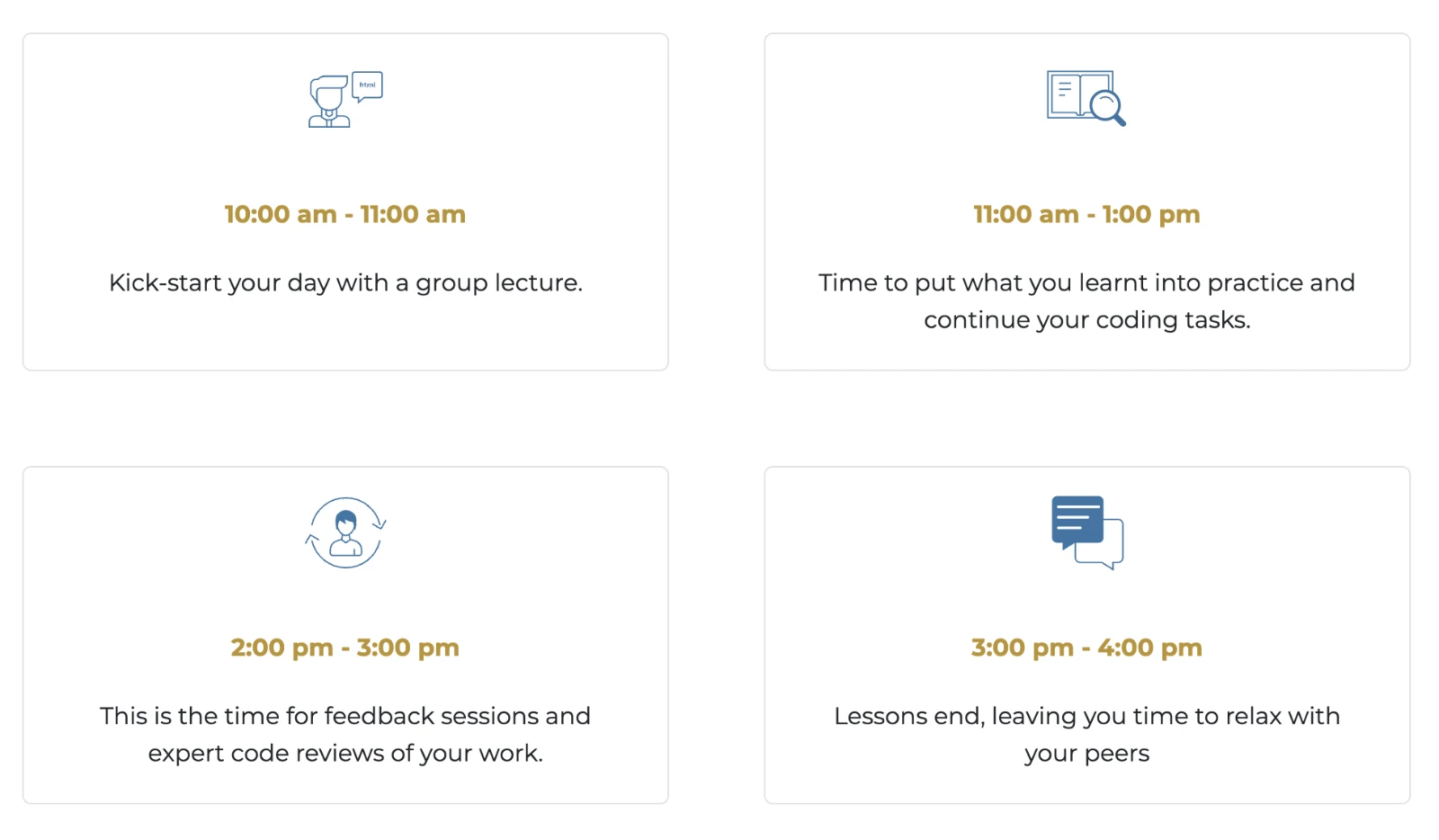
Online coding bootcamps tend to be more flexible and part-time (in-person coding bootcamps are likely to be full-time). With an online coding bootcamp you get to fit in your course work around your other obligations. This means that you can carry on working and earning money while studying. You can schedule your studying and calls with your personal mentor for evenings or weekends. Most online coding bootcamps require 5-30 hours per week. In addition, your risk is much lower and once you’ve gained the skills, you can start applying for other jobs while still being employed.
Here’s a summary of online vs on-site coding bootcamps:
Online Bootcamp:
- Own pace and location
- Less social interaction
- Good self-discipline and self-motivation
- Greater flexibility
- Experience working on your own – great for future programming projects
- Lower cost
- You’re more on your own when stuck, unless you have your own personal mentor
On-site Bootcamp:
- Interactions with other students and the instructor
- Classmates can motivate and encourage you
- Greater structure
- Experience working on a team – this is useful for your future coding projects
- Higher cost
- Limited by location – you can’t do it anywhere in the world
Whether you choose a HyperionDev online bootcamp or an on-site bootcamp, you will still receive the incredible benefits of our industry-standard content, expert code review and access to the HyperionDev Graduate Program.
If you’re keen to upgrade to a tech career this year, consider carefully which of these options best suits both your learning style and your resources. At HyperionDev you can enrol on the following coding bootcamps: Full Stack Web Development, Data Science or Software Engineering.

Career Advice
What’s Next After Matric? Explore Your Career
It can be hard to decide exactly what to do after Matric. There’s lots of contradicting advice, so here's a breakdown.
Finishing Matric isn’t easy – and it’s not just the exams we’re talking about. There’s huge pressure on matriculating students to know what they want to be, and to have it all figured out. If you’re stuck and wondering what to do after Matric, you should know that there are many options for you, even in these uncertain times. In this blog, we take a look at all the things you can do after Matric, and give you advice on their pros and cons.
Taking the University Route
This is probably the most common answer you’ll hear if you’re wondering what to do after Matric. It’s easy to see why so many people advise it: on paper, universities offer a formal, in-depth education, where you can study for your career specialisation and graduate with a recognised degree from a reputable university.
The sad truth is that university remains out of reach for thousands of students.
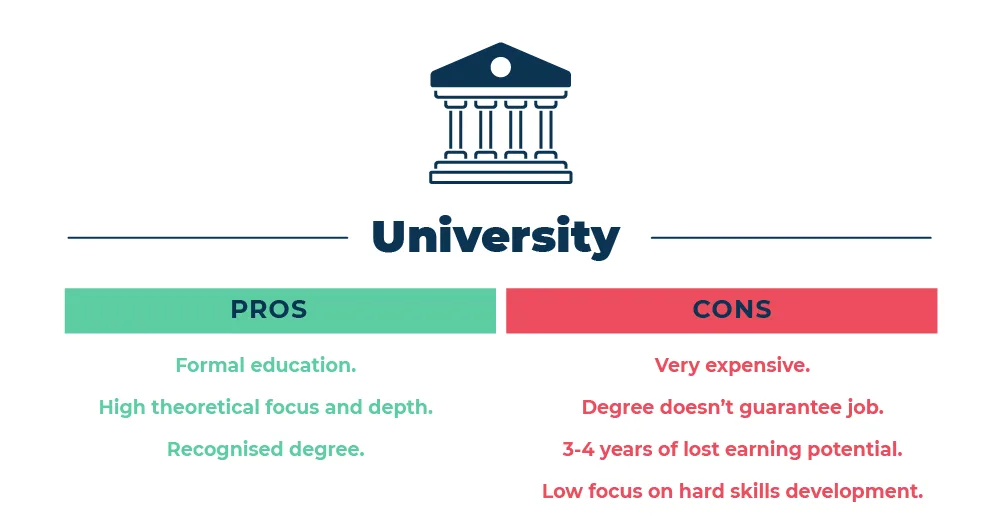
Many South African youth are simply unable to afford a university education. According to Statistics SA, 51% of youth aged 18–24 claimed that they did not have the financial means to pay for their tuition. This is a problem, because every year tuition fees continue to rise by up to 25%; in South Africa, the cost of going to university has skyrocketed, with an undergraduate degree costing on average between R30,000 and R70,000 per year.
Many South African youth are simply unable to afford a university education. According to Statistics SA, 51% of youth aged 18–24 claimed that they did not have the financial means to pay for their tuition. This is a problem, because every year tuition fees continue to rise by up to 25%; in South Africa, the cost of going to university has skyrocketed, with an undergraduate degree costing on average between R30,000 and R70,000 per year.
All of this is happening as COVID-19 and the global shutdown forced universities to do online courses and restrict in-person learning. Ask yourself, would you pay R70,000 for just Zoom calls?
Then there are two other issues. Firstly, while you’re studying, your career development is on pause. So when you graduate, chances are you’ll apply for a job without having the two or three years’ experience the vacancy requires. Secondly, this time is lost earning potential: by the time you graduate after 4 years, you’d be over R700,000 in total income behind someone who started working after a one-year study program, like a bootcamp – and that’s without mentioning the debt a lot of students accumulate during their studies.
Besides, there are plenty of things that make a bootcamp better than university.
Gap it on a Gap Year!
A gap year is a lot of fun. It’s a good opportunity to push the reset button and find out what kind of person you are outside of high school cliques and small town boundaries.
If you have the money to take a whole year off, that is.
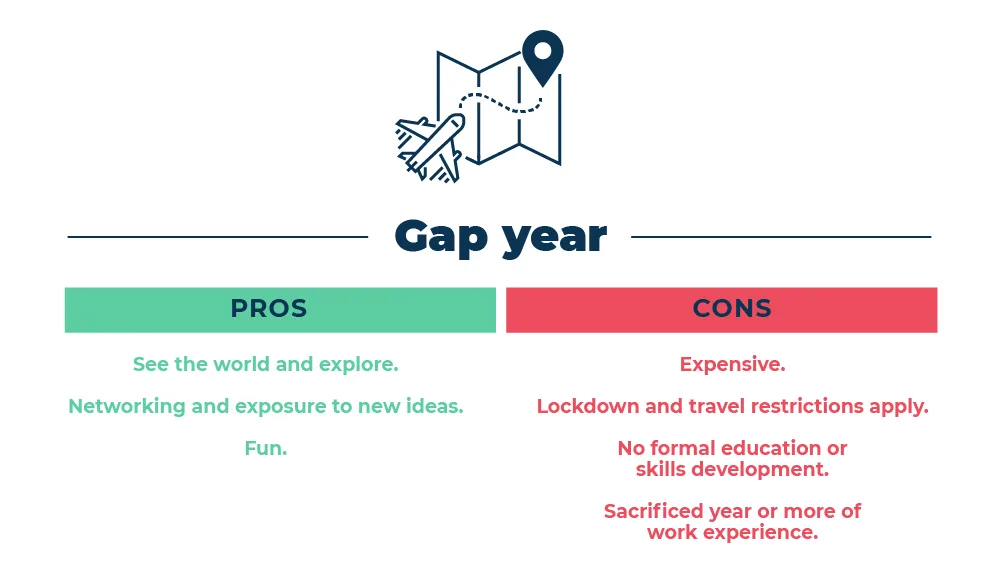
Gap years fall into the same trap as universities: they’re fun and tempting, but they carry significant financial costs – and that’s without considering the outright bans and uncertainty that COVID-19 and global travel lockdowns have introduced. Then there’s the painful reality that gap years aren’t what you see on Instagram. Often your options for fun stuff like sightseeing, snorkeling, and travelling are limited or impossible because of the expense. Then, if you do take work to make some money to do fun stuff, the work is entry level and the pay is shockingly low.
There’s also the fact that once your gap year is over you won’t automatically have transferable skills or qualifications that you can use to find a job. If you are thinking of a gap year, you should also be thinking about what short skills development programs – like bootcamps – you can do to ensure that “finding yourself” isn’t a sentence that ends with “in a very difficult career position”.
Thinking about College?
The trades are a great industry to end up in, if you’re thinking about what to do after Matric. They offer steady work and reasonable pay, and let you develop skills that you can use anywhere in the world.
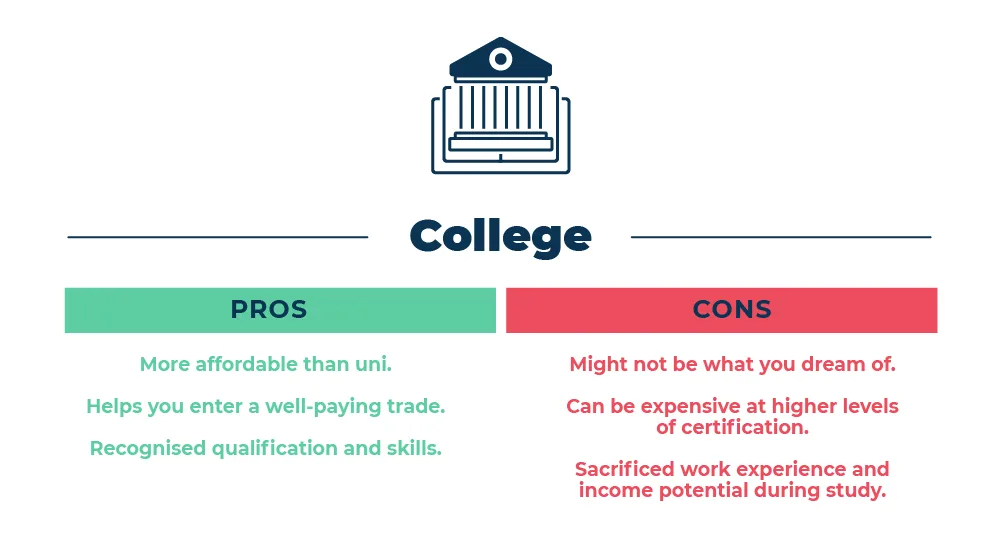
Colleges and technikons (and similar technical schools) teach you hands-on skills in these fields, and also give you an industry-recognised qualification when you graduate. They’re also reasonably priced and follow a practical structure, so that you don’t get lost in endless impractical theory. Best of all, the technical skills you learn (such as electrical engineering or plumbing) usually feature on critical and scarce skills lists, meaning you have options and demand for your skills wherever you go.
However, these aren’t the most glamourous jobs: the trades can involve hard or dangerous work, and while the supply of work is consistent, it’s also a pressured environment that features a lot of travel and on-site work.
The realities of entering the world of work
Making your own money right away is always at the top of the list when thinking about what to do after Matric. It brings you more freedom, choice, and helps you to start building your career with valuable work experience.
With the number of graduates and degrees in the jobs market these days, hiring managers are on the lookout for people with a proven track record of professional success. Companies realise this too: it’s easier to hire someone who has the experience than to take a risk on a fresh graduate who might need extra training.
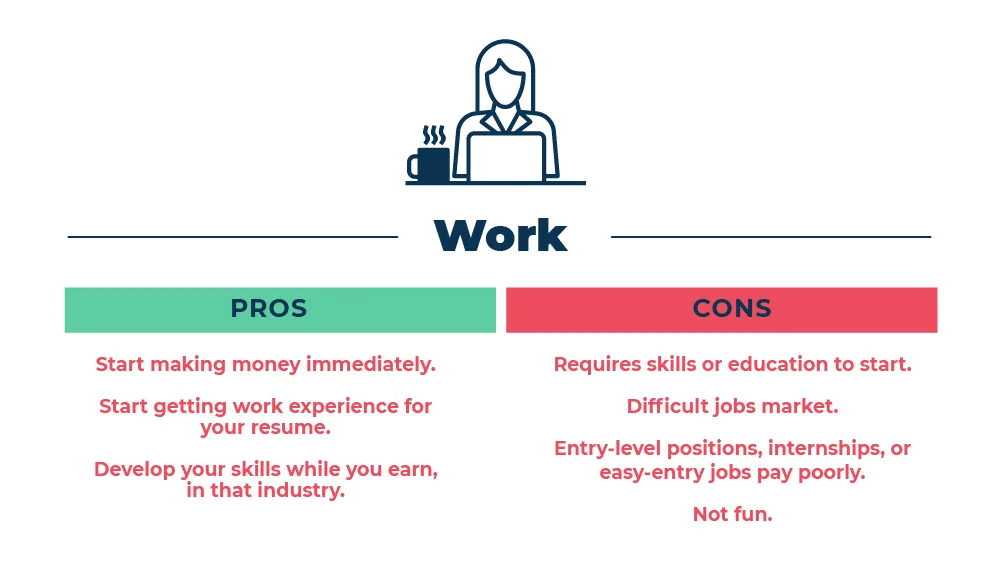
However, there are several problems with the advice of “just start working”.
Many jobs require some sort of certification for you to be eligible, or at least some proof that you have the relevant qualifications and skills to do the work.
Plus, if you find work that doesn’t have a lot of eligibility clauses and requirements for certificates or degrees, chances are you’ll be competing for those jobs with thousands of other applicants – and the jobs market is incredibly tough at the moment for these kinds of jobs. Approximately 8.2 million (40.1%) of South Africa’s 20.4 million young people aged 15 to 34 are not in employment, education or training of any sort, according to the latest figures released by Statistics SA in the Quarterly Labour Force Survey (QLFS), and the official unemployment rate increased (from its 11-year peak) by 1.0 percentage point to 30.1% in the first quarter of 2020 compared to the fourth quarter of 2019.
If you’re looking to get a job after school, the reality is you’ll need the skills – or education – to stand out from the crowd.
Why Not Consider a Bootcamp?
A coding bootcamp offers it all: you can develop in-demand, transferable tech skills; you can fit education into an active career or travelling itinerary; and you can build a demonstrable portfolio of practical work experience without needing to sacrifice years of time and lost earning potential, or having to pay hundreds of thousands of rand in tuition.
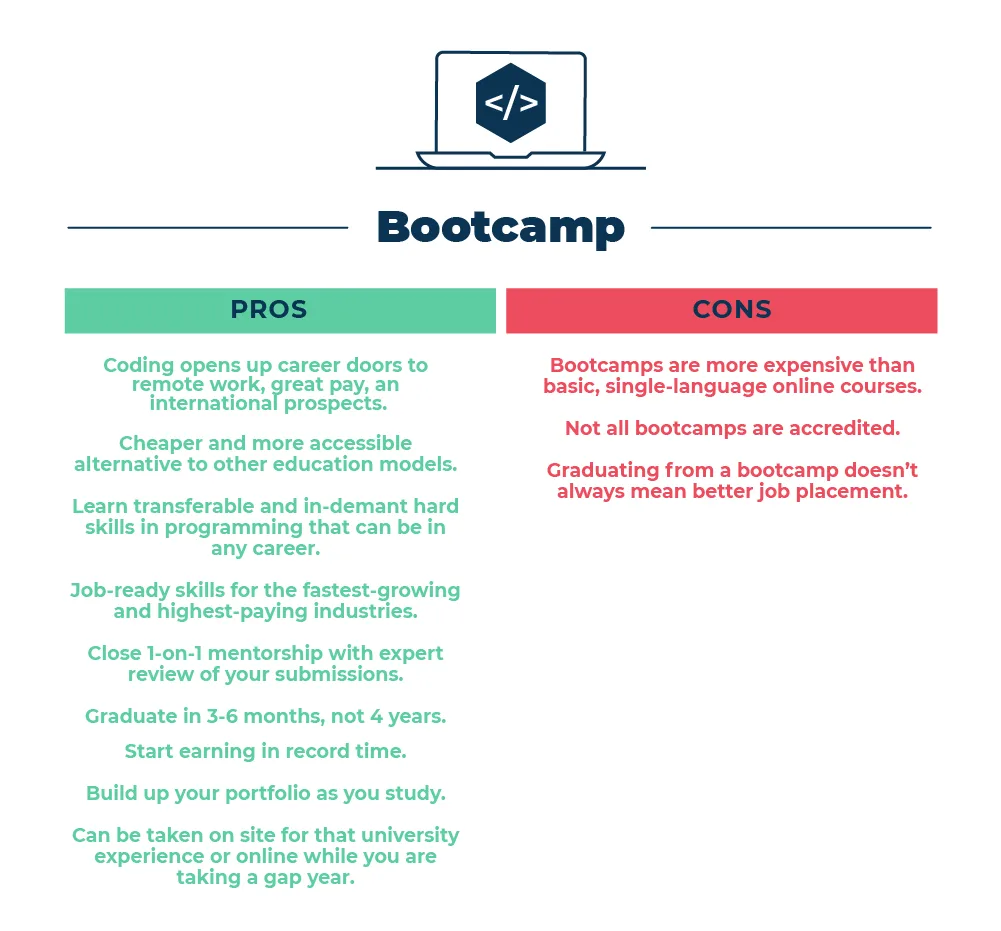
The most valuable thing about a coding bootcamp is that you’ll learn the technical skills that thousands of industries are fighting over, as they move their businesses remote, their stores online, and make their operations digital. Knowing how to code and work with technology is key to a career that is both worldproof and futureproof: so you’ll be able to work whenever, wherever, and no matter what global events break out.
Are you uncertain about what to do after Matric? Why not try our coding bootcamps? Our bootcamps are designed for you to succeed, with full dedicated mentorship, expert code review, and full career development support. Best of all, you can start learning right now, without even needing your matric or any previous coding experience. Get in touch with an Admissions Consultant to learn how we’ll help you build your future with essential tech skills.
If you want to start learning the very basics of coding, totally free of charge, then click here to apply now, where you can learn the essentials in data science, full stack web development, or software engineering.

Career Advice
10 Everyday IoT Devices Powered by Code
Here are ten unexpected and useful examples of IoT-enabled everyday objects that are making our lives more interesting.
We all too often overlook the masterpieces code creates that serve us in ways unthinkable by those who lived 100 years before us. The “Internet of Things” is seamlessly woven into our everyday lives, with IoT-enabled products in every corner of the modern home. Here are a few unexpected and useful ways that everyday objects use programming and connectivity to make our lives easier (or at least a lot more interesting).
1. Coffee Makers
A smart coffee machine that you can programme from your smartphone is a real dream come true on those hard-to-wake-up mornings. Appliances like Smarter Coffee can be controlled via your mobile device, to give you a caffeine boost on demand. You can start brewing your next cup based on time or geo-location, schedule several cups in a row to wake up your whole household, and even select your preferred strength. What a smart way to start the morning!

2. Athletic Wear
Wearable tech now plays a big role in the way we monitor our daily health and fitness levels. IoT-enabled activewear is becoming more commonplace, with smart clothing items being programmed to help you achieve your fitness goals. Some notable examples include running socks with pressure sensors to monitor your running style, workout gear that monitors your heart rate, breathing and movement, and even a “smart sports bra” that uses AI to track your workout stats and conditions. In this way, code serves some of the most natural aspects of human need. It helps to make progress measurable and keeps us in the know of what our bodies are up to.
3. Cooking Appliances
Smart kitchen devices are here to help you get cooking down to a fine art. These IoT-enabled cooking gadgets are ideal for time-sensitive or temperature-reliant tasks. Think connected crock pots, fryers, sous vide cookers and even digital, Bluetooth-enabled meat thermometers. Ever wanted a personal chef? Well no need to hire anyone, code is doing it for you.
4. Light Bulbs
That’s right, even the humble light bulb can be programmed to run code. The Philips Hue LED light bulb is one great example of this; the bulbs feature a bridge that allows you to connect them to your mobile device, and then customise the lighting in your home remotely. More and more companies are focusing on the idea of “smart lighting”, with applications ranging from security and convenience, to ambience and mood lighting with customisable colour and brightness settings. It’s fascinating that code can set a mood that aligns with where we’re at emotionally or simply conserve energy. No more hunting for that light switch in the dark.

5. Baby Accessories
Young, tech-savvy parents are choosing coded baby wear to ensure their little ones’ safety. Smart onesies, socks and hats now come with built-in sensors to track a baby’s heart rate, temperature and breathing. Programmable changing pads monitor a baby’s weight and relay collected information about growth and development to the parents. Digital pacifiers create a time-stamped log of a baby’s temperature, which helps parents to monitor and treat common illnesses. All in all, IoT-enabled baby care helps to relieve some of the anxiety that comes with looking after a tiny human.
6. Teddy Bears
Your child’s cuddly night-time protector just got a whole lot smarter, with biosensors that help to monitor activity levels, heart rate, temperature, posture and even oxygen saturation. Teddies and other soft toys can now be programmed to keep track of a growing toddler’s biometric data. This allows mom and dad to stay in the know between visits to the doctor. There’s much to be said about the intuitive, omniscient nature of the technology code is able to create.

7. Water Bottles
Staying hydrated is important, and easy to lose track of, especially when you’re busy. Water bottles like H2OPal and Hidrate Spark offer a smart solution. I0T-enabled Water bottles that leverage the power of code work with apps on your smartphone, which will notify you about your hydration levels based on your physical activity, the amount of water consumed in a certain period of time, and other key statistics (depending on your choice of bottle). This is great news for your daily wellbeing, whether you’re outdoors being active, or working at your desk for long periods of time.
8. Showers
There’s nothing quite like a refreshing shower to perk you up, and now your bathroom appliances can be programmed to give you a fully customised shower experience. Smart shower systems like U by Moen can be controlled via mobile devices or voice commands. You can easily control temperature, scheduling and timing, to ensure your whole family gets a hot shower in the morning, without wasted water, or a fight for access to the bathroom. We tend to see code as something opposite to what it is to be human. And yet we see that it can be a language of harmony and order that produces a gentler way to live.

9. Family Photos
IoT-enabled photo frames take the concept of a digital photo frame one step further. Forget the hassle of loading photos manually from your laptop – these frames are coded to automatically sync with an app on your phone, which will choose your photographs for you. You can also allow your family and friends to add their own shots to the app. Wi-Fi-enabled digital photo apps like Aura run each photo through a series of algorithms before displaying it, so you don’t have to worry about blurry, low-res shots or inappropriate pics.
10. Ice Cubes
A clever, if somewhat quirky, application that code has made possible in retail, the “Smart Cube” from Martini is a Bluetooth-enabled ice cube that uses liquid sensors to anticipate when bar patrons will need a drink refill, and communicates this to the bar staff in real-time. This nifty gadget is designed to reduce crowds and queues, while improving sales.
It’s amazing to think just how many common objects in our homes, offices and favourite hangout spots can be programmed to run code in unexpected ways. If you want to learn how to create cutting-edge code that allows you to build software and apps like these, visit HyperionDev and discover just how far this innovative industry can take you.
Editors note: this article was originally published in July 2018.

Career Advice
The 10 most in-demand tech careers of 2021
There's never been a better time to start a career in tech. Here is a definitive list of the top 10 tech careers in SA and the world in 2021.
Every year, we gather hiring reports and take a look at the tech industry to figure out which are the best developer jobs and most in-demand tech careers. We took a look at reported data from one of the world’s largest jobs platforms, Glassdoor, and carefully considered their reported data for the 50 highest earning and most in-demand jobs in the United States and in the United Kingdom. After close analysis of this data, here are the top 10 most in-demand tech careers in SA and the world in 2021.
In our estimation, these aren’t just the best and most in-demand tech careers in SA and the world in 2021, they’re also the best jobs out of almost all professions. Outside of a few outlier careers, these (and many, many other) tech jobs dominate the top 50 ranked careers in the world according to pay and vacancy availability – making tech-based jobs the best idea for any person who wants to find a vocation that pays well, has great security and opportunities, and which will bring them a rewarding and fulfilling career.
Without further ado, here are the Top 10 most in-demand tech careers in the world in 2021.
10 . Mobile Engineer
- 8th best job in the US
- Average annual salary in the US: $94,301
- 4,631 listed vacancies in the US
- 6th best job in the UK
- Average annual salary in the UK: £50,602
- 960 listed vacancies in the UK
- 4.2 / 5 average job satisfaction rating
People are using their mobile devices and phones more and more, and it shows in this year’s global career rankings. Mobile development has always been a strong career field, but for the first time, the title of Mobile Engineer has made it on the Top 10 list of best jobs in the world, ranking 8th in the US and 6th in the UK for the best job. Mobile engineers build applications, programs, and software for mobile devices, a key role in today’s ever-connected and increasingly remote and mobile workforce.
9. Information Security Engineer
- 6th best job in the US
- Average annual salary in the US: $110,000
- 5,621 listed vacancies in the US
- 18th best job in the UK
- Average annual salary in the UK: £50,276
- 677 listed vacancies in the UK
- 4.2 / 5 average job satisfaction rating
The intense growth of online activity over the last two years has meant one simple thing: millions more people, businesses, and organisations coming online. All that activity generates extremely valuable (and/or very sensitive and private) data. People want this data secure and private; they want their accounts, credit card information, and photographs safe and secure.
The job of an information security engineer (also called a cybersecurity engineer) is simple: identify, manage, and prevent risks, threats, and vulnerabilities in software, networks, and systems, and develop and implement software and solutions that prevent the many dangers of online activity (for example, hacking, ransomware, malware, and so on). It’s no surprise then that Information Security engineers have made it onto our list again in 2021: a strong contender on last year’s list, this role is ranked 6th in the US and 18th in the UK for best job.
8. DevOps Engineer
- 5th best job in the US
- Average annual salary in the US: $110,003
- 6,904 listed vacancies in the US
- 16th best job in the UK
- Average annual salary in the UK: £50,184
- 2,040 listed vacancies in the UK
- 4/5 average job satisfaction rating
DevOps Engineer once again reprises its place in the rankings for top careers in the world. Rated the #2 best tech job in our 2019 rankings, and #5 in our 2020 rankings, this career has been ranked as the 5th best job in the US and the 16th best job in the UK by Glassdoor in 2021.
What is a DevOps engineer? Simply put, it’s a software developer who also knows how to do server configuration and management, and therefore doesn’t rely on a system administrator for an operating system, platform and hardware support. DevOps engineers therefore take on more senior, high-level responsibilities in the developer world, straddling deployment and network operations as well as scripting and coding.
7. Back end engineer / back end developer
- 16th best job in the US
- Average annual salary in the US: $90,757
- 3,001 listed vacancies in the US
- 4.3 / 5 average job satisfaction rating
Back end engineers serve an important role in today’s increasingly digital business world. With millions of businesses, organisations, workers, and people relying on online web applications to do their work, shop, connect, and find entertainment, back end engineers have enjoyed a revitalised demand in the jobs market, now rated the 16th best job in the US. These tech professionals specialise in building the ‘back ends’ of web pages and applications: whenever you see a button, enter your security details, buy things online, or interact with a website’s functions, a back end engineer is a person who made that work.
6. Front end engineer / front end developer
- 19th best job in the US Front End Engineer
- Average annual salary in the US: $81,360
- 6,978 listed vacancies in the US
- 11th best job in the UK
- Average annual salary in the UK: £40,741
- 1,935 listed vacancies in the US
- 4.2 / 5 average job satisfaction rating
Front end developers are the yin to a back end engineer’s yang: they build all the visual elements, buttons, wireframes, and layouts that a back end engineer uses for their work. This tech specialisation has been a consistent top performer in our annual global rankings of best jobs in the world, rising from the 5th best job of 2019, to the #1 best job in 2020. This year is no different: with the extremely rapid growth of digital platforms, online economies, and remote businesses, front end engineers have been ranked as the 19th and 11th best jobs in the US and UK respectively.
Generally, front end engineers use their knowledge of a range of different coding languages and tech tools (such as HTML, CSS, JavaScript and various APIs) to write code to display websites on a user’s internet browser.
5. Full-stack web developer/ full-stack engineer
- 4th best job in the UK
- Average annual salary in the UK: £45,000
- 1,264 listed vacancies in the US
- 4.4 / 5 average job satisfaction rating
Ranked the 4th best job in the UK by Glassdoor, full-stack developers have officially passed their single-stream counterparts (front end and back end engineers) to claim our 5th best job tech in the world. Full-stack developers (also called full-stack engineers) take on responsibilities and work in both front end and back end development, building the visuals of websites and applications as well as coding the ‘back end’ that allows them to work as intended. Full-stack developers are highly prized because of this dual specialisation and multi-role capability, making it a highly in-demand role for any would-be developer.
4. Enterprise Architect
- 4th best job in the US
- Average annual salary in the US: $131,361
- 10,069 listed vacancies in the US
- 2nd best job in the UK
- Average annual salary in the UK: £71,392
- 1,517 listed vacancies in the UK
- 4.2 / 5 average job satisfaction rating
The career of enterprise architects takes 4th place on our list of best jobs in the world in 2021 because of its combination of staggeringly high pay and relatively extensive job opportunities and security. Enterprise architects typically take up a more senior position in businesses and tech organisations, generally second only to the CIO or CTO.
Enterprise architects are responsible for making sure that a company’s business strategy uses proper technology systems architecture to achieve its goals, and take on the upkeep and maintenance of that system’s IT services and networks. This highly technical role is the 2nd best job in the UK and the 4th best job in the US according to Glassdoor’s rankings, making it a highly prized career and easily in our Top 5 tech careers in the world in 2021.
3. Data Scientist / Data Engineer
- 2nd best job in the US
- Average annual salary in the US: $113,736
- 5,971 listed vacancies in the US
- 17th best job in the UK
- Average annual salary in the UK: £45,542
- 934 listed vacancies in the US
- 4.2 / 5 average job satisfaction rating
The incredibly rapid growth of Big Data over the last decade has only accelerated over the past two years. In the wake of the global pandemic and international mass digitisation of business, entertainment, work, and play (and almost all human activity), data is the internet’s new gold rush. Businesses understand that generating, managing, and understanding the core data and key insights of their customers is an exceedingly powerful way to unlock wider margins, better profits, more efficient systems, and bigger business. Data scientists and data engineers are their way to that better business.
There are more similarities than differences between data scientists and data engineers.
A data scientist uses data analysis tools, software, and statistics to manage, analyse, understand, and draw useful insights from complex data. Data engineers take up the more hands-on setup, maintenance, and management of the systems that track, manage, store, and analyse this data; they need to have a great knowledge of data systems and the integration of both hardware and software into a company’s data needs. They don’t just know how to work with data, but also understand the systems and processes that this large-scale analysis requires, and how to work with these technologies.
Data engineers were the 20th best job in the UK according to Glassdoor; Data scientists took the 17th best job in the UK and the 2nd best job in the US. On our list, these two roles share the #3 spot, due to their international demand and high job security.
After all, to these tech specialists, data is data: they have the tools and expertise needed to work across almost all industries and fields, making data one of the fastest-growing fields on the jobs market
2. Software engineer
- 9th best job in the US
- Average annual salary in the US: $110,245
- 40,564 listed vacancies in the US
- 4.3 / 5 average job satisfaction rating
Software engineers are a generalized developer role, typically making all kinds of software for all manner of business, entertainment, and computer needs. Software engineers do all manner of jobs, thanks to their transferable skills and deep knowledge of one or more programming languages. This places them at #2 on our list of best tech careers in the world in 2021.
Software engineers have always enjoyed incredible pay, boundless career opportunities, and solid job security. This role took the #9 spot in our 2020 rankings of best tech jobs in the world, having been ranked the 6th and the 7th best job in the world by Glassdoor in 2019 and 2020.
1. Java developer
- Best job in the US
- Average annual salary in the US: $90,830
- 10,103 listed vacancies in the US
- 4.2 / 5 average job satisfaction rating
A Java developer does exactly what it sounds like: uses primarily the Java language to create high-functioning web applications, software, and programs. Java developers have long enjoyed the top ranking job of the world, rated as the #1 top job of 2021 in the entire world by Glassdoor, an improvement from its 2020 ranking of second best job in the world. Java is still one of the most popular programming languages in the world, reflecting both the global demand for experienced Java programmers, and also the growing ubiquity of applications and companies using Java for all kinds of tech applications and features. This year, Java developers are our #1 best tech career in the world.
Our human-led coding bootcamps teach you all the job-ready tech skills you need to enter any of these top 10 tech careers in South Africa and across the world. Our intensive coding bootcamps combine personalised coding education support from our expert code reviewers with industry-aligned practical skills training to give you exactly what you need to start building software, applications, websites, and other tech applications.
Best of all, you’ll get all the help you need in preparing for and launching your job search with our Graduate Program. With our technical CV writing assistance, portfolio creation help, mock interview training, career coaching, and networking springboard, you’ll graduate with an unrivalled edge to find your high-paying, in-demand tech career.
Enrol now to secure your seat on our intensive coding bootcamps.

Career Advice
What are the expectations of a junior developer?
The expectations of a junior developer do not include moving mountains - at least not in your first few months. Here’s what you can expect!
So you’ve just landed your first job as a Junior Developer. You’re likely feeling excited, nervous and maybe slightly overwhelmed at the prospect of being an actual developer. The first thing to remember is that companies offer Junior Developer jobs because they see it as an investment for long-term growth as opposed to an immediate payoff.
The promise that lies in building you into a formidable developer is where the demand for Junior Software Developers forms. That means you can relax (a bit!) and anticipate an exciting immersion into real-world experience. This leap from a bootcamp or short course is sure to massively fast track your progress. We’re going to take you through the timeframes that you’ll encounter as a Junior Developer and precisely how to approach these periods.
Starting out as a junior developer
Different companies look for different skill-sets. You may be expected to be a “specialist generalist” and have broad knowledge and experience with using a number of languages and libraries. Alternatively, you may be expected to be a specialist in one language like Python or Ruby.
The best idea is to throw yourself in the deep end, and let go of the notion that you have to know everything and get everything right. After all, if you got everything right, the experienced developers that guide you wouldn’t have a job to do.
Your best hacks are to be transparent – being vulnerable enough to indicate where you’re getting stuck or where you’re not understanding something. That will be both sincere and appreciated. People will be eager to help because everyone knows what it was like to start out. Be proactive and do your level best. Coworkers notice that passion and will always be happy to offer a helping hand.
If you need to know more, plug into the dev community and ask for help, contact your lecturers or connect with a senior developer and ask questions. Read widely, set your Google alerts to flag the latest news on relevant topics, and stay in touch with what’s going on in the world of code. A proactive approach to learning the ropes can make the difference between a Junior Developer who gets overwhelmed and goes back to the drawing board, and the type who acknowledges their shortcomings and makes up for them by having a deep curiosity and a good mix of humility and confidence.
Your first three months as a junior developer
As a Junior Developer, you’ll be tasked with small and relatively simple bug fixes like typos or fixes that generally only involve a few lines of code. You may also be expected to attend and contribute to company development meetings and assist the development manager with many aspects of software design and coding. The hack here comes down to an attitude of willingness. Stay open-minded and it will fill up with all you need to know.
During your first three months, your employer will be sussing out much more than your ability to code. Do you put in minimal effort to get the job done or resort to quick fixes? Or are you conscientious about even the smallest tasks and make sure you double check your code? Hopefully, you’ll adopt the latter approach because in the long run, developers who scrutinise their own work, ask for second opinions and draw on the experience of those around them, are the ones who advance to senior level and build viable careers.
According to Tom Kleingers, the owner of web architecture consultancy, Evanston Avenue: “The best Junior Developers find solutions to issues by using the tools at their disposal.” Being resourceful is key. Even when you don’t have all the answers, it’s important to develop a sense of ownership over your work and make use of the tools and knowledge available to you.
Your first year as a junior developer
As Ken Mazaika explains, during your first year, you’ll grow accustomed to something called “sprint planning.” This term describes a process whereby a traffic manager or dev team leader will receive build jobs, bug fixes and coding work as well as deadlines for when these tasks need to be completed. Once these tasks have been assigned, the team will meet to assign tasks to devs.
In the beginning, as a Junior Developer, you will be assigned the easier, quicker jobs with shorter lead times. Don’t underestimate your importance in the work cycle – your role is to solve problems quickly so that more senior developers can solve the longer term problems.
Give yourself a few months to settle in and get comfortable with the processes. Then, challenge yourself and ask to be assigned a task that’s a bit more complicated than what you’re used to. Be proactive about your growth as an employee and don’t be afraid to test your limits. Sometimes getting ahead is all about taking a few calculated risks.
Eventually every Junior Developer wants to know what they can do to level up their career and become a senior – and that’s another topic entirely. However, one key hack is to get a mentor and stick to them like glue. The final piece of advice is to simply put in a few extra hours of learning and you’ll remain one step ahead.
Are you wanting to make a move into the world of tech? Our expert-guided approach helps people develop job-ready, practical coding skills and start their career in tech in as little as 3 months. Our focus on practical experience and human-led learning means that you’ll make fast progress and learn to write code at the level that real developers do.
Enrol in a HyperionDev bootcamp with just a few clicks.
Editors note: this article was originally published in January 2019.
Career Advice
Software Development Creates Opportunities for SA’s Youth
As jobs are becoming available in the tech space, it is vital to bridge the digital skills gap in South Africa.
Youth unemployment has hit a record high, with 64.4% of those aged 15 to 24 unemployed, according to Statistics SA. As more and more jobs are becoming available in the tech space, it is vital to bridge the digital skills gap in South Africa to minimise the youth unemployment rate and improve the livelihoods of young people in the country.
This is according to Riaz Moola, CEO at HyperionDev, South Africa’s leading provider of tech education, who says that the rise of the Fourth Industrial Revolution has resulted in an influx of digital job opportunities.
“However, locally this demand far exceeds supply, leading to a severe skills gap.”
This is reflected in the Institute of Management Development’s (IMD) Digital Competitiveness Ranking which ranked South Africa at 60 out of 64 countries in 2021. The report measures the capacity and readiness of the same economies to adopt digital technology, with South Africa’s overall top weaknesses listed as digital and technological skills, as well as higher education achievement.
With this in mind, Moola points out that a viable career for local youth to consider is to become a software developer. Here are his top reasons why:
Software development has a relatively low barrier of entry: Programming is far more accessible than most other conventional careers. For example, law, medicine, accounting, and engineering require expensive degrees, years of study, and intensive exams or industry body registrations to accreditations to work in that profession.
“Programming, on the other hand, offers a range of far more accessible education paths such as mentor-led bootcamps and online courses,” adds Moola. “Plus, the ability to write good code and being able to prove your experience in creating highly functioning programs are far more valued by prospective employers than degrees.”
Software developer skills are future-proof: COVID-19 and the national lockdown highlighted the importance of tech skills. “As brick-and-mortar shops and traditional industries ground to a halt, the tech space thrived with internet use, online and digital services skyrocketing.”
“Chatbots, websites, online stores, and new customer platforms became essential, however, they need whole teams of trained professionals to keep them running smoothly,” Moola explains. “In short, the world relies on software developers more than ever, meaning job security in this industry is relatively stable.”
Demand for programmers outweighs the supply: He adds that even before COVID-19 forced hundreds of businesses to turn to online and digital services to keep their operations going, the tech industry was a growing force.
“To this day, the demand for professional programmers far outstrips the supply, and with more and more businesses going online, that demand is only set to increase.”
Moola points out that the high cost of traditional tertiary education remains a challenge for many in South Africa.
“As such, to assist local youth to realise their dreams and improve their livelihoods, HyperionDev has launched student funding assistance and scholarship programmes which are already helping hundreds of students start their rewarding careers in the tech sector,” he says.
“As the digital world is constantly evolving, it offers a world of opportunities for South African youth from all walks of life,” he adds.
“However, it is vital that all players in the country provide as much support as possible to provide them with much-needed accessible education to forge future-proofed career paths,” Moola concludes.
If you’re thinking about starting your career in tech, or switching careers to a highly-paid developer role, our bootcamps are the ideal way to accelerate your job-ready skills development and fast-track your career start. Our in-depth student assistance, expert code review, and focus on practical capstone projects equips our graduates with the critical software engineering, data science, and web development skills they need to start their careers.
Learn more about HyperionDev’s world-class, affordable, and beginner-friendly coding bootcamps.

Career Advice
How to stand out from the crowd as a new developer
HyperionDev alumnus and developer, Mordi, shares the two fundamental things that helped him in his journey to a fulfilling tech career.
Mordi Goldstein is a HyperionDev graduate and professional full-stack developer working at Simply Anvil. In this HyperionDev Alumni article, he shares his insight into the difficulties that new developers face when starting out their career journey and provides two simple solutions for overcoming these challenges.
—
What are the skills that will take you from just starting out learning to code, to working as a professional developer?
It’s a deceptive question. Of course, knowing how to code is an obvious part of the answer. However, it’s so much more than that, especially with the growing number of people who are (or are becoming) software engineers and developers. So, how can you stand out from the crowd as a junior developer or someone who is learning how to code?
There are many skills (other than actually knowing how to code) that are important for success in this industry. In this article, I will focus on the two which I believe are critical for new (and even experienced) developers: testing and continuous learning. These two things can be the difference between good and great.
Let’s take a closer look at each.
Tip #1: Testing
The secret to writing high quality code is testing. Yes, it’s not a well-kept developer secret that testing can be viewed as the most boring part of coding, but I guarantee that it is the most valuable, as it can save you a lot of potentially wasted labour and time.
Writing your tests before you write the code forces you to think through the problem you are trying to solve: what you need to solve it, how it will work, and what success looks like.
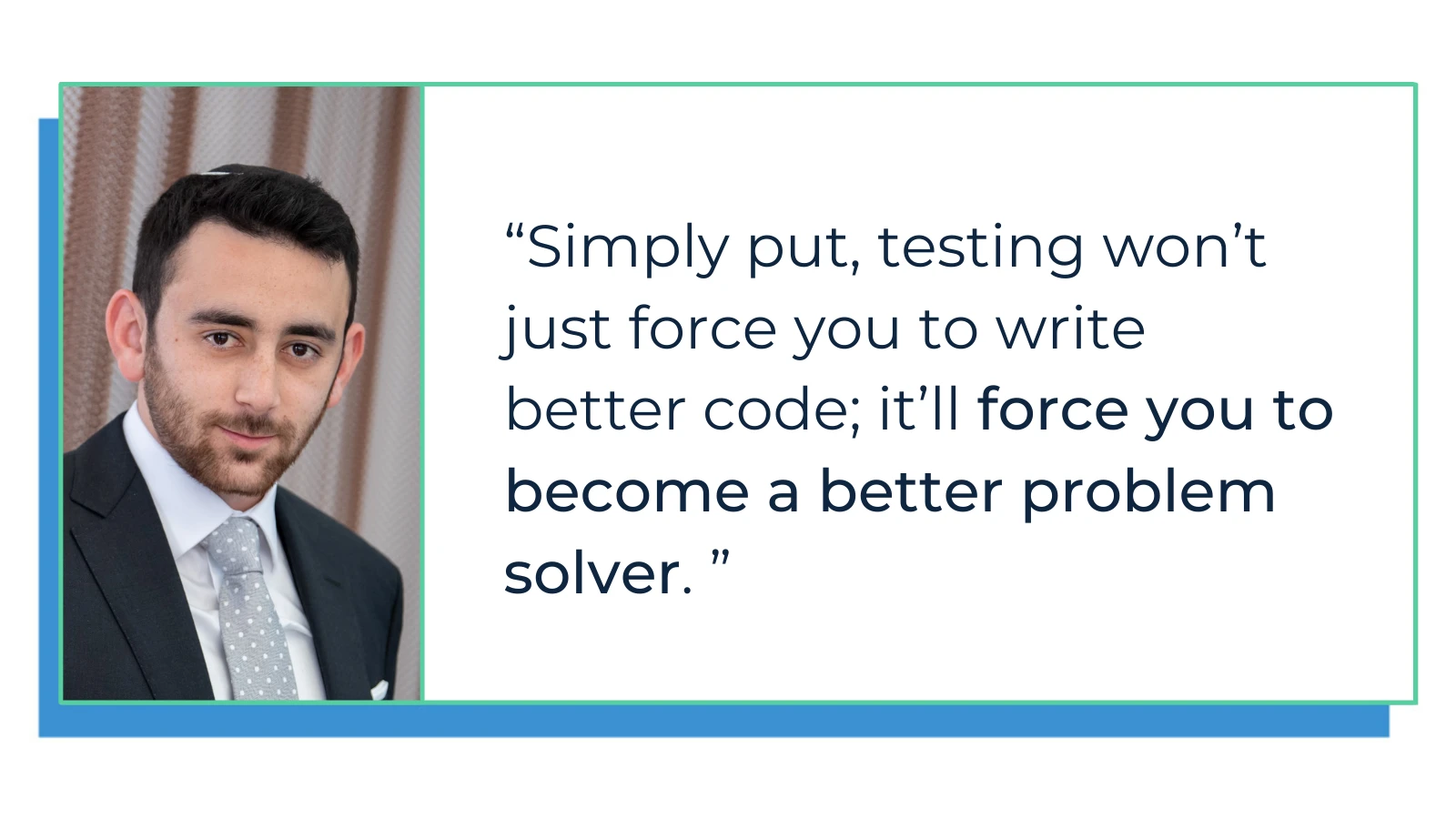
Testing is crucial for high-quality code. What’s more, if you or someone else ever needs to revisit a piece of code you’ve written, it will be much easier to figure out what’s happening in the code and how to work with it.
More importantly, the benefits of good testing practices go far beyond your coding. Learning what metrics define success and continuously testing for those, enables you to iterate and improve quickly. This process can be extremely valuable in situations other than coding, and it often lies at the heart of success for people and companies. Simply put, testing won’t just force you to write better code; it’ll force you to become a better problem solver.
Tip #2: Continuous Learning
Learning how to code is not a once-off process. You can’t complete a course or bootcamp and think that you now know everything you need. Success in coding is a product of continuous, never-ending learning. This learning can take shape in different ways.
One of the most important aspects of learning is being curious. Reading blog posts, listening to podcasts, following social media, watching YouTube videos, and exploring new and interesting topics – these are all great ways to keep learning and honing your abilities.
The world – and especially the tech world – is changing quickly. Being a software engineer who has their finger on the pulse of what’s happening around them makes you a great asset.
However, remind yourself that you are not expected to be an expert in everything. It is totally normal to get stuck on a problem and to have to work hard (or work with others) to solve the problem.
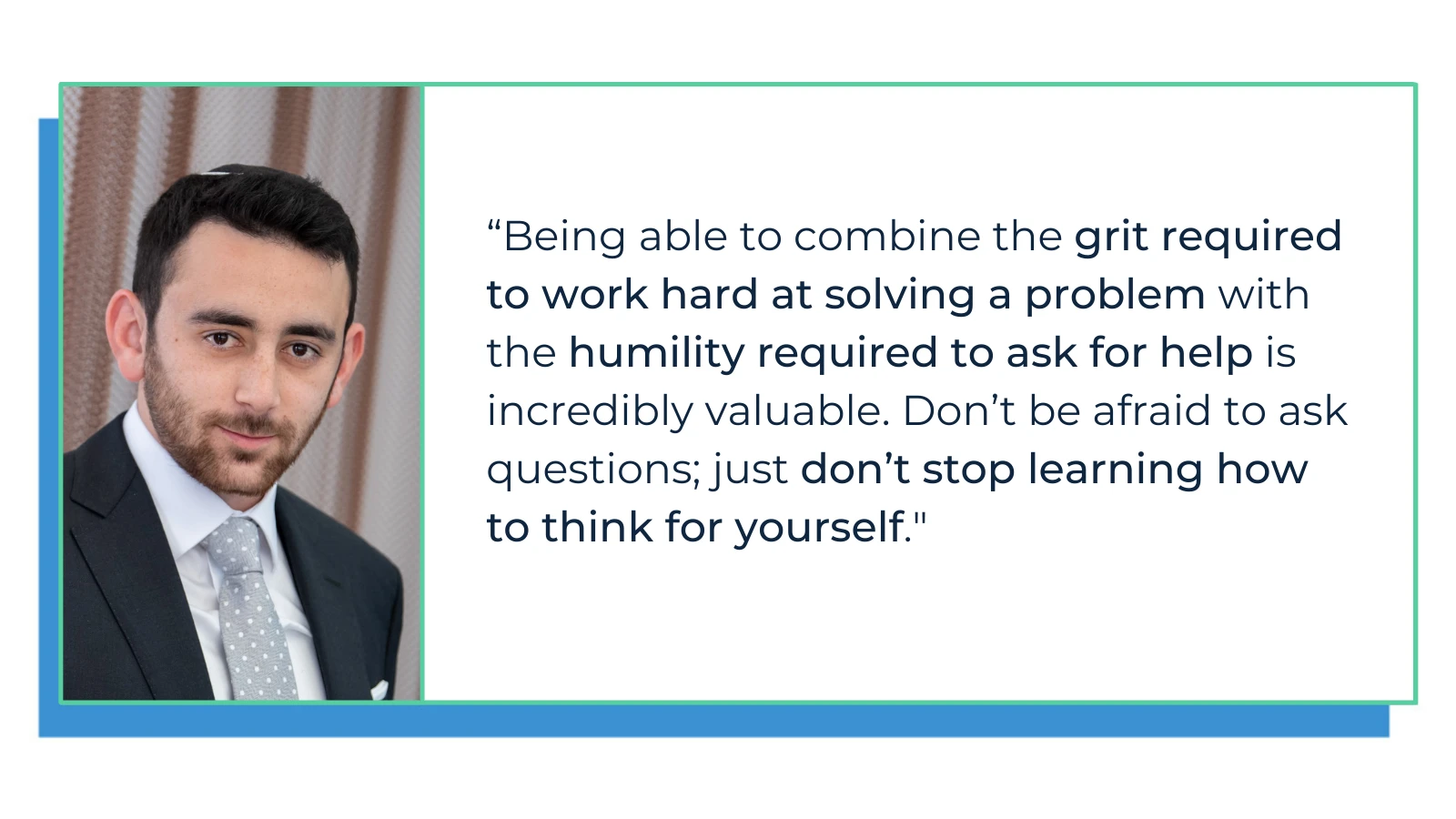
Asking questions is a vital part of learning. It is important to ask questions and get advice from those around you and, at the same time, it is critical to learn how to problem solve. Jumping to ask for help as the first response every time you get stuck is the wrong approach. However, being able to combine the grit required to work hard at solving a problem with the humility required to ask for help is incredibly valuable. Don’t be afraid to ask questions; just don’t stop learning how to think for yourself.
Stay curious and keep learning
There are, of course, many possible ways that young developers can stand out as they start their coding careers. However, good coding practices, networking, and all the other go-to tips you’ll hear are rooted in these two simple things: continuous learning and testing.
Software development is a fascinating field and I am obsessed with the feeling of building, creating, and solving problems. I started my coding journey in May 2020 with online courses and YouTube videos. I quickly became obsessed with coding! I did theHyperionDev part-time web development bootcamp which was a game-changer for me. After the bootcamp, I completed another online data science course until I could find a job.
Shortly thereafter, I started an internship, which is now a full-time, permanent job. Being a developer encourages you to think, problem solve and collaborate. It can be competitive and standing out from the crowd can be challenging – take it from me, learning how to test and how to learn are two skills that can help you stand out from the crowd.
—
Are you like Mordi? Passionate about technology, interested in learning to code, and eager to get into the exciting and rewarding tech career space? Our bootcamps are the ideal place for you to do just that. Our expert-guided approach helps people develop job-ready, practical coding skills and start their career in tech in as little as 3 months. Our focus on practical experience and human-led learning means that you’ll make fast progress, with experts on hand 24/7 to help write code at the level that real developers do.
Enrol in a HyperionDev bootcamp with just a few clicks.
Share your words with our wide network of graduates, students, and industry tech professionals. Write for our blog and get your voice heard.

Career Advice
What’s the difference between a HyperionDev bootcamp and an online course?
When deciding to kickstart your coding journey, there are so many options available. So, bootcamp vs short course - what's the difference?
If you want to learn to code and start your tech career, you’ve no doubt been flooded with countless options in your search for the best way to do it. So, in this piece, we’ll be comparing a HyperionDev bootcamp vs short course; what’s the difference between a bootcamp and an online course, and which should you take? We’ll explore the differences and determine which one is right for you.
Before diving into the details, let’s take a high-level look at the key differences between a HyperionDev Bootcamp and an online short course.
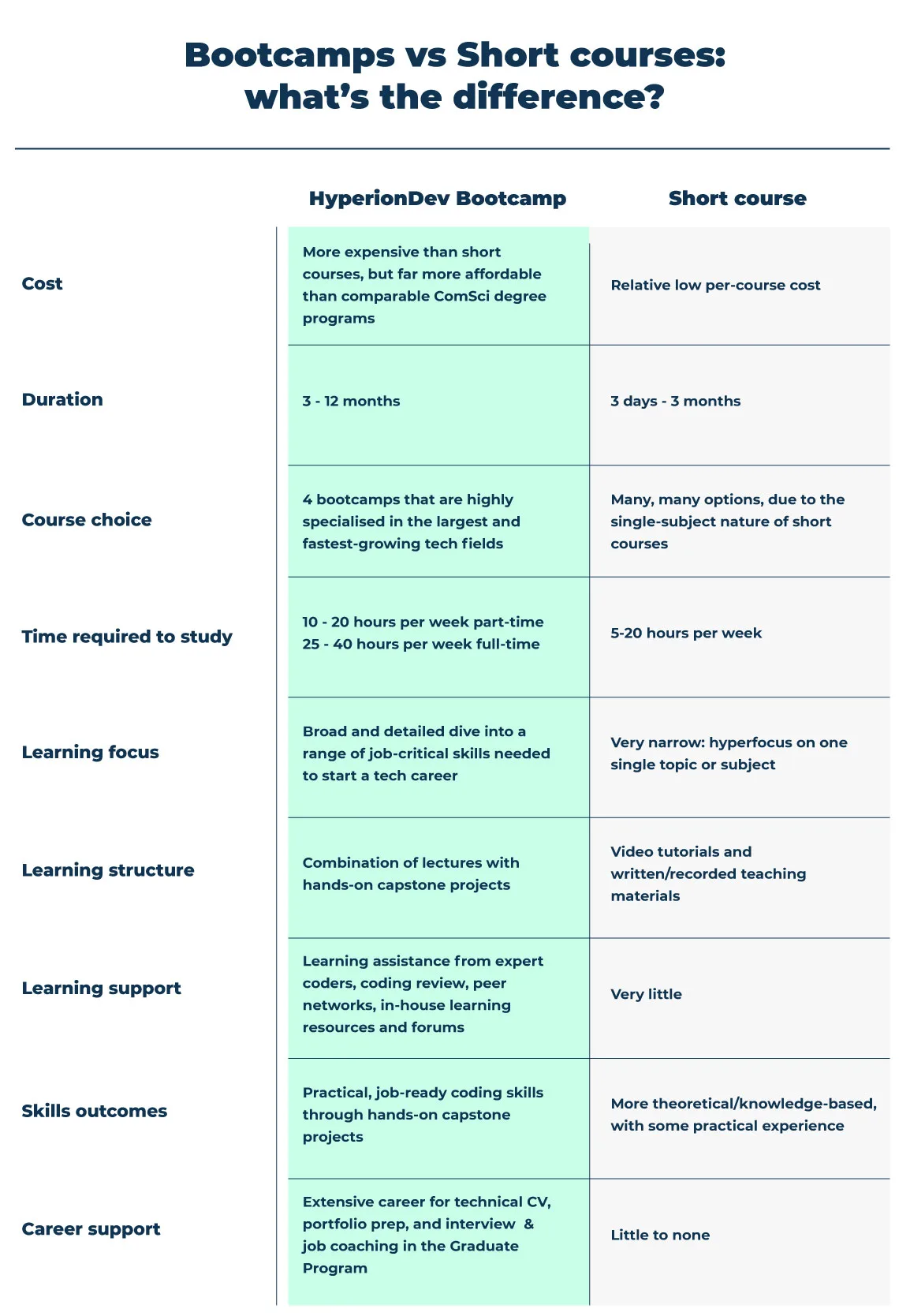
Learning and skills development: Bootcamp vs short course
There are many, many short courses out there, so it’s difficult to pin down exactly what each one teaches. In general, the focus tends to be more narrow and focused on one specific skill. A short course might teach you HTML, or database management through SQL, or how to style your web pages in a certain way through CSS – but it will typically teach only that one subject, with little to no overflow into areas covered by other, topic-specific short courses.
Coding bootcamps, on the other hand, teach a far broader range of technical skills that range from entry-level functions to more advanced techniques. This wide range of subjects usually features several hands-on exercises and practical capstone projects, aimed at helping students practice real coding techniques they’ll be using in an actual developer job.
The aim of an online bootcamp, states Business Insider, is “to take in students with minimal coding knowledge and shoot them back out a few months later as employable software engineers”. And that’s exactly what HyperionDev’s bootcamps do, and have done, for thousands of students [link to success stories page].
HyperionDev offers four coding bootcamps, each specialising in a highly in-demand area of the tech industry. These include:
- Software Engineer Bootcamp
- Web Developer Bootcamp
- Data Scientist Bootcamp
- Immersive Fullstack Web Developer and Software Engineer Bootcamp
Learning duration: Bootcamp vs short course
A short course is made for developing a specific skill, and so in general they’re much faster to complete than bootcamps. Depending on their level of difficulty and their scope, a short course can take anywhere between 3 hours and three months to complete.
This usually means that in order to develop a well-rounded skill set you will need additional short courses, more time, and more money. For example, you might complete a short course in MongoDB – however to become a full stack developer, you’d need to take more courses to learn Express, React, Node.js, Linux, Apache, MySQL, or PHP to be able to do the job.
Bootcamps take slightly longer than a short course because they roll all necessary career-critical skills into one curriculum. Bootcamps can take anywhere from 3 months full-time for single-stream specialisations (e.g. web development or data science) to 12 months part-time for highly advanced, multi-specialisation bootcamps (such as our Immersive Full Stack Web and Software Engineer bootcamp).
That being said, bootcamps are still a faster way to develop tech skills than the traditional computer science degree.
Time and effort requirement: Bootcamp vs short course
Short courses are typically designed for module-centred learning in short, digestible bursts or for a relatively deep and concise dive into a single topic or area. This means that a short course will ask you to spend anything between 1 hour to 20 hours per week on them.
Bootcamps tend to require more time, due to their immersive, hands-on nature, and their progression from beginner fundamentals to advanced techniques.
At HyperionDev, bootcamp students typically require up to 20 hours a week for a part-time bootcamp, and up to 40 hours a week for a full-time bootcamp.
Learning structure and focus: Bootcamp vs short course
When it comes to the content that short courses teach and how they teach it, it’s simple and hyper-focused. Short courses would cover all or most of a single subject or topic, teaching the most critical parts of that material.
This is great for people who have an existing skill set and want to expand it with specific new skills, taught as concisely as possible.
Similarly, short courses have a learning structure that sticks to the essentials, with very little supplemental material or additional learning outside of the core focus area.
This learning is typically done completely on your own and in short bursts, making it more suited to self-driven learners.
In contrast, a HyperionDev coding bootcamp focuses on a range of career-critical, job-ready skills. They start with the fundamentals of coding and other critical tech skills, and work towards increasingly more technical and advanced concepts. In this way, a coding bootcamp develops the well-rounded and extensive skill set that today’s tech companies and start-ups are looking for.
Learning and career development support: Bootcamp vs short course
In general, coding bootcamps offer far more learning and career development support than an online course. Online courses focus purely on teaching the subject matter. They can be cheap, but that low cost comes at a price: many online short courses offer little to no personal learning assistance or support outside of their learning material.
In contrast, bootcamps feature multiple, rich layers of student learning support. At HyperionDev, for example, students get full access to a support network of expert code reviewers and access to a community of fellow peers who are on the same coding journey.
What’s more, our student support doesn’t stop at graduation: with our HyperionDev Graduate Program, graduates get extensive career development support, including technical CV assistance, help creating their developer portfolio, and detailed career and interview coaching.
If you’re thinking about starting your career in tech, or switching careers to a highly-paid developer role, our bootcamps are the ideal way to accelerate your job-ready skills development and fast-track your career start. Our in-depth student assistance, expert code review, and focus on practical capstone projects equips our graduates with the critical software engineering, data science, and web development skills they need to start their careers.
What’s more, we do it in a fraction of the time and cost of traditional computer science programs, and with all the intensive student support and career development assistance that many short courses simply don’t offer.
Enrol in a HyperionDev coding bootcamp today!
Editors note: this article was originally published on Jan 11th, 2019.
Still have questions?
Contact our Admissions Team, and a real person will get back to you.