
Career Advice


Career Advice
What do Software Engineers do?
What do software engineers do? This article explains what software engineers do, as well as the skills and technologies requires to be a software engineer.
Ever thought you might want to become a software engineer? But what do software engineers do? Well, here are some options. You could find yourself:
- Controlling the movement of assembly line robots.
- Creating the intelligence of online characters like those found in games like The Sims.
- Developing software for GPS so drivers don’t get lost.
- Writing software to make it possible for people to communicate over great distances. Think of the benefit small companies now have to hire workers from all over the world. And how remote office environments have radically changed conditions of employment.

Dr. Melanie Willett, content writer at HyperionDev and former ICT lecturer at Nelson Mandela University and CTI Education Group, explains that there is a difference between a developer and software engineer. “Put simply,” she says, “the difference is that a developer is usually thought of as someone who mainly writes code to solve a problem, whereas an engineer, engineers the solution to the problem. They design the solution, see which components are needed for the solution, how they interact with other systems and users etc.”
So if you’re someone who wants to develop cool video game computer software or you want to make the software run faster on different computers or those that have different operating systems, you should think about software engineering. You’re basically using computer skills to solve problems with software and software is everywhere.
Think about it. Says Willett: “Software affects almost every aspect of our daily lives. You cannot go a day without encountering some sort of software; software is everywhere.” The interesting thing that you may not realise is that software is not just a computer program that provides specific features and functionality. It also includes all the associated documentation and configuration data to ensure that the software operates smoothly and effectively. And of course, there’s also software sold onto customers, known as software products. Software engineering is basically an engineering discipline concerned with the development of software products, using well-defined scientific principles, methods and procedures.
<Quick Read: If you want to more about what a software engineer does on a daily basis, then read this interview with Jeff Hagen who works as a manager for a team of software engineers.>
Software Engineers: Key Requirements
So have you got what it takes to be a software engineer? The good news is that you don’t need a Computer Science degree – an informal education is sufficient (such as an online coding bootcamp), as long as you learn the appropriate technologies and can code proficiently. In addition, companies frequently look for other things besides your credentials. This includes big tech companies like Google, which, in a New York Times piece, states that the “proportion of people without any college education…has increased over time”. And that cognitive or learning ability, the skill of processing on the fly, is more important.
If you want to become a software engineer, you should possess the following:
- Deductive and inductive reasoning
- Mathematical reasoning
- Original thinking
- An understand of what people want from their computers
As far as computer languages and technologies go, Willett explains that it depends on the application you’re building and the environment in which you find yourself. In the Software Engineering Bootcamp at HyperionDev, we teach Java and Python, which are good languages because of their “versatility and their ability to be used to build many different types of applications in different environments – e.g. desktop, mobile and web,” she says. Besides programming languages, you should also be comfortable working with one or more software development frameworks, such as Eclipse or Django, and you should have a good grasp of how to apply the most important aspects of computer science, data science and software engineering to the software development process.
<Read about how to become a software engineer in South Africa.>
If you decide to switch careers to become a software engineer, what can you expect?
Software Engineering: The Working Life
Good Job Demand
In the US, there are currently about 718,400 Software Engineers. This is expected to grow by 24 percent from 2016 to 2026, much faster than the average for all occupations, according to the Bureau of Labor Statistics. Also, increasing automation of various industries will contribute to that growth, as well as greater concern about computer security.
High Pay
The median US salary for software engineers is $98,260 per year, with a range between $57,340 and $153,710. Here is more information on developer salaries by region internationally.
Wide Range of Work Environments
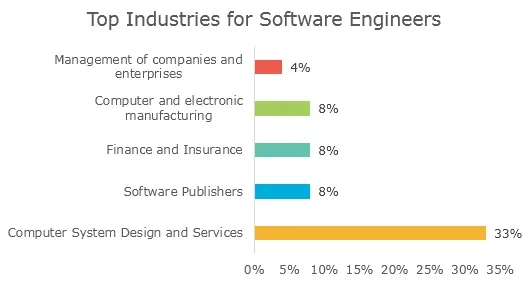
Although you’re likely to work in a tech company, this doesn’t have to be your only option. As can be seen from the graph below, there are a wide variety of settings that will appreciate your software engineering skills.
Lastly, what makes a good software engineer? Here are a few ideas.
Software Engineers: What Makes a Good One?
You might think software engineering is just about technical experience and knowledge. However, this is not entirely true. A good software engineer is more than the sum of their technologies with which they have worked. Below is a list of some important characteristics embodied by these professionals:
Passion for code – you should have an inherent interest in programming and enjoy working with code.
Good team player – you’ll frequently find yourself working as part of a team.
Excellent communications skills – you have to be able to communicate with team members and clients, as well as write reports and give instructions.
Curious – you’ll be the sort of person who wants to know why and how things happen. This enables you to think out the box and come up with creative solutions.
Broad technical experience – you should know a variety of computer languages, as well as agile methodologies, task management software and version control. And of course you must be willing to continue studying and learning new technologies.
Check out HyperionDev’s Software Engineering Bootcamp.

Software Engineering
Run multiple operating systems on your PC without dual-booting
Learn to run multiple operating systems on your PC without dual booting. Learn about local desktop virtualisation and its uses.
Curious about running an operating system from within another operating system? This practice is called local desktop virtualisation, and has plenty of practical uses.
What is local desktop virtualisation?
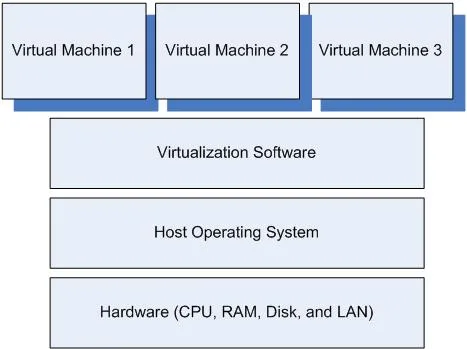
Virtualisation on its own is the practice of separating the logical execution of operating system software from the underlying hardware it runs on. This means that many logically and geographically differing hardware components can be virtualised as a single computer for the software it is running. However, this is often an enterprise focus, so you’ll likely be exposed to local desktop virtualisation instead. The latter is using software to emulate a virtual computer system using local hardware, from within an existing operating system running on that local hardware. The computer the virtualisation software runs on is known as the host, whilst the guest is the “virtual machine”(VM) which runs inside the software on the host.
The VM software itself (referred to as the hypervisor) has the ability to use the hardware running on your host computer and simulate an instance of that hardware as a guest machine. It allows resources such as RAM, CPU cores, USB peripherals, keyboard and mouse input, and more which are part of the host computer to be allocated to an operating system running in a virtual environment. The VM is a container running on the hardware platform of the host computer.
The guest is an entire operating system, but it only “sees” the hardware of the host through the hypervisor that defines what resources are passed through. This means you can emulate other hardware to the VM via the hypervisor than what your PC actually has, if necessary. Both the previously mentioned resources, but also network adapters, USB devices, and shared network folders can be shared between host and guest.
Why is virtualisation useful?
Running VMs can have many benefits. Firstly, compatibility. How often have you not needed another operating system, such as an older version of Windows because some software package won’t work on the newer, shinier iterations? Secondly, security. You can test drive a beta OS, or run a sandbox, isolated from your personal data, without having to switch between OSes. Thirdly, if you’ve had a task which needed the Linux terminal, for example, it’s very convenient to just use a Linux VM. You’ll save yourself the hassle of re-partitioning your storage, setting up a dual-boot system or accidentally overwriting your bootloader. Also, because you can set up plenty of VMs for each use-case, you can keep using your host OS while you use your VM, because the VM is just an application window.
Aside from the usefulness of OS-in-OS, VMs are often used on high-powered high-resource servers, with each one playing a different sort of role i.e one a fileserver VM, another a database VM, and so on.
As expected, running a hypervisor with a VM means sacrificing your host OS’s resources while the VM is running, so you’ll have to have enough RAM, hard disk space, and CPU power to allocate to your VM and make sure your host OS doesn’t choke for lack of resources.
If you’re interested to apply these concepts in practice, check out our tutorial to setting up VirtualBox on Windows and installing Ubuntu as a VM.
Comment with your views on this article in the comments section below, and follow Hyperion Hub developments in the future if you’d like to see more articles like these for the South African market.

Career Advice
5 programming Terms You Need to Know
Software Development Dictionary - five concepts explained: Responsive Web Design, Object-Oriented Programming, Agile dev, Compiler/Linker and Patching
Are you unsure what a software development-related concept entails? Is it a term commonly used but never explained? Here, we’ll touch on 5 such terms and help you update your software development dictionary:
1. Software Development Dictionary: Responsive Web Design(RWD)
Put simply: if you find yourself having to pan and zoom repetitively around a site, then it probably isn’t designed using RWD. Responsive Design is a programming approach that uses a website’s CSS functions to gauge the dimensions of the browser it’s running in, and resize, crop and move assets and text around based on that size. This should be done on-the-fly if a user decides to resize their browser, but is primarily used to allow viewing the same site on multiple devices (PCs, phones, tablets etc.) without having to design a separate “mobile” version of the site.

2. Software Development Dictionary: Object-Oriented Programming
This is a programming model focusing on objects to be defined instead of actions to be taken (the latter is the traditional “procedural programming” model). To compare it to traditional models, a “program” in traditional methods is just a procedure of logic where input data is processed and outputted in some way. In OOP, the focus is on the objects you want to manipulate more so than the logic needed to do so. Objects may be categorized into generalised “classes”, which inform the program exactly what features (“attributes”) the object has, and what logic can be used to manipulate it (“methods”). Properties such as inheritance allow “type-of” relationships between objects. (i.e. “VW is a type of Car” given a car base class and a VW derived class)
3. Software Development Dictionary: Agile Software Development
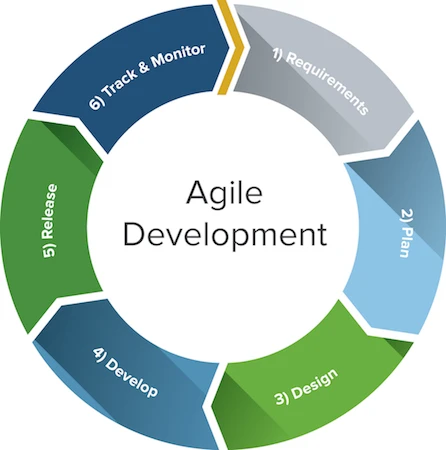
Certainly a popular term the past few years, the “agile” approach to software development seeks to change the ‘traditional’ paradigm of code design. In the past, rigid steps (as in the Waterfall Model) had to be followed if software was to actually get to market. Code would be written, tested completely, and signed off on before the next stage began. Plenty of form-filling and rigidity was the norm here. Agile methods instead championed developers responding quickly to change, and encouraging changes of plan, having frequent client-developer interactions, and using new methods like pair programming and self-motivation as opposed to set deadlines, to build software.
4. Software Development Dictionary: Compiler/Linker
Usually a part of an IDE, but can be used on its own. The compiler is the software portion that takes the high-level language you’re coding in and translates it into something lower-level, to be understood by the computer you’re compiling on. This lower-level language is referred to as machine code.
The linker is the helper to the compiler. Once the compiler has generated the machine code from the high-level language, it stores the machine code in some form of generic object. The linker’s purpose is to aggregate the objects generated by the compiler, as well as any dependencies the program needs (read: the includes you added in your file or the libraries it needs to use) into one neat package.
5. Software Development Dictionary: Patching
This is common for large software projects. A patch is a piece of code, or some new executable, which is created in response to a deficiency in existing code. Patches often correct bugs discovered by users in software, or could treat vulnerabilities in code which are endangering the security of users. Patches do not have to be the optimal solution, but simply the stop-gap measure for an issue (these are often known as “hotfixes”).
How many of these terms were you already familiar with? Was there anything new you learnt? Comment with your views on this article in the comments section below, and follow Hyperion Hub developments in the future if you’d like to see more articles like these for the South African market.

Career Advice
5 MORE Python Packages South African Developers Should Know About
Five More Python Packages for South African Developers - if you require functionality, the changes are high that someone has developed a package.
The Python community is alive and growing at a staggering rate. It is an active community that has many benefits. New people bring new ideas, fresh perspectives, and different levels of experience.
One such benefit is the proliferation of packages. If you need functionality, there is a good chance that someone else needed it before you. The beauty of the Python community is that most of these functions become packages.
“There should be one — and preferably only one — obvious way to do it.”
-The Zen of Python
This is not always the case, sometimes you have options, so many options. Feel free to explore them all. Before you do, make sure you have the first of these packages installed.
Here are 5 more packages you should know about:
VirtualEnv
Trying out a package the first time is a risk, it might not work, you might find something better. VirtualEnv creates an isolated environment where you can install and use packages without influencing the environment used for another project. Starting with a clean slate is as easy as setting up a new virtualenv. If you are serious about programming, this is the first package you need to install.
Python-dateutil
Python comes with a useful datetime module. When you need more power there is dateutil. Imagine having to parse dates in formats you do not control, like when you are trying to make sense of some scrapped information from dynamic source, the dateutil package will allow you to parse almost any string format to the generic date format. Need to calculate how long ago a twitter post was made? Dateutil easily calculates differences between date objects.
bpython
Python already have a relatively good REPL, which stands for “Read Evaluate Print Loop”. Basically this is where you get to run python commands in the terminal, and immediately see the effect. It is really helpful when exploring data, or some new code. I’ll let you try it out, most python tutorials starts you out in the REPL. bpython extends the functionality of the vanilla REPL to include syntax highlighting and expected parameter lists. The biggest help of the lot is the ability to Rewind. In the default REPL if you make a mistake in a loop it breaks, and you get to start from scratch. Rewind lets you “undo” some of the code you typed, and fix it.
pillow
Somewhere in your life as a developer you will crash into the need to do something with images. Maybe you want to resize images uploaded to a website so they fit specific dimensions. Maybe you are a bit more adventurous and want to apply funkey Instagram-esque filters for an image. You can even add watermarks to all images on your website like StockPhoto. Whenever you want to do work with images, start by importing pillow.

decorator
Decorators are functions that take other functions as arguments. Adding a decorator to a function allows you to change the input and output of the decorated function. In a simplistic use-case adding a decorator to a function that processes a dictionary can allow you to pass a raw JSON string to the function while the decorated function remains ignorant of the JSON and keeps processing the dictionary.
There you have it – 5 more python superpowers to add to your toolkit. Check out some of our previous python packages. Also, why not install virtualenv today and begin playing with some of these without messing with your main development environment?
Comment with your views on this article in the comments section below, and follow Hyperion Hub developments in the future if you’d like to see more articles like these for the South African market.

Career Advice
5 Steps to Becoming an Expert Software Engineer and Getting Any Job You Want
Expert Software Engineer - here are five steps to getting the job you want as a software engineer.
Step 1: Be proud to be an engineer
What ever happened to praising the hard working engineer? The Steve Wozniaks and Linus Torvaldses of the world? We have put managers, directors, and CEOs so high up on a pedestal that many of us actually believe, unless we end up becoming one of them, that our career is a failure. We are in the middle of the information age right now; computers are literally transforming the world around us, and we are the men and women shaping it in our hands. Even though the part you play may seem small and insignificant, remember that the whole is far greater than the sum of its parts – your impact on the world is more significant than you might think.
As software engineers, we give computers new purpose every day. We bring them to life by imparting pieces of our intelligence to them; we create whole new worlds and ecosystems governed by laws we enforce in our code, but most importantly, we love what we do.
In his book: “Drive: The Surprising Truth About What Motivates Us”, Daniel Pink narrows motivation down to 3 key elements: autonomy, mastery, and purpose. Without a genuine interest in what we do, we will never be proud of it; we will never master it, and we will never feel purposed for it. In short, if you are not interested, you are not motivated, and without motivation, you will not succeed.
Although the origin is greatly disputed, it is generally accepted that Confucius was the one to say: “Choose a job you love, and you will never have to work a day in your life”. This quote has taken a lot of heat, but I think it’s just misinterpreted. The emphasis should be on the words: “have to”. If you choose a job you love, you will want to work every day of your life.
Step 2: Prepare to work for what you want
The most valuable asset you could offer a potential employer is experience. Although a qualification can be great for getting a foot in the door, anyone who has worked long enough knows that theory and practice are not often synonymous. Remember, what you are being hired for is to do work, and experience proves that you can do just that (well, it almost does). Years of flying under the radar at a company is hardly going to leave you with many tangible skills. The only valuable form of experience you can gain is the kind you actually worked for, because experience you work for is experience you can demonstrate. Proving your proficiency in the job you’re asking for is by far the most convincing argument you can make.
By now, you’ve probably gathered that this is not a get-rich-quick scheme. I’m not here to teach you any tricks to cheat the system, or to tell you that being lazy is ok. My aim is to help you get your priorities straight and work smarter, but by no means does working smart automatically replace working hard. Hard work spent doing something worthless will always be worthless no matter how hard you work, but hard work spent doing something beneficial becomes more beneficial the harder you work.
A lot of people associate the words: “hard work” with feelings of displeasure. To many of us, the word: “work” is reserved for the stuff we do at our jobs, work we tend to see as benefiting our employer more than it benefits us. When we have this mindset, the harder we work, the greater the gap seems to grow between our employer’s benefit and our own. We need to break out of this way of thinking. Sure, hard work is not necessarily fun, but it should always feel worthwhile. If your job does not leave you proud after a hard day’s work, you need to find one that does.

Step 3: Take the “dream” out of “dream job”
Earlier, I quoted the maxim: “Choose a job you love, and you will never have to work a day in your life”. There are a few variations of this quote, the most common being: “If you do what you love, you’ll never work a day in your life”. Although the intent is still there, in my opinion, this variation has lost the most important element of the original message: The word: “job”. You could love the field you’re in, but hate the job you have. Unfortunately, many of us are driven into directing frustration towards our field of work, rather than the job that drove us there.
We need to take a step back and remember why we chose this career. Where did we dream of being? What did we dream of doing? Maybe the job you really want is right there in the company you already work for. It could be a shift in the projects you’re assigned to, a promotion to higher profile work, or a whole new position entirely. The perfect job could be waiting for you at the company down the road, or across the ocean on a whole other continent. The point is, without aiming high and having a specific job in mind (and actually believing you can achieve it), you’ll just continue to spread yourself thin across broad goals that lead you nowhere.
Why do we insist on seeing our dream job as only a dream? Why does it feel so out of reach and intimidating? Well, my theory is: because all jobs require some level of experience, experience in the work you will only be doing once you actually get the job, experience you almost never have due to a lack of overlap in the work you do at your current job. It’s a tricky chicken and egg situation, and is why so many of us tend to stagnate on the specific technologies and domains we started with at our first job. So how do we break from this stagnation? Get back to programming for fun! Your aim should be to eventually land a job doing what you love, and a good indicator of whether you will actually love the job is to see how motivated you are to do it after hours.
Jobs are real, and they exist to be filled. Nobody has ever been turned down for a job because they were perfect for it. The trick is to find a job that will be a perfect fit for you, then get to work on making yourself perfectly fit for it.

Step 4: Put your software where your mouth is
Virtually every job listing you’ll ever come across will require one very important document- a résumé. The impression that this document makes on your prospective employer is crucial. Not only does it stand as a representation of you before you are able to represent yourself, it determines whether or not you will get the opportunity to represent yourself at all. Your résumé should already prove that you are perfect for the position you’re applying for before you even get the interview. How is that achievable? Well, your résumé should obviously mirror as many of the requirements on the listing as possible, but what will truly differentiate you from everyone else is having hard evidence that proves you meet them.
There is a famous quote by Linus Torvalds that goes: “Talk is cheap. Show me the code”. Simply stating that you possess a skill, or even a good idea, doesn’t mean much until you can actually prove it with something tangible. Enter open source software. What better way is there to prove a skill in coding than with code itself? For each new skill you seek to acquire, and for each pre-existing skill you wish to showcase, you should be writing software to demonstrate it, and making the source freely available online. Not only should you make your code clean and readable for the world to see, it should be user-friendly and fully functional for the world to use. Knowing that your code can be read and critiqued by anyone across the globe is both an excellent source of motivation for you to do your best work, as well as validation to your employer that this is real software with real users.
The title of this step is a play on the words: “Put your money where your mouth is”, but there is another reason I’ve replaced the word: “money” here. In no way am I proposing that you selfishly abuse open source software as a means of making money. In fact, money shouldn’t even enter into the motivation you have for your dream job. You should be driven by a passion to do what you love in a job you can be proud of. Trust me, the money will follow, but don’t sell yourself short either, you should be paid what you deserve for the position you have earned.
We owe a lot of respect to what free and open source software has done in the world of computing. We should show our appreciation by contributing good free software that is well written and helpful to ourselves and to others. Good free software that will earn us our dream jobs.
Step 5: Understand what it takes to be an expert
In 1993, a professor at Florida State University by the name of Dr. K. Anders Ericsson published a paper entitled: “The role of deliberate practice in the acquisition of expert performance”. The study was conducted with subjects from ultra competitive, high performing fields such as: professional athletes, world class musicians, and chess grand masters, with the aim of determining how many hours of practice it took for them to reach expert level. Dr. Ericsson concluded that it takes around 10,000 hours of deliberate practice to become an expert in almost anything (the equivalent of a full time job for 5 years).
Unfortunately, this “10,000 hour rule” wound up being widely misinterpreted as: “It takes 10,000 hours to become good at anything”. I’m sure you’ve personally experienced when practicing anything that a pretty decent level of proficiency can be achieved in far less than 10,000 hours. So how many hours does it really take to become good at anything? In his book: “The First 20 Hours: How to Learn Anything… Fast!”, Josh Kaufman sought out to determine how long it takes for us to learn new skills. Kaufman was particularly interested in calculating the time it takes for us to traverse the steep initial incline of any learning curve from incompetent to proficient, at which point the curve begins to plateau and further advances take longer to achieve. I’m sure you gathered by the book’s title that his conclusion was 20 hours. It takes 20 hours of deliberate practice to learn anything and reach a decent level of proficiency, and any time spent practicing beyond that initial period will make you better and better at it.
So what am I trying to say with all of this? Expertise is more often than not measured in the time you’ve spent practicing. Even then, how can you prove that the time you’ve put into something was spent deliberately practicing it? Sorry to break it to you but spending 5 years doing busy work at a software company does not make you an expert software engineer. I can’t stress enough how valuable it is to possess experience you can prove to have earned. Writing free and open source software not only allows you to prove that you have put in the hours, it allows you to showcase the result of your practice in the form of real, working software.
BONUS Step 6: Read this book
The above is an excerpt from my book: “How to Become an Expert Software Engineer (and Get Any Job You Want)” by Marcus Tomlinson.
In this book, I will show you the system I use to design, develop, and deliver open source projects, steer you away from the mistakes I’ve made along the way, and help you build an impressive résumé of projects that’ll get you that job you’ve always wanted, and in time, will earn you the right to call yourself an expert.
Available in print and eBook form: http://amzn.com/B01A36ZI66
Career Advice
5 Python Packages South African Developers Should Know About
Five Python Packages that South African developers should know including Requests, NumPy, Beautiful Soup, Flask and Unitest
Very few things just work out of the box. As developers we know this, and are ready for it. When you dive into Python for the first time, the number of things that do indeed just work is amazing. Why then a post about more packages to use?
These 5 packages will give you the ability to move beyond what you think is possible, and in a couple of lines of code, allow you to grab information from web pages, do complex calculations on it, and push your findings onto your own web app in a matter of minutes not weeks, and as an added bonus, you get to sleep at night knowing your code is doing what it should be doing.
The 5 Python Packages every South African developer should know about are:
1. Requests

Whether you want to integrate with an external API or just grab a webpage’s content, Requests is the way to go. After installing the module, you just need 2 lines in your code to access any url over HTTP. Requests also allow you to set GET and POST variables with ease, or add JSON to the request body.
2. Beautiful Soup

Eskom se Push won a couple of app awards, all they did was setup a program to grab loadshedding information from a couple of sites, and then send the information to the app. Beautiful Soup makes getting the information out of a web page you downloaded with Requests as simple as searching a bit of text, an HTML tag, or CSS attribute and grabbing what you need from there.
3. NumPy

If you need to do some heavy numbers lifting, NumPy’s scientific computing capabilities will come in very handy. It supports N-dimensional arrays, linear algebra, and random number generators among other things. There is also support for including C++ or FORTRAN libraries, should you need those. NumPy is the reason a number of scientists are switching to Python, and a must if you are interested in data science.
4. Flask

Building your very first web app can be intimidating, unless you are using Flask. This micro framework allows you forget about complex routing of requests and files defining url endpoints. You define the endpoint right there at the function that returns the result. It is the quickest way to get something “out there”. It does not matter if you are writing prototypes, or creating a minimum viable product, Flask will have you done in no time.
5. Unittest
Unittest is one of those batteries that come included with the Python standard library. As the name suggests, it is a package that allows you to do unit testing of your code. This is the part that makes you sleep at night, knowing that the code you wrote does what it is intended to do. It is also the part of the project that helps you not have a panic attack when you need to change something 3 months after you built it.
If you get into the habit of writing unit tests, you will find that you trust the code you wrote more, and you also make changes with more confidence, knowing that the changes you made did not break something that was working yesterday.
Are there any other Python tools you use frequently? Let us know in the comments section below. Follow Hyperion blog in the future if you’d like to see more articles like these for the South African market.

Career Advice
The Top 10 Skills in Demand in South Africa Today Are Tech Based – Are You in the Right Field?
Top ten tech skills in South Africa - the highest demand is in tech. The skills required include: programming, statistical analysis, web architechture
In an age with so much competition in the job market, it is so important to equip yourself with the “right” skills in an evolving environment, particularly in the field of technology and information technology. According to Career Junction’s recent report, the demand for tech professionals has increased by 13% since the start of 2015. With an influx of applications in October every year, the need to diversify and position yourself in the job arena is essential for landing a position in the new year.
Careers24 has done some research and the result of what the “right” skills are is almost expected but still very interesting. Due to the stronghold tech firms have on the world, it is no surprise that 9 out of the 10 most in-demand skills for 2016 are related to tech based professions. Although there are variations in demand for jobs every year, data suggest that these tech skills will be needed across all industries for many years to come, so learning these skills will allow for career longevity.
According to Careers24, these are the 10 most in demand skills in South Africa:
1. Statistical Analysis and Data Mining
3. Network and Information Security
7. Middleware and Integration Software
8. Web Architecture and development Framework
9. Mac, Linux and Unix Systems
10. Public Policy and International Relations
These are high paying professions (due to this increased demand) and ensure a long successful career, so why are there still so many vacancies in these positions? The answer to this is generally that there are not enough people with the necessary skills to enter this particular profession. This could be due to issues of accessibility, misconceptions of the field’s difficulty, and lack of resources.
The largest misconception about computer science is that only a specific group of people are suited to become software developers, as if this profession has been reserved for people with pale skin and thick glasses. This is not at all true. Putting people in boxes only limits their potential. This misconception about computer science and IT has held so many people back from a promising career in a market that truly needs these sorely missed skills.

Due to these results, we have found the best institutions in each sector of computer science education, to help you find the best way to acquire these valuable skills:
University: University of Pretoria
College: Damelin, Intec College, CTI
Online: Hyperion Development
TheUniversity of Pretoria engineering faculty has been ranked in the top 1% globally by International Science Index’s Essential Science Indicators. Falling within this faculty is the department of Computer Science, with the only A rated professor in Africa teaching the degree. This Bsc Computer Science qualification takes place over a period of three years, and students study the course full-time. This faculty is renowned for its modern and state of the art equipment, attracting many students annually.
Damelin has a legacy of educating top students for over 70 years, and is an accredited institution with 17 campuses countrywide. It has a well-equipped Information Technology department that offers a Diploma in Information Technology that spans a period of three years, as well as a few short courses, completed on either a full-time or part time basis.
Hyperion Development is an online education solution for students and professionals alike to upskill in various computer science fields. Endorsed by Google, Facebook and Cambridge University, these bootcamps and part-time courses can be completed over a 3-6 month period, and may be the pivotal step in taking your career to the next level. Designed to make you a specialist in a CS field in a short space of time,these courses are ideal for newcomers, working professionals and students alike. The high demand for these skills means that once you’ve completed a course (or more!), your placement in a top tech position is almost completely guaranteed!

The future is here now and you need to evolve with it. Learn these “right” skills and become a sought after candidate in the tech industry, and set yourself apart from the rest by becoming a specialist in your chosen Computer Science field. Interested in boosting your career in these skills? Browse Hyperion’s range of part time, online & face to face courses.

Career Advice
Do we really need to learn coding?
Do we really need to learn coding? Is it possible learning coding will become fruitless? There are reasons to learn coding.
Some people think coding is not the future. One day – so the argument goes – I’ll be able to tell my computer to make an app based on some brainwave I’ve had, and the computer will program the app itself. I’ll just speak to the machine in whatever language I want. No need for me to learn coding or use algorithms or PHP or Java, or to know coding at all. Could this be the next stage in our relations with computers, or is this just a crazy pipe dream?
Tech columnist Kevin Maney, writing for Newsweek, takes the firm position that “learning a programming language could turn out to be fruitless for most kids”, and that by 2030 it won’t be needed. On what does he base this opinion? Computers are becoming more “brainlike”, he says, and should soon be able to understand us on our “our terms, not theirs”, because their processing power keeps improving. Dan Auerback in Medium draws the connection between software developers and 19th century telegraph operators, who received and transmitted messages in Morse code over telegraph wires, a job that ultimately became obsolete.
If you think about it, learning coding is really just learning computer-speak – but what if computers’ abilities to comprehend ideas or instructions improved drastically? Look how far things have moved already. John Backus, an IBM scientist, invented FORTRAN in the 1950s to communicate with computers, and now we have languages like Python, a popular programming language based on human languages.
And take MUSE, a project begun by the US military’s science lab, which aims to form a giant database of millions of lines of code, all tagged. The thinking is that somebody who knows nothing about programming can come along and just tell MUSE what to do. It will have enough examples of code in its databases to be able to assemble whatever program you want.
But, says The New Yorker, introducing a more pragmatic approach, computer scientists have been dreaming of such utopian fantasies for years and so far, it hasn’t happened. Here are some major obstacles:
We’ve had evolution but not revolution
Sure, there have been improvements in coding; we’ve got better debuggers, more libraries of freely available code etc., but the core concepts of coding have not changed. “Today’s young programmers still think in terms of algorithms and data structures, just as their grandparents might have. What information will my program store in memory, and how? What steps will the computer take to transform inputs into outputs? All programming is, and remains, on the machine’s terms,” states The New Yorker.
No meeting of minds
English is still beyond computers. Okay, there’s Siri, which understands limited English. It’s also more likely to understand you if you speak in an accentless, robotic-like voice – and it can be rather literal at times. However, computers still lack the precision needed for building software or apps from scratch via a human language.
Good programs are frequently not just combinations of existing code
A good programmer does more than just cut and paste different bits of code from a code library. Instead, a programmer ideally understands a problem more deeply and then creates the right architecture for solving a problem that hasn’t necessarily been solved before. It requires a deep understanding rather than a cut and paste approach. Lower level programming might become more automated. However, more complicated programming languages – and remember, there are always updates happening – are not likely to go anywhere soon. Read more Quora arguments here on this issue.
Computers don’t understand the external world
Computers, understandably, don’t understand how the external world works. This makes it difficult for them to anticipate how their programs will actually operate. Tom Dean, a researcher at Google says the following in The New Yorker: “Programming is (challenging for artificial intelligence) not because it requires concentration and attention to detail but because the path from the conception of what you want to accomplish to the realization of the code that actually accomplishes it requires artistry, insight and creativity as well as incredible mental dexterity.”
If you control the code, you control the world: learn coding
These are the words of Marc Goodman, a futurist interested in the intersection between science, crime and the darker side of technology. The point here is that the “ability to write code has become not just a desirable skill but a language that grants insider status to those who speak it,” says Wired. Such people have access to what one may call the “levers of power” and this is still likely to be the case even if computers become more adept at coding themselves.
It’s certainly possible that AI will bring great advances (and that many jobs will ultimately be automated); however, it doesn’t seem that if you learn coding, you’re moving towards irrelevance. Tim Cook, CEO of Apple, even suggests in this interview that French children should learn coding before learning a second language like English. Seems coding is going to remain on the cards for a while yet. In fact, have a look at this piece that says that the demand for developers continues to rise. If you are thinking about changing to a career in coding, you might want to check out some of HyperionDev’s courses

Career Advice
Traditional vs Online Education in Software Development in South Africa
Online education South Africa: as tech industry expands, there is an increasing demand for qualified developers. Online courses bridge this gap
As South Africa’s tech industry expands, it must also meet the needs of employers and potential employees alike, and that means broadening perspectives on how to educate the next generation of developers. Internationally, online education has become incredibly important in educating people in the digital age, but South Africa still lags behind in terms of how we think of, and treat people, within the tech industry. Institutions take years to update their syllabi with essential learning areas that employers demand, meaning that a lot of what is learned at traditional institutions is outdated at best and obsolete at the worst, while online training providers are constantly shifting and transforming to cater to the learning needs of future developers – a group as diverse and rapidly-evolving as technology itself.
Considering the amount of time it takes to follow a traditional study path, such as at a university or technical college, combined with the financial pressure acquiring a degree places on a student, it is no surprise that South African university drop-out rates are high. The Department of Education and Training publishes an annual report on graduate statistics, and this year revealed that 47.9% of university students do not go on to complete their degrees for various reasons, study fees being the usual culprit.
Statistically, only around one in twenty black students go on to finish their degree, compared with almost one in two white students. Fifty years ago the South African government was spending 16 times more on the education of a very small privileged portion of society, and all one needs to do is read some of the statistics to see how oppressive policies have affected people’s access to education. Overall, owing to Apartheid’s legacy, most people and families of colour in South Africa do not have the ability to afford exorbitant university fees.

Online education can help bridge the gap between these enormous inequalities. Studying a course online is not only more affordable than going to university, but also more accessible, as a student need not factor in other concerns such as transport or university residence costs. There are still many barriers between disadvantaged communities and South Africa’s flourishing tech industry, but one way to reconcile them is through building technological literacy outside of major cities. While access to the Internetis still considered a luxury for many South Africans, someone from an underdeveloped area who may never have the opportunity to go to university still has a number of routes to access online education. Smartphones are also a significant tool for online learning, with recent research showing 34% of South Africans have phones that can access the Internet and applications.
On a global level, support for online learning resources is high. A recent survey asked 20,000 people from 187 countries about how they learned to code, and huge numbers stated that they found online learning more helpful in their path to becoming a developer than through other more traditional learning avenues. They listed websites such as freeCodeCamp (77%), Stack Overflow (62%), W3Schools (54%), and Codeacademy (53%) as beneficial to their learning journey, while only 38% of respondents had completed a Bachelor’s Degree from a traditional tertiary education institution. Of that number, most respondents hadn’t studied a technology-related subject, which solidifies the idea that online learning will make becoming a developer more accessible to people from all walks of life.
Furthermore, the Institute of Race Relations 2016 South Africa Survey shows that there are nearly half a million South Africans with a tertiary qualification from a university or college who are currently unemployed, proving that that traditional education is neither the most effective nor the only manner in which to penetrate South Africa’s modern job market.
It is worth noting that most professional developers have used other forms of education to assist them in their career paths. As seen in the table below, over 90% were self-taught and over 44% using online short courses to assist in developing their skills.

Career Advice
Python – Industry’s New Favorite
Python is a powerful and popular programming language. Python is a high level language that is used by many programmers in a wide variety of contexts.
We often think of a Python as a famous dangerous snake. In this article, we will be looking at it from a software development perspective. So what exactly is Python? Simply put: it is a popular programming language, which is similar to a human language – like English or French – but it is used to communicate with computers. Software developers, also sometimes known as coders or programmers, write computer software in programming languages to tell a computer what to do.
Python is a high-level programming language. This means that it’s closer to human language and further from machine language. The advantage of this is that it’s easy to read and simple to implement. It is also open source – free to use, even for commercial applications.
In addition, Python is a good programming language for beginners. As a high level language, it makes it easier for a programmer to focus on what to do instead of how to do it. Writing programs in Python takes less time than in other languages, such as C/C++.
Another interesting aspect of Python is that it is an interpreted language; interpreted languages do not need to be compiled to run. This means that a program called an interpreter runs the code (in this case, the Python code) on any kind of computer, which means it can be used more efficiently and runs much faster.

Python is used by hundreds of thousands of programmers in many areas, including web development, desktop graphical-user-interfaces, scientific computing and even network programming. Some of the most popular applications of Python are Youtube – Youtube’s core functionality is written in Python, and Dropbox – Python powers the largest cloud storage platform, which we use on a daily basis to sync, store and share almost anything. Python also boasts some powerful web frameworks such as Django, which is the engine behind popular websites such as Instagram, The New York Times and the likes.
Thinking of getting ahead of the competition with a career in software development? Learning Python would be a good place to start. Hyperion Development offers a range of Python courses, from beginner to advanced. These courses are internationally recognized and can land you some of the hot jobs in software development in South Africa.

Career Advice
8 Different Types of Software Development Careers
There are many different types of software development careers. Which one is right for you? How should you position yourself in this lucrative field?
It’s no secret that software development careers are lucrative and in demand. Check out these web developer salaries. But where should you position yourself in this field, and what pays favourably? Below we present 8 different career prospects in software development. Salary figures are sourced from PayScale showing aggregated minimum-maximum figures for South Africans who have reported being in each respective career.
1. Software development careers: Front-end developer
As a front-end developer, your job encompasses both the experience and the aesthetics of websites and applications. The first thing a user visiting your site or opening your application will notice is your handiwork in action. This doesn’t include the graphics of the site per-se, which is often left to a graphics designer who doesn’t necessarily code. Instead, the task of the front-end developer is to engineer the flow of the actions, buttons, prompts, links and assets on-screen to make that interaction as pleasant as possible. Apart from UX, a front-end dev often has excellent Javascript knowledge; a key competency for this career. Check out the HyperionDev Full Stack Web Developer course which also includes JavaScript, HTML and CSS, front-end developer languages.
Salary prospects: R119 460 – R358 848 per annum
2. Software development careers: Back-end developer
While the front-end developers are often applauded for successful software projects, the sweating engine-room programmers deserve just as much credit. Back-end development involves the design and implementation of databases, APIs and frameworks, server hosting, cloud setup, content management system implementation, and a whole host of further ‘behind the scenes’ tasks needed to maintain the uptime and successful operation of an application or website. Great examples include designing algorithms, installing Content Management Systems (CMS), configuration of server software such as Amazon EC2 instances. The irony is that if a back-end developer does his job correctly, a user will never notice. For a closer look at the difference between front-end and back-end web development, both important software development careers, check out this article.
Salary Prospects: ~R308 872 per annum (Source – “database developer” benchmark)
3. Software development careers: Full-Stack Developer
A full-stack developer is competent in both back-end and front-end development, and as much as possible in between. This means a working knowledge of servers (AWS, Linux scripting etc.) is required, as well as version control proficiency. Beyond this, full-stack means knowing Apache and Nginx as well as competence in PHP/Ruby and databases languages like SQL. Then there’s the front end: HTML, CSS, XML, Javascript, RWD, and possibly some UI/UX design basic Photoshop to ice the cake. Full-stack careers are increasingly important these days in companies that need multi-talented people, so employment shouldn’t be hard to find. Check out HyperionDev’s Full Stack Web Developer Course.
Salary Prospects: upwards of R480 000 per annum (Source – “Senior full-stack” position)
4. Software development careers: Site Reliability Engineers/DevOps
A SRE ensures that the work of a back-end and front-end developer doesn’t result in a tangled mess of 404 and 500 server errors. SREs ensure everything works over a long period, and if any piece of website or software goes down, they can get it back up as quickly as possibly. SREs are incredibly valued at companies such as Google where YouTube being down for just minutes means millions of dollars in lost revenues. This essential role means a career in DevOps/SRE is popular: big names like Uber, Facebook, MathWorks and HBO are all looking for people in this field.
Salary Prospects: R408,402 – R881,777 per annum
5. Software development careers: Data Scientist
“Big data” is all the rage these days, and whilst consumer-side tech is racing to have anything with a processor in it connect to the internet, that data still has to be mined and interpreted, or else it remains useless. That’s where you as a data scientist come in; you’d assign meaning and order to the chaos of billions of data packets sailing through their networks.
Data scientists span a wide field, because the data you’d analyse spans mathematical computations, physics, statistics, signal processing, biological data, and even climate. It would even include artificial intelligence and cluster computing. From there, it’s all about designing and implementing systems and models which can learn, draw conclusions and perform inference on the data sets. Given say a billion pictures of people’s faces, you could design models to infer the expression, emotion, ages and so on. This career is exciting because just about every type of company needs you – from banks to intelligence agencies. To find out more about whether your job is safe from automation, read this.
Salary Prospects: R120 000 – R320 000 per annum (locally, significantly higher overseas)
6. Software development careers: Embedded Software Developer
Whilst not part of the mainstream software development careers, this is very popular with makerspace movements and the “hobbyist hacker” hardware community. It’s exactly for this reason that start-ups have risen out of this passion and have turned this into a viable career option that’s lucrative. As an embedded developer, you’ll work with embedded ‘low level languages’. These languages run closer to the ‘bare-metal’ of embedded systems (such as the Raspberry Pi, Intel Galileo, Arduino) as it were, with the ability to directly write binary values to I/O pins connected to the CPU. This means that you’re flipping bits, modifying individual memory locations and pretty much deciding everything with a ‘first-principles’ instruction approach.
Salary Prospects: R168,000 – R443,248 per annum
7. Software development careers: Mobile Developer
This type of development is all the rage since smartphones dawned into the public consciousness several years ago. As a mobile developer, you’ll be involved in designing a variety of apps – think mobile games, communication software such as a WhatsApp, and even mobile developers. You’ll also work to set up frameworks that support those apps, and design tools that work with the APIs that the platform offers. Mobile developers often specialise in one particular platform such as iOS, Windows Phone or Android, but there’s increasing scope for designing cross-platform software to make apps work across mobile, desktop, and different smartphone platforms. Check out HyperionDev’s Introduction to Mobile Development course, as well as their Advanced Mobile Developer course, both excellent software development careers.
Salary Prospects: R124 109 – R655 573 per annum
8. Software development careers: Security Developer
As a security developer, you’ll probably end up as a hacker. Wait, what? That’s a type of software development career? Certainly, and it’s a critical field. Penetration testers (“white-hat” ethical hackers that try to find security flaws in systems) and cyber-security experts work together for the good of companies and their systems and data. You’ll develop software to keep important company assets safe from theft, viruses and other malicious attacks, and as a pentester you’ll try to “hack” into the system to find where the vulnerabilities are. In this way, there’s less chance your “black-hat” malicious friends will get into your important data.
Salary Prospects: R156,000 – R533,249 per annum
Looking to get into one of these careers? Hyperion offers part-time, online certifications in many of these areas using the most in-demand programming languages in Southern Africa. Comment below on which career in software development you find most exciting!

Career Advice
How to become a Software Engineer in South Africa
How to become a software developer in South Africa. One of the most respected jobs is that of a software developer. Learn how to become a software developer
One of the most respected positions in the US and UK right now is that of a software developer. Much of the ‘Silicon Valley’ culture has found its way out of San Francisco to dominate some of the best paying and most appealing careers in the West.
This is rapidly becoming the trend in South Africa, driven by the fact that software developers in the country are actually the highest paid in the world according to the 2016 StackOverflow Developer Survey.
That’s right – it’s not just the tiny percentage of software engineers hired by Google to work in Zurich or Mountain View that are making it big, but our own home-grown developers sitting under the shadow of Table Mountain or the Marine Parade of Durban beachfront.
But just how can I become a software engineer or software developer?
It all starts with education. In no other field can you more easily not have a formal qualification in the field, but land yourself a great career. For example, no hospital is going to hire a doctor that doesn’t have years of training in the field of medicine, no court will listen to a lawyer that doesn’t have 5 years training in the legal system, but a tech startup or even corporate will hire a software developer with some knowledge of the technologies they need – that’s how high the demand for programmers is right now.
Having demonstrable experience and a portfolio will have your LinkedIn inbox exploding with messages from recruiters looking to snap you up.
So what are my options for education?
The traditional route – If you’ve got 4 years and the resources, and you’re still young – definitely go for a Computer Science degree, and try get some study abroad experience during that degree. There are many great Computer Science departments in South Africa, which we’ll be sure to cover in another article, and taking your time to understand the theoretical mechanisms behind the field will only stand you in good stead for the years to come, but the truth is, not everyone has the time or opportunity to do a full degree.
The new route – With just 6-12 months of full or part-time education, you can learn focussed skills in software development and cover the fundamentals of Computer Science. Software development is one of the few fields where you don’t need a formal degree or diploma to get a job. Over 90% of software developers are self-taught, with nearly half learning to code online. That’s great news if you want to enter this field. One of the mechanisms for this is to take a online MicroDegree course with Hyperion Development, the largest trainer of software development & Computer Science skills in Africa. You can find out more about online coding bootcamps here.
For example, the Full Stack Web Developer or the Introduction to Software Engineering MicroDegrees will give you the breadth of knowledge of the most popular programming languages (Java/C#/Python) and depth to apply it to build complex web systems using Django and Python.

You’ll also develop a portfolio of exercises you complete on the course – or on your own time, which you must display on Github or a similar hosting platform, along with assistance to find a job in South Africa through the Hyperion Careers platform.
One thing you may want to consider is a free trial before taking anything further. With Hyperiondev, you can get access to beginner courses in Java, Python, C#, C++, PHP (and others). This gives you a feel for the way the MicroDegrees operate, as well as the specific programming language.

Career Advice
Web Developer Salaries by Region: What Can You Expect to Earn
Web developer salaries, what can you expect to earn. Find out about how your region or country has a direct effect on web developer salaries. Top cities for
When I was seven years old I asked my mother for a job. She told me to sweep the leaves in the driveway and put them in refuse bags. Of course I agreed – finally, a paid labour job. I spent all afternoon sweeping and packing, arduous tasks, before she helped me carry the heavy bags to the driveway to be removed later that week. When I’d finally finished, she gave me one Rand, the equivalent of about 7 US cents. Naturally, I complained bitterly, but she wouldn’t change her mind. “You need to know what your labour is worth upfront,” she said to me – well, I’m sure she used simpler language, but that was the essence of the message. It was a lesson well learnt. And as an adult before switching careers into web development, it’s useful to know expected web developer salaries.
Here’s a general rule of thumb: senior developers in a major tech area with 5-10 years experience can expect to earn between $100 000 – $150 000 per year and up. Junior developers with not much experience can expect to earn about half of that. However, here’s the really good news, if you’re thinking about a career change to web development, then: be aware that a web developer’s salary growth and future salary expectations increase much faster than most other jobs. So you might not start out with your ideal salary but after one year of work, your salary grows quickly and significantly. You can sign up for a three-month Full Stack Web Developer part-time course via HyperionDev.
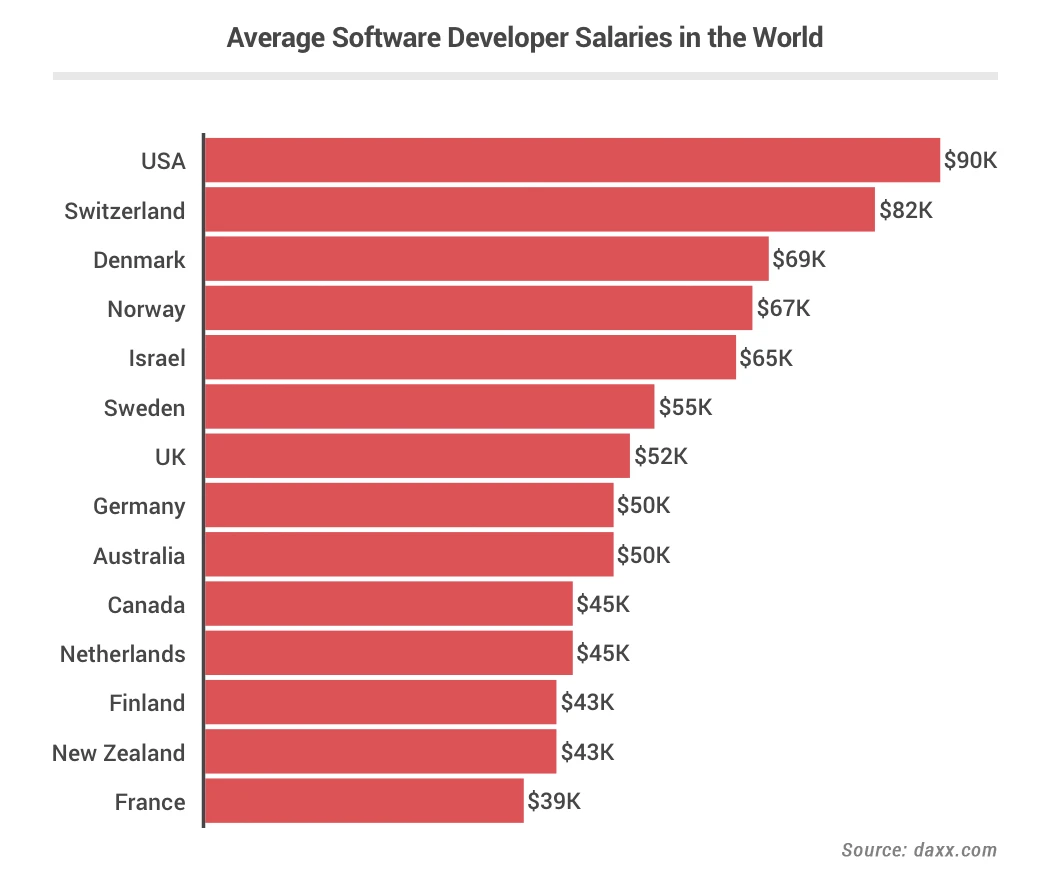
Interestingly, one of the biggest factors affecting web developer salaries concerns where the developer works. “For instance, the median salary in the US is considerably higher than in Canada, Germany, UK or France,” states TechWorm. Based on data from Stack Overflow, a developer who has at least five years experience could, on average, earns $34 000 more in the US than in Canada, Germany or the UK.
If you want to check out your potential salary, have a look at Stack Overflow, which is a popular developer community. Not only does it offer a Q&A for coders, but it also has a new salary calculator that lets you work out what you should be earning as a result of variables like your role, location, education level, experience and areas of expertise. It’s based on a survey that the company conducts annually with about 65 000 developers.

So, for example, if you’re a London-based back-end developer who has 3 years experience, a graduate degree and knows Python, C# and PHP, you could expect, if you were earning at the 50th percentile, to earn a web developer salary of £36 000 per annum. And at the 75th percentile, you’d be getting £44 000. Here’s an interesting graph outlining average software developer salaries by nation. If you want to learn these skills, take a look at HyperionDev’s Web Development or Python course.
Bear in mind, however, that a software engineer builds (or engineers) software, including desktop, mobile and web applications, whereas a web developer is a software engineer who only builds web application (like Gmail, Facebook, Instagram etc.). A software engineer and a web developer working on a web application are really doing the same work.
So where is it worst to be a web developer? The lowest developer salaries are in these countries: India ($4600), Indonesia, Egypt, Kenya and Argentina. What is the average web developer salary in South Africa? According to PayScale, the average salary for an experienced web developer is R353 749 ($26 414) per annum, and people don’t generally have more than 10 years’ experience.
Web developer salaries are not only influenced by country but also by city. Compare an entry level web developer in Cape Town (R182 711 or $13 733) with Johannesburg (R172 445 or $12 967). What are the top web developers salaries for cities in the US? In descending order, they are San Jose, California ($107 500), San Rafael, California ($104 580), San Francisco ($97 400), Framingham in Massachusetts ($95 350), and Seattle ($91 740). It’s no surprise that California comes out top!
There’s more good news: web developer salaries are continuing to grow. Half the top-paying jobs are in the tech industry, reports CNBC, for September 2017. Also, the supply of tech talent is lower than demand, which places IT workers in enviable positions for negotiating higher wages. The Harvey Nash Tech Survey 2016, which involved 2959 technology professionals from 36 countries, stated that the tech shortage is particularly acute in Europe (56% of technology hiring managers reported shortages), and 44% of hiring managers predict that the shortages will get worse in the future.
So, how best to negotiate those high salaries? Lifehacker proposes two strategies:
1. Strategy One: Noel Smith-Wenkle Approach
Noel Smith-Wenkle was a top job headhunter who used this approach for his clients to get the highest possible salary for them. According to this method, you must never tell the employer how much you want. The organization must name the first number. To avoid naming your number, tell the company that you’re more interested in doing [type of work] at the specific company than the salary when asked how much you want. Even if the company asks you straight out, just say you’ll consider any reasonable offer, and add that the company is in a much better position to make an offer based on what you’re worth. Once the offer is made, if it’s above your minimum, then you take it. If it’s too low, tell them, but not by how much.
2. Strategy Two: Jack Chapman Method
Career coach Jack Chapman, author of the book Negotiating Your Salary: How to Make $1000 a Minute, states five rules for negotiation:
- Only discuss salary negotiations after you’ve been offered the job.
- Let the other side make the first offer.
- When the offer is made, repeat it – and then stop talking. This is called “the flinch”; often your silence prompts a raise. The silence also gives you a chance to think while putting pressure on your potential employer.
- Research the market, the company and the value of your skills. Counter an offer with a well-research response.
- Even after the deal is clinched, carry on negotiating: lock in other benefits, such as extra days leave or a company car etc.
Whichever strategy you follow, think about changing careers and studying one of HyperionDev’s coding courses. They can be done part-time and online. You’ll also have access to on-demand code reviews by our full-time coding educators.

Career Advice
What qualifications do you need to become a developer in South Africa?
What are the various developer qualifications South Africa? What should I study to become a developer? How the National Qualification Framework operates.
There are many routes into the tech industry. The traditional route of studying Computer Science or Engineering at university is now competing with a range of other learning paths, such as short courses, diplomas, certifications, and the ever-expanding world of online education. And as research has shown, developer salaries are worth achieving.
South Africa’s education system operates under the National Qualifications Framework (NQF), which recognises and categorises qualifications into levels of achievement ranging from NQF Level 1 (Grade 9 of high school) all the way to NQF Level 10 (Post-doctoral research degree). Below are qualifications that fit into the NQF in South Africa.

Short courses
Part-time online courses, internationally recognised and good CV-boosters.
FOR DEVELOPERS
There are hundreds of short courses to help you become a developer, some of them specialising in a particular area such as Java or Software Engineering
WHERE TO STUDY
Damelin, UNISA, Hyperion Development, CTI Education Group, Mancosa, Intec College
DURATION
3 – 9 months
COST
R8,000 to R15,000 per course
Higher Certificate NQF Level 5
Skills-based, typically industry-orientated, and could help propel you into the world of technology.
FOR DEVELOPERS
Higher Certificate in IT or Systems Network Engineering
WHERE TO STUDY
Please see a list of all the public Technical Vocational Education and Training Colleges in South Africa here. Note that not all of these colleges will offer an IT-related qualification.
DURATION
1 year
COST
About R20,000 for a full certificate
National Diploma NQF Level 5
These are good qualifications in South Africa, and while they are a lot like degrees, they are more career-centric and practical.
FOR DEVELOPERS
National Diploma in IT or Software Development
WHERE TO STUDY
Cape Peninsula University of Technology, Central University of Technology, Durban University of Technology, Mangosuthu University of Technology, Sol Plaatje University, Tshwane University of Technology, University of Mpumalanga, Vaal University of Technology
DURATION
Usually 2 or 3 years full-time
COST
About R30,000 a year
Tech NQF Level 7
WHY
A practical-focused qualification that is an alternative to Bachelor degrees in South Africa, with less of a focus on theoretical Computer Science or Engineering knowledge.
FOR DEVELOPERS
B.Tech IT B.Tech Software Development
WHERE CAN I STUDY IT
Cape Peninsula University of Technology, Central University of Technology, Durban University of Technology, Mangosuthu University of Technology, Sol Plaatje University, Tshwane University of Technology, University of Mpumalanga, Vaal University of Technology
DURATION
1-year top-up following completion of a National Diploma
COST
Tuition varies upon university, with annual fees between R30,000 and R50,000 or more.
Bachelor’s Degree NQF Level 7
One of the more traditional route to becoming a developer is through studying a BSc, which aims to balance theoretical Computer Science with software development skills.
FOR DEVELOPERS
BSc Computer Science BSc IT
WHERE CAN I STUDY IT
Nelson Mandela Metropolitan University, North West University, Rhodes University, Stellenbosch University, University of Cape Town, University of Fort Hare, University of Johannesburg, University of Kwa-Zulu Natal, University of Pretoria, University of Witwatersrand, University of the Free State, University of the Western Cape, Walter Sisulu University
DURATION
3 years full-time, 4 – 5 years part-time
COST
Annual fees vary between R30,000 and R50,000 or more.
Honours Degree NQF Level 8
Specialises in one subject and is at least 25% research.
WHERE TO STUDY
Nelson Mandela Metropolitan University, North West University, Rhodes University, Stellenbosch University, University of Cape Town, University of Fort Hare, University of Johannesburg, University of Kwa-Zulu Natal, University of Pretoria, University of Witwatersrand, University of the Free State, University of the Western Cape, Walter Sisulu University
DURATION
1-year top-up following completion of a Bachelor’s Degree
COST
Between R30,000 and R50,000

Career Advice
How to Get a Job at Google
Riaz Moola's journey in software development and his top tips for landing a job at the tech Giant, Google. How to get a job at Google.
By HyperionDev CEO, Riaz Moola.
1. Overcome your inferiority complex
The university you went to, high school you studied at, or country you come from simply don’t matter when trying to get a job at Google. During my work at Google, I worked alongside people from Cambridge, Harvard, and Stanford but also graduates straight out of the University of KwaZulu-Natal, University of Cape Town, and University of Johannesburg.
Some of the most successful people at Google come from places and universities you haven’t heard off, and it’s a very internationally diverse place.
As a South African you have a great chance of joining Google, regardless of your background. You don’t even need to have worked at similar ‘tech giants’ before such as Amazon or Facebook. Having relevant experience/studies (which can be attained anywhere) will get you an interview, and your performance on these interviews will determine whether you get in – not the ranking of your university!

2. Prepare to fail

I was rejected from Google three times over three to four years before finally securing an internship that successfully converted into a full-time offer.
In fact, the role I secured at Google was after I responded to a rejection email after a failed application to Google’s Software Engineering internship in London. I simply asked if I could apply for another role – they directed me to the website again and I had little hope of a response. Three months later I had been accepted for an Associate Product Manager internship in Zurich.
Another thing to consider is that previous rejections don’t matter at all. I can remember clearly flunking first round interviews twice in a row with Google – being absolutely embarrassed and simply not being able to answer anything at all. This never had any impact on the future internship and full-time job offer I received. Don’t give up.
3. Be open-minded about roles and locations

When I first applied to Google, I was set on their Software Engineer (SWE) role, and only vaguely considered their Site Reliability Engineer (SRE) position. I simply didn’t think of any other positions, even after attending a workshop at their London offices about their Associate Product Manager (APM) position. At first, I dismissed the role as non-technical, ‘design and marketing’ – simply not right for a CS graduate like myself. I was completely wrong. The APM role was much better suited for me, and required a CS degree and a highly technical background. I interviewed much better for the APM role over SWE, and actually enjoyed answering interview questions and preparing.
Identify at the earliest opportunity all the possible roles open to you at Google, and prioritise applications to the roles that fit objectively with your strengths and interests, even if they seem unconventional. For example, it’s not as simple as ‘software engineering’. There are site reliability, security, product management, and testing roles that all fall under technical internships leading to full-time roles.
Don’t shun the opportunity to travel. Google may not have an engineering office in South Africa, but you’ll love to be in Europe or the US – especially for a summer internship. Google’s engineering offices are only in the best cities to live in – I was totally blown away by Zurich. It may be a once in a lifetime opportunity to live in these places.
4. Plan & Prepare

If you’re aiming for an internship, apply every possible holiday period, even if you fail each time. You’ll only be able to do internships while still a full-time student, and the earlier you start preparing for interviews and gaining confidence, the better. Sit down and check when applications open for the next round of internships, put it in your calendar and don’t forget.
Put aside at least 40-80 hours before your first round phone screen to prepare with mock interviews, example questions, and lots of practice. Plan the date of the phone screen (you have a choice) such that it isn’t at a time when you’re busy with exams, tests, or other work – you need to focus fully for this. Understand clearly how many interviews you will have in the whole process (it’s typically one or two phone screens, then 3-4 onsite interviews at one of their offices that they fly you to) and the type of questions that are asked.
5. Practice, Practice, Practice

There really is no easy way around this step. You’ve got to divide up the types of questions you will be asked for your role. There are a plethora of resources online with example questions and answers. For example, the Product Manager role will feature a mix of product questions – “Tell me about your favourite product”, estimation questions – “How many lightbulbs are in in the US?”, technical questions – “What is caching? How would you implement a cache in Python?”, and personality-type questions – “Tell me about a hard problem you solved?”.
Once you’ve identified the main categories of questions, pick your weakest. For me it was the estimation-style questions. At first, I simply couldn’t work out how to go about answering them. After picking up the ‘Cracking the PM interview book’ (far superior to ‘Cracking the coding interview’), and practicing around 30 estimation questions, I’ve found them much easier to do, and sometimes even do them for fun!
If your interviews will mostly be technical, definitely sign up for an advanced Python course with Hyperion. Mention to your tutor that you will be taking the Google interview tests and you’ll be moved to the advanced materials on computational complexity and data structures. It is of key importance that you focus on these aspects, which may only be touched on briefly in a Computer Science degree. You need to know Big O notation, sorting and searching algorithms, and data structures well enough to recite them in your sleep.
The outcome?

Get a job at Google – even an internship – will change your life forever. There simply is very little in the tech world that trumps having worked for Google. It will make securing future interviews easier, build confidence and teach you things that are hard to pick up elsewhere. Also, you will receive an invaluable perspective that can help define your future career, whether at Google or elsewhere.
Related article: 10 Steps to Switching to a Career in Coding

Career Advice
Is Your Job Safe from Robot Automation?
Which jobs will be automated in the future and what can you do to keep your job secure. Is your job safe from automation?
It’s a well-imagined theme of science fiction: robots vs people in mortal combat.
Certainly Elon Musk seems to agree. He claims artificial intelligence is humanity’s greatest threat, leading possibly to a third world war. Should we imagine the worst, or is a more moderate view called for? Although automation will hit all kinds of industries, it’s not as clearcut as you might think, and there could well be certain advantages if you play your cards right.
Watch this 3-minute video to see how robots can replace human workers in a warehouse.
Will your job be around in the future?
Let’s start where automation is likely to hit hard. Bookkeepers, for example, have a 97.6% chance of being automated. Contrasted with bookkeeping, right at the bottom end of the automation spectrum, are mental health and substance abuse social workers, who have a 0.3% chance of being automated, because their jobs require high levels of original thinking, negotiation and helping others. How are these percentages calculated? The researchers looked at jobs across four variable: does your job require that you come up with clever solutions, do you have to personally help others, does your work require negotiation and, interestingly, does your occupation need you to squeeze into small spaces (i.e. jobs that are routine, repetitive and predictable)?
Check out this nifty guide to assess the likelihood of your job being automated, but first see if your job is one of those that has a higher likelihood of being automated.


Whole sectors will become automated in the future. For example, this walk-out technology from Amazon means you can do retail shopping with no staff (using the same technology as self-driving cars):
Before becoming despondent, remember automation does not necessarily equate to job losses. Instead, jobs will be redefined with technology playing a much greater role. What does this mean for software developers? Good things. They have only a 12.8% chance of being automated, but there are vital factors worth considering. Mario Peshev, the CEO of DevriX and a digital consultant, on the Forbes website says: “A certain portion of the software development industry will become automated and obsolete to some extent”. This is particularly the case where elements are repetitive or could be bundled together. But, the software development industry “isn’t going anywhere”, especially where custom work and innovation is required.

Over the next few decades, software developer jobs that include these three aspects will still be in high demand:
Flexibility
This will include custom features, integrations, tailored admin, and user areas that are specifically adaptable for given industries. Workers who can cover all aspects, including the front-facing aspect of software development, the behind the scenes part, and the various systems operating in between, will be in high demand. Here your full stack web developer who is capable of using a combination of HTML, CSS and JavaScript to build everything a user sees and interacts with on a website, as well as developing the application, server and databases (using Java, PHP, .NET, Ruby, Python, Perl) that make up the back end or foundational structure of a website.
Performance
You will need coders who can help with a variety of performance issues as they relate to software applications – for example, where you are bundling together a number of tools or solutions, or where there is a massively large volume of users or data.
Security

In an application, there is a relationship between security and freedom of use. The more secure an application, the more steps or restrictions it includes. So ‘off the shelf’ solutions are, as a general rule, either super secure or usable but vulnerable. However, if you want something highly secure and usable, you would require a customised solution and people capable of implementing this.
Download the Programming Languages Guide 2017 to know which languages will be popular in the future.
In addition to the work required for building applications, think about what our homes, transport networks and work environments will look like. For example, it’s relatively easy to imagine the smart home – smart phones unlocking our front door, voice-activated virtual assistants controlling the lighting and the temperature, coffee machines activating when we get up etc. – and how it will get even better (although most of the technology already exists for the ideas listed above). But as technology continues assisting us in our day-to-day lives, you will need people who are able to design and implement it. Even if we think of a world with automation handling 90% of the tools, components and libraries out there, you will still needs millions of software developers who can support, extend and integrate these solutions.
This means you shouldn’t worry as long as you are can possess the technological skills required in the next few decades. Browse some courses we recommend you should take, especially if you are wanting to upskill or shift the focus of your sellable expertise.
Perhaps it’s best to think of tech as a job creator, and not a destroyer. And remember, it’s never too late to learn something new.

Masako Wakamiya, a retired banker from Japan, started taking online tutorials to learn how write software code at 82! She was frustrated by the lack of mobile games for the elderly and so made one of her own.
Think About
What will happen when robots or algorithms know us better than we know ourselves? Says the Guardian when reviewing Max Tegmark’s book Life 3.0: Being Human in the Age of Artificial Intelligence: “Instead of fearing assassin robots that try to terminate us, we should be concerned about hordes of bots who know how to press our emotional buttons better than our mother, and use this uncanny ability to try to sell us something.”

Career Advice
What is an Online Coding Bootcamp?
Learn about the benefits and trends of an online coding bootcamp and what it entails. Read about Carl's experience on an online coding bootcamp.
When Carl, a US-based 38-year- old high school Math teacher, decided he wanted a career change, he wasn’t sure what to do next or what would work for him with his teaching schedule. ‘I was in no position to give up my job entirely,’ he says, ‘I needed the salary, but I knew I had free time in the evenings and on weekends for upskilling.’ Naturally his mind turned to coding, bearing in mind his aptitude for logical thinking, and his belief that there were job opportunities in that field.
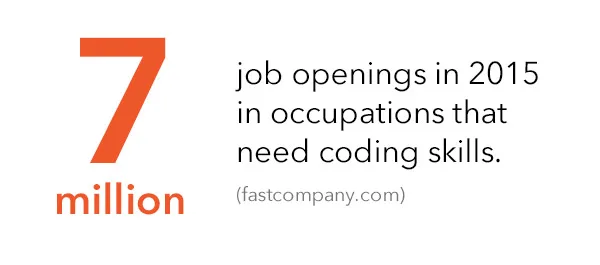
He was not wrong. Last year an international job market analytics company called Burning Glass released a report showing that there were 7 million job openings in 2015 in occupations that need coding skills. Based on 26 million US online job postings they found that half of all programming vacancies are in industries that are traditionally seen as outside of technology, including:
– Finance
– Manufacturing
– Health Care
So how best to gain these valuable coding skills? One option is to attend a coding bootcamp, a high-impact technical training program that focusses on market needs. It can last between 6 and 28 weeks, with prices ranging from $5000 to $21000. The goal is to teach students about 10% of a traditional computer science degree.
But for Carl, a coding bootcamp was not the way he wanted to go. ‘It was too expensive and I didn’t have that kind of time,’ he says. He also didn’t want to go the self-guided or Massive Open Online Course (MOOC) route. ‘Honestly, I knew I would need help when I got stuck,’ he states. After considering his options, he realised that an online coding bootcamp, which combined the mentoring of a coding bootcamp with the cost-effectiveness and flexibility of a MOOC, was the way to go. As Carl put it: ‘It’s the best of both worlds’.

Online bootcamps are structured, mentor-guided learning platforms that replicate the in-class experience. You should expect to devote between 5 to 30 hours per week to the course, but the flexibility of an online medium allows you to choose when those hours will take place.
If your goal is to change careers (while maintaining your current job in the interim) or to upskill in an adjacent area from your key proficiencies, an online bootcamp is ideal. In addition, if you’re wanting to build your own app, website or company, this kind of course will teach you to do this.
Mentoring is a vital advantage of the online bootcamp experience. Many coding students hit a wall when they become stuck with a MOOC and they have no one to help them. Says Riaz Moola, Founder and CEO of Hyperion Development, a leading online bootcamp educational provider: ‘Often a student is unable to get ahead when stuck on a learning wall. Rereading the same passages endlessly or repeatedly watching the same videos won’t let the student overcome the learning block. But an expert mentor will give valuable feedback swiftly, helping the student.’
Carl is happy with his choice. He is a month into his online coding course in backend web development. ‘It’s a challenge,’ he says, ‘but I feel like I’m learning something new every day.’
Interesting Fact: Many coding bootcamps in the US and Canada have an almost 100% post-course employment success rate. Most students end up in entry level jobs as programmers, but these can pay as much as $80 000 per year.
Career Advice
The Programming Languages Guide 2017
An up-to-date analysis of today’s most popular programming languages. Find out which language is for you with real-world applications and salary data.
An up-to-date and thorough analysis of today’s most popular programming languages. Find out which language is for you with real-world applications and salary data in South Africa and abroad.
What the guide will discuss
● Ranking of programming languages popularity in 2017
● In depth analysis of Python, Javascript, PHP, Java, C# and C++
● Real World Applications per programming language
● Programming Language Trends 2017
● Salary Data per language in South Africa and abroad in 2017
This guide will help you decide which language to learn first! Download your copy today and take an easy step towards your new coding career.

Career Advice
10 Steps to Switch to a Career in Coding
Even if you didn’t do a degree in computer science at a university, it's still possible to pursue a career in software development. Here are 10 steps to switch to a career in coding.
So you didn’t do a degree in computer science at a university, but you want a career in software development. Why? Because you know software development is often well-paid, can offer flexibility, is likely to be stimulating and is part of a growth industry. Perhaps you want to become an app developer, a back-end web engineer or a website developer: all careers on the up. But is it still possible? Actually, yes. Here’s 10 steps on how to switch to a career in coding and succeed.
1. Don’t underestimate what you do know
First, sit down and think about what you do know. Believe it or not, that philosophy major you did has its uses. What are they? You’ve probably picked up analytical skills, critical reading skills, the ability to assemble and simplify large tracts of information, clear writing, and even people skills, such as working in groups or pairs. Think of your old career as a stepping stone. Don’t undersell yourself when putting together your CV. Also, people who blend a variety of seemingly disparate skills are often in high demand, because they now have a unique professional profile – for example, think of a software developer who has done a fashion degree. Think how better placed you’d be for a job designing websites or apps for a clothing retailer than someone who doesn’t know fashion.

2. Now decide on the best route for learning what you don’t know
There are a variety of options to achieve this, from an online MOOC (Massive Open Online Courses), which is free, to a coding bootcamp, which can be face-to-face or online. Coding bootcamps are great for the following reasons:
- Offering a focused environment
- Mentorship when you need it
- Teaching you the essentials to land a job
- Assuming no prior knowledge, plus will teach you the basics
- Offering a network of motivated peers
- Instituting progress checkpoints
- Providing career services
However, face-to-face bootcamps can be expensive and inflexible. You may want to opt for an online bootcamp, like those offered at Hyperion Development, where you would have your own mentor. These are ideal when you want the benefits of a face-to-face bootcamp but are on a budget and need to be able to learn in a flexible manner from anywhere because of time constraints and existing commitments.
3. Give yourself an actual project
What do you feel passionate about? Animal rights? Archery? Fitness? Think about creating a website, an app, a game, some software. Have a look at codeconquest for some great coding project ideas. Now do it.
4. Showcase what you know
You’ve been doing a few projects, a little bit of coding, and now can put some stuff together. It’s time to open an account with GitHub, a software development platform, where you can host and review code, manage projects, and build software alongside millions of other developers. Add your existing code to share with prospective employers or start new projects to keep yourself relevant. GitHub accounts are free, and it’s the best place to swap ideas and code with other programmers online.
<Tip> Be selective with what you show on your GitHub profile. A public repository allows anyone to read your code. Hiring managers might well check out your code there. Only make substantial or interesting projects available for viewing.

5. Understand that you will need to invest in your career change
From books to classes to subscriptions, training to become a software developer is going to cost something. Accept this. However, off-play it against the expected salary you’re likely to earn. Check out these figures for interest.
An entry-level software developer in 2017 in South Africa will earn R234 502 per year.
Hired in their 2017 ‘State of Global Tech Salaries’ notes that the average software engineer in Seattle will earn $126 K, in New York – $120K, in Austin – $110K, in London – $73K, in Paris – $55K, and in Singapore – $90K annually.
6. Prepare yourself for the interview
Programming interviews are likely to be different from interviews you’ve had in the past. They can involve coding challenges, writing pseudocode, pair programming and feedback. Try and find out as much as you can about coding interviews before going to your first one by researching them online. Here are some brilliant ideas from Quora for how to prepare for a tough coding interview, including cheat-sheets, book suggestion and online resources.
7. Find a Mentor
Chris Myers, a startup founder and CEO of a financial management solutions company, says on Forbes that if he could give young professionals one piece of advice it would be to find a mentor. “I firmly believe that mentorship is the best path to career success, hands down,” he says. See if you can find a software developer who is willing to mentor you. You need to see it as a two-way relationship – do what you can to reciprocate, even if it’s just occasionally buying the person a cup of coffee.
8. It’s not just about skills, it’s also about personality
To be successful at something you don’t just need the knowledge or the ability, you also require the right personality set. Psychology Today lists a number of traits of successful people, including being able to face (and conquer) your fears, staying focused and flexible, not giving up on your dreams, staying upbeat and seeing stumbling blocks as stepping stones in disguise. When it comes to software developers the following personality traits, according to Bloc, are useful:
- Curiosity
- Grit
- Communication
- Attention to detail
- Divergent thinking or thinking outside the box
- Modesty
- Ability to work in a team
9. Wherever you can, dip your feet into the water
You need to try out stuff to see how you find it. Try this free trial for a beginner introduction to coding microdegree for starters. Other things worth trying include:
- Programming challenges: you can choose from a wide variety of languages, including Ruby, Python, SQL, C++ etc.
- Watching YouTube videos to learn programming. Click here for 30 excellent channels to get you started:
- Hanging out with fellow developers. Go to Stack Overflow, where, each month, over 50 million developers meet to discuss programming.
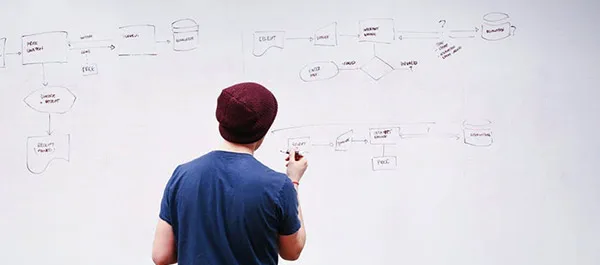
10. Accept that your journey probably won’t be linear
If you’re juggling a career as well as other commitments, you may only be able to focus on developing your programming skills for a few hours per day. Accept that you won’t progress in a linear fashion. Instead, you’ll go through spurts and stalls.
Remember, there are many software developers out there who started coding only recently, but still landed themselves good jobs. According to Stack Overflow’s 2017 Developer Survey, 36.9% of people learnt to program only one to four years before beginning their careers as developers.
Believe in yourself and trust that you will get to where you want to be. Develop the right mental attitude, optimistic but realistic, for the long and exciting journey of becoming a software developer.
To browse our courses in software development, click here. Otherwise, continue reading more articles related to software development here.
Career Advice
The South African Developer Report 2017
Hyperion Development has compiled this report to highlight the South African educational routes into a developer career, as well as compare qualifications.
Hyperion Development has compiled this report to highlight the South African educational routes into a developer career, as well as compare these qualifications to allow potential students to make informed decisions about their future.
Becoming a developer in South Africa is more attractive now than ever before. Industry skill shortage and the movement towards online functionality means high demand and very high earning potential for developers. In an increasingly automated world, more and more people are exploring the “future proof” career of software development. Traditional Computer Science education has proven outdated and the gap between “student” and “employment” is demanding to be bridged.
Key findings:
Download the full report for crucial insights into the different paths students can take to break into this thriving industry, the benefits and what it takes to be a developer in South Africa today.
View another popular resource, The Programming Languages Guide 2017
Still have questions?
Contact our Admissions Team, and a real person will get back to you.