
Career Advice


Career Advice
Can you really become a programmer in 6 months and get hired?
Become a programmer in six months. Can you really learn to become a professional programmer in six months? Learn how successful programmers have picked up programming and found a job after their coding bootcamps.
It seems almost impossible to imagine you can go from zero to hero in a period of six months. Surely it takes longer than that to become a programmer? Not necessarily. Gina Fabienne, a HyperionDev graduate, found work as a junior web developer at a web design agency after completing a six-month Full Stack Web Developer Bootcamp.
Gina says: “HyperionDev gave me the confidence and ability to assess problems. Working through the tasks by myself with the help of a mentor during the bootcamp taught me how to work through my current work tasks by myself and only ask for help when I’m really stuck.”
Gina is not the only success story – there are many others. A Reddit thread about the success rate among self-taught programmers makes this clear. Interestingly, the success stories seem to fall into two categories:
- Those who are entirely self-taught: This group of people seem to have taught themselves a specific language, such as Python or Java. (Python is actually a relatively easy computer language to learn; it’s also the fastest growing language in high-income countries such as the US, UK, Germany and Canada.) In fact, 85,5% of developers say that they taught themselves a new language, tool or framework, according to 2019’s Stack Overflow Survey.
- People who have signed up for online courses: It seems that a Full Stack Web Developer bootcamp is a popular option for those who choose a more formal method of learning, because you cover many languages. You would, for example, cover the basics like HTML and CSS, as well as intermediate languages like Python, SQL and Java.
Even though bootcamps are a way for newcomers to transition into a tech career, a fair number of professional developers, 15,4% to be precise, have actually taken a bootcamp, according to the 2019 Stack Overflow Developer Survey Results. Why? Quite simply, many developers decide during their career that they need to learn new technologies or upgrade their skills to retain relevancy.
If you’re looking for a bottom line, it’s this: you might not be able to become an expert programmer in 6 months, but you can certainly reach a basic level of competency. This is a point frequently made on many online forums like Quora.
In fact, as pointed out by the Stack Overflow Developer Survey of 2019, a common misconception about developers is that they’ve been programming since childhood. Although there is a wide range of experience among developers who work in the industry, a full 45% of professional developers only learned to code less than 10 years ago.
And you don’t need to get to 100% – i.e. knowing everything about your selected programming languages – before moving onto the next stage of your life as a professional programmer. ‘For most skills,’ states a piece in Medium, ‘including programming, the closer you get to 100%, the longer it takes to get there.’ You rather need to think about the 20% that will get you 80% of the results.
So what should you be doing to pick up the sufficient skills to land you a programming job as soon as possible? Here are some ideas:
- Learn HTML and CSS first. Buy a domain and put up a website, which will be your portfolio. Edit and update it as your skills increase.
- Learn JavaScript to make your site interactive.
- Put up small projects on GitHub, a software development platform that allows you to manage your coding projects. Employers could well check out your GitHub profile. Read more about GitHub here.
- Learn to use Stack Overflow, which you will most likely use for research and to get solutions to your programming problems.
- Use a command line to do stuff like automating specific tasks or diagnosing and even correcting some Windows problems, or, for example, finding all the files you worked on last month. Try using it instead of a GUI (graphical user interface).
- Attend local meet-ups and hackathons. Start networking and learning the lingo.
- Apply to recruitment agencies early – here’s how to ace the tech interview.
- Create a LinkedIn profile – make it look professional.
Lastly, when people ask what you do, tell them you’re a programmer. Part of forming a new identity is convincing yourself. Read more HyperionDev success stories here. You can become a programmer in 6 months; remember, others have done it before!
Editor’s note: This was post was originally published 19 March 2018 and has been updated 7 August 2019.

Career Advice
Women in Tech: what do female developers look for in a job?
Women in Tech - what do female developers look for in a job? We look at the 2019 HackerRank Tech Report to find out what female developers, particularly Gen Z, look for in prospective employment opportunities.
What’s it like to be a woman in tech? HackerRank has recently released its 2019 Women in Tech Report. After interviewing more than 12 000 developers, fascinating insights have emerged, particularly for Generation Z female coders – those born from 1997 onwards. Let’s take a closer look at women in tech, particularly what female developers look for in a job.
Professional development + prestigious brands
Female developers rank “professional development” and a “work-life balance” as the most important aspects of a job. However, Gen Z women – those 21 and under, are “twice as likely to seek out an employer with a prestigious brand as women from previous generations”. A potential reason for this is that Gen Z women, or “digital natives”, have spent so much of their life engaging with prestigious digital brands like Apple or Twitter (remember, 25% of them had smartphones before the age of 10) that they now seek out such brands in their work life.
Here’s a graph depicting the things women look for in a tech job.
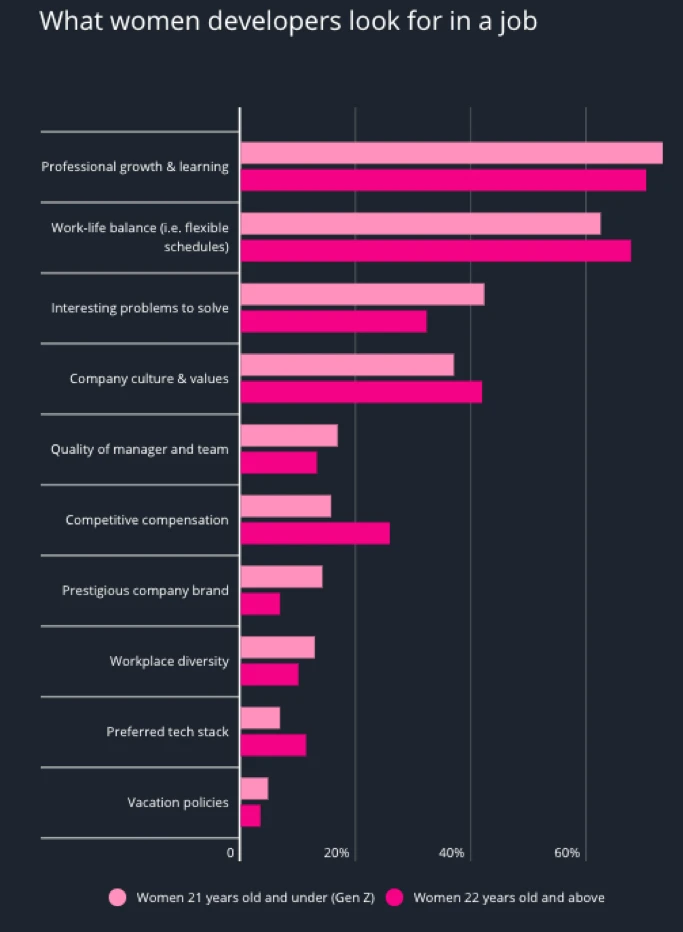
Image Source: https://research.hackerrank.com/women-in-tech/2019
A new career path
23-year-old Zita Preuss, who just misses the Gen Z label, is enrolled on a HyperionDev Full Stack Web Development course. She attends classes at their Woodstock campus in Cape Town. As a newbie developer, she, too, is looking for professional growth opportunities. Says Zita: “I’m keen for a new career path. I considered Computer Science, but I was put off by the long time commitment – three years is just too long! I needed to find a viable alternative, which led me to this bootcamp.” Interestingly, bootcamp graduates stack up well against graduates with degrees. A 2017 survey conducted by job site Indeed found that the vast majority (72%) of employers consider bootcamp grads to be “just as prepared to be high performers” as graduates with degrees.
Professional development is obviously important, but what about money? For Gen Z women, compensation is viewed somewhat differently from previous generations – it’s just not as vital a factor as it was for older women (16% of Gen Z women consider compensation important compared with 26% from other generations). For the Gen Z, it’s just lower down on their list of priorities.
The HackerRank report explains this finding as follows: “(M)ost Gen Z women currently do not have the same financial obligations that their older counterparts do, and can thus move compensation lower on their list of priorities in favor of other factors like company prestige.”
Zita doesn’t mention compensation as one of her chief priorities. However, after bartending, which she did before enrolling on her bootcamp, she’s keen “to find herself a proper career path”. Her plan is to move overseas with her bootcamp qualification after she has acquired the relevant skills and experience.
And how is she finding her bootcamp? Says Zita:
I really enjoy it, because I have the freedom to do tasks at my own pace. Plus, the environment is so friendly and welcoming. When I need help, my mentor is always available. Because it’s such a practical course, you get to try out a lot of the coding yourself.
Zita is sure to graduate from her bootcamp with in-demand skills that companies want. According to the HackerRank report, JavaScript, Java and Python top the list.
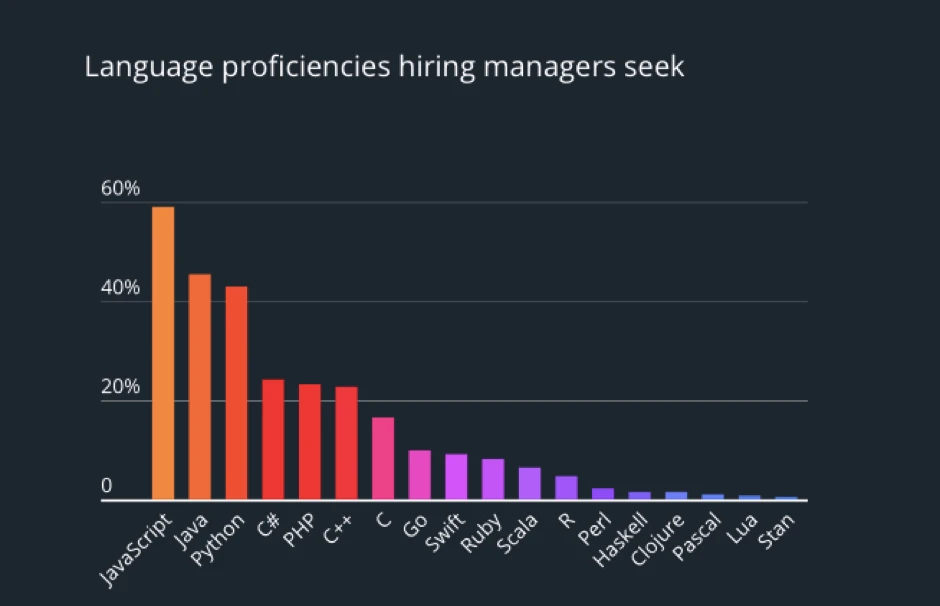
Image Source: https://research.hackerrank.com/women-in-tech/2019
Luckily for Gen Z women, the majority of them entering the workforce know Java and Python, while about 50% are proficient in JavaScript. Here’s a graph showing the languages Gen Z women and men know.
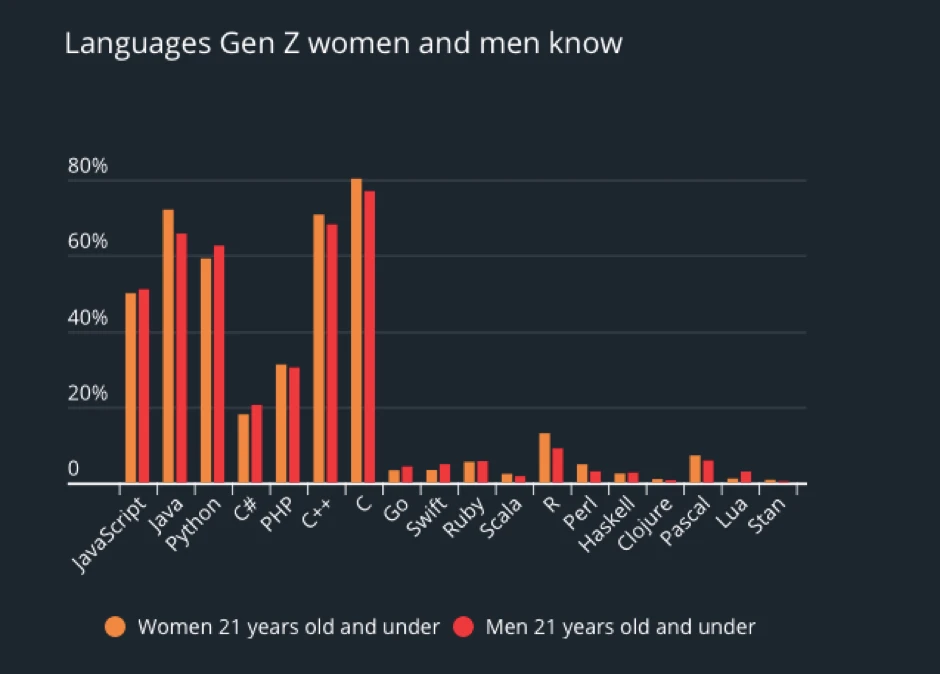
Image Source: https://research.hackerrank.com/women-in-tech/2019
Perhaps part of their skill proficiency comes from the fact that Gen Z women are coding at a younger age than generations before them. Almost a third of women in this generation learned to code before they were 16 years old. For previous generations, only 18% of women learned to code at such a young age.
The good news is that HyperionDev offers a Software Engineering course that covers Java and Python, and their Full Stack Web Developer courses incorporate JavaScript, among many other languages and frameworks. You can enrol to do the course online or on-site at one of their campuses in Cape Town or Joburg. Part-time and full-time courses are available. If you’re a woman who wants to enter the tech field, now is the time to make your dream a reality.
Career Advice
Infographic: CS degrees vs bootcamps
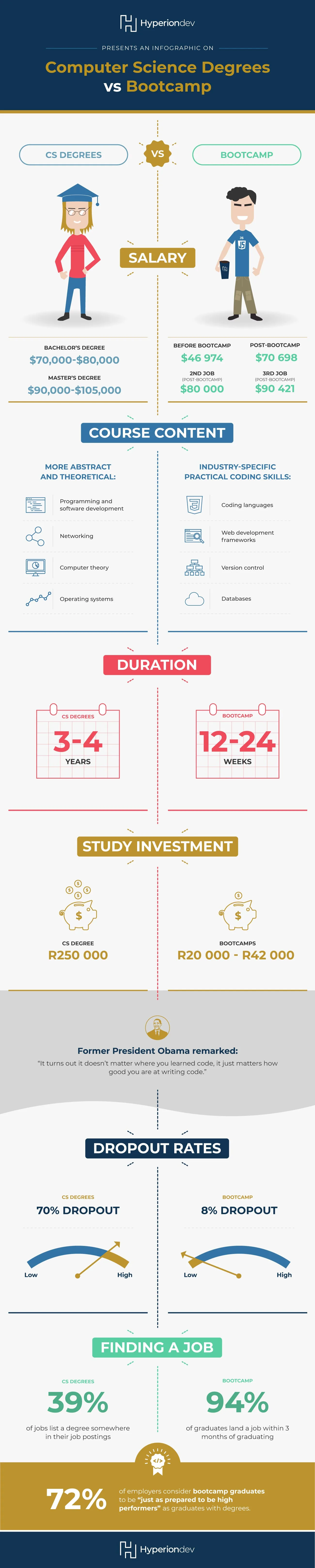
If you’re thinking of entering the lucrative field of technology, what’s the best route of study to take? Here we consider CS Degrees vs Bootcamps - how they differ with respect to salaries, course content, duration, dropout rates and time taken to land a job.
If you’re keen to enter the in-demand tech field with its excellent salaries, you need to ensure you have the appropriate skills. You could upskill via a Computer Science degree or a Bootcamp, but which one would better serve your needs? We analyse these two educational routes by looking at course content, potential salaries once you’re finished studying, duration, dropout rates, and more. Take a look below for a comprehensive infographic on CS degrees vs bootcamps.
Career Advice
In a world of job automation is programming safe?
We know that automation is likely to impact on many jobs. But what about programming? In a world of job automation is programming safe? We discuss what kinds of coding skills will see you holding onto your job for many decades to come.
As we head towards 2020, it’s more than reasonable to ask whether your job will still be around in the next decade or two. Job automation is happening across a vast range of fields. Breast cancer detection, for example, can be done via neural networks, which have been trained to pick up cancer signs from past viewing of tens of thousands of mammographic images. Even the creative fields aren’t safe, take Magenta, for example: a machine learning library from Google that can computer generate new music. In a world of automation is programming safe? We look at the likelihood of programming remaining an in-demand skill.
Hitting hard
Let’s start by looking at where job automation is likely to hit hard. Bookkeepers, for example, have a 97.6% chance of being automated. In contrast, mental health and substance abuse social workers have only a 0.3% chance of being automated, because their jobs require high levels of original thinking, negotiation and helping others.
What distinguishes one job from another? It seems four variables are at play: does your job require that you come up with clever solutions, do you have to personally help others, does your work require negotiation and, interestingly, does your occupation require you to squeeze into small spaces (i.e. jobs that are routine, repetitive and predictable)? Here are four graphs depicting these results.
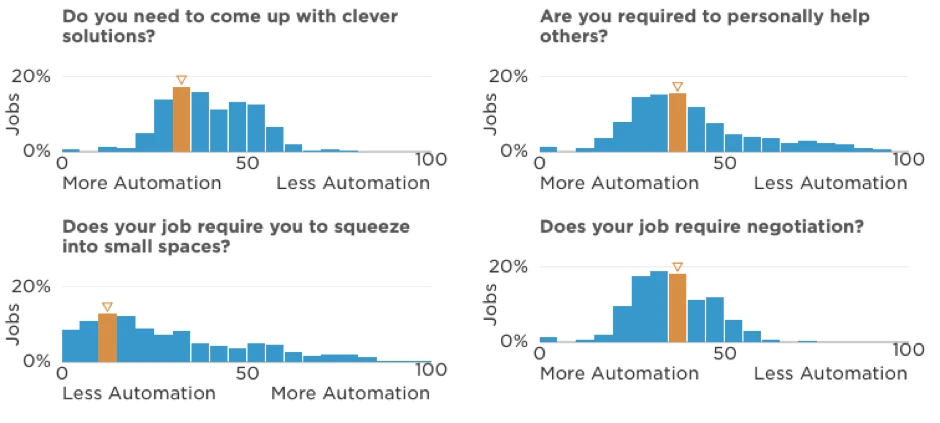
Image source: https://www.npr.org/sections/money/2015/05/21/408234543/will-your-job-be-done-by-a-machine
If you want to calculate the chance of your job being automated, check out the ‘Will Robots Take My Job’ site. Software developers seem safe with a 4% probability of automation and a projected growth of 19% by 2024. However, over time, within the next two decades specifically, there is a 31% chance of automation.
There is some risk
Mario Peshev, the CEO of DevriX and a digital consultant, on the Forbes website says: “A certain portion of the software development industry will become automated and obsolete to some extent”. This is more likely to happen where elements are repetitive or could be bundled together. But, the software development industry “isn’t going anywhere,” especially where custom work and innovation is required.
A joint project between Microsoft and Cambridge University called DeepCoder is suggestive of this future, particularly where repetitive programming is found. DeepCoder can search a body of code to build a specific project to spec. As the system practises, it gets smarter, learning which bits of code work best together and when to replace a snippet of code with another.
But the future isn’t too bleak. Although systems like DeepCoder have some code development potential, this isn’t going to take away the jobs of developers, according to Armando Solar-Lezama of MIT. Rather, a combination system is likely to develop: developers will focus on more complex tasks while the more tedious aspects of code development will be automated.
So what kinds of software developers will be in high demand over the coming decade? Here we list three attributes:
Flexible
Programmers who embrace flexibility are in a stronger position. This would include being able to develop custom features, integrations, tailored admin, and user areas that are specifically adaptable for given industries.
High-performing
You will need coders who can help with a variety of performance issues as they relate to software applications – for example, where you are bundling together a number of tools or solutions, or where there is a massively large volume of users or data.
Knowledgeable about security
In any application, there is always a relationship between security and freedom of use. The more secure an application, the more steps or restrictions it includes. So ‘off the shelf’ solutions are, as a general rule, either super secure or usable but vulnerable. However, if you want something highly secure and usable, you would require a customised solution and people capable of implementing this.
There is a growing demand for the job role of cyber security specialist. From 2016 to 2026, the Bureau of Labor Statistics anticipates a 28% increase for work in this category. That’s faster than the average growth for all occupations in the US.
In conclusion, think about the future – what will smart homes, transport networks and the work environment look like? As technology continues assisting us in our day-to-day lives (and environments), you will need people who are able to design and implement it. Even if we think of a world with automation handling 90% of the tools, components and libraries out there, you will still need millions of software developers who can support, extend and integrate these solutions. Job automation is likely to hit hard, but software developers appear relatively safe.
If you’re keen to change careers or upskill, consider enrolling on a HyperionDev online bootcamp in Full Stack Web Development, Data Science or Software Engineering. You can also trial one of these courses for free. If online learning is not your thing, you could enrol in an immersive, face-to-face Web Developer or Software Engineering course in Cape Town or Johannesburg. Python is included in the Software Engineering and the Data Science bootcamp.

Career Advice
Big salary increases in tech in South Africa
South Africans can expect, on average, a salary increase of approximately 7% in 2019. However, in tech, salaries fare much better with predictions of increases above 10% in 2019.
I’ll buy you a diamond ring my friend if it makes you feel alright
I’ll get you anything my friend if it makes you feel alright
Cos I don’t care too much for money, and money can’t buy me love’ (Beatles song)
We all know money can’t buy you love, but it sure can buy you a whole lot of other things. Not all South African salaries are on the up, but the good news is that tech salaries certainly are. We look at which tech skills are in demand, and how you can enjoy a slice of this lucrative pie.
Not all doom and gloom: tech salaries in South Africa
The average South African can expect a year-on-year salary increase of 7% from 2018, according to online job aggregator Adzuna, which recently published their 2019 salary report. The stats are based on analysing more than 100 000 online job listings. Although the increases are inline with some predicted inflation rates in South Africa, they are still way below expected price hikes in other areas, such as electricity, predicted to be 14% higher this year than last year, petrol, medical aid membership (for example, some Discovery schemes will cost 9% more), and school fees, states Business Insider.
However, it’s not all doom and gloom. Here’s a graphic depicting wage increases in the various sectors. Of the 10 sectors analysed (not all are listed below), IT came out top with wage increases predicted to be above 10%.
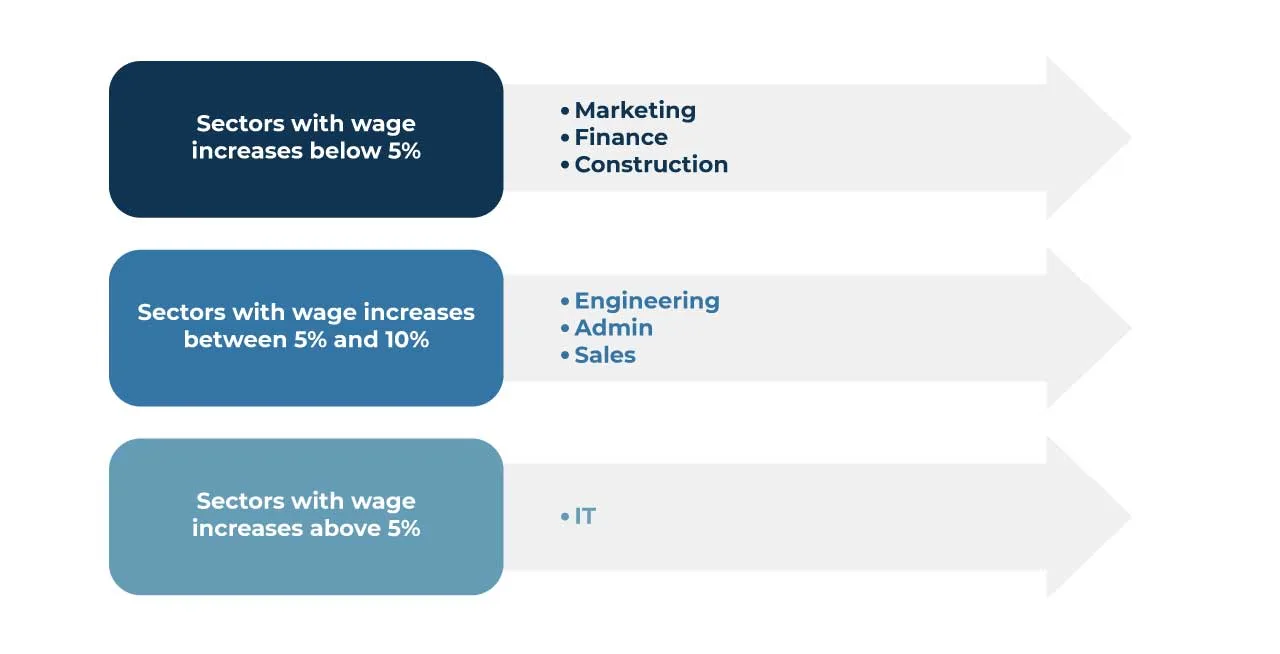
Image Source: https://businesstech.co.za/news/business/305576/these-are-the-best-earning-professions-in-south-africa/
Jesse Green, South Africa’s Adzuna manager, says: “As AI rises in business and society, the demand for employees with tech skills and knowledge continues to skyrocket, and the salaries for these jobs reflect the same principle”.
Web developers earning 15% more in 2019
If you’re wondering which tech salaries in South Africa are the highest, you may want to consider web development. These specific skills, states the Adzuna study, earned developers 15% more than they were getting in 2019. Here’s a table showing the highest-earning professions in South Africa. You can see how many of them require tech skills, including ‘php developer’, ‘web developer’, ‘designer’, ‘developer’, ‘net developer’, ‘software developer’, ‘analyst’, ‘technologist’ and ‘java developer’.
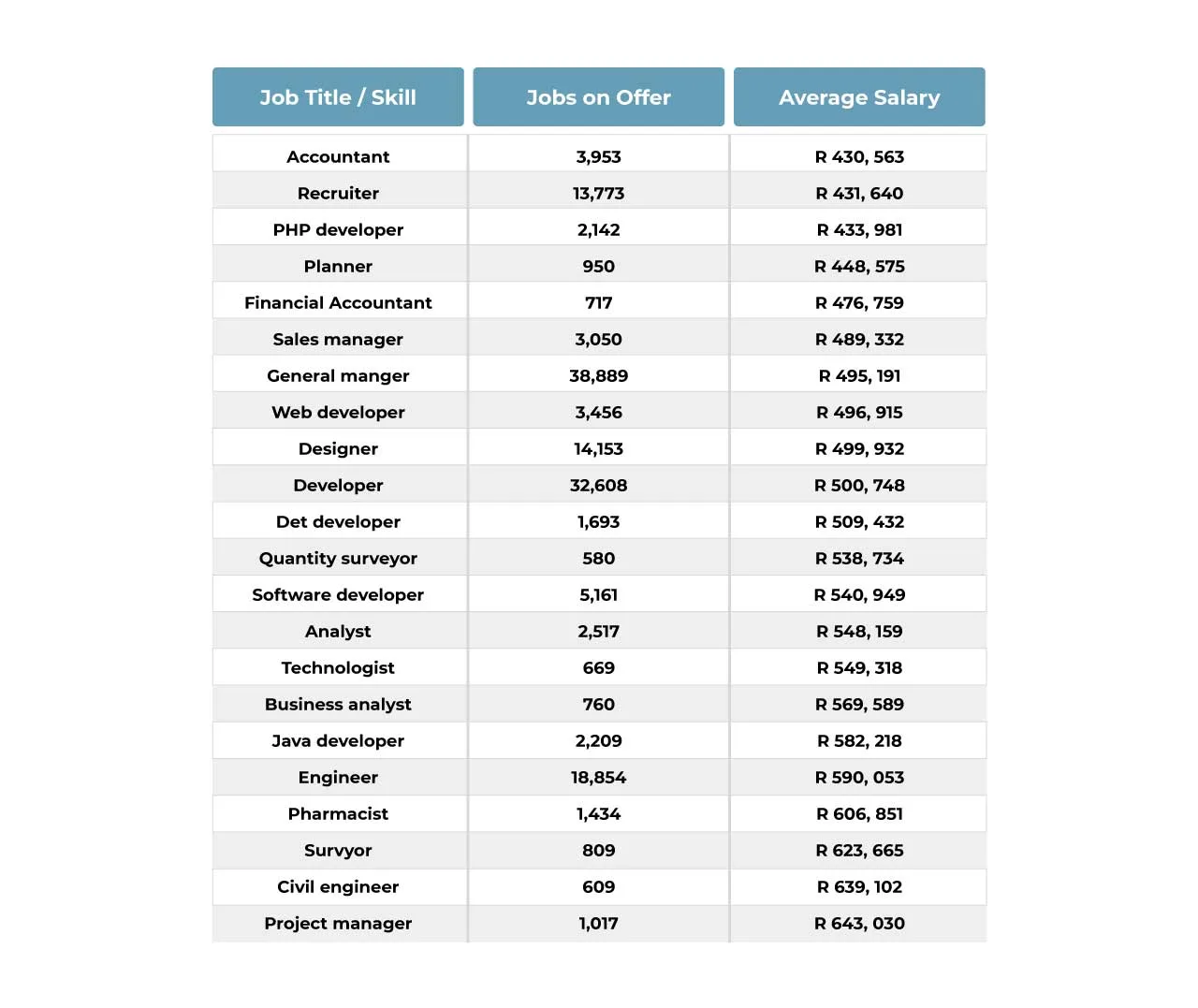
Image Source: https://businesstech.co.za/news/business/305576/these-are-the-best-earning-professions-in-south-africa/
Highest-paid programming languages
It’s worth finding out which programming languages offer the highest salaries. OfferZen, a South African recruitment company, has conducted some research in this area. You can see that, on the whole, those who know Python and Ruby earn the higher salaries.
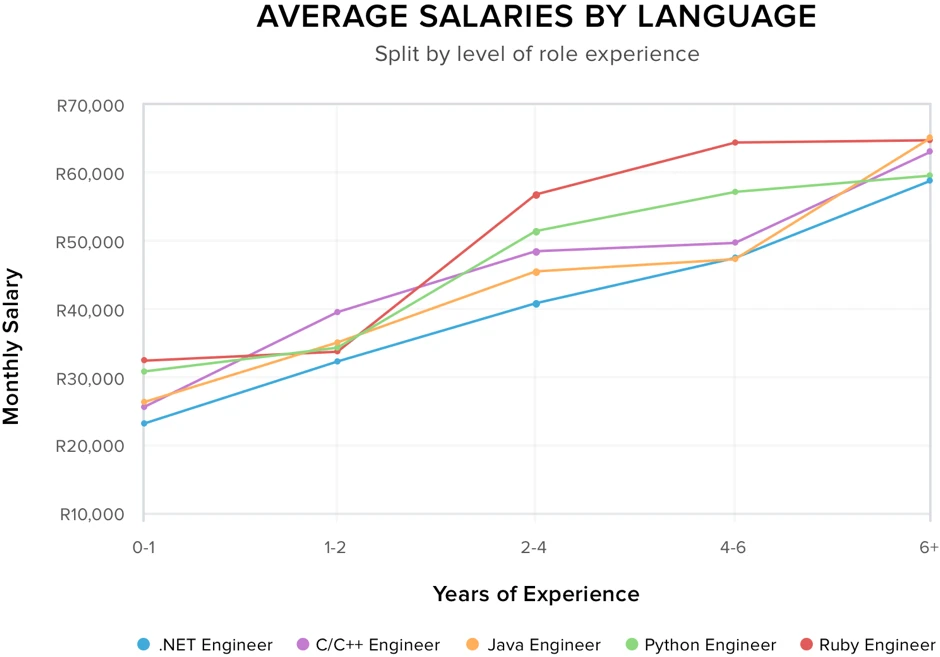
Image Source: https://www.offerzen.com/blog/developer-salaries-for-different-programming-languages
It seems that Ruby and Python developers earn between 15% to 45% more than other developers assuming they all have the same level of experience. Python and Ruby tend to be less commonly-taught languages than some of the others, states OfferZen, and scarcity obviously creates higher demand.
In conclusion, tech salaries in South Africa are enjoying significantly higher increases than other salaries in different industries. If you’re keen to change careers or upskill, consider enrolling on a HyperionDev online bootcamp in Full Stack Web Development, Data Science or Software Engineering. You can also trial one of these courses for free. If online learning is not your thing, you could enrol in an immersive, face-to-face Web Developer or Software Engineering course in Cape Town or Johannesburg. Python is included in the Software Engineering and the Data Science bootcamp.
Career Advice
Developer Survey Results 2019 – Key Findings
Each year Stack Overflow surveys developers across a wide variety of issues, from their favoured languages to how they learn new programming languages. We outline the key findings of the Stack Overflow Developer Survey 2019.
This year’s Stack Overflow Developer Survey 2019 analysed responses from 90 000 developers (down from 101,592 developers in 2018). Developers filled in a 20-minute survey to share their views and experiences about their career and learning paths. Interestingly, approximately 75% of professional developers who took the survey were younger than 35. This piece will explore the top takeaways, as well as some interesting stats that arose from the survey, such as developers’ best and worst technologies.
Top takeaways
The Stack Overflow Developer Survey 2019 noted the following top takeaways:
- Python, the fastest-growing major programming language, edged out Java this year. Behind Rust, it’s the 2nd most loved language.
- By the time they were 16, more than half of the respondents had already written their first line of code.
- When it comes to successful developers, DevOps specialists emerged as the highest paid, most experienced and most satisfied with their jobs.
- Where will you find the most optimistic developers? Chinese developers top the list believing that people born today will enjoy a better life than their parents. More pessimistic developers come from Western European countries like France and Germany.
- Men are more likely to complain about being tasked with non-development work, while toxic work environments are potential productivity blockers for gender minority respondents.
Education
Only 46% of respondents have a Bachelor’s degree – it is fairly common to find accomplished programmers who haven’t completed a formal degree. Of the developers who studied at a university level, approximately 40%, majored in something other than computer science, computer engineering, or software engineering – e.g. health science, humanities or even fine art.
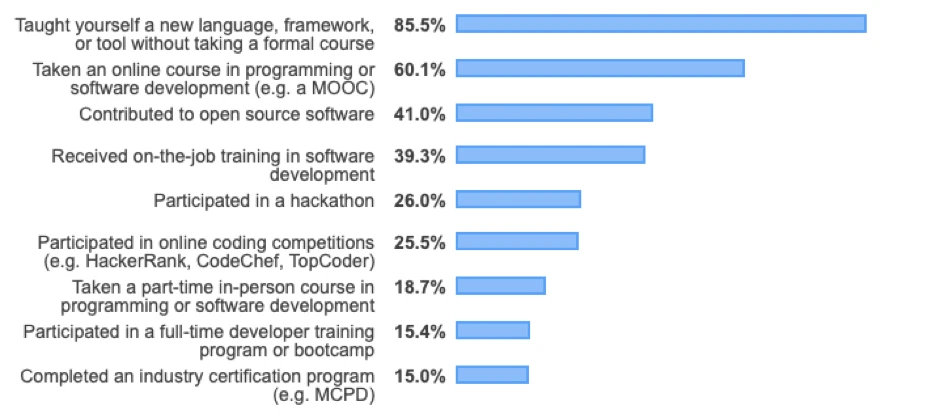
In addition, developers tend to be lifelong learners. Almost 90% of all developers say “they have taught themselves a new language, framework, or tool outside of their formal education”. Among professional developers, about 15% of them participated in a full-time developer training program or bootcamp.
Most loved technologies
According to the Stack Overflow Developer Survey 2019, JavaScript is again the most commonly used programming language (for the seventh year in a row), while Python has once more risen in the ranks. Python edged out Java this year – similarly, it surpassed C# last year and PHP the year before that.
The top three programming languages, form part of HyperionDev’s Full Stack Web Developer course. And Python and Java are a core section of the Software Engineering bootcamp’s curriculum.
Here are the six most popular programming, scripting and markup languages:
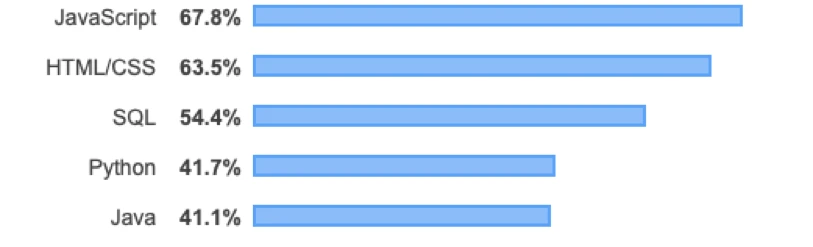
As far as web developer frameworks go, here are the top three. The HyperionDev Web Development bootcamp covers React, as well as other frameworks, in its online and on-site programs.

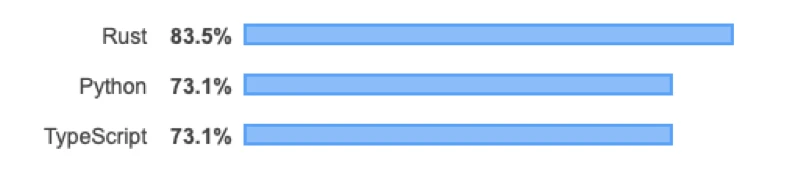
For the third year in a row, Python is the most wanted language. Basically, developers who don’t yet use Python want to learn it.

Rust, for the fourth year in a row, came out tops as the most loved programming language, followed closely by Python. More developers, therefore, want to continue working with these languages rather than other languages.
Salaries
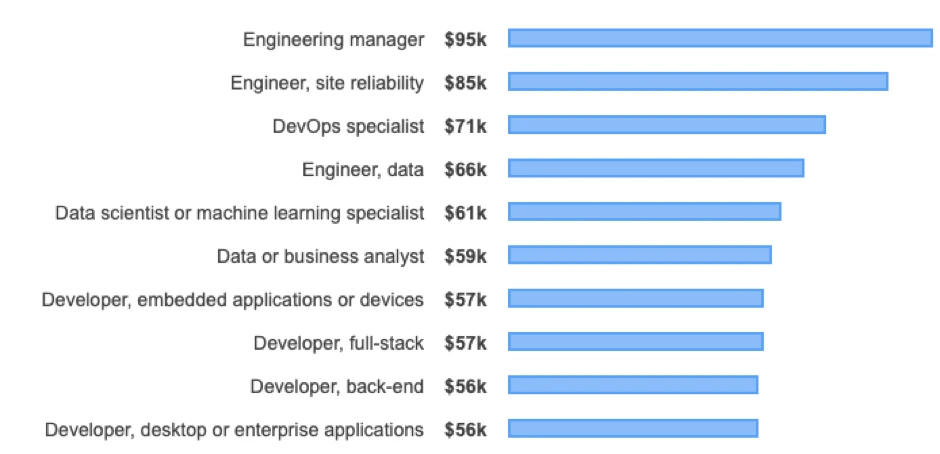
It’s well-known that programming work is both in high demand and able to command a lucrative salary. Here are the top ten salaries for developers, globally. You can see that data scientist is in the top five.
Developer Satisfaction
Almost 75% of developers report that their work brings them some satisfaction. Similar to previous years, “developers tend to be more satisfied with their career than with their current job”.
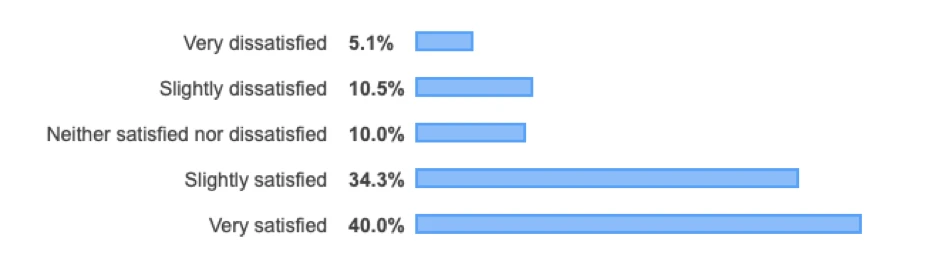
In closing, we’ve covered the top findings of the Stack Overflow Developer Survey 2019. Perhaps of greatest relevance to developers and those wanting to enter this field is that learning never stops. Developers are lifelong learners. They are also, by and large, satisfied in their chosen field.
If you’re keen to change careers or upskill, consider enrolling on a HyperionDev online bootcamp in Full Stack Web Development, Data Science or Software Engineering. You can also trial one of these courses for free. If online learning is not your thing, you could enrol in an immersive, face-to-face Web Developer or Software Engineering course in Cape Town or Johannesburg. Python is included in the Software Engineering and the Data Science bootcamp.

Career Advice
Which industries will be impacted by tech?
Read about the impact of technology on various industries, such as medicine, bookkeping and even law. Is your job under threat?
It’s difficult to think of an industry that has not been affected by tech. And of course automation and AI (Artificial Intelligence) is a huge driver of this change. Austrian economist Joseph Schumpeter came up with the concept of “Creative Destruction” to describe “the way technological progress improves the lives of many, but only at the expense of a smaller few,” states Investopedia. During this process, certain industries are destroyed, but the industries that replace them create new jobs. Let’s look at the impact of technology on a variety of industries.
Automation – what can we expect?
A recent study by the Brookings Institution, a Washington think tank, reported in Techradar, found that 25% of jobs in the US – the more “repetitive ones”, as one might expect – are under direct threat from automation. The Future of Jobs Report 2018, put out by the World Economic Forum, confirms this. “Nearly 50% of companies expect that automation will lead to some reduction in their full-time workforce by 2022, based on the job profiles of their employee base today,” states the report.
Who is highest at risk? It appears that low-skilled workers, particularly those who work in the food service industry, could be replaced. This is already a reality for some waiters in Japan whose work has been taken over by robots. (Interestingly, the robots are controlled by people with severe physical disabilities.) Highly creative or technical positions are least likely to be automated.
However, all is not lost. New technology also creates jobs, which means you need people familiar with this new technology. The report conducted by the World Economic Forum found that “75 million jobs may be displaced by a shift in the division of labour between humans and machines, while 133 million new roles may emerge that are more adapted to the new division of labour between humans, machines and algorithms.”
What are these emerging in-demand roles? Certain established roles that will experience increasing demand in the period up to 2022 include Software and Applications Developers, Data Analysts, and Ecommerce and Social Media Specialists. New specialist roles include AI and Machine Learning Specialists, Big Data Specialists, Information Security Analysts, User Experience and Human-Machine Interaction Designers, Robotics Engineers, and Blockchain Specialists. In essence, by 2022, “no less than 54% of all employees will require significant re- and upskilling,” explains the report.
Impact of technology on specific industries
Here are some industries that are likely to feel the impact of technology directly:
Bookkeepers and Accountants: According to the website Will Robots Take My Job, these jobs have a 98% chance of having their jobs automated. Whether your job is at risk from AI generally depends on four variables: does your job require that you come up with clever solutions, do you have to personally help others, does your work require negotiation and, interestingly, does your occupation need you to squeeze into small spaces (i.e. jobs that are routine, repetitive and predictable are more likely to be replaced)?
Lawyers: 20 corporate attorneys specializing in corporate law and contract review competed against AI to spot mistakes in Non-Disclosure Agreements (NDAs). The outcome: AI achieved 94% accuracy versus 85% accuracy from the lawyers. Plus: it took the lawyers 92 minutes on average, whereas AI could spot errors in a staggering 26 seconds! This doesn’t bode well for the law profession.
Medicine: Tech could prove to be even better at diagnosis than doctors. In fact, Stanford researchers developed a health screening program to distinguish between cancerous and non-cancerous moles with more than 90% accuracy – that beats the human dermatologists.
In closing, the impact of technology on virtually every industry cannot be underestimated. We will all be affected. “Unless you are 80 years old or something, you will have to repeatedly reinvent yourself in the coming decade – you’ll probably change your job a number of times,” says Yuval Harari, famous historian and author of 21 Lessons for the 21st Century. Perhaps it’s time to think about upskilling. If you want to learn programming skills to stay relevant, consider enrolling on a HyperionDev online bootcamp in Full Stack Web Development, Data Science or Software Engineering. You can also trial one of these courses for free. If online learning is not your thing, you could enrol for an immersive, face-to-face Web Developer or Software Engineering course in Cape Town or Johannesburg.

Career Advice
How universities are partnering with coding bootcamps to update curriculum
What’s behind the growing trend of traditional universities partnering with bootcamp academies, allowing learners to enrol in university coding bootcamps?
There is a growing trend of traditional universities teaming up with bootcamp academies, giving learners the opportunity to enrol in university coding bootcamps. Which universities have been pioneering this movement, and how is it benefitting their students?
Let’s start with a look at some recent university coding bootcamps that have been made available to learners:
Recent university & bootcamp partnerships
Wyncode Academy & Lynn University: Web development and UX bootcamp provider Wyncode has partnered with Lynn University in Florida. The partnership offers university credits to learners who graduate from the 9-week Wyncode Web Development bootcamp. Graduates can put these towards the 36 credits required for a Master’s degree.
Dominican University & Make School: California’s Dominican University found they were lacking offerings for students interested in tech and computer science. They have partnered with Make School, a coding bootcamp school in San Francisco, who were looking to get their 2-year programme accredited to offer a Bachelor’s degree. Each school is now helping to fill in the gaps for the other. Dominican will help Make School add liberal arts courses to its coding curriculum, upgrading to a Bachelor’s degree programme, and Make School will help Dominican create a minor in computer science.
Flatiron School & Yale University: The Flatiron School and Yale University’s Summer Session have teamed up to offer a Web Development bootcamp to students for Summer 2019. The bootcamp will carry 2 Yale College credits. This 10-week course is a special collaboration between Flatiron and Yale’s Computer Science department, providing an introduction to full stack web development.
DevPoint Labs & University of Utah: DevPoint Labs partnered with the University of Utah’s Professional Education department in 2017, launching a full-time 11-week web development programme for adults who want to change careers.
Trilogy Education & multiple universities: Several universities are partnering with the workforce accelerator Trilogy Education, to launch part-time bootcamps in their continuing education departments. The courses usually take place on the university campus, through the department of continuing education. Graduates receive a certificate of completion from the host university.
The power behind these partnerships
What’s behind this trend in the education world? There are a number of reasons why traditional educational institutions are partnering with more modern learning providers.
Online coding bootcamps are highly relevant, with content that is constantly updated and fresh. This is essential for those looking to start out in the fast-evolving tech industry. There also tends to be more of a practical focus in a bootcamp curriculum, whereas universities offer more theoretical learning to aspiring coders.
In short, coding bootcamps can help graduates become better equipped to launch a coding career.
Partnerships like these also allow universities to keep up with the “digital economy” offering quick and affordable computer science minors for students across a range of disciplines.
Choosing a university coding bootcamp
If you’re looking into a university coding bootcamp partnership, here are a few tips to help you make an informed choice:
Look at student outcomes: The practicalities of your qualification are just as important as the prestige that comes with completing a bootcamp attached to a university – if not more so. Find out the bootcamp’s graduation rate, and the employment rate for those graduates. This will help you to determine whether the bootcamp qualification will help you to land a job quickly and easily after graduation.
Find out who will be teaching: Most likely, a bootcamp instructor and not a university professor will be teaching this course. This is a good thing however; it means you’ll be learning from someone with real-world, professional experience.
Do your homework: Do as much research into a university-aligned bootcamp as you would for an independent bootcamp. This will help you ensure you’re making a choice that aligns with your learning and career goals.
Cut the middle man out and join a coding bootcamp today. HyperionDev offers a choice of full-time and part-time bootcamps for those interested in web development and data science. Our courses include personalised mentorship and on-demand code review, to help you learn and grow at a fast pace.
Whether you’re looking at university coding bootcamps or the independent coding bootcamps from HyperionDev, there’s a learning opportunity out there for you, to help you advance in today’s increasingly digital workplace.

Career Advice
Tech in South Africa: initiatives that support tech education and job creation
These five innovative initiatives are helping to make education and employment in the tech sector more accessible to South African youth.
Tech in South Africa is on the rise, yet the country is still facing many challenges, including unemployment and the prospect of automation. It’s estimated that 90% of all jobs in the future will require some level of digital skills or capability. Here are a few more fast facts about the tech job landscape:
- 98% of South African CEOs say they are worried about the availability of key skills for the future.
- An estimated 5.7 million jobs in South Africa are at risk of total automation. Strong tech skills are essential in order to stay relevant in the job market.
- South Africa has a national unemployment rate of 27,2%, with the country’s youth (ages 15-34) being largely affected.
These five innovative initiatives are helping to make education and employment in the tech sector more accessible to South African youth.
- The YES Initiative
Summary: The Youth Employment Service (YES) programme is a collaboration between business and government, focused on helping black South African youth in urban, peri-urban and rural areas.
Objectives: The programme aims to create one million new jobs and job opportunities for young people in South Africa, over the next three years. The YES initiative successfully found work opportunities for 4,600 young people in 2018.
Apply: You can find out more about the programme and application criteria online.
- CapaCiTi
Summary: The Cape Innovation and Technology Initiative (or CiTi) is the oldest tech incubator in Africa. CiTi works with government, business and society to promote the inclusive growth of the digital economy. CapaCiTi is CiTi’s technology skills and job readiness programme.
Objectives: In 2018, CiTi announced a significant scale up of the CapaCiTi programme, having unlocked R250 million to support technology skills and job creation. Over the next three years, the programme aims to train more than 3,000 young people with in-demand technology and business skills, and place them in permanent jobs.
Apply: Click here to find out more about CapaCiTi tech skills training, career coaching, career matching and internships. You can also apply for the CapaCiTi programme online.
- The Innovation Hub
Summary: The Innovation Hub is the innovation agency of the Gauteng Province, based in Pretoria. It is a wholly owned subsidiary of the Gauteng Growth and Development Agency, established by the Gauteng Provincial Government through its Department of Economic Development.
Objectives: The Innovation Hub aims to promote economic development and competitiveness of Gauteng, by fostering innovation and entrepreneurship. Their programmes include skills development initiatives like the FabLab Schools Programme, and the CoachLab skills and leadership development programme.
Apply: You can find out more about skills development and business incubation offerings from The Innovation Hub online.
- Silicon Cape
Summary: Silicon Cape is a non-profit, community-driven initiative in the Western Cape. It’s a community of tech entrepreneurs, developers, creatives and investors.
Objectives: The initiative aims to improve the environment in the Western Cape to create and improve start-ups, and increase access to capital.
Apply: You can join the Silicone Cape community by applying for membership online.
- JoziHub
Summary: JoziHub is a co-creation space in Johannesburg
Objectives: JoziHub is looking to transform the technology industry by connecting entrepreneurs and developers with the critical resources they need. It has partnered with industry heavyweights like Google for Entrepreneurs, and Omidyar Network.
Apply:JoziHub offers networking, mentorship and workspace services. Read more online to find out how this initiative can help you launch your tech career.
- LaunchLab
Summary: This Nedbank-backed initiative is based in Stellenbosch, and forms part of the University’s Innovus initiative for technology transfer, entrepreneurial support and development, and innovation.
Objectives: The LaunchLab offers incubation space, pitching competitions, workshops and more, to help tech start-ups and entrepreneurs. The initiative has raised R110 million since 2016.
Apply: You can complete the Lift-Off Application Form online to become a part of the LaunchLab.
- The Sable Accelerator
Summary: The Sable Accelerator is an international partnership group dedicated to helping South African entrepreneurs and start-ups to promote and commercialise their technology innovations.
Objectives: The accelerator aims to promote and protect intellectual property, fund new business concepts, finance growth, and help South Africans expand into global markets. It is powered by MentorCloud, a cloud-based mentorship platform, which also works with the University of the Witwatersrand Alumni Association.
Apply: Become a member and take advantage of Sable’s tech acceleration services.
Another less traditional route towards a recognised coding qualification is to sign up for an online coding bootcamp. This learning pathway is quicker, more flexible and more affordable than a traditional Computer Science degree. Read some of our student success stories, to find out how we’ve helped South African learners to find employment or switch careers.

Career Advice
[Infographic] What are Income Sharing Agreements (ISAs) and are they worth it?
Our simple infographic outlines the benefits and the downsides of these agreements, so that you can make up your own mind.
Income Sharing Agreements are a relatively novel way of paying your tuition costs. But as with any financial decision, you should think carefully about signing up for any long-term debt agreement – and understand the fine print like the back of your hand. Sometimes a great deal is simply too good to be true.
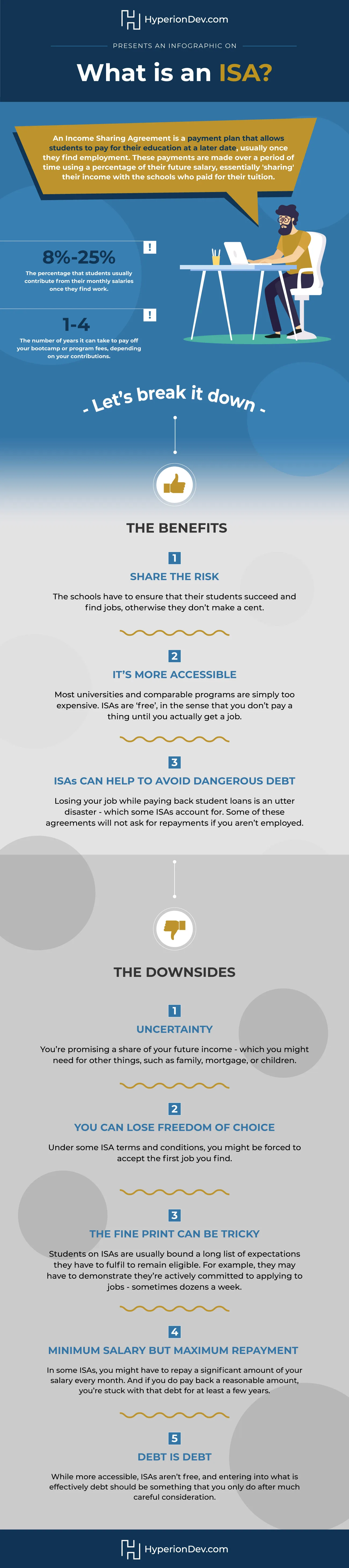
According to the HyperionDev Graduate Outcomes Report you can expect, on average, a salary increase of R12 000 per month, equating to an extra R144 000 per annum after completing your coding bootcamp. You need to think carefully if you want to commit a portion of this increased salary to paying off your tuition costs, sometimes for years on end. In the the long term, you could well end up forced to work a job that wasn’t your first pick, to pay back far more debt that you initially bargained for.
At HyperionDev, we think some things are simpler. Like our various tiers of payment plans, including upfront and installment schedules that make it easier to plan your budget when studying and when you land your first job. And when it comes to our 2018 graduates, 72% found a new tech job within three months after graduating – earning salaries that were all theirs, with no long-term payments to us.
If you’re keen to change careers or upskill, consider enrolling in a HyperionDev online bootcamp in Full Stack Web Development, Data Science or Software Engineering. If online learning is not your thing, you could enrol for an immersive, face-to-face Web Developer or Software Engineering course in Cape Town or Johannesburg. Best of all, you can also try any one of these courses for free.
Editor’s note: This was post was originally published on 29 April 2019 and has been updated on 12 March 2020.

Career Advice
The tech startup scene in South Africa: Cape Town vs Joburg
What is the tech startup scene in South Africa like? We outline key trends, including most popular city in which to start a tech business as well as which city has the greatest success rate.
If you’re a South African tech entrepreneur, what’s the South African startup scene like? Should you be opening your new business in Cape Town or Joburg? Where are you most likely to encounter success? Here are the key trends on the tech startup scene in South Africa.
Gauteng winning
At first glance, it seems that Gauteng has the upperhand. It appears to be the most popular province in which to run a tech startup in 2018, according to the Ventureburn Tech Startup Survey. Check out the below graph, which shows 55% of the 153 tech founders questioned in an online survey operate in Gauteng compared with the next highest contender at 37% in the Western Cape. The data also indicated that the rise in Gauteng startups is driven by an increasing number of black tech entrepreneurs.
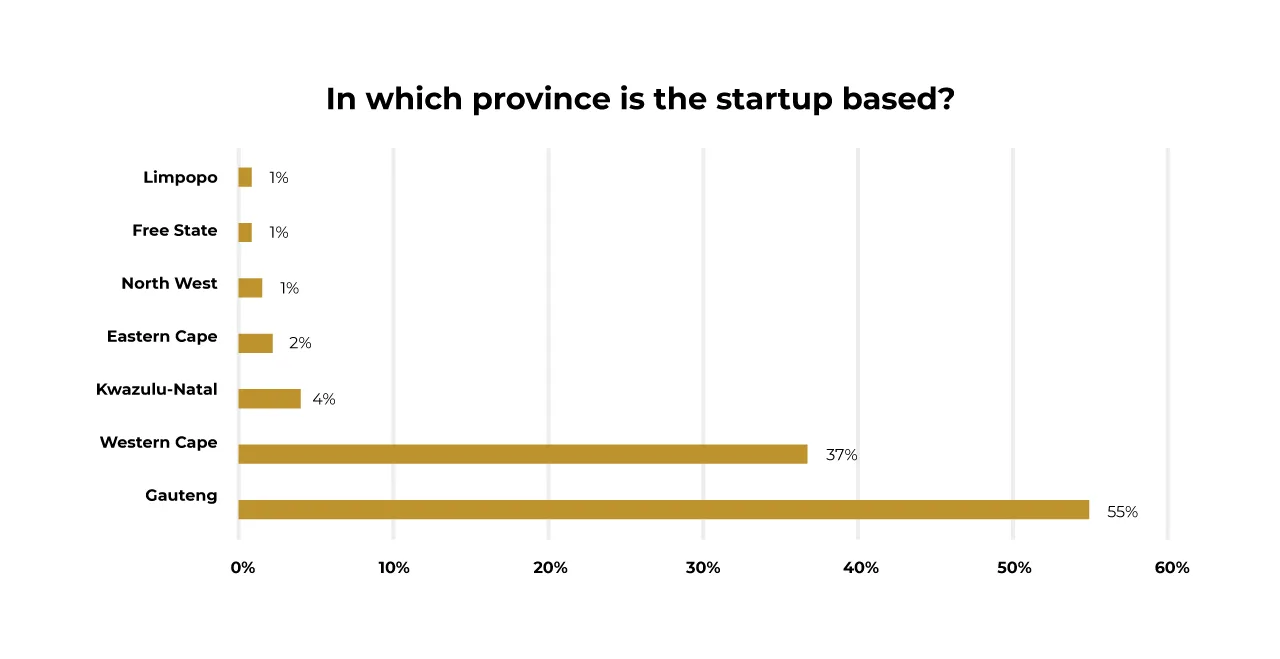
Img Source: http://ventureburn.com/2018/11/gauteng-top-2018-ventureburn-survey/
Western Cape still popular for tech entrepreneurs
However, even though most tech startups begin their journey in Gauteng, here’s an important addendum: the more successful startups tend to be Western Cape based. 36% of startups in the Western Cape report making a profit whereas the figure in Gauteng sits at a lower 23%. Of those surveyed, only 21% are turning over R1 million per annum. 27% generate between R100 000 and a million per year. According to Stephen Timm, editor of Ventureburn and reported in ITWeb, the key reason “behind this success is the higher prevalence of venture capital (VC) funding in the Western Cape.”
Behind the startups
What kind of people are involved in tech startups? And what is the nature of the businesses? Let’s look at who is behind the tech startup scene in South Africa.
The biggest driving force behind tech startups tend to be men between the ages of 25 and 50. 65% of tech startup founders are male. The three most popular areas for startups are SaaS (Software as a Service) at 19%, fintech and insurtech at 18% and the media, advertising and marketing sector, which sits at 13%. Here’s a graph indicating the various sectors within the tech startup environment.
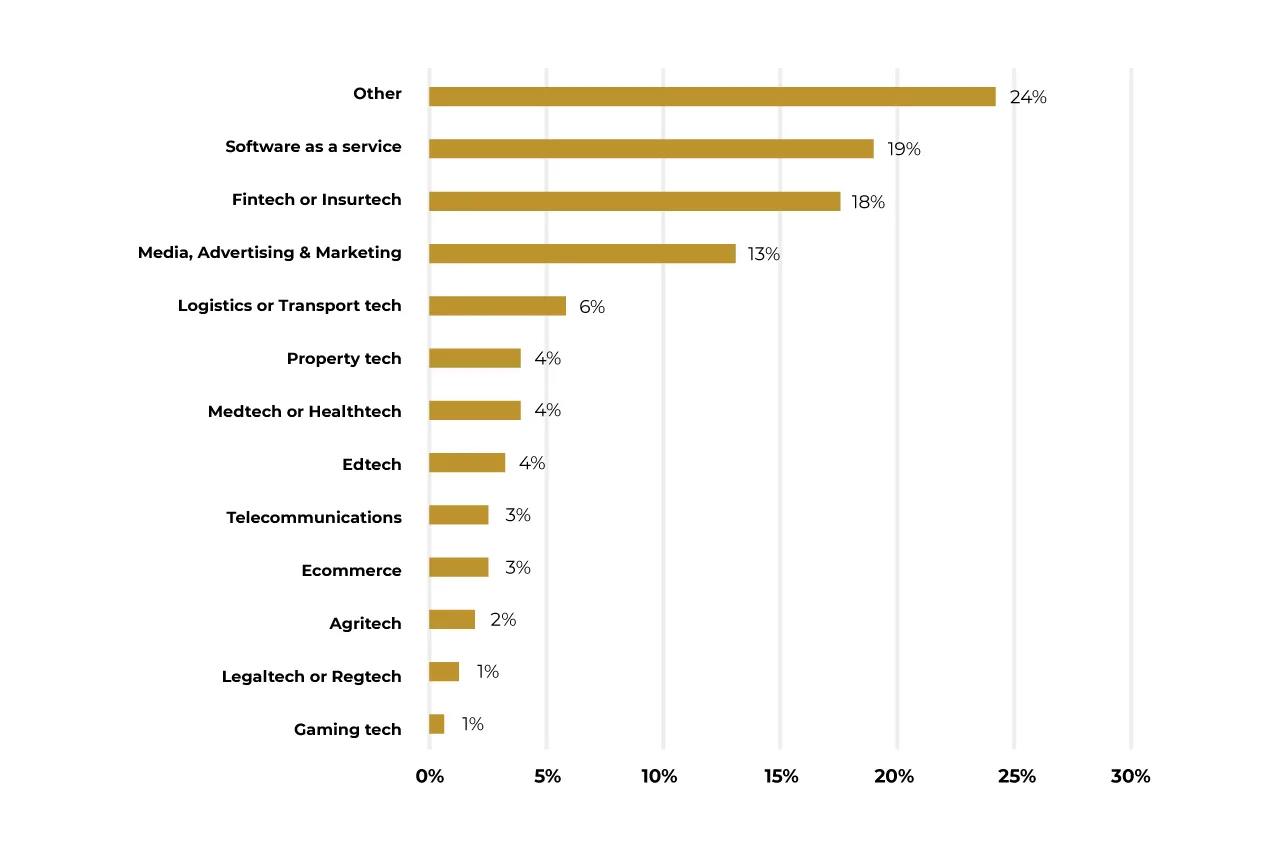
Img Source: http://ventureburn.com/2018/11/gauteng-top-2018-ventureburn-survey/
Now for some good news: about a third of the respondents began their startup in the last year. Remember, it’s never too late to begin a new tech venture or career in tech. In fact, according to the 2018 Stack Overflow report, a full third of professional developers only learned to code within the past five years. Moreover, almost 12% of developers who work in the industry only learnt to code in the past two years.
And some more good news about the tech startup scene in South Africa: only a quarter operate from the office. The overwhelming majority work either from home or remotely. (If you want to read more about remote development work, check out these tips.)
Black tech entrepreneurs: problems encountered
It’s not all roses, however. Startups begun and run by black tech entrepreneurs struggle more than their white counterparts, although, as mentioned earlier, there are an increasing number of black tech entrepreneurs. Only 7% of black-owned tech startups are turning a profit compared with 15% of startups begun by white entrepreneurs. Also, the financial position of black startups is more dire than for white-owned new businesses: 28% of white founders have three or fewer months left of funds whereas the equivalent situation for black tech startup founders is 51%. The reason for this appears to be that white tech startup founders have greater access to capital, skills, experience and productive networks, which obviously has a knock-on effect.
In closing, the tech startup scene in South Africa seems to be shifting to Gauteng, although companies in Cape Town enjoy greater success. If you’re got a killer tech idea, consider a startup, particularly if you would enjoy remote work. To brush up on your coding skills, think about enrolling on a HyperionDev online bootcamp in Full Stack Web Development, Data Science or Software Engineering. You can also trial one of these courses for free. If online learning is not your thing, you could enrol for an immersive, face-to-face Web Developer or Software Engineering course in Cape Town or Johannesburg.

Career Advice
Where to study coding in Johannesburg
Few industries offer job security like a career in coding. This is a result of the global tech skills gap, and the ever-growing demand for industry-expert coders. If you’re keen to study coding in Johannesburg, here are some excellent options.
Gauteng is known for its hard work and getting things done. Don’t knock back on Friday at 2 – that’s a Cape Town thing. Besides industriousness, there are also great places to study coding in Johannesburg. Whether you’re interested in software engineering or web development, you’re bound to find a course that suits your pocket and your schedule. We’ve listed six awesome places to study coding in 2019.
This non-profit organisation has a unique vision involving no teachers or classes; students learn via a peer-to-peer problem solving environment. The two-year course is sponsored by companies looking to support the development of local tech in the digital economy, which means there are no tuition fees. The aim of the program is to teach students how to solve problems using coding as their tool.
Anyone can apply provided you’re between the ages of 17 and 35, and you’re able to study full-time for two years at one of their campuses, situated in Cape Town or Johannesburg (at 84 Albertina Sisulu Street, Johannesburg CBD). No prior education or coding experience is required. To get into their course, you have to pass their online application process. Successful applicants are invited to participate in a selection bootcamp and then ultimately onto the full-time course.
HyperionDev offers part-time or full-time 3 month intensive classroom learning experiences in Web Development or Software Engineering. In the Software Engineering course, you’ll master Python and Java and learn to apply important computer science, data science and software engineering principles. The Web Developer course teaches you to build your own dynamic, data-driven web applications. You’ll learn HTML, CSS, JavaScript, Node.js, MongoDB, Express and React. Basically, you’ll cover back-end, front-end and full-stack web development.
Courses take place at their Cape Town or Johannesburg venues (all courses are also offered online) and include job search support and career coaching. During the course you’ll learn to write industry-quality code with the help of your own mentor. You’ll attend physical classes, while work will be submitted to an online platform.
Located in Woodmead, Code College offers a wide variety of short and longer courses. There are two categories of courses – ‘short courses’ and ‘Full Stack Web Coding Bootcamps’. They also offer a variety of coding courses for kids, including Scratch, MBot Robotics and Python for kids. Their short courses cover JavaScript, .Net, Java, Android, Python, and more. Many of the courses take place over five days and include an online component.
This institution, located in Centurion, offer a number of programming courses, both virtually and in their physical classrooms. Programming courses include the following: Java, .Net, C and C++, Web Development, Object Oriented courses, as well as other programming courses (e.g. Perl, SQL, Linux, etc.).They also have a variety of one-day technology seminars in JEE, Web Services, Mobile Application Technology and Coding Ethics. You can view their full training schedule here.
Leading Edge operates from Sandton. The institution offers a variety of short courses in programming and IT. Part-time and full-time study is available. In-person, instruction-led tuition, as well as online training, is offered. Courses include web design as well as programming (HTML, CSS, Bootstrap, Flash and others). There is also training in databases, such as SQL and MySQL.
Damelin, which has campuses throughout South Africa, offers both university-level and Further Education and Training (FET) qualifications. They offer a Bachelor of Commerce in Information Management, which takes place over 3 years, full-time. You can choose a career in one of a number of fields, such as Software Development, Database Analysis, E-commerce Management, etc.
In conclusion, if you’re keen to study coding in Johannesburg, we’ve listed some excellent options. HyperionDev, particularly, offers industry-specific courses in a stimulating environment. If you want to change careers in 2019, check out one of these courses. Remember, few industries offer job security like a career in coding. This is a result of the global tech skills gap, and the ever-growing demand for industry expert coders. Let us know if there are any other tech courses in Johannesburg you’d recommend in the comments below.

Career Advice
Will I get a job after a coding bootcamp?
Many students want to know: will I get a job after a coding bootcamp? How employable does a bootcamp qualification make you, and how long will your job search take?
Coding bootcamps are a challenging, rewarding and fun way to learn new skills or improve your existing knowledge. But naturally, many students want to know: will I get a job after a coding bootcamp?
So, how employable does a bootcamp qualification make you, and how long will your job search take?
It’s important to remember that a bootcamp certificate alone won’t get you a job – but then, neither will a traditional degree or diploma. Industry-aligned skills, sound technical knowledge and a strong portfolio are the attributes you need to land the developer job you’ve always wanted.
How do employers perceive bootcamp graduates?
A 2017 survey conducted by job site Indeed found that the vast majority (72%) of employers consider bootcamp grads to be “just as prepared to be high performers” as graduates with degrees.
A much smaller percentage of employers (17%) favoured degree holders over bootcamp grads, while 12% of employers actually perceived bootcamp learners to be “more prepared to be high performers” than traditional graduates.
Simply put, a large majority of employers out there view bootcamp graduates in a fair light, and don’t consider a lack of a traditional computer science degree to be a setback.
More recently, in 2018, Fullstack Academy released findings that showed a positive upswing in bootcamp graduate hiring trends over the past 5 years. According to Fullstack Academy:
- Start-ups have been hiring bootcamp grads since 2013, but bigger companies took longer to get on board.
- By 2018, major companies like Google, Facebook, LinkedIn, Amazon, Dropbox, JPMorgan, Goldman Sachs and Amex were hiring bootcamp graduates.
- Middle-grade companies, which are profitable but very risk-averse, are still the most hesitant to hire bootcamp grads.
Employment rates for coding bootcamp graduates
The results of the Stack Overflow 2018 Global Developer HIring Landscape report shone some light on the statistics around bootcamp learning:
- Nearly 90% of developers have taught themselves a new language, framework or tool outside of their formal education.
- 10.5% of these learners participated in a full-time developer training programme or bootcamp.
- Other popular learning methods included participating in hackathons, and contributing to open source software.
- 45% of coding bootcamp participants already worked as developers, using the bootcamp experience to update their skills.
What do the success rates look like for the other 55% of bootcamp graduates, in search of their first coding job?
- 16.3% found a job immediately after graduating
- 7.5% found a job in less than a month
- 10% found a job in 1-3 months
- 5.2% found a job in 4-6 months
- 3.6% found a job in 6-12 months
- 3.2% took longer than 12 months to find a job
- 8.7% are still in the job market
Misconceptions about coding bootcamp graduates
There are still some false beliefs and misconceptions floating around the job market, but these are shifting as more employers and learners become aware of the value of bootcamp training.
- Bootcamp students have no experience working as professional developers: Looking at the Stack Overflow report, we can see this is false, as nearly half (45%) of bootcamp learners surveyed were already working as developers before starting the course. That means many coding bootcamp graduates have plenty of experience under their belts and are actually ready to take on senior roles.
- Bootcamp graduates struggle to find jobs: Graduates with recognised bootcamp qualifications are in high demand, just as their counterparts with more traditional degrees are. Of course, a bootcamp certificate doesn’t guarantee a job, but the interview and hiring process won’t differ significantly between bootcamp graduates and more traditional graduates. Technical ability speaks louder than a piece of paper.
- Students only use bootcamps as a way to change careers: This is certainly the case for some learners, but many others enroll in bootcamps to supplement their current non-programming jobs.
- Bootcamp students need a background in science: Neither science nor maths is a prerequisite to succeed in a coding bootcamp. Many learners come into the course with non-traditional backgrounds, including writing and art. At the end of the day, the most important thing is the developer’s ability to write quality code.
HyperionDev bootcamp graduate success rates
Our 2018 Graduate Outcomes Report for our South African bootcamp graduates revealed these positive trends:
- 95% of graduates reached their career outcomes.
- These outcomes include: moving to a tech career, starting a business, upskilling in their current tech role, or using their new skills in a non-tech job.
- 61% of graduates switched to a career in tech.
- 72% switched to a new career within 3 months.
- Average salary increases post-graduation were estimated at R12k per month/ R144k per year.
Post-course support improves the hiring process
Our support doesn’t end once graduates receive their bootcamp certificates. We also offer career services to help set them apart from other candidates. While we don’t place our graduates directly in jobs, we do provide comprehensive post-course support to make the process that much easier.
Technical CV and portfolio creation: We provide technical assistance in getting each CV industry-ready.
Interview preparation: Helps graduates know what to expect when getting ready for that big interview, with expert preparation and advice from industry professionals.
Hiring network: We work with select hiring partners to place our students in new jobs within 6 months of graduating. There are also internship placements available with select partners.
To sum up, skilled coders are in high demand, and in most employers’ eyes, your skills and knowledge often take precedence over the type of qualification you have. It’s certainly possible to get a job after a coding bootcamp – and a rewarding one too – especially with the help of post-course services.
Editor’s note: This was post was originally published on 28 May, 2018 and has been updated on 4 March, 2019.

Career Advice
How can you become a VR developer?
Where do you start if you want to design virtual reality games or apps? Here’s how you can become a VR developer, or virtual reality developer.
VR or virtual reality is a field on the up. For starters, there are 171 million active VR users, according to Statista reports. And this market is said to surge. In 2016, the global virtual reality market stood at $2.02 billion. However, from 2017 to 2022, the revenue in this market is forecast to reach $26.89 billion. Remember: VR development is not only for games; other areas, such as education and healthcare, are going to see rapid increases as well. So how can you become a VR developer?
No simple set of requirements
Because it’s a relatively new area of expertise, there’s no clearly mapped out route to become a VR developer. A good place to start, claim many experts, is with traditional game development, where you look at things like systems design, physics, animation, 3D art, etc. It’s fairly common to move from standard game development to VR.
Choose your game engine
There are two popular game engines for VR: Unity 3D and Unreal Engine. “The first engine uses C#, the second one C++,” says Maciej Szczesnik, a freelance developer, Lecturer of Game Design at Warsaw Film School and Packt author on Techworld.
According to The Ghost Howls, a blog about VR and AR (augmented reality), a game engine is a “big software framework that offers you lots of functionalities (rendering pipeline, model importing, physics engine, multiplayer, etc.) out of the box, so you can develop a game in an easy way”.
Both engines include support, video tutorials, documentation and an active forum for troubleshooting, though Unity, many people say, tends to be easier to learn. In fact, the Unity game engine is the most popular game engine today. 34% of top free mobile games are made with this engine, as well as 90% of all Samsung Gear and 53% of all Oculus Rift VR games and apps.
Learn a visual scripting language
Although you’ll eventually have to learn a scripting language, like C# or C++, the good news is that you can start with a visual scripting language, which allows you to build a prototype – i.e. an early model of your game or app. Both game engines have visual scripting languages: Blueprints for Unreal Engine and Playmaker for Unity. Here’s an example of Blueprints’ visual scripting system – you can see how everything is done visually. It’s a way for non-programmers to dive straight in.

Image source: https://forums.unrealengine.com/filedata/fetch?id=1149664&d=1431301479
Learn the scripting languages
As mentioned, you will ultimately have to learn C# or C++ for the various game engines. C# (pronounced ‘sea sharp’), one of the most popular programming languages in the world, was developed in 2000 by Microsoft. It’s an object-oriented programming language, which means it’s organised around objects rather than actions, and data instead of logic. C++ (pronounced see-plus-plus) was created back in 1985 – it literally means ‘increased C’ (technically, it’s the C language but with classes added).
Create a simple game
Users on Quora frequently mention playing and creating VR games as a strategy for learning how virtual reality works. One user recommends creating a VR pacman game. You’ll need to Google the things you want to add – e.g. gravity, and then showcase your demo to the local VR community. Crowd learning is certainly the way to go. You’ll also want to learn about VR hardware, such as Google Cardboard, a simple way to make a virtual reality headset, or Oculus Rift, a state-of-the-art headset.
Once you’re up to speed with VR, you might be keen to get a job. What can you expect to get paid? The average annual VR developer salary in the US is $104 000. Here are the average salaries for other tech hubs around the world.
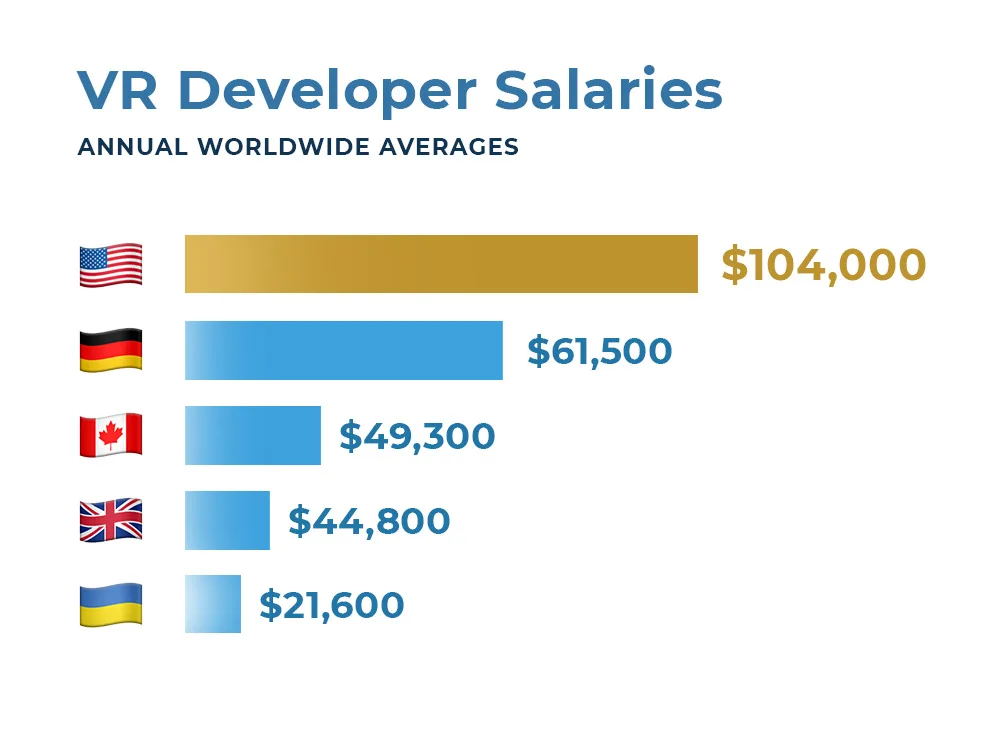
Image Source: https://mobilunity.com/blog/how-much-does-vr-development-cost/
In conclusion, according to an article in Medium, it took 27 years for PCs to grow from 2% to 70% of US adoption, the Internet took 13 years and smartphones averaged at 8 years. Many analysts predict VR will achieve this in the next 4-5 years. It’s clearly time to climb on the bandwagon. If you’re interested in learning the scripting languages for VR, consider signing up for a HyperionDev part-time, 3-month C# short course or a short course in C++.

Career Advice
Top tech events to look out for in 2019
Learn the latest tech trend or expand your network by attending a tech event this year. We’ve listed the top tech events in 2019 in Europe, USA, Africa and Asia.
Make 2019 your year by expanding your network, learning the latest tech trend or meeting prospective clients or investors. How can you do this? One excellent way involves attending a tech event – it’s sure to give your career a boost and you’re likely to become inspired by meeting like-minded people. Let’s have a look at the top tech events in 2019.
Europe
Where and when? London, April 25 & 26
What is this event about? Attend the world’s largest blockchain conference and exhibition to find out which key industries are set to be disrupted by this new technology, including legal sectors, retail, financial services, healthcare, insurance, energy, music, government, real estate and more.
Where and when? Paris, May 16-18
What is this event about? This tech event celebrates innovation. Meet up with startups and leaders, while discovering tech trends in VR, AR, robots, drones, and more. VivaTech is an excellent springboard for early-stage startups.
Where and when? Amsterdam, May 9-10
What is this event about? This technology festival brings together international technology executives, top-tier investors and promising startups for two days of business and knowledge sharing. With more than 17,500 attendees a day and 3,500 companies from all over the world, you’ll extend yourself discussing topics ranging from artificial intelligence to blockchain, and everything in between.
USA
Where and when? San Francisco, 25-26 March
What is this event about? This event covers human-computer interaction and everything AI related. The 2019 event will encompass three main themes: What’s Next for AI?, AI’s Economic Impact, and A Global View. You’ll gain a much deeper understanding of the growing economic impact this field is having on organisations and industries around the world.
Where and when? Onboard the Royal Caribbean ‘Harmony of the Seas’ cruise, departing Orlando, Florida, 7-14 June
What is this event about? Now this is something different. Who says your tech conferences have to take place on dry land? You’ll cover all aspects of digital marketing sailing via the Bahamas, Costa Maya, Roatan and Cozumel, including content strategy, web experience management, mobile marketing, customer engagement, social media, analytics and data, marketing automation, and much more.
Where and when? San Francisco, 9-11 April
What is this event about? With over 450 sessions and keynote speakers, Google Cloud Next provides opportunities to meet one-on-one with Google experts on a wide range of topics, such as AI, machine learning, security, enterprise friendliness and infrastructure. Learn about the latest all-important Google Cloud innovations.
Africa
Where and when? Johannesburg, 26-27 March
What is this event about? This is the premier IoT event on the continent bringing together the biggest players to showcase many of the latest IoT solutions to the public and private sectors. IT leaders will rub shoulders with senior business executives at presentations, panel discussions, industry-focused break-away sessions and interactive case studies.
Where and when? Cape Town, 18-19 March
What is this event about? Join 300+ tech leaders and professionals at Africa’s vibrant centrepiece for women in tech. The conference includes inspirational keynotes, deep insight into tech trends and business strategy, technical classes, and career development workshops.
Where and when? Cape Town, 4-5 September
What is this event about? This is the largest business focused Artificial Intelligence (AI) & Data Science Community event in Africa. It includes investors, buyers, suppliers, innovators, enterprise executives and global brands. The event will cover real enterprise cases studies and the application of AI and data science in business today, available technology and cloud platforms, deployment challenges, as well as ethical considerations.
Asia
Where and when? Thailand, 19-20 June
What is this event about? Said to be the “best and most diverse tech summit in Asia”, this event brings together entrepreneurs, startups, artists, filmmakers and more to talk about blockchain, VC, healthtech AI, smart cities and other fascinating topics. It’s a diverse “cultural festival” that goes beyond tech into music and fashion.
Where and when? Singapore, 11-15 November
What is this event about? This is the world’s largest Fintech festival and global platform for the Fintech community – fintech is an area of technology to aid banking and financial services.
Where and when? Singapore, 2-3 April
What is this event about? This 2-day event is dedicated to business innovation within all major industries from the Food Sector to AI. Sixteen industries, including Energy, IoT, Gaming, Aviation, Cyber Security, AI, Fintech, etc., will share one stage.
In conclusion, we’ve listed twelve great top tech events 2019, taking place all over the world. Make this the year for broadening your tech skills and networking. Feel free to add any other tech events in the comments below.

Career Advice
Top tech trends in 2019
What tech trends in 2019 are going to take the world by storm? Here’s a look at five top predicted trends for the year to come.
With the new year well underway, predictions for 2019 are still coming thick and fast – especially in the world of technology. What tech trends in 2019 are going to take the world by storm? Here’s a look at five top predicted trends for the year to come.
Cryptocurrency
What is it? A cryptocurrency is a digital, encrypted currency. Encryption methods are used to regulate how units of this currency are generated, and to ensure secure transfers of funds. These digital currencies operate independently of central banks. Bitcoin, Ethereum and Zcash are all popular examples of cryptocurrencies.
Why is it trending? Cryptocurrency uses a system called Blockchain, where records of the transactions (these records are called “blocks”) are kept across several computers linked in a peer-to-peer network using cryptography. Blockchain is an extremely secure way of maintaining records, and those in FinTech are realising how useful it could be elsewhere.
The coming year will see new, experimental blockchain applications in banking, business and media. Blockchain systems could be the future of record-keeping in a world where security concerns around digital data are very real.
Screen time services
What are they? Screen time services are apps designed to monitor how much time a user spends online – and reward them for the time they spend logged off. Examples include Apple’s iOS Screen Time, Android’s Digital Wellbeing Dashboard, and third-party apps such as Hold. The aim is to help people develop a healthier relationship with technology.
Why are they trending? Social media, which was everyone’s favourite way to waste time online in the early 2000s, is out of vogue. Facebook especially earned itself a big “dislike” from users last year, after a major data mining scandal. Plus, many of us are waking up to the fact that all that scrolling simply isn’t healthy.
2019 is set to be a big year for “digital detoxing”. Jaded users are stepping away from their screens, using “screen time service” apps to put controls in place and keep their online time low. Soon, instead of measuring how many people liked our latest profile pic, we’ll be comparing screen times and seeing how low we can go. Time to ditch that feeling of FOMO for good!
Regulation
What is it? Now more than ever before, our privacy is under threat. Regulations are being introduced in some parts of the world, to help protect private information online. Europe’s latest General Data Protection Regulation (GDPR) came into force in May, 2018.
Why is it trending? The demand for regulation is spreading. Americans can expect some movement on data protection regulations in 2019. A collection of bills from the US House and Senate, aimed at officially regulating the tech industry, could eventually be combined into one comprehensive Personal Data Privacy Act. This would make it harder for companies like Google, Facebook and Amazon to use customer data without explicit consent.
5G
What is it? 5G is fifth-generation wireless – the latest iteration of cellular technology, designed to make wireless networks even faster and more responsive.
Why is it trending? The first 5G-ready mobile CPUs should become available in 2019, alongside improved infrastructure that makes widespread 5G technology a reality. It takes time for this sort of infrastructure to become widely available, so it’s expected that we’ll start to see 5G gaining traction from 2020 onward.
Robotics
What is it? Robotics is the branch of technology, science and engineering that deals with the design, construction, operation, and application of robots. Once the stuff of science fiction, robots and AIs are now very much a part of our daily lives.
Why is it trending? Robots are advancing in leaps and bounds. In 2017, the world welcomed its first robot citizen, Sophia – this Hong Kong-made robot became the first of her kind with legally recognised personhood. The era of truly agile, realistic humanoid robots has arrived, and we should expect more fascinating advances in this field in the next few years.
Augmented reality
What is it? Augmented reality (AR) is a technology that superimposes a layer of computer-generated content over a user’s view of the real world, creating a composite view. Users can interact with the digital elements. We’ve seen some really innovative applications of AR in recent years, from advertising campaigns that turn everyday objects into something remarkable, to next-level mobile gaming like the wildly popular Pokémon Go.
Why is it trending? Augmented reality will have a big year in 2019, with many flagship phones now supporting it. More AR tools for business and personal use will start to make an appearance on the market, as consumers look for more ways of using technology to enrich and simplify their day-to-day lives.
If you want to find out more about AI and software engineering – the type of skill set that could land you a job working on one of these big tech trends in the next year – check out a HyperionDev online bootcamp, and enter the exciting world of code.
Career Advice
Top 5 open source projects on GitHub in February
Used by over 31 million developers, GitHub is a place for developers to collaborate on projects. Here we list the top five open source projects on GitHub in February 2019.
GitHub is a globally recognised software development platform and is popular amongst developers when creating and sharing coding projects. The platform is home to over 31 million developers. Most of the developers, 80% in fact, come from outside the United States. With so much action, what are the top five open source projects on GitHub in February 2019?
Firstly, just a quick recap: GitHub is a site where developers can store their projects and work with other like-minded individuals. It’s clearly an excellent place to collaborate, which happens via Pull Requests that let you notify others about changes you’ve pushed to a GitHub repository. Interested parties can then check out these changes and propose potential modifications (read here about how to create a Pull Request). Also, like Microsoft Word or Google Drive, you can maintain a history of your code – with new iterations, you don’t lose previous versions.
So without further ado, here are the top five open source projects on GitHub in February 2019.
Interestingly, the most popular repository this month is a collection of full-stack resources for developers. The goal is to make you a more proficient developer – included are timeless classics and inspiring resources. There’s also a list of must-read books and articles, as well as many other resources including stuff on developer environments and tools, debugging, interviewee resources, databases, and much, much more. The repository is very comprehensive. And of course you can also contribute your own recommendations.
This project is an intriguing one. The goal is to train a NSFW (Not Suitable For Work) Image Classifier via a collection of scripts, which will categorise tens of thousands of pulled images according to these categories:
- Porn
- Hentai
- Sexy
- Neutral – safe for work neutral images of everyday things and people
- Drawings – safe for work drawings
This project requires Java runtime environment knowledge, as well as the Linux command line tools.
If you’re interested in getting involved in e-commerce, this project might be just the thing you’re looking for. Fescar is an easy-to-use, high-performance, Java based, open source distributed transaction solution. Contributors are welcome to join the FEATS project. You need to check out CONTRIBUTING about how to contribute to this project.
Here’s a cool 2019 February GitHub project – a repository of awesome podcasts which are helpful for software engineers and programmers. You’ll find stuff on .Net, Agile, Android, C++, relevant career interviews with developers and CEOs, Data Science, Machine Learning, Devops, Python, etc. It’s a fantastically long list, so there’s sure to be something that grabs your attention. In true GitHub style, you can also add new podcasts to this extensive list.
React is a tool for building User Interface (UI) components. In essence, it’s a JavaScript library created by Facebook. This GitHub project is an app that will help you learn the fundamentals of React. You need to install this application locally – there’s a guided tutorial, as well as exercises. Once more in the GitHub tradition, if you see any inconsistencies as you go through the exercises or if you have an idea about how to make the overall tutorial better, you can open a PR or Pull Request.
We’ve mentioned the top five open source projects on GitHub in February 2019. You can also check out the trending repository on GitHub to see what the community is most excited about on a daily basis. To brush up on your coding skills, consider enrolling on a HyperionDev bootcamp in Full Stack Web Development, Data Science or Software Engineering. You can also trial one of these courses for free.

Career Advice
Top 5 online coding bootcamp scholarships
Funding your bootcamp to change career to tech shouldn’t have to cost you an arm and a leg. Check out our list of the top online coding bootcamp scholarships.
Coding bootcamp tuition can range from $9,000 to $21,000, according to Course Report, although online coding bootcamps are more cost effective. For this kind of bootcamp you can enrol for as little as $3,000. To find the required financing, you may want to consider online coding bootcamp scholarships. Many schools offer such scholarships, particularly if you belong to an under-represented group, such as women or persons of colour, in the tech industry.
Remember, there’s no harm in asking your preferred bootcamp provider about scholarships – the worst thing is that you’ll be met with a ‘no’. Scholarships are often based on a student’s background, merit or need. Here we’ll list some of the top online coding bootcamp scholarships.
This coding bootcamp offers face-to-face programs in Software Engineering and Data Science in a variety of locations, including NYC, Brooklyn, Washington DC, London, Atlanta, Seattle, etc, as well as online courses.
They offer a variety of scholarships aimed at fostering diversity – women, minorities and veterans are encouraged to apply – as well as merit-based scholarships. Their Lifelong Learning Scholarship starts at $1,000 with a rolling admissions process. There’s also a Houston Heroes scholarship for all veterans and their family (to transition into the civilian workforce) for their face-to-face course at their Houston campus. It’s valued at $5,000.
- HyperionDev Merit Scholarship
HyperionDev offers the following online coding bootcamps: Full Stack Web Development, Data Science or Software Engineering. They all take place part-time with your own personalised mentor. You can also trial one of these courses for free.
HyperionDev is always on the lookout for those deserving a little extra help. Perhaps you’re one of them. They want to assist people who are passionate about becoming developers, because they know there is a high demand for these skills in the job market.
If you’re someone who possesses grit, determination and a will to succeed, you might be the ideal candidate for a HyperionDev Merit-Based scholarship. To be in line for this scholarship, schedule a call with one of their Course Consultants.
Fullstack Academy offers an immersive web development bootcamp (as well as other courses) with campuses in New York City, Chicago as well as online through their platform. The courses range from 13-week to 28-week courses.
The school offers a variety of scholarships including partial tuition for their remote immersive students. To qualify for this scholarship, you need to state why you’re interested in a software engineering career and you’ll have to collect references on a Facebook campaign page. There are also a variety of needs-based scholarships as well as those aimed at women and veterans.
Located in San Francisco, this all-woman school offers a variety of programs, such as Software Engineering and Full Stack Web Development. Students are eligible for $1,500 off their Software Engineering Program once they’ve completed the Prep course. Alternatively, learners can complete an Online Python course and are then eligible for a $695 scholarship off further tuition.
In addition, there’s the Hackbright Phenomenal Woman Scholarship, which offers $8000 to two phenomenal women who demonstrate incredible technical ability and dedication to pursuing a software engineering career. Scholarship applicants will be evaluated based on a technical work sample and performance on the technical interview based on a rolling admissions process.
General Assembly offers courses in web and mobile development, product management, data science and more, online and in-person, across 15 campuses on 4 continents.
The school offers a variety of scholarships including a scholarship of $10,000 towards their Web Development Immersive program. They also offer two full scholarships, $14,950 each, for women. Plus, there are various scholarships through their Opportunity Fund. Upon acceptance to a course, students should ask their admissions consultant for a fellowship application if interested.
In conclusion, we’ve listed some of the top online coding bootcamp scholarships. Here are other excellent ideas for funding your bootcamp. If you’re keen to change careers this year, don’t let finances stand in your way. Where there’s a will, there’s a way, and scholarships might just be your ticket to getting there.

AI Engineering
How AI is being used to stop Netflix account sharing
A new AI system to help curb Netflix account sharing has just been unveiled, and this is just one fascinating example of how AI and data science are revolutionising business.
Netflix account sharing is a sneaky way of allowing more people to access Netflix and view content without paying for their own accounts. While it’s not considered an above-board thing to do, many people simply don’t see any harm in sharing their streaming accounts. In fact, a recent survey showed that 35% of young adults in the Millennial age group admit to sharing their account login details with multiple users outside of their homes – not only for Netflix, but for other popular streaming platforms like Hulu and Amazon as well. As a result, these streaming services are of course losing a lot of potential revenue.
Now, Netflix is harnessing the power of artificial intelligence to help them crack down on account sharing. Video delivery software and solutions providers Synamedia recently unveiled an AI system created to track down any accounts that share their login information with others.
How it works
The Synamedia software works by analysing geolocation data. (Geolocation is the identification of a device’s real-world geographic location.) The AI analyses this data to determine which accounts are logged in at any one time, and where they are logged in from. By doing this, they can pick up discrepancies and identify which users are sharing their credentials. These accounts will then be flagged.
This AI can identify not just location, but location type as well (e.g. home, office or vacation destinations). This helps the company to figure out whether businesses are using the streaming service to make money (for example, viewing parties in public venues like bars and restaurants).
Ultimately, the aim is to stop Netflix account sharing and convince more users to become paid subscribers. However, customers who want to continue sharing (and paying for) Netflix services for their other family members, or even for close friends, can opt to pay for a premium additional fee that covers multiple users at different locations.
Data science is changing the way we do business
This is just one innovative example of how collecting and analysing data can help modern businesses to be more efficient, offer more targeted services, and generate more revenue. For example:
- By analysing geolocation data captured via mobile devices or wearable technology, marketers can see which advertising efforts are attracting attention, and which types of consumers they’re attracting.
- AI and predictive analysis can be used to analyse a consumer’s location history and personalise location-based offers based on that history.
- “Geofencing” can be used to create a zone around a business for advertisement targeting; so advertisements for that business will appear on mobile phones and devices within that zone.
- Brands can even use weather data to advertise specific products and services based on the weather conditions in their location.
A closer look at data science
Data science is the use of statistics and scientific systems to extract meaningful information from large amounts of complex data. Data scientists use AI and machine learning to analyse huge amounts of raw data, and use these analyses to provide businesses across many industries with valuable information and insights.
Qualified data scientists are in high demand, so if you’re thinking of entering a career in this fascinating field, now is the perfect time to take the plunge.
HyperionDev now offers a comprehensive 6-month Data Science Bootcamp that covers the fundamental concepts in data science. This includes programming with Python, as well as data analytics and visualisation, machine learning and artificial intelligence.
The course takes place online, which makes it easy to learn at your own pace. The curriculum also includes one-on-one mentorship and career coaching, so you’ll be better equipped to enter the industry after completing your bootcamp.
Try the free bootcamp trial, or register for the next course starting on 5 February. You’ll get to practise real-world data science, with applications that are just as exciting and relevant as Synamedia’s Netflix account sharing solution.

Career Advice
Why you should learn to code in South Africa
Read about why you should learn to code in South Africa. Key reasons include a high demand for developers, the rise of the gig economy in South Africa and a thriving tech startup scene in major cities.
Speaking at the IMB South Africa annual Think Johannesburg conference, Bridget van Kralingen, the senior vice president for global industries, platforms and blockchain at IMB said that everyone needs to become a coder. Here’s a sobering statistic from McKinsey: about 50% of all jobs could be automated by existing technology, states an Investec article. With these predictions, it makes sense to learn programming or coding skills, but how and where should you do this? We look at why you should learn to code in South Africa.
Not enough developers
South Africa doesn’t have enough developers to build a digital economy, states Quartz. Despite hubs in Cape Town and Gauteng for startups and tech innovators, there is a developer shortage. James Manyika, director of the McKinsey Global Institute, explains that the kind of jobs being automated are not just those requiring physical work but also what he calls “knowledge work” – cognitive tasks like image recognition and data analysis. Think about new jobs that have arisen in the South African and in the global context – uber drivers, 3D printing technicians, social media managers, web designers, etc.
The dire need for programming skills is apparent if one looks at Careers24, one of South Africa’s top recruitment websites, with approximately 680 000 searches performed annually. Shaun Clarke, brand manager of Careers 24, explains on MyBroadband that there is consistent demand in the IT and engineering fields. In IT, vacancies exist in these fields: software developers, .NET developers, IT project managers, QA analysts, system administrators and Java developers.
The gig economy set to rise in South Africa
South Africa is likely to follow the global trend of a rising gig economy, according to Amanda Arumugam, senior associate at Bowmans on BusinessTech. What is the gig economy? It’s a freelance, flexible, on-demand labour market as opposed to the traditional nine-to- five concept of work, explains Arumugam. The idea is that workers are paid for each ‘gig’ they do such as a delivery, writing a blog post or designing a component of a piece of software. The focus is on independent contractors and short-term workers.
In the UK, the gig economy is pegged at around 15,6%, in the US that figure is at 34% with the expectation that it will rise to 43% by 2020. “South Africa will, no doubt, follow suit,” says Arumugam. And remember this: gig workers can often work where they want – e.g. remotely. Think about earning in dollars or pounds while living on rands. (Read more about the advantages of remote work and which companies you want to work for.)
Thriving tech startup scene
According to a Wesgro and Cape Innovations and Technology Initiative report, which interviewed tech startup funders, the Western Cape is perceived as the best place for technology startups, reports IOL. Lifestyle was a key factor mentioned by these entrepreneurs, especially when compared with tech hubs across the continent.
But Gauteng might still catch up. According to a 2018 Ventureburn Tech Startup Survey, Gauteng is home to 55% of tech startups, ahead of the Western Cape’s 37%. However, Western Cape startups tend to be more successful with a higher percentage turning a profit: 36% versus 22% in Gauteng. The bottom line, it seems, is that both cities offer a thriving tech startup culture and South African developers are in a position to plug into these innovation centres.
In conclusion, this article has mentioned a number of key reasons why you should learn to code in South Africa, including a high demand for developers, the rise of the gig economy in South Africa and a thriving tech startup scene in major cities. If you’re keen to find out more about various options – online courses versus computer science degrees – check out this piece. HyperionDev offers the following online coding bootcamps: Full Stack Web Development, Data Science or Software Engineering. You can also trial one of these courses for free.

Software Engineering
Here’s what you need to know about object oriented programming
If you’ve been doing your research on what’s happening in the world of coding and how to go about becoming a professional dev, you will most likely have heard of object-oriented programming. In this article, we look at what object-oriented programming is, and how it’s done.
If you’ve been doing your research on what’s happening in the world of coding and how to go about becoming a professional dev, you will most likely have heard of object-oriented programming. Before we delve into what this means, it may be useful to think of object-oriented programming as the coding version of building a Lego structure piece by piece according to a diagram. It’s a kind of “paint by numbers” way of coding that plans first and codes later. In this article, we look at what object-oriented programming is, and how it’s done.
What is object oriented programming?
Let’s start with a simple definition. According to Margaret Rouse, “object-oriented programming (OOP) is a programming language model organised around objects rather than “actions” and data rather than “logic.” So what is an object? The easiest way to answer this question would be to look at a real-world example.
Let’s consider a “clown” as a real-world object for instance. As a real-world object, it shares two characteristics with other objects – state and behaviour. A clown for example, has a state (a name, a colour, a voice, a smile) and behaviour (laughing, jumping, frowning). Being able to identify these states and behaviours in real-world objects is a very practical way of beginning to understand what object-oriented programming is.
In simple terms, a program is a logical procedure involving logically different objects which communicate with each other according to the rules defined in that program. In other words, a program takes input data, processes that data and produces output data. And as Kelly Eliason explains: “Objects are able to pass, receive messages or process information in the form of data.”
How does object oriented programming work?
When developing with object oriented programming (OOP), the application and everything about how it works, must be plotted out in a series of steps through mind-mapping and diagrams. The first question that every dev must answer is what the application or program must be able to do and how it will function. They will need to answer important questions around who will use the program, how they will access it, how much control they will have over the data in the system and how data will be stored in the system. This can prove very time-consuming, but this step is essential.
Another consideration that the dev will make is which classes will need to be included in the program. Examples of a class include users, schools, colours, sizes etc. These classes will make up a system, which the dev will organise into a class diagram. Doing this enables the program to make more visual sense. Once the planning is complete, the dev begins the coding process. This method can be compared to building a house from blueprints.
Three different authors and their take on the benefits of object oriented programming:
- Robert Half: Object-oriented programming is a very practical way of coding that will become second nature once you get the hang of it. It’s a technique that allows devs to break their programs down into bite-sized problems that can be solved one object a time. Devs have to become natural problem-solvers, so object oriented programming is a great way to sharpen this skill.
- John Papiewski: Object oriented programming is a great tool for devs in the long run because it forces devs to consider where the glitches and gremlins will pop up and how to solve them, before the cording work has even begun. In the long run, this makes sure that programs work better, have more features and are easier to read and maintain.
- Green Garage: Object oriented programming makes working in a team so much easier than other methods. Each dev in the team can work independently once the modular classes have been worked out. This allows for a great degree of parallel development, which might otherwise not be possible.
- Kelly Eliason: The majority of programming languages using object oriented programming will “dump or destroy unused objects or classes” in order to free up system memory. As a result, this ensures that the program runs as fast and efficiently as possible.
According to Robert Half, “ Thanks to the ubiquity of languages like Java and C++, you can’t develop software for mobile unless you understand the object-oriented approach. The same goes for serious web development, given the popularity of OOP languages like Python, PHP and Ruby.” It’s a great route to follow if you’re thinking of developing mobile apps, although its application extends to other mediums as well, including software engineering. Four of the most popular object oriented programming languages are Java, Python, Ruby and C++.

If you’re ready to kickstart your career and learn how to master object-oriented programming, you’ve come to the right place. Try our software engineering bootcamp – it’s the perfect foundation for building a great career.

Career Advice
Top 6 pre-bootcamp tutorials
If you’re wanting to upskill into tech in 2019, then you may be considering enrolling on a bootcamp. Here’s a list of the top 6 pre-bootcamp tutorials in Software Engineering, Full-Stack Web Development and Data Science.
It’s always a good idea to prepare well before embarking on a new journey. If you’re thinking of changing to a career in tech and enrolling on a bootcamp this year, then check out these pre-bootcamp tutorials. Your path towards becoming a developer will be much smoother if you can hit the ground running. Here’s a list of pre-bootcamp tutorials for Web Development, Software Engineering and Data Science.
Web Development: pre-bootcamp tutorials
If you’re keen to become a web developer, you’ll want to learn HTML, a markup language, CSS, a style sheet language, and JavaScript (JS) for starters. JS is a powerful tool for creating complex web applications. The State of the Developer Nation report, which analysed more than 21,700 developers in 169 countries in 2017, found that JavaScript is the most popular programming language, used by 9.7 million developers.
Here are two pre-bootcamp tutorials for web development.
Programming for Entrepreneurs – HTML and CSS
This 1.5 hour tutorial will take you through the basics of web development. No prior knowledge is needed, so it’s perfect for someone new to coding. You’ll be better able to talk and understand web concepts. In fact, once you’re done, you may wish to consider listening to some web developer podcasts. Here we’ve listed 10 of the best podcasts for web developers aimed at covering all skill levels and interests.
This tutorial is aimed at beginners and will take you through the basics including operators, loops and functions, etc. It consists of one page with easy-to-use navigation. However, on the downside you won’t get a lot of chance to practise with this important language.
Software Engineering: pre-bootcamp tutorials
Software engineers create the technologies that we interact with every day, from the app that wakes you up in the morning to social media and music platforms. Judged 2018’s best job by the U.S. News and World Report, software engineering is an excellent career option.
Two pre-bootcamp tutorials for Software Engineering include:
Software Engineering Introduction
This quick, text-based tutorial is suitable for those wanting to enter the software development field. Topics include: the Software Development Lifecycle, Software Project Management, Software Design and Coding, etc. An hour or two should allow you to cover the material on offer.
Software Engineering Essentials
This edX tutorial is more advanced. It introduces the basic concepts of object-oriented software engineering. You’ll cover project management techniques for developing complex software systems. You’ll also find out about the different phases of a software project. Before enrolling on your bootcamp, it might be worth listening to this material for free.
Data Science: pre-bootcamp tutorials
If you’re keen to become a data scientist, then you should definitely check out Python – the language of choice for many data scientists. Why is Python used so widely in data science? One important reason is that powerful statistical and numerical packages exist in Python for data analysis (such as PyBrain, NumPy and MySQL).
Here are two pre-bootcamp tutorials worth exploring:
This free tutorial is offered by Udemy. No programming experience is required and you’ll learn some of the basics of Python. It includes 4.5 hours of video and some articles. It’s particularly aimed at those learning Python for the first time. The good news is that Python is one of the easiest coding languages to learn.
The downside is that the course is pitched at a beginner level and if you’re wanting to become a programmer, you’ll obviously need to dive deeper. In addition, if you get stuck, you’ll have to work out the solution for yourself.
GitHub is a place for developers to collaborate on projects; however, you can also find more than 500 free programming books that cover more than 80 different programming languages on this popular repository hosting service. The resources are frequently updated by collaborators. Here’s a GitHub project that lists free learning resources for data science and big data related concepts, techniques, and applications. Each entry includes the expected audience for the book (beginner, intermediate, or veteran). Although it may suffer from subjectivity, it does still provide some indication of how difficult the book is.
In conclusion, we’ve listed six pre-bootcamp tutorials. You could also trial one of the HyperionDev courses for free as a pre-bootcamp tutorial. HyperionDev offers the following online coding bootcamps: Full Stack Web Development, Data Science or Software Engineering.

Career Advice
Where to study IT in South Africa: online courses versus computer science degrees
Tech careers in South Africa offer excellent salaries and are in high demand. If you want to study IT in South Africa, how should you do it? We look at various options, including online versus degrees, as well as the top courses in South Africa.
South Africa’s IT spend is on the up. In addition, the demand for IT skills continues to outstrip supply, claims the ICT Skills Survey. High demand occupations include the following: software developer, applications programmer, web developer, ICT security specialist and database designer among others. With this in mind, we look at where you can study IT in South Africa, and how online courses compare with Computer Science degrees.
Study IT in South Africa: online courses vs. degrees
Let’s say you’ve decided you want to go into tech. Now what? You need to make an important decision: do you want to pursue a Computer Science degree or study tech skills online? An online course, or bootcamp, states Business Insider, aims “to take in students with minimal coding knowledge and shoot them back out a few months later as employable software engineers”.
This is a key difference between an online course and a CS degree – namely, time taken to complete the course. A bootcamp is likely to be much shorter than a degree, which will generally take three to four years. Remember, there is loss of income, or opportunity cost, during a longer study period.
Either way, once you’ve completed a tech degree, you can expect to see a hike in your salary. A Stack Overflow survey compared salaries in the US between Computer Science graduates and those who had picked up their expertise via bootcamps. Those with a PhD or Masters in Computer Science earned the most ($122,219 and $118,803 respectively), but bootcamp graduates (who had completed an ‘Intensive Program’) came in at 3rd place with an average annual salary of $112,493, which was above that of undergraduate degrees in Computer Science. The average salary for IT professionals in South Africa is R42,673 per month, according to MyBroadband’s 2018 IT Salary Survey.
Other key differences between online courses and degrees include duration and the course content itself. Degrees have a longer duration, approximately three to four years, compared with a bootcamp, which can be a couple of weeks up to six months. As far as course content goes, bootcamps tend to teach industry-specific coding skills, whereas a university Computer Science degree is likely to be more abstract, focussing on things like how computers are able to solve problems for programmers”. It’s a more theoretical than a practical approach – consequently, you might not learn how to actually code in real-life scenarios.
Now that we’ve covered the main differences between online courses and degrees, where can you study IT in South Africa?
Top Online Coding Courses in South Africa
This school offers online as well as face-to-face tuition, in the Western Cape. They include a wide variety of courses, including PC Engineering, Web Design, SQL, Programming courses, AutoCad, Social media and MS Office. Programming courses cover C#, Java, Python, Android and C++. School of IT focuses on the practical side of programming and IT.
HyperionDev offers three online coding bootcamps: Full Stack Web Development, Data Science or Software Engineering. You’ll be paired 1:1 with an expert mentor as you work your way through industry-aligned course content. With next-day code reviews, on-demand feedback and direct referrals to their handpicked hiring partners, you’ll be well on your way to landing your tech dream job.
GetSmarter offers a variety of online short courses in tech, including IT management, Internet of Things, Blockchain Strategy, Digital Marketing Analytics, Cybersecurity and Artificial Intelligence.
Top Computer Science Degrees in South Africa
- University of the Witwatersrand (WITS)
This BSc in Computer Science teaches the fundamental mathematical and scientific principles behind computer science. Students will learn about computer networks, database systems, operating systems, artificial intelligence, formal languages, software design and data structures.
- University of Pretoria
The Computer Science Department offers two three-year degrees, the BSc (CS) and BSc IT. The BSc (CS) degree covers computer science fundamentals by offering a wide variety of computer science and mathematical courses. The BSc IT degree covers different application environments – including Data Science, Genetics, Geographical Information Science, IT and Enterprises, IT and Law, IT and Music and Software Development – from which a student chooses one. There are also fundamental and core modules.
- University of Cape Town
The School of IT at University of Cape Town incorporates both Computer Science and Information Systems. You can choose to major in Computer Science in a Science degree, Information Systems in Commerce, Informatics in Humanities or Business Computing in Science.
- Rhodes University
Rhodes University offers an undergraduate degree in Computer Science, a BSc in Information Systems, and a four-year BSc in Software Development.
In conclusion, a tech career offers multiple opportunities and high rewards. If you choose to study IT in South Africa, decide whether a CS degree or online course suits your needs better. At HyperionDev you can enrol on the following online coding bootcamps: Full Stack Web Development, Data Science or Software Engineering. You can also trial one of these courses for free.

Career Advice
Top 10 sites for programming questions
Coding can be difficult and lonely at times. Here are the top sites for asking those programming questions when you get stuck. You’ll be able to link up with other developers to get the support you need.
Learning to code is difficult – it can also be lonely. Coding students will go through a number of psychological stages, states The Footnotes, a career portal website. These include: The Honeymoon (the first magical introduction to coding), The Cliff of Confusion (when you start getting stuck and need help), The Desert of Despair (you’re really stuck – this can be a fairly long stage), and The Upswing (when things start coming together). Bearing this in mind, we’ve listed the 10 top sites for programming questions that may come up during these phases. Link up with other developers to get answers to your questions or the support you need to carry on programming.
This is a great place to start. The site attracts over 50 million developers on a monthly basis. Ask your programming questions here and you’re almost guaranteed that a helpful developer will come along and help you out. The site hosts questions concerning multiple programming languages, platforms and services. The top languages covered include JavaScript, Java, C# and PHP. There’s an up-vote system to ensure answers arrive quickly, as well as are moderated efficiently.
Bookmark this site for your coding questions. Make sure to read the FAQs before submitting a post – many questions have been asked and answered before. There are also other Reddit communities you could check out including AndroidDev or SoftwareEngineering.
This is a Q&A site on any topic. The good thing about Quora is that many of the responses are from experts; however, the site deals with a vast range of topics and not just those related to coding and software development. After you’ve signed up, you can either ask or answer questions.
This paid site hosts a team of highly-acclaimed technology experts, available 24/7. “Whether disaster comes in the form of a small issue or an enterprise outage, get online help from expert consultants who are ready to provide fast, actionable solutions for each and every problem,” states the site.
This is a Q&A community where users vote on posts to ensure that the more helpful answers are easier to find. It consists of 133 Q&A communities including Stack Overflow, mentioned above, Software Engineering, Game Development, etc.
With over 3.5 million users each month, including employees of companies like Microsoft, Sun, Oracle, and more, CodeProject prides itself on bringing “industry and the developer community together”. The site includes separate forums focussing on programming languages, development platforms and web services. It also features articles, beginners’ tutorials, discussion boards, the lounge (for members only), the newsletter and community services.
This is a great resource if you’re a newbie programmer. Here you can learn the basics of Java, Android and iOS programming – as well as many other topics. The site includes categories like “recent topics”, “hot topics” and “best topics”.
This service from Google offers multiple communities where people with similar interests can congregate and discuss issues. You can even create your own group based on your specific programming interests.
Featuring a tech Q&A section as well as an opportunity to find projects, Nerd Digest offers advice on a wide variety of issues such as UI Design and UX, Software Engineering, SEO and Business Intelligence, etc.
This online community for programmers and web developers has over 650 000 users. Members have access to thousands of programming tutorials, code snippets, forum topics, and more.
In conclusion, we’ve listed the 10 top sites for programming questions. If you’re keen for more support while learning to program, consider enrolling on a HyperionDev bootcamp in Full Stack Web Development, Data Science or Software Engineering. You can also trial one of these courses for free.
Still have questions?
Contact our Admissions Team, and a real person will get back to you.