
Career Advice


Career Advice
What is a coding bootcamp?
If you’re interested in changing careers or extending your available skills, you may be interested in a coding bootcamp. But first, what is a coding bootcamp? We discuss various coding bootcamp options, including in-person and online bootcamps.
Jen, 26, went straight from school to a job. “My family just didn’t have the money to pay for my tertiary education,” she explains. “And I had a friend who told me about this vacancy in the company she was at. I ended up working for a mobile phone company at their help desk. I picked up a fair amount of tech along the way, but the job had a ceiling both with respect to advancement and salary. Because I was in no position to give up my job – I needed the salary – I decided to study part-time and online, which is why I signed up for a coding bootcamp. It was the best decision I ever made and I’m now involved with coding for a small software company – it’s so stimulating and the salary is much better!” But what is a coding bootcamp? We’ll explain the types of coding bootcamps, as well as their benefits and limitations.
Coding bootcamps have seen a huge uptick in numbers. According to Course Report’s 2018 coding survey, there will be a 20% growth in students to an estimated 20,316 graduates in 2018 (up from 16,687 in 2017) in the US. 1,846 of these students graduated from online coding bootcamps – that’s a 173% growth rate in the number of students attending online coding bootcamps between 2017 and 2018. If you’re thinking about changing careers and enrolling on a coding bootcamp, should you sign up for an online or face-to-face course?
Coding bootcamps: online vs. in person
One of the biggest benefits of online learning relates to flexibility (in-person coding bootcamps tend to be full-time). You get to fit in your bootcamp work around your other obligations. This means that you can carry on working and earning money while studying. You can schedule your studying and calls with your personal mentor for evenings or weekends. In addition, your risk is much lower and once you’ve gained the skills, you can start applying for other jobs while still being employed.
Particularly for non-traditional students, flexibility in an online bootcamp holds a major appeal. According to a report from the American Council on Education, which was quoted in Ed Tech magazine, non-traditional students tend to be older than 25, working full-time and, financially independent, with some of them likely to be parents. In essence, they are early- to mid-career adults seeking career growth or change – and they are the ones who value flexibility the most.
What can I expect from my online coding bootcamp?
Jen explained that the workload on her online coding bootcamp was pretty intense. “I found myself working about 20 hours per week,” she explains. “I did most of it on the weekend, because I preferred to give myself a good long stretch of working time.” Jen’s experience was not unusual. Most online coding bootcamps require 5-30 hours per week.
Tip: Download some apps to ensure greater productivity during your “learning times”. Be Focused, for example, makes you get more done by breaking up projects into tasks and then scheduling breaks, so you’re forced to work for a certain number of minutes before checking your phone. It utilises what’s known as the Pomodoro Technique, which is a time management method, to break work into 25 minute intervals with short breaks between.
The online coding experience mirrors the in-class experience. It’s frequently structured closely around a set curriculum with mentor-guided learning. “Almost 90% of all developers say they have taught themselves a new language, framework or tool outside of their formal education,” states 2018’s Stack Overflow Developer Report. However, this option better suits those who have prior coding experience, because you’ll need to set up your own curriculum without the assistance of a mentor. Also, think about whether you’ve stayed motivated in the past when you’ve given yourself a project or self-study experience. If you’re going the self-study route, you might want to augment it with a MOOC (Massive Online Open Courses). However, know that these courses tend to have less than a 15% completion rate.
Regarding duration, coding bootcamps range from 4 to 104 weeks with an average of 14,3 weeks, according to Course Report. Most courses are in the 12 week range. Online bootcamps tend to be longer at an average of 15.4 weeks and cheaper, with an average cost of $11,100, though prices vary widely.
In conclusion, we’ve covered what is a coding bootcamp, including in-person and online options. The bottom line is that if you’re keen to upskill or change career, a coding bootcamp is good way to achieve this. At HyperionDev you can enrol on the following online coding bootcamps: Full Stack Web Development, Data Science or Software Engineering. You can also trial one of these courses for free.

Career Advice
Learn to code Cape Town: top 5 IT courses in Cape Town
Few industries offer job security like a career in coding does. This is a result of the global tech skills gap, and the ever-growing demand for industry expert coders. Here are the top 5 IT courses in Cape Town.
If it’s job security and high demand you’re after, perhaps you’re considering a tech career for 2019. Find out the top 5 IT courses in Cape Town. Let 2019 be the year you implement those tech career plans.
This full-time, one year coding program is based in Harrington Street in Cape Town’s East City Precinct. The curriculum focuses on Full-Stack web development. The goal is not to teach specific frameworks, but to expose students to the building blocks of programming so that you pick up whatever framework you require at a later stage. Students learn to build secure web applications using encryption, authentication and authorisation, and then deploy to the cloud. The core curriculum is based on JavaScript, but graduates use various tech stacks including Ruby, Python, PHP, .Net and Java.
The 2018 cost is R70,000 (ex VAT). Eligible coders with demonstrated financial need could qualify for a Stipend Scholarship for transport and living costs, as well as Tuition Sponsorship covering some or all of the tuition costs. The school also offers loans on commercial terms.
This Non-Profit organisation has a unique vision involving no teachers or classes; students learn via a peer-to-peer problem solving environment. The two-year course is sponsored by companies looking to support the development of local tech in the digital economy, which means there are no tuition fees. The aim of the program is to teach students how to solve problems using coding as their tool.
Anyone can apply provided you’re between the ages of 17 and 35, and you’re able to study full-time for two years at one of their campuses, situated in Cape Town or Johannesburg. No prior education or coding experience is required. To get into their course, you have to pass their online application. Successful applicants are invited to participate in a Selection Bootcamp and then ultimately onto the full-time course.
This school offers both online and face-to-face tuition in the Western Cape. They offer a wide variety of courses, including PC Engineering, Web Design, SQL, Programming courses, AutoCad, Social media and MS Office. Programming courses include C#, Java, Python, Android and C++. School of IT focuses on the practical side of programming and IT.
CodeSpace offers a range of full-time and part-time face-to-face courses that include lecture and project days. The full-time courses include Web Development Extended (R37,500, 17 weeks) and Web Development Intensive (R29,500, 15 weeks). The aim is to create functional, interactive web applications using HTML, CSS, JavaScript, PHP and MySQL.
There are a variety of part-time coding courses including coding websites (HTML and CSS), Intro and Intermediate JavaScript, Intro to Deployment, Intro to React, Intro to SQL – courses range from 2-4 weeks in length.
You’ll be paired 1:1 with an expert mentor as you work your way through industry-aligned course content. With next-day code reviews, on-demand feedback and direct referrals to their handpicked hiring partners, you’ll be well on your way to landing your tech dream job. HyperionDev offers three online coding bootcamps: Full Stack Web Development, Data Science or Software Engineering.
The Software Engineering bootcamp ensures you’ll master Python, Java, Object Oriented Programming and machine learning to guarantee your future as a software engineer. Students learn how to use the right software and techniques during the Data Science bootcamp to read visual and statistical data and to present the data in a way that solves real world problems. The Full Stack Web Development course teaches you to build your own dynamic, data-driven web applications. Learn HTML, CSS, JavaScript, Node.js, MongoDB, Express, React, Python and Django part-time and online.
With HyperionDev, you can enrol on a free bootcamp trial at no cost (and learn Python) before you purchase a course to assess how the learning program works for you.
In conclusion, we’ve covered the top 5 IT courses in Cape Town: codeX, Wethinkcode, School of IT, CodeSpace and HyperionDev. If you’re keen to change careers in 2019, check out one of these courses. Remember, few industries offer job security like a career in coding does. This is a result of the global tech skills gap, and the ever-growing demand for industry expert coders. Let us know of any other tech courses in Cape Town you’d recommend in the comments.

Career Advice
Software engineer salaries in South Africa
These fast facts about software engineer salaries and hourly rates in South Africa will give you some useful insight into your earning potential in this career.
As the new year begins, many of us are evaluating our financial stability and future career prospects. If you’re in the software development field, what can you expect going forward? These fast facts about software engineer salaries in South Africa will give you some useful insight into your earning potential.
How much do SA software engineers earn on average?
According to the latest statistics from PayScale, most senior software engineers in South Africa earn an average hourly rate of R320. This translates to an average annual salary of R567,996 per year.
On the lower end of this scale, the average hourly pay for a software engineer is R143, which works out to an average of R361,000 a year. Earners on the higher end of the scale earn just under R729 hourly, taking home an average of R827,000 annually.
What are the differentiating factors that have some South African software engineers earning so much more than others? Experience plays a big role, and location can make a significant difference in your earnings too.
Software engineer salaries by experience
The newbies:Entry-level software engineers in South Africa typically start off with an hourly rate that can range anywhere from R75 to R240. This works out to an annual salary of between R280,000 and R649,000.
In the middle:Mid-career software engineers will get significantly higher pay. Hourly rates start at just over R190 and can go all the way up to around R560. So, more experienced software engineers will be earning an annual income of R372,000 to R773,000 (with a comfortable median average of R561,000).
The old hands:More experienced software engineers will start to see a higher hourly earnings rate, ranging from just under R150 on the lower end, to R780 on the high end. Average annual salaries are around R651,000, with the lower end being R422,000 and the high earners taking home R914,000 yearly.
The experts: Late-career software engineers will have many years of experience under their belts, which makes for better salary prospects. Average annual pay starts at R450,000 and can go as high as R979,000, with most senior engineers earning R632,000 a year.
Software engineer salaries by city
City of gold: In bustling Johannesburg, the average hourly rate for a senior software engineer is R350. This works out to a monthly salary of around R42,330 and an annual salary of R508,000.
Jacaranda city: Further north in Pretoria, the earning prospects are a little higher than Jo’burg. Here, software engineers with the same level of experience will earn roughly R46,250 monthly and R555,000 annually.
The mother city:Cape Town is often labelled as a city of low salaries, but not in this case. Software engineers in the Cape can take home an average of up to R48,830 monthly or R586,000 a year.
The harbour city: Further along the coast in Durban, software engineers typically earn a median average of R47,000 monthly or R564,000 annually.
Exciting growth trends for SA software engineers
Software engineering and development was recently named “the fastest-growing job skill in South Africa”. With technology taking over almost every facet of the modern-day workspace, more and more employers across various industries are looking to employ developers that can properly maintain their digital systems.
With software engineering in such high demand nationally, we can expect this field to become a really lucrative career for South African developers.
Looking to start a software engineering career?
So, how do you go about qualifying as a software engineer? An online bootcamp is the perfect place to start.
HyperionDev’s 3-6 month online course is designed to help you start coding professionally as quickly as possible. The curriculum includes an introduction to Python, Java, Object Oriented Programming and machine learning, as well as data science and algorithms. You’ll also have access to expert mentorship, and post-bootcamp support.
Take this first exciting step on your career journey, and join the ranks of South Africa’s up-and-coming software engineers.

Career Advice
How clued-up criminals are taking advantage of technology
The proliferation of social media, keyless technology and tracking software has brought an unprecedented level of convenience into our lives, but it’s also led to a rise in tech-driven crime. In this post we look at some of the ways in which criminals are taking advantage of technology.
We’ve heard it said by politicians and cyber crime investigators – the smarter technology gets, the smarter criminals get. It’s an unfortunate reality. The proliferation of social media, keyless technology and tracking software has brought an unprecedented level of convenience into our lives, but it’s also led to a rise in tech-driven crime. In this post we look at some of the ways in which criminals are taking advantage of technology.
Keyless car crime
According to Oscar Quine, industry experts have reported a surge in keyless car crime since 2017. Criminals are taking advantage of technology to break into vehicles. Most drivers today will be familiar with digital fobs, which are slowly but surely replacing keys. Unfortunately, thieves are launching “relay attacks” which make use of handheld electronic devices to amplify the signal given off by a digital fob, in order to override the car’s security system and “fool” the car into unlocking. The disturbing part is that relay amplifiers and transmitters are easily available on the internet for a few hundred dollars.
Big data crime
If you’ve ever received an SMS or email claiming that you’ve won a big cash prize that you need to pay a small fee to collect, you’ve most likely been contacted by a big data crime syndicate. These kinds of crimes are on the rise throughout the world, although there has been a particularly high surge in Africa. Big data has opened up new doors of possibilities for companies to get to know their customers – to understand consumer behaviour and predict trends that will drive product and service innovation. Unfortunately though, when databases fall into the wrong hands, the results can be devastating. Cyber criminals traffic in massive information and sell the data to the highest bidder on the dark web. Think about it, a simple data breach at a major organisation can cause millions of records to be compromised – mobile numbers, addresses, credit records. For this reason, major companies are investing heavily in cyber security systems and coders who can help them protect their data.
Social media and identity theft
Social media has brought the world closer together; there are a myriad of benefits that are being derived from this social form of technology. But with people living online lives and providing information like where they are, what they’re doing and who they’re connected to, it’s become so much easier for cyber criminals to get away with fraud. We’ve all heard the horror stories – Facebook profiles being hacked, people being blackmailed with personal information and data being used to hack online banking profiles. The security threats are real. This is why Facebook in particular is investing millions into security measures and systems. As Khari Johnson explains, “Facebook has committed to doubling the headcount of its safety and security workforce from 10,000 to 20,000 in the coming years. Some of those additional 10,000 people may not be Facebook employees but rather partner businesses.”
Some staggering stats:
- According to VPN Geeks, “over 24 000 malicious mobile apps are blocked daily.”
As a report by Symantec details, lifestyle apps are the main targets. Apps for romance, cooking and health hacking for example are more than likely to be used a few times each day and feature more shareable content to increase their virality, making them more susceptible to malware. These apps are built to leak phone numbers as well as device locations and banking details.
- On average, companies take over 6 months to notice a data breach.
More specifically, research suggests that companies take up to 197 days to realise that they have been breached. For most consumers, this is an arresting statistic – definitely something to consider if you want to work in cyber security.
- More than 60% of fraud originates from mobile devices.
According to VPN Geeks. “fraudulent transactions are now over double the value of real transactions.” Consumers have been urged to protect their mobiles using multiple passwords and forms of access control. The threat is very real.
Could the increased need for cyber security be an opportunity for aspiring coders? We think so. Understanding how the internet works, how websites are built and how systems work online is a great place to start if you would like to be part of the team that builds the next social network, the next online banking app or even the next newsletter database. A career in cyber security in an age where the human need for privacy and safety online is imperative, is a good prospect for any budding coder.
Connect with us – we’ve got the accolades to prove that when it comes to giving coders a boost into lucrative careers, we know what we’re doing. We promise you’ll have fun learning.

Career Advice
US cities with the highest-paid Python developers
Python developers are in high demand. The average Python salary in the US per annum is $92,000, but you can expect to earn much more in these five US cities, which pay their Python developers the best.
You’ve probably heard how Python is a popular and in-demand programming language. According to Glassdoor, the average Python developer in the US makes $92,000 per annum, but with highs up to $137,000 per year. So which are the US cities with the highest-paid Python developers?
Firstly, it’s worth mentioning why Python is so well paid. A key reason is that Python is probably the most used programming language in Data Science. The language includes powerful statistical and numerical packages for data analysis (such as PyBrain, NumPy and MySQL).
Also, anyone comfortable with the Python programming language can use it as a tool to organize, process, and visualize data. Even if programmers are not in a Data Science field, Python is still useful to them because most programmers deal with data, in one way or another, in their day-to-day work. Further, Python is one of the more versatile, with over 125,000 third-party Python libraries available as a resource.
Besides Data Science, Python is well placed to aid with future technologies. It’s one of the top four languages for building IoT, or Internet of Things, solutions. IoT is really about connecting things – such as coffee makers, washing machines, lamps, etc. – to one another via the Internet, explains Forbes. Most things that have ‘on’ and ‘off’ switches can be part of IoT.
In addition, Python is a very popular language. The TIOBE index looks at the popularity of various programming languages. This is determined by looking at the following variables: number of skilled engineers in a particular language world-wide, courses offered in that language and third party vendors. This information is combined with popular search engine results for the different languages on Google, Bing, Yahoo!, Wikipedia, Amazon, YouTube, etc. For December 2018, Python was ranked as the 3rd most popular language, up from 4th place in December 2017.

Image Source: https://www.tiobe.com/tiobe-index/
Now that it’s clear why Python is so in-demand, which are the US cities with the highest-paid Python developers?
Highest-paid cities
According to Indeed, a career website, the highest-paid Python engineers live in San Francisco, where the average salary of a Python developer reaches $137K per year. Below, Daxx lists the US cities with the highest-paid Python developers.
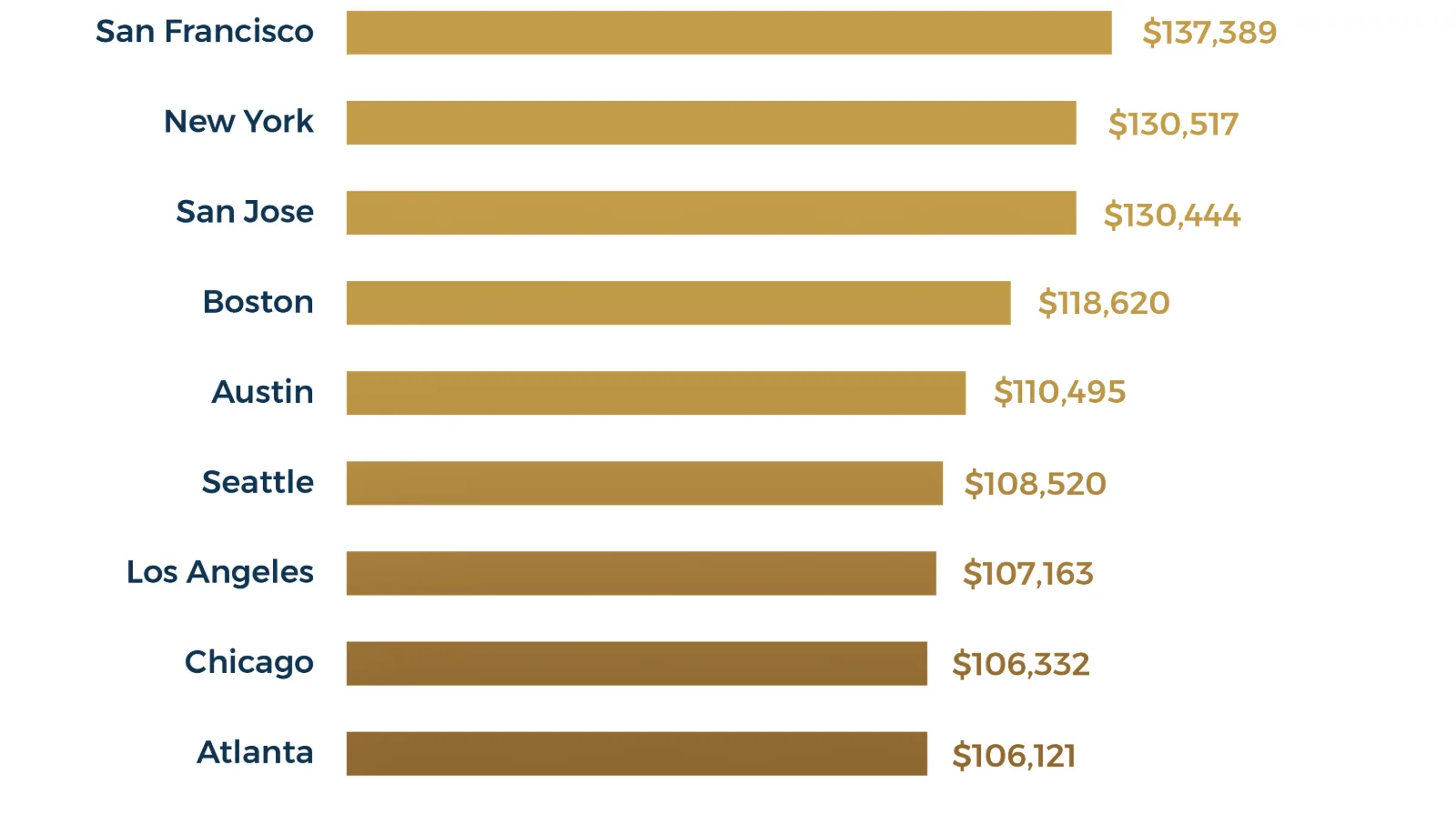
Image Source: https://www.daxx.com/article/python-developer-salary-usa
The good news is that it’s an easy language to learn. Responses to questions about Python on Software Engineering Stack Exchange, indicate that it’s one of the first languages newbie developers should learn, because it’s simple to read. In fact, it reads similarly to English, which means it removes a lot of syntax-learning stress from coding beginners. Python handles the complexity for you.
And it might just be the only language you need, because it’s such a versatile language. From building websites to developing GUIs and analysing data, Python can do it all. To cover your development needs, it’s an excellent place to start.
This piece has mentioned the US cities with the highest-paid Python developers. If you’re keen to learn Python in 2019, HyperionDev offers a six month online Software Engineering Bootcamp, which includes Python as part of its back-end programming. Or you could enrol on the Full Stack Web Developer Bootcamp. Each of these courses includes your own personalised mentor to ensure your learning happens smoothly and easily.
Career Advice
Top 5 open source projects on GitHub in December
Used by over 31 billion developers, GitHub is a place for developers to collaborate on projects. Here we list the top five open source projects on GitHub in December 2018.
There are over 31 billion developers on GitHub, according to the 2018 Octoverse report that analyses GitHub statistics over the previous year. There are also more projects than ever before with co-operation across 1.1 billion contributions. Most of the developers, 80% in fact, come from outside the United States. With so much action, what are the top five open source projects on GitHub in December 2018?
Firstly, just a quick recap: GitHub is a site where developers can store their projects and work with other like-minded individuals. It’s clearly an excellent place to collaborate. The collaboration happens via Pull Requests, which lets you tell others about changes you’ve pushed to a GitHub repository. Interested parties can then check out these changes and propose potential modifications (read here about how to create a Pull Request). Also, like Microsoft Word or Google Drive, you can maintain a history of your code – with new iterations, you don’t lose previous versions.
So without further ado, here are the top five open source projects on GitHub in December 2018.
Here you’ll design components for a CSS framework. Cascading Style Sheets, or CSS, provides the layout for a web page. With CSS, you can utilise a single style sheet across multiple web pages. It’s an ideal language to learn if you’re interested in becoming a front-end or even a full-stack web developer.
Flutter makes it easy and fast to build beautiful mobile apps. It is Google’s mobile app SDK (Software Development Kit) for putting together high-quality interfaces on iOS and Android very quickly. Flutter is free and open source, and it’s used by developers and organisations around the world. It works with existing code as well.
Even if you don’t have any mobile development experience, this is an easy and fast way to build awesome mobile apps. Potentially, this is a good GitHub project to explore, because Android developers are well paid – according to Glassdoor, the average US annual salary for Android developers is $101,572.
This project empowers you to use machine learning to get valuable insights from data. You’ll learn how to implement basic ML algorithms and deep neural networks with PyTorch. You’ll find out how to run it all on the browser, and you’ll learn object-oriented ML to code for products.
In case you don’t know, Machine Learning brings together computers and statistics to build algorithms that allow computers to learn new tasks. It allows the computer to learn by seeking statistical patterns in the data. An example of Machine Learning would be teaching a computer to distinguish between dogs and cats – for example, working out that cats have shorter noses and dogs come in a larger variety of sizes.
This image compression web app lets you make images smaller using best-in-class codecs, right in the browser. A codec is a computer program for encoding or decoding a digital data stream. This project lets you update and streamline Squoosh.
This is a JavaScript framework for building User Interfaces on the web. It’s also an open-source project. To use the framework, you need to know HTML, CSS and JavaScript. There are multiple fixes and upgrades you can get involved in on this GitHub project.
We’ve mentioned the top five open source projects on GitHub in December 2018. You can also check out the trending repository on GitHub to see what the community is most excited about on a daily basis. To brush up on your coding skills, consider enrolling on a HyperionDev bootcamp in Full Stack Web Development, Data Science or Software Engineering. You can also trial one of these courses for free.

Career Advice
7 FAQs about coding bootcamps
Many people are keen to upskill or change careers by enrolling on a coding bootcamp. In this article, we cover 7 FAQs about coding bootcamps.
There are are many reasons to enrol on an online coding bootcamp. For example, you can study in your own time while still holding down a full-time job and earning a salary. Here we’ve outlined the most important FAQs about coding bootcamps. Find out whether this is the right career choice for you by checking out the answers to these frequently asked questions.
- What is an online coding bootcamp?
Online bootcamps are structured, mentor-guided platforms that replicate the in-class experience. You should expect to devote between 5 to 30 hours per week to the course, but the flexibility of an online medium allows you to choose when those hours will take place. The average length of a coding bootcamp is about 14 weeks or about 3.5 months. 80% of coding bootcamp graduates, states Course Report, say that they’re employed in work requiring the technical skills they learnt in the bootcamp, and the majority are finding full-time employment.
- Why pay for a coding bootcamp when I can do an online course for free?
It’s true, there are many online free coding course – you could try a coding MOOC (Massive Online Open Course), for example. But if you get stuck, you could well run into problems. One of the most important aspects of a paid online course is the mentorship you receive.
Coding mentors are particularly helpful, because they:
- Teach coding best practice – a mentor helps you avoid common stumbling blocks and teaches you best industry practices.
- Offer constructive feedback – mentor feedback should be specific, timely, understanding and positive. The faster you receive feedback on your code submissions, the better.
- Allow for individual attention – Mentorship is 1:1 personalised feedback.
- What is the difference between a coding bootcamp and a Computer Science degree?
Firstly, there’s the time issue: many degrees have a longer duration, approximately three to four years, compared with a bootcamp, which can be a couple of weeks up to six months. And then there’s the course content itself: bootcamps tend to teach industry-specific coding skills, whereas a university Computer Science degree is likely to be more abstract, focussing on things like how computers are able to solve problems for programmers”. It’s a more theoretical than a practical approach – consequently, you might not learn how to actually code in real-life scenarios.
- Will I get a job after completing a bootcamp?
Yes, more than likely you will. Here are some reasons why:
- 68% of graduates work in IT within 6 months of graduating from an online coding bootcamp, according to SwitchUp.
- A 2017 survey, conducted by Indeed, found that 72% of employers think graduates from bootcamps are “just as prepared” as degree holders to be high performers. In fact, 12% of employers think bootcamp graduates are more prepared and more likely to be high performers than those with computer science degrees.
- How much more can I expect to earn after finishing a bootcamp?
Simple answer: a lot. After surveying reports from 73 qualifying coding schools, Course Report found that average salary increase was 50,5%, which equated to $23,724 extra per annum. The average post-bootcamp salary was $70,698. The average salary for a web developer in the US, for example, is $76,633.
- How do I choose the right coding bootcamp?
Coding bootcamps aren’t a one size fits all; they need to map to your needs, states a Medium article. Before deciding on a particular bootcamp, some questions you should ask yourself include:
- What do you want to achieve from the bootcamp?
- What languages do you want to learn?
- Do you want personalised mentoring, or are you happy to learn alone?
- How much money are you wanting to spend on tuition?
Once you’ve answered these questions, do some research among the wide pool of bootcamps. You could check out the following sites: CourseReport or SwitchUp. To figure out which bootcamp is worth your time or money, you need to do some further research via reviews, Quora or searching for blog posts.
- What should you do if you can’t afford a bootcamp?
From an affordability perspective, an online coding bootcamp makes sense bearing in mind that a face-to-face bootcamp in the US costs in total between $9,000 to $21,000, with an average of $11,451, whereas you can enroll at an online coding bootcamp for as little as $3000. But this is still a fair amount of money, so what should you do if you can’t immediately afford a bootcamp? Here are some ideas:
- Plan and save: A Business Insider case study works out that if you forego your daily purchased coffee, you save in the region of $1000 per year.
- Try for a scholarship: Plenty of coding bootcamps offer scholarships on the basis of financial need or merit. Here’s a list from Course Report of scholarships on offer for bootcamps.
- Crowdfund: Digital Trends lists some of the best crowdfunding sites online including Indiegogo and GoFundMe.
- Opt for a different payment plan: Many bootcamps offer a variety of payment plans, from paying the full amount at a slightly discounted rate upfront to paying off the course over the duration of study. HyperionDev offers several payment plans, including a monthly option and a significant discount if you choose to pay upfront.
- Work sponsorships: If you’re planning on continuing your full-time employment during your online coding bootcamp, consider speaking to your employer – they may want to invest in the skillsets of their employees.
We’ve covered 7 FAQs about coding bootcamps. If you have any further questions, feel free to ask them in the comments below.

Career Advice
How do cities become tech hubs?
Some of the world’s most well-known capitals are stepping up their game in the tech space and developing into booming tech hubs. In this article we look at Silicon Valley and ask some important questions around how cities become tech hubs.
Some of the world’s most well-known capitals are stepping up their game in the tech space and developing into booming tech hubs. The spotlight is also falling on smaller cities like Manchester and Leeds for their rate of progress in the tech arena. In this article we unpack what the startups in these flourishing cities are getting up to, and which cities are making their mark on the world through innovation. We also look at Silicon Valley and ask some important questions around how cities become tech hubs.
What is a tech hub?
Quite simply, a tech hub is a community that fosters innovation for technology startup companies. When most of us think “tech hub,” we think “Silicon Valley,” because it has risen to prominence in recent years as the home of Apple, Google and Facebook. But a tech hub can also be a specific part of a city, like London’s Silicon Roundabout, a building or a collective like Silicon Cape Initiative in Cape Town, South Africa. Tech hubs often provide opportunities for startups to meet potential investors and funders while providing a platform for business networking. According to Joe Svetlik, this is done by “encouraging experimentation, not demonising failure, and helping firms network with other like-minded individuals and enterprises.”
Which are the biggest tech hubs in the world?
According to the Global Startup Ecosystem Report (and an analysis by CityLab), these are some of the biggest players in the tech hub space globally:
Silicon Valley, California
The study identified Silicon Valley as a Heavyweight Hub due to its high concentration of big names in tech. As a Heavyweight Hub, it has fewer new companies entering the market than more emerging hubs, as well as a stable growth rate. In Silicon Valley there is also a higher density of engineering hiring and on average, investment 670 deals were sealed by the startups in the region between 2012 and 2017. In terms of deal values, $38 billion was raised (on average) by startups in the region between 2012 and 2017. These staggering figures make Silicon Valley a proverbial Shangri-La for budding startup founders and digital entrepreneurs.
Beijing, China
Beijing, China is considered a High Growth Hub for a number of reasons. Firstly, in relation to Heavyweight Hubs like Silicon Valley, Beijing has a higher frequency of early startups entering the market. As such, it has higher dollar investment, deal count rates and corporate-backed deal-making. According to the study, the average investment deal count between 2012 and 2017 was 171. The average dollar amount raised between those same years equated to $14 billion.
Stockholm, Sweden
Europe has its fair share of developing tech hubs which are outside of London. Amongst them is Stockholm, which according to the Global Startup Ecosystem Report (and an analysis by Citylab), is an “up and comer.” Tech hubs in this category generally have lower deal counts than other hubs, and lower dollar investment. There are also a high percentage of first-time funding rounds and high foreign investment rates. On average, the investment deal count between 2012 and 2017 in Stockholm amounted to 75, with an average deal amount of $2.5 billion within the same time period.
What are startups in these tech hubs getting up to? The study suggests that there is an overall trend towards “investment in AI, Big Data and Analytics, Blockchain and Advanced Robotics and Manufacturing.
How cities become tech hubs
100 years. That’s how long it took for Silicon Valley to become synonymous with technology. This may be a surprising fact given that it seemed to have sprung up overnight. To illustrate some of the highlights in the history of Silicon Valley, Corey Protin, Matthew Stuart and Matt Weinberger put together this timeline:
- Late 1800s: San Francisco became one of the earliest hubs of telegraph and radio. In 1909, San José was the birthplace of one of America’s first radio stations. Less than two decades later, Moffett Field became the early home of the aerospace industry. In 1939, due to the work of the Ames Research Centre, the same area played host to the world’s largest wind tunnel.
- 1939 arrived, William Hewlett and Dave Packard founded Hewlett-Packard in Palo Alto. During these formative years, computers were the size of a room!
- In the 1940s, William Shockley invented what would become the computer processor, at Bell Labs. Later, he would found his own company and be the first to make processors out of silicon rather than germanium.
- In 1957, eight of Shockley’s employees became disgruntled, left his company and partnered with Sherman Fairchild to create Fairchild Semiconductor. A few years later, Fairchild helped to make components for the Apollo program. In the 1960s, those eight employees founded their own independent companies, some of which led to the establishment of brands like Intel, AMD, Nvidia and Kleiner Perkins.
- In 1971, journalist Don Hoefler entitled a 3-part report on the semiconductor industry “SILICON VALLEY USA.” The name stuck.
- During the 1970s, Atari, Apple and Oracle were founded in the area.
- In the 1990s, eBay, Yahoo, Paypal and Google were founded in the area.
- In the decade that followed, Facebook, Twitter, Uber and Tesla joined the suite of flourishing startups.
Tech hubs develop slowly but surely, and are accelerated by concentrated efforts to encourage tech incubators, investors and innovation hubs to move their efforts into a particular geographical region.
There are major considerations to be made during the developmental stages of a tech hub. For example, with Amazon considering establishing its second headquarters in Seattle, there are a number of important factors to be considered. What will the effect on traffic be? Which construction company will handle the development of the building? How will the GDP of the city be affected? Will it mean more jobs for Seattle dwellers? As technology continues to demonstrate its pervasiveness, the world and how we perceive our urban environments will need to evolve in order to accommodate society’s inevitable progression.
Excited about what the tech industry has to offer you? Join us for a bootcamp and kickstart your career. We’d love to meet you.

Career Advice
Top 10 tech jobs in high demand in 2020
These days, almost all companies use tech. But what are likely to be the top tech jobs in high demand in 2020? Here we list ten of them.
We all need to look ahead to make sure our skills stay in demand. With this in mind, what are the top tech jobs for 2020? For starters, IT roles will include more advanced technologies like artificial intelligence (AI), augmented and virtual reality (AR and VR) and the Internet of Things (IoT). Raj Mukherjee, the Senior Vice President of Product at Indeed, a global job search site, says: “Demand for tech workers continues to grow at a pace that’s unmatched in other industries.” Some jobs that have enjoyed high demand, like full-stack developers, will maintain their growth position in the coming years, but newer job roles will gain popularity as well. So what are the other top tech jobs for 2020, as published by ZDNet in a special feature?
1. Computer Vision Engineer
Computer Vision Engineers “build and improve computer vision and machine learning algorithms and analytics to detect, classify, and track objects,” states ZDNet. It’s basically recreating the human ability to understand, interpret and interact with images and visual surroundings. It’s already being used in image recognition technologies found in certain applications, such as Google Lens and SnapChat. But it will be used in many more technologies including self-driving cars, robotics, drones and medical data.
2. Machine Learning Engineer
These are advanced programmers, capable of developing AI machines and systems. AI, explains this YouTube video, is a broad area of computer science that makes machines seem like they have human intelligence.
These factors have made AI the Next Big Thing:
- Huge amounts of data are now being created every minute (90% of the world’s data has, in fact, been generated in the past two years).
- Increased computer processing; computers can now make sense of all this data.
- Tech giants and venture capitalists are keen to infuse the markets with cash, as they have bought into the idea of AI.
3. Network Analyst
IoT (Internet of Things) refers to the interconnectedness of devices that communicate with each other. With this in mind and as IoT enters the workplace, businesses are investing more heavily in their networks. Things need to be connected efficiently and that will drive the demand for network analysts.
4. Security Analyst
A cyber security specialist is “in charge of the electronic security of an organization”. This could include re-certifying or updating the security of applications and servers, troubleshooting country-wide security threats, testing, as well as regular updates for virus protection. Other important aspects of the job involve training workers on security procedures to maintain security and informing management of any security violations. The demand for this job will increase as cyber attacks become more sophisticated as well as the technologies that fight them.
5. Cloud Engineer
As more companies move their vital systems to the cloud, these cloud engineers will be in high demand. They will need to develop solutions at scale, which makes use of both in-house technologies and various outside systems.
6. App Developer
Revenue from apps is climbing hugely: mobile apps are projected to earn $188,9 billion in revenue via app stores and in-app advertising by 2020. Consequently, we can expect an increase in the demand for app developers.

Image Source: https://www.statista.com/statistics/269025/worldwide-mobile-app-revenue-forecast/
7. Business Intelligence (BI) Analyst
This job entails analysing where the company stands in comparison to the industry and how growth can happen. The analyst gathers data from a variety of sources, including internal software, competitor information as well as industry trends.
8. DevOps Lead
Gareth Dwyer, software and operations developer at HyperonDev, explains that a DevOps engineer is “a software developer who also knows how to do server configuration and management, and therefore doesn’t rely on a system administrator for operating systems, platform and hardware support.” DevOps straddle deployment and network operations as well as scripting and coding. They have skills in development and project management.
9. DataBase Administrator
This job will see a growth in demand as more companies offer software that includes AI, and the potential to put together AI-powered models. Companies will need databases that are effectively maintained for these products to work efficiently.
10. User Support Specialist
Support specialists will be vital as digital transformation happens. Both employees and users will require training, upskilling and support.
This piece has identified the top tech jobs for 2020. It’s more than likely that one of these jobs will suit your aptitude and skills. If you want to get a headstart, consider learning programming skills. Sign up for one of HyperionDev’s six-month, part-time online coding bootcamps in Full Stack Web Development, Mobile Development or Software Engineering.

Career Advice
How to win a hackathon
Hackathons are a great way to learn to code while building something awesome. They also often offer cool prizes - here are some strategies on how to win a hackathon.
Hackathons are a great way to improve your coding skills or even get into coding. They frequently also offer cool prizes. Essentially, says Hackathon Guide, hackathons are about ‘creative problem solving’. That means they don’t have to be technical in nature, although they frequently are. At its most basic, it’s an event of any duration where people come together to solve problems. Here are some strategies on how to win a hackathon.
1. Putting Together The Team
There are definitely advantages to setting up the team before the hackathon, states The Tech Edvocate. For example, you’ll already know the strengths and weaknesses of the group and their degree of compatibility. Because the group is working under pressure at the hackathon, you need to be able to communicate effectively and if you know each other, this might be easier.
In addition, if the group is set up beforehand, you can ensure there is the right technical expertise, including at least one front-end engineer. Ideally, you also need the following skill sets: organisational skills, business acumen and presentation skills. Basically, you’re looking for a broad range of skills, states a Medium article. And you should include the following roles besides the front-end developer: a designer to make the hack look professional and the back-end developer to provide the “core of your product, connecting the APIs and writing the algorithms”.
If you can’t build the group prior to the event, ensure you choose a group based on compatibility and roles rather than just a cool idea.
2. The Idea
Here’s how to win a hackathon: make sure you have the right idea before you start programming. And know this: pivoting, a Silicon Valley idea referring to starting something and then leveraging aspects of the technology into something else, happens often in hackathons. Be open to it. Spend the first three hours of your hackathon on coming up with the right idea, but be open to the pivot.
Here are a few further tips:
- Find a cool API, recommends Medium – cool APIs provide the WOW moment in the final presentation that set you apart.
- Choose the right platform – for example, is it going to be a website or an app?
- Plan the main features of your app first.
- Write down some ideas before the hackathon and then research its feasibility, uniqueness and the cost of implementation. Even if there are similar technologies out there and there’s a good chance that’s the case, you may still be able to find differentiators that make your product better than the current players.
3. The Hackathon Itself
Group management is key here. Some tools to help with that include:
- A chat platform: try Slack, which is simple to set up.
- A task list: check out Trello. You need to be able to split tasks, know what everyone is working on and add relevant tasks as the development proceeds.
Also, ensure you meet regularly, say every hour to ensure everyone is on board a new idea or a potential pivot.
Remember, states George Krasadakis, a Product Architect writing for Medium, “You need to build an impressive prototype fast, and this is challenging.” He divides the prototype into two elements: the core innovation or key components and the secondary components, which include data, models, user interfaces and APIs to support the core components. The thing to remember is that you need to prioritise and focus on the right items. “Instead of wasting time and energy on ‘secondary components’ (those needed for your prototype but conventional — needed only to support/frame your solution) you can hard-code them, mock data and consume existing API’s wherever possible.”
4. The Pitch
Depending on the hackathon, the pitch could take a number of different forms such as a video presentation or presenting to a panel of experts.You’ll need to include your product design, wireframes, code and functional prototype. Here are some tips for the pitch:
- Research the background of the judges before the pitch – what is their knowledge level like? This helps you decide how technical you want to go.
- Summarise the competition and how your product can be differentiated from this competition.
- Use key statistics, which could be from the public domain with references.
- Keep it simple and fast but passionate.
- No login screen – assume the user is logged in. With a short presentation, you don’t want to waste time inputting emails and password.
Now that you know how to win a hackathon, it’s time to sign up for one. “You’ll gain more practical knowledge in one hackathon than from a month of lecturers,” says Tim Fogarty, the EU commissioner for MLH (Major League Hacking), a global student hackathon league. Not only will you learn the technical aspects of a project like APIs, frameworks libraries, version control, testing, etc. (stuff software engineers know), but you’ll also learn about idea generation, working with others, and managing a project. In fact, if you want to learn how to code, go to a hackathon!
If you’re keen to brush up on your coding skills first, consider signing up for one of HyperionDev’s six-month, part-time online coding bootcamps in Full Stack Web Development, Mobile Development or Software Engineering. You’ll get your own personalised mentor to help you whenever you get stuck and with those finely-honed coding skills, you’ll be well set to ace that hackathon.

Career Advice
Top five sites to find remote programming jobs
If you’re keen to be employed and enjoy all the benefits of not having to sit in an office all day, check out these top five sites where you can easily find remote programming jobs.
Of course you want to work remotely – there are many benefits, such as:
- Greater productivity (remote workers say their productivity levels are 7.7 out of 10, compared with a score of 6.5 from those in open plan offices), according to a Canada Life Survey.
- Lower stress levels.
- More time for exercise, states The Telegraph.
- Improvement in the environment. Forbes states that the average commute in the UK is between 60-80 minutes. Remote work reduces our carbon footprint and allows companies to be more green.
- Less cost for the company including lower leases, less expenditure for furniture, equipment and office supplies.
Here we list five sites to find remote programming jobs.
Remote Tech jobs have thousands of remote programmer jobs, and all the jobs get removed after 30 days to ensure fresh listings. This site comes best-of list, because tech is what Remote Tech Jobs does and you don’t have to pay anything to apply for jobs. You can also tailor your search across a wide range of technologies, including Android, Angular, JavaScript, Python and Java, or different fields such as Sales, Security, or Copywriting, but you’ll probably come off best if you’re a developer or an engineer.
From part-time to full-time, entry-level to executive, this site has over 50 categories of over 30 000 remote positions. It’s also ideal for freelancers who are looking for more clients and projects. You can read their guide or watch their video on how to find a remote job.
The software development jobs on the site cover a wide range of categories, including Java and Android jobs, PHP, Python, Ruby on Rails and iOS jobs. The upside about this site is that they screen each posting, so you know they’re legitimate. The downside: there are fees involved ($14.95 per month) – and you can only apply and see a job’s full details once you’re a member.
Upwork claims the title of “largest global freelancing website”. Millions of jobs are posted annually, with freelancers earning money by providing companies with over 5000 skills across more than 70 categories of work. You need to complete your profile and the site will then highlight the most ideal jobs for you. In return for the services provided, Upwork charges freelancers a 20%, 10%, or 5% service fee depending on the total amount they’ve billed with a client, but you can earn bonuses from work well-performed on this site.
If you want daily or weekly emails with lists of remote jobs, sign up with with Working Nomads. You can check the categories, such as Development, that interest you. This is particularly useful for those who don’t have constant internet access.
This site claims to have the largest community on the web, with over 2 500 000 monthly visitors. Although they include non-tech categories, there are also a wide variety of tech fields, including programming, DevOps, sysadmin and design. This site is definitely worth a daily check. There are also a variety of resources, such as the ‘Top 100 Remote Companies’ and ‘Top Products for Remote Workers’, as well as community pages worth checking out.
In closing, this piece has listed five sites to find remote programming jobs.
Many developers dream of working remotely. In fact, 10,3% of developers regard the opportunity to work from home as a top priority, according to the 2018 Stack Overflow Developer Survey, which interviewed over 100 000 developers. If you’re keen to work remotely, think about signing up for one of HyperionDev’s six-month, part-time online coding bootcamps in Full Stack Web Development, Mobile Development or Software Engineering. You’ll get your own personalised mentor to help you whenever you get stuck and coding skills are always in high demand at remote companies.

Career Advice
Top 10 programming blogs to follow
A list of 10 great programming blogs, tutorials & resources, which aim to provide aspiring coders with relevant industry information, insights & career advice.
Beginner, intermediate and advanced coders alike find programming blogs to be an excellent source of industry information, news and insights.
Part of growing and honing your skills as a programmer is keeping yourself updated on the latest trends and developments in the world of coding. Bloggers will also share valuable tips, tricks and hacks to help you master your chosen coding languages.
Here are our recommendations for 10 great programming blogs to inform and inspire you.
- Microsoft Developer
This is the official Microsoft programming blog, run by professional software engineers who have a wealth of knowledge to share. This is where you’ll find the latest info on software and tech developments, as well as expert coding advice.
Visit the Microsoft Developer blog here.
- Google Developer
This is Google’s official resource for programmers, and includes a range of discussion groups for programmers using Google Developer products. In addition, the blog will keep you updated on the latest Google tools, platforms and events.
Check out the Google Developer blog here.
- Linux Foundation
For those who favour Linux over Windows, this is the Linux Foundation’s official open source community blog. There’s a wide range of content here, contributed by experts in programming and software engineering.
Get the latest from the Linux Foundation blog here.
- Geeks for Geeks
This is a computer science portal for new and aspiring programmers looking to launch their careers. In this online journal, programming “geeks” discuss the best answers to potential programming questions and problems they may be presented with in an interview. There are also regular guest blog posts with insight into common programming queries and practices.
Get involved with the Geeks for Geeks community here.
- HyperionDev
HyperionDev is a resource for mentor-led online coding bootcamps, and the site includes a blog which has loads of relevant advice for new programmers. Topics include the most in-demand programming languages, average salaries for developers in different roles, and the best companies and areas for a developer job search. There are also tutorials for those looking to get to grips with the basics.
Read the HyperionDev blog here.
- CSS-Tricks
This is the ultimate resource for developers working with cascading style sheets (CSS). However, the blog also covers JS, jQuery, PHP and many other commonly used components of web development.
Find out more by visiting CSS-Tricks here.
- Code Cartoons
Something a little different – this blog is a collection of animated illustrations that explain programming concepts like Flux, Redux and Facebook Relay. This is a great resource for those who prefer a more visual learning medium.
Watch some educational Code Cartoons here.
- The JavaScript Playground
This is a useful resource for JavaScript tutorials, focusing on topics like BackboneJS, FirefoxOS, NodeJS and jQuery. It’s a good blog for full-stack developers, as it covers quite a broad range of technologies.
Take a look at The JavaScript Playground here.
- Coding Horror
This quirky blog is run by Jeff Atwood, creator of StackOverflow. It covers a variety of relevant programming topics and coding concepts, accompanied by useful (and often humorous) visuals.
You can read some Coding Horror stories here.
- David Walsh
David Walsh is a respected senior web developer at Mozilla, who has a rich depth of knowledge to share. David’s tutorial-style blog focuses on the practical rather than the theoretical. You’ll find some useful development demos here, with frequent updates to keep your learning fresh.
Check out David Walsh’s blog (DWB) here.
These are just a few of the best programming blogs out there. Find your favourites and feel free to share them with us in the comments!
Career Advice
4 reasons why you should tackle the #100daysofcode challenge
If you’re connected to the coding world in any way, you will most likely have heard about the #100daysofcode challenge. Here’s why we think it’s a great way to level up your coding skills.
If you’re connected to the coding world in any way, you will most likely have heard about the #100daysofcode challenge. Developers from all over the world are filling their social media pages with their progress reports and inspiring stories about how it’s changed their perspective on coding. But what exactly does the challenge entail? According to Richard Middleton, the challenge is a simple one – code for at least one hour every day, and tweet your progress using the hashtag: #100daysofcode. Here’s why we think it’s a great way to level up your coding skills.
Practice makes perfect

Source: Medium
This comic by Sarah Anderson illustrates what many believe is one of the English language’s biggest cliches. But “practice makes perfect” is a cliche that bears a real nugget of truth, and in the world of code, it’s proven to to be quite the anthem. At this point you may be asking – why commit to a 100-day challenge when you can just practice in your own time and at your own speed? Fair point. But there is something you’ll get from taking the #100daysofcode challenge, that you might not develop on your own – consistency. Some of the most successful practitioners in their field claim that consistent practice is the key to mastering a skill. The #100daysofcode challenge only involves an hour of your day, but it’s a meaningful hour – an hour of growing your skill set and knowledge, that you will build on the next day (and the next…). If you make a commitment and follow through with it consistently, you’ll be well on your way to forming a new habit of learning how to hone your skill, one day at a time.
Become accountable
Consistency isn’t the only new habit you’ll form if you decide to tackle the #100daysofcode challenge. What you’ll also learn is accountability. Part of the challenge is to tweet about your progress every day – what you’re working on, how far you’ve gotten and which day of coding you’re on.
If you’re a coding newbie and you’re just starting to find your feet, this challenge is a great way to learn how to work with a mentor. As we keep hearing from some of the top names in dev, mentorship is a key ingredient of a successful career in coding. And part of building that relationship is learning how to become accountable – learning to admit your mistakes, finding a solution to problems and checking in with someone consistently. If you’re new to all of this and you find the whole idea of building a professional relationship with someone intimidating, then the #100daysofcode challenge is the perfect crash course. Why? Every time you tweet, it’a a little check-in with a global community – a way to make sure that you’re staying on track. Even though it’s on a micro level, you’ll be learning accountability.
Join a global community
When you tweet, and follow the hashtag, you’ll become connected to a network of developers from all over the globe. You’ll meet new people with whom you can share ideas and victories. The hashtag has become an almost infinite repository of inspiration and ideas. Coders have used the challenge to build entire websites, mobile apps and other side projects. When you join a like-minded community, the task will feel less daunting and more exhilarating.
Take the opportunity to build a portfolio
If you’re really smart, you’ll use the #100daysofcode challenge as a step up to bigger, better things – like your next job. Think about it, by taking the challenge you’re able to build a portfolio of work – something to show for the skills and knowledge you’ve acquired over time. Remember, if you’re fresh out of college or you’ve just completed a bootcamp, you still need one more essential ingredient to put your best foot forward, and that’s experience.
Coding employers these days look for candidates who have hands-on experience with working in the field. And it’s a tough one because to get experience, you may think you first need a job. But this doesn’t necessarily have to be the case. Showing some evidence that you’ve done the challenge, means that you can show that you’ve taken initiative to gain valuable experience. It might just give you the competitive edge you need to get ahead.
When Alexander Kallaway proposed the #100daysofcode challenge, he had no idea that it would become as ubiquitous as it has. The challenge was born out of his personal frustration with lack of consistency and a struggle to find the drive to code. Today, he has inspired millions of coders to build their ideas, one day at a time, for 100 days. Are you up for the challenge?
Want to be part of the challenge but don’t know where to start? Schedule a call with us today and we’ll give you helpful advice on how to build a future in coding.

Career Advice
IT salaries in South Africa
Before learning IT skills such as programming, you need to know what you can expect to earn. Read about IT salaries in South Africa, including geographical differences in earning potential and the price range for different positions in the Information Technology field.
Are you thinking about entering the lucrative field of technology? Before doing so, you’re probably keen to know what IT salaries in South Africa are really like. The good news is that MyBroadband recently completed their 2018 IT Salary Survey, which interviewed 2,695 respondents. Let’s see what the results showed.
Facts At Your Fingertips: IT Salaries in South Africa
According to the Salary Survey, the average salary for South African IT professionals has increased from 2017 to 2018 – it’s up from R41,555 to R42,673 per month. Let’s compare this to the average salary for South Africans. Stats SA reports that the average monthly salary decreased from R20,060 in November 2017 to the February 2018 salary of R19,858, as reported in BusinessTech. There is some controversy, however. BankservAfrica reports the average salary is significantly lower at R13,621 a month – which equates to R163,450 a year. Either way you look at it, IT salaries in South Africa are a lot higher.
Here are some other interesting facts about the IT field:
- Salaries increased by 74% from 2017 to 2018
- The average salary increase during this period was 8.7%.
- Last year, 60% of IT professionals received a bonus.
- As far as perceptions go, 55% of IT professionals think their salary is fair, while 43% believe they are underpaid, and 2% think they are overpaid.
Here’s a table showing the gross monthly salary for various IT professionals. To interpret that data, know the following: Entry-level (little experience, 10th percentile), Experienced (relevant experience, 25th percentile), Mid-level (5-10 years relevant experience), Senior (senior level, 75th percentile), High-end (very senior, 90th percentile).
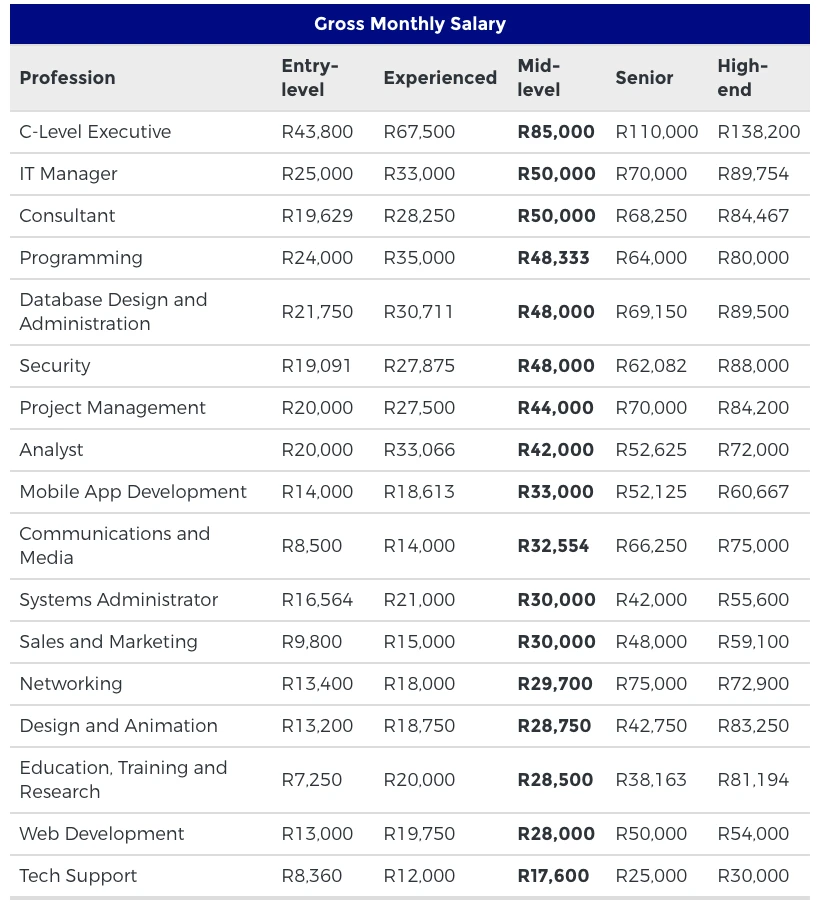
Image source: https://mybroadband.co.za/news/business/275951-south-african-it-salaries-in-2018-how-much-people-really-get-paid.html
Regional Differences: IT salaries in South Africa
CareerJunction released its 2018 Salary Review survey based on 16 000 job posts. Here’s what they found regarding geographical differences in IT salaries in South Africa. Perhaps as expected, the Western Cape and Gauteng remain the best locations as far as salary goes for IT professionals. “Salaries in these regions are very close to the national average, while salaries in KwaZulu-Natal are not nearly as competitive,” said CareerJunction.
OfferZen has conducted similar research and found that Cape Town entry level salaries for developers are on average 14% higher than their Northern cousins: Joburgers starting out can expect to earn about R22 000 per month, while developers in Cape Town earn, on average, about R25 000 per month. However, at the 4-6 year experience mark, Joburg takes the lead: with more than 6 years of experience, the average monthly salary for Joburg developers is R61,240, whereas Cape Town developers with the same number of years of experience earn on average R54,750 per month. Essentially, entry level salaries for developers are better in Cape Town; however, the more years of experience you gain, the better off you are salary-wise in Johannesburg. One potential reason for this is the high number of large financial institutions in Joburg.
In both cities, there is high demand for the following programming languages:
In addition to the languages, Cape Town also currently has “high demand for UX Designers, Python, and PHP developers,” states co-founder Philip Joubert from OfferZen in My Broadband.
In conclusion, IT salaries in South Africa look healthy; they are certainly better than the national average. If you’re thinking about entering the lucrative field of programming, consider signing up at HyperionDev with one of their part-time online coding bootcamps in Full Stack Web Development, Mobile Development or Software Engineering. Alternatively, if you’re keen to equip yourself with valuable data science skills and tools required to think like a data scientist, pre-register for HyperionDev’s brand new data science bootcamp today. You’ll learn about machine learning, data analysis and bioinformatics to prepare you for your career as a data scientist.

Cyber Security
Should you consider a career as a cyber security specialist?
Are you keen to ensure that a computer’s networks and systems remain safe? If so, becoming a cyber security specialist might be the ideal occupation for you. Read more about this job, the computer languages required, expected salaries and demand.
There are many ways to enter the lucrative field of programming, from designing mobile apps to looking after the safety of a computer’s networks and systems. If you’re interested in risk reduction strategies, particularly in the field of information technology, cyber security might be just the right job for you. We’ll explore the career of cyber security specialist in more detail, including what you need to know, expected salaries, the demand in the workplace for this role and more.
What is a cyber security specialist?
In essence, a cyber security specialist is “in charge of the electronic security of an organization”. This could include re-certifying or updating the security of applications and servers, troubleshooting country-wide security threats, testing as well as regular updates for virus protection. Other important aspects of the job involve training workers on security procedures to maintain security and informing management of any security violations.
What languages should I know to become a cyber security specialist?
According to the website Cyber Security Jobs, specialists in this area should know about “system architecture, system administration, operating systems, networking, virtualization software, and other major components of IT systems”.
Although not all cyber security specialists have coding skills (products such as Solar Winds’ Access Rights Manager are coding-free solutions to improve IT and data security), you may find your path severely limited without some programming knowledge. Programming is used to assemble software, apps and websites. You will need to understand how these applications work to understand how they can be hacked or manipulated. Here are some languages you should think about learning:
JavaScript
This is one of the best languages to learn because this language is everywhere. In addition, if you want to steal cookies, manipulate event handlers and perform cross-site scripting – i.e. hacking-type behaviour – you’re likely to use JS.
Python
In answer to the question on Quora, ‘What programming languages are best for cyber security?’, many respondents mention Python. Some reasons they give include: (1) Interacting with files, dealing with binaries and much more (2) Automating tasks and tools to enhance your security arsenal. In addition, Python is an easy language to learn for newbies. In fact, it reads similarly to English, which means it removes a lot of syntax-learning stress from coding beginners.
C
Many Operating Systems and 90% of libraries and frameworks are written in C. Learning how to program in C will help you a lot as a cyber security specialist.
Various front-end and back-end web languages
You’ll want to understand how websites are coded in order to know how they can be hacked. From a front-end perspective, you could consider HTML (a markup language for website), CSS (a styling language to determine how the website will look) and JavaScript, as discussed earlier. You might also want to include a framework, which allows you to work with all three front-end languages, such as Bootstrap, the most widely-used open source framework in the world.
Back-end languages for websites include PHP, SQL, Python and Ruby among others. A popular back-end framework is Ruby on Rails.
Let’s look now at the demand for cyber security specialists.
What is the demand for cyber security specialists?
There is a growing demand for this job role. From 2016 to 2026, the Bureau of Labor Statistics anticipates a 28% increase for work in this category. That’s faster than the average growth for all occupations in the US.
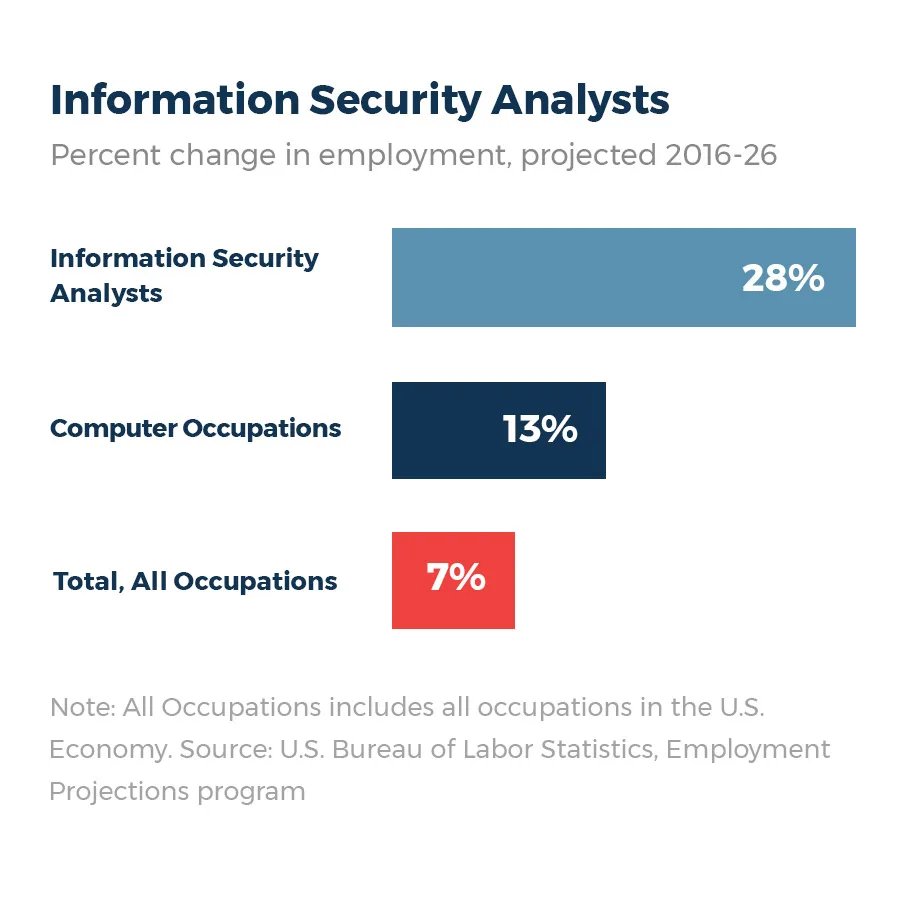
Image Source: https://www.bls.gov/ooh/computer-and-information-technology/information-security-analysts.htm#tab-6
The reason for the high demand relates to an increase in cyberattacks. Cybercrime will cost the world $6 trillion annually by 2021, according to Cybersecurity Ventures. This is substantially up from the 2015 amount of $3 trillion. If these predictions bear out, cybercrime will be more profitable than the global trade of all major illegal drugs combined. No wonder cyber security specialists are in such high demand.
What can I expect to be paid as a cyber security specialist?
The average annual salary for cyber security specialists in the US in 2018 is $107,433, according to ZipRecruiter. The majority of salaries – i.e. from the 25th to the 75th percentile – range between $79,500 and $122,500.
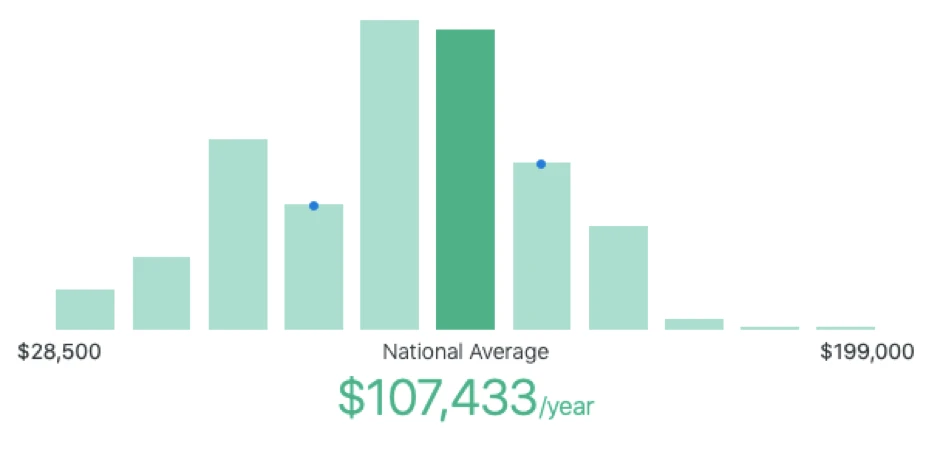
Image Source: https://www.ziprecruiter.com/Salaries/Cyber-Security-Specialist-Salary
In conclusion, the job of cyber security specialist seems absolutely worth pursuing. The demand for the position is high and the jobs are well paid. You can learn the coding skills component of the job at HyperionDev with one of their part-time online coding bootcamps in Full Stack Web Development, Mobile Development or Software Engineering.
Career Advice
Top 5 beginner-friendly open source projects on GitHub
If you’re keen to be a developer, GitHub is an important place to be. Check out these top five open source projects on GitHub across multiple areas, including Machine Learning, JavaScript, group chat applications, etc.
Launched 10 years ago, GitHub has grown exponentially. In fact, as of October 2018, the GitHub community reached 31 million users. In essence, it’s a site where developers store their projects and network with like-minded people. “GitHub is a good place to collaborate and meet with other developers,” says Gareth Dwyer, software and operation developer at HyperionDev. One key reason developers love GitHub is “much like using Microsoft Word or Google Drive – you can have a version history of your code so that it is not lost with every iteration.” Why have we put together the top five open source projects on GitHub for this month? Quite simply, when things happen in the coding world, they happen on GitHub, so we’d encourage all devs to jump on this bandwagon.
This is a curated collection of useful JavaScript snippets that you can understand in 30 seconds or less. You can check out these snippets here as well. The goal of this project is to provide a quality resource for both beginner and advanced JavaScript developers. They have collected hundreds of snippets of code that are useful in a wide range of situations. They also welcome new contributions and fresh ideas provided the code is short and can be grasped in about 30 seconds. The only downside is that some of the snippets are not ideally optimised for large, enterprise applications – i.e. they are not yet production-ready.
This is a great project to help beginners contribute to open source projects. The rationale behind this project is that doing something is probably better than merely reading articles and watching tutorials. Ideally, however, you should be doing both. This project will cover the procedures you’ll need to master if you want to contribute to open source projects on GitHub. From there you can move on to contributing to other projects by checking out their web app.
- TensorFlow Models
For those interested in Machine learning and Deep learning, you might be interested in checking out this TensorFlow project.
TensorFlow Models is the open-source repository that consists of many libraries and models related to deep learning. You would start with checking out the official models that are well-maintained, tested and kept up to date. Thereafter, if you want to contribute to models, be sure to review the contribution guidelines. There are also TensorFlow tutorials.
This powerful, open source group chat application combines the immediacy of real-time chat with the useful productivity of threaded conversations. It’s one of the fastest growing open source group chat projects with over 300 contributors.
You could get involved in any of the following:
- Contributing code. Check out our guide for new contributors to get started.
- Contributing non-code. Report an issue, translate Zulip into your language, write for the Zulip blog, or give feedback.
- Checking Zulip out. Drop by the Zulip community server.
- Running a Zulip server. Setting up a server takes just a couple of minutes. Zulip runs on Ubuntu 18.04 Bionic, Ubuntu 16.04 Xenial, Ubuntu 14.04 Trusty, and Debian 9 Stretch. The installation process is documented here.
This is not really a project, but a useful repository, which has the goal of helping developers master concepts in JavaScript. Here are some of the things you will learn: Factories and Classes, DOM and Layout Trees, JavaScript Engines, etc.
We’ve mentioned the top five open source projects on GitHub. You can also check out the trending repository on GitHub to see what the community is most excited about on a daily basis. To brush up on your coding skills, consider enrolling on a HyperionDev bootcamp in Full Stack Web Development, Mobile Development or Software Engineering. You can also try out any of these courses for free on the trial. Read more about what you can expect on your free trial with HyperionDev.

AI Engineering
How IoT and machine learning could change everything
With the convergence of machine learning and IoT (the internet of things), our lives could start running more seamlessly than we ever imagined, thanks to our smart devices.
You wake up. Your first port of call? The bathroom. You stop at the mirror to check if any new spots appeared overnight. The mirror recognises your irises and displays a motivational quote. As the quote appears, your bathroom sound system switches on and plays ambient rainforest sounds. Your shower starts running. You step inside. It’s going to be a good day. Sound like a movie? With the convergence of machine learning and IoT (the internet of things), our lives could start running more seamlessly than we ever imagined, thanks to smart technology.
What is IoT?
The term IoT, or “the internet of things” was coined by tech innovator, Kevin Ashton in 1999. In the broadest sense, IoT refers to the interconnectedness of devices that “communicate with each other.” The computers that we have come to know and use in the twentieth century, are essentially “brains without senses” in that they only “know” what humans tell them. They are wholly reliant on a specific kind of input from humans in order to function. Smart thermostats that maintain the temperature of a space at an optimum level, are just one example of how IoT is taking shape in the world as we know it. These kinds of inventions are changing the way we interact with each other and the world around us.
What is machine learning?
Writer, Daniel Faggella explains (on behalf of Tech Emergence) that machine learning “is the science of getting computers to learn and act like humans do, and improve their learning over time in autonomous fashion, by feeding them data and information in the form of observations and real-world interactions.” In the consumer electronics arena, machine learning means that smart devices can learn human preferences and make “decisions” based on repeated human behaviour over time.
A different perspective
Software developer and data scientist, Shayaan Jagtap argues that the move towards the convergence of IoT and machine learning can be explained visually as a simple shift. What the world has grown accustomed to, can be represented like this:

Source: Towards Data Science
In this scenario, we are used to smart devices that make our lives easier. Our fridges for example can be programmed to operate at a the ideal temperature in different parts of the fridge, to preserve certain types of food. We can connect our television to our smartphone at the touch of a button and use it as a remote control. We have grown accustomed to smart technology. But think about it – the common denominator, is humans. We programme our devices manually and tell them how to operate. What we are moving towards in the future, is something that looks more like this:

Source: Towards Data Science
In a reality where IoT and machine learning meet, our smart devices will “talk” to each other. As Shayaan Jagtap puts it, it is a world, “independent of human error.”
The Comparison
Taking the lead from an article written on the subject by Jagtap, let’s look at how the convergence of IoT and machine learning can affect the way we live.
Scenario 1: IoT
17:15 PM: I get into my car. It’s a blustery day outside so I turn on the heater function for the drive home.
18:00 PM: I’m not sure what to make for dinner so I use an app that suggests a recipe based on which ingredients I have in my fridge. I decide on the recipe and wait for the oven to warm up.
18:15 PM: While my meal cooks, I set my electronic egg timer to time the meal. The timer displays digital information on the progress of the meal, taking readings from the food thermometer that I inserted into the oven.
18:30 PM: I turn on the chill setting on the water container in the fridge with a remote.
18:45 PM: Dinner is ready, and so is a glass of fresh, cold water. I sit down in front of the television to enjoy the meal – it flips to the channel I programmed in for 18:45 PM. Life is good.
Scenario 2: IoT with machine learning
17:15 PM: By the time I get into my car, it has already recognised that my work computer has been turned off for the day and has heated itself to the optimal temperature based on my preferences in relation to the temperature outside.
18:00 PM: As soon as I get home and open the fridge, my smartphone automatically scans the fridge and notifies me of a possible recipe using the ingredients I have. As soon as I select the recipe, the oven turns on automatically and begins to warm up to save time. When the oven turns on, the water container in the fridge activates its chill function. The oven knows exactly when the food has been cooked to perfection and notifies me when it’s ready.
18:30 PM: Dinner is ready, and so is a glass of fresh, cold water. The television turns on automatically when it detects my irises and flips to my favourite channel. A message in the corner of the screen reminds me to take my after-dinner meds. Life is even better.
Siri, Cortana, Gmail’s predictive text, Uber – these are all examples of the level of machine learning that we enjoy today. Our devices are becoming extensions of who we are and how we live. At the meeting place between IoT and machine learning, is a world of possibility for the seamless integration of our devices and our everyday lives. The more we learn about our devices, they more they “learn” about us. With the fourth industrial revolution well underway, these are the kinds of developments that will help us take the next step in human evolution.
Want to know what it is like to work at the forefront of the industry that is changing the world? Ask us about how you can jumpstart your career in development. We’re eager to connect with you.

Career Advice
Programming 101: How to get started
Anyone can learn how to program. If you’re keen to start building your own software, here are some practical tips on how to get started with programming.
If you’re keen to build your own software, web or mobile app, we’ll show you how to get started with programming. It’s probably easier than you think. Developers teach themselves new technology or languages all the time. ‘(A)lmost 90% of all developers say they have taught themselves a new language, framework or tool outside of their formal education,’ states 2018’s Stack Overflow Developer Report. So how should you get started? Here are some useful principles.
1. Don’t get hung up on a particular language
Many beginners distract themselves from learning the fundamentals by getting stuck on trying to work out which language they should learn, states Lifehacker. Remember, there’s no one “best” language. In fact, the language matters less than other important things like “understanding data and control structures and design patterns”.
Instead, think about the kind of development you want to do and for which platform – such as web or mobile development, or perhaps you want to get started with programming on your desktop.
2. Choose a scripting language
At its most basic, a script, or scripting language, refers to a computer language consisting of a series of commands within a file that can be executed without being compiled. Scripts have multiple advantages including being:
- Open source – allowing users to view and edit the script if required
- Easy to learn and write
- Able to port between different operating systems
- Faster to develop than an actual program
Here are different scripts you can develop for a variety of platforms:
2.1 Desktop scripting
For those new to programming, desktop scripting is a great place to start. Learn how to automate actions on your desktops with these free tools:
AutoHotkey (for Windows) – known as the “ultimate automation scripting language for Windows”.
Automator (for Mac) – watch this video for more on Automator.
2.2. Web scripting
Perhaps you want to look at a web scripting language, such as CSS (the style information for the site) or JavaScript (to make web applications more interactive), to develop a web app.
HTML is a very popular first language to learn for web development but strictly speaking, it’s not a scripting language. It’s a markup language to create structure for a document aimed at web publication. Scripting implies that the code can evaluate and take an action on what it finds; there is a decision-making capacity. To find out more about the difference between HTML vs. CSS, check out this piece. Other examples of web scripting languages include PHP, PERL, Python and Ruby, which are server-side scripting languages.
2.3 Command line scripting
The command line might not be as exciting as a web or desktop app; however, if you want to write a program that takes textual or file input and outputs something valuable, the command line is the place to do it. This is about the rapid development of quick scripts to automate processes.
States Hongkiat: “Some developers cringe at the mere thought of opening a terminal window. For the uninitiated it can be daunting, stressful, and downright annoying. But devs who understand the command line would argue it’s one of the best tools at your disposal.” If you get confused along the way, websites like Stack Overflow have many of the solutions to your programming challenges.
3. Learn about add-ons
Many modern browsers and web apps support add-ons – bits of software that bolt onto them and add features. This is another good place to get started with programming. Take Greasemonkey, for example – it’s an add-on for Mozilla Firefox that allows users to install or create scripts to make on-the-fly changes to web page content either before or after the page is loaded on the browser. Watch this short one-and-a-half minute video to see how it works and how you can develop or download scripts as add-ons. Developing Firefox extensions, for example, has merit, because it forces you to be comfortable with JavaScript and XML, a markup language that is similar to HTML, but with a stricter format.
You could also look at extension frameworks for other web applications, like WordPress and MediaWiki. These are PHP apps, so you would need to feel comfortable with that language as well. Here’s how to write a WordPress plug-in using PHP.
4. Perseverance
Programming is about problem-solving. Although it’s a highly rewarding activity, it can at times be frustrating and solitary. You need to learn to persevere during the difficult times.
We’ve provided some recommendations on how to to get started with programming. However, if you’re interested in learning coding part-time, consider enrolling on a HyperionDev bootcamp in Full Stack Web Development, Mobile Development or Software Engineering. You can also try out any of these courses for free on the trial. Read more about what you can expect on your free trial with HyperionDev.

Career Advice
The top 10 industries disrupted by tech
There are multiple industries that have been disrupted by tech. Which ones are they and which industries can we expect to be disrupted in the future?
“Creative Destruction” is a concept thought up by Austrian economist Joseph Schumpeter to describe “the way technological progress improves the lives of many, but only at the expense of a smaller few,” states Investopedia. During this process, certain industries are destroyed, but the industries that come after them create new jobs. For example, take cars, which disrupted horse transportation, and all the related industries, such as the building of carriages, that must have accompanied equestrian modes of transport. However, the automobile industry that came after added many jobs in a wide variety of fields. So what are some of the industries disrupted by tech currently and what can we expect in the future?
Industries Disrupted by Tech
Here are some industries that have already been disrupted by tech.
1. Are you still booking your travel via human agents? Probably not. You’re likely to book airline tickets directly through the relevant airlines or via multiple sites, such as Expedia. And the same holds true for accommodation – nowadays you might use Airbnb or a site like Booking.com.
2. The financial industry has been hit hard by tech, from stockbroking to the reduction of human bank tellers. There are online trading websites like eTrade and even robo-advisors, which offer financial advice with minimum human intervention.
3. It’s well-known that the print industry has suffered terribly at the hands of tech. Newspapers have seen steadily-declining circulations. However, that’s probably just the start. Computer software will likely produce news stories as we move into the future.
4. Job recruiters have certainly seen their skills falling by the wayside. Websites like LinkedIn, Indeed and Monster, where job seekers can get masses of information about vacancies and potential salaries, have taken over.
5. Warehouse workers. Watch this this 3-minute video to see how robots can replace human workers in a warehouse. In fact, back in 2016, the Internet retailer Amazon was a leader in warehouse innovation with their fleet of 30,000 robots operating as an automated workforce.
And here are some industries that are in the process of being disrupted.
6. Wedding planners are on the out. Despite the fact that the wedding industry grew from $72 billion to $76 billion last year, Americans are spending less on wedding planners, reports Inc.. Younger people, who are very tech savvy, are very comfortable using wedding planner apps, such as The Knot, as well as various startups (Joy let’s guests manage their guest lists and RSVPs) to get the job done.
7. The call centre industry – Cristian Rennella, CEO and co-founder of Colombia-based elMejorTrato.com, states that the call centre industry will be replaced by AI. He says: “Thanks to Artificial Intelligence through deep learning with Google’s TensorFlow platform, we were able to automate 56.9 percent of queries. In this way, the user receives their response in seconds and our team only has to answer those questions that were never consulted before.”
Now what about the industries that are likely to be disrupted in the future? Yuval Harari, the famous Israeli historian and author of 21 Lessons for the 21st Century, states in GQ that we assume that “AI will kind of reach its maximum capacity by 2025, which is extremely far from the truth. We’re not even approaching the full capacity of AI. It’s going to just accelerate. So yes, we will have these huge changes by 2025—but then we’ll have even bigger changes in 2035, and even bigger changes in 2045, and people who have to repeatedly re-adjust to these things.”
Here are some industries likely to be disrupted in the future.
8. Bookkeepershave a 97.6% chance of being automated. Whether your job is at risk from AI generally depends on four variables: does your job require that you come up with clever solutions, do you have to personally help others, does your work require negotiation and, interestingly, does your occupation need you to squeeze into small spaces (i.e. jobs that are routine, repetitive and predictable are more likely to be replaced)?
9. Lawyers are not on a winning wicket – they may well need to reinvent themselves sooner rather than later. In a key study, 20 corporate attorneys specializing in corporate law and contract review competed against AI to spot mistakes in Non-Disclosure Agreements (NDAs), reports Hackernoon. The outcome: AI achieved 94% accuracy versus 85% accuracy from the lawyers. Plus: it took the lawyers 92 minutes on average, whereas AI could spot errors in a staggering 26 seconds!
10. Medicine is a big one. AI is likely to be even better at diagnosis than doctors. In fact, last year, reports Inc., Stanford researchers developed a program to distinguish between cancerous and non-cancerous moles with more than 90% accuracy – that beats the human dermatologists. The researchers fed the system more than 130 000 images of moles and lesion, some of them cancerous. The system could ultimately be installed on smartphones. And there are other programs in the pipeline: Freenome, a startup, is looking at technology that could detect cancer in the body, including its location and type, using only blood samples.
Clearly, we can expect the number of industries disrupted by tech to increase over the upcoming years. Yuval Harari says: “Unless you are 80 years old or something, you will have to repeatedly reinvent yourself in the coming decade – you’ll probably change your job a number of times.” Perhaps it’s best to think of tech as a job creator, and not a destroyer. And remember, it’s never too late to learn something new. If you want to learn programming skills to stay relevant in the future, consider HyperionDev’s online coding bootcamps in Full Stack Web Development, Mobile Development and Software Engineering.

Web Development
Here’s what you should know about Web 3.0
The web as we know it, has changed dramatically since its earliest origins as Web 1.0. In this post, we explore what Web 3.0 is, and why it matters.
The web as we know it, has changed dramatically since its earliest origins. We used AltaVista to browse some of the first websites that were published in Web 1.0. Later, we turned the sharing of content into a global culture, posting images, recording our own videos and contributing to huge information hubs online – no question was left unanswered. We called this version, Web 2.0. Now we’re talking about Web 3.0. In this post, we explore what Web 3.0 is, and why it matters.
What is Web 3.0?
As Daniel Nations explains, coming up with a definition for what Web 3.0 is, is a challenging task. One of the reasons for this, is that technically the origin of Web 3.0 cannot be pinned down to an exact date and time. Some would argue that technically Web 3.0 is already a reality, while others may argue that the transition from Web 2.0 is still a few years away. Either way, it’s difficult to define something that is intangible and without any defining parameters. What we can do towards finding some kind of workable understanding of Web 3.0, is look at its predecessors.
Quite simply, as Nations suggests, Web 2.0 is an “interactive and social web facilitating collaboration between people.” We’ve seen the development of Web 2.0 reach benchmarks like the invention of social media, blogs, wikis and collaborative consumption platforms. This contrasts starkly with what we understand by the term Web 1.0, which can be defined as “a static information dump where people read websites but rarely interacted with them.” By definition then, Web 3.0 is the next generation in the evolutionary progression of the world wide web.
A Brief History of Web 2.0
Web 2.0 is characterised by “greater user interactivity and collaboration, more pervasive network connectivity and enhanced communication channels.” Traditionally, before Web 1.0 went mainstream, its usage was reserved for a select few – the few people who understood a bit about how the first search engines worked and the basic technology behind what was then called the “world wide web.”
The evolution of Web 2.0 however, marked the onset of what many now refer to as the “sharing economy” or a more collaborative global community that uses the internet to share information and relay content in a more interactive and participatory way than was previously imagined. Web 2.0 can be associated with social networking sites like Facebook and Twitter, as well as user-generated content, like the information we see on blogs. It is also marked by the emergence of platforms that rely solely on the collaborative knowledge base of its users, like Wikipedia, as well as SaaS (Software as a Service), which includes web applications like Gmail, Dropbox and Slack.
A Snapshot of Web 1.0
Web 1.0 is largely thought of as the first stage in the development of the world wide web. Technopedia explains that generally speaking, Web 1.0 was a set of static websites that were not yet providing interactive content. These static websites provided users with no reason to return to the site other than to reread existing content. In Web 1.0, users had no influence over the site content and had no ability to interact with the site by leaving comments, making suggestions or sharing the content. Examples of Web 1.0 websites included Ask Jeeves and MSN messenger.
What Does Web 3.0 Mean for the World?
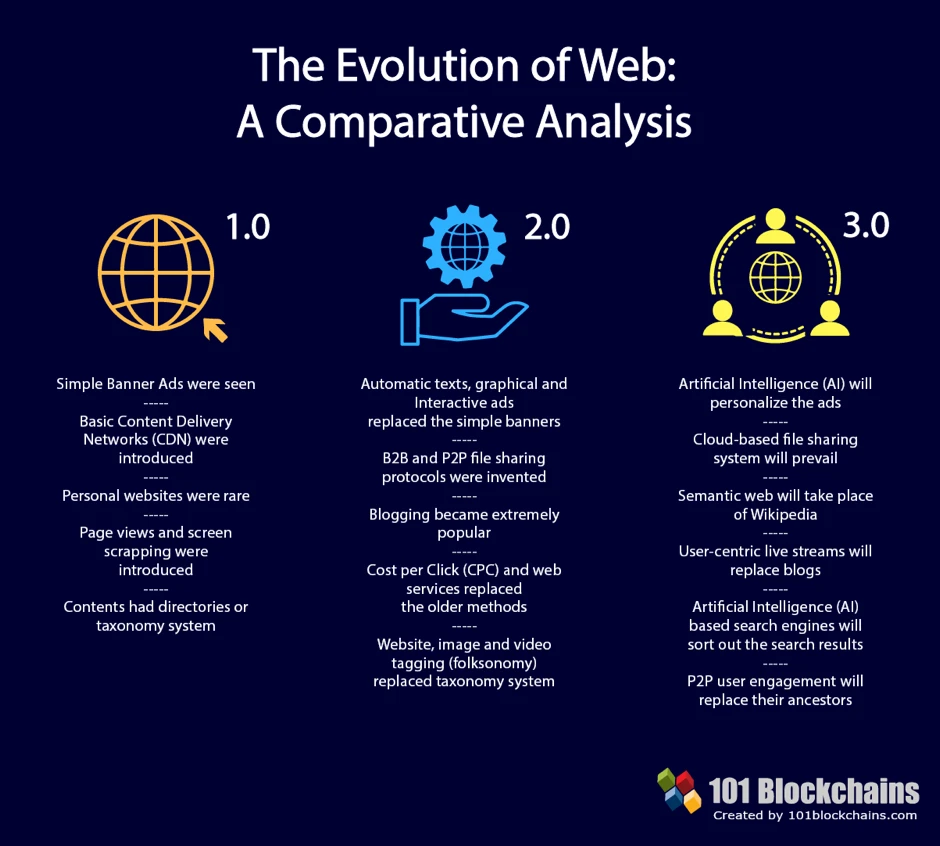
Web 2.0 and the global culture of sharing content has led to the rise of important issues around web security and privacy. Founder of Essentia.one, Matteo Gianpietro Zago suggests that Web 2.0’s successor will be more human-centric: “Rather than concentrating the power (and data) in the hands of huge behemoths with questionable motives, it would be returned to the rightful owners.” So what will this change in direction mean for the web?
Zago predicts that the power will be placed back in the hands of users who will have the security of encryption so that they can regain complete control of their own data. A further development might be the interoperability of applications – instead of only being able to run on one type of device, applications will be device-agnostic and able to run on smartphones, TVs, car operating systems and home appliances. In other words, “the internet of things” will become ever more interconnected.
Whether it’s called Web 3.0 or another name, the fact that the next evolution of the web is imminent, is arguably undeniable. Exciting times lie ahead for the connected world as we redefine the parameters of a system that we have all contributed towards in one way or another. Now more than ever, the world needs devs who can drive the next evolution of the web as we apply the lessons we have learnt.
Interested in trying your hand at web development? Hyperiondev is a great place to start. Schedule a call with us and our mentors will give you great advice on how you can get started.

Career Advice
3 ways to succeed at an online coding bootcamp
A professional, effectively facilitated bootcamp can be the key to unlocking a thriving career in development. It all begins with the right mindset. Here are our tips on how to maximise the positive impact of a bootcamp.
Coding bootcamp. The term may conjure up images of life in the military – instructors barking orders, being made to feel like a broken human and hours of what feels like physical, mental and emotional torture. Getting through 3 to 6 months of intense theory and training may sound like it fits the stereotype, but in reality, online coding bootcamps are very different. A professional, effectively facilitated bootcamp can be the key to unlocking a thriving career in development. It all begins with the right mindset. Here are our tips on how to maximise the positive impact of a bootcamp.
Stay away from the comparison trap
Before choosing an online coding bootcamp, you may read success stories about how students have built award-winning apps or started their own businesses after maximising the positive impact of a bootcamp. In scenarios like these, human beings have the weird tendency to focus on the differences between people rather than their similarities, and to start drawing proverbial battle lines between those who know their stuff and those who don’t. We encourage you to resist the urge to compare yourself to others – it’s a sure-fire way to feeling inferior, whatever your level of knowledge is. And quite frankly, the comparison trap detracts from your ability to learn from others.
Stay away from comparing yourself and the pace at which you work, to the stories you may hear. Everyone learns at their own pace and with different results. Own your journey and take responsibility for doing your best – beyond that, with a bit of luck and good timing, your bootcamp will be a stepping stone to something big.
Get honest
Most coding students think that anxiety or nervousness is a sign of weakness. Not so. Feeling anxious about learning something new is a completely natural response. And let’s face it, bootcamps are not for the faint-hearted. The solution is simple – get honest with yourself, with your peers and with the bootcamp facilitator. The worst thing you can do is bottle up your anxiety, suffer in silence and eventually allow it to ruin what should be an informative and uplifting experience.
You may even find that your peers relate to what you are feeling, and that the facilitator finds it useful to know that you are anxious so that they can give you individual attention when possible. Another great way to combat your nerves is to join online forums on the topic and get tips on how to overcome anxiety as you dive headfirst into complex concepts. Reach out – you might be pleasantly surprised at how many people are willing to listen and give you valuable advice.
Some online coding bootcamps are mentor-led, so you’ll have the opportunity to work 1:1 with a mentor, who is a specialised trainer. Mentors review your code to make sure that it’s accurate and aligned to industry standards. They’re also a source of personal motivation and an infinite source of knowledge, so if your bootcamp provides you with a mentor, reach out to him/her and discuss your challenges. Good mentors are good listeners.
Be Proactive
If you go into an online coding bootcamp expecting school-style learning where teachers guide the process step by step, you may find it challenging. Good bootcamps are the ones that encourage proactiveness. You won’t simply be given answers – you’ll be expected to think independently and do extra research to solve problems. In this way, bootcamps prepare you for the world outside the classroom, where you’ll be expected to take responsibility for your career and the course it takes. Bootcamps require you to think on your feet and go the extra mile.
This is certainly not one of those cases where you’ll achieve a good result by doing the bare minimum. If you really want to maximise your return on investment (so to speak), you’ll need to be proactive. Before the bootcamp begins, inform yourself, do research and learn as much as possible on the topic so you attend your first lesson prepared and ready to go. And after every lesson, go over the material and apply it practically in whichever way you can. Build as you learn. Practice makes perfect.
Coding bootcamps can be intimidating, especially if it’s your first one. But don’t let that stop you from getting it under your belt and pursuing a career in what can arguably be thought of as the most lucrative field in the digital age. Bootcamps are intense because they’re designed to be that way. They are designed to equip you with the tools you need to build a strong foundation in your field of development. With the right mindset and work ethic, an online coding bootcamp can be a springboard to a successful future.
Thinking about attending a bootcamp? Ours are award-winning. Browse our bootcamps here and ask us any questions you may have. We can’t wait to get to know you.

Career Advice
4 dying programming languages developers should avoid
As an aspiring developer, it pays to focus on learning in-demand, relevant programming languages and avoid these dying programming languages.
As an aspiring developer, when you’re deciding which languages to start learning, it pays to focus on those that are highly in-demand by potential employers in the industry. There are also some dying programming languages that have lost their relevance, and beyond your own personal curiosity, there’s no reason to spend weeks of months getting to grips with them. Which programming languages are on their way out?
Objective-C
Objective-C is a programming language developed in the 1980s, and was the main language that Apple used for their macOS and iOS operating systems. But in 2014, Apple launched Swift, a general-purpose language designed to replace Objective-C (to be used for building iOS, macOS and watchOS apps).
Objective-C has experienced a steady decline since then, although there are still a lot of apps around today that were written in this language. It will take a while for Swift to make its predecessor obsolete, but it is sure to happen in the coming years.
Perl
Perl was first developed in 1987, and became really popular in the years that followed. The language once held a position in the TIOBE Index Top Ten, and has been used to build some of the biggest websites around, such as the American classified ad site Craigslist.
Perl’s popularity has declined significantly, and many programmers attribute this to the rise of Python, which has a cleaner, simpler syntax and is attracting more beginner developers. Python is in demand and more programmers are choosing to learn this language over Perl.
CoffeeScript
This is a younger programming language, released in 2009. CoffeeScript is designed to transcompile into JavaScript (meaning it takes the source code of a programme written in CoffeeScript as input, and uses it to create the equivalent source code in JavaScript).
Today, the advantages that previously came with CoffeeScript have been incorporated directly into JavaScript itself. This has made CoffeeScript far less relevant, and largely unnecessary for developers to learn. There has been a distinct drop in developer interest over the years.
COBOL
COBOL (common business-oriented language) was specifically designed for corporate use. First developed in 1959, this long-established language is something of a grandaddy in the business world, and many younger developers consider it a dinosaur.
Numerous large corporations still have COBOL codebases in place, and developers who have been working in COBOL for a while do have good salary prospects. However, it’s not recommended for new developers. As more corporations switch to cloud-based solutions and replace their tech stacks, a career in COBOL programming is becoming less viable.
Top programming languages to learn today
In contrast to these dying programming languages, there are a few languages that stand head and shoulders above the rest in the development industry. Employers are on the lookout for devs who can programme in Python and Java.
Python
Demand for Python developers increased by around 5000 job postings during 2017, and this trend has continued throughout 2018. It’s also been ranked #1 on the PYPL (PopularitY of Programming Language) Index.
Java
Java is a long-established language that’s relatively easy to learn, and widely used by large multinational companies. 90% of Fortune 500 companies today choose Java for their backend development, and all apps developed for Android devices are Java-based.
The fastest way to learn top coding languages online
To learn these relevant coding languages and more, sign up for an online coding bootcamp and get the skills you need to get you noticed by prospective employers.
The HyperionDev Software Engineer Bootcamp covers Python and Java, as well as object oriented programming. Secure your place in one of these online courses and get the grounding you need to launch your career in development.

Career Advice
The best websites for your developer job search
If you’re starting your online developer job search, these trusted websites will help you find excellent opportunities and salary estimates in your region.
Now that you’ve got your qualification and your developer job search has begun in earnest, where do you start? With so many online job resources out there, it can be hard to differentiate quality from quantity. To help you get the most from your online job hunt, here are our top website recommendations.
Indeed
Indeed is a worldwide job listing search engine based in the USA. This job site gets over 200 million unique visitors every month. The site places a strong focus on job seekers, allowing them to create and upload their resumés, access thousands of job openings in their regions, and research companies, free of charge.
The site’s Essential Job Search Guide provides job seekers with valuable insights, from research tips to interview advice. There’s also a functionality that allows users to view salary ranges for popular job titles.
Glassdoor
Glassdoor is a website that allows job seekers to search for open positions in the development field, and also lets current and former employees post anonymous reviews of companies. Job hunters can also look at personalized salary estimates, based on their field of expertise, their years of experience, and their location.
Monster
Monster is a UK-based site that also operates in Europe, the USA and Canada, the Middle East and Asia Pacific. Monster helps to match job seekers and hiring companies in a variety of fields. The site also provides tools like Monster Career Snapshots, and Monster Career Benchmarking.
Tech in Asia
Tech in Asia is the largest English technology-focused media source covering the Asian region. Developers can search for tech and startup positions in China, Japan, India, Malaysia, Vietnam and more. The site also covers tech trends and news in the region, and organizes tech conferences across Asia.
Graduateland
Graduateland is Europe’s largest career portal for graduates and students in search of jobs, internships and graduate programmes. As well as a job search function, the site also provides links to upcoming career fairs, and gives students advice on acing interviews and excelling in their first jobs.
JobRapido
JobRapido is an employment site that serves the Americas, Europe, Africa and Asia Pacific. You can search for available job postings in your region, and if you’re unsure of the exact job title to search for, the site provides their top searched positions to guide you.
OfferZen
OfferZen is a South African site that helps developers find tech jobs that perfectly suit their skill levels. Job seekers can reach more than 800 applicants at once by making their details available on OfferZen. Applicants create a profile, chat with a skilled talent advisor, receive interview requests from companies, and find their perfect match.
Tips for your online developer job search
Use reliable platforms: Use trusted search engines and sites, like those listed above, which have high rates of traffic and proven results.
Brush up your skills: Read the industry news and interview tips on these platforms. They’re typically written by industry insiders, and will give you valuable information you need to make a good impression.
Do your homework: Research the employer beforehand. Take advantage of the company information and reviews provided on the websites above, so you get a feel for the company culture and history. This knowledge will help you with your cover letter.
Build your presence: Do some networking, both online and in the real world. Join industry forums, participate in industry surveys, and get your name out there on trusted job sites. Attend local tech networking events and get to know people – most employers like to put a face to a name.
Apply for a narrow range of positions: Don’t waste your time on “long shot” applications for jobs you aren’t well suited for. Keep your focus on positions where you can add value to the hiring companies.
Switch to a career in tech
Get qualified with an online coding bootcamp, run by coding specialists and dedicated mentors. Adding this qualification to your CV will get you noticed by prospective employers as you start your developer job search online.

Career Advice
Get the lowdown on self-taught courses vs coding bootcamps
So you’ve decided that you’d like to turn your love for all things coding into a career. Great! Now you’re at the first of many crossroads - self-taught courses vs coding bootcamps. In this post, we break down the main differences and shed some light on these forms of learning to help you make an informed decision.
So you’ve decided that you’d like to turn your aptitude for all things coding, into a career. You know a few of the basics and have an end goal in mind. Brilliant. Now you’re at the first of many crossroads – self-taught courses vs coding bootcamps. It can be a tough decision, especially when resources are finite and time is of the essence. In this post, we break down the main differences and shed some light on these forms of learning to help you make an informed decision.
Personalised pace vs an immersive experience
Individuals who are self-starters and are willing to spend a generous amount of time on gaining practical insights often gravitate towards teaching themselves to code. And there’s a lot to be said about that level of dedication. But it’s easy to get distracted and fall into the procrastination trap. What’s great about teaching yourself to code is that you can do it at your own pace, in your own time.
Bootcamps, on the other hand, are immersive experiences. It’s about eating, drinking, walking and talking code for a specific amount of dedicated time. Bootcamps are faster-paced than university or college qualifications – so expect them to be intense and comprehensive. For some, that’s exactly what’s needed – a crash course on everything you need to know so that you can take the next step.
Independent learning vs mentorship
Massive open online courses (MOOCs) are great for people who can’t stand group work and prefer to be in control of the entire learning experience, from the time they dedicate to certain tasks to which learning areas to tackle first. Independence and learning on your own terms may be how you prefer to work, but developers from all over the world seem to agree on one point – coding mentorship gives you an edge.
As Ken Mazaica puts it, “The best developers seek out coding mentors who can challenge them and lift them beyond their limits.” The most effective bootcamps assign mentors to students. Mentors serve as guides, fellow problem-solvers and coding peers. Some coders develop lifelong friendships with their mentors. The general consensus is that when it comes to bootcamps, mentorship is one of their best selling points.
Self-driven learning vs networking opportunities
With a MOOC, you’ll gain access to valuable content. Self-taught courses seemed to lack real quality in the past, but MOOC providers have really levelled up. Today, there are countless coding MOOCs that provide students with a learning experience that’s pretty much on par with formal learning. However, a good bootcamp not only provides valuable content, it offers potential for networking with like-minded individuals.
Some of the people you meet may be future colleagues, teammates, employees and clients. Some of them may be the key to unlocking employment opportunities. Socially-driven individuals flourish in this kind of environment. So if you’re not afraid to put yourself out there and enjoy meeting new people, a bootcamp may be exactly what you need to kickstart your career.
Flexibility vs structure
MOOCs are perfect if a flexible schedule is what you’re after. Self-taught learning has a certain mix-and-match character to it – you learn what you think you need to learn, as you go. A lot of coding when you’re self-taught comes with trial and error, and for some coders, that’s the best way to learn.
With a bootcamp, however, you’ll work systematically through a strategically planned structure of content. You’ll build your skills one level of mastery at a time, and be assisted by mentors who will help you sift through some of the complexities you’ll face along the way. For some coders, there’s a sense of security and comfort in this level of structure and support.
When it comes to self-taught courses vs coding bootcamps, it’s important that you know one thing – no one course or qualification can teach you everything you’ll need to be a great coder. A blended approach is what works best. As an aspiring coder, your first bootcamp may set you on the right path or inspire your next move.
Ultimately, you’ll always be learning and evolving – it’s the nature of the industry. Somewhere along the line, a self-taught, independent method of learning will come into play. Know that you’ll need to be dedicated and persevere. For many, coding becomes so much more than a career, a side hustle or a fun pursuit. It’s a new way of thinking about the world around you. And that requires a paradigm shift that happens over time, with lots of thought and lots of action.
Thinking of enrolling in a bootcamp? We can help you with that. Check out our different bootcamps and ask us questions – we’d love to get to know you.
Still have questions?
Contact our Admissions Team, and a real person will get back to you.