
News & Announcements


News & Announcements
November 15, 2022
Top-Ranked SA University Introduces Coding Bootcamps
To equip South Africans with the skills needed to make the career move to tech, HyperionDev has partnered with Stellenbosch University’s School for Data Science and Computational Thinking in providing bootcamps in Data Science, Web Development and Software Engineering.
Southern Africa’s largest tech education provider is partnering with Stellenbosch University to future-proof careers
Globally, 44% of people working in non-tech occupations have pivoted into tech jobs1. This figure is set to further increase as the career landscape evolves and automation makes some work redundant2. “Locally, with vacancy volumes reflecting growing demand for tech professionals3, coupled with tech skills featuring prominently on the country’s critical skills list4, South African working professionals should consider making a change now to future-proof their careers,” says Riaz Moola, Founder and CEO of HyperionDev, southern Africa’s largest tech education provider.
To equip South Africans with the skills needed to make the career move to tech, HyperionDev has partnered with Stellenbosch University’s School for Data Science and Computational Thinking in providing bootcamps in Data Science, Web Development and Software Engineering.
The School’s Director, Prof Kanshukan Rajaratnam, explains that these bootcamps form part of the institution’s mandate to build capacity in data science and computational thinking through education and training. “Given the ubiquitous nature of data and technology, today’s learners need to position themselves to take advantage of opportunities that will present themselves in the Fourth Industrial Revolution. It is for this reason that we have partnered with HyperionDev to accelerate what learners and the School can achieve.”
He adds that by working together, Stellenbosch University and HyperionDev are able to teach students tech skills as they are being introduced in the industry and as a result, meet employer demand.
“Coding bootcamps are considered the quickest and most efficient way to adopt tech skills and speed up the time it takes to switch careers since qualifications are earned in between three to six months,” shares Moola. “Typically, those who participate in bootcamps are able to change jobs within three months and emerge with an average annual salary increase of R44,148.00.”
He also points out that, since obtaining a traditional university degree cannot be juggled with a full-time job, the partnership means that those who are already working now have an opportunity to gain these skills and alter their career path.
Starting in October 2022, each online bootcamp will equip students with the theoretical knowledge and practical experience required for 21st century careers:
The Software Engineer Bootcamp is structured to include training in Python, Object-Oriented Programming, and Natural Language Processing (NLP). These skills enable graduates to work with software, hardware and other computer systems in a wide range of industries and jobs.
The Data Scientist Bootcamp teaches popular programming languages such as Python, scikit-learn, NumPhy, Matplotlib, and pandas, in addition to the fundamental concepts of machine learning and AI.
The Full Stack Web Developer Bootcamp offers coaching in both front- and back-end web development including HTML, CSS, React, JavaScript, and the MERN stack, amongst others. Competency in these areas can be used to launch a multi-role developer career, allowing graduates to work in a variety of jobs.
Moola notes that for many potential students, financing studies presents a huge challenge. “However, HyperionDev will offer access to study loans, a partial needs-based scholarship, payment plans, or discretionary discounts. After all, everyone should have access to quality education to increase their chances of employment both now and in the future.”
“There has never been a better time to gain these skills to participate in the future of technology!” concludes Prof Rajaratnam.
For more info on the partnership please see full video HERE.
_______
Footnotes
- https://www.mckinsey.com/Business-Functions/People-and-Organizational-Performance/Our-Insights/Overcoming-the-fear-factor-in-hiring-tech-talent
- https://www.weforum.org/reports/the-future-of-jobs-report-2020/in-full/chapter-2-forecasts-for-labour-market-evolution-in-2020-2025#2-1-technological-adoption
- http://cj-marketing.s3.amazonaws.com/CJI_Executive_Summary.pdf
- http://www.dha.gov.za/images/PDFs/47182-2-8-CriticalSkillsDHA.pdf

News & Announcements
July 13, 2022
Our HyperionDev Career Expo was a great success
HyperionDev's Tech Career Expo 2022 hosted in June was the most successful one yet! An exciting lineup of industry partners and employers presented at this event. Find out who they were.
The past month of June has seen our biggest and most successful Tech Career Expo yet! A special notice of appreciation and gratitude to everyone who attended and participated in this 2-day event hosted on the 29th and 30th of June. We are very proud and excited about the line of industry partners and employers who presented at this event.
Here are the guest speakers who shared their invaluable insights:
Francios Van Louw from SOCO_ED

Francios Van Louw is a South African entrepreneur with a passion for marketing, branding, the youth market and all things tech. Having worked in the marketing and content creation industry for over a decade, he founded Just Brands Africa in 2013 – a company of which he is currently also the managing director.
SOCO-ED is an adaptive online learning platform, used by the likes of Stellenbosch University, Central University of Technology and other independent educational institutions and is fast becoming the preferred online educational solution for many leading educational institutions in South Africa.
With Van Louw’s keen interest in the youth market and by following a consumer-first approach, SOCO_ED is set to disrupt and change the way learners view and engage with education on digital platforms.
Paula Macnab from Yellow

Paula Macnab – Head of Brand and Communications
Yellow‘s purpose is to make life better for customers living in Africa.
Through a digital technology platform, Yellow enables a distributed network of sales agents to serve rural households with life-changing products and services.
Rachel Joffe and Kevin Da Silva from Entersekt
Rachel Joffe – Talent Development Coach @ Entersekt.
Rachel is hugely passionate about people’s development and having an impactful relationship with the world around her. Since she entered the talent management and development space in 2007, she has been refining her skill set so that she can best support the teams she works with, in changing lives. Rachel is dedicated to working with people and organisations that strive for positive, solution-focused approaches and are not afraid to employ non-traditional methods in working towards their mission.
Kevin Da Silva– Technical Talent Specialist @ Entersekt
Kevin is an Experienced Team Lead with a demonstrated history of working in the staffing and recruiting industry. he is Skilled in Local Area Network (LAN), Sales, Databases, Management, and Recruiting. And is Strong information technology professional with a National Diploma focused in Management from Cape Peninsula University of Technology.
Entersekt was born with bright ideas and big dreams of solving the problem of fraud consumers have to deal with on a daily basis. Over time, a secure, simple, and user-friendly experience became increasingly important. This helped to crystallize the company’s vision: to make the digital world not only a safer place for all but more user-friendly too.
As the business continued to grow, the knowledge gained from working with financial institutions, technology partners, and industry experts proved invaluable in establishing Entersekt’s core offering: a single authentication hub that allows consumers to transact securely and easily on any digital channel, from any device. Today, Entersekt touches the lives of more than 65 million people across 50 countries – and counting.
What sets us apart? By remaining honest, humble, and authentic in our approach, we’ve become known as one of the few globally trusted fintech companies to consistently deliver on their promises, without fail.
Bakuena Ntshasa from Bandbook
Bakuena Ntshasa as the co-founder is involved in all aspects of consumer intelligence and shopper behavioural research. His focus is mainly on sales, product and systems innovation, business strategy, product strategy, and general management of the rest of the teams. One of his most important responsibilities is to help ensure that Brandbook remains a high-performing team focused on delivering value back to its users and clients at all times.
At Brandbook they unlock your brand’s capability to know what shoppers are buying and why. All with a click of a button.
Daniel Montague from Ezoic
Daniel Montague is a HyperionDev, Full Stack Web Development Bootcamp graduate. He has gone on to be a Software Engineer for JP Morgan in the United States and is currently a sales engineer with Ezoic in London.
Ezoic uses AI to help sites gain the most out of ads they place. We also help with SEO and other Core Web Vitals. As the first Google Certified Publishing Partner, we have great ties to Google and other big players in the tech world.
Wahlied Cole from Scoothero and Quikr

Wahlied Cole is an Experienced Director with a demonstrated history in the logistics and supply chain industry. He is Skilled in Negotiation, Operations Management, Import, Freight, and Retail, and is a Strong professional with a SMDP focused in Management from Stellenbosch University/Universiteit Stellenbosch.
Scoothero – The first food, grocery and delivery network marketplace ecosystem.
Quikr– The most cost-effective same-day delivery partner in South Africa from as little as R50 per order.
Zahed Rassool – RRZ Innovations
Zahed Rassool AKA ZEE is an apple-loving (yes the tech), fun-going, semi-authentic, family-driven, young professional. He is the type that aims way too far and believes that he can always embed himself as part of the solution. The type that makes promises that his team needs to fulfil. He was Voted best daddy by his firstborn and the current rock-paper-scissors Champion at RRZ. A serial entrepreneur that debugs his way through life.
RRZ Innovations consists of a team of talented individuals who share the same dream. We pride ourselves on our efficient software design, quick workflow, excellent service and professional outlook on business relations. RRZ Innovations has grown to employ an elite group of developers and designers who regard customer satisfaction and great software as part of their core values. You will always receive top-quality products from us and you can rest assured that we deliver on time.
Starting off developing simple Content Management Sites (CMS) for a small group of clients we found that we were quickly growing and ended up venturing into .Net and biometrics. This led to an influx of clientele. Our hunger for new challenges combined with excellent software and great hands-on service ensured the return of many of our clients as well as an influx of new clients through word-of-mouth. Some of our main income is generated from assisting and consulting for other Software Development companies that do not have the manpower or expertise to complete projects on their own, as well as the development of custom Business Management Software (BMS).
We have many products in the Public and Private sectors which include Municipal Productivity, Websites, Webapps, Hosting and Native Mobile Applications in iOS, Android and BBOS10.
RRZ has made great strides in the advancement of municipal productivity as well as business management systems while creating a stable platform to help educate newcomers in the field of graphic design, website design and information technology.
——————
Our Career Services team provides post-bootcamp support to keep our graduates in the loop and informed of the updated trends on the job market, expected salary scales, introductions to industry experts, information about available graduate placement programmes, industry projects, jobs, internships and a whole lot more.
We also give graduates holistic career development, from their CV and technical skills, to networking, events, and industry introductions. Providing our graduates with the skills, support, resources and mentoring to engage with industry and the job market. Through our Graduate Programme of intensive career support and development, we prepare our graduates to be job-ready for the tech industry.
News & Announcements
April 6, 2022
HyperionDev’s Learnership Programme: A light in the dark for SA’s unemployment crisis
In an increasingly digitising economy, standing out from the crowd with critical tech skills is essential. To address the global tech skills shortage, HyperionDev is launching a world-class, industry-relevant and highly practical learnership programme.
In today’s post-pandemic climate, standing out from the crowd with critical skills is becoming increasingly important. South Africa’s unemployment rate has hit a record high of 35.3%—the highest level since Statistics South Africa’s first Quarterly Labour Force Survey in 2008. This means that 7.9-million people remain jobless. So, how do we, as a country, rectify this?
HyperionDev’s Business Development and Relationships Manager, Rudi Mdima believes that “The private sector needs to play a bigger part in pulling our people out of unemployment, and learnerships focused on sought-after skills are the way to do it.”
HyperionDev’s 2021 Tech Graduate Futures Report shows 87% of executives are experiencing a tech skills shortage. Exacerbated by the COVID-19 pandemic and Great Resignation, many industries rely on coding and highly skilled tech talent to remain competitive in the digital age. Yet, it is these very skills that are so scarce in South Africa.
To address the tech skills shortage, HyperionDev is launching a world-class, industry-relevant and highly practical learnership programme to service the South African market and African landscape. This work-based learning programme provides world-class tech skills for in-demand careers and leads to a National Qualifications Framework (NQF) registered certification.
Starting in June 2022 and running online for 12-months, the programme will enable participants to earn a National Certificate in Information Technology specialising in Systems Development. The curriculum is strategically structured with 30% theory and 70% practical tech studies. During the second half of their learning journey, learners will be placed with employer partners and given real-world exposure and outcomes-aligned tasks to complete, overseen by their assigned mentors.
On completion of the learnership, graduates will have the confidence and skills base to tackle junior roles in IT systems engineering, desktop support, IT support, computer or network support, business analysis, or database administration. These sought-after skills fortify modern businesses in an ever-evolving digital economy.
Graduates are also put through HyperionDev’s bespoke 90-day graduate programme, available on all of HyperionDev’s full bootcamps. The programme is designed to maximise graduates’ candidacy for job opportunities, and covers three levels of focused career development phases, namely: technical career readiness, alumni network, and introduction to the industry. By the end of the programme, graduates are equipped with the real-world skills needed to help them attain in-demand careers or to strengthen their position within their current company.
For HyperionDev Employer Partners, the learnership presents an opportunity to build and maintain a strong and future-proofed pipeline of key talent and young professionals. Mdima says, “Employer partners will also be in a position to apply for and take advantage of mandatory and discretionary grant funding from the Sector Education and Training Authority. Plus, they will benefit from tax deductions under Section 12H of the Income Tax Act, as well as B-BBEE points depending on the percentage of the organisation’s staff that are registered on the programme, along with bonus points should unemployed learners be absorbed.”
Learnerships are a win-win for everyone involved, with the biggest wins including being able to help the Government tackle the unemployment crisis in our country, improving South Africans’ livelihoods and closing the global tech skills gap.
00
If you would like to find out more about our learnership programme and how this would benefit you as our employee partner, visit https://www.hyperiondev.com/corporate-services or reach out to our Partnerships team at partnerships@hyperiondev.com.

News & Announcements
February 24, 2022
Employee Story: Ronald Munodawafa – Quality & Support Manager
This HyperionDev employee ensures the coding university stays true to the promises it makes. Here’s how.
Our HyperionDev employees prioritise student support. It’s what makes our students thrive. And when it comes to the bootcamps we offer, we always make sure they’re high quality. We’ve promised to provide accessible learning opportunities that equip our students with the skills they need to enter the working world and shine.
At HyperionDev, we know that support ensures student progress, and it’s the quality that nurtures their success. Ronald Munodawafa is our Quality and Support Manager, and he’s done a spectacular job in keeping our bootcamps first-rate and our students supported throughout their learning process. With a background in computer science, Ronald knows what students need when it comes to learning tech skills. Here’s a little more about this HyperionDev employee who ensures HyperionDev stays true to all the promises we make.
oo
What do you enjoy most about working with HyperionDev?
I appreciate the company’s culture. It values efficiency, commitment, and responsiveness to change. Many individuals and organisations are averse to change. It’s different as a HyperionDev employee; we see change as an opportunity to grow.
What’s the heart and soul of your role?
I’m the Quality and Support Manager. I ensure our product offerings run smoothly at their core so that we deliver on all our promises. Our team takes pride in the quality and effort that goes into the personalised support we provide to our students and our clients.
What motivates you to come in or log in every morning?
I’m motivated by a challenge, and I live for the “difficult problems.” When I discover a major issue that needs to be resolved, I really shine. People have placed their trust in us, and their future depends on our work. Because of this, I’m committed to making sure our students start and end their journey with us in the best possible way.
Tell us a bit about your professional development whilst working with HyperionDev.
I come from a computer science background. Despite my exposure to business courses, I only had a hazy idea of how businesses could run efficiently. But at HyperionDev, I learned what simplicity and innovation mean in the face of difficult challenges.
Which of the 4 P’s (Purpose First, Progress Always, Problem Solving, People First) resonates with you most and why?
‘Progress Always.’ Never settle for 100% – because that’s actually 70%. If you reach 100%, go back to the drawing board, find what you’ve ignored, and improve it. And always move forward because being at the top is only temporary.
How is HyperionDev different from other places you’ve worked?
Everyone on the team is here because they love what they do. HyperionDev employees share a combination of cohesion, focus, and prioritisation – rare qualities to see in a team. It’s because of this that they’re always exceeding expectations.
What makes you feel PROUD to work for HyperionDev?
Being Quality and Support Manager means that I’m part of the Education Division. They’re a highly intelligent and hard-working team. Pretty much everyone I’ve worked with at the company does their best to ensure the team wins at the end of the day.
What’s a fond memory you have of working at the company?
Everyone gets imposter syndrome. It means they don’t pursue opportunities where they could learn and deliver. A couple of times, some of our graduates came across technologies they were unfamiliar with and froze. But after brief, reflective discussions with them, they pulled up their socks and rose to the occasion. It didn’t matter where they started. They realised that they had it in them to excel in whatever space they were in and could learn anything if they really wanted to.
Is there anything else about your journey at HyperionDev you’d like to share with us?
Being a HyperionDev employee has made me a well-rounded and competent professional. Rather than narrowing down as a specialist, I’ve developed a more holistic view of my role. Not just at HyperionDev, but in the tech education industry overall.
———–
oo
At HyperionDev, we’re always looking for talented professionals to join our team. Whether you’re a project management pro, a high-achieving sales executive, or someone who has a passion for teaching newcomers as they learn to code for the first time, there’s a place for you in our diverse and international team. As a HyperionDev employee, you’ll enjoy more than just fulfilling and challenging work with a fast-growing, internationally scaling start-up – we provide medical insurance, extensive remote working allowances, a generous leave policy, and real avenues for career growth, experimentation, and promotion.
Do you think you could be our next star HyperionDev employee? Visit our career page to see all our available positions and apply to join our team today!

Software Engineering
October 8, 2021
Is code the new cupid?
Dating apps have revolutionised the love game. Discover how code has made this possible and exactly what goes into creating digital chemistry
Once upon a time, in order to find a connection, one would have to perhaps count on a friend introducing them to a mutual friend or kindling a spark at a get-together. This limited past generations to their local dating pool of acquaintances, unlike today where code has opened up much more choice and opportunities to meet new people. Today we look at how code opens up many opportunities to meet like-minded individuals we are genuinely attracted to.
Once upon a time…
In 1965, a Harvard student co-founds Operation Match. It was used by more than a million daters in the 1960s. In the same year, with increased sophistication (100 questions and an IBM 1400 Series computer), New York City’s first computer dating service, Tact, opened. Despite thousands of customers, a co-founder believes computer dating is a fad and leaves the company.
Fast forward to 2004, 40 years later, four Harvard students launched what would become OKCupid. The site allows users to submit questions that others can weight as important or not. OKCupid’s popularity allowed the company to correlate interests to dating actions. In 2012, a little-known startup called Tinder was launched, and an entirely new demographic of people took to online dating.
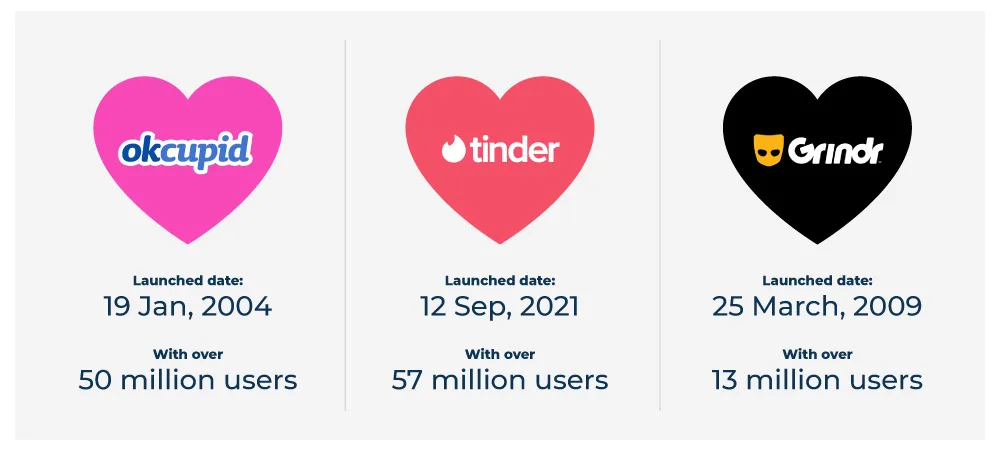
Whatever taboo that remained of internet courtship quickly fell to the wayside when technology-discerning 20-somethings started swiping in 2012. Just as Grindr opened the floodgates for the gay community, Tinder did for single millennials. Since its release, the app has garnered over 50 million swipe-happy users in more than 190 countries.
What the dating app industry looks like today
In the Online Dating segment, the number of users is expected to amount to 489.9 million users by 2025.
According to the Pew Research Center, between 2013 and 2015, online dating usage has tripled among those between the ages of 18 and 24. Dating services also welcome an untapped market, increasing millennial spending power, and young people delaying life milestones, as well as working longer hours. Users are also able to safely screen their potential partners. Tinder assists with this by having users ‘verify’ their images with a selfie needing to be taken that will validate the other photos that are chosen.
Each app has its own competitive advantage or spin on the dating game: With its monthly subscription fee, Match.com attracts people willing to put their money where their mouth is. Tinder pairs potential hookups based on a mere glance and swipe of a photograph, making it simple and user-friendly. Bumble uses a similar format to Tinder, but with a twist: only women can send the first message. The League is an elite dating app focused on accomplished, ambitious young professionals.
When it comes to the most popular apps by audience size, Tinder, Plenty of Fish, Match.com and OkCupid lead the pack. The biggest player in the online dating game, the Match Group, dominates 25% of the market share.
Alluring algorithms
Make no mistake: nothing about the Tinder algorithm is random. You might think that the profiles you are seeing are just a random bunch of people that fit your age and gender preferences and live relatively close. In fact, Tinder wants to match as many couples as possible and designs its algorithm to put certain profiles in front of you. Of course, you’re free to swipe right to your heart’s delight and ignore the people Tinder recommends, but the algorithm penalises you for swiping left too much. So how does Tinder decide whose profiles to show you?
The Tinder algorithm allocates every user a personalised “desirability” score, to represent how much of a catch any particular person is. Users are then sorted into tiers based on their desirability score, and that is, in essence, the algorithm: you get presented with people who are approximately on your level of attractiveness when you swipe.

There may be an element of superficiality to an algorithm like this. Then again, the question is perhaps, are the users seeking something based on looks alone that would call on an algorithm like this? After all, if it’s the human being one is interested in, this algorithm would ultimately make no difference.
The heart and soul of dating technology
So how did code build the dating industry? Many languages are used to make all the magic and romance happen. The technology stack for apps like Tinder includes JavaScript, Python, HTML5 as programming languages, and the AWS Mobile platform to build and test apps. To identify user location, Tinder utilises a smartphone’s GPS or data from the wi-fi network connection.
Apps such as Tinder share personal user data with around 45 other Match Group companies, such as Hinge, OK Cupid, and Plenty of Fish among others. The company shares user data with third parties for purposes such as analytics, advertising and payment processing.
Augmented/virtual reality, artificial intelligence, chatbots, machine learning… How will our kids meet online in the future? And how could this contribute to making a better society? Online dating is set to evolve into an experience closer to what we do on social networks. It will definitely enhance the experience and make it more authentic and closer to a real-life experience. Existing dating apps, based on simple images, are still very static for a generation that swears by video, so the next decade will see apps emerge with more content, more curation, and new ways of presenting this content.
It’s amazing to think that the most authentic human connections can be born from lines of code that seek to serve the true nature of love and the way we romantically relate. If you’d like to be part of the revolution, why not make a date with code? Learn more here.

Software Engineering
October 8, 2021
How code brought food to our fingertips
Our ancestors spent most of their time finding food. Thanks to code, food now finds us. Read more about how #CodeDidThis.
Tech has revolutionised many industries, but when it comes to the food industry, it’s really savoured success. Nowadays, you can get just about any meal, anywhere, at virtually any time.
This, however, wasn’t always the case. For more than a thousand years, there wasn’t so much as take-outs, let alone all the other advancements tech has brought to the table for the food industry (pun deliciously intended). It wasn’t until King Umberto of Naples, Italy demanded to have a pizza pie delivered that the food industry enjoyed its first big idea.
The following year, a Bombay businessman started a lunch delivery service through which he provided lunch to blue-collar workers all over the city. Since then, the food industry developed a hunger for ingenuity. Let’s dig into just how tech has evolved the food industry.
Cooking up a revolution
The day smartphones were able to connect to the internet is the day the food industry truly experienced a digital awakening. At the time, restaurants were still taking care of their own deliveries, but customers would order via an app such as GrubHub or Just Eat.
What came next was more logistical support for restaurants, with apps not only providing the platform but also an intuitive, integrated delivery system. Examples of this type of business include Uber Eats, Spoon Rocket, and Rappido. In this model, restaurants don’t have to develop their own apps or even grow their own delivery sides; the app does it for them. As of 2020, Uber Eats was supporting around 600,000 restaurants. Internationally, the app has 66 million users. Now that’s a mouthful.

Have your code and eat it
The global online food delivery services market is expected to grow from $115.07 billion in 2020 to $126.91 billion in 2021 at a compound annual growth rate of 10.3%. In South Africa alone, there were at least 6,400 active food delivery drivers in 2020.
It’s amazing to think that code is the reason someone is waiting at your door with a steaming hot pizza. Not only that, but the fact that code is used to build apps that can predict what we want and offer all kinds of suggestions.

Powerful algorithms are able to discount prices during off-peak hours in order to increase sales. Lower prices allow lower-income customers to order delivery, when they may have previously been priced out of the market. There are so many other algorithms fine-tuning the value offering coming from the food industry for consumers world over.
How code is redefining the future of food
We are now close to approaching the next stage of development, which is the introduction of ghost restaurants. This idea proposes restaurants that only have kitchens. In other words, they are focused on delivery, rather than on offering up a dining experience. You may be questioning the efficiency of this model, as it’s general knowledge that, in most cases, restaurants earn more when customers consume on the premises. They order drinks and desserts, pay for the service, which sometimes doesn’t happen when you order online. But, focusing your cost on an efficient delivery system can help save real estate costs, staff, insurance, among other factors. Also, the restaurants have more time and resources to bring in new strategies to make their system more efficient.
Food delivery apps are the tip of the iceberg because the food industry is also getting accustomed to grocery delivery apps, restaurant booking apps, meal planner apps, and food by drone delivery. Ultimately, our core needs are being met in more and more dynamic ways, thanks to code. At the end of very long lines of code awaits a fresh meal to be enjoyed. The food industry has also been galvanised by these innovations in the wake of the pandemic, with more efficient ways for food to reach consumers.
Who knows – we may be teleporting food around the globe in the next 10 – 20 years. The possibilities are endless. The power of code is evident and this is your opportunity to possibly be the cause of the next world-changing piece of technology. We at HyperionDev relish in the opportunity to connect you to a world of coding possibilities with coding courses that’ll tantalise your tech tastebuds. Check them out here.

Software Engineering
October 6, 2021
How code took us to the moon
It’s 1969. It’s lift-off. And it’s up to code to help these astronauts cross the galaxy and land on the moon.
Only thousands of lines of code made thousands of kilometers to the moon possible. One small step for man. One giant leap for software. And just by the way, behind that small step for man was, in fact, a woman.
Margaret Hamilton wasn’t exactly supposed to invent the modern concept of software and land men on the moon. After all, it was 1960, unfortunately not a time when women were encouraged to do high-powered technical work. Hamilton, a 24-year-old with an undergrad degree in mathematics, had acquired a job as a programmer at MIT, and the plan was for her to support her husband through his three years at Harvard Law. But the Apollo space program materialised and Hamilton began working on an epic feat of engineering that would help change the future of what was at the time thought to be humanly – and digitally – impossible.
Today, we explore the vital role code played in getting us into space as well as the many other places it could take us in the future.
The birth of code
The original document laying out the engineering requirements for the Apollo mission didn’t so much as mention the word software, MIT aeronautics professor David Mindell writes in his book Digital Apollo. “Software was not included in the schedule, and it was not included in the budget.”
As Hamilton and her colleagues programmed the Apollo spacecraft, they were also hatching what would become a $400 billion industry.
Once the code was solid, it was shipped off to a nearby Raytheon facility where a group of women threaded copper wires through magnetic rings (a wire going through a core was a 1; a wire going around the core was a 0). Forget about RAM or disk drives.
Without code, Neil Armstrong wouldn’t have made it to the moon. And without the software created by Hamilton, Eyles, and the team of MIT engineers, the computer would have been a dud. Software engineering, a concept Hamilton birthed, has found its way from the moon landing to nearly every human endeavor.

Where code is now
The code created for the Apollo mission is now available on Github. The code might be alien to most modern programmers, but features comments that provide a sense of what these pioneers were trying to achieve. The total weight of the whole program is slightly bigger than 2MB. Isn’t it fascinating that such a tiny piece of code could take us so far?

Programming languages like C and Java are now primarily used to operate the rovers exploring Mars. Space missions have become more ambitious and so has the code used to make it all possible. It’s hard to imagine what may be achievable in the decades to come. What will code look like in the future? Where could we go? What could we achieve? The possibilities are out of this world.
The future of code
The most important trend in programming for the foreseeable future will be using machine learning and artificial intelligence to automate much of coding. AI and machine-based learning can automate coding and help programmers write faster and better code. When combined with IDEs – software used by programmers when they are writing code in a specific platform, such as Visual Studio etc – it can save companies a lot of time and money.
Programmers will still need to learn new languages over the next decade. But watch this space because change is the only constant in the coding game. Doesn’t a career in coding seem quite attractive now?
Thanks to one space mission, the sky’s the limit for programmers, now and into the future. As coding becomes the most in-demand skill to have, the pace of human progress is increasing exponentially. Why not be part of the revolution? If you’re interested in a career in coding, your lift-off can happen right here.
News & Announcements
September 30, 2021
Why Upskilling Is Key to Future-Proofing Your Business
Forward thinking companies should be upskilling their employees in order to remain competitive, urges HyperionDev’s Caissa Veeran.
It is expected that by 2025, 85 million jobs globally may be displaced as a result of technology. However, as we continue to adopt technology into our work lives, 97 million new roles have been predicted to emerge. With this in mind, forward thinking companies should upskill their employees in order for their businesses to remain competitive, urges HyperionDev’s Caissa Veeran.
Currently, South Africa is faced with a skills gap. This is reflected in a 2020/21 survey released by XpatWeb that shows the demand for ICT skills remains steady, with 13% of respondents indicating that they struggle to source skilled professionals to drive their operational demand to transition into the digital economy.
The survey revealed that the most sought-after jobs include IT Application Developers, Data Analysts, Data Scientists, Software Developers, Software Engineers, IT Program Managers, and Network Architects.
With this in mind, upskilling on-the-job is a sustainable option to bridge this skills gap through ongoing training and development programs, especially as many long-established and experienced employees are running the risk of becoming obsolete.
It is also often simpler to address the skills gap by training the existing workforce rather than recruiting a new candidate. However, after the economic fallout from last year’s COVID-19 pandemic, many employers may be tempted to shelve employee upskilling plans for the future. It is important to note that although upskilling can seem costly, it provides a significantly higher return on investment.
Learning code is a win for all
The best place to start when it comes to future-proofing a company is to upskill employees with coding skills. Even providing non-technical employees with the chance to learn code gives them the opportunity to advance in their current roles or uncover new areas they may have an interest in or aptitude for. This makes it more likely they’ll stay with the company as their professional goals evolve.
In addition, it assists with arming employees with skills such as problem solving. Although many think that this is a soft skill, it’s one that’s best practiced through learning to code. That’s because part of learning to code is learning how to think like a programmer and defining a problem, breaking it down into smaller pieces, and exploring various possible solutions.
By understanding what developers, engineers, and data scientists do, non-technical roles will be in a better position to work with them to co-create solutions or products, ultimately benefiting the business
Equipping your employees with coding skills prepares them for the future of work and gives leadership a greater opportunity to fill future talent gaps internally. It’s a win-win.
Coding is everywhere
All sectors of the economy need programmers. As the healthcare industry leverages data to improve, it will result in more efficient operations and better patient outcomes. Agriculture and the blossoming agri-tech sector need talented coders to help solve the complexities of food supply. In finance, programming is useful in setting up electronic trading systems, pricing derivatives and creating tools to analyse data. Finance professionals rely on programming languages like Python for risk management, pricing, and trade management programs
As marketing continues to expand into the digital realm, employers look for candidates with programming skills. Product managers, in particular, often blend marketing with technical skills as they design and create new products.
But nowhere is coding more needed than in artificial intelligence (AI), as man and machine join forces to work in simpler, quicker and more cost-effective ways. As the digital landscape rapidly changes, the focus of today’s world is around AI. The need for AI engineers exists in all fields, as artificial intelligence is one of the fastest-growing areas for high-tech professionals.
Upskilling retains and retrains staff
In order to create a robust upskilling program, employers need to devise a strategic plan. This can be done by building a long-term view of the company’s skills requirements, mapping out the current workforce’s strengths and gaps, as well as identifying the skills in which employees could be trained. The goal is to be proactive and stay ahead of future demands to get an edge over competitors.
Learning and development is the critical link in employee retention. It signals that the employer values its people and is invested in their success. An employer who doesn’t focus on upskilling is certainly going to lose out.
No matter the industry, job roles and the skills required to do them are rapidly being redefined. Additionally, technology is advancing so fast that linear career paths are a thing of the past, with employees of today constantly trying new roles and learning new skills. As such, companies should be looking for ways to future-proof their staff in these uncertain times and make their business less vulnerable to external shocks.
Caissa Veeran is the head of partnerships at HyperionDev, which provides online and one-on-one coding bootcamps that accelerate students’ entry into a fulfilling tech career. She is passionate about being part of evolving the educational landscape, not only through delivering knowledge, but more importantly by assisting students to develop skills that keep them future-fit and improve their employability.

News & Announcements
September 17, 2021
Employee Story: Melissa Gozongo – Admissions Consultant
Melissa helps students of all walks of life find direction that will lead to the most rewarding career outcomes possible.
Work done with a sense of passion doesn’t feel like work. It’s fun. It’s inspired. It’s what sits at the core of our purpose at HyperionDev – to enable entry into a fulfilling tech career. To achieve that, we examine the strengths of every student and then recommend guidance on a course direction that best utilises their talents and interests.
That’s where a HyperionDev Admissions Consultant comes in. They guide students on how to excel and achieve their educational and career goals.
Melissa has an outstanding gift for knowing how to do precisely this – help students of all walks of life find direction that will lead to the most rewarding career outcomes possible. She understands that every student who leverages HyperionDev’s dynamic offering is a unique individual with their own goals and passions.
We asked Melissa about what moves her in working at HyperionDev and what keeps her motivated to bring every student’s dreams to life.
What do you enjoy most about working with HyperionDev?
I enjoy working with a group of amazing individuals that are always willing to offer a helping hand, that are fun and purpose-driven.
What’s the heart and soul of your role?
My colleagues and I enjoy helping people change their lives, and what better way to do that than through education? It’s all about getting feedback from students, all those sharing their experiences, to those landing their first job – and knowing that I had a hand in the process is gratifying!
What motivates you to come in every morning?
It’s knowing that each day, there will be a different student with a different story to tell and I have an opportunity to help them get a step closer to achieving their goals.
Tell us a bit about your professional development whilst working with HyperionDev.
I have grown so much working as an Admissions Consultant. Each day I learn something new and I am motivated to continuously work on improving myself professionally. Thinking outside of the box and having a problem-solving mindset is what my role involves and what keeps it exciting.
Which of the 4 P’s (Purpose First, Progress Always, Problem Solving, People First) resonates with you most and why?
People First. I am always working with the mindset of how I can help my students, how I can make the process easier for them.
How is HyperionDev different from other places you’ve worked?
At HyperionDev, I truly believe we live our values in that each and every person knows their duties and do not need to be reminded. We work as a team and always look at ways to better ourselves while working towards one goal.
What makes you feel PROUD to work for HyperionDev?
I am proud to work at HyperionDev because I believe in our Bootcamps and I know the entire team works towards delivering world-class service.
At HyperionDev, we’re always looking for talented professionals to join our team. Whether you’re a project management pro, a high-achieving sales executive, or someone who has a passion for teaching newcomers as they learn to code for the first time, there’s a place for you in our diverse and international team. As a HyperionDev employee, you’ll enjoy more than just fulfilling and challenging work with a fast-growing, internationally scaling start-up – we provide medical insurance, extensive remote working allowances, a generous leave policy, and real avenues for career growth, experimentation, and promotion.
Do you think you could be our next star HyperionDev employee? Visit our career page to see all our available positions and apply to join our team today!
News & Announcements
August 26, 2021
Employee Story: Tevin Pitts – Student Progression Associate
Meet Student Progression Associate, Tevin Pitts, whose mission it is to help students and make sure their voices are heard.
Our bootcamps would not be what they are without the thousands of students who have come through them. They are everything to us; they are our focal point in our mission to bring affordable and accessible modern tech skills education to the world. Without our people, we’d fall apart.
Since joining our ranks almost a year ago, Student Progression Associate Tevin Pitts has led the charge on refining and revolutionising how we hear, support, and engage with our HyperionDev community. Tevin brings nearly a decade of excellence in customer service and support experience to HyperionDev, and it shows: he has driven hundreds of positive reviews and success stories, helped countless students with difficult problems, and recently won our Employee of the Month “Kudos” Award.
We asked him some questions about his professional experiences, what his job responsibilities are, and what it’s like to work at HyperionDev.
What do you do at HyperionDev?
I’m a Student Progression Associate and I fulfill an integral role in ensuring the continued success of our fast growing student base.
What’s the heart and soul of your role at HyperionDev?
Being the custodian of our Student Success Division is such a pleasurable experience. I’ve been working in the Customer Facing and Education sector for the past 10 years and along the way I’ve learned that understanding my client’s needs, being consistent, honest and knowledgeable provides world-class service. It’s always been my nature to assist, solve and help others progress. Having these contributing factors has allowed me to deliver tasks exceptionally well and support our students’ progress at an adequate pace.
Making a true difference in the lives of our students motivates our Team to strive for excellence in everything we do. My colleagues aren’t just my coworkers: I’ve made some good friends along the way.
At HyperionDev we believe that education shows us the importance of hard work and, at the same time, helps us grow and develop.
What motivates you to log on in the mornings?
Being praised for a job well done – and believing in the work I do – motivates me to log on to work in the mornings. I like knowing that I’m appreciated, because I give every deliverable my all, and I also like knowing that the work I’m doing is producing results that matter to people everywhere.
What do you enjoy most about working at HyperionDev?
There are so many wonderful things about working for HyperionDev. My favourite is probably the flexibility I have with my hours. I also love the company culture and enjoy working with a team of highly skilled and hardworking individuals. At HyperionDev we maintain a transparent work culture. The team is personable, professional, and strives for excellence, the rare type! What’s great is everyone working at HyperionDev was meticulously selected to fit the company culture as this is an essential key to employee engagement, performance, and productivity.
Tell us a bit about your professional development whilst working with HyperionDev.
My journey at HyperionDev thus far has been ever-changing, I’ve been granted the opportunity to contribute to various interdepartmental processes and deliverables, from Student Success to Technical Support, and Education to Marketing.
There has not been a single day where I haven’t learned something new. At HyperionDev, we are not only doing a day-to-day job but we are constantly learning, developing, and improving our departmental processes and personal careers.
Working for a company that values my input, allows me to share my ideas and creativity has surely taken me out of my comfort zone. There is no room for complacency! I’m inspired to always put my best foot forward and to think out of the box, not only for myself but for our students and the importance of their futures.
How do you ensure that you keep yourself upskilled + knowledgeable in your field of expertise?
As our working environment is also a learning one, it’s essential that I constantly keep myself informed and updated with the latest tech tools and how to provide world-class service to our clients, students, and prospects. We live in a digital world and this allows me to get all the information I need right at my fingertips! In short: Taking professional development courses, the use of online resources, attending webinars that align with my field of work, and the insight from my seniors and mentors is such an important factor in helping me excel in everything I do at HyperionDev.
Which of HyperionDev’s core values resonates with you most & why?
I would have to say the value of ‘People First’. Happier employees work harder and smarter to achieve personal, departmental, and organizational goals.
What’s a fond memory you have of working at the company?
At HyperionDev we celebrate many wins, and one of those wins was raising 200% + in our CrowdCube social impact investment crowdfunding campaign.
Also, being a couple of months into the company and achieving the employee of the month award (as we call it Monthly Kudos). This was a great achievement and being recognized at such an early stage within the company, was truly a remarkable feeling.
How is HyperionDev different from other places you’ve worked?
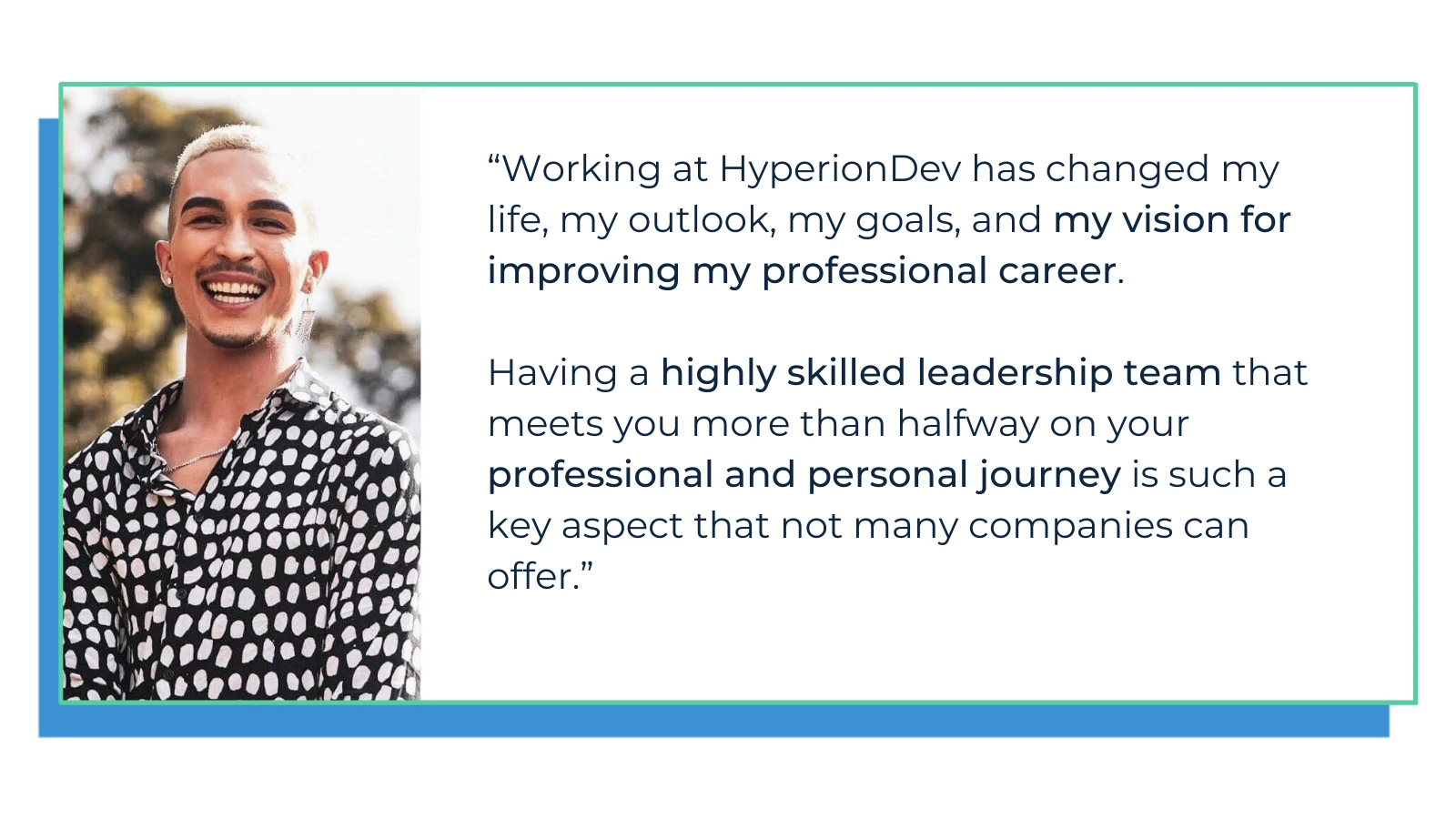
Working at HyperionDev has changed my life, my outlook, my goals, and my vision for improving my professional career.
Having a highly skilled leadership team that meets you more than halfway on your professional and personal journey is such a key aspect that not many companies can offer. This speaks volumes of what it is like to work for a start-up company.
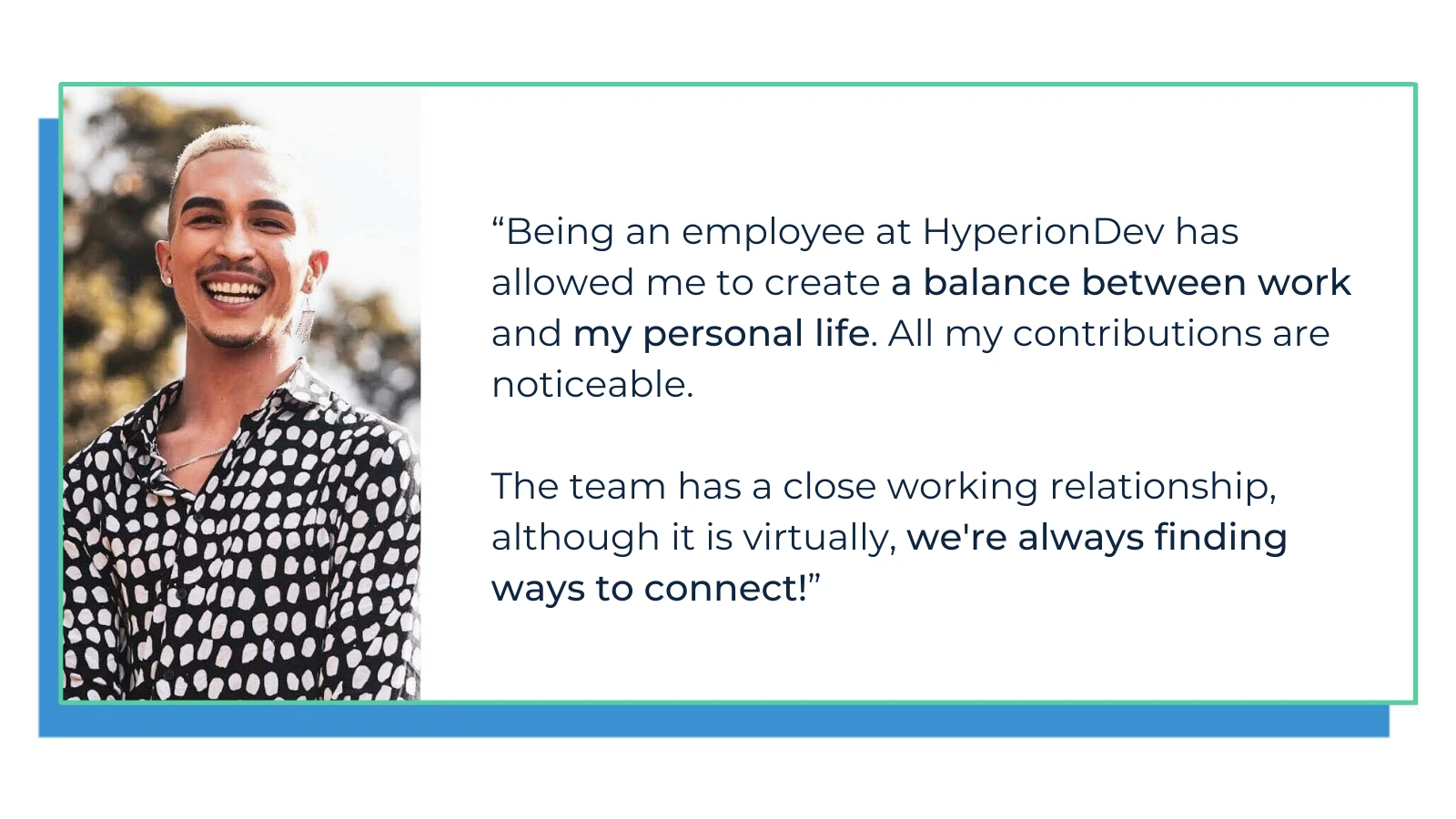
Being an employee at HyperionDev has allowed me to create a balance between work and my personal life. All my contributions are noticeable. The team has a close working relationship, although it is virtually, we’re always finding ways to connect!
What makes you feel PROUD to work for HyperionDev?
We have a core mission at HyperionDev and that is “to close the global tech skills gap by enabling education that is an accessible alternative to traditional university degrees” – Our Team truly stands for this and we work smart to maintain our core goal.
We celebrate our people, our students/clients and we are dedicated to making a change in the EdTech Sector. We work smart, we give back, we’re optimistic, we produce quality products and services, we respect our business practices and therefore we are known as one of Southern Africa’s Largest Tech Education Providers.
Go HyperionDev!
At HyperionDev, we’re always looking for talented professionals to join our team. Whether you’re a natural ‘people person’ with a flair for support and success, a passionate educator, or a project management pro, there’s a place for you in our diverse and international team. As a HyperionDev employee, you’ll enjoy more than just fulfilling and challenging work with a fast-growing, internationally scaling start-up – we provide medical insurance, extensive remote working allowances, a generous leave policy, and real avenues for career growth, experimentation, and promotion.
Do you think you could be our next star HyperionDev employee? Visit our career page to see all our available positions and apply to join our team today!

News & Announcements
August 16, 2021
HyperionDev bootcamps: Everything you need to know!
What is a bootcamp? Do I need coding experience to learn to code? We gathered the FAQs we get from students exploring our bootcamps.
So you’re thinking about learning to code, or want to join our coding bootcamps. Maybe you’re a student just leaving school, and are exploring your options. Maybe you want to switch careers, and join the high-paying, opportunity-rich tech industry. Or perhaps you just want to learn some essential tech skills to build cool apps, websites, or programs.
Whoever you are, you have questions – and we have answers. Here are the answers you’re probably looking for, in our most common HyperionDev FAQs (Frequently Asked Questions).
These are by no means all the questions we get from students just like you. If there’s something you need to know, but can’t find in these HyperionDev FAQs, please don’t hesitate to contact one of our friendly Admissions Consultants, or join one of our monthly informational Open Day sessions, where you can participate in live Q&A sessions with our staff, educators, and mentors.
Q: What is a coding bootcamp?
A: A coding bootcamp is a fast, affordable, and accessible way to learn critical, job-ready coding skills to find work at a fraction of the time and cost of other comparable courses & degree programs. With a coding bootcamp, you focus on learning real developer skills, so that you can start building real programs and finding paying tech jobs as quickly as possible.
Q: What kind of coding courses do you offer?
A: We have a number of different bootcamps on offer. These include:
- The Full Stack Web Developer bootcamp introduces the learner to web development essentials before teaching the technical specifics of building feature-rich web applications. To complete the learning path, you will focus on using frameworks to develop fully functional web applications.
- The Software Engineer bootcamp takes you beyond coding to teach you how to think like a software engineer. You will construct software in various programming languages to solve specific real-world problems.
- The Data Scientist bootcamp empowers you to master the tools, techniques and knowledge required to work with data and become a qualified data scientist.
- The Certified Immersive Full Stack Web and Software Engineer bootcamp is our most advanced bootcamp. It teaches you rich and varied skills set across both software engineering and full stack web development, giving you freedom and flexibility in starting a multi-role developer career.
Q: How is the immersive coding bootcamp different from your other coding bootcamps?
A:The immersive bootcamp is by far our most advanced coding bootcamp. It teaches you core and advanced principles of both software engineering and full stack web development in a greater level of detail than our other bootcamps.
Q: Are your coding courses for students coming out of high school, or for working professionals?
A: Our on-site and online coding courses are for both working professionals and students coming out of high school. We have online part-time courses that are perfect for those with a full-time job, but we also have full-time courses for school leavers who are looking for a more hands-on, in-depth experience.
Q: I don’t have any background in coding, IT, or computer science. Can I still take your bootcamps?
A: Of course! Our bootcamps are beginner-friendly, and designed to accommodate even students who have never tried coding before. Many of our students successfully switch careers to programming after taking our courses, even if they were absolutely new to programming when starting out. With the personalized support we provide, all you need is discipline, persistence, and a willingness to work hard and learn to code.
Q: For those who want to take an online course, do they still have the same chance to gain the knowledge as those doing on-site?
A: Yes, our online bootcamps and on-site bootcamps teach the same curriculum and will give you the same set of job-ready developer skills. These different options have been designed to cater for students with different learning needs and styles. You can study however you want, and be confident that you’ll graduate as a job-ready professional developer.
Q: How long are your coding bootcamps?
A: It depends on what you’re studying and your chosen method of learning. A bootcamp can be completed in as little as 3 months, with our most intensive or part-time options taking up to 12 months. You can take as long as you need, with learning options individually tailored to your education goals and career needs.
Q: Are your bootcamps certified or accredited?
A: Yes! We are registered as an accredited training provider with SAQA via the MICT SETA.
- Our latest Accreditation Certificate with MICT SETA is available here.
- A previous Accreditation certificate with the SETA is available here.
- The Certified Full Stack Web & Software Engineer bootcamp is currently accredited with 30 credits that are aligned under the National Certificate in Information Technology Development, NQF Level 5 (SAQA ID: 48872).
- All of our coding bootcamp programs contain content, learning, and career support that goes beyond the unit standards currently available under SAQA in order to best position graduates of this programme to secure their careers in tech.
Q: What kind of computer or laptop do I need to start my coding bootcamp?
A: Our coding courses are designed for low bandwidth and entry-level PCs, so you don’t need a super computer or high-end machine. We recommend using a device with at least 2gB of RAM and at least 80gB of hard drive space.
Q: I’m at school/college, or have work and hobbies. Can I learn part-time?
A: Yes! Our bootcamps have full-time and part-time learning options to give you flexibility in how you learn to code and prepare yourself for a career in tech. With our part-time bootcamps, you can learn at your own pace and on your schedule.
Q: What is your student support like?
A: We offer comprehensive student support throughout your coding bootcamp, with career development support after you graduate through the HyperionDev Graduate Program. During your bootcamp, you’ll get personalised guidance as you learn to code, with expert feedback from our team of reviewers, community access to learning resources on our Reddit community, 1-1 video calls, and more. After graduation, our career support experts will help you prepare your technical CV and developer portfolio, give you job search coaching and mock interview training, and help you to connect with our network of hiring partners and industry contacts.
Q: I’m looking for funding or financial assistance for my bootcamp. Should I enroll first or apply for funding before registering?
A: You can apply for funding with our student financing partners when you sign up for your coding bootcamp. You can learn more about that here:
Q: Do you think building up a portfolio of work can be as promising to employers as previous work experience or degree?
A: Absolutely! We encourage our students to always work on side projects alongside their bootcamps, as these then build up and form part of their portfolio and accumulated experience once they have completed the course. During your bootcamp, you’ll work on several capstone projects, which require you to build real working programs, software, and web pages using what you’ve learnt during the bootcamp. Our post-bootcamp support and Graduate Program also help you to set up your portfolio, GitHub account, and technical CV so that you have plenty of proof of your skills to show off to potential employers.
Q: In terms of practical experience, do students collaborate on projects or are projects just for individual students?
A: Our bootcamp projects are assigned to students individually, but you will have plenty of opportunity to work collaboratively with other students during your bootcamp, including on your post-bootcamp larger paired project.
Q: Are there any discounts or course specials for your coding bootcamps?
A: We frequently run promotions and discounts on our bootcamps, for example during Black Friday. The details of these promotions are advertised on our social media pages and through our mailing lists, so please be sure to subscribe and follow along!
Our coding bootcamps are the best way to become a job-ready developer in months rather than years – with an added layer of career development and job-search support that will help you land your dream role in the fields of software engineering, web development, or data science.
Our coding bootcamps are the best way to become a job-ready developer in months rather than years – with an added layer of career development and job-search support that will help you land your dream role in the fields of software engineering, web development, or data science.
Enrol now and join our online or on-site coding bootcamps, which will teach all the hands-on developer skills you need to do real developer work and get hired in as little as 3 months.
Didn’t find the answers you were looking for in these HyperionDev faqs? Get them now by chatting to an Admissions Consultant, or by signing up to attend our Open Day.

News & Announcements
July 22, 2021
Employee story: Roberto Gallotta – Senior Digital Designer
Every business has to have a great marketing team – and that team needs a senior designer with world-class creative skills.
Great design and branding is about much more than simply looking great and having a good colour palate. It’s a holistic, ongoing process of experimentation and iteration that covers everything from perfecting tiny icons and kerning, to translating technical information into visuals that enlighten, entertain, and inform.
Senior Digital Designer Roberto Gallotta is the person who makes that happen at HyperionDev. With a degree in Brand Building and Management from Vega and a postgraduate degree in Entrepreneurship from UCT, Roberto brings nearly a decade of professional branding and design expertise to HyperionDev’s look and feel. His wide range of talents spans visual design, conceptualising web pages from scratch, perfecting UI/UX, and creating beautiful videos and animations. His work gives our brand a face and a voice – sometimes literally, if you’ve watched any of the adverts he has lent his voice to in the past few years.
We asked him some questions about his professional experiences, what his job responsibilities are, and what it’s like to work at HyperionDev.
What do you enjoy most about working at HyperionDev?
What I love most about HyperionDev is the sense of camaraderie we all share. We all share this mission of being a leader in tech and education in South Africa and the world, which makes every win – small or big – noticed. You are appreciated and valued for going the extra mile.
What’s the heart and soul of your role at HyperionDev?
Working as the senior digital designer means that I ensure that the HyperionDev brand is portraying the high-end work that we do through visual and animated aesthetics. I work closely with content creators and the performance team to take words and bring them to life for social media, PR, adverts, and our website. I make it my mission to make sure that our brand looks amazing and stands out from our competitors, showing users why HyperionDev is the best choice for them when switching to a career in tech.
I also have also been dubbed the cheerleader of the marketing team, making it my mission to spread positive vibes to the rest of the team. I do what I do, because I’m passionate about creating a positive workplace culture, helping employees with their professional development and resolving office problems.
What motivates you to come in or login in the mornings?
What motivates me everyday is that I have the platform to push boundaries and create artwork everyday that inspires people to want to make the career switch to tech. I do this through always thinking about the box, putting my feet in the shoes of our users, and delivering content that makes them surprised and excited about HyperionDev.
What’s a fun fact about you?
I’m actually green-red coloublind, which is probably why I love working with the blue tones of the HyperionDev branding. Some may say this is a BIG ISSUE that the lead designer is colour blind, but I see it as an advantage, because I create artwork and communication that is accessible to people who otherwise would be excluded and can’t see our communications.
Tell us a bit about your professional development as an employee at HyperionDev.
I started off as a midweight designer back in 2018, when we first went through a rebrand, taking the company from orange and grey to blue and gold. With the company believing in me and my abilities, I’ve been given the space to grow and learn from every task I do.
I have grown to love User Experience design, and animation, where making a design is not about how pretty it looks, it’s more about how best a piece of content can be received by a user. This is mostly applied on our website, where I ensure that the images used represent our audience in the best way, and guarantee that our information is delivered in the way that’s easiest to understand. Working at HyperionDev has also allowed me a lot of career experimentation: I’ve worked as a director on a HyperionDev commercial that aired on TV in 2020, and have flown across the country to meet and interview students for testimonials.
How do you ensure that you keep yourself upskilled & knowledgeable in your field of expertise?
Working as a digital designer in a saturated market, you always have to upskill yourself. I’ve done it through teaching myself animation, where I can take static designs and bring them to life with motion. I’ve done a UX course, to better understand how users think and how to deliver wireframes and high in mockups to developers. I’m also in the process of starting the HyperionDev Full Stack Web Developer bootcamp because, as we say, tech is the future, and I would be silly not to ride that train.
Which of HyperionDev’s core values resonates with you the most, and why?
Problem Solving. I believe that with every roadblock, there is a way to jump over it. It takes a little bit of thinking smart, but anything is achievable. It’s almost like designing an infographic: it’s a step-by-step process of thought, where you need to understand the problem at hand, and you brainstorm different ways to build over the roadblock. A quote I like to say to myself when faced with a problem is “1 ounce of self doubt is a mile away from your successes”. You have to be confident in your abilities, no matter how long it takes; be easy on yourself and your solutions will come to you.
What’s a fond memory you have of working as a HyperionDev employee?
Some of my best moments were when the team would get together for drinks and play board games at the office (before the big lockdown). It was so fun and we’d get a little silly, dance to music, and have the best time. I have made many close friends at HyperionDev.
How is HyperionDev different from other places you’ve worked?
HyperionDev makes me feel appreciated and trusted in what I do. Other companies I’ve worked at have been very corporate. Here, I’ve been given the freedom to explore my creativity and implement my ideas.
What makes you feel PROUD to be a HyperionDev employee?
I feel proud of what we do: giving people an alternative way to learn coding skills. Tech is the future and we should all be a part of it.
At HyperionDev, we’re always looking for talented professionals to join our team. Whether you’re a master of beautiful design, a project management pro, or someone with a passion for teaching newcomers as they learn to code for the first time, there’s a place for you in our diverse and international team. As a HyperionDev employee, you’ll enjoy more than just fulfilling and challenging work with a fast-growing, internationally scaling start-up – we provide medical insurance, extensive remote working allowances, a generous leave policy, and real avenues for career growth, experimentation, and promotion.
Do you think you could be our next star HyperionDev employee? Visit our career page to see all our available positions and apply to join our team today!
News & Announcements
June 23, 2021
Tech in Africa: Why Diversity & Inclusion Are Key to the Future
Africa’s rapid digitisation and ICT growth have established it as a formidable contender for the next global tech hub.
Forget outdated stereotypes of the “Dark Continent”. In recent years, Africa has become a blazing beacon of Silicon Valley replicas, bustling tech hubs, and explosive digital growth.
There’s no doubt that Africa’s future is bright, given its rapid digital development in the past decade. But how much promise does Africa hold as a future international tech hub? What are the challenges that stand in the way of that dream? And what should our societies, governments, schools, and development agencies be focusing on to maximise this potentially multi-billion-dollar promise of growth?
In this article, we’ll take a look at Africa’s status as a new home for some of the world’s biggest tech companies, its significant improvements in availability and access to tech, and the biggest challenges that our continent needs to address to ensure its brightest future.
Africa’s promising rapid tech growth
Africa’s many problems are widely known: barely a week goes by where headlines don’t draw attention to the civil unrest, regional instability, famine, economic downturn, and poverty that affects swathes of the continent.
However, behind the media doom and gloom is a surge of heavy investment and economic refocus that is at the heart of Africa’s rise in the tech space. In the past decade, Africa has made tremendous progress across a range of sectors that serve as the foundation of its new-found international tech hub status.
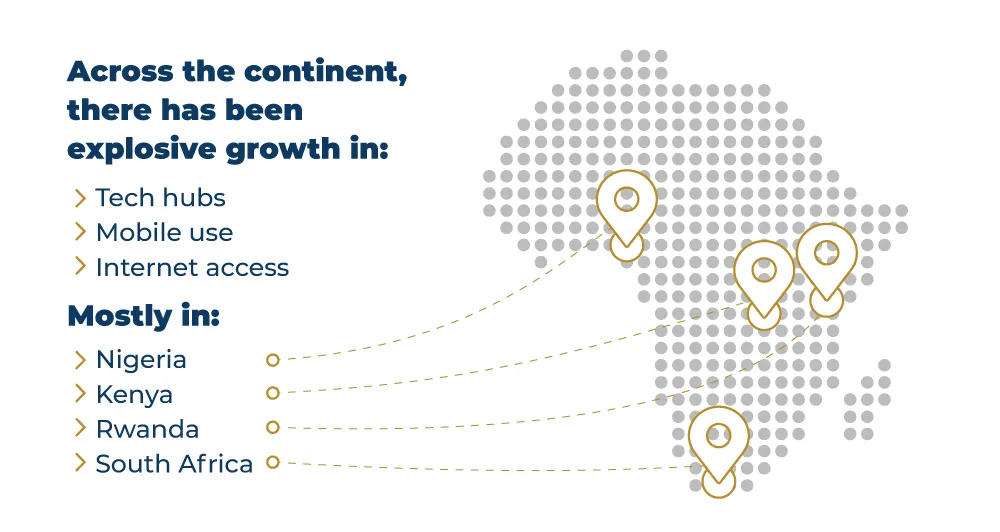
Rwanda is among the leaders in fast-growing ICT development. Today, the country’s internet penetration stands at over 52.1%, compared with a dismal 7% in 2011, while mobile phone penetration has grown to over 80.6% from 33% in 2010, according to the nation’s Ministry of ICT and Innovation.
Kenya is no different: active internet and data subscriptions totaled 42.2 million in 2018, while broadband covers more than 45% of the population, according to official figures. Meanwhile, in Nigeria, phone access grew from just 200,000 subscribers in 1999 to 133 million in 2020, and teledensity went from 63% to 107% in just the last decade.
These are trends we’re seeing across the continent. Reports show nearly half a billion people now subscribe to mobile services in sub-Saharan Africa, with more than 272 million Africans now connected to the internet on their phones. In fact, from 1999 to 2004, Africa was the world’s fastest-growing mobile phone market: subscribers jumped from 7.5 million to 76.8 million in that period, an annual growth rate of 58%.
The rapid proliferation of connectivity on the African continent is a driving force for its wide scale digitisation. Today, much investment and economic interest and activity has been put into African states, resulting in an extraordinary growth of tech hubs- places where coders, web developers, graphic designers, hackers, and entrepreneurs can come together to create new digital products and set up businesses, all championed by young people. According to African investment firm Africa Prudential, these hubs have directly led to NGOs, venture capitalists, investors, donors, and technology providers all over the world looking to explore and tap into the vast human capital in the African market.
Diversity, inclusion, and the African perspective
This new foundation of tech ubiquity and access means that Africa will have advanced technological and technical capabilities to solve its many pervasive issues.
However, as Africa builds these hubs and repositories of technological excellence, there will be an increased need to ensure that diversity and inclusion are the very soul of these initiatives. Diversity and inclusion have always been seen as a powerful way to drive more efficient, innovative solutions, by drawing on the wide experiences and backgrounds of many different people; Africa is no different.
A focus on diversity would avoid the many issues that arise from simply importing European, Asian, or American perspectives and solutions for an entirely different African context of wholly different problems. At the most basic level, Africa’s people are best aware of the problems they need to address, and so to exclude them from these discussions would be to waste time, energy, limited resources, and risk misdiagnosing (or outright exacerbating) the biggest issues.
The promise and potential of Africa’s youth
Accessibility and inclusion are no good if they don’t include Africa’s young talent (and their fresh, on-the-ground perspectives of Africa’s issues). In Africa, nearly 60% of the continent’s population are below the age of 30, and they are a central, critical part of what has made the continent a ‘darling’ of the tech world.
Inclusion of the youth will also help to solve a serious issue plaguing Africa’s development: youth unemployment. In South Africa alone, youth unemployment stands at a staggering 46%. This demonstrates that modernisation and digitisation of the continent will do nothing for her people if they’re left behind by a system that doesn’t prepare them to be a part of that growth.
However, it’s not simply enough to give these people jobs, especially with the threat of automation to low-skill, low-education labour. Africa’s tech future needs a new system of education that focuses on skills development and job-readiness, in a way that’s accessible, affordable, and time-sensitive. After all, if Africa’s growing labour force are not properly upskilled to take advantage of this digitisation, it’ll only worsen unemployment and exacerbate the growing global tech skills gap.
Better access to a modern education
Across rural Africa the issues of low-quality, poor education are well known. However, even in the revitalised tech hubs, there persists an outdated reliance on expensive in-person education that takes years just to prepare someone for an entry-level job.
To best prepare Africa’s young workforce for this wave of digital work, and take advantage of the tremendous progress made in connection millions of people, education models should instead be:
- As accessible as possible, via the internet and mobile devices;
- Designed to take into account limited access to computers/devices;
- Accessible on even low-bandwidth and limited internet connections;
- Focus on practical skills development to to get them jobs as soon as possible;
- Cheap – rather than require tens of thousands of dollars;
- Time sensitive – rather than require four years of study just to get an entry-level position;
- Open to all, in a way that takes into account limited access to decent primary and secondary education.
Africa’s many issues have kept it at a serious global disadvantage for many, many years now. However, with the massive wave of digitisation happening across the continent, it’s clear that Africa is a serious contender for the title of the Next Big International Tech Hub. If Africa’s governments can address the core issues that we’ve outlined above, and truly help young Africans learn the skills they need to be included in this wave of transformation, it would accelerate Africa into the digital limelight, and uplift many millions of her people.
Our bootcamps are keeping a finger on the pulse of these African issues, and many other problems across the world that contribute to the growing global tech skills gap. Click here to find out more about our 1-on-1 mentored approach to teaching Africa’s future tech leaders job-ready essential tech skills for the new African context.

News & Announcements
June 16, 2021
SA’s youth unemployment rate: what we should be doing about it
In Q1 2021, the official youth unemployment rate officially hit 46.3% in South Africa. Here's what we should be doing about it.
Youth unemployment has long been one of South Africa’s most pressing and complex challenges, and in 2021 it only got worse.
The South African government recently shared the results of the 2021 Quarterly Labour Force Survey and it paints a bleak picture for the state of unemployment in the country, specifically amongst the youth. As of Q1 2021, the official unemployment rate among youth (15-34 years) was 46.3%.
The COVID-19 pandemic is widely understood to have negatively impacted employment opportunities for young South Africans; however, the severity of this social issue is also due to many other systemic factors, such as our broken and outdated education system, which leaves matriculating students at a disadvantage in the globally online world.

What the president had to say
In his most recent weekly letter to the public, President Cyril Ramaphosa weighed in on the topic as he reflected on Youth Day and the role of young people in South Africa. The president claimed that the government’s current top priority is to create training and employment opportunities for young people, as well as systems of support that help them to succeed in these opportunities.
President Ramaphosa’s open letter stated:
“Everything that we do as a government contributes towards improving the lives of young people. Tackling youth unemployment requires accelerating economic growth, particularly in labour-intensive sectors, and building the capability of the state to fulfil its developmental role.”
The president’s letter addressed the Presidential Youth Employment Intervention, which reportedly began a few weeks before South Africa’s national lockdown last year and is soon to be fully implemented.
Ramaphosa wrote that:
“The Presidential Youth Employment Intervention was built on the understanding that to address the youth unemployment crisis requires innovative thinking and strong partnerships across society. Its ultimate objective is to find models that work, whether in skills development or active labour market policies, and to scale these models rapidly to reach as many young people as possible.”
“Most importantly, it recognises that young people must be at the centre of any effort to boost youth employment. Young people are our greatest asset, and our greatest weapon in this fight.”
The president outlined two Presidential Youth Employment Intervention initiatives that the government believes will help to combat youth unemployment.
- The Presidential Employment Stimulus. This is a fund that “aims to create new jobs, provide support for livelihoods and protect existing jobs in vulnerable sectors”
- A National Pathway Management Network. This is an initiative that helps young job seekers to view and access opportunities and “receive active support to find pathways into the labour market”
The untackled challenges
On paper, the Presidential Youth Employment Intervention initiatives seem to hold promise. However, they fail to address some key issues that are at the root of our youth unemployment crisis, ultimately misdiagnosing the problem. The answer to youth unemployment isn’t merely to give young people money or temporary jobs, because this ignores the fact that the systems that prepare these youth for jobs are ‘training’ them for shrinking low-skill and high-competition positions in labour or services. Instead, the President’s response should consider these key contributors to the worsening crisis:
- Outdated education systems
The unemployment crisis is deeply connected to our outdated education models. There is a disconnect between what the knowledge, skills, and training that traditional secondary and tertiary education providers offer and what the labour market and employers actually need.
According to Stats SA, “…the young work-seekers are not well educated and do not possess sufficient skills and previous work experience demanded by employers in the labour market. The economy demands skilled and experienced work-seekers, which makes it difficult and lessens the chances for young people to find employment, which ultimately results in some losing hope of ever finding a job.”
- The serious role of poverty and other social issues
Many young people who are struggling to find employment are also reckoning with other complex socio-economic factors, predominantly issues of poverty. These challenges can greatly hinder their ability to take part in necessary training and employment opportunities.
In a recent BizNews article, three researchers weigh in on this, saying that:
“Evidence repeatedly shows how many barriers and challenges young people face as they leave the education system and begin to find their way towards a job, and perhaps even a career. These barriers are not only related to the labour market or education system. They also include issues such as food insecurity, income poverty, and care responsibilities, among others. Each of these limit the ability of young people to look for work.”
- Supply versus demand
Skills and training aside, young people’s ability to find work is contingent on the availability of employment opportunities, and therefore an existing demand for employees. In essence, job placement statistics speak more to demand than supply.
On this, the same three researchers shared with BizNews that:
“A young person’s ability to find a job doesn’t depend only on their skills but also on whether the labour market is creating sufficient demand for employees. No matter how well a programme trains and supports a young person, if there are limited jobs, young people are unlikely to be employed.”
What is needed?
We don’t have all the answers, but based on the complex set of challenges that we face as a country when it comes to youth unemployment, it’s clear that what’s needed is a multidimensional approach that accounts for South Africa’s many social and economic factors.
- A fresh take on education
Young people need to receive training that has a strong practical focus, is industry aligned, and that is actively connected to relevant organisations in the public and private sectors.
- Continuous training
We need to focus not only on simply placing someone in a job, but ensuring that they are placed into a meaningful career pathway that also provides continuous training and growth opportunities. In this way, we can ensure that our workforce continues to upskill, while also having the security of employment.
- Meaningful support
It’s not enough to merely train young people and place them in a job, especially when many of them are coming from a position of poverty. Young job seekers need intensive social and financial support from both government and the private sector to ensure they can thrive in education, training and early employment.
We believe that our model of combined online education with personal mentorship and a focus on job-ready skills for an increasingly digital world are at least part of the answer to the crisis of youth unemployment. Our ability to offer accessible, affordable tech education that gets job seekers ready to work in as little as 3 months (rather than 4 years in comparable degree programs) truly empowers youth not just to find work in the rapidly growing global tech industry, but to learn transferrable, in-demand skills that set them up for a lifetime of fulfilling work and career growth.
As a tertiary education provider in South Africa, we’re committed to ensuring that we’re doing our part in solving the youth unemployment crisis in our country.
Read more about our methodology and vision here.
News & Announcements
June 8, 2021
HyperionDev Secures £2.5M in Africa’s Largest EdTech Series A
Southern Africa’s leading tech education provider secures over £2,521,000 (R50 million) in Africa’s largest edtech Series A fundraise.
Southern Africa’s leading provider of tech education secures Africa’s largest edtech Series A fundraiser, raising over £2,521,000 (R50 million) in just 12 weeks through combined private investments and public crowdfunding. This milestone will help the Facebook and Google-backed coding bootcamps specialist drive its planned UK, US, and global expansions, and enable over R3.5 million in full scholarships for students in need.
Through an innovative combination of public crowdfunding and private investment, coding bootcamps provider, HyperionDev, has raised over £2,521,000 (R50 million) in an edtech Series A fundraiser.
This combined funding strategy attracted over 1,500 investors from more than 20 countries, culminating in one of the largest ever edtech Series A fundraises in Africa. HyperionDev’s public investment crowdfund on crowd investment platform CrowdCube was particularly successful: from its original goal of raising £750,000 (R15 million) in 31 days, the company was swarmed with public interest, surpassing its target in just 5 days. Within 14 days, HyperionDev’s campaign raised £1,866,123 (R37,250,000).
Founder and CEO of HyperionDev, Riaz Moola, said:
“This incredible milestone will directly benefit thousands of students across the globe who are looking for an accessible and affordable way to learn job-ready, practical developer skills in months rather than years. In the past 12 weeks, we’ve welcomed over 1,500 new stakeholders. We believe that our coding bootcamps are the best way to close the growing global tech skills gap, and with this wave of support we are one step closer to fulfilling our mission in the US and UK markets.”
The HyperionDev Series A milestone will mark the next stage of its planned expansion into UK and US markets on the back of the company’s success in Africa, including 640% revenue growth since 2018, a 254% growth in active users during lockdown, and more than 100,000 student registrations.
This fundraising success will also directly enable over £175,000 (R3.5 million) in full coding bootcamp scholarships for deserving students. In addition, the campaign included investor scholarships and investor awards to the value of £700,000 (R13,850,000), with new stakeholders donating free bootcamps and discounted courses to students in need.
Moola continues:
“This has been our biggest campaign to date. The reaped rewards will allow us to give back over R3.5 million in full coding bootcamp scholarships for students in need. What’s been particularly great is our investors’ generosity and belief in our vision for accessible education. These investors were promised a reward of a free or heavily discounted bootcamp with their investment; many of them have chosen to donate their bootcamp reward to students. It’s been amazing to watch so many people get on board with this social impact investment and make real change to the lives of South African youth.”
Many South African youth are simply unable to afford a university education. According to Statistics SA, 51% of youth aged 18–24 claimed that they did not have the financial means to pay for their tuition. This social issue persists in an environment where tertiary education fees rise by up to 25%; in South Africa alone, the cost of going to university has skyrocketed, with an undergraduate degree costing on average between R30,000 and R70,000 per year.
The increasing inaccessibility and high cost of university bodes well for the edtech sector and HyperionDev’s future, which continues to dominate the education alternatives sector. Today, the global tech education & assessments market is estimated to be valued at around $300 billion.
Moola concludes:
“I strongly believe that accessible tech education is the future of social upliftment and mobility for thousands of people across the globe. In South Africa, there are far too many people who do not have the skills or opportunities to find well-paying, decent jobs.
Our focus on close mentorship and developing practical, job-ready skills to get students ready for real developer work in months rather than years proves that people are hungry for a world-class education that helps them build their future, without having to sacrifice years of study or spend thousands of dollars to do so. We are thrilled to see that this initiative has raised the bar for Africa’s digital future, bringing us one step closer to closing the global tech skills gap for good.”
For more information about HyperionDev’s award-winning coding bootcamps, visit www.hyperiondev.com

News & Announcements
June 8, 2021
Is Digital Education Truly Closing the Global Skills Gap?
It’s easy to assume that digital education is revolutionising the world, as internet access and online courses become more ubiquitous.
Mariken Jansen van Vuuren is an education and marketing specialist, and HyperionDev’s Head of Product and Brand Marketing. She draws on nearly a decade of marking strategy and branding expertise to help us in our mission to close the growing global tech skills gap.
In today’s era of web accessibility, it’s easy to assume that everybody has access to digital education, and with good reason. In Africa alone, internet users have grown from just 4.5 million in 2010 to over 100 million, and those are only the users that can be verified.
However, despite this sharp increase in internet access , there are still challenges to accessibility: in many cases, learners are forced to share devices, have limited access to often low-bandwidth connectivity, or are hindered by the unfamiliar challenges of virtual learning presenting new challenges.
There is no singular simple solution that will close the growing tech skills gap. What is needed is a deep and nuanced understanding of exactly what challenges and hurdles lie ahead.
The biggest challenges in digital education
The past year of global lockdowns has shown the world the true power and flexibility of online learning. However, this method of learning still has many challenges that educators and course creators will need to overcome if online learning is to become the primary method of receiving a world-class education.
- Unregulated courses and quality concerns.
Creating an online learning experience isn’t difficult in the age of ubiquitous online courses, democratised media, and drag-and-drop web builds. Anyone with sufficient internet access and some basic technical knowledge can now create a course online. - While there are benefits such as allowing for niche learning and a variety of approaches, it can also mean that courses are not adequately regulated and don’t offer recognised certifications. As a result, learners question the value and validity of courses, and job-seekers often lack the tools they need to step confidently into a new role.
- Minimised face-to-face interaction.
While many online learning systems include peer interaction and two-way learning, most online courses are delivered in siloes. We can’t underestimate the importance of access to lecturers and personalised support in this virtual environment, especially in highly technical subjects like computer programming. - Online systems are often demanding.
Most online learning platforms inevitably require more effort from students compared to traditional learning. Whether a student is submitting an assignment, getting to grips with their new digital learning environment, or accessing and categorising learning materials online, can mean more work in the short term. Also, traditional or hybrid learning approaches, typically mean access to tutors or academic advisors, which is not always the case in a purely digital learning format. - In my experience at HyperionDev, we’re constantly iterating on our learning design, process and experience in order to combat this and to ensure that we can offer students a more hybrid and supported learning approach through initiatives such as our 1:1 mentorship model.
- An increased need for self-discipline and direction.
Without regular visits to class or campus, the pressure to drive learning and participate in the education system falls entirely onto the student. . e-Learning requires self-discipline. Submitting assignments, joining quorums, and attending class are important ways to adequately prepare and pass.
The fact remains that skills gaps have, and will always be, a concern for jobseekers and a thorn in the side of entrepreneurs and industries that require specialised competencies. Of course, that is without an accessible solution. Unsurprisingly, LinkedIn released research based on a survey of over 1,200 professionals, indicating that assessing and addressing skills gaps was the most important metric for “talent developers”.
The power of online learning
The flexibility, adaptiveness, and accessibility of online learning solutions are what make it the best method of delivering a world-class skills education, while overcoming the many hurdles of traditional and in-person education.
- Self-paced learning and flexibility.
Today, even EMBAs are administered online, giving executives the opportunity to continue meeting the demands of their busy work schedules while upskilling. This reflects the reality of most post-secondary education: most adult students need to work while they learn. The flexibility and self-paced nature of virtual learning creates greater access for part-time students and indeed anyone with major commitments. - Greater accessibility for the majority.
While there are still areas where internet adoption is low, most countries in the world have some form of individual or shared access to connectivity in developed areas. This is critical in our present day context where transport barriers and social challenges like global virus outbreaks make it more difficult than ever to travel. Both of these factors demonstrate why accessible online learning remains the best way to close the global skills gap. - Crucial tech skills and digital integration.
- As the world changes, learners must become familiar with digital interfaces. Online educational systems can pave the way for easy entry and advancement in online learning by taking advantage of cutting-edge User Interface and User Experience techniques.
- Cost effectiveness.
Online learning experiences are typically less expensive to deliver and therefore consume. And while prices vary, there are many ways in which learners save on travel costs, housing, physical textbooks and stationery when their courses are run online. - Centralised learning materials and access.
Accessibility of online learning also involves a student’s access to their learning environment and materials – and online courses easily beat physical classes. Instead of trying to keep copies of important documents in one place or trying to locate books or learning materials at short notice, students can virtually access everything they need from one place, where data and assets are securely stored. This simplicity streamlines learning like nothing else. - Accreditations for guidance.
Certificates are not always an incentive for learning. In some cases, the credibility of an experience manifests in the ability to complete tasks. However, in industries such as technology, analytics, communications and project management, certification can play a vital role in qualifying job applicants. The increased demand for digital skills in particular, has subsequently increased the demand for regulation and accredited learning experiences online. While the system as a whole isn’t perfect, it is improving. - Greater investment in the e-learning space.
As the benefits of learning online become increasingly apparent, governmental programmes and stalwart institutions are now investing more in creating effective platforms. With functionality like peer-to-peer interaction, Q&As, document uploads, calendar management, and personalised dashboards, students are reaping the rewards of this investment from reputable institutions.
If we consider these benefits, and the ways in which we can address current challenges to access, there is still a viable argument for closing the skills gap using e-learning. Now, the question veers away from the efficacy of digital education to the real question: How are we making a viable contribution with online education?
How to secure the future of online learning
To truly revolutionise the future of learning will take a three-pronged approach. First, we need to create reputable learning platforms that students can trust; second, we need to futureproof this style of learning; and third, we need to create an education style that is more highly targeted towards societal impact. Here’s what we think that looks like:
- Addressing the challenges
Accessibility, accountability, time management and credibility are all key challenges in closing the gap. So, where does the most comprehensive answer lie? Immersive learning is the key to driving these changes, offering students the chance to focus on practical skills development and real problem-solving with frequent check-ins on their progress. We’ve seen the positive effects of this in our immersive bootcamps, where frequent lessons, practicals, and mentoring form a big part of the overall demands.
- Future-proofing education
Education needs to have a technical element at every level to acclimatise students to the future of work. Numerous dot coms and businesses ultimately fail because they don’t have the tech skills to effectively run and market their businesses – and this is where code plays a significant role. Big Data, SAS, and advanced analytic analysis are here to stay, and if you can’t operate in basic virtual environments, you’re going to struggle as tech progresses. At HyperionDev, we’re committed to teaching these highly technical developer skills that enable students’ careers.
- Impacting society as a whole
As learners pick up critical skills they can begin to close the skills gap that persists across the world. With skill development comes greater employment, shared opportunities, and faster advancement in the world of tech, philanthropy and development. The benefits of alleviating poverty, democratising opportunity and creating room for new digital ideas can transform societies more effectively than offline pursuits.
In a nutshell
Ultimately, immersive learning is the key to driving skills development on a global scale and should become standard practice for anyone operating in the e-learning space. As the coming era demands digital transformation and upskilling in this sector, educational bodies and conveners need to create the right environments for this learning to take place. Through key elements of user experience, support and regulation, we can begin to transform society as a whole and establish a new generation, equipped to crack the code of operating in a virtual world.
News & Announcements
May 27, 2021
HyperionDev Employee story: Serge Thomas
Our coding mentors are the heart and soul of our world-class coding bootcamps. In this HyperionDev employee story, we ask a few questions to Serge Thomas, one of our on-site mentors, about his background, his work, and what it’s like to be a part of HyperionDev.
Our mentors are what make our bootcamps such a world-class essential tech skill education. Learning to code isn’t easy: there are lots of new concepts, jargon, and technologies for newcomers to grasp. Luckily, many of our mentors know what it’s like to start learning from scratch, and many of them are even products of our bootcamps, making them naturals at helping beginner coders. Today’s HyperionDev employee story focuses on one of our friendly, expert coding mentors, Serge Thomas.
Serge came to HyperionDev with a background in freelance development, mostly in python. However, his passion for learning and teaching drove him to apply for a position helping others along the difficult road of learning to code. Today, Serge’s work as a HyperionDev mentor is a critical part of our bootcamps’ successes: he helps hundreds of people switch careers into high-paying developer roles, with a patient ear, and a smile. We asked him a few questions about what it’s like to work on our team.
——-
What do you enjoy most about working at HyperionDev?
The coworkers! Everyone I work with has passion for what they do. The energy they all bring makes it worth being here.
What’s the heart and soul of your role as an on-site HyperionDev mentor?
My team works within the HyperionDev education department. On a daily basis, we mentors are actively engaging with people to help them learn a skill that has the potential to open so many doors for them. This could be in achieving a dream in tech, or in pursuing their career goals. I find it so interesting to be part of someone’s journey and kind of tag along for the ride with them.
What motivates you to come in or log in in the mornings?
The students! The students that come onto campus have different backgrounds and personalities so it’s always interesting to engage in such a diverse environment.
Tell us a bit about your professional development whilst working with HyperionDev.
I was originally a Software Engineering student and I am currently upskilling my Web Development skills as well.
How do you ensure that you keep yourself upskilled & knowledgeable in your field of expertise?
I am always relearning, mostly through online tutorials and learning resources. It might sound like ‘tutorial hell’ but I’ve come to realise that revisiting the fundamentals keeps me sharp and solidifies the concepts.
Which one of HyperionDev’s core values resonates with you most and why?
Progress Always, Its common knowledge that programming is hard but It is not as common that mistakes are allowed in the learning stage so this resonates with me because most students don’t anticipate the amount of mistakes they’ll make and I like to get to a point with them where they realise that it’s normal to make mistakes as long as they carry on with the journey and try to move forward.
What’s a fond memory you have of working at HyperionDev?
We got donuts/doughnuts from Jena and we had a mini donut party with everyone which was just thoughtful. Donuts can cure fatigue!
How is HyperionDev different from other places you’ve worked?
I had on/off jobs before this so as my first full time job I could not have wished for a better start in my career, from my managers to my co-workers it is really not what I expected of the work environment.
What makes you feel PROUD to work for HyperionDev?
The people I work with, the energy in the Edu-department is of a genuine need to help people get a start in their career in tech. They are all so helpful and knowledgeable it kind of motivates me to try my hardest as well.
_________________________________________________________________________
At HyperionDev, we’re always looking for talented professionals to join our team. Whether you’re a project management pro, a high-achieving sales executive, or someone who has a passion for teaching newcomers as they learn to code for the first time, there’s a place for you in our diverse and international team. As a HyperionDev employee, you’ll enjoy more than just fulfilling and challenging work with a fast-growing, internationally scaling start-up – we provide medical insurance, extensive remote working allowances, a generous leave policy, and real avenues for career growth, experimentation, and promotion.
Do you think you could be our next star HyperionDev employee? Visit our career page to see all our available positions and apply to join our team today!
News & Announcements
May 20, 2021
Empowering 50 Future Tech Leaders with R3.5M in Scholarships
After a long and difficult judging process of hundreds of exceptional entries, we have picked our 2021 HyperionDev Scholarship Winners. We’d like you to meet three of our winners who have been awarded full coding scholarships.
Our 2021 social impact crowdfund scholarships have been awarded. Thanks to the support of almost 1,500 investors from across the globe, we raised almost £2 million in just 14 days – a staggering achievement that has allowed us to award more than R3.5 million in full coding bootcamp scholarships to students in need.
This social impact investment will change the lives of more than 50 students across South Africa, who have been granted full scholarships to study software engineering, full stack web development, or data science on one of our mentor-led coding bootcamps. It is our hope that these scholarships represent a bold and practical effort to close the growing global tech skills gap, by empowering youth education.
We’d like you to meet three of our scholarship winners below: Njabulo, Buzwe, and Philile.
Njabulo is a student from Port Elizabeth who is currently completing her final year at Rhodes University. She works part-time writing educational content for an edtech startup, and also volunteers for a non-profit organisation at her university. Njabulo’s exposure to the tech space has sparked a passion to learn more about the solutions that coding has to offer the South African education system.
In her own words, Njabulo says:
“My experience at both the NPO and part-time job has made me realize the huge gap that South African learners, particularly those in government schools and low income households, have with regards to access to an understandable and quality education. It is problems and solutions like these that propel my interest in Artificial Intelligence and the many possibilities it offers for humanity, all through coding.”
Njabulo will be starting her coding journey with HyperionDev Software Engineer Bootcamp later this year. When asked what she is most looking forward to in her coding bootcamp, Njabulo shared that:
“Learning and applying the skills I acquire is the most exciting part for me. I have zero knowledge on coding so I’m really curious to see where this journey will take me. I’m a natural problem-solver so this bootcamp will DEFINITELY keep me on my toes!”
Njabulo is excited to see where this coding journey takes her, as she hopes to not only develop her skills on a personal level, but to also use her coding skills to create a positive impact in society.
This is what Njabulo had to say on where she hopes her coding bootcamp will take her:
“After a year I hope to see myself not only getting exposed to the South African tech space, but also to the international tech space and its opportunities, as small of a fish as I am. Employment would be great but I’m also curious to see what I (or a group of collaborators and myself) am able to create that’ll ensure a positive impact. The tech skills I’ll acquire are not only for my personal gain and for me to hone them, but they are also for society too, in whatever space I find myself in.”
Buzwe is originally from Khayelitsha, Cape Town. Buzwe developed an interest in entrepreneurship through the Bridges for Music Academy in Langa and has since been upskilling himself through various seminars and entrepreneurial workshops. Buzwe describes himself as a “social entrepreneur at heart”.
“My entrepreneurship drive was refined by an academy called Bridges for Music in Langa Township in Cape Town which focuses on music and entrepreneurship. Bridges for Music Academy is where my skills of mindfulness, entrepreneurship and sound production were sharpened and enhanced. I had the privilege of being mentored by various active agents in social entrepreneurship in South Africa.”
Buzwe has a keen interest in cybersecurity and hopes to one day develop tools to protect consumers from money laundering scams, and to safeguard consumer data.
In line with his entrepreneurial spirit, Buzwe is excited to connect with fellow coders and coding mentors when he starts his HyperionDev Data Scientist bootcamp later this year. After his bootcamp, Buzwe hopes to work as a developer and to be able to give back to other young entrepreneurs.
“I would love to create a mini Khan Academy for pupils and those with an entrepreneurship spirit like myself.”
Our next scholarship winner Philile hopes to explore her interest in technology by developing her coding skills through the HyperionDev Software Engineer Bootcamp.
“I want to be part of the change taking place in the world. I want to look at the technological and digital progress and be proud that I am part of carrying that change. It is especially important to me because I am a young, black woman therefore being part of the tech industry will be ground-breaking and powerful.”
Philile has a clear vision of where she hopes to see herself in the future, after completing her HyperionDev bootcamp and intends to combine her passion for food science with tech skills.
“I see myself as a Junior Software Engineer at a prominent tech organization that values innovation, diversity, and quality, while upskilling and improving my knowledge with another one of HyperionDev’s bootcamps.
I would love to work my way to being a Senior Software Engineer. The ultimate project I see myself designing and creating is a food safety compliance software that maintains records of Food Quality Control, and keeps track of temperature control, pest control, hygiene and sanitation, and adherence to food safety protocols such as Haccp and ISO22000. This program would be suitable for validation and verification, and would be effective, efficient, and reliable for quality controllers and food technologists and scientists.”
Philile is excited to develop new skills through our bootcamps. She shares what she is most looking forward to during her course:
“I am mostly excited for the challenge. I enjoy problem solving and puzzling scenarios so it is only fitting for me to learn a skill that will not only uplift me but also challenge me. I am excited about learning how to take a problem, create a vision and combine it with the realities of the computer language to create a product/solution that performs all the tasks it is expected to.”
These remarkable students are just 3 out of the numerous winners selected to win a fully funded HyperionDev coding bootcamp. Njabulo, Buzwe and Philile will be joining our coding bootcamps soon and we will continue to follow them on their journey to achieving their goals.
Be sure to follow along as we have many more incredible stories to share with you as we introduce more of our scholarship winners.
News & Announcements
May 19, 2021
HyperionDev Employee Story: Julia Unite
This HyperionDev employee story explores the work of Julia Unite, our Product Marketing Coordinator. With her diverse background in education, online marketing, and public relations, Julia empowers our brand and public communications. We asked her a few questions about what it’s like to work at HyperionDev.
Our marketing team plays a crucial role in our continued rise as Africa’s leading coding bootcamp. Julia Unite is one of the newest members of this team: she brings her experience in PR and online marketing, and her expertise in educational content creation, to fine-tuning our outreach to new students. With her broad range of professional skills in making educational content, drafting course curricula, and crafting marketing strategies and adverts, Julia is a key part of making our marketing tick.
We asked her some questions about what it’s like to work at HyperionDev, what her roles and responsibilities are, and how she got to this point in her professional career.
What is your role at HyperionDev?
I’m a Product Marketing Coordinator.
What do you enjoy most about working at HyperionDev?
I’ve had a fairly unorthodox journey with HyperionDev (more on that later) and as a result have worn many different hats during my time here. I’ve really enjoyed having the freedom to explore different areas of the business and the opportunity to learn and grow through this.
What’s the heart and soul of your role at HyperionDev?
Knowing that what you’re doing is always, in some way, directly impacting someone else’s life for the better. In my role specifically, I love being able to share and promote the amazing work that the HyperionDev Team does, as well as the stories and successes of our students and employees.
What motivates you to come in or login in the mornings?
Is it cliché to say coffee? Aside from a warm caffeinated beverage, I’d have to say my team – we always find time in the day to check in with each other and/or crack a few jokes.
Tell us a bit about your professional development as a HyperionDev employee.
I’ve had a pretty interesting journey at HyperionDev. When I first joined I was part of the Education Team. In many ways, the Education Team is the heart and soul of what HyperionDev does and I really learnt a lot about our product and customers while being ‘on the ground’ and directly interacting with students. Since then, I’ve had the opportunity to work with almost every team in the company, including Education, Careers, Student Success, Fundraising, Brand, and Marketing. It’s really pushed me out of my comfort zone, and has given me a really well-rounded understanding of the company, and the EdTech space in general. I’ve ultimately found my home in the Product & Brand Marketing Team, which has been awesome. I feel as if I’ve been able to put the experience I’ve gained in the company so far to good use in this role, while also being able to learn from a really experienced, supportive and collaborative team.
What’s a fond memory you have of working at HyperionDev?
At the end of 2020 we launched a campaign to close a Series A funding round (with local and international investors) and ended up hitting 250% of our initial target. It was such an incredible experience being part of the team to pull this off. It was a challenging experience to say the least, but all in all incredibly rewarding.
Which of HyperionDev’s core values resonates with you most & why?
I’d have to say the value of “People First”. I think people are the heart and soul of any organisation, be it in the capacity of employee or consumer.
How do you ensure that you keep yourself upskilled + knowledgeable in your field of expertise?
I think learning is a lifelong commitment: no one is ever too smart to learn something new. Being in the brand and product marketing space, there is always so much creativity and innovation to be inspired by. In short: podcasts, books, industry newsletters/reports, online courses and following interesting people and brands on social media channels.
How is HyperionDev different from other places you’ve worked? We are keen to hear about the positive differences.
HyperionDev really focuses on diversity and inclusion. I have met some truly incredible, passionate, smart and inspiring people while working here.
What makes you feel PROUD to work for HyperionDev?
Knowing that we are making tech education more accessible and inclusive.
At HyperionDev, we’re always looking for talented professionals to join our team. Whether you’re a specialist in project management, an online marketing guru, or a skilled developer who is passionate about tech education, there’s a place for you in our diverse international team. As a HyperionDev employee, you’ll enjoy more than just fulfilling and challenging work with a fast-growing, internationally scaling start-up – we provide medical insurance, extensive remote working allowances, a generous leave policy, and real avenues for career growth, experimentation, and promotion.
Do you think you could be our next star HyperionDev employee? Visit our career page to see all our available positions and apply to join our team today!

News & Announcements
April 1, 2021
Get to Know Your HyperionDev Mentorship Team
Personal mentorship is what makes our coding bootcamps so successful. Our mentors are there every step of the way to make sure you’re learning to code the way professionals do. We asked our HyperionDev mentorship team a few questions so that you could get to know them a little better.
HyperionDev has been a leader in the tech education space for a number of years, providing over 100,000 registered students with practical, high-quality coding skills. If there’s anything that this time and experience has shown us, it’s this: learning is not a ‘one size fits all’ experience – and learning to code is no exception.
This is why our coding bootcamps focus as much on people as we do on tech. Our novel mentorship system assigns each new student to an experienced coding mentor, so that they get hands-on guidance that’s beginner friendly, at every step of their coding bootcamp.
The HyperionDev mentorship structure ensures that our students progress rapidly and stay on track to graduate, and that every student gets a one-of-a-kind learning experience that fits their specific needs, aptitudes, and schedule.
Our mentors are the heart and soul of what we do at HyperionDev: they take our bootcamps to the next level. We asked a few of our mentors about themselves and their coding journeys with HyperionDev, so here’s your chance to get to know them a bit better.
Here’s what they had to say:

1. I’ve been a HyperionDev mentor for:
1 Year
2. My #1 piece of advice for people learning to code:
Learn to use Google effectively. Google is not considered as cheating!
3. Why I decided to become a HyperionDev mentor:
I became a mentor because I enjoy teaching and educating people. I also love seeing how a student progresses and develops into a strong developer!
4. One of my favourite moments as a mentor was:
My favorite mentor/student moment is the excitement when a difficult problem or task is solved.
5. The best part about being a HyperionDev mentor:
Seeing how students grow and develop throughout the duration of the bootcamps.
6. The thing that excites me most about coding:
The satisfying feeling of finally managing to get your code working after months of working on a project.
7. My favourite resources for coding:
Geeksforgeeks.com and w3schools.com are both great resources.

1. I’ve been a HyperionDev mentor for:
A month. I’m one of the latest team members to join!
2. My #1 piece of advice for people learning to code is:
Learning will positively transform your life, and help you to bloom into a distinguished valuable being.
3. Why I decided to become a HyperionDev mentor:
I wanted to be an HyperionDev mentor because to me it was a great opportunity to have a career where I can do what I love most, software development and share my passion for tech with others.
4. One of my favourite moments as a mentor was:
My favourite moments are when a student finally get those “light-bulb” moments after I guide them and they are able to complete a task that they have been struggling with.
5. The best part about being a HyperionDev mentor:
What I enjoy most is assisting and guiding students to be the best developer they can be.
6. The thing that excites me most about coding:
I love the process of making something from nothing. Coding allows me to put my thoughts and solutions to problems into software that anyone can use.
7. My favourite resources for coding:
Mostly I use blogs on Medium, and learn new things on Youtube.

1. I’ve been a HyperionDev mentor for:
1 year and a month
2. My #1 piece of advice for people learning to code is:
Coding requires all of your attention, all of the time. Keep working at it!
3. Why I decided to become a HyperionDev mentor:
Becoming a HyperionDev Mentor came naturally for me as I enjoy interacting with people and exchanging knowledge on a daily basis. It also came as an opportunity for me to pick up new skills.
4. One of my favourite moments as a mentor was:
Having light-hearted conversations and getting to know the student as a person is by far one of my favourite student/mentor moments. This is because it makes the teaching and learning experience much easier, as I can then break down seemingly hard concepts, in a language that the student understands.
5. The best part about being a HyperionDev mentor:
Being able to interact with people from different educational and professional backgrounds.
6. The thing that excites me most about coding:
Seeing an idea come to life, after so much hard work.
7. My favourite resources for coding:
Hackerrank.com, mainly because anyone can go there and practice coding with relevant, realistic scenarios.

1. I’ve been a HyperionDev mentor for:
1 year and 3 months
2. My #1 piece of advice for people learning to code is:
Don’t be afraid to make mistakes
3. Why I decided to become a HyperionDev mentor:
To make the learning to code journey easier by helping another person get over the stumbling blocks they’ll encounter on the path.
4. One of my favourite moments as a mentor was:
A moment I truly enjoy is when they’ve been stuck on a certain problem and we sit through it over a call or in person onsite and there’s this tiny breakthrough where through the guidance I provide by asking questions and pointing out certain things to them it all just comes together for the student and everything basically falls into place. That moment they realize they fixed a certain problem through code and the little celebration we have after that is a moment I enjoy.
5. The best part about being a HyperionDev mentor:
Satisfaction from solving a problem with the students. I enjoy that moment when they realize that they can make the computer or program do something they didn’t understand.
6. The thing that excites me most about coding:
Creating and solving. That is why I enjoy the position I am in since I am also learning, I’m strengthening my tools for future projects
7. My favourite resources for coding:
Google and Naps.

1. I’ve been a HyperionDev mentor for:
1 year & 7 months
2. My #1 piece of advice for people learning to code is:
Keep practicing and continue to work independently. You can’t always depend on others.
3. Why I decided to become a HyperionDev mentor:
To use my knowledge and skills to benefit others and help them progress in understanding how to code. When a student starts out knowing nothing and seeing them progress over time.
4. One of my favourite moments as a mentor was:
Building a relationship with the student. Seeing them graduate and able to apply their coding skills in the work industry.
5. The best part about being a HyperionDev mentor:
Meeting new students and watching them grow as a developer.
6. The thing that excites me most about coding:
How it can solve almost any human problem.
7. My favourite resources for coding:
The two I use a lot are Stackoverflow.com and w3schools.com

1. I’ve been a HyperionDev mentor for:
Around 9 months.
2. My #1 piece of advice for people learning to code is:
To not Google is to not code correctly.
3. Why I decided to become a HyperionDev mentor:
I enjoy helping people and I like explaining things so it seemed like a good fit (I code too).
4. One of my favourite moments as a mentor was:
Every time a student graduates from their bootcamp. Anytime I can help a student graduate is a good day!
5. The best part about being a HyperionDev mentor:
Sometimes I get called a wizard, which is pretty cool!
6. The thing that excites me most about coding:
Once you can code it just takes one good idea and you could be rich, save the world, make people’s lives easier, make people laugh… the choice really is yours. Remember it is often not the code but the idea that makes the project special.
7. My favourite resources for coding:
Chrome extension called Grepper, by far.

1. I’ve been a HyperionDev mentor for:
1 and a half months
2. My #1 piece of advice for people learning to code is:
Remember not to rush through your work to stay up-to-date. If you rush just to get the project completed, you will not learn as much, meaning you will struggle in future tasks taking up even more time. Oh, and also, don’t be scared of getting errors in your code. I still get them all the time and always will. Errors help you learn and are not a sign of failure.
3. Why I decided to become a HyperionDev mentor:
I love meeting my new students. Everyone has their history, a whole story to tell that you never once knew existed! And not only that, but students actually help me learn even more because we all think of solutions in different ways, so helping you solve your project the way you envision it gives me a new viewpoint on fixing the problem! Basically, without you, I’d be a sitting duck sticking to my ways of solving things!
4. The thing that excites me most about coding:
Getting a different error message! I wish I were joking, but actually, that is my favourite part of programming! Debugging. If anyone has ever worked on a large code project and needed to fix an error, you’ll know exactly how exciting it is to get a new error message. It means I’m going to have to do more thinking to fix the problems I’ve run into. Dang, now I want to go and debug a project.
5. My favourite resources for coding:
Other people. Just like I said with my students goes the same way with my co-workers; I love getting viewpoints from them on how I can solve a particular coding issue because they can see exactly what my problem is, and we are more likely to solve it by brainstorming than having myself sit through multiple Google pages!
—————————–
Our bootcamps teach job-ready skills in software engineering, web development, and data science, so that our students can graduate ready to start their career in tech in just months (instead of years).
Whether you’re learning to code on our leading bootcamps part-time or full-time, on our campuses in Johannesburg and Cape Town or from your couch at home, our HyperionDev mentorship team are there 24/7 to ensure that you’re making consistent progress to graduating a professional developer.
Apply for your beginner-friendly coding bootcamp (no matric or previous coding experience required!) now by clicking here.

News & Announcements
March 23, 2021
What HyperionDev’s New Bootcamp Accreditation Means for You
We’re constantly expanding our mentor-led coding bootcamps’ accreditation, certification, and industry recognition. Here’s how our new accreditation system for all our bootcamps will work, and what it means for you.
In an education landscape packed with countless universities, short courses, distance-learning programs, and online colleges, we believe that the main goal of modern education should be teaching a transferable, practical skill set that allows students to find and do fulfilling work. However, we also understand that recognition of the course that gets you those skills is just as important when it comes to your job search.
We’re constantly expanding our accreditation and certification processes so that graduating from HyperionDev will prepare you with job-ready practical skills to find work, and get you recognised by your employers and the industry as a graduate from a leading and reputable coding school.
Here’s how our new and expanded coding bootcamp accreditation works, and what it means for you.
Why is Accreditation Important
Accreditation is important for a number of reasons:
- It helps determine if an institution meets minimum quality standards.
- Accreditation allows students to transfer credits for courses they’ve completed between learning institutions.
- It helps employers determine the validity of programs of study and whether a graduate is qualified for the job.
- Accreditation can also be an important part of eligibility criteria for scholarships, bursaries, student loans, or even employee benefit programs.
What does MICT SETA mean
As a company, we are registered as an accredited training provider with SAQA via the MICT SETA. This means that we are allowed to teach content that can give students academic SAQA credits. You can see a copy of our latest MICT SETA accreditation documentation by clicking here.
Since our bootcamps launched, we’ve been hard at work ensuring that all of our graduates have their accomplishments and their bootcamp graduation recognised as the result of an accredited, industry-recognised course. Currently, our Immersive bootcamp, The Certified Full Stack Web & Software Engineer bootcamp, is accredited with 30 credits that are aligned under the National Certificate in Information Technology Development, NQF Level 5 (SAQA ID: 48872). What’s more, all of our coding bootcamp programs contain content, learning, and career support that goes beyond the unit standards currently available under SAQA, in order to best position graduates of this programme to secure their careers in tech.
Additional accreditation – across ALL of our bootcamps
We have recently secured full accreditation for all of our coding bootcamp programs.
In all of our bootcamps, we have chosen to teach a few unit standards from the Higher Certificate in IT: Systems Development (ID: 48872) qualification. This full qualification is 152 credits, and our bootcamps can award you 30 of those credits. These credits can be acquired either by doing a whole qualification, or just certain unit standards part of a qualification.
For an additional administration fee, you will graduate from any HyperionDev bootcamp and receive formal accreditation and certification of your coursework and graduation. This once-off fee covers the cost of formal accreditation through the SAQA, as well as the costs associated with standardised assessments and moderation for accreditation before your graduation.
This improved bootcamp accreditation is the product of our programs’ combination of accredited content and Recognition of Prior Learning (RPL) certification. Thanks to the accredited content that we teach through MasterSkill, including modules focusing on database design, development, and implementation, our bootcamps and curriculum are recognised by the industry, and carry formal credits when you graduate.
What’s more, if you want to study further, and enter a program that requires a prerequisite number of credits, your bootcamp will carry weight towards this minimum. Plus, your bootcamp credits will be valid for when you apply for jobs, scholarships, and bursaries.
Find out more
If you’d like to find out more about our accreditation and what our industry-recognised bootcamps will do for you, why not get in touch with one of our Admissions Consultants? They’ll be able to answer any questions you might have, and help you find the right coding bootcamp for your career and educational goals.
Our bootcamps are recognised, and they teach the practical developer skills that companies, start-ups, and employers are looking for. Our combination of mentor-led learning, expert code review, and accredited, industry-aligned educational content is designed to maximise your chances of finding a job when you graduate: our last published Graduate Report found that 75% of our students found their first job in tech within 3 months of graduating. From sales consultant to solutions architect; from waiter to Java developer; and from fabric specialist to software engineer – these are just a handful of our student success stories. Our bootcamps give people the skills they need to start their new careers in tech in just a few months.
You can read these and other success stories from our graduates by visiting the Student Success Stories section of our blog.
Apply now to join your coding bootcamp, and graduate with job-ready developer skills that are recognised by the industry, with full certification from tech education’s most trusted standards authorities.
News & Announcements
March 19, 2021
HyperionDev employee stories: Junke Schoeman
This HyperionDev employee story explores the background and role of our PeopleOps Manager, Junke Schoeman. With over a decade of human resources experience, Junke empowers our teams to work at their best by making sure they have what they need, and by keeping our organisation ticking along smoothly. We asked her a few questions.
A company, team, or bootcamp can’t be the best if it’s not working smoothly. Work stress, job equipment, dispute resolution, and help resolving issues – these issues are all just as critical to your team being an A-team as them being hard-working, diligent, or experts in their field.
That’s where PeopleOps manager Junke Schoeman comes in. Her over a decade of experience in human resources, as well as her tireless work connecting, smoothing, and empowering our teams, is an integral part of what helps our bootcamps claim the title of leading tech education provider in Southern Africa.
Whether it’s hiring to fill roles, organising team training and events, resolving disputes and issues, or making sure everyone has what they need to work (or the innumerable other daily tasks she does), Junke is a key figure in making HyperionDev tick as smoothly as it does.
We asked her some questions about what it’s like to work at HyperionDev, what her roles and responsibilities are, and how she got to this point in her professional career.
What do you enjoy most about working with HyperionDev?
Our super dynamic team is definitely one of our biggest assets as a business, and it is such a pleasure to work with every single person in the company. It’s also great to work with such a diverse group of people: our team is very diverse and is a true representation of South African society. I also really enjoy being able to get involved in projects beyond the scope of my normal duties. The variety keeps things interesting and challenging.
What’s the heart and soul of your role?
My role is to support the business to deliver people-related processes, to ensure we have a workplace that is fair and compliant with labour laws and to promote employee wellness. I do what I do, because I’m passionate about creating a positive workplace culture, helping employees with their professional development and resolving labour issues.
What motivates you to come in (log on) in the mornings?
Often not knowing what the day will hold – it keeps me on my toes.
Tell us a bit about your professional development as a HyperionDev employee
I’ve been in my current role since January 2020 and have been exposed to many new projects and initiatives during this time. I think this exposure has really helped me to improve my project management skills, and has allowed me to develop my professional skill set in areas of human resources which I have not previously been exposed to. One of our core values as a business is Progress Always, and from personal experience I can say that this is certainly something we’re constantly doing.
How do you ensure that you keep yourself upskilled & knowledgeable in your field of expertise?
I’m part of a bigger HR network where we’re constantly keeping each other updated in terms of outcomes of labour court matters, where we can debate and ask questions and provide general support to each other. It’s been fantastic to be part of a bigger group of like-minded professionals and where we’re all able to learn from one another. I also follow a number of HR blogs and have done a few crash courses to ensure I stay on top of trends.
Which of HyperionDev’s core values resonates with you most & why?
People Forward. I think this is an obvious one for the PeopleOps Manager. Like Richard Branson said, “If you take good care of your employees, they will take good care of your customers”, and this is a win-win situation for everyone.
What’s a fond memory you have of working at the company?
There are so many, it’s hard to narrow one down. We’ve worked hard together but we’ve also had a lot of fun together. My fondest memories are definitely all of the times when the entire team has been together.
How is HyperionDev different from other places you’ve worked?
I come from a very corporate environment where the wheel tended to turn very slowly. It has been a breath of fresh air to work in an environment where you’re not held hostage by red tape. In our environment you can affect positive change very quickly, you have the freedom to try new things and to make some mistakes along the way.
What makes you feel PROUD to be a HyperionDev employee?
It’s great working for a company whose mission I believe in. We offer a great product and are making a real social impact.
At HyperionDev, we’re always looking for talented professionals to join our team. Whether you’re a specialist in project management, a gifted developer, or someone who can code and is passionate about tech education, there’s a place for you in our diverse and international team. As a HyperionDev employee, you’ll enjoy more than just fulfilling and challenging work with a fast-growing, internationally scaling start-up – we provide medical insurance, extensive remote working allowances, a generous leave policy, and real avenues for career growth, experimentation, and promotion.
Do you think you could be our next star HyperionDev employee? Visit our career page to see all our available positions and apply to join our team today!

News & Announcements
March 11, 2021
Introducing HyperionDev’s new Graduate Program
To stand the best chance in the industry, you need a rich network, fantastic portfolio and CV, and help in cultivating new opportunities.
When you’re learning to code and starting your new tech career, knowing how to program is only half the battle. We understand better than anyone else the challenges that new developers face when entering the tech space for the first time – that’s why our newly launched HyperionDev Graduate Program adds a deeper, more refined level of career development support to help new graduates as they prepare enter the working world.
This new program is an overhaul of our post-bootcamp careers support, and has been designed to help graduates cultivate their industry networks, find new job opportunities, and maximise their candidacy for job opportunities.
“The graduate program is an opportunity for graduates to develop a refreshed career mindset,” says Amena Hayat, HyperionDev’s Career Services Manager. “It equips them with both technical and practical career development skills that they will need to enter the job market. Embarking on this journey alongside a dedicated career services team ensures that they are supported throughout their journey to start a new career.”
The HyperionDev Graduate Program is provided free of charge to all HyperionDev students, and it includes three levels of focused career development. Let’s take a look at what it helps you with.
Level 1 – Technical Career Readiness
This level of development is all about building up the graduate’s skills, portfolio, and career readiness to its full potential. To help you build a strong foundation to enter your job seeking phase, this level of support focuses on building up your technical and professional eligibility through in-depth coaching and career readiness reviews.
“Ensuring that our graduates are equipped with career support that understands the current job market and the future of work is at the core of our graduate program,” says Amena. “We’ve designed the core of Level 1 support to ensure that the graduates we send into the market are confident, interview-savvy, and prepared for the world of work that awaits them.”
Level 1 includes:
- Career development learning webinars,
- Career consultation sessions,
- Full CV review and assistance,
- Assistance with creating and fine-tuning your portfolio,
- LinkedIn professional profile review,
- Interview coaching & mock interview sessions,
- Assignment of technical reading material.
This is our most critical part of the career development support process, and it requires you to pass an end-of-level review before moving on to the next level.
Level 2 – Alumni Networking
Once you are deemed technically ready to enter the job market, you’ll get the opportunity to join the Alumni network. The Alumni network is a group of graduates who can guide and support you in networking and finding the right job opportunities.
“The current job market is competitive and can take a lot out of a new graduate who is excited to start working and using their new skills, but is finding it difficult to find a job,” says Amena. “Creating a sense of community creates a healthy space for our graduates to continue being motivated in their job search and to share job search experiences with colleagues who are going through their job searches too.”
During level 2 of the HyperionDev Graduate Program, you’ll receive a range of support tasks and assistance that will help you to discover, enter, and grow the professional networks that will be critical to your job success.
With its focus on networking, Level 2 includes:
- Membership to the HyperionDev alumni network,
- Collaborative exercises with other alumni,
- Invitation to meet-ups with industry experts and affiliate alumni,
- The chance to ‘pay it forward’ by contributing to the community through your own alumni & community projects, presentations, or events.
“‘Paying it forward’ during the grad program doesn’t just allow our graduates to add a notable piece of experience to their CV’s,” says Amena. “It also helps them develop a sense of camaraderie and connection between newly graduated alumni and current students who want to join the alumni network, make new connections, and find career opportunities.”
Level 3 – Introduction to the Industry
This final level of the Hyperiondev Graduate Program builds on to the networking development of level 2, but with a greater emphasis on job seeking, professional networking, and cultivating new career opportunities.
“I often share the common notion that ‘what you know‘ gets you into the room, but ‘who you know’ gets you a seat at the table’,” says Amena. “This has proven to be true in many professional situations and the best way to bolster this power of personal connection is through active networking. Networking is vital to career growth: it allows graduates to build long-term relationships and develops their professional reputation.”
During level 3, you’ll get the final booster you need for your career development, through a range of rich networking and connection-building activities, including:
- Memberships to the HyperionDev Affiliate alumni network
- Membership to the exclusive LinkedIn HyperionDev networking group
- Introduction to our hiring partners
- Invitation to external networking meetup events
- The opportunity to get involved in the wider community of developers.
This new HyperionDev Graduate Program is just a part of our online and on-site coding bootcamps’ focus on creating job-ready developers who can find high-paying, rewarding careers in months rather than years.
Our coding bootcamps do more than just teach job-ready, industry-aligned practical skills in full stack web development, software engineering, and data science; we also help students maximise their chances at entering the professional tech space, through career development, practical skills refinements, and networking opportunities.
To learn these essential tech skills, and get your kick-start into the tech industry, simply click here to register for your bootcamp. All of our bootcamps are accessible and meet your schedule, with part-time, full-time, online, and on-campus structures to fit your personal, educational, and career goals.
If you’re a current student and haven’t yet received your career development assistance, opt-in for the Graduate program by clicking here.
News & Announcements
February 26, 2021
HyperionDev employee stories: Mitso Qalaba
This HyperionDev employee story explores the background and responsibilities of our new Front-end Developer, Mitso Qalaba. Mitso brings nearly a decade of development experience to our team, and keeps our systems, website, and bootcamps running smoothly. We asked her a few questions.
Our bootcamps rely on more than just amazing mentors, up-to-date educational material, and expert code review to help students graduate as job-ready developers. They also need a stable online learning platform, a responsive and functioning website, and reliable internal systems. Our development team is a crucial part of what makes our affordable bootcamps so accessible – and the latest member to join this critical team is Mitso Qalaba.
Mitso is a talented Front-end Web Developer with nearly a decade in professional web development. Tasked with keeping our website looking and working great, turning designs, copy, and wireframes into working sites, and making consistent improvements to our student portal, Mitso has her hands full in making sure our websites are visually appealing, easy to use and load optimally.. This is a critical part of our mission to close the growing global tech skills gap.
We asked her some questions about what it’s like to work at HyperionDev, what her roles and responsibilities are, and how she got to this point in her professional career.
What do you enjoy most about being a HyperionDev employee?
I love working in a small, young collaborative and reliable team of engineers that are flexible to pick frequently changing tasks and quick to jump to resolving bugs. What’s more, Hyperiondev is a diverse and inclusive company, whose leadership comprises many people across the gender and race spectrum. It’s a truly optimistic outlook in the SA tech space in general. I also think HyperionDev is a great place to be because it’s constantly growing. It has a great product that is helping to solve an enormous burden in the country’s skills shortage, The company continually reevaluates itself, and isn’t afraid to change and adopt new ways of working based on the changing business and education landscape.
What’s the heart and soul of your role at HyperionDev?
The core of my role is front end engineering builds and maintaining our software features for the different business projects such as the hyperiondev.com website, the student dashboard, and so on. I work with HTML, django templates and views, Sass and Javascript. Applying a component base approach on the frontend using BEM, SMACSS methodology as well as introducing javascript framework such as node, webpack and Next.js to our technology stack. For example, I maintain our main HyperionDev bootcamp offerings website components, collaborate with the designer to translate visual design to code from Figma and update the various pages with new information or page layouts, create new web pages for campaigns (like our yearly Black Friday specials), and much more. Finally, I assist with the integration of third-party platforms like Intercom and Sendgrid into our platform as well as website optimisations. Of course, all of this comes with the typical version control (we use gitlab), hosting (ssh to a server and deploying the codebase), performance (we use Chrome Lighthouse, Google Analytics, pagespeed insights) and testing processes on Sentry, checking AWS instances and uptime robot status, and the other usual tasks that every developer is familiar with.
What motivates you to come in or log on in the mornings?
Being able to lead and finish off campaigns, and working in a collaborative environment with smart and hard-working stakeholders from almost every team at HyperionDev. I also love our missions of giving people an alternative way to study, up skill and become job-ready developers.
Tell us a bit about your professional development as a HyperionDev employee.
Being at HyperionDev is itself a continuous learning and development experience. I’ve only just scratched the surface of the product components we use, and there are so many moving parts that I discover new software components and new challenges to solve almost every day.
How do you ensure that you keep yourself upskilled & knowledgeable in your field of expertise?
Practice and self-driven learning. I read technology news in the industry from platforms such as Smashing magazine, JS Weekly, CSS Weekly, and various industry blogs I follow, and I pick up new techniques and insights from the learning material I receive on community-based Slack groups, like ZATech. I also keep myself busy with mini projects during weekends and holidays.
Which of HyperionDev’s 4 core values resonates with you most & why
People First! Ideas come organically with people; and solutions, ideas, and hard work come organically when people are able to speak, are listened to, treated well, included, and valued.
What’s a fond memory you have of working at the company?
When Gary and the engineering team threw a surprise birthday party! They all put up cool celebration props at our big team meeting, and this happened just as I had started working here. It was an amazing gesture. I also have countless fond memories of working with the various departments and outside team members on projects over the last few months. It’s been such a pleasure to work with them all. Also, meeting new people and forming new acquaintances – it’s been a pleasure to do so.
How is HyperionDev different from other places you’ve worked?
HyperionDev’s inclusivity and diversity give it an advantage in forming strong teams. The other thing is that HyperionDev cares. It doesn’t just want to close the skills tech gap; it cares a lot about getting more people studying and learning code. It’s also exciting that HyperionDev chases so many different avenues to fund students to enrol with us, for example our partnership with entrepreneur and DJ Black Coffee to create a scholarship fund and spread the word about coding to SA youth.
What makes you feel PROUD to work for HyperionDev?
Hyperiondev works with students with little to no tech skills. This is a hard thing to do and being successful at doing so is an incredible accomplishment. It makes me proud to know that this is something the company is able to do on a daily basis.
At HyperionDev, we’re always looking for talented professionals to join our team. Whether you’re a specialist in project management, a gifted developer, or someone who can code and is passionate about tech education, there’s a place for you in our diverse and international team. As a HyperionDev employee, you’ll enjoy more than just fulfilling and challenging work with a fast-growing, internationally scaling start-up – we provide medical insurance, extensive remote working allowances, a generous leave policy, and real avenues for career growth, experimentation, and promotion.
Do you think you could be our next star HyperionDev employee? Visit our career page to see all our available positions and apply to join our team today!
Still have questions?
Contact our Admissions Team, and a real person will get back to you.