
Our latest insights
Read the latest insights


Career Advice
Five tips for being a remote developer
Working remotely as a developer is a dream job for many. Here are five useful tips to help structure your working life as a remote developer.
Coronavirus has changed the way we do business. Overnight, companies that have spent years putting off remote working strategies have been forced to go online just to stay open. However, even before mandatory distance work, developers have always regarded remote work options as one of the most important job factors: 33.3% of respondents in the 2020 Stack Overflow Developer Survey, which surveyed over 65,000 developers, cited remote work options as one of the most important considerations for choosing one job over another. Remote work brings up fantastic benefits: no long commutes, no traffic jams, and the power to manage your own schedule and work. Here are a few tips to help you unlock the full potential of being a remote developer.
Be clear on your expectations and responsibilities
There are a variety of ways to work remotely, including:
- One-to-one, where you’re working for a single person.
- A company that has many remote contractors. (Check out the five best companies to work for remotely.)
- A company where you are the only remote worker and everyone else is on-site.
- You’re partly working remotely and partly on-site (this is probably the most common arrangement at the moment, given the realities of the Covid-19 lockdown)
However, whichever of these arrangements you pursue, you should ensure that you and your client (or employer) have an up-front and fair understanding of work expectionas. After all, just because you’re not in a traditional working arrangement does not mean you should be treated any differently from a normal, on-site employee.
And so it is important to enforce reasonable boundaries upfront – for example, stipulating that you won’t work at inappropriate times like after 8pm or before 6am, or over weekends, without a previous agreement on overtime or other remuneration (just like you would in a formal workplace).
Formalise your work arrangement with a contract. This goes a long way in preventing and lessening workplace misunderstandings and disagreements.
Set appropriate boundaries
Your bedroom isn’t your office. To maximise your focus, and create a clear mental distinction between work spaces and relaxation spaces, you should make sure that where you work isn’t a place where you want to do anything but work.
There are two ways to set boundaries while being a remote developer: first, you can leave your home and work in a dedicated workspace, be it a coffee shop or a makeshift office. This isn’t so easy with lockdown regulations in full swing, so the second option is to section off a part of your home – a space room, or a quiet desk by the window perhaps – that is used only for work. This space should be free from distractions.
To help emphasise the work-home separation of spaces in your house, we recommend you dress ‘for work’ (even if no one can see you in your PJs in the Zoom call). This will help to put your mind in the zone to be productive.
The converse of this boundary setting is also true: when you switch off after work, don’t bring your work into the bedroom. HyperionDev front end developer Tafadzwa Gonera emphasises the importance of being able to switch off and separate your work and personal time.
“The most important thing I’ve learned in my developer work is balance,” says Tafadzwa. “You can spend hours writing reams of code, but this can be a trap that’s bad for both your health, and the integrity of the code you write. Early on in my career I would spend my evenings studying and learning but that burns you out quickly.”
Make sure you have the right tools for the job
Once you have set aside your quiet corner or spare room, it’s important that you have everything you need to work effectively and productively. Here are a few things you should add to your office must-haves:
- Headset: You’re going to be on a lot of conference calls, so you should get a decent headset with a good microphone so that you can communicate yourself clearly. As an added bonus, noise-cancelling headphones can help you to concentrate and stay in your coding flow state by cutting out outside noises and distractions.
- A stable Internet connection: this goes without saying. If you can’t be online, you can’t work remotely, and few companies will tolerate a poor or unreliable connection for long.
- Take care of your eyes, hands, and back. These are vital to your work, so make sure you have a decent ergonomic chair and keyboard, and that you’re managing your screen time to prevent eye strain. Light filters like Flux make all the difference in helping to minimise damage to your vision.
- Time Zone Converter – for working with clients or colleagues around the world. Try Time And Date’s World Time Clock or Every Time Zone.
- Bug Tracking Software – a software application that keeps track of bugs in software development projects. Here are 10 free and open source bug tracking software solutions.
Ensure your developer growth
Being a remote developer comes with unique challenges. The foremost challenge is that you are essentially working ‘alone’: you need to hold yourself accountable to your projects and tasks, often figuring out solutions to problems on your own.
This ‘being alone’ also extends to self-improvement and career development. You need to make sure you’re putting aside time every day to improve your programming proficiency, expanding your skills and knowledge, and building your career prospects.
Some tips for growth for remote developers include:
- Setting aside an hour a day to learn something new.
- Join the online developer support community. Stack Overflow is the most popular of these: attracts over 50 million developers on a monthly basis, to the point where 90% of respondents to Stack Overflow’s 2020 Developer Survey said they had used the site to solve problems. It’s not the only place to figure out problems, however: the Programming subreddit is also a good spot to bookmark, and you can also check out free and paid forums like Experts Exchange and Quora.
Enjoy the benefits of remote work
Finally, you should make sure that you’re making full use of the benefits of remote work. After all, if you’re not enjoying the relative freedoms and pluses to this new arrangement, what’s the point of it?
- Take advantage of the lull during peak traffic hours, and finish running your errands without worrying about crowds.
- Refresh if you’re feeling groggy or can’t focus. A power nap or short break away from ‘work’ can make all the difference in helping you to focus and work to your best ability – and you can always schedule the missed time later in the evening or early the next morning.
- Go on that holiday. So what if you have to spend some of the time working – at least you’ll be in a new environment.
- Switch off from the ‘office space’. Spend quality time with your family. If you have children, fetch them from school. Find a new hobby, and take time to enjoy it.
Does the freedom and self-determination of remote work sound appealing to you? Software developers and programmers work in jobs that are increasingly remote, sometimes working across timezones for companies on a totally different continent. If you’re looking for the skills to join this freeing and highly-paid line of work – or if you want to pad your core skill set and open up new career opportunities – you should consider enrolling for one of HyperionDev’s online coding bootcamps in Full Stack Web Development, Data Science, and Software Engineering.
Our bootcamps teach real developer skills to make you job-ready for your new (hopefully remote) tech career in just 6 months. Best of all, they can be taken part-time and online, so you fit a tech future into your spare time.
Sign up for your free trial today.
Editor’s note: This post was originally published on 12 October 2018 and has been updated on 22 July 2020.

Career Advice
A Day in the Life of a Developer – Tafadzwa Gonera
Many people are attracted to the role of a developer because of its career opportunities and great pay. But what developer work does a programmer do on a typical day? We asked Tafadzwa Gonera, a front end developer at HyperionDev, to describe a day in his working life.
Every day, we help hundreds of students on their journey to becoming a developer in the high-paying, fast-growing tech industry. However, many people thinking about learning to code aren’t sure what developer work looks like. So what does a software developer do all day? Tafadazwa Gonera, a front-end developer at HyperionDev, tells us about a day on the job, and the developer work he does on a daily basis.
Before the day begins: catch up, set up, and warm up
Every morning in the developer world starts just like it does in any other job: I check my email, catch up on the progress of team projects, and get ready for the day’s work ahead. We work in large, diverse teams, so a good project management tool, like Trello or Basecamp, is critical for keeping all the different teams and tasks working together smoothly.
Once I know the status of our projects and how my team members are getting along, I decide on a few key tasks to dedicate myself to during the day. This keeps me accountable, and gives me clear, high-priority goals to work towards and hopefully complete by the end of the day.
However, I don’t dive immediately into fixing bugs or building web elements. Coding is a little like sport: you’ve gotta warm up a bit. So before starting on my main tasks for the day, I run through a few coding exercises on Hackerrank or Code Chef, to brush up on my problem solving skills. It’s so important for a developer to focus on the fundamentals, especially programming language constructs that aren’t tied to a language, for example data structures, algorithms, design patterns, the art of writing clean code, and loops. A lot of people don’t spend enough time honing these critical skills that are fundamental to coding.
Sometimes I’ll spend maybe half an hour or so learning about new and useful programming tools on official developer forums, community developer platforms like StackOverflow, or on subreddits that focus on programming.
What I usually work on during a typical workday
The nice thing about developer work is that you’re always solving new and interesting problems. The tasks I work on during a typical day are always changing, depending on what the company is up to (like launching a new jobs portal, or revamping the student dashboard), but in general I work in a space that neatly joins front end website development with my career experience in SEO and brand engagement.
At the heart of my job is one important function: I build clean, high-performance user interfaces and create engaging user experiences that help our company attract students, that help students learn coding without any interruptions. I have other responsibilities, too: I advise managers on technical implementations, SEO, user experience and web analytics, which all play an important role in the kind of front end developer work I do. And that really answers the heart of the question -”what does a software developer do?”
Developer work is both rewarding and challenging. Early on in my career, I transitioned to front end development in less than a week. Learning a new set of languages in such a short time was incredibly challenging, but the things I learned are tools I now use every day. This personal experience is why I highly recommend people take an active interest in education and improving their coding. You never know when these new skills will suddenly become mission-critical.
Developer work is also work that I love. I love creating something that has immeasurable impact in real time, in a tangible way, out of thin air. I think that coding is as much of a creative endeavour as it is technical, and man, does it feel good to create real, working things that people use every day.
The most important thing I’ve learned in my developer work is balance. You can get too much of a good thing: there are a lot of memes and talk about crunch, and spending hours in a flow state writing reams of code, but this can be a trap that’s bad for both your health, and the integrity of the code you write. Early on in my career I would spend my evenings studying and learning but that burns you out quickly and leaves you less inspired.
At this stage of my career, I spend my evenings after work relaxing. I read news from around the world, watching interesting content on YouTube (Dave Chapelle’s channel is a favourite of mine), or simply listening to classical music or Mali desert blues. I also enjoy chit-chat with family and friends.
If you’re thinking about learning how to code, and finding your own developer job, I say go for it. It’s challenging work, a rewarding career space – and I can promise that you won’t be bored a single day on the job.
Are you interested in doing what a software developer does, and earning what they earn? Start your career with us! HyperionDev specialises in accessible, affordable coding education that gets you job-ready to start your career in tech in less than 6 months. Learn practical on-the-job skills that professional developers use every day, under the close help and attention of your personal 1-on-1 coding mentor. Get started on the journey to join this high-paying industry by signing up for our free trial: Click here to sign up for your free trial.
Student Success Stories
Student Spotlight: Craig – Full Stack Web Developer
The past 100+ days of lockdown have brought increasingly difficult times upon all of us. Perseverance and hard work are values that are more important than they’ve ever been. Today, we want to shine a light on full stack web developer student Craig, who demonstrates the value of never giving up.
The national lockdown has proven to be one of those incredibly tough times that push people to rise to incredibly tough challenges. But even in the lead-up to this lockdown, the economy was in a ditch: GDP shrank more than 2% in the end of 2019, and unemployment had grown to nearly 30%, the highest it has been in over a decade. South Africans everywhere are finding themselves in a constant struggle to improve themselves and grow towards a better future.
One of those people is 39-year-old Craig Wentzel, a Capetonian who joined HyperionDev’s Full Stack Web Developer bootcamp after he lost his job in the lead-up to the national shutdown. The sudden shock left Craig devastated.
I came from a background with extensive technical training in SharePoint, and worked in the IT sector, doing projects for a large bank. I thought of myself as the resident joker and also the life saver of many projects where I worked – and I lost it all in one single day. On the day before the Rugby World Cup Final, I had to tell my wife that I was out of a job.
Faced with terrible news that he’d been retrenched from a job he had worked hard at for years, Craig decided it was time that he built himself a skill set that would open up new career opportunities, in technology and full stack web development.
I had a choice: I could accept that I had no job and sit around feeling sorry for myself, or I could do something positive that would help me to grow. I took up the challenge to redefine myself and my career by enrolling for the Full Stack Web Development Bootcamp.
Craig started his Full Stack Web Developer Bootcamp with us, completing his course work part-time on our online learning platform.
I joined HyperionDev 3 weeks after losing my job and this course is the only thing that has kept me going. I have learnt a tremendous amount of code and grew in this course. From every sleepless night to every Unexpected Error it has been an unforgettable journey! In fact, in the 6 months with HyperionDev my mind and thinking has been challenged. The ‘I can’t’ that always tries to sneak up has become a strong ‘I can’!
Not just a bootcamp: a future
Our bootcamps focus on giving students real skills in coding, so that they can learn to build programs and solve problems on their own. It’s an environment of constant challenge and growth – and one that Craig found himself enjoying immensely.
The challenge of coding was highly rewarding. I liked it because you can’t just sit around and guess the answer; you really have to think, research, ask questions and have a desire to grow, grow, grow. It is hard work yet rewarding. If you are not willing to sit and put in the time, then you cannot reap the rewards.
Whenever Craig was stuck on a problem, he had access to his peers, teaching assistants, and his 1-on-1 mentor, Tavonga, to help him to understand his errors, and write better, more efficient code.
As he learnt more about code, he started to look at the tech industry and his situation in a different light. Today, Craig feels confident and excited for his bright future in technology.
COVID -19 has thrown the door wide open for more online and cloud-based platforms to evolve from simple business, as training institutions and large scale businesses have had to find alternate ways to work under the new regulations. With more and more web solutions needed, it is a great space to be in, to really take hold of this opportunity. It may seem impossible to get there, but all you need is a desire and hard work.
He already has plans for his future: in five years, he sees himself running his own successful business – where he can pick his hours and work from wherever he wants – and building his local community.
I would love to get back into the Corporate Sphere or even start my own consultancy named Craig Ryan Consultants, after my late brother, Ryan.
Are you facing your own, similar uncertainties in your career? The tech space is one of the few industries that has not been ravaged by the national shutdown, and demand for talented programmers and junior developers is as high as ever.
Learn skills to join the high-paying field of web development, software engineering, or data science through one of our dedicated coding bootcamps. We specialise in mentored, 1-on-1 learning that is designed to get you writing industry-standard code for real problems, so that you can join the tech industry and find your coding career in less than 6 months, and without spending years of your life and hundreds of thousands of rands studying.
Our bootcamps can be taken online or on our campuses in Joburg and Cape Town, full-time or part-time to fit your schedule. Best of all, they focus on job skills and practical learning so that you can do what professional programmers do.

Career Advice
Top 10 Productivity Tools Every Developer Should Use
Why not make your programming job easier? With these productivity tools for developers which cover a wide range of issues, from tracking your time to finding the best text editor, you’re sure to find something useful.
Coding isn’t easy. Luckily, there are a lot of amazing tools out there that can help developers code faster, work harder, or simply have more fun doing what they do. Here are the 10 best productivity tools for developers we found (and which our devs highly recommend).
1.Habitica
Sticking to a learning schedule isn’t fun – so why not make a game out of it? Habitica turns your to-do list into a game so you can track your goals. It’s simple: good habits earn you rewards; bad habits earn you penalties. As you progress through your tasks, you’ll earn rewards, like coins or pets, to motivate you. You can also play with your friends or combine team members’ tasks together into a group quest.
2.Cold Turkey
Distraction and procrastination are the two biggest enemies of a good developer. You can limit both with this app, which allows you to restrict your access to certain desktop applications, websites, or even the Internet. With Cold Turkey you can set your own schedule, timers, and limits, with a wide range of customisation to block even specific Google search terms. Plus, its built-in statistics feature will suggest problem areas for you to restrict.
3.Pi-hole
Adverts aren’t just distracting and irritating; they can also reduce network performance, and make your websites load more slowly. Pi-hole goes far beyond the limitations of a browser blocker extension by connecting directly to your router to block ads across your entire network.
4. The Silver Searcher
Finding one specific piece of code in a large document thousands of lines long is a pain; this tool makes it quick and easy. No surprise it ranks among the top productivity tools for developers.
5. musicForProgramming
This is a quirky music tool that mimics a code editor and which adds your coding tasks to the playlist you’ve selected. It’ll increase your productivity by helping you focus on individual tasks as you progress through a planned-out series. The music is pretty cool too — there are a lot of high-focus instrumental tracks to keep you in a good flow state (perfect if you find vocals or singing distracting).
6.Clockify
Track the time you spend on various projects with Clockify. This handy tool reports on how productive you’ve been reporting weekly, monthly or yearly summaries of the work you’ve done. It’s especially useful for freelance developers who need help tracking and calculating billable hours for project work.
7. f.lux
It’s important to take care of your eyesight while you’re working – and too much screen time can impair your vision. This tool helps to reduce eye strain by adjusting the colour of your display. It has handy automatic sensors that will change your light levels to match where you live, the time of the day, and the kind of light you have in your workspace.
8. UltraEdit
This is a great text editor for large projects, because it works for most programming languages. Some of its productivity-inspired features include:
- Syntax highlighting
- FTP support and SSH/telnet console
- Logical file ordering and grouping
- Support for editing of large files up to 4GB – great for databases
- Versions for Windows, Mac and Linux
9.Dewo
There’s nothing worse than getting into the flow of coding, only to have your concentration interrupted. Dewo tracks your tasks, times how long you spend on each one, and maps out whenever you switch from one job to another. It then takes this information and uses it to automatically silence any notifications and distractions that might pop up, so that you can focus on writing great code without being bothered.
10.Trello
Keep on track of every project’s tasks, contributions, work flows, and progress with this handy card-based management system.
It’s visual, simple to use, and keeps you up to speed with your entire workflow. It’s also the management tool we personally use to keep all of our different teams working together without a hitch.
Programming is a growing and lucrative field, and new productivity tools for developers are frequently being developed to make our students’ lives that much easier. If you want to join the high-paying industries that coding skills open up, consider enrolling on one of HyperionDev’s coding bootcamps in Full Stack Web Development, Data Science, or Software Engineering.
These bootcamps are available part-time or full-time to suit your schedule, and come complete with personalised 1-on-1 mentorship to ensure you’re making fast, consistent progress towards your future career.
Sign up for a free trial by clicking here.
Editor’s note: This post was originally published on 21 November 2018 and has been updated on 13 July 2020.

Career Advice
Beginner’s tips for learning how to code
Starting the process of learning to code as a beginner can seem overwhelming, simply because there’s so much to take in. We make it easy with a few beginner’s tips for starting your learning process.
So you’ve decided to start learning how to code. Whether you made this choice because you want to change careers and become a developer earning on average R305,000 a year, or get new skills for your career or personal interests, coding for beginners can seem daunting. However, it doesn’t have to be; with our helpful tips for learning coding for beginners you can start learning, stress free. Let’s break it down.
It’s all about the mindset
Coding isn’t simply about writing code, especially at the beginner’s level. It’s about cultivating a mindset for analysing and solving problems. For professional developers, programming isn’t an answer, but a tool. Before they write out even their first line of code, they ask themselves, “what problem am I trying to solve here?” and, “how could I start engaging this problem?” When coding for beginners, the best thing is to start thinking like a programmer. This mindset has three features:
Logic: think about problems, and their solutions, critically.
This is about coming up with effective and efficient solutions for problems, even if they don’t necessarily lie in programming. For example, your boss asks you to go through a folder of documents and change every caption of a certain picture in those files. Would it be faster to code something to scan through those documents and make those changes more efficiently, or just do it by hand yourself?
Persistence: don’t give up easily, and break big tasks into simpler parts.
Whether it’s the program you’re writing, or your learning journey in coding, it’s always important to remember to keep it simple, and keep at it. Stick to your learning schedule. Write out one part of a challenging, complex program at a time.
Intent: a clear and methodological workflow that shows you know the answer, and shows others how you got to it.
A great habit is keeping a clean workspace that’s easy to follow. This includes well-structured code that’s clearly signposted for others to follow and understand. This is especially important because developers have to ‘think like a computer’: the machines they use have a rigid set of rules for logic, syntax and structure, and knowing how to think about problems in terms a computer can understand.
Taking on the mindset of a developer is a step you should take even before you think about what kind of developer work you want to do.
Picking a field
Go with your heart.
There’s a lot of talk out there about earning a lucrative salary in particular languages or systems, but burnout and career crashes are as real in the tech industry as they are in any other professional environment. If you pick a career solely for the money, and not because it interests you, you’ll eventually have had enough and do something that you actually want to do.
So the answer is simple: do what you love. If you’re creative and enjoy making visually beautiful things, then the field of front end web design and development is the way to go. If you love being an entrepreneur and want to make better decisions for your business and future, then understanding data through data science is the field for you.
This decision will naturally lead you to your next decision, which is…
Picking a language
There are over 700 programming languages out there, and if you google the phrase “what is the best programming language”, you’re bound to encounter a thousand thinkpieces from a thousand different specialists each claiming the title for the language they use every day.
Don’t get caught up in this petty fight. Instead, think of programming languages as tools to solve a problem, rather than a box you have to dedicate yourself to using exclusively for the rest of your career.
Often, languages will share – or have a lot of similarities in – their syntax (how you write and structure your code), and use the same logical functions (things like loops, which run a piece of code a certain number of times, are everywhere in all kinds of languages). In fact, in many professional environments, you’ll supplement the language you code in with technology stacks that add an additional layer of functionality into your program.
At the end of the day, however, a beginner can’t go wrong with picking one of the top ten most popular languages in programming. The winners of this top ten are:
Python
JavaScript
Java
C#
In terms of best utility, ease of use, and good career flexibility, any of these languages are a great place to start.
And if you are an absolute newcomer to coding for beginners, the best bet is to start quite literally from Scratch: this beginner language is a surefire way to practice the very basics of programming, and understand how logic flows would work in a more complex language or application, While solving problems, designing projects, and communicating ideas.
Choosing your learning path
There are a lot of ways to learn how to code, and each one has its own strengths and weaknesses.
University
✔️Internationally recognised degree when you graduate
✔️The deepest, years-long dive you can take in learning programming
❌Expensive. Can cost hundreds of thousands of rand
❌Time-consuming. It could take you 3 years or more to start working and earning
Massive Open Online Courses (MOOCs)
✔️Accessible and online courses you can do anywhere
✔️More affordable than uni
❌These courses’ open structure doesn’t work for some people
❌Some course content can be shallow, filler, or out of date
Coding Bootcamp
✔️ The most accessible and affordable
✔️Highly structured learning environment that’s dedicated to coding
❌Not all bootcamps are fully certified
❌Many bootcamps don’t offer a traditional ‘campus experience’
When deciding what learning path is best for you in coding for beginners, you’ll have to take a personal decision, weighing the pros and cons of each against your lifestyle, availability and budget. There isn’t a ‘right’ or ‘wrong’ decision for learning how to code, so take a look at where you are, think about where you want to be, and consider how each kind of education model could get you there.
Final checks
Once you get signed up, registered, or logged in to your first coding lessons, there are a few extra things you’ll want to do as a beginner programmer that will help you to grow, and help to develop your career.
Register for a GitHub profile – this is where you’ll manage and contribute to large projects, and start building a personal portfolio of work. Most developer teams use GitHub to manage their projects, so it’s also good work preparation.
Sign up for challenges – check out sites like coderbyte and hackerrank to keep your developer skills up to speed with daily coding challenges.
Bookmark useful tools – Stack Overflow is perhaps the most popular community forum to find answers to coding problems, but there are hundreds of tools out there that can make your developer journey that bit easier.
Start a personal project – this could be a personal website where you keep your CV and published work, a banking app to stop cheating on your family Monopoly games, or anything you’d like to make yourself. Plus, you can add it to your personal portfolio of work!
If you want to start your journey of coding for beginners, our bootcamps are the ideal place.
We believe that anyone can code, even with limited education and no previous experience of programming. Our bootcamps are designed for you to succeed, with full 1-on-1 personal mentorship, expert code review, and full career development support as you progress to getting job-ready in just 6 months – or less.
Want to start learning the very basics, totally free of charge? Click here to check out our free trial, where you can learn the essentials in data science, full stack web development, or software engineering.

Career Advice
Six Ways to Finance Your Bootcamp
Six Ways to Finance Your Bootcamp - so you’ve decided to upskill or change careers though an online coding bootcamp. But how do you afford it? Here are six ways to finance your studies.
So you’re keen to add a new skill to your existing set, or even change careers to join the tech world. You’ve been checking out online coding bootcamps, and thinking you could become a programmer, possibly a software engineer, full stack web developer, or data scientist. From an affordability perspective, an online coding bootcamp is a fantastic route to achieve these goals: an online coding bootcamp can cost as little as $4,000. In comparison, a face-to-face or on-site bootcamp costs anywhere between $7,800 to $21,000, with an average cost of $13,584. Traditional learning avenues will cost you even more, with a four-year computer science degree forcing you to fork out on average $157,760. But even with online bootcamps being the most affordable option, it can still be a challenge for the average person to simply save up extra cash (how often do we just have “extra cash” unused in our budgets?) and pay that amount all in one go. So how can you finance your bootcamp? Here are some ideas.
1. Mobicred
A lot of bootcamps – especially ours – make use of microfinancing options through trusted financial organisations to finance your bootcamp. One of these is mobicred, a simple credit facility that takes one easy application and has an approval period of just a single business day, so you can get learning as soon as possible.
Mobicred couldn’t be easier to apply for. All you need to do is apply online with your supporting documents, which are:
- A valid SA ID number.
- A current and valid email address and mobile number.
- A minimum monthly salary of R550.
- An existing and valid bank account in your name.
- The submission of three months of your most recent bank statements or payslips.
Once your application is approved, you can start learning online right away, as mobicred is integrated into our subscription platform. Best of all, the credit you receive is repayable over 12 monthly payments. If you’re interested in mobicred, we’ve written more about how it works with our online bootcamps here.
- Apply for a scholarship
Many coding bootcamps offer scholarships, particularly if you belong to an under-represented group, such as women or persons of colour, in the tech industry. These scholarships can range from hundreds to thousands of dollars, and can even finance your bootcamp completely.
Here’s a list, from Course Report, of scholarships on offer for bootcamp. If you don’t see the bootcamp you’re thinking of attending on that list, take a chance and email them directly about their scholarship programs. There’s no harm in asking – the worst thing is that you’ll be met with a ‘no’.
The good news is that HyperionDev offers Merit-based scholarships for students from the US, UK and South Africa, making our bootcamps that much more accessible to those who would otherwise be left out.
3. Crowdfund
Crowdfunding is another great way to raise money to finance your bootcamp. Your active social community can help to make your education goals a reality, and there are plenty of platforms that will make this funding drive a breeze. Digital Trends lists some of the best crowdfunding sites online including Indiegogo and GoFundMe.
Remember with crowdfunding, states Entrepreneur, you need to self-promote intensively, read the fine print for details and have a plan of action for rewarding your investors. For example, you can offer to spruce up the code on the back-end of their website after you finish your online coding bootcamp!
4. Think About a student loan
Perhaps the most traditional method of financing your bootcamp or studies is the much-maligned student loan. It’s not great to be indebted, but your earning potential post-bootcamp is likely to be much improved, meaning the overall value of the loan to your life greatly outweighs the interest. After surveying reports from 73 qualifying coding schools, Course Report found that the average salary increase after a bootcamp was 50,5%, which equated to $23,724 extra per annum.
Think about approaching your bank for a personal loan. It’s likely that they’ll want some commitment from you (in the form of collateral or security), so you should factor in a contribution of your own. Remember also to read the terms and conditions so that you understand the terms of the loan and its interest rate. With a loan that fits your current financial situation, you should consider the loan you’re taking as an investment in your future.
And if you can’t get a loan through your bank, many coding schools offer Income Sharing Agreements, where your tuition is paid for upfront, and you only pay the school back once you start working at your new tech job. ISA’s can be pretty complex, so be sure to read over the fine print of what they involve – and check out our separate blog post about whether or not an ISA is right for you.
5. Opt for different payment plans
Many bootcamps offer a variety of payment plans, from paying the full amount upfront (with an added discount), to paying a monthly fee, to paying your bootcamp fees in agreed installments. Make sure you speak with someone about all the options available, so you can make the best financial decision for you.
HyperionDev offers several payment plans, including a monthly option; plus we give students a significant discount if they choose to pay upfront.
6. Work sponsorships
If you’re planning on continuing your full-time employment, consider speaking to your employer. They may want to invest in the skillsets of their employees! Remember to show how your upskilling will be of direct benefit to the company. Factors you could mention include passing on new skills to the team, accepting greater responsibility and adding to your skill base to take the company in a new direction.
HyperionDev offers corporate training packages at a greatly discounted rate, so that groups of professionals can learn critical skills for the digital marketplace. You get to learn coding, and your business gets to future-proof its employees – it could be a win-win situation for everyone.
Conclusion
Often our goals might seem out of our reach, especially with tight budgets and increasingly uncertain times. However, there are a multitude of available paths to that goal. Keep looking, keep persevering, and your goals will be an inch closer every day.
If you want to learn coding to become a web developer, software engineer, or data scientist, and can’t figure out how you’ll be able to sign up, for any reason, contact one of our admissions consultants to discuss the options available to you.
Editor’s note: This was post was originally published on 16 April 2018 and has been updated on 17 June 2020.

News & Announcements
April 9, 2020
The spread of COVID-19 shows the power and importance of tech
The financial and human toll of COVID-19 has been devastating and clear to see. But amid all this uncertainty and darkness, we have seen the power of digital technologies bring us all together, keep businesses functioning remotely, and take the fight directly to the disease.
As COVID-19 passes the 1,000,000 cases mark, the effects of the virus have been horrific and inescapable. Travel has been banned. Entire economies have been put on pause. Whole countries have gone into lockdown. In America alone, the number of unemployment claims rose by 3,000% in just a few days to a peak of 6.6 million claims. Closer to home, economists warn that South Africans should brace for job losses that could potentially surpass those seen during the last economic recession. But among all this, this disastrous period has revealed the importance of technology: not just of keeping us sane while we self-quarantine and pass these lockdown days, but in keeping us working and connected. Technology empowers businesses to function remotely; it keeps us connected to our loved ones, and it enables research into the spread and evolution of COVID-19 so that we are better equipped to fight it.
Online activity surges
As COVID-19 forces real-world activities to a standstill, internet use has skyrocketed. Forbes reports that total internet hits have surged between 50% and 70%, while streaming has also jumped by at least 12%. Telecom giant Verizon has reported voice usage increasing on its network by 25% in the space of a single week, and total web traffic up 22%. Similarly, Vodafone reported data traffic increases of 50% in some of its markets.
As internet use soars, traditional media is suffering a considerable decline. Technology research firm Omdia predicts nearly $11 billion in losses for the movie industry, alongside a 25% decline and a 15% drop in TV advertising.
Simply put, online technologies are filling in where traditional companies and brick-and-mortar establishments simply cannot. As Forbes noted,
The big winners will be the online companies, healthcare providers, supermarket chains—especially those with a robust online presence— pharmaceutical companies working on cures for diseases, technology companies and services, such as Zoom, that cater to people working from home.
It’s a simple fact: tech-focused jobs are becoming increasingly important in continuing the basic systems we’ve enjoyed for so long.
Technology and communities, coming together
It’s all too easy to get distracted by the fake news and online negativity as COVID-19 takes up more and more international headlines. But hidden behind the nonsense and clickbait are countless stories of people coming together with technology to help each other out in ways both big and small.
Businesses are converting their machinery to produce masks and other PPE. Factories have turned away from making perfumes and iPhones to manufacture hand sanitiser and masks. Alcohol distilleries and gin brewers are putting away the booze and instead crafting hand sanitiser.
That’s just on the business side; individuals across the world have also come together in a wonderful show of unity to fight COVID-19 and its far-reaching effects. People are refitting 3D-printers to produce protective gear for medical staff. Neighbours are working together online to buy groceries for at-risk individuals such as pensioners. Millions have come together in crowdfunding ventures to help those businesses and workers who would otherwise be totally doomed. Crowdfunding site GoFundMe reported on March 24 that over 35,000 coronavirus-related projects had been started with more than $60 million dollars raised to help those in need.
Technology helping win the war against COVID-19
Technology isn’t just keeping businesses remote and afloat. Aside from the power of applications like Zoom, cloud technologies, digital conferencing technology, and online storefronts, technology is also the primary means for mapping and combating the spread of coronavirus.
We wrote about this in our previous blog about HyperionDev’s origins and history in virology, computational biology, and the study of infectious diseases, but we’ll repeat it here: outside of wet labs, using data science and evolutionary mapping or models are the only ways to understand these illnesses and predict their growth and evolution.
Already there are innumerableapplications and websites, made both internationally and locally, that are helping us to track, understand, and predict the growth and spread of COVID-19. What’s more, it’s helping us to create strategies to halt its spread, treat the infected, and ‘flatten the curve’. COVID-19 is a complex issue, but the efforts of programmers and data scientists across the world have shown us the power of programming know-how and technology in tackling seemingly insurmountable challenges.
It might be too early to say how COVID-19 will develop over the new few weeks and months, and what far-reaching ramifications it will have on our societies, financial systems, and ways of life. However, what’s abundantly clear, even just days into the national shutdown, is that technology – whether it’s used to fight disease, entertain bored people at home, or keep businesses functioning in difficult times – will play a fundamental role in the world when the shutdown ends.
—-
Do you want to develop skills in data science to understand the frighteningly complex numbers coming out of COVID-19 news, or web development skills to make your own tracker, application, or public resources site? Perhaps you want to learn how to code so that you can get a job that keeps running, even when your physical offices have been shut down by exceptional circumstances? Right now is the time to learn how to code, and open up your career futures.
All of our bootcamps can all be taken online and part-time, so that you can learn even whenever and wherever you are. Sign up for your free trial in any one of our immersive coding bootcamps in Full Stack Web Development, Software Engineering or Data Science, and make your career quarantine-proof.

News & Announcements
April 2, 2020
Why COVID-19 takes me back to the early days of HyperionDev – a note from CEO, Riaz Moola
Perhaps you’ve heard the story of HyperionDev’s beginnings with just a laptop and a couch – but what many might not know is the company’s earliest work in bioinformatics and virology. In its early days, HyperionDev had a strong focus on computational biology, a field that is now more relevant than ever before.
The effects of COVID-19 have left the world reeling. Businesses have closed doors and people have retreated to their homes, as everyone comes together in an effort to flatten the curve and beat back the virus. Cut off from physical things, people and companies are turning at an unprecedented rate to digital services and operations. Working from home is the new norm. Internet usage has spiked. Colleges and universities have taken up remote learning not as an add-on, but a core part of their central education model. More than ever, we are all seeing quite clearly the power and importance of the internet and tech in society, work, and the virology to fight COVID-19.
The global pandemic has been disruptive, but it’s also been a reminder of why HyperionDev exists. The world of coding still has a tech skills gap that needs to be closed, and which is exacerbated by obstacles like these. People shouldn’t need to put aside hundreds of thousands of rands and years of their time to get the skills to start their tech career.
Personally, it’s been a reflective moment that draws me back to the earliest coding courses of HyperionDev, when my work was directly centred around computational biology and the study of the evolution of viruses and other facets of virology..
In fact, serious outbreaks and diseases played a role in creating HyperionDev in the first place.
A couch, a laptop… and a whole lot of virology
I’m sure everyone has read the story of HyperionDev’s humble beginnings: a ComSci major, a laptop, and a couch. But what doesn’t make a Destiny magazine profile or Venturebeat interview is the central place Computational Biology and the study of serious and infection diseases had in creating our education model.
In my uni days, I used to specialise quite deeply in some subfields of virology, especially the evolution of viruses and virus responses. Computational Biology (also known as bioinformatics) is a powerful tool for making an impact on preventing pandemics. In fact, outside of the higher risk wet laboratories used to study viruses, it is the only way you can actually understand a virus scientifically.
Toward the end of my studies, I completed two internships specializing in viruses and virus epidemic response, which introduced me to Python. While working at SACEMA (this is a website I actually built, and one they continue to use to this day!), the team asked me to teach Python to trainee biologists, who needed to learn programming so they could build algorithms and perform high-level data analysis in order to understand the evolutions of viruses. It made me realise just how important coding is for biologists, scientists and researchers, not just developers.
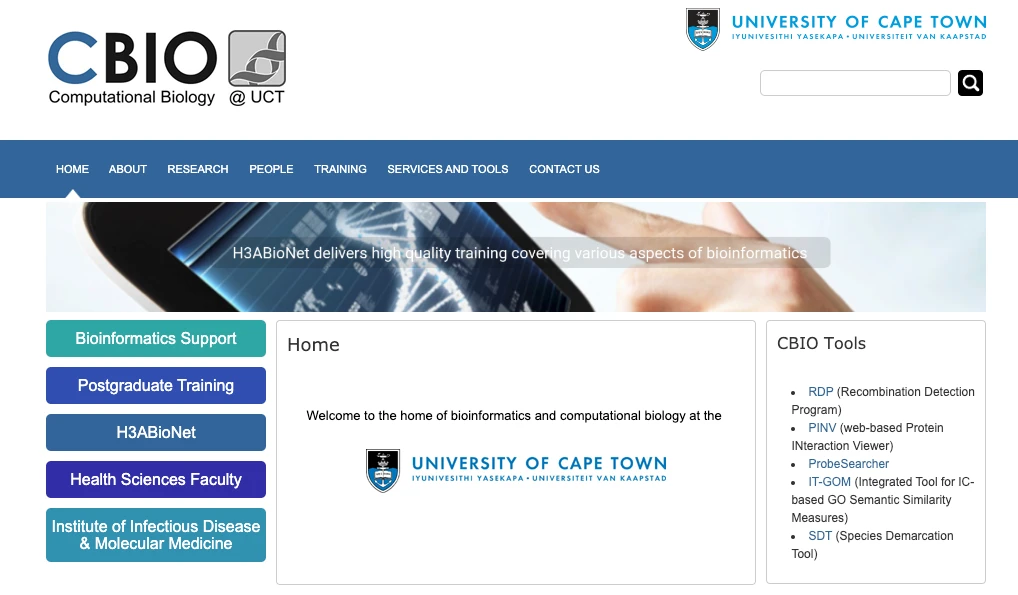
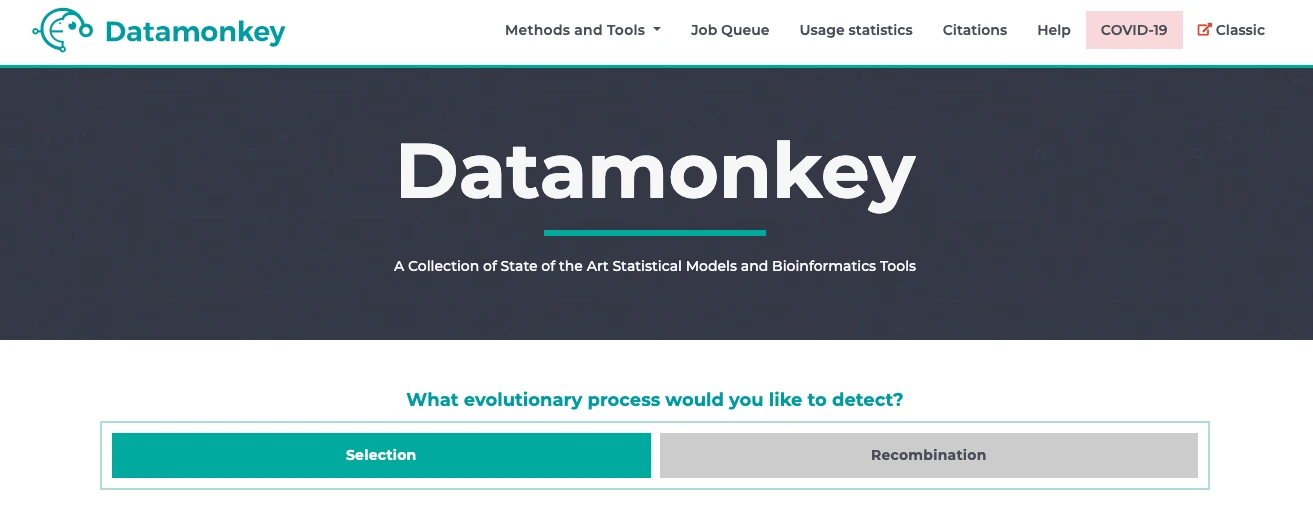
Later, I worked at CBIO, an epidemiology group that styled itself as the ‘home of bioinformatics and computational biology’ at the University of Cape Town. During my time there I worked on a number of projects all of which involved using computers and software to create models to analyse and map out large, hard-to-decipher datasets. It was an exciting time: we worked in a wave of new methods in virology and biology to use web servers, algorithms and machine learning to understand the evolution of viruses. Researchers would come up with new methods and publish research papers but then also build websites, like Data Monkey or HyPhy, where you could run their method on your dataset of genetic information to analyse or model its potential developments.
As I kept working in this field, I eventually got accepted to work with Andrew Rambaut at Edinburgh who is one of the leading figures of this branch. He headed a team who came up with a Java tool called BEAST, which is the method for understanding where any virus comes for or evolves. He is the author of one of the biggest and most important papers on nCOV right now, and his work uses that codebase to understand the origins of many diseases including COVID-19. BEAST is a jaw-dropping tool for understanding ‘evolution’ in all its varied forms: it’s used for all kinds of research, from understanding where a new species of crocodile comes from, or how languages evolve. Not too long ago, it was the main tool used to discover the main hypothesis on the specific origins of HIV.
The internet grew, and HyperionDev moved from labs to websites
The time I spent in computational biology was inspiring, and it stays with me to this day. In fact, when HyperionDev was first launched as an online course, it was specifically tailored to teach Python to people in biology and epidemiology who did not have any coding skills, so that they could build algorithms and models to understand the evolution of viruses.
Of course, programming soon began outgrowing the realm of pure academia: social media exploded onto the scene between 2006 and 2009, opening up a whole world of growth for coding. More people wanted to learn how to create websites, manipulate databases, and create applications — and so while we no longer offer an extremely niche bioinformatics and programming course (as we did until 2014), the last few years have taught us how crucial its core tenets are to understanding – and overcoming – new challenges. After all, the vigorous standards that you’d need to map serious viruses over time are the standards you need to create world-class websites and apps. That’s why our Software Engineering bootcamp still uses all of the core modules and course knowledge from those bioinformatics courses to this day.
Today, HyperionDev offers coding bootcamps in Data Science, Web Development and Software Engineering (all of them now online only for the time being, thanks to COVID-19). I can only hope that somewhere along the way, these bootcamps help someone to see the value and applicability of programming to solving some of the toughest challenges facing us these days. And for those who don’t go the route of bioinformatics, skills in programming are helping people to get jobs that aren’t shut down, even when the nation is.
Riaz Moola is the founder and CEO of HyperionDev.
HyperionDev exists with one goal: to close the global tech skills gap by giving people the skills they need to switch to a fulfilling career in tech. Tech careers remain one of the least-affected jobs a person can have, as the effects of COVID-19 force physical offices to shut down. HyperionDev works to get you a job that can’t be quarantined, through our specialised mentored online coding bootcamps, in Data Science, Software Engineering, and Full Stack Web Development.
You can try out any of these courses and learn the essentials of programming right now, for free, with our free trial. Sign up today.
Student Success Stories
Student Success Story: Michael – from IT Technician to Web Developer
Michael Boonekamp had ambitions to climb his career ladder. However, the saturated jobs market was holding him back. Unfazed, Michael decided to expand his technical skills with a HyperionDev coding bootcamp - and our placements team was quick to step in and help him land his first job as Web Developer.
Thirty-two-year-old Michael Boonekamp worked as an IT Technician, repairing and maintaining computer systems. He liked the work that he did: it was technical, and required him to discover, investigate, and solve problems. However, Michael wanted a career where the demand for his skills was higher than the supply of these skills; he wanted more mobility and he wanted a job that was as financially rewarding as it was personally fulfilling. He didn’t want to just fix the software and hardware his colleagues and clients used, as a normal technician would; he wanted to create the systems they were using, just as a software engineer or web developer would.
I really enjoyed working with computers and I enjoy problem solving. I tried finding work further in the IT technician field but I found it to be very saturated. When I saw an advert for learning Web Development, I dived straight into it.
There is some difference between a programmer, such as a web developer or software engineer, and a technician.The job of an IT technician can be more hands-on and manual, primarily involving the repair, maintenance, installation and testing of computer systems and software, rather than making brand new programs, or fixing bugs in program code. However, the close work with computers this career involved made Michael’s decision to learn about the computer system a natural progression.
He signed up for an online part-time Full Stack Web Developer bootcamp with HyperionDev, hoping to learn how to turn his computer knowledge into full programming capability.
What he didn’t predict was that HyperionDev would help him find his first job as a Junior Web Developer.
From fixing to creating
While Michael wanted a drastic change in his career path, he still had work and personal commitments that he couldn’t sacrifice to take up studying full-time. Thankfully, our part-time and online bootcamps have been made exactly for students like Michael, so they can learn at a pace that fits their lives and livelihood.
I worked full time, so [the bootcamp] worked perfectly.
HyperionDev’s educational structure and one-on-one mentored design helped him to dive straight into solving a whole new set of computer problems. Outside of this tight expert-to-student learning model, Michael was never alone in his efforts, and, via the online student forum, had a rich peer network to work with to solve problems and collaborate with on challenges. Even in the online environment, Michael felt drawn into a community of people who all had similar dreams and ambitions to his.
The peer learning environment was great. There was a sense of commonality and shared visions, and [there were] people who are getting to grips with the same challenges you are. They were all amazing friendly people.
In this accepting and collaborative working space, Michael was able to make quick progress through the phases of his Full Stack Web Developer bootcamp.
At the end of the program, HyperionDev’s dedicated placements support stepped in to do their work. Within just a few months of graduating, Michael was able to find his first job as a web developer.
I now work at VMG Software, as a junior web developer. I have to work on Angular JS and Angular 8 projects. I’ve learnt from HyperionDev how to properly carry out debugging and work with JavaScript. Definitely, without HyperionDev I wouldn’t be where I am today. I would recommend others to join HyperionDev to get your foot into the door.
Getting the skills to go with the job – and vice versa
VMG Software is just one of the many corporate hiring partners that we’ve forged strong ties with to complete our vision of closing the global tech skills gaps.
At HyperionDev, we believe in more than just giving you some coding skills and then saying goodbye. Our mission to help companies find the tech talent they so desperately need is what drives our dedicated career and placements support, which is freely given to all students as soon as they enter Level 3 of their bootcamp. At this level, which is close to their graduation, students get personalised development and career services from a team that is dedicated to connecting students and tech companies. This support includes:
- brushing up students’ LinkedIn profiles and technical resumes,
- helping students refresh their github profile,
- giving students valuable CV advice from experienced recruiters,
- hosting mock job interviews,
- and providing students with introductions to hiring companies.
“The Placements team has one mission: getting our graduates hired,” says Developer Placements Manager Ilze King. “Every day my work focuses on reaching out to potential hiring companies across the country, introducing our graduates’ profiles to organisations, and guiding our graduates through the interview and assessment processes. We know that it isn’t the easiest thing to break into your first developer role right out of school – that’s why we’re there to give you access to an active hiring network, and make sure your CV and portfolio are up to scratch.”
“On behalf of the VMG Exco and development Managers, we wish to thank you for sending us such wonderful interviewees. HyperionDev is the first time we have worked with a placements manager that has met our needs so perfectly. Our appreciation could not be overstated. I am happy to speak to any other company owners / managers about our excellent experience with HyperionDev”
– Alan Green, Managing Director, VMG Software
Are you looking to make a move to a career in tech, where pay, career mobility, and job security are considerably higher than most other fields? Why don’t you sign up for our free trial, which has all the programming basics you’ll need to make whole computer programs or applications, work with large data sets to help business be more profitable, or create beautiful and fully functional websites. You don’t need any prior coding experience whatsoever; and when you finish your bootcamp, we’ll help you land your first programming job.
Contact one of our admissions consultants today to find out how we’ll help you get to the future you’re thinking about.
Student Success Stories
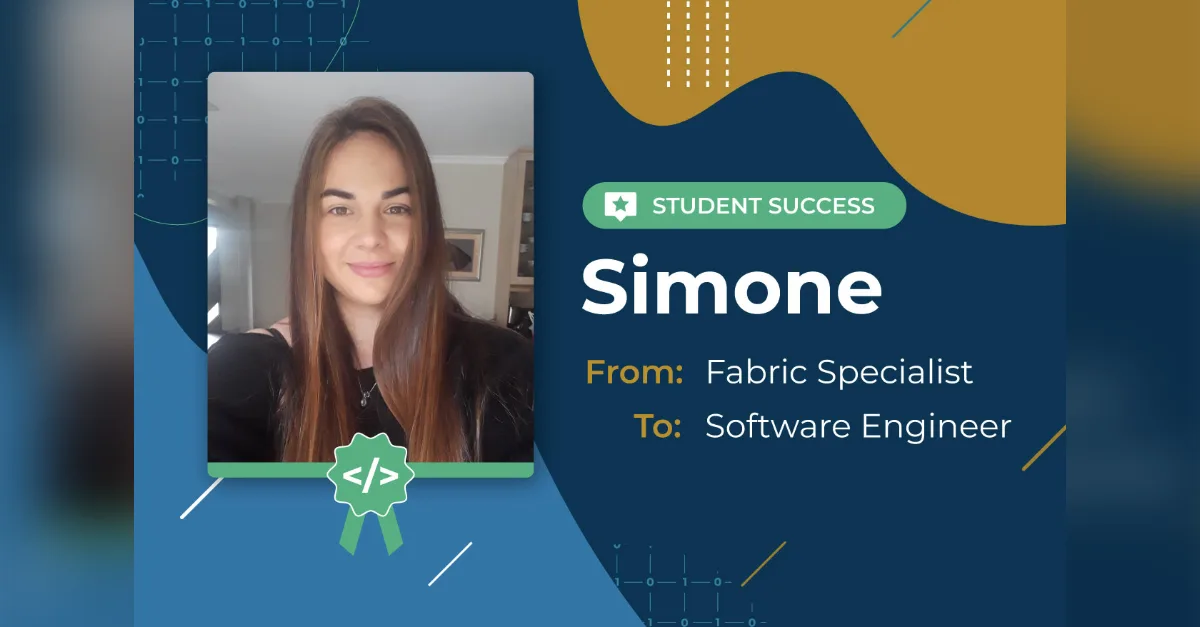
Student Success Story: Simone – from Fabric Specialist to Software Engineer
Simone Groenewald had finally started working in the field she had spent years studying towards: the textile industry. There was just one problem: she wanted more. Looking to grow her career, Simone took a Software Engineer bootcamp. Soon, she found a job as an engineer.
Having spent years studying to work in the Textiles industry, 25-year-old Simone Groenewald had finally started working professionally with fabrics. The work was intensive, and everything she had studied so hard towards, but Simone soon found that the environment was not focused on constant self-improvement and learning. This disappointing lack of creativity and continued education was made more painful due to the long commutes she made each day to get to work. So, looking to develop a strong and modern skill set, Simone joined an online part-time HyperionDev Software Engineer bootcamp.
I worked for Truworths as Trainee Fabric Specialist and before that as a Textile Laboratory manager at a factory as I studied a BSc in Textile Science. As I was working in the city and living quite far out, getting to and from work took a lot of time out of my day.
Simone soon discovered that learning software engineer skills wasn’t just a way to keep her creativity and hireability honed – it was also a path to a drastic career change.
A career change that was much more effortless than anyone could have predicted, Simone was able to find a job before she completed her bootcamp.
Work, learn, code, play – all at your own pace.
While learning the foundations of a brand-new programming language are challenging enough, Simone also needed to make sure she could still fulfil her work obligations and make her daily commute. Thankfully, our part-time and online Software Engineer bootcamp was made for professionals like her – and she was able to work on tasks and complete modules at a pace that didn’t demand her giving up work or fun.
The flexibility of the course made it possible for me to still accomplish my goals. I had to work after work hours and on weekends, and tried to complete tasks between the time I got home (around 19:00) and before I went to bed (around 22:00). Some of the tasks are quite lengthy to tackle and take a few days to complete. I would try and tackle these tasks over weekends when I can sit down and work for longer periods of time and research everything properly.
Our one-on-one mentoring model made sure that whenever Simone got stuck on a particular task, she would get the help and expert insight she needed to make her programs work.
I really enjoyed having my mentor. He was very helpful, supportive and understanding. I really appreciated the fact that my mentor would be understanding and accommodating to my busy schedule and would meet with me later in the evenings. I really enjoy the extra tips that we receive in the notes, the connections we can make through discord and being with us every step of the way.
Passing the test and getting the new tech job
All of Simone’s hard work and time soon paid off, as she found a job as a Software Engineer at TooMuchWifi, even before she had completed the final phase of her bootcamp. Her interview involved several technical tests, which HyperionDev’s specialised and dedicated career and placements support services help all of its students prepare for.
I hadn’t really been looking for a job as I thought that I should first complete my course. I found myself chatting with a developer that works at TooMuchWifi, and he said I should apply. I had to do a telephonic interview and then complete a small assessment task. Once that was done I met with the one of the founders and he proceeded to give me another task in order to help me learn Django, the framework that they use. They were quite pleased with what I submitted and made me an offer a week or so later.
Everything she learned didn’t just help her pass the dev interview tests: it comes in use every day.
The knowledge that I gained whilst doing my study allowed me to gain enough programming logic and self study skills to be able to pass the interview process. The company does use some other frameworks that I didn’t get to cover in my course, but I get to use and apply all the programming foundations and skills that I learnt every day.
And Simone could not be happier at her new software engineer career.
I feel so much more satisfied with my current job as it challenges me every day. It is a lot of learning, hard work, and perseverance but if it something that you really want then there is always a way to make it happen. I would say that if you feel the need to switch careers, go for it!
Are you not getting the challenges and educational development you need to thrive at your workplace? Perhaps it’s time for a change.
The world of computer programming comes with challenges and new things to master every day, as the world increasingly turns to digital technologies and online services. Our coding bootcamps in Full Stack Web Development, Software Engineering and Data Science are your first step to these exciting and rewarding fields, where ability and adaptability go hand-in-hand with fantastic work prospects and improved earnings.
And if your commitments – or other circumstances – make it hard or impossible to dedicate a commute or long hours to learning, our bootcamps can be taken online and part time, so that you learn on your terms.
Student Success Stories
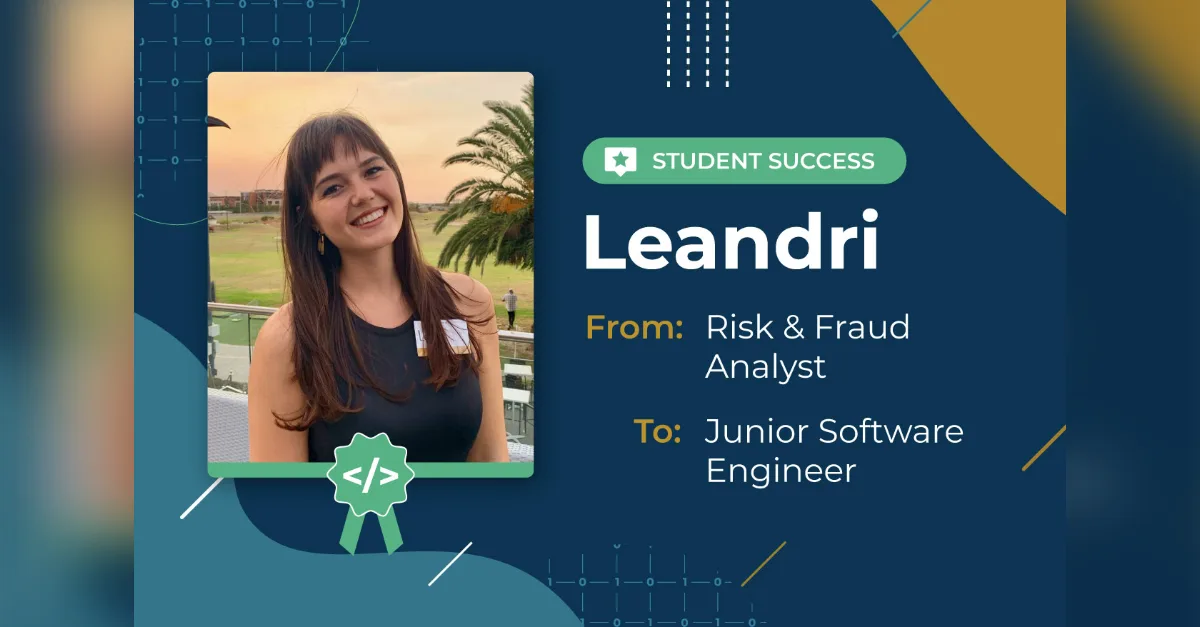
Student Success Story: Leandri – from Risk & Fraud Analyst to Junior Software Engineer
HyperionDev doesn’t just want to give our students the tech skills they need to switch careers - we want them to get those jobs as soon as possible. Our Placements team dedicates its time connecting talented graduates and talent-hungry companies. Leandri Nieuwoudt is our latest placements success.
Since 2012, when we first started our work to close the global tech skills gap, we’ve had hundreds of students come to us because they wanted to make drastic career changes. Some wanted to learn web development or software engineering in order to join an industry that was the cause – and not a casualty – of digital disruption. Others wanted to find better career prospects, and personal and financial freedom. For students like Leandri Nieuwoudt, a 25-year-old who worked in Risk and Fraud Analysis in Cape Town, the reason to become a software engineer was much simpler: she wanted work that would free up her creativity and keep her constantly developing new skills.
I wanted a complete career change. I wanted to be able to be more creative and learn new skills regularly.
Leandri worked in risk assessment after completing her BSc at Stellenbosch University, but soon turned to HyperionDev’s Full Stack Web Developer bootcamp when she felt that her day-to-day was becoming stagnant. Her hope was that a whole new set of skills would allow her to make a more significant contribution to her work as a Risk Analyst.
I wanted to be able to contribute more substantially to the company that I work for.
However, what she got out of her bootcamp instead was a whole new career, as a Junior Software Engineer for Sweepsouth – thanks in part to the HyperionDev placements team.
From Risk to Reward
Making such a drastic career change isn’t easy, but Leandri progressed at a rapid pace thanks to her hard work, and the course and support structures at HyperionDev. HyperionDev’s online and part-time bootcamp allowed her an immersive, hands-on coding education that fit into her busy schedule and allowed her to tackle real-world software engineering problems herself.
I enjoyed the bigger ‘capstone projects’, where you can really be creative with your solutions and work on one project for a longer period of time. You have to get used to being uncomfortable, stuck, and losing confidence every now and then. I was able to get my bootcamp work done whenever I had some off time. Sometimes that meant early mornings and some late nights, but it was worth it. It’s definitely not easy, but it is loads of fun! Luckily I could rely on my mentors for a bit of a boost and some tips to help me get unstuck.
Wherever she encountered a hurdle, her mentors were there to help her come up with solutions that worked and that were constructed to the industry standards you’d find in any tech company.
The code reviewing process was great: it showed me alternative ways of solving challenges, and let me know if I was on the right track. Tav and Nkosi (my mentors) were so helpful and patient with me! I really appreciated their feedback and motivation.
The HyperionDev bootcamp prepared her well for her responsibilities at her new position as software engineer at Sweepsouth.
Along with my team, I am responsible for improving and maintaining the website as well as the app that our company uses. The company uses a number of different technologies, some of which I learned to use in my bootcamp. The bootcamp also taught me how to teach myself, so I’m able to learn new languages and technologies as I go along.
We help you find – and land – your first coding gig
Of course, learning new skills in Software Engineering and Web Development is just one side of the equation – finding a new job is a whole other subject.
That’s where HyperionDev’s specialised placements and career support services stepped in. Thanks to the hiring companies HyperionDev has partnered with in the growing tech industry, Leandri was able to land a job as a Junior Software Engineer soon after her bootcamp.
I was placed via Hyperion Connect. It was great walking into interviews knowing that the company knows exactly what to expect because they were in contact with HyperionDev beforehand. It allowed both myself and the company to manage our expectations.
HyperionDev offers its career and placements support as soon as students enter Level 3 of their bootcamp. At this level, which is close to their graduation, students get personalised development and career services from a team that is dedicated to connecting students and tech companies. This support includes:
- brushing up students’ LinkedIn profiles and technical resumes,
- helping students refresh their github profile,
- giving students valuable CV advice from experienced recruiters,
- hosting mock job interviews,
- and providing students with introductions to hiring companies.
“The Placements team’s dedication to getting our graduates hired is our number one priority,” says Developer Placements Manager Ilze King. “We work around the clock, reaching out to potential hiring companies across the country, introducing our graduates’ profiles to organisations, and guiding our graduates through the interview and assessment processes.”
And Leandri couldn’t be happier at her new job.
I used to work shifts of 6am to 2pm, 2pm to 10pm, or 10pm to 6am (throughout the night. Now however, I’m quite happy to be able to work flexible hours at SweepSouth (so I miss city traffic) and I even get to work from home one day every week! Special thanks to Ilze for the career support after I graduated! She really had my back and I’m really thankful for the work that she and her team does!
Is your job not letting you be as creative or agile as you wish you could be? Or maybe you want to potentially double your salary, and open up career opportunities that could take you overseas? Whatever your dream or plan, our one-on-one mentored coding bootcamps in Software Engineering, Data Science, and Full Stack Web Development will give you the skills to get there – or even bring you more than you’d thought possible.
Register on our website for your free trial and you’ll have access to all the beginner basics to get you started on your coding journey.

Career Advice
The Top Ten Tech Careers in 2020
We look at data on number of job openings, salary and overall job satisfaction ratings to bring you the top ten tech careers in 2020.
All-in-one jobs site, Glassdoor, recently released their Top 50 Best Jobs report, and just as in 2019 and the year before, careers in technology are rising quickly in the global rankings of the hottest, highest-paid, most-in-demand jobs out there.
The Glassdoor report considers three factors for the Top 10 Tech Jobs: the number of job openings in that field, the average salary for that position, and the overall job satisfaction rating reported by those working in that career.
As you’ll see, there’s never been a better time to get a foot in the door of the tech world, and work towards one of these highly lucrative careers. In fact, the top seven best jobs on the list are all tech positions, with the other three jobs in the top ten competing comfortably against highly-paid non-tech positions as diverse as ‘Strategy Manager’, ‘Nurse’ and ‘Business Development Manager’.
Let’s take a look at which tech jobs are coming out tops in 2020.
# 10 Cloud Engineer
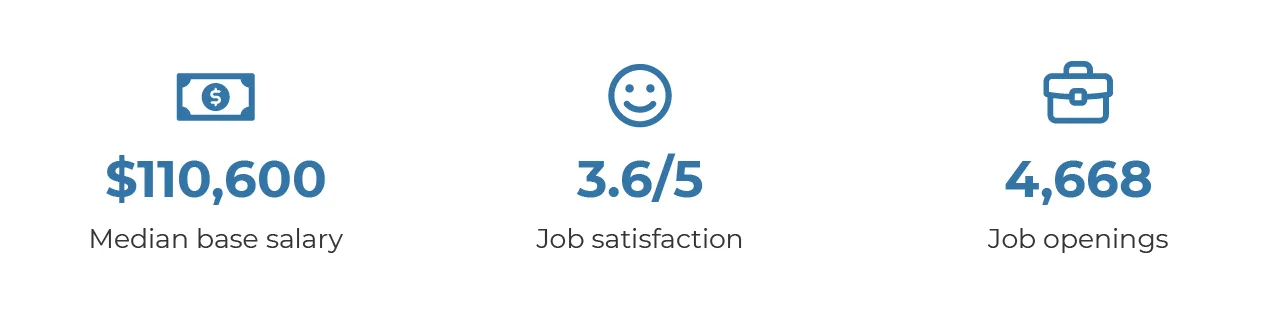
Companies everywhere are digitising their services at an unprecedented rate. However, the move from more traditional form of business operations to online technologies is not simple, and requires an expert who can install, set up, and maintain the machines necessary for these online cloud services. A Cloud Engineer makes this transition as seamless as possible: they deal with the technical aspects of migrating clients and companies onto the cloud, and use their knowledge of scripting, automation, and cloud technologies to make the move to cloud services and cloud-based operations easy-breezy.
# 9 Software Developer
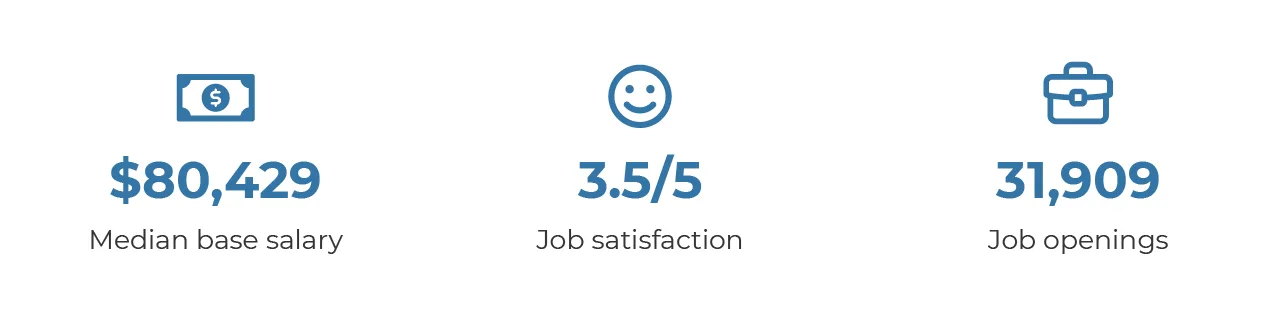
At the number 9 spot, and taking a respectable 32nd best job in 2020, is the title of Software Developer. Software Devs work with a much more focused scope and specific tool set than their software engineer colleagues, and thanks to today’s app- and computer-filled world they enjoy an incredibly high number of job openings. As the 21st-century digital landscape expands, more and more software experts are required to build, maintain, and repair the complex coding creations we use every day. Software developers require a deep knowledge of one or more programming languages, and can work with many different frameworks to both create and maintain applications and programs – responsibilities that net them a very attractive annual salary.
# 8 Systems Engineer
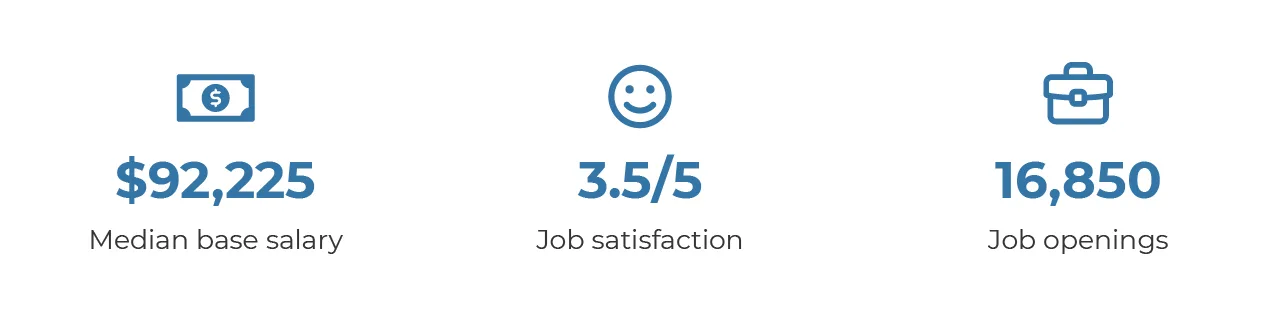
Officially the 27th best job out there, Systems engineers claim the title of 8th best tech job. People in this field work with specialised systems that require specific kinds of software and hardware in sometimes very complex and demanding environments, for example production lines, airports, or control centres. Not only are these positions paid well, but the popularity of other streams of software and hardware specialisation means the niche career positions that systems engineers work in enjoy an increased amount of job security.
# 7 Software Engineer
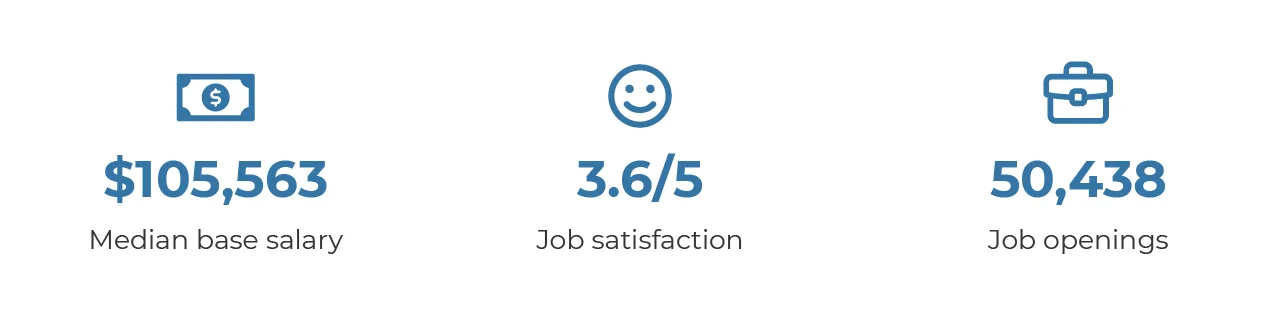
Down a spot from last year’s Glassdoor rankings, the title of Software Engineer is still showing its value. The need for people who can create and maintain the programs we interact with on a daily basis is as clear as ever: simply put, software is everywhere. You can’t help but run into it no matter where you go or what you do. This omnipresence means that Software Engineers are a skilled professional in very high demand.
# 6 Data Engineer
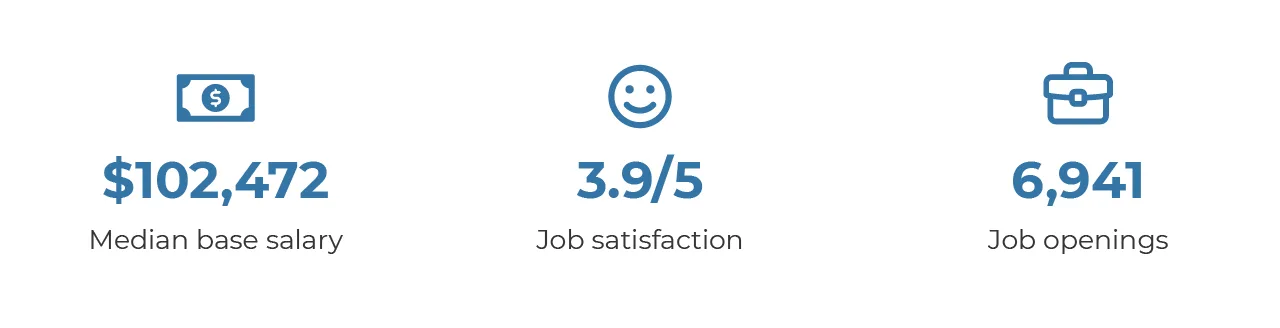
Big Data is a buzzword we’ve all heard a dozen times, but for good reason: right now, thousands of companies across the globe are sitting on mountains of data from years of business that hold the key to better sales, more efficient operations, and considerable spikes in profitability. Data Engineers are the people these businesses rely upon to install and set up the hardware and software they need to start examining and interpreting that data.
Data Engineers need to have a great knowledge of data systems and the integration of both hardware and software into a company’s data needs. They don’t just know how to work with data, but also understand the systems and processes that this large-scale analysis requires, and how to work with these technologies.
# 5 DevOps Engineer
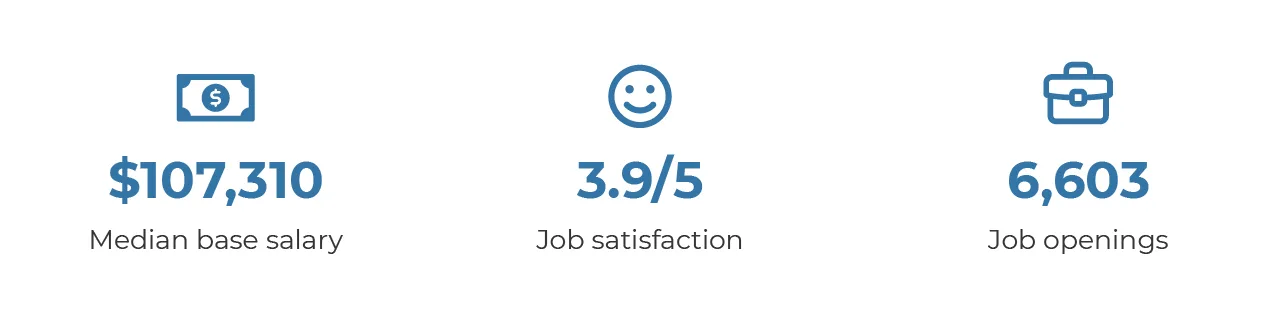
Slipped down, historically strong – has been a top ten contender, being number 2 last year.
Gareth Dwyer, software and operations developer at HyperonDev, explains that a DevOps engineer is ‘a software developer who also knows how to do server configuration and management, and therefore doesn’t rely on a system administrator for operating system, platform and hardware support.’ DevOps straddle deployment and network operations as well as scripting and coding.
# 4 Product Manager
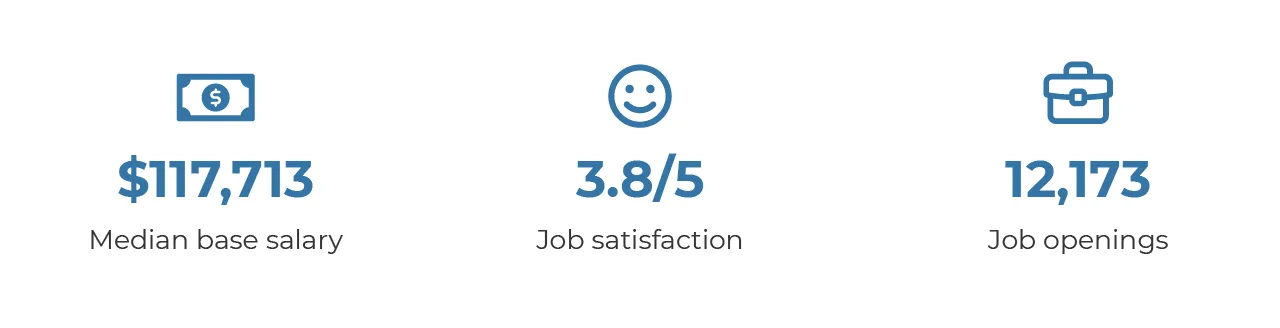
Maintaining its position from last year, the position of Product Manager retains its title as a reliable top-contender in the list of best tech jobs. The strength of this position rests on its multifaceted ability to balance different worlds of business; both the technical side of tech, and the business-facing side of strategising, creating, marketing and selling quality products.
With so many new tech products on the market, companies need a technical, organised and logistics-driven employee who can manage it all. It’s essentially an organisational role that guides the strategy, roadmap and feature definition for either a product line or a product.
# 3 Data Scientist
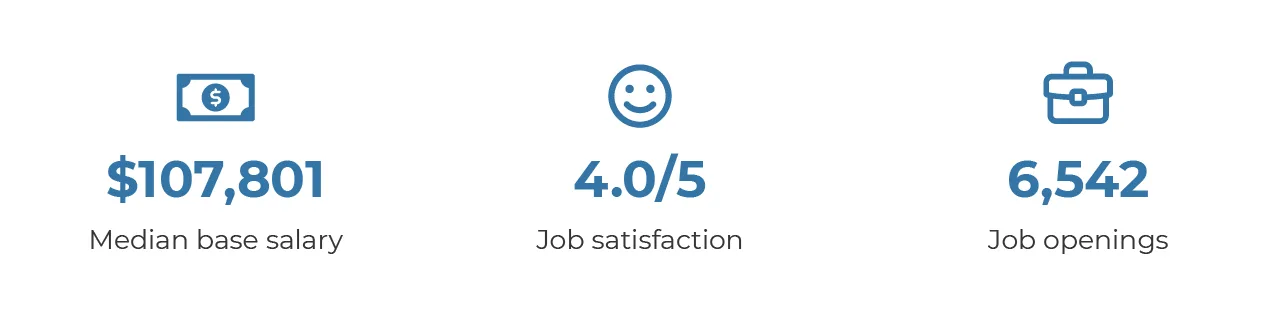
While this has slipped a few places from last year’s best jobs rankings, the allure of large profits hidden in piles of data mean that Data Scientists still sit comfortably in the top three. After all, Data Scientists are the key to unlocking the meaning of that data.
Data Scientists are slightly different to Data Engineers in that they’re the ones who primarily crunch the numbers of the businesses they work with, and have a more hands-on role with analysing and interpreting data than with the hardware itself. One benefit of the job of Data Scientist (just like many other top tech jobs) is that it is at a lower risk for automation. Automation is likely to hit certain jobs hard: bookkeepers, for example, have a 97.6% chance of being automated.
# 2 Java Developer
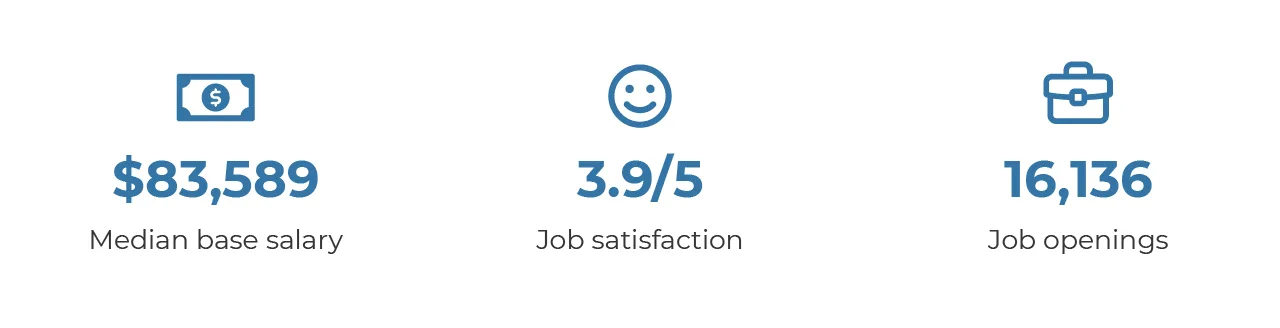
A fast riser, this job title has skyrocketed into the top ten this year, reflecting a growing and hungry market for developers experienced in creating applications in this language. This reflects not only the global rise in demand for experienced java programmers, but also the growing ubiquity of applications and companies using Java for all kinds of legwork and features. As the Stack Overflow 2019 Developer survey states, Java has been the most popular programming language in the world for the past seven years in a row, in a trend that is likely to continue.
# 1 Front End Engineer
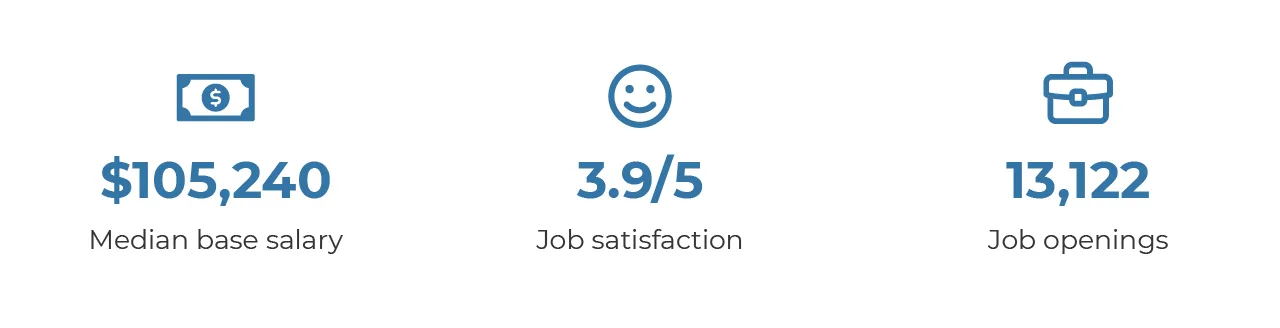
Up an eye-opening 4 places from its number 5 place last year, Front End Engineer has claimed the #1 spot for best tech job. And it’s easy to see why: their role is crucial to the constant and reliable operation of probably every website you use.
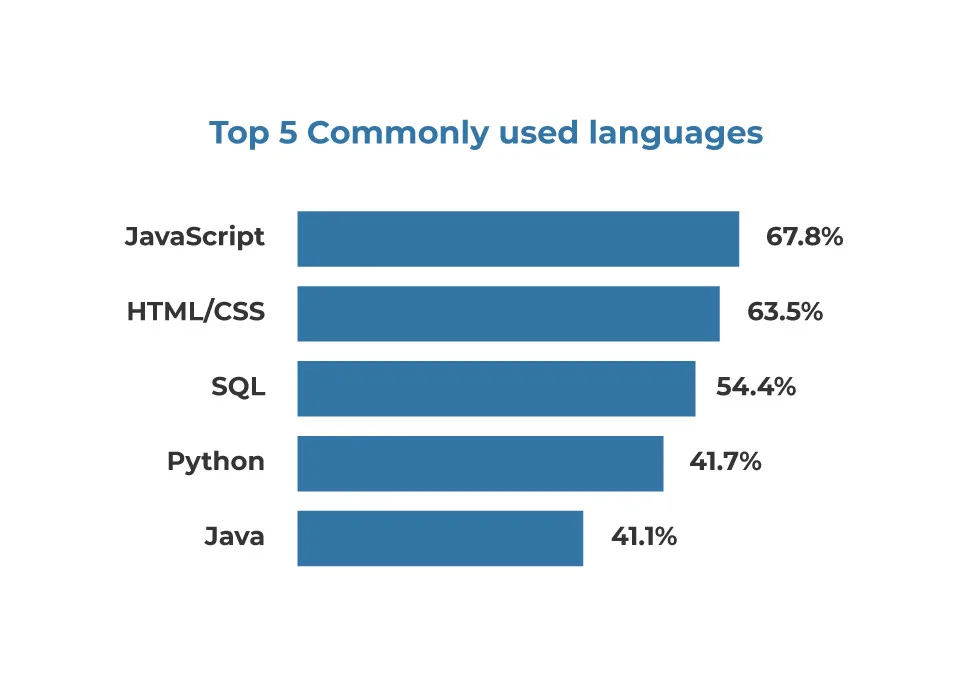
At its most basic, front-end engineers tend to write code that runs on a user’s browser, which translates into knowing HTML, CSS, JavaScript and various APIs. HTML, CSS and JavaScript are frequently used in the developer world. Check out this graph, which shows commonly used programming languages, from the 2019 Stack Overflow Developer Survey.
Are you looking to get into a job in tech, which offers more work options, greater pay, more freedom, and the ability to travel and work remotely from wherever you have an internet connection?
You can take your first step today by seeing if this future is right for you by taking our free trial. It has all the basics you need to get started on your coding journey, free of charge.
It’s our mission to close the global tech skills gap by offering high-quality, specialised, and intensive bootcamps in web development, data science, and software engineering. Our mentor-led model gets your code from HelloWorld() to hello new job under the support and guidance of your own experienced coding mentor.
And once you graduate, the programming world is your oyster, with our career support and placements services helping you not just hone your CV, code portfolio and interview skills, but give you preferential access to our list of corporate partners who are looking for fresh coding talent.
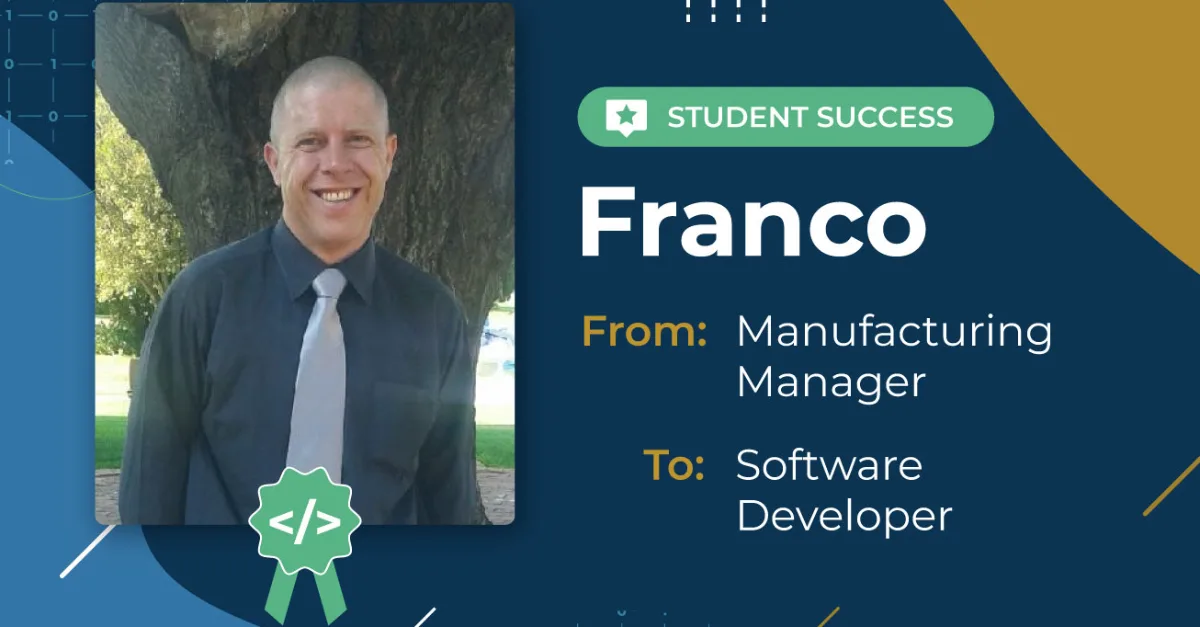
Student Success Stories
Student Success Story: Franco – from Manufacturing Manager to Software Developer
Loadshedding is back. Economic growth isn’t promising. Manufacturing and other important indexes are down. So what do you do if every morning you wake up wondering if you’ll still have a job by Christmas? You can worry - or you can take control of your future and career, just like Franco did.
The economy isn’t in the greatest place right now. Growth is poor, unemployment is rising even from its 11-year high of 29.1%, and the manufacturing index is down by 6.4 points – a drop that has only worsened from its lows since June last year. All this uncertainty is what led Franco Groenewald, a 41-year-old from Pretoria who worked as a manager at a manufacturing company, to ensure that his future and career had flexibility through learning Software Developer skills.
For Franco, the path to a more certain future lay in computer programming, and a HyperionDev Software Engineer bootcamp.
“I used to be a manufacturing manager, but I knew I wanted to change careers from manufacturing to coding. Now, I am a web app developer. The bootcamp gave me the basic skills I needed to be able to land a junior position as a software developer.”
Work. Play. Code.
Franco signed up for an online bootcamp, which he completed part-time so that he could balance his upskilling with his need to earn a living. This flexible program fit into his lifestyle very well, allowing him to garner a wide range of crucial skills in Java and other frameworks at a pace that suited his needs.
“I had more than enough time to be able to do my bootcamp and work. The bootcamp was really good, and the code reviewing process was great because it showed me alternative ways of solving programming challenges, and helped me to know I was on the right track to the correct solution.”
This combination of hard work, and the right kind of skills helped Franco to land his first job as a Junior Software Developer at Software Worx, a software development firm that creates all kinds of programs for clients across the world. His current responsibilities include web application development, a role that relies on the Java skill set he practiced at his HyperionDev bootcamp.
There simply isn’t a better time than right now to start learning the fundamentals that could land you a job with more mobility, pay, and freedom of choice. What’s more, the tech industry isn’t plagued by doom and gloom, with lots of opportunity for growth: a report by IT market research firm Intrado found that over 13,000 IT companies and over 3,000 electronics companies operate in South Africa. This, in an industry that is among the fastest growing in the world, and an even larger contributor to South Africa’s GDP than agriculture.
And that’s just at home: in the US, seven of the Top Ten best careers are tech-related. Long story short, getting skills in technology and computer programming is a surefire way to secure your work possibilities no matter where you are.
So what’s Franco’s advice for those who are thinking about making the switch to a new career like he did becoming a software developer?
“See if you enjoy it. Do as much of the course as possible and work hard.”
You can try the bootcamps for yourself with our free trials, which give you a solid foundation to understanding the key tenets and beginner need-to-knows of Full Stack Web Development, Data Science, or Software Engineering. This free trial has everything you need to get started in coding – or even start making your own basic programs and games.
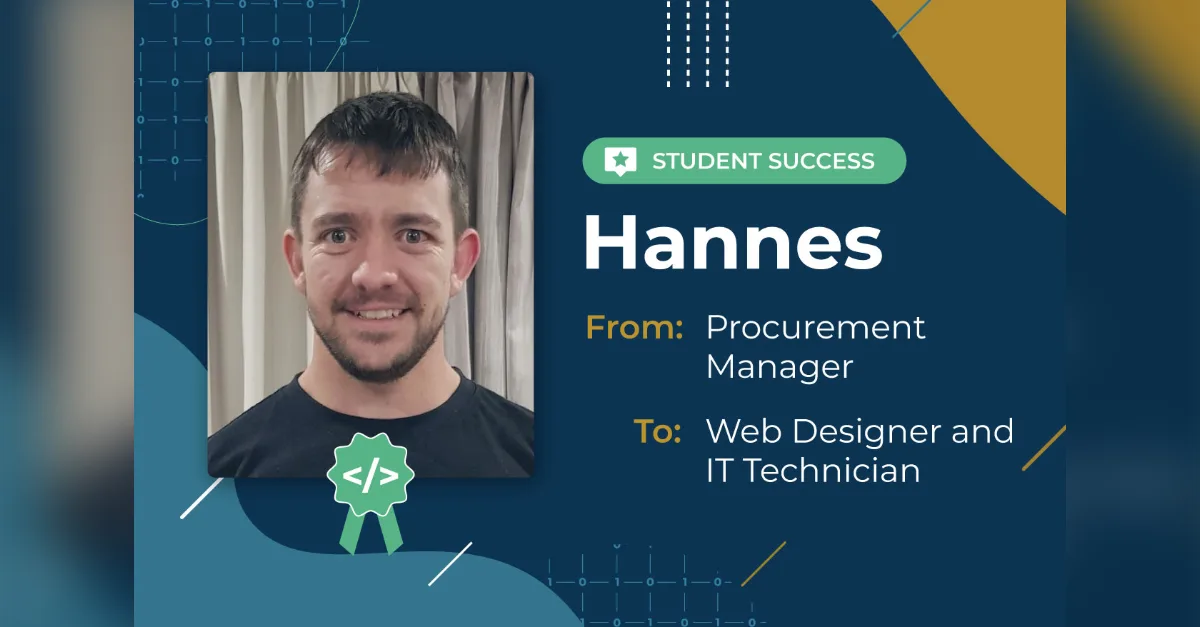
Student Success Stories
Hannes – From Procurement Manager to Web Designer and IT Technician
Career growth is the most crucial element for a comfortable lifestyle. But what happens when your future prospects don’t seem as dazzling as they once were? For Software Engineer bootcamp graduate Johannes Grobbelaar, the answer was clear: get the skills that expand your prospects.
Many of us have jobs that we’re comfortable with. Jobs that are good – for right now. If you’re planning for tomorrow, however, you’d probably want your career to grow at a constant rate, and go to work at a place that is providing for your financial and personal fulfillment needs. When Hannes Grobbelaar realised that his Right Now wasn’t right for his Tomorrows, he made a choice that more and more career professionals are making: start the switch to a new career in technology, digital services, or programming. And this switch started with an online, part-time Software Engineer Bootcamp at HyperionDev.
I used to work as a Procurement Manager. I thought the company’s growth prospects were poor. I wanted to earn a better salary. I wanted to work remotely, and be able to work from wherever I want.
The intensive focus of the course let him add to his available career options, and develop new skills that enriched his procurement background and opened up new work opportunities that require a digital touch.
As Hannes showed, making the jump to a new career requires two things: hard work, and good support. HyperionDev’s mentor-led model was there to help him constantly improve his code, which was being developed for realistic industry needs and applications.
It was a lot of hard work, dedication, and sacrifice. But there are 24 hours in a day, you can work 18 hours and sleep the other 6 hours. So fitting in the studies was no problem. But if it wasn’t for the certificate on my name and the 6-month practical course, I wouldn’t have landed this job.
And his mentor Nkosi was there every step of the way.
The code reviewing process was very supportive, and it was an absolute pleasure working with him. I had challenges with Java, but I worked harder and studied more.
And the results speak for themselves: Hannes has already started his new position as a Web Designer and IT Technician and developer, working more and more with automated systems.
Making the move to take up a whole new career path can be scary, but it’s one that Hannes recommends.
Do it!!! Never quit, because the light on the other side is worth seeing!!!
Are you ready to move from your Okay Right Now to your Best Tomorrow? You can take the first step by taking your very own free trial bootcamp. It has the basics you need to take your first step into understanding the basics of code, totally free of charge.
Our bootcamps in Software Engineering, Data Science, and Full Stack Web Development use an intensive mentor-led and hands-on approach to make sure that everything you code – from your first HelloWorld to your first working application – isn’t just up to industry standard, but something you’d be expected to make at your new tech job in the real world of work.
You can find out more about our courses by visiting our courses page.

Career Advice
How to stand out during the recruiting process
The demand for developers and skilled programmers is growing every day, but this means competition as well as opportunity. So how can you stand out from the crowd of applicants in your search for developer jobs?
Guest blog contributed by Darshan Somashekar
Darshan Somashekar is a guest contributor, startup entrepreneur, and expert in hiring processes. He brings his expertise in finding the right person for the job, and for the company’s future, to the complex world of ensuring that both students and educators are doing the right thing to ensure that finding a developer job is as easy as their first line of code. When it comes to what starter techies can do to stand out from the crowd, Darshan has the insider’s secrets.
As the tech co-founder of numerous startups, including my newest one, Solitaired, I’ve directly or indirectly hired over a hundred engineers. I’ve worked with external recruiters, internal recruiting teams, and worn the recruiting hat myself. I’ve had a lot of experience interviewing engineering candidates, many whom came straight from dev bootcamps.
Many people think coming out of a bootcamp automatically tags you as an entry level engineer, but my experience is different. I’ve found that bootcamp hires can provide unique perspectives that can benefit a team beyond strictly the core engineering skill set they bring.
If you’re coming from a bootcamp, here are some suggestions to stand out during the recruitment process as you find your new programming job or developer job.
Technical communication skills: Most recruiting processes for developer jobs these days include a coding assignment. If you pass the assignment and move onto the onsite interview, you’re likely going to be asked about the code you wrote. A big determinant in landing your next programming job is how you communicate about your code. More specifically, you need to be able to explain the following:
- The high level architecture of your code: you need to be able to visually diagram how your code works.
- Why you chose this approach you took: as you code, note down different ways you could have done something and why you chose this way. What matters here isn’t the choice itself, but the reason why.
- How you would extend your code: You’re going to be asked, “hey if we need to change X aspect, or add Y feature, how would we do that?” Make sure your code is broken down in a modular enough way where you can isolate specific actions and describe how you’d swap them out.
Tip: Prior to going to an onsite interview for your developer or programmer job, you may want to do a mock interview with a friend who can help you flesh out these areas.
Preparedness: Know about the company you’re interviewing at. Coming from a bootcamp, you may not have years of technical expertise that you can rely on to help you in the interview process. However, you can still shine in a different way. Bring up a company’s mission or its product portfolio. Ask about the company’s direction. Have some good, specific questions that show your interest.
Domain expertise: One of the advantages that you may have over other applicants for the developer job you’re applying to is your background before the bootcamp. For example, one of my companies, Imagine Easy, helped students with their bibliography citations. We sometimes came across candidates that had Library Science degrees – this immediately improved their chances since we knew the candidate would immediately understand the pain points our products solved. Be sure to update your resume to highlight any relevant background you may have regarding the company.
Community: Another unique benefit you might have as a bootcamp graduate is the alumni network and community that comes along with many bootcamps. By participating in events, doing speaking engagements, and knowing the main organizers of a bootcamp, you can offer companies a unique recruiting channel that they may not have access to otherwise. And if they do, being active in the community will still help you by improving your chances at future opportunities for developer jobs.
Personally, I’ve found that the hires we’ve made from bootcamps perform exceedingly well on our teams, and round out our teams in ways we didn’t expect. In my new role, as co-founder of casual gaming platform Solitaired, I hope to continue to leverage the power of bootcamps like HyperionDev to our recruiting process.
—
At HyperionDev, we don’t just specialise in teaching people software engineering, data science, and full stack web development so that they can upgrade their salaries, mobility, and career prospects in programming jobs – we work to bridge the global tech skills gap, at all levels.
Our placements service helps to develop our students portfolios, CVs, and interview skills, so that new programmers can fill the growing holes in the rapidly expanding tech market; while our revamped HyperionDev Connect platforms help companies to fill their coding and tech vacancies with programmers who know what they’re doing.
If you want to find out if the tech space is for you, why not take our free trial? It has everything you need to get started on the road to hearing “you’re hired” at your new tech career.

Career Advice
Why programming is your ticket to a bright future, regardless of your geo-location
Whether you’re a stalwart #ImStaying fan or already applying for your visa, there are many, many reasons why programming is your best bet at a new life, either in SA or abroad.
When talking about learning programming and the lucrative career opportunities this ever-growing industry offers, it’s inevitable that the conversation turns to the world of work abroad. Right now, many South Africans want options, especially for chances to work overseas from South Africa. Despite whatever conversation there is over the negativity in South Africa, one truth still stands strong: skills in programming and computer science are an unrivalled path into a career that is highly mobile and incredibly rewarding.
So, whether you’re in the #ImStaying crowd, or already applying for your visa, there’s plenty of reasons to consider programming as the pivotal part of a better tomorrow.
Emigrating from South Africa to the UK
This is the primary go-to location for South Africans looking to work overseas from South Africa or to emigrate. An often overlooked piece of news that comes out of the UK at the start of the new year is the wholesale update to existing policy documents – one of which is the piece of paper which is central to the whole question of emigrating to the UK. This is the Shortage Occupation List, a comprehensive and codified document that outlines all occupations that are in high demand in the UK – and since the prospects of Brexit first broke four years ago this is a document that has only increased in length, with developer and IT-related specialist fields now including ‘All jobs in this occupation code’. That means that, no matter which language or framework you specialise in, there’s a good chance of a bright future in Britain.
UK developer jobs are among the most highly paid positions in the world, with an average salary of £30,915 a month, with other sources stating that a UK-based developer can take home 145% more money than other jobs. The closer you get to the central IT hub of the English economy, London, the more you earn: London-based programmers can make nearly 30% more than they would anywhere else in the country.
There’s a lot of opportunity on the shores of Great Britain: opportunity that has even been seized by past students of ours who started in careers totally unrelated to programming, such as teaching. What’s to say you can’t do the same?
Emigrating from South Africa to the United States
Despite the projected downturn in growth for local developers in the US market, developers and programmers take home an eye-watering figure. Even with the size of the US and the variance of pay and work demand from state to state, developers coding in America can take home anywhere between $63,000 and $81,000 a month on average, with government estimates for median pay slated at $84,000 (that means you’re more than likely to earn closer to the high end of the averages than the low end). What’s more, the overwhelming majority of highest-paying states for dev jobs in the US have all enjoyed significant salary growth in the past year, especially when compared to all other occupations.
Of course, these bright prospects are somewhat dulled by the convoluted US visa system, with its multiple tiers and codes each with their own work and/or work exchange programs. If you’re thinking about taking your career to the land of the free, your best bet is to first familiarise yourself with the long list of visas, and whether or not your field of tech expertise falls into eligible categories.
Emigrating from South Africa to New Zealand
Given the global interest of other first-world nations to be the world leaders in all things programming, New Zealand has similarly expanded its interests in snapping up talented developers and programmers. While its own lists of shortage occupations and critical skills are growing, the New Zealand government has been quick to announce that its doors are open, with determined efforts to turn its homeland into “a breeding ground for innovation [that] competes successfully on the world stage” – and their industry reflects this attitude, with a positive sector growth of 12% in the last year alone.
Salaries in New Zealand stand at around NZ$76,000 a year, and with three years’ experience in a programming field prospective or emigrating jobseekers can get quick access to the country on a Skilled Migrant Category visa for a whole range of IT and development-related positions, including web development, software engineering, systems analysis, or even software testing!
Emigrating from South Africa to Australia
Finally, there’s Australia, where developer salaries can start at AU$68,830 according to Payscale – a figure that seems somewhat conservative, given Glassdoor’s stated salary average for web developers to be closer to AU$124,000 a year.
Just like its neighbour to the North and its tech rivals to the east and west, Australia wants to be at the forefront of the digital frontier, and is hungry for talent. It’s list of skilled occupations – which qualify for work visas – has similarly expanded to include a wider range of programming and development jobs than previous years.
Growing opportunities right here in South Africa
Whatever you read in the papers about SA or our economic situation, there’s one simple truth: it pays to know how to code. Payscale reports that the average salary for a software developer in South Africa is R307,734 per year, with our own Graduate Outcomes Report from 2018 showing that on average our grads were able to double their salaries with a change in career to tech. Plus, there isn’t a huge disparity in developer salaries between our two largest metropoles, with the earning capacity of developer jobs in both Cape Town and Joburg showing that the industry’s slow expansion is pushing even junior positions into higher earning brackets in comparison to previous years.
And if things improve with loadshedding, the economy, and life in SA, the devs looking to work overseas from South Africa will find themselves in a position to snap up the lion’s share of work flooding in (digitally) from abroad. With the US Bureau of Labor Statistics predicting a decline of over 7% in industry growth for US-based programmers as American companies look overseas for cheaper coding labour, there’s a wave of opportunity heading for locally-based programmers who have the skills to deliver high-quality code to overseas digital giants. Even if things don’t turn around in SA, these developers’ new proficiency in high-demand programming languages means they are well equipped to make a better informed decision about their work future overseas, as more foreign territories expand their lists of IT-related critical skills for priority work placements.
A world of opportunity, no matter where you are
Regardless of your decision to explore greener pastures overseas, or set yourself up to take advantage of growth opportunities in SA, there’s no doubt that learning to code is probably the best decision you can make. The earning potential, the freedom to work remotely, and the career mobility that allows you to work overseas from South Africa across the world are simply unrivalled by any other career out there.
If you’re looking to get the skills that rank at the tops of nearly all the world’s government’s critical skills lists, why not look at our Web Developer, Software Engineer and Data Science bootcamps? They’re specially designed to teach industry-grade skills that get you hired, even if you’ve never read a line of code in your life. Our expert mentors guide you through an intensive program that teaches you practical skills for real-life development problems, and nurture your coding skills to go from Hello World to Hello… wherever you decide to work one day. Best of all, these bootcamps fit into your busy life and schedule, and can be completed online or on-site, full time or part time.
Click here to speak to one of our expert consultants who can find out which programming career is your best fit, or register for your free trial to learn the basics to get you started on your path, with no commitment.

Web Development
2020 US Web Developer Salaries
Find out about the highest-paying Web Developer jobs in the US in 2020, and what cities are best for US web developer salaries 2020.
Before switching careers, you want to be 100% sure your new career will offer you everything you want. That could well include a better take-home salary. If you’re thinking of becoming a web developer, then the good news is that salaries are looking pretty good in the US in 2020. Before taking a closer look at 2020 US Web Developer salaries, here’s a quick reminder of common web developer tasks. These include the following:
- Test and document software for web sites.
- Work with designers and people who produce content.
- Write, modify, and debug software for web sites.
- Write code to generate web pages, access databases and business logic servers.
2020 US Web Developer Salaries
In the US, according to Indeed, web developers can expect to make an average annual salary of $76,271 (this estimate is based on 3,792 anonymously-submitted salaries to the site).
Of course experience is going to play a large part in determining the size of your salary, but the range is generally between $35,000 and $89,000. Here’s how it pans out. Entry-level web developers (less than 5 years experience), according to PayScale, can expect an average annual salary of $50,137. Those with mid-career experience (5-10 years) will receive an average compensation of $56,374, whereas an experienced web developer (10-20 years of experience) could pull down $70,258 per annum. And if you have more than 20 years experience, your salary should be in the region of $76,396.
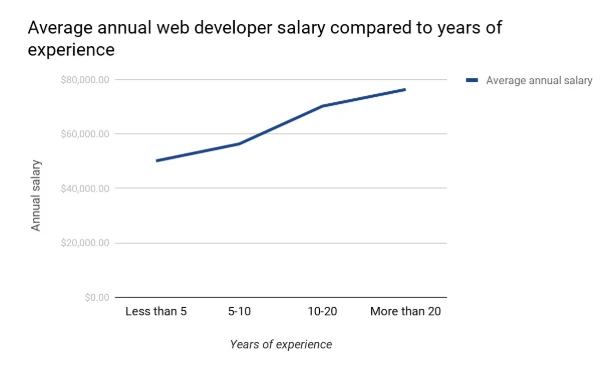
Glassdoor, which conducts millions of anonymous salary reports, released their US Web Developer salaries updated 2020 figures. Web developers’ average pay amount was $68,524. More impressive was the salary range, which shows that time and experience add up to significant growth in your earning potential: growing from around $44,000 on the lowest end, up to $111,000 in the highest earning brackets. According to Payscale, programmers in their mid-career stage have seen an 11% increase in their earning potential since last year, with late-career web development specialist salaries skyrocketing at a 29% increase on 2019’s pay figures.
2020 US Web Developer Salaries: Highest-Paying Companies
Unsurprisingly, the highest-paying companies in the US for web developers include the following:
- Amazon ($96,000)
- Wells Fargo Bank ($92,000)
- Velir ($84,000)
2020 US Web Developer Salaries: Top Cities
According to Zippia, the best paying cities for web developers are the metropolitan areas of Framingham, Massachusetts; Seattle, Washington; and San Francisco, California. The top five places to look for a high-paying web developer job in the states haven’t changed much since our report last year, with the 2019 Top Cities merely exchanging places on the rankings.
- San Jose, California: $107,500
- San Francisco, California: $97,400
- Framingham, Massachusetts: $95,350
- Seattle, Washington: $91,740
- Austin, Texas: $76,580
Also, interestingly, web development ranked 3rd in US New & World Report’s Top 10 Tech Jobs in the US. It also ranked 23rd in the Top 100 Best Jobs in the U.S. News & World Report’s 2020 job rankings table. Guess which job came out on top of both lists, essentially taking the title of best job in the world? Software Engineering.
In summary, if you’re looking for a lucrative career change this year, web development is definitely worth thinking about. It’s also a career that is globally in demand, judging by this US Web Developer salaries 2020 analysis. HyperionDev offers a 6-month part-time Online Bootcamp in Full Stack Web Development. Book a free trial now.
Editor’s note: This was post was originally published on 9 February 2018 and has been updated on 14 January 2020.
Tutorials
[Tutorial] Build Your Own Python Game – Try HyperionDev Free
You don’t need years of previous experience coding to get the basics and start making your very own code. Our Free Trial gives you what you need to get started on the journey to become a professional programmer - and it certainly gives you enough info to make your very own short game.
Free trials have a bad rap. Often, the interesting and useful aspects of a product are hidden behind a paywall, with free content being merely surface level nonsense that’s aimed at luring you into paying a fee to get the information that’s actually of value.
That’s why our free trial is designed to get you started with useful basics and key beginner’s insights, so that you can get what you need to start your journey to becoming a fully-fledged professional programmer. It gives you a beginner’s guide to programming language essentials that let you get a feel for coding and prepare you for our intensive bootcamps which give you job-ready skills in three to six months.
However, a big question that we get a lot is, “is the HyperionDev free trial actually useful?”
The answer (from a copywriter with no professional experience in coding): yes!
Using just the information made available in the introductory lessons in the Software Engineer Bootcamp free trial, including introductions to variables, such as integers and boolean, and conventions that deal with turning numbers into printable strings, I was able to make a simple game for me and my office colleagues to play and compete in. It’s a very short piece of work, requiring only 40 lines of code to work properly.
The game is as simple as it is catchy, and you’ve probably played it in a junior school playground: try to guess if an unknown number the other player (here, the computer) makes is higher or lower than the last one it told you.
I chose Python because of its ease of use and its wide popularity, among other reasons. I also want to learn a language that allows me the freedom to do many different things from one platform, which Python allows as well. It’s an all-round strong programming language that’s perfectly suited to beginners and advanced coders alike.
Want to see how you can make it for yourself? A full version of the game code can be seen here, but we’ll also walk you through the process of understanding how the game itself was crafted line by line, so that you can make the game yourself and see how it works.
How to make the game
We’ll be making all our code in Repl.it. This is an online coding platform that allows you to code in multiple languages without installing a development kit onto your computer, or even without needing a registered account. Plus it’s also the embedded tool we use in all our free trial tasks.
You can follow along and paste or write the code yourself into your repl coding window.
First, the game will need to generate random numbers, print in colour for win/loss messages, and exit the game when we lose and don’t want to play again. Also, when you use a print command, it will print everything at once, so a short pause between print messages will give the player time to read.
Imagine you want to write a short letter on a piece of paper with a blue pen. It saves you time and effort to just get a blue pen from your storage room, rather than bring all your paints, oils, hammers, and the kitchen sink. Python can do a lot, efficiently and quickly, by doing only what you need it to, rather than load every single library/package in existence. So to do all the things mentioned above, we’ll need to import certain packages:
Now let’s make the actual game. We start by telling the player what the game is about and how to play. They play by entering their guess, “up” or “u” and “down” or “d” (we want it to be simple to play). Instinctively, you’d want to use the “up” and “down” arrows of your keyboard, but that kind of functionality (namely, a key listener) is of an intermediate level that you’d be able to learn during your HyperionDev bootcamp.
In this game, the computer will generate a random number and tell us what it is. It will then generate a second random number without showing it, and we have to guess whether this number is higher “up” or lower “down” than the first number.
If you guess correctly, the computer will tell you you were right, print what the number was, and keep score of your number of correct guesses in a row. It will then come up with another random number. Again, you have to guess whether this is higher or lower than the last number you guessed. Repeat this until the user guesses incorrectly.
If you lose the game, the computer tells you, ends the game, and then asks if you want to play again (after all, it’s irritating to have to re-run the game every time you lose!).
To run this game we will have a loop that runs while you’re still playing the game: ie, while playing is ‘true’, the game will run. In programming, a loop is a sequence of commands or actions that is continually repeated until a certain condition is met. Without a loop, we would have to write out the code dozens of times so that the code runs again each time the user wins; but with a loop, we can write the code once and use it repeatedly until the user loses. ‘True’ and ‘false’ values mean that we’re using a boolean, a variable type that can only have these two values. We can change this ‘true’ to ‘false’ later on to quit the game.
Inside that loop, we’ll have a loop that dictates the game mechanism itself.
This second loop uses a different method (which I used to practice different ways of running loops): you set a value and run the loop while that value is higher than a certain amount. If you lose, that value is decreased, which breaks the loop.
This is also the first time we’re playing the game, so we need to generate a random number between 0 and 1000 for the game, using the random number generator we imported in the opening lines of this program.
First of all we need the user to know what the first number the computer guessed is, so they can think about whether the new random number is probably higher or lower. As the HyperionDev Free Trial teaches you, you can’t just print a value that’s a number, you first have to turn it into a string, which we do with the str() function.
The computer now makes a second, secret number, which we’ll call “guessvalue” (it’s good to call things specific names – if you use generic names like “number1” and “number2” it can be really difficult for later programs that use hundreds of numbers!).
Now we ask the user to type in their guess as to whether the secret number is higher or lower than the starting number. Remember to leave a space after the end of your sentence in quotation marks, so that the user can read what they’re typing.
Let’s check what their guess was. We’ll also include single-character answers like “u” and “d” to make the game quicker to play. The program checks which required answer the user enters, and then creates a ‘true’ or ‘false’ boolean depending on what answer you entered. If you enter “u”, and the secret number is higher than the starting number, then ‘check’ will be true. It will do the same for if you enter “d”, and the number is lower than the starting value.
We want to make sure the game doesn’t crash if they don’t enter intended words. So here, if you don’t enter the exact game commands, it does nothing but start this loop again, keeping your current score and maintaining the last secret number (so you can still guess).
It needs to check if you’re right or wrong using the ‘true’ or ‘false’ we created for the “is this number higher than the starting number” IF statement we created. This is the meat of the game’s code.
We’re using a true/false value (a boolean) to check if you’re right. If you are correct (namely, if you guess “up”, and the secret number is higher than the starting value, or the opposite for “down”) the computer will add one to your score, tell you the secret number and make this the new starting point. The loop will then run again, coming up with another secret number that you have to guess is higher or lower than the last secret number. (Bonus – We’re also going to use our imported ‘color’ package to change the colour of the text so that you can make win messages green and lose messages red.)
If you’re not right, then it’s gonna reduce the value we’re using to run our while loop that makes this game run. When this value decreases, the loop breaks, ending the game.
If you’re wrong, end the game and tell the person what the computer’s value was.
Finally, we’ll end the game (if you lose, this is where you’ll end up) by asking the person if they want to play again. If they say no, the boolean-based loop we’re using for the game will break, and we’ll exit the game.
Congrats, you now have a beginner-level game that uses a wide range of fundamental coding concepts! It’s harder than you think (the beauty of random numbers) – try to get to ten correct guesses in a row!
Full copy of code:
Go from beginner coder, to job-ready in six months or less
This code is beginner-level and isn’t fully optimised. However, that’s where our mentor-led bootcamp design comes in: some parts of this program were improved with hints and tips by HyperionDev’s mentors (the original version would have to be restarted every time you lost!). With a free trial and our mentor-guided support, you’d be able to create code that’s much cleaner than this: code that is industry-ready and up to the highest conventional coding standards.
If you’re curious about code, you can try it out yourself with one of our free trials, where you can get the basics and try your hand at a few practical code exercises – no previous experience necessary! HyperionDev offers online bootcamps in Full Stack Web Development, Data Science or Software Engineering. If online learning is not your thing, you could join a face-to-face Web Developer or Software Engineering course in Cape Town or Johannesburg. Start your new career in tech today.
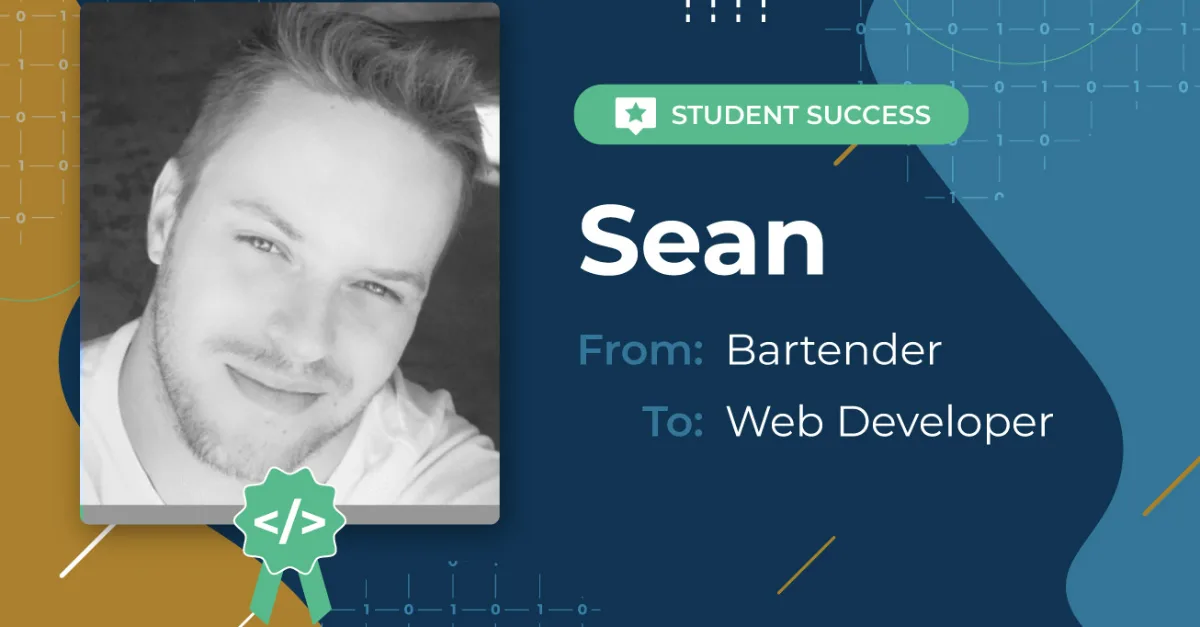
Student Success Stories
Student Success Story – Sean Van Loggerenberg – From Bartender to Web Developer
Our part-time and online bootcamps are helping people who need time and flexibility in their career development and coding skills education. Just take it from HyperionDev student Sean Van Loggenberg, who was able to balance his work with his coding studies through an online bootcamp.
It’s a story we’ve heard many times before. Someone is working a job with demanding and unpredictable hours, and they want to develop a new set of skills that will allow to make a drastic and much-desired career change. However, traditional education models often demand far more time – and money – than these jobs can provide. That’s where new education models, like HyperionDev’s mentor-led online coding bootcamps come to the rescue. These bootcamps allow prospective students the time, flexibility, and affordability they need to meet their responsibilities at work, and give them full stack web developer, data science, or software engineering skills that will build their career mobility and land them a job in a whole new industry.
One such student was Sean Van Loggerenberg, a 28-year-old bartender from Cape Town, who came to HyperionDev because he wanted to make a drastic career change to become a web developer. Sean knew that an in-demand career in tech could earn him a better salary and allow him the possibility of working overseas or remotely.
I found programming very interesting and decided to look into it; And then I fell in love with it. The course helped a lot to build my knowledge and skills to achieve my new career goal of being a web developer. The part I enjoyed the most was interacting with other students, all of us helping each other with coding issues and solving them together.
Sean was able to grow in this collaborative environment and learn his new web developer skill set under the guidance and assistance of his one-on-one mentor who helped him to grow and learn during his part-time online Full Stack Web Developer bootcamp. This unique HyperionDev model of constant iteration and live code review by experienced coders helped to take Sean’s code from beginner to industry-ready.
My mentor was great. He was always there when I needed him and the way he explained the content was easy to follow. The code review process was very supportive, because I knew I was on the right (or wrong) track and it showed me alternative ways of solving programming challenges.
For Sean, the decision to learn how to code and become a web developer is one he strongly recommends to anyone looking to upskill and upgrade their careers.
Becoming a developer was the best choice I ever made, and I can guarantee you will feel the same.
Are you a bartender, waitress, Uber driver, or other worker who wants to make the jump to a highly-rewarding and fulfilling career in tech, but just can’t seem to take the time to focus on learning the skills? Then HyperionDev’s online and part-time bootcamps have been tailor-made with you in mind. They’re affordable and can be completed at your own pace, allowing you the space to tend to your job needs, pay the bills, take care of the kids, or finish college essays, while giving you industry-ready skills in Full Stack Web Development, Software Engineering, or Data Science that will prepare you for a brand new career. What’s more, our placements and career support services will help you build up the CV, profile, and interviewing skills you need to land that new job.
Student Success Stories
Talitha Kruger: You don’t need to be a natural problem solver to become a developer
There’s a common myth that to be a ‘real’ developer you need to be a natural problem solver. This isn’t true, writes HyperionDev graduate and blog contributor Talitha. In this piece, she shares insight into how she overcame worries that she wasn't “the right fit”, and completed a Full Stack Web Developer bootcamp.
During the early stages of learning to code and becoming a developer, I worried that I was not a “natural problem-solver”. In my eyes, developers were defined by this trait: they were people with a superhuman ability to solve incredibly hard problems quickly and under pressure, and I subconsciously disqualified myself from being “a good developer” because I didn’t see myself as having that characteristic.
But just because I’m not a natural problem solver, it doesn’t mean I haven’t been able to solve problems I would have once thought impossible. And so I wanted to share what helped me to improve my areas of weakness so that I could better assess and understand problems, and figure out working solutions to these challenges. Here are some key points that I learned along the way:
Problem-solving is not a Genetic Trait
Problem solving isn’t something that some developers have, and others don’t. It is a skill that is acquired with perseverance and practice. You will make mistakes, but you shouldn’t let that damage your self-esteem or discourage you from trying. Try to think of challenging problems as opportunities that can make you a better developer.
Never give up (as cliche as that sounds)
When learning to code, approaching problems in a particular programming language can be very frustrating. Getting stuck and breaking your code doesn’t mean that you are bad at that language or a bad developer; you just don’t know how to fix it yet.
One thing at a time
Take it slow, line by line, bit by bit. Rather write a few lines that work and build on them bit by bit, than churn out an entire function that doesn’t work. Breaking the problem up into pieces and tackling one at a time is cliche for a reason: it works.
Practice makes perfect
Embrace the fact that problems are a part of development, and that the problems themselves do not get easier to solve – the problem-solver just becomes better at solving them. The only way to strengthen a muscle is to use it, so I highly recommend sites like Leetcode and HackerRank to start practicing your problem solving and also prepare you for coding interviews.
Dear Dev Diary…
Journalling the issues and errors I was faced with, and how I solved them not only gave me something to refer to when similar errors came up further along the way, but it also gave me a huge sense of achievement. Keep a track of how you solved a problem; it’ll give a good point of reference down the line – and also remind you that you’ve come up with clever solutions to coding challenges before.
Always take your best shot at solving the problem before you ‘cheat’
Looking up your errors on Google can be a quick fix, but it can only benefit you if you first give yourself some time to try and troubleshoot the error on your own. Don’ be afraid to make a mistake, because it means you’re engaging directly with the problem. The code you write might not be the cleanest or most optimized, but you’ll learn to solve problems on your own. Besides, you can always ‘cheat’ later on when you refer to resources such as StackOverflow to see best practices.
Never underestimate the power of a break.
Taking a step away from the problem will let you come back to it with a fresh perspective. Next time you are stuck, take a quick walk, read a blog post, or watch a short Youtube video (as long as your break doesn’t turn into an elongated distraction).
For a long time, I couldn’t identify with developers who were excited to take on extremely difficult coding challenges; in fact, just the idea made me extremely anxious. But the reason for this was that I had little practice and a lot of self-doubt, not because I wasn’t a “good problem-solver”. I am still learning to embrace the errors and unwanted behaviour in my code, I have to consciously choose how I approach problems. Since I have done so (especially after listening to this enlightening podcast called “Fail Better” by Command Line Heroes), there has been a lot less frustration, and more freedom in my work. I encourage you to choose to embrace when your code fails: every error will become an experience, and every problem will become an opportunity.
—
Talitha Kruger is a graduate of the HyperionDev Full Stack Web Developer bootcamp. She completed a part-time bootcamp, and was featured in a HyperionDev student spotlight. She is also a past contributor to the blog, and has recently shared the highs and lows of her coding journey with students starting their path in tech.
If you want to learn how you can start the journey into your new career in tech, you should look into our specialised bootcamp programs that give you the industry skills in Data Science, Software Engineering, or Full Stack Web Development that you need to thrive in the tech space. These part-time or full-time programs can be completed on one of our campuses in Johannesburg or Cape Town, or from the comfort of wherever you are connected to the internet. You don’t need any experience with coding, and you don’t need to be like the media stereotypes of what a ‘proper developer’ is. Why not try a free trial and see where it takes you?

Student Success Stories
Student Success Story: Zubair – From Travel Coordinator to Chatbot Tester
When Zubair felt pressured and unhappy at his stressful travel coordinator job, he felt that a career in tech could be his path to a better future. Find out how a part-time online HyperionDev Full Stack Web Developer Bootcamp allowed him the time and flexibility to switch to a brand new job.
When job unhappiness or breakdowns in the work environment strike, it can have a devastating effect on your self-esteem and personal sense of fulfillment. But what happens when employees feel locked into their jobs because of a static or industry-specific skill set? More and more, employees in jobs of all kinds are realising that upskilling programs like HyperionDev’s Full Stack Web Developer Bootcamp are powerful tools that give them a solid footing into brand new career paths. One such employee is Zubair Tassiem, a 26-year-old from Cape Town who left his old, unfulfilling job as travel coordinator for a new career in tech.
According to Zubair, the Full Stack Web Developer Bootcamp he joined gave him the confidence and skills he needed to pursue a better, more fulfilling career.
I worked in an unhappy environment, in a company where people left after two weeks because of the unfair treatment they received. However I was unable to just pack my bags and leave because I have a family to support. So I decided to upskill. Eight months later, I am in a better environment doing what I love.
The structure of the bootcamp, and its hands-on, mentor-led design that teaches practical skills with industry-real applications, helped Zubair feel ready to pursue a web development job in no time. In fact, through the bootcamp, Zubair got a new job as a Chat Bot Tester at XIB Solution after passing just the first level of the bootcamp.
I had only completed level 1 [out of 3 levels] when I informed my mentor that I felt ready to enter the IT and web developer field. He helped me update my CV, and recommended the type of jobs I should apply for. I got my first tech job before I even completed level 2.
Zubair’s HyperionDev mentor was there every step of the way to help him transition to a better, more fulfilling job.
My mentor was very helpful. What I really appreciated was the mock interviews, which helped me a lot, especially since it was my first time going for IT interviews. These mock interviews helped a lot in preparing me for the questions they would ask and how I would be expected to answer them.
And this was all helped by the flexibility and freedom to study offered by our online, part-time Web Developer bootcamp, which gave Zubair the ability to work and look after his family, while progressing continuously and at his own pace towards his goal of a new job in tech or web development.
The mentors really helped me to figure out new ways of solving problems. I really enjoyed the process of creating something amazing out of only a few lines of code. To anyone who wants to change careers I would say the only way you can start is by starting today.
Is your job getting you down, or are you looking for a way to enter into the in-demand field of tech, data science, or web development, no previous experience necessary? HyperionDev offers online bootcamps in Full Stack Web Development, Data Science or Software Engineering that will give you the skills you need to make the career change you’re longing for – and if you’re currently working, you can do these bootcamps part-time and from the comfort of your couch. You can also trial one of these courses for free.
Start your career in tech today.
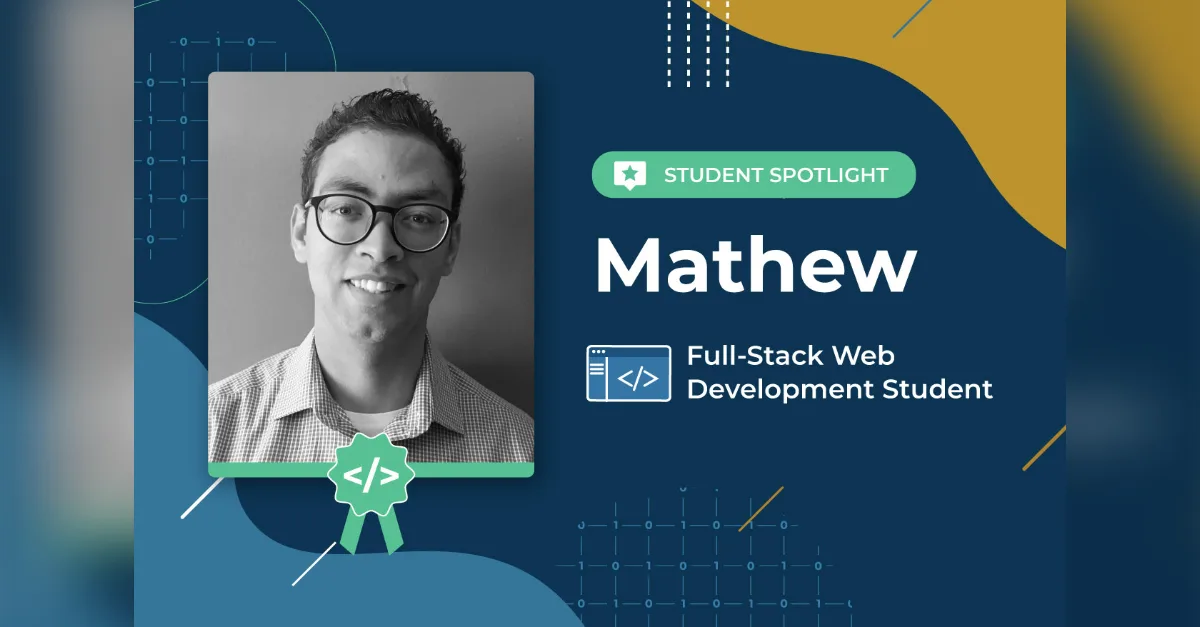
Student Success Stories
Student Spotlight: Mathew – Full Stack Web Development student
As new technologies change the way we work, students like Mathew Starr are actively pursuing the skills they need to open career doors in web development.
According to research from Gartner, South Africa is expected to have the fourth fastest-growing IT market in the world in 2019. The growth of our tech sector has been significant in the last half decade, and is predicted to rocket even higher, especially with the opening of new data centres and professional web development companies, and a considerable government drive toward the 4th Industrial Revolution.
It was this technological career evolution that led 24-year-old Mathew Paul Starr from the Northern Cape to take a HyperionDev Full Stack Web Development bootcamp online.
For the young GAAP Point of Sale technician, a bootcamp wasn’t just a tool to more career freedom and remote work, but an unrivaled opportunity to broaden his understanding of information systems and start a career shift from equipment technician to web development and systems manager.
I worked as an install and support technician with GAAP Point of Sale. Being a technician made me realise that developers are the key players in the IT game. Whenever issues would come up onsite then technicians would have to document those issues and report to the development team, which made me curious to know how software systems are designed and created.
A new set of skills in software or web development were what Mathew needed to empower him to take up new and more demanding jobs, and pursue opportunities that would allow him greater work mobility, pay, and time to focus on his interests in non-profit work.
All organisations need a digital presence in this day and age. As a web developer I could help build a web system internally or for the public that will speed up the day-to-day processes in the workplace.
And the HyperionDev bootcamps’ one-on-one mentorship approach brought these skills in heaps.
The code review system is great, because it showed me alternative ways of solving programming challenges. It’s also very supportive, because I then know I’m on the right or wrong track. Mentors are helpful and very understanding.
The coding course was an eye-opening introduction not just to brand-new skills, but also the iterative and novel approach to figuring out solutions to the many programming problems that appear in the course of web development.
The most important lesson I learnt was patience. There were times during the course when I would be sitting with a problem for days and couldn’t figure out what the issue was. The strangest part is that I would get the answer not while I was in front of my PC writing code, but while I was doing something else.
Whatever you’re looking to get out of a new skills program, HyperionDev’s bootcamps bring skills that go beyond just career relevance.
Coding helps you to think in a logical and critical way, which in my opinion can boost anyone’s ability to see the bigger picture in every situation they find themselves in. It can give people the confidence to pursue a career that is fulfilling and beneficial to a wide variety of people.
You, too, can acquire new professional skills that give you the freedom to work when and where you want. HyperionDev offers online bootcamps in Full Stack Web Development, Data Science or Software Engineering. You can also trial one of these courses for free. If online learning is not your thing, you could join a face-to-face Web Developer or Software Engineering course in Cape Town or Johannesburg. Courses are offered on a part-time or full-time basis.
Student Success Stories
Student Spotlight: Leandri – Full-Stack Web Development Student
Skills in Web Development or coding are a crucial part in bringing freedom and mobility to your career. Find out how Leandri opened the door to new career opportunities.
It’s no secret that web development and programming are among the most in-demand professions on the jobs market. According to figures from the US Bureau of Labor Statistics, the employment of software developers is projected to grow 21 percent from 2018 to 2028 – a rate that is much faster than the average for all occupations. In fact, most, if not all, code- and computer-related professions, including web development, are projected to enjoy faster than average growth than all other jobs in the coming years, as ICT becomes cheaper and more ubiquitous.
It’s no surprise, then, that so many students – and even fully qualified, currently employed professionals – are turning to coding to bring more freedom and mobility into their lives and careers.
One such qualified professional is 25-year-old Leandri Viljoen, a BSc graduate who works in Risk & Fraud analysis. Leandri enrolled in an online HyperionDev Full Stack Web Developer Bootcamp, which gave her the freedom to upskill at her own pace from home without having to take valuable time off work.
Leandri says she was attracted by the freedom and endless possibilities that professional skills in web development and coding bring.
I love the fact that there is a space for everyone. It’s really possible to lean into your own strengths (and past experiences before learning how to code) to create something new and useful. From e-commerce sites to VR- adverts to powerful software for big companies, the options really are endless.
That’s when she found out about HyperionDev’s one-on-one mentored web development bootcamps, which teach practical skills to first-time or experienced coders in a well-structured and methodical approach that fosters good problem solving and teaches best coding practices.
I’ve always been curious about learning to code & have started multiple free courses, but unfortunately I got overwhelmed by the number of different routes available. HyperionDev’s web development course structure seemed like a straight-forward path to follow and to keep me focussed. Plus, the company I currently work for is always looking for developers, so I thought I’d give it a shot!
A strong set of coding skills bring with them so many benefits including job security, career mobility, and the freedom to work remotely.
I want to develop skills for an in-demand job, because I know that most companies need programmers. I also love the idea of being able to control my time and being able to work from wherever I want, like on the beach or in coffee shops. Plus, I know that with programming skills I will have a lot of work opportunities overseas, and I really want to travel.
The course, she says, was both challenging and rewarding, and a process that brought her practical web development skills that are relevant to the modern workplace.
It challenged me mentally and forced me to think of creative ways to solve problems. It has also taught me to manage my time between having a full-time job and taking the time to work on my tasks. I enjoyed being able to ask for help when I really got stuck and frustrated (it happens!). My mentor would often give me clues on how to figure it out on my own, instead of just giving me the answer straight away. It’s not easy, but it’s so rewarding to be able to build something you can show people and say, ‘I created that!’
And Leandri’s advice for people who are thinking about learning more about programming or developing their own website from scratch?
Just try it! You don’t have to be a natural “techie” in order to learn how to code – I certainly wasn’t!
If you’re curious about code, you can try it out yourself with one of our free trials, where you can get the basics and try your hand at a few practical code exercises – no previous experience necessary! HyperionDev offers online bootcamps in Full Stack Web Development, Data Science or Software Engineering. If online learning is not your thing, you could join a face-to-face Web Developer or Software Engineering course in Cape Town or Johannesburg. Start your career change today.
News & Announcements
October 15, 2019
Find the best developer jobs out there with HyperionDev Careers
When it comes to developer jobs, tech companies look for the best candidates. HyperionDev Careers, our placement and career support service, will ensure you put your best foot forward by offering you a variety of services as you approach your bootcamp graduation.
So your HyperionDev bootcamp is done and dusted. Now what – how are you going to take that all-important next step: landing a job as a developer? With HyperionDev Careers, HyperionDev’s placement and career support service, it’s sorted. This division is dedicated to securing developer jobs for our graduates by connecting students with employers of their choice.
As with any traditional degree or diploma, a bootcamp certificate alone may not be sufficient to get you that developer job. Employers also look for the relevant skills, sound technical knowledge and a strong portfolio to close their tech skills gap and hire for the developer jobs that are needed. HyperionDev Careers’ mission is to ensure that as a developer candidate have the best possible career profile to catch the recruiter’s eye.
So how does ‘Careers’ boost your chances of landing that lucrative developer job? Here are some of the services we offer:
Connections
We’ll link you up with the employers of your choice, including our relevant contacts.
Technical interviews
The technical interview can be a minefield, because your technical knowledge is frequently tested. Don’t worry, we’ll show you how to ace that interview, because we understand the components of the tech interview, which could include quizzes, hypotheticals (‘What would you do if…?’), and likely tech interview questions. We’ll conduct mock technical interviews with you so you are best prepared for this challenging process.
Personality tests
We’ll conduct the relevant personality tests so that you learn to know yourself, particularly your strengths, in more detail. This will help greatly with job interviews.
The technical CV
The technical CV is a little different from a run-of-the-mill CV, because it emphasises your technical skills. We’ll show you how to put one together to optimally highlight specific tech qualifications or skills, and grab the attention of the hiring manager paging through a stack of CVs.
Some estimates claim that up to 85% of jobs are found via networking, states an article on PayScale. LinkedIn is a prime spot for networking, but you need to know how to do it most advantageously. We’ll show you how.
Assistance in building up and refining your GitHub profile
GitHub is a software development platform, where you can host and review code, manage projects, and build software alongside millions of other developers. It’s also one of the first things hiring managers look for when picking the best candidates for the job. We’ll help you build up and refine your GitHub profile, a vital asset in promoting your skills and knowledge.
Support
You’ll receive assistance from a dedicated team who are committed to supporting you from the day of your onboarding right through to your new career in tech.
During level 3 of your bootcamp, you will be invited to join the HyperionDev Careers community. When it comes to finding developer jobs, the stats look very promising for our HyperionDev graduates. According to our 2018 Graduate Outcomes Report, the following positive trends were noted:
- 95% of graduates reached their career outcomes. These outcomes include moving to a tech career, starting a business, upskilling in their current tech role, or using their new skills in a non-tech job.
- 61% of graduates switched to a career in tech.
- 72% switched to a new career within 3 months.
- Average salary increases post-graduation were estimated at R12k per month/ R144k per year.
To sum up, it’s much easier to land a tech job with dedicated professionals who know the industry supporting you. HyperionDev Careers serves precisely this function. If you’re keen to change careers or upskill, consider enrolling on a HyperionDev online bootcamp in Web Development, Data Science or Software Engineering. You can also trial one of these courses for free. If online learning is not for you, enrol in an immersive, face-to-face Web Developer or Software Engineering course in Cape Town or Johannesburg. Courses are offered part-time or full-time.
Still have questions?
Contact our Admissions Team, and a real person will get back to you.