
Our latest insights
Read the latest insights

Student Success Stories
Student Success Story: Kerusha – Software Engineering Student
Kerusha felt boxed in by her masters in Historical Studies. She wanted to move out of her comfort zone and try something new.
26-year-old Kerusha Govender, who hails from Paarl, felt “boxed in” while studying for her masters in Historical Studies. In response, she made the radical decision to completely change paths and enrol on a full-time Software Engineering Bootcamp, which she completed online. She says:
I enrolled on the Software Engineering Bootcamp, because I needed to do something to empower myself in the job market. I was not enjoying my masters so I quit and tried to look for a job, but I was unsuccessful. It was clear I needed to upskill. I also wanted to move out of my comfort zone. I had boxed myself in in ways that were not helpful to my career.
Many people find themselves in such a “comfort zone” in their work. Basically, it’s where familiarity and routine give you a sense of safety and predictability, explains TopResume. However, stepping out of your comfort zone can increase your productivity, creativity and ability to cope with change. Learning new technology is an excellent way of achieving this productivity boost.
Kerusha confirms this by explaining that completing the bootcamp helped her see her capacities. She says:
The Software Engineering Bootcamp helped improve my confidence and showed me what I’m capable of – this was an invaluable experience. The exposure and learning process also gave me a fair introduction to what the industry is about.
Excitingly, she has now landed a job as an intern at Iris Business Systems, where she is writing a user manual from scratch for the business’ biggest software product. In part, this requires SQL, which she was introduced to on the bootcamp, as well as several other languages and tools. Kerusha will need to draw on what she learnt during her bootcamp in order to come to grips with these languages and tools. She says:
I think my bootcamp experience equipped me in my current role of having to pick up new skills.
Regarding the bootcamp itself, Kerusha “really enjoyed learning new concepts and writing code.” But it was the capstone projects, where there was some leeway for initiative, which were her absolute favourites.
The capstone projects are vital for populating your developer portfolio, which shows off your newly acquired skills to prospective employers. Some things you might build include an investment calculator or a system that interacts with databases. You’ll also learn about the important version control system, Git, to host and review your code.
Throughout the process, Kerusha had the support of her own personalised mentor. Here’s what she says about the experience:
Clarinda, my mentor, is very nurturing. I enjoyed our chats about her experiences in the industry. As a student, it’s very comforting to know you have access to assistance. Her support meant a lot to me.
And what advice would Kerusha offer to newcomers wanting to start a career in tech. She says:
Make sure you do your research, so you know what you’re getting yourself into. Try to get a mentor or a friend who is a developer. Plug into online platforms or channels, because they help with the learning process. Work hard and persevere, but enjoy the process.
If you’re keen to upskill or you just want to enter the in-demand field of tech (no previous experience necessary), HyperionDev offers online bootcamps in Full Stack Web Development, Data Science or Software Engineering. You can also trial one of these courses for free. If online learning is not your thing, you could join a face-to-face Web Developer or Software Engineering course in Cape Town or Johannesburg. Start your career in tech today.

Career Advice
Larry Jimu: Top 10 Websites I Use When I’m Stuck
If you’re in the market for coding help, check out former HyperionDev student Larry Jimu’s suggestions. He’s listed his top five websites and top five YouTube channels for those tricky coding questions.
As a new, or even experienced, programmer, you’re going to run into difficulties. That’s why, as a former HyperionDev student, I’ve put together this useful list of the top ten websites for coding help. I’ve divided this list into two sections: five websites and five YouTube channels. I hope you find these websites as useful as I find them.
Websites
- Stack Overflow
Ah Stack Overflow. The number one go-to location for all programmers. Stack Overflow is the most popular social network for developers worldwide, with over 4.7 million users. The beauty of Stack Overflow is that it allows you to ask custom-made questions to a community of capable developers. Members in the community are rewarded for providing the solutions to these problems, meaning you are more than likely guaranteed to receive a response to your coding question. Also, it hosts questions in numerous programming languages, platforms, and services – the top ones among them are JavaScript, Java, C#, PHP, Android, jQuery, Python, and HTML.
There is nothing you cannot find on reddit, and that is also the case for serious programmers who value useful information. Reddit is made up of thousands of communities that host discussions about particular interests and topics, including programming languages, computers, the Internet, and more. When I have a problem, the useful communities I visit include r/Python, r/AskComputerScience, r/programming and r/dailyprogrammer.
- Tutorialspoint
Tutorialspoint is a digital library where you can learn a wide variety of software technologies. The library is divided into many useful sections including ‘Latest Technology’, ‘Machine Learning’, ‘Web Development’, ‘Java Technologies’, and so on. I often visit Tutorialspoint when there’s a particular topic I have not yet fully grasped, since their material is dummied down to the point where you can teach what you see there to a monkey.
- MIT OpenCourseWare
MIT OpenCourseWare offers courses from MIT professors to anyone with a thirst for knowledge, free of charge. Complete with video lectures, activities, and much more, you can’t beat access to free state-of-the-art learning on the fly. I highly advise the MIT Open Courses for anyone who wants to gain a more in-depth explanation for programming concepts.
- CodeRanch
CodeRanch is a discussion board for programmers. It’s an ideal place for novices to learn the basics of Java, Android and iOS programming, as well as posting queries about the things with which they need help. Sub-forums on databases, computer engineering, and other languages, including Python in Machine Learning, are also available. One can easily register, join a sub-forum, ask questions, and reply to unanswered questions.
YouTube Channels
- Colt Steele
Without doubt, the number one YouTube Channel I recommend for all programmers is Colt Steele. He is a very experienced tutor who lectures on his coding bootcamps in the USA. His videos incorporate a wide range of topics including Full Stack Web Development, Python, React, Node and several other Computer Science platforms. I highly recommend his videos to anyone who needs basic and easy-to-understand explanations for the most complex problems.
- TheNewBoston
TheNewBoston has more than 4,200 videos and over2.4 million subscribers. TheNewBoston is arguably the single best resource for anyone who wants to become a programmer. The tutorials in this channel cover a range of different programming topics including developing for Android and Web design. Bucky Roberts is the guy who manages the channel and teaches the lessons, using a teaching style best described as entertaining and simple. He makes me feel very comfortable whenever I’m stuck with coding.
- Treehouse
Treehouse, a YouTube channel run by teamtreehouse,is one of the most popular programming tutorial resources on the Internet. On Treehouse, you can find programming tutorials on PHP, CSS, JavaScript, Python, Apple’s Swift programming language, and C++. Teamtreehouse offers lessons on numerous topics including coding in C# and Python. Treehouse has over 332 videos and more than 154,000 subscribers.
- Programming Knowledge
Here you will find a variety of videos aimed at new programmers. The tutorials on Programing Knowledge range from an Android tutorial for beginners to Python, Java, and C++ tutorials. Among the resources is a C programming tutorial that is widely considered the best course in that language that you will find anywhere. The channel (along with the ProgrammingKnowledge blog) is owned by Yogesh Patel. The sheer number of videos – over 1,000 of them – is incredible, and all of them are geared towards beginners, making this one of the first channels that anyone who gets stuck in coding should bookmark. Programming Knowledge has over 443,000 subscribers.
- java Brains
JavaBrains is a popular YouTube channel, probably because the focus of this channel is simple yet precise. It’s a channel entirely dedicated to free Java tutorials. The Java programming language is known for its usefulness in building Android apps, server-side applications, web applications, and much more. So, the Java Brains channel provides video courses on Java essentials, enterprise Java courses, Java EE courses, and many more. There are even some JavaScript and AngularJS courses as well.
In conclusion, it is inevitable for a developer to need coding help. Like the great Sylvester Stallone said, “It’s not about how hard you hit. It’s about how hard you can get hit and keep moving forward. How much you can take and keep moving forward.” When that bug hits me with everything it has, I hit back and keep moving forward, using one of the resources listed above.
This post was written by Larry Jimu.
News & Announcements
September 27, 2019
#ChangeWithCode – Win a R45 000 Coding Scholarship
You can win a R45 000 HyperionDev coding scholarship with our #ChangeWithCode competition. All you need to do to change your life with a coding career is share your big tech idea on social media.
Self-driving cars, the blockchain, 3D printers: all these ideas started with a spark – perhaps an a-ha moment or a big plan scribbled on a small post-it note. Greatness often has humble beginnings. Now it’s your chance to share your revolutionary tech idea and win big in our #ChangeWithCode HyperionDev competition.
What do you need to do to win? It’s simple:
Step One: Post your idea for a game-changing game, website or application on any social media channel of your choice, including Facebook, Instagram, Twitter, and LinkedIn.
Step Two: Explain your idea any way you want. For example, you could draw something, shoot a video or outline your great idea in writing. Just make sure you communicate your idea as clearly as possible.
Step Three: Tag us in your creation with @HyperionDev, and remember to include the hashtag #ChangeWithCode.
And what is the prize? The best ideas stand a chance of winning one of three full HyperionDev Bootcamp Scholarships, valued up to R45 000. Scholarships are available for both online and on-site courses, which take place in Cape Town or Johannesburg.
If you’re keen to upskill or you just want to enter the in-demand field of tech, HyperionDev offers online bootcamps in Full Stack Web Development, Data Science or Software Engineering – no previous experience necessary! You can also trial one of these courses for free. And if online learning is not your thing, you could join a face-to-face Web Developer or Software Engineering course in Cape Town or Johannesburg.
Technology is a space that’s constantly on the move: something that appears impossible today might well be possible just around the corner. Be part of changing your life, career and even the world with our #ChangeWithCode competition. We want to hear from you today.
Terms and conditions:
- This competition is run and sponsored by HyperionDev. No other organisation or entity is involved in its running or sponsorship.
- Be sure to follow all entrance instructions, including use of our hashtag #ChangeWithCode and our and social media handle @HyperionDev.
- Competition is only open to single entrants.
- Prizes are non-transferrable and cannot be exchanged for their monetary value.
- Entrants must be 16 or older.
- Nominees and winners will be contacted via social media.
- Judges’ decision will be final and no correspondence will be entered into.
- No entries will be considered via email.
- Entries close 31 October.
- Nominees will be announced 8 November.
- Winners will be announced 15 November.
- HyperionDev reserve the right to adjust or end the competition at any time.
- By entering this competition you agree to abide by the terms and conditions set out by HyperionDev for this competition.
Student Success Stories
Student Success Story: Sedeshtra – Data Science Graduate
Sedeshtra decided to upskill by picking up valuable data science skills. He recently landed a job as an analyst for a top company. Read his full story here.
Johannesburg-based Sedeshtra Pillay, aged 25, is no stranger to studying. He followed up his bachelor’s degree in Finance with a master’s degree in Demography and Population Studies. However, he was still keen on upskilling and while working as an Associate Consultant at IQbusiness, a management consulting firm, he decided to enrol on a HyperionDev Data Science Bootcamp. He says:
I wanted to upskill and improve my current job prospects.
Sedeshtra has now landed a job at Deloitte Consulting as an analyst in the Actuarial, Rewards and Analytics Practice. He believes his data science competency, learnt during his bootcamp, helped him to secure this position.
These days, upskilling is an integral part of a career. A 2018 study, published by the Organisation for Economic Co-operation and Development, estimated that 46% of all jobs have at least a 50% chance of being lost or greatly altered. In addition, there is a chronic shortage of appropriate talent in tech, with an anticipated tech skills shortage of approximately 500 000 people in Europe by 2020. In the US, the Bureau of Labor Statistics anticipates a 19% growth between 2016 and 2026 in the software engineering field – i.e. jobs that involve solving “problems in computing for business, medicine, science, and other fields.”
Sedeshtra, who has just started his exciting new job, says, “I will be engaging mainly with Excel and SQL, though I hope to make use of my Python and Tableau skills down the line.” He was able to ramp up his tech skills by studying part-time and online. The great thing about an online bootcamp is that it offers maximum flexibility and freedom. Plus, with a HyperionDev bootcamp you don’t need any background in coding, IT or computer science.
Besides wanting to land a new job, Sedeshtra was in favour of upskilling to earn a better salary and prepare himself for work opportunities overseas. At some point in the future, Sedeshtra wants to travel – his programming skills will stand him in good stead for this potential future endeavour.
And how did he enjoy his HyperionDev Data Science Bootcamp? Sedeshtra explains that the “data visualisation aspect” of the course was his favorite part, but the 1:1 mentorship and code reviewing were integral in advancing his coding skills. As far as advice for newcomers wanting to enter the lucrative field of coding, Sedeshtra says:
The world is moving fast. You need to be able to adapt quickly to market trends and demands. Upskilling yourself never hurts, especially in an age where data has become the world’s most valuable resource.
If you’re keen to upskill or you just want to enter the in-demand field of tech (no previous experience necessary), HyperionDev offers online bootcamps in Full Stack Web Development, Data Science or Software Engineering. You can also trial one of these courses for free. If online learning is not your thing, you could join a face-to-face Web Developer or Software Engineering course in Cape Town or Johannesburg. Start your career in tech today.

Career Advice
Are robots stealing our jobs?
With the rise of robots, job automation has become a serious threat to future employment. Find out the likelihood of a robot taking your job, and how you can best future-proof your career.
The age of robots and job automation is upon us. There has been a lot of discussion over the past few years about the rise of robots and the impact they will have on our jobs. And the outcome sounds very ominous. In fact, the OECD estimates that 14% of jobs will be replaced by automation and another 32% will be radically changed by emerging technologies very soon. While it is certain that robots are going to displace portions of the workforce, should you be worried?
The rise of the robots
While machines and automation are nothing particularly new, current industrial automation and robots are multipurpose and reprogrammable. Across all industries, robots are being developed and deployed to increase productivity and profit margins.
Intelligent Transport Systems use real time traffic and passenger information to automatically adjust timings – potentially disrupting the transportation industry. Office and administrative support is being replaced by more efficient algorithms and software. ‘Less Paperwork = Higher Profits?’ by Verizon Connect explains how in the world of logistics, fleet management software allows invoices, quotations, job statuses, and other pertinent information to be automatically shared between concerned departments. This eliminates the potential of paperwork being delayed or lost in processing.
While it was traditionally believed that automation would only displace repetitive and menial jobs, huge leaps made by technology such as artificial intelligence and machine learning has put even more complex jobs at risk.
Will a robot take your job?
Robots are being adopted in relatively high-tech but labour-intensive industries. A Brookings study claims that jobs that require precision and repetition like the food service industry, manufacturing, and clerical support are the most vulnerable and these jobs could be displaced in the near future.
The study also warned that automation could replace jobs that are currently held by lower to lower-middle class workers – potentially increasing the already worrying income gap in most countries. As it is, workers in the Slovakian manufacturing sector have a 62% chance of being automated.
The McKinsey data used in the study also suggests that countries with a high ratio of service sector jobs like the UK and France are at a lower risk of being upended by robots in the near future.
Job loss or better jobs?
While headlines are mostly concentrating on the effect of robots and automation on our jobs, economic experts say that there is a false dichotomy when reporting job loss brought about by technology.
Computer World details that robotic process automation will only obliterate a portion of jobs. But automation will also create a higher demand for higher paying ICT labour markets. As often cited, the use of robots in Amazon and Walmart only led to its need for a higher quality workforce.
As robots in industries become more common and advance in quality, the gap in the demand for tech jobs and the labour market will become more pronounced. This opens an opportunity for workers to adapt and close in on this gap – reskilling the workforce for the new jobs that automation brings with it.
The good news is that certain kinds of software developers will be in high demand over the coming decade. Generally, these programmers will possess one or both of these attributes:
- Flexibility: Programmers who embrace flexibility are in a stronger position not to be automated. This would include being able to develop custom features, integrations, tailored admin, and user areas that are specifically adaptable for given industries.
- High-performing: Coders who can help with a variety of performance issues as they relate to software applications will be needed – for example, where you are bundling together a number of tools or solutions, or where there is a massively large volume of users or data. All the HyperionDev bootcamps – Software Engineer, Data Science, Full Stack Web Developer – incorporate multiple frameworks and languages in their course content.
As the rise of the robots is inevitable, future proofing yourself by learning new skills should be of the utmost importance. If you’re keen to change careers or upskill, consider enrolling on a HyperionDev online bootcamp in Full Stack Web Development, Data Science or Software Engineering. You can also trial one of these courses for free. If online learning is not your thing, you could enrol in an immersive, face-to-face Web Developer or Software Engineering course in Cape Town or Johannesburg.
Editorial composed by Janna Therese for the exclusive use of hyperiondev.com
News & Announcements
September 12, 2019
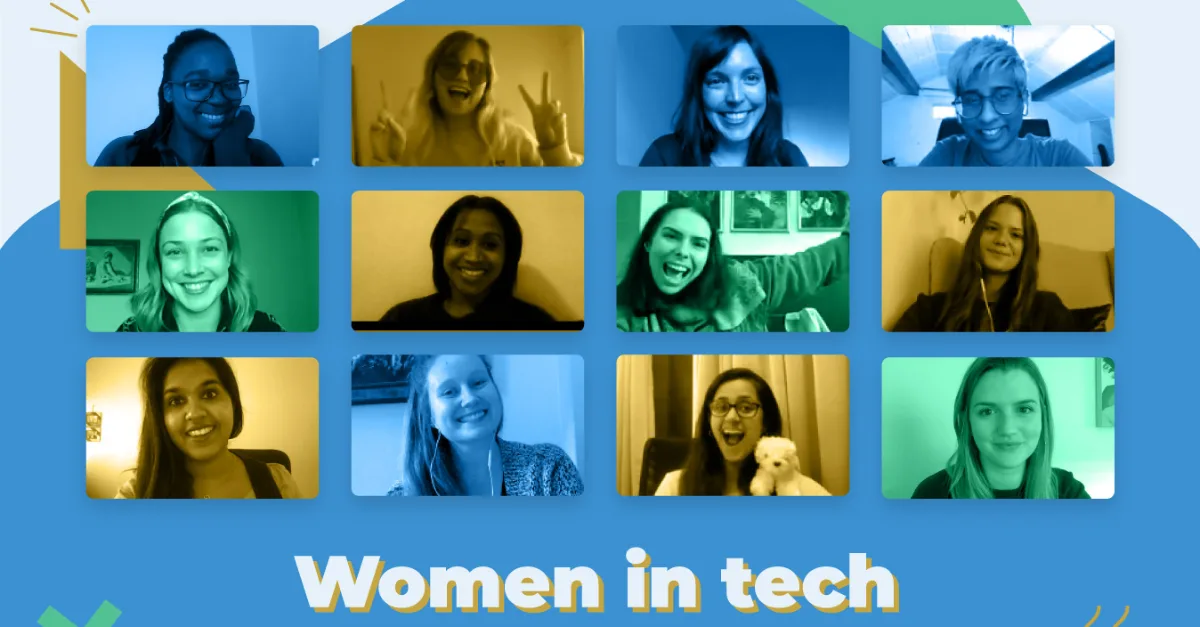
Women in tech: what is it like?
Women in tech is an issue that requires a lot more work and visibility to make up for the clear disparities in the STEM fields.
Onalerona, one of our HyperionDev Software Engineers, was 14 years old when she knew she wanted to be a programmer. “My high school did a ‘test’ IT class”, she shares. “During that class, we had to code in Pascal and Delphi to create a program that had a button, and the button would turn the screen green when clicked. The program, in its entirety, was probably 6 lines of code. But the feeling I got when that screen changed colour – I’ve been hooked on the idea of being a programmer ever since.”
But why are there so few stories like Onalerona’s? We spoke to Onalerona as well as HyperionDev’s UX/UI designer, Marianne, about their experiences of being women in a tech field, as well as what they hope to see in the future, to get a better understanding of the issues that women in tech face.
Women in Tech: the stats
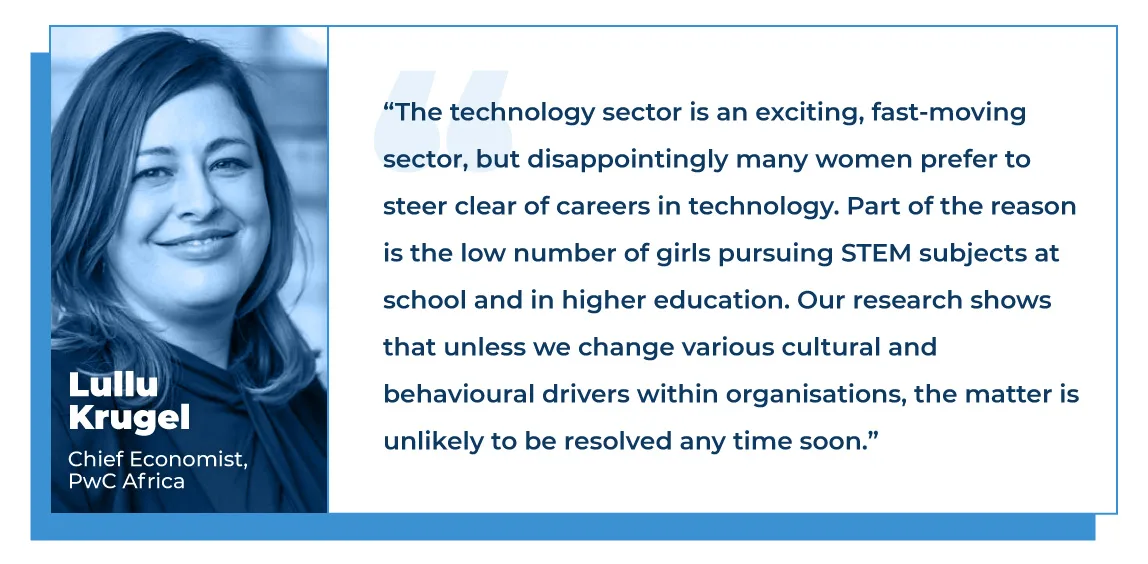
Despite the years of progress made towards gender parity, especially in the workplace, women still remain critically underrepresented in most STEM fields – across tertiary education institutions and the workforce.
A recent PwC #WomeninTech report found that at the top 10 global tech companies, only 19% of tech-related roles were held by women. What’s more, women made up a mere 28% of their senior leadership, relative to the 72% male leadership.
In South Africa specifically, the number of males graduating with STEM-related degrees far outweighs the number of women graduating with these degrees, especially when it comes to ICT and tech.
- Men outnumber women in maths and statistics degrees 4:5.
- Men outnumber women in ICT and technology degrees 2:5.
- Men outnumber women in engineering, manufacturing and construction degrees 3:10.
It’s clear that drastic change is needed on multiple levels. The PwC #WomeninTech report asserts that in order to alter the way in which we develop and deploy female tech talent, we need an ‘undoing and relearning of age-old thought processes and the formation of new norms and values – especially in the education system and labour market. Biases are ingrained in our cognitive processes and undoing them is difficult’.
The report outlines a number of the barriers that contribute to this issue:
- A lack of female representation in the workplace.
- A lack of representation in senior leadership roles.
- Gender-biased classrooms and educational settings.
- Gender-biased behavioural design from an early age.
What it’s like for women in tech
Onalerona had always wanted to get into programming as a career. “Initially, it was the love for programming, but it has since evolved,” she told us. “While I was studying at the University of Cape Town, I started doing a lot of tech-related community work. I volunteered for Code4CT, which was a non profit organisation that taught high school girls how to code. I was also Chair for Women in Computer Science UCT.”
“I grew a passion for advocating for women in tech, and I feel my purpose to still be here is to expose as many tech opportunities to women, retention of women in tech, and aid where I can to make their tech journey a little bit better.”
Marianne, on the other hand, had spent years as a multidisciplinary designer, but had always felt drawn to the tech industry.
“Ironically I probably related more to the tech industry than the creative industry. I didn’t identify with the stereotype of an eccentric ‘creative’,” she shares.
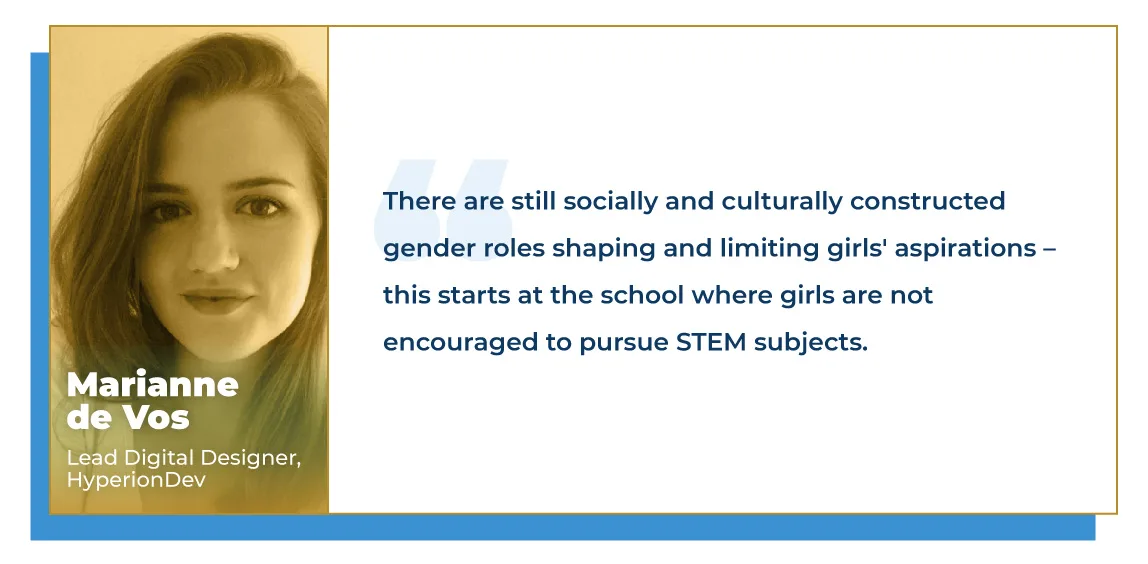
“Having worked in multiple design disciplines, I can see in retrospect that as soon as I designed my first unique web interface, it was all I wanted to do. I loved exploring the functionality needed and where the user interactions would work logically and creatively,” Marianne shares. “I grew more and more interested in satisfying user needs: creating functional products to be used daily, impacting user’s lives. That desire drove my career path to the tech industry pretty naturally.”
Many barriers still stand for women in tech
However, from both Onalerona’s and Marianne’s experiences it’s clear that there are many obstacles to surmount.
Marianne shares that, “It becomes apparent in more informal social settings that there are still fundamentally prejudiced nuances embedded in conversations around women in tech. The underrepresentation of women in tech then equates to a lack of female role models to inspire girls at an age where parental control, peer pressure and self-esteem can heavily influence their career decisions.”
For Onalerona, overcoming these hurdles was a matter of her passion for the industry and the work she does – although putting on a brave face and keeping at it isn’t always so easy.
“Representation matters a lot and makes a big difference. In my first year of studying, we had a huge and quite diverse computer science class. By my last exam in my third year, there were only 4 girls in the examination room. A lot of my female friends left computer science mostly because they felt as if they were struggling alone.”
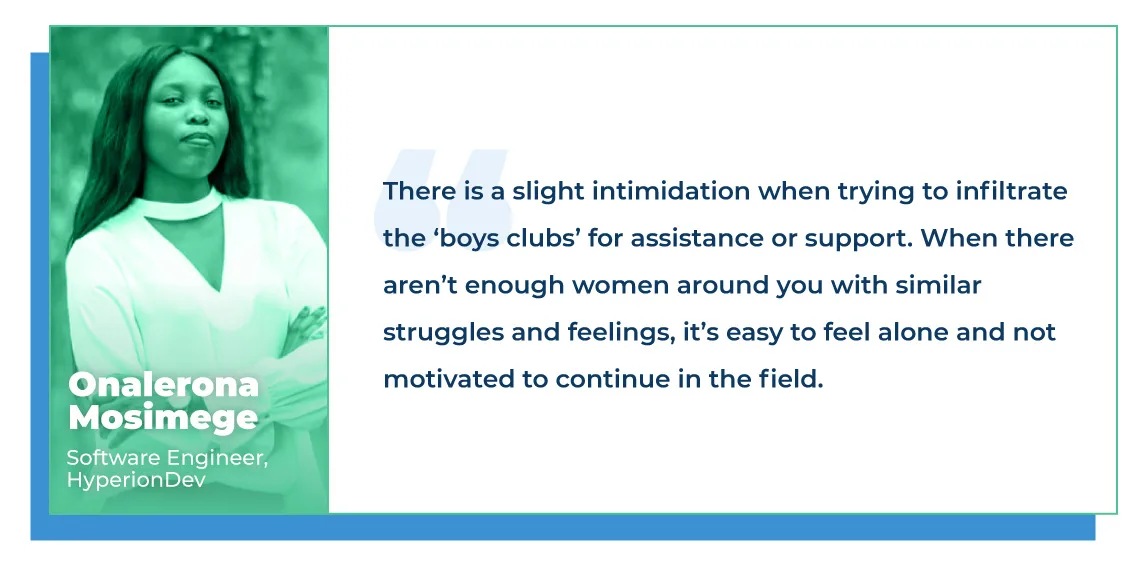
Fast forward to working in the industry, Onalerona is now committed to championing diversity and inclusion in the tech space in order to ensure that these issues are curbed and more women can be retained in the industry.
What can be done to improve the situation
While the issues women face in joining the tech industry might be numerous and powerful, they’re not impossible to overcome. There are a number of strategies that schools, businesses, and parents can take to support girls and women as they pursue their passion and interest in technology.
- Improve female representation in companies.
- Implement double-blind strategies to combat biases in hiring
- Create and support education initiatives, like scholarships, that support young women in tech
- Create an industry that listens to and addresses the problems women have in the tech sector
Our coding bootcamps and hiring strategies are designed to build people up into experienced and high-achieving tech professionals, no matter their background. Our online and on-site coding bootcamps teach job-ready tech skills to the people who need them, with no requirement for a high school diploma or any coding experience; and our team of expert A-players is always looking for passionate, dedicated, and hard-working women (and men!) to scale our bootcamps to be the best in the world.
Find your start into a rewarding and fulfilling tech career by clicking here, or find out how you can join our diverse, international team by clicking here.
Student Success Stories
Student Spotlight: Etienne – Data Science Bootcamp Student
It’s possible to change career at any age. Find out how Etienne Bauschere experienced his online HyperionDev Data Science Bootcamp.
43-year-old Etienne Bauscher, who comes from Cape Town, has done a wide variety of different occupations including releasing his own debut gospel album, which he engineered himself. Before that, he worked as a Procurement Engineer in the mining industry at Group Five, a Structural Steel Draughtsman and he also owned his own Corporate and Promotional Clothing and Gifts business. So what made Etienne decide to sign up for a HyperionDev online Bootcamp in data science, and how can you know if it’s the right time for you to make a significant career change?
According to Entrepreneur, people are likely to change careers five to seven times during their working life. Here are five signs that it might be time for you to switch careers:
- Your company is driving you crazy – for example, perhaps you’re not being used to your full potential or there is no room for any more company growth.
- Automation is likely to hit certain industries hard. Check out this useful guide to assess the likelihood of your job being automated.
- Automation aside, a global economic downturn is predicted for 2020, and that could hit certain industries harder than others. The good news is that software developer jobs are predicted to grow by 17% from 2014 to 2024, according to the US Bureau of Labor Statistics. This is much faster than the average for other occupations, which is at 7%.
- There’s a poor match between your talents and the job you’re doing – for example, you’re a high school teacher who doesn’t enjoy high-intensity social interactions.
- According to Business Insider, here are some good reasons for not switching career:
- It’s the end of the year. This has to do with hiring logistics. A lot of people who make hiring decisions are away and you’ll need to be more patient waiting for job interviews and callbacks.
- It’s right before a monumental change like pregnancy or marriage.
- You’re over or under worked – this might not be a sufficient reason. Rather analyse how you’re managing your time, and then plead your case to the boss.
So what were Etienne’s reasons for changing careers. Ultimately, he wanted to do something “more in demand”. He says:
I love coding and machine learning. The concepts behind data science also interest me greatly.
He mentions a number of other key reasons for his monumental mid-forties career shift including the desire to work remotely and travel – he loves the idea of being able to work from wherever he wants. In addition, there are likely to be good data science work opportunities worldwide. When not travelling or working remotely, Etienne is also keen to do stimulating and meaningful work, perhaps at an NGO or in his community. Says Etienne:
I want to contribute to the Fourth Industrial Revolution.
It’s worth noting that Etienne doesn’t mention an improved salary as one of his motivators for his career change, but guess the best job in the US for the past few years running? It’s data science, according to Glassdoor, which combines three factors to work out its top-job rankings: number of job openings, salary and overall job satisfaction rating. The average salary for a data scientist in the US, according to PayScale, is $91,035.
Etienne, who has recently graduated, enjoyed his Data Science Bootcamp greatly. He says:
I got to engage with a wide variety of concepts. In data science, there are multiple approaches to different problems. It’s very stimulating to find the right one to suit the objective which needs to be achieved.
And what advice does he have for people wishing to enter this stimulating career?
Start somewhere and let the road lead you onwards. At first, you might find yourself jumping around a lot, but you will find stability in the process. Don’t quit. Also, you need to define your goal – is it web development or data science, for example? Then learn how to code for that particular aspect of tech. I received excellent advice from someone working in blockchain technology. She said, ‘If you want to learn how to code, join a bootcamp.’ Previously, I tried to learn so many languages all at once and I almost lost my mind. To summarise: decide what tech you want to get involved in, and then learn how to code! It’s that simple.
Not only is Etienne excited about his future, he is also upbeat about the future of programming. He puts it like this:
Technology is forever changing and evolving. Future technologies are now being made available on simulation platforms which I believe is great for preparing developers for the changes to come.
If you’re keen to change career or you just want to enter the in-demand field of tech (no previous experience necessary), HyperionDev offers online bootcamps in Full Stack Web Development, Data Science or Software Engineering. You can also trial one of these courses for free. If online learning is not your thing, you could join a face-to-face Web Developer or Software Engineering course in Cape Town or Johannesburg. Start your career change today.

Career Advice
Can you really become a programmer in 6 months and get hired?
Become a programmer in six months. Can you really learn to become a professional programmer in six months? Learn how successful programmers have picked up programming and found a job after their coding bootcamps.
It seems almost impossible to imagine you can go from zero to hero in a period of six months. Surely it takes longer than that to become a programmer? Not necessarily. Gina Fabienne, a HyperionDev graduate, found work as a junior web developer at a web design agency after completing a six-month Full Stack Web Developer Bootcamp.
Gina says: “HyperionDev gave me the confidence and ability to assess problems. Working through the tasks by myself with the help of a mentor during the bootcamp taught me how to work through my current work tasks by myself and only ask for help when I’m really stuck.”
Gina is not the only success story – there are many others. A Reddit thread about the success rate among self-taught programmers makes this clear. Interestingly, the success stories seem to fall into two categories:
- Those who are entirely self-taught: This group of people seem to have taught themselves a specific language, such as Python or Java. (Python is actually a relatively easy computer language to learn; it’s also the fastest growing language in high-income countries such as the US, UK, Germany and Canada.) In fact, 85,5% of developers say that they taught themselves a new language, tool or framework, according to 2019’s Stack Overflow Survey.
- People who have signed up for online courses: It seems that a Full Stack Web Developer bootcamp is a popular option for those who choose a more formal method of learning, because you cover many languages. You would, for example, cover the basics like HTML and CSS, as well as intermediate languages like Python, SQL and Java.
Even though bootcamps are a way for newcomers to transition into a tech career, a fair number of professional developers, 15,4% to be precise, have actually taken a bootcamp, according to the 2019 Stack Overflow Developer Survey Results. Why? Quite simply, many developers decide during their career that they need to learn new technologies or upgrade their skills to retain relevancy.
If you’re looking for a bottom line, it’s this: you might not be able to become an expert programmer in 6 months, but you can certainly reach a basic level of competency. This is a point frequently made on many online forums like Quora.
In fact, as pointed out by the Stack Overflow Developer Survey of 2019, a common misconception about developers is that they’ve been programming since childhood. Although there is a wide range of experience among developers who work in the industry, a full 45% of professional developers only learned to code less than 10 years ago.
And you don’t need to get to 100% – i.e. knowing everything about your selected programming languages – before moving onto the next stage of your life as a professional programmer. ‘For most skills,’ states a piece in Medium, ‘including programming, the closer you get to 100%, the longer it takes to get there.’ You rather need to think about the 20% that will get you 80% of the results.
So what should you be doing to pick up the sufficient skills to land you a programming job as soon as possible? Here are some ideas:
- Learn HTML and CSS first. Buy a domain and put up a website, which will be your portfolio. Edit and update it as your skills increase.
- Learn JavaScript to make your site interactive.
- Put up small projects on GitHub, a software development platform that allows you to manage your coding projects. Employers could well check out your GitHub profile. Read more about GitHub here.
- Learn to use Stack Overflow, which you will most likely use for research and to get solutions to your programming problems.
- Use a command line to do stuff like automating specific tasks or diagnosing and even correcting some Windows problems, or, for example, finding all the files you worked on last month. Try using it instead of a GUI (graphical user interface).
- Attend local meet-ups and hackathons. Start networking and learning the lingo.
- Apply to recruitment agencies early – here’s how to ace the tech interview.
- Create a LinkedIn profile – make it look professional.
Lastly, when people ask what you do, tell them you’re a programmer. Part of forming a new identity is convincing yourself. Read more HyperionDev success stories here. You can become a programmer in 6 months; remember, others have done it before!
Editor’s note: This was post was originally published 19 March 2018 and has been updated 7 August 2019.
Student Success Stories
Student Spotlight: Talitha – Full-Stack Web Developer
Talitha Kruger started to teach herself web development through various online resources. However, she wasn’t making the progress she desired, so she decided to enrol on an online HyperionDev Full-Stack Web Development Bootcamp. Find out how she is experiencing this method of learning to code.
Because coding is such an in-demand skill, many people are keen to pick it up. But can you learn this valuable skill on your own? According to the 2019 Stack Overflow Developer Report, almost 90% of developers have taught themselves a new language, framework or tool outside their formal education. 25-year-old Talitha Kruger, based in Kempton Park, attempted this strategy as well. She says:
I tried to teach myself front-end web development through various online resources, but I wasn’t making the progress I wanted.
She decided instead to enrol on a part-time Full Stack Web Developer Bootcamp, which she’s doing online with HyperionDev.
Web development is not her first career. Many people start working in one field only to find themselves changing careers to something completely different – for example, from restaurant owner to doctor, or from marketing specialist to web developer. So too with Talitha who has tried a number of different careers. She says:
I have a background in aviation. I worked for Mango Airline, rotating between Check-in, Cabin Crew and Call Center departments. I was then recruited by Qatar Airways, but I became homesick. When I returned to South Africa, I started working as an au-pair, which is what I am currently doing.
Talitha is motivated to embark on her career change for two reasons. Firstly, she wants to earn a better salary and secondly, she’s keen to do stimulating and meaningful work, potentially at a non-government organisation or in her community. But currently, Talitha is really enjoying her web development course. Here’s what she says:
There’s nothing better than proving myself wrong – I look at something that seems beyond me and then I find a way of working it out. I love it when my code works! I also really like that idea that programming is only becoming more powerful, in the sense that it can be used to make people feel and think and ultimately change their lives through their user experiences.
Talitha recommends taking a bootcamp to acquire “industry-ready knowledge and know-how”. However, if you’re considering whether to study coding on your own or via an online course, consider the following five questions, via Course Report:
- Do you have prior coding experience? Those with a computer science background or a knowledge of programming will find it easier to fly solo and teach themselves another language. If your knowledge is fairly minimal, you’ll learn quicker with a coding bootcamp.
- Will you be able to set up your own curriculum? If you don’t have a mentor, you’ll need to decide what you should and shouldn’t be learning. This can be tricky for new learners in coding.
- What is your learning style? In the past when you’ve given yourself a project or a self-study, have you finished and stayed motivated? MOOCs (or “massive online open courses”) tend to have less than a 15% completion rate.
- What are your time and commitment pressures? The chances are that it will take you longer if you’re doing it by yourself. It’s a matter of calculating how much it will cost you (e.g. lost salary) to take longer to qualify.
- Is a network of fellow programmers important to you? Do you have a group of people you can consult for basic support and future job opportunities? If not, a mentor-guided online experience will help set you up with your fellow classmates who will be of use to you in your coding career.
If you’re keen to learn coding via a course, HyperionDev offers online bootcamps in Full Stack Web Development, Data Science or Software Engineering. You can also trial one of these courses for free. If online learning is not your thing, you could join a face-to-face Web Developer or Software Engineering course in Cape Town or Johannesburg. Courses are offered on a part-time or full-time basis. Start your career change today.
Student Success Stories
Student Spotlight: Saranne – Software Engineer Bootcamp Student
Software engineering is ranked the top job in 2019, according to the U.S. News & World Report. Companies often need to provide flexible hours, remote work opportunities and professional development to lure workers. Find out how Saranne Ndamba is experiencing her online HyperionDev Software Engineer Bootcamp.
Every year the U.S. News & World report, the global authority in rankings and consumer advice, reveals their best jobs. Not only do they look at salary, they also assess other important aspects of a job, including growth potential and work-life balance. “For the second year in a row, software developer takes the No. 1 spot as the Best Job overall,” states the report. What is it about software engineering that makes it so desirable? Kim Castro, the executive editor at U.S. News, explains that it’s not just the high salaries. She says: “To lure and retain workers, companies are also boosting the benefits they provide, offering flexible hours and remote work opportunities while investing in individuals’ personal and professional development – all reasons why software developer continues to top the Best Jobs list.”
19-year-old Saranne Ndamba, who comes from Johannesburg and is currently enrolled on the HyperionDev online Software Engineer Bootcamp, has certainly picked the right profession. Prior to this, she was involved in running a restaurant. About her career choice she says:
I have always had a love for computers and I thought it was time to explore my passion. I want to be prepared for the future.
And Saranne is certainly likely to be well-prepared for the future. According to the Bureau of Labor Statistics, which calculates the employment growth for various occupations, software engineers are projected to experience a startling 24% employment growth between 2016 and 2026. This is much faster than the 7% average for other occupations.
Saranne definitely has big plans for her future. She’s keen to own her own company, possibly in tech. Alternatively, she would be more than happy working at a big tech company like Google or Facebook. In Saranne’s own words, she sees herself doing the following:
I want to build fantastic artificial intelligence, which has the capacity to do incredible things.
She’s finding her HyperionDev online Software Engineer Bootcamp most manageable due to two aspects. She says:
My mentor’s assistance is great, especially the code reviews as these show me alternative ways of solving programming challenges. What also makes the course very enjoyable for me is the fact that I can work at my own pace.
Saranne also offers some advice for newbie programmers. She says that it’s never too late. You just need to do it.
If you’re keen to change career or you just want to enter the in-demand field of tech (no previous experience necessary), HyperionDev offers online bootcamps in Full Stack Web Development, Data Science or Software Engineering. You can also trial one of these courses for free. If online learning is not your thing, you could join a face-to-face Web Developer or Software Engineering course in Cape Town or Johannesburg. Start your career change today.
Student Success Stories
Student Spotlight: Keith – Full-Stack Web Developer
Keith Sinclair has a dream: he wants to travel the world while earning money through coding. Find out how Keith is experiencing his online HyperionDev Full-Stack Web Developer Bootcamp, and how it’s helping him realise his dream.
Many people have a life ambition. Keith Sinclair is no exception. To achieve his dream, he’s becoming a web developer at HyperionDev. The 41-year-old is currently enrolled on an online HyperionDev Full Stack Web Developer Bootcamp. Before that, his work background included time as a franchise owner, as well as many years spent in logistics and the fast food business. So what is Keith’s dream? He says:
My wife and I want to set ourselves up so that we can travel the world while earning. The great thing is that all you need is a laptop and you can code from anywhere: that’s our dream.
He’s not alone. Many developers have the same objective. According to the 2019 Stack Overflow Developer Survey, 31.9% regard the opportunity to work remotely as a decisive factor when it comes to picking a job. And because developers are in such high demand worldwide, remote work, which really means you can work outside of a traditional office environment, is a reality for many of them. So instead of commuting to a claustrophobic office through dense traffic, you get to choose where and when you want to work. It was Keith’s passion for gaming and figuring out how things work that led him towards learning to code. He says:
I’m motivated by practical solutions to everyday problems.
How is Keith finding his web developer bootcamp? He finds his HyperionDev mentor and the code review process very useful. Although Keith likes working things out for himself, he also likes to know that there’s someone around to make sure he’s on the right track. He explains that his mentor shows him better ways he could have coded something and he particularly loves the code reviews, which take his coding forward. And what does he most enjoy about the course? He says:
I love building apps and showing them off.
After he’s learnt to code, Keith has a number of ambitions. Like most people upskilling, he wants to earn a better salary, but his top post-bootcamp desire is travelling and working remotely.
What advice does he have for people thinking about coding as a career? Here’s what he says.
I’d like to quote Stephen Hawking’s on this – ‘Whether you want to uncover the secrets of the universe, or you just want to pursue a career in the 21st century, basic computer programming is an essential skill to learn.
If you’re keen to learn this essential skill via a course, HyperionDev offers online bootcamps in Full Stack Web Developer, Data Science or Software Engineering. You can also trial one of these courses for free. If online learning is not your thing, you could join a face-to-face Web Developer or Software Engineering course in Cape Town or Johannesburg. Courses are offered on a part-time or full-time basis. Start your career change today.
Student Success Stories
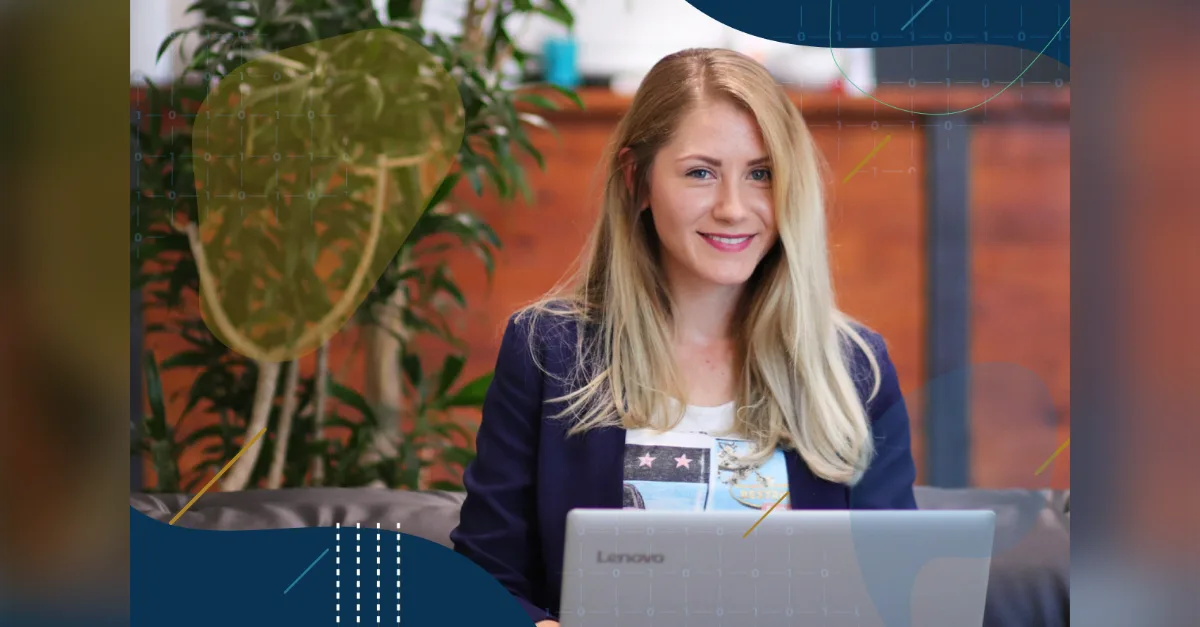
Talitha Kruger: the coding highs, the lows and everything in between
If you’re keen to learn to code, find out what it’s really like. Talitha Kruger shares her coding journey: the highs, the lows and everything in between.
HyperionDev is excited to introduce a new series about our students’ coding journeys. What is it really like to learn to code? HyperionDev students reflect honestly on their experiences: the ups and the downs. Find out what it actually takes to become a coder. Here we feature Talitha Kruger, who is enrolled on a part-time Full Stack Web Developer Bootcamp. Over to you, Talitha.
My coding journey
I’ve come across an interesting description of the four stages of learning to code. As I learn to code, these psychological states of the coding process resonated with me. I’d like to describe them here with reference to my own coding journey.
- The Honeymoon

This is the first magical introduction to coding. I remember when I rendered my first “Hello World”. In my grand naivety I thought to myself, “That’s it, I’m a web developer!”. I was in love with the fact that code in itself was not some type of superior magic (which I thought it was – not too long ago) to be used by the PC Master Race – i.e. people who can hack your fridge, etc. But now I commanded it, and it taught me so much at the same time. It ignited a curiosity I never knew I had, and that was so empowering.
- The Cliff of Confusion

The cliff of confusion is defined as that time when you’re getting a little stuck and you need help. During this time I experienced my first inkling that there is no simple solution to fixing a bug, especially when learning a new concept.
The process goes something like this: I go through my code line by line, commenting segments of my code out to see if I can avoid the bug instead of resolving it. Let’s refresh. Oh no! It’s still there! I copy and paste the error message my debugger threw into Google search. I read the solution on Stack Overflow, but to be honest, what that code was doing is not what I want my code to do. I browse through as many resources as possible only to realise I am confusing myself even more!
- The Desert of Despair

Now I’ve reached the Desert of Despair. This is defined as a long and lonely stage. I’m so stuck that I don’t even know how to phrase my questions. Imposter Syndrome creeps in – even doing something as simple as logging in to a console becomes a dream.
In my anxious imagination, the bug gets bigger and becomes a dry desert wasteland. I am wandering around trying to find my way back to where everything was working fine. It has been hours now and I still have not figured out how to run my code without throwing an error. Is there anyone who can help me?
- The Upswing

After hours of searching, my code is running. The pride coursing through me is enough to power a nuclear plant and I am motivated to try build something else, something even more challenging. I reflect on a famous quotation by Theodore Roosevelt that has helped me through many deserts of despair. It’s called “The Man In The Arena”. And this is how it goes: “It is not the critic who counts; not the man who points out how the strong man stumbles, or where the doer of deeds could have done them better. The credit belongs to the man who is actually in the arena, whose face is marred by dust and sweat and blood…”
While learning to code, I feel like I am that man in the arena.
If you’re keen to experience a coding journey of your own, consider enrolling on a HyperionDev course. Bootcamps include Full Stack Web Developer, Data Science or Software Engineering. You can also trial one of these courses for free. If online learning is not your thing, you could join a face-to-face Web Developer or Software Engineering course in Cape Town or Johannesburg. Courses are offered on a part-time or full-time basis. Start your career change today.
Student Success Stories
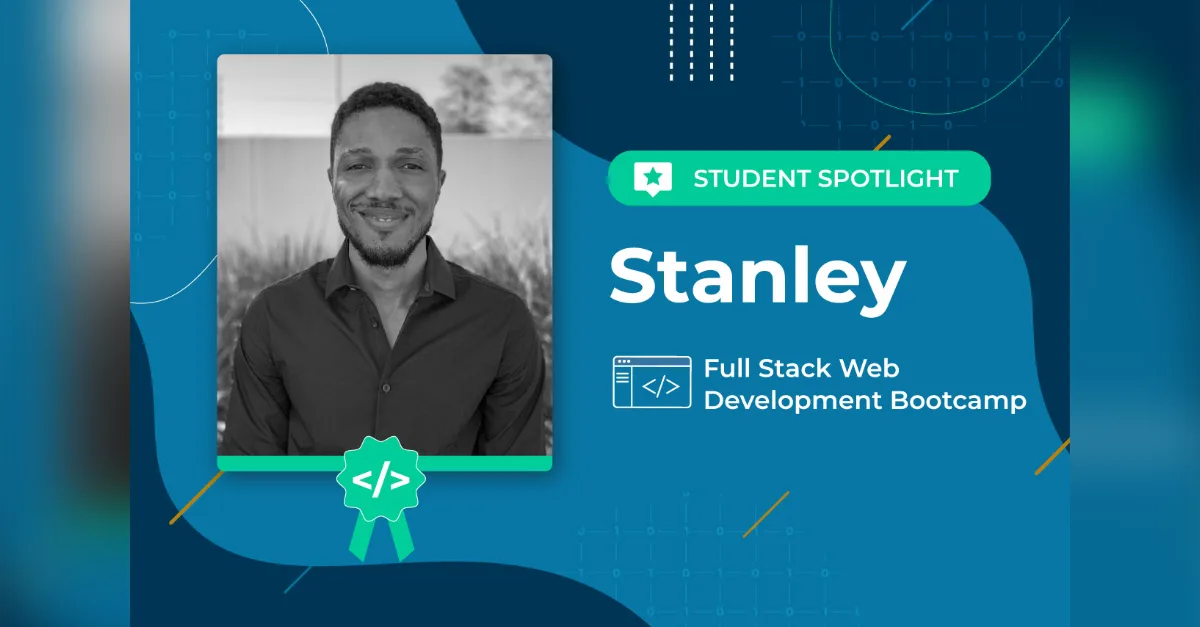
Student Spotlight: Stanley – Full-Stack Web Development Student
Stanley Ikegbulam wants to further his skills to enter the in-demand field of full-stack web development. He decided to study part-time and on-site. Find out how he’s experiencing his HyperionDev Full-Stack Web Development Bootcamp in Johannesburg.
Stanley Ikegbulam comes from Pretoria. To reach his career goals, he’s enrolled on the on-site, part-time HyperionDev Full Stack Web Development Bootcamp. Before that, he studied Computer Science and Business Administration. He arrived in Pretoria in 2016 and has been working freelance in audio visual production, branding and marketing. When outlining his decision to study web development part-time, he says the following:
This course will allow me to create and design – two things I love doing. I’ll also be able to switch careers and earn more.
Part-time study has many advantages, particularly if you need to carry on working to fund your course. The Good University Guide outlines a couple of other benefits including:
- Lifestyle – your routine is more interesting, because you’re blending coursework, employment and leisure.
- Variation of the student body – part-time study tends to attract non-traditional students. According to a report from the American Council on Education, which was quoted in Ed Tech magazine, non-traditional students tend to be older than 25, working full-time and, financially independent, with some of them likely to be parents. In essence, they are early- to mid-career adults seeking career growth or change – and they are the ones who value flexibility the most.
Stanley is very excited about his part-time web development course. He’s already started planning where he’ll be in five years time. As far as these ambitions go, he lists the following:
- Working in a stimulating job.
- Earning an excellent salary, potentially at a big tech company like Google or Facebook.
- Freelancing while travelling the world.
- Meeting new and fascinating people who are making a difference in the world.
But currently, Stanley is really enjoying the studying process. He says:
I’m fascinated by this new world and I love being able to create and bring coding to life. Because programming and the web is an ever-evolving field, it’s definitely the future, so I’m excited about being in the driver’s seat.
He’s also got some thoughts for those thinking about coding as a career.
Learning coding is both beautiful and lucrative – it’s like learning hieroglyphics.
It may be like hieroglyphics, but Stanley is in the enviable position of having a mentor offering code reviews to help him in his journey. All HyperionDev students receive personalised feedback on their code to ensure they’re writing industry-standard, professional code. Says Stanley:
The code reviews from my mentor give me a major confidence boost. They make me believe that I can do more.
If you’re keen to upskill or you just want to enter the in-demand field of tech (no previous experience necessary), HyperionDev offers online bootcamps in Full Stack Web Development, Data Science or Software Engineering. You can also trial one of these courses for free. If online learning is not your thing, you could join a face-to-face Web Developer or Software Engineering course in Cape Town or Johannesburg. Start your career change today.
Student Success Stories
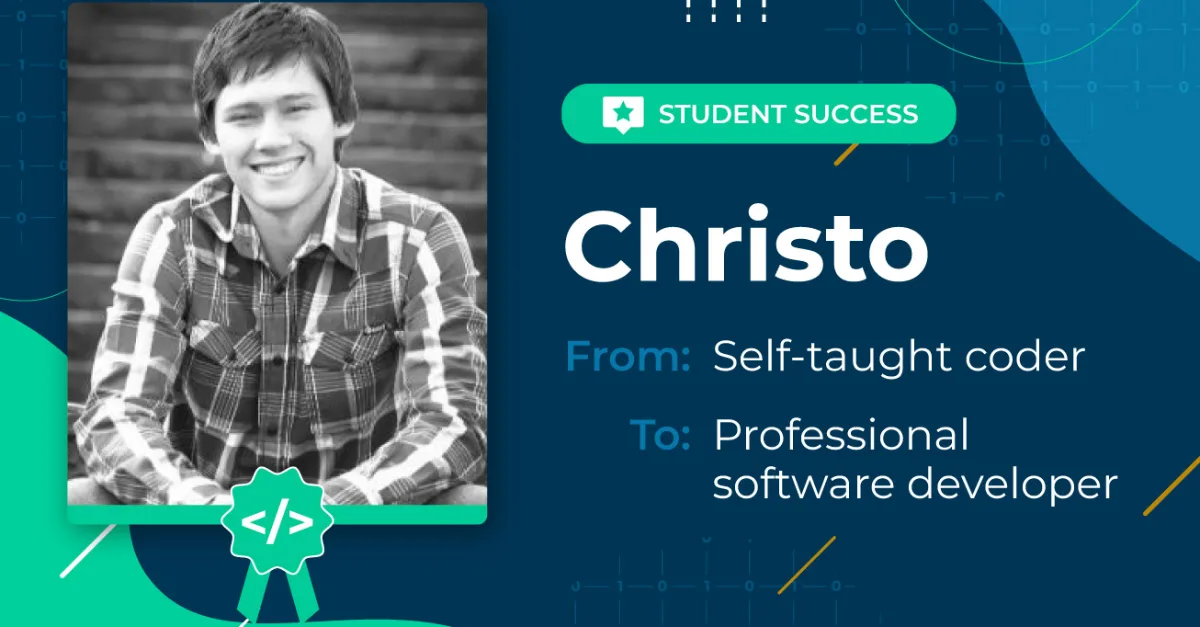
Christo: From self-taught coder to professional software developer
Christo has always had an interest in technology and creating his own software. This drew him towards HyperionDev and their study opportunities for upskilling. Read his story here.
Since childhood, Christo loved the idea of creating software. Because he was a self-taught programmer, he always sought out potential upskilling opportunities. This led him to HyperionDev, where he enrolled on several different software engineering courses in order to become a software developer. He was excited by the flexibility and practicality offered by the institution. Says Christo:
I decided to take these courses with HyperionDev, because I could do everything in the comfort of my own home. Also, the courses are practical. Every evaluation and test is a practical application. It’s not just about theory – you actually build something.
Christo is a guy on the move. He currently works for Tennant Administration Services, which forms part of the Tennant Group. The company specialises in administering pension funds and they’ve built their own software suite during the 28 years they’ve been in business.
My role as a software developer is to maintain and develop the applications they have. I also build new applications, as the business grows and technology changes.
Christo acknowledges that before taking a course with HyperionDev he didn’t have the confidence he has now when pushing out code. He was always questioning whether he was writing code or building software the correct way.
HyperionDev gave me the knowledge to know that the software and code I push out is well-written code. The courses are so comprehensive with an abundance of information. After finishing the Python Software Developer MicroDegree, the fear of doing something wrong was gone and I finally finished a project that I had been working on for quite some time.
What was one of Christo’s favorite parts of his HyperionDev course? The mentors!
The mentors are awesome. They were always keen to help with the necessary resources I needed to either finish an assignment or to offer advice on a specific topic.
If you’re keen to upskill or you just want to enter the lucrative and in-demand field of tech (no previous experience necessary), HyperionDev offers online bootcamps in Full Stack Web Development, Data Science or Software Engineering. You can also trial one of these courses for free. If online learning is not your thing, you could enrol in an immersive face-to-face Web Developer or Software Engineering course in Cape Town or Johannesburg. Python is included in the Software Engineering and the Data Science bootcamp.
Student Success Stories
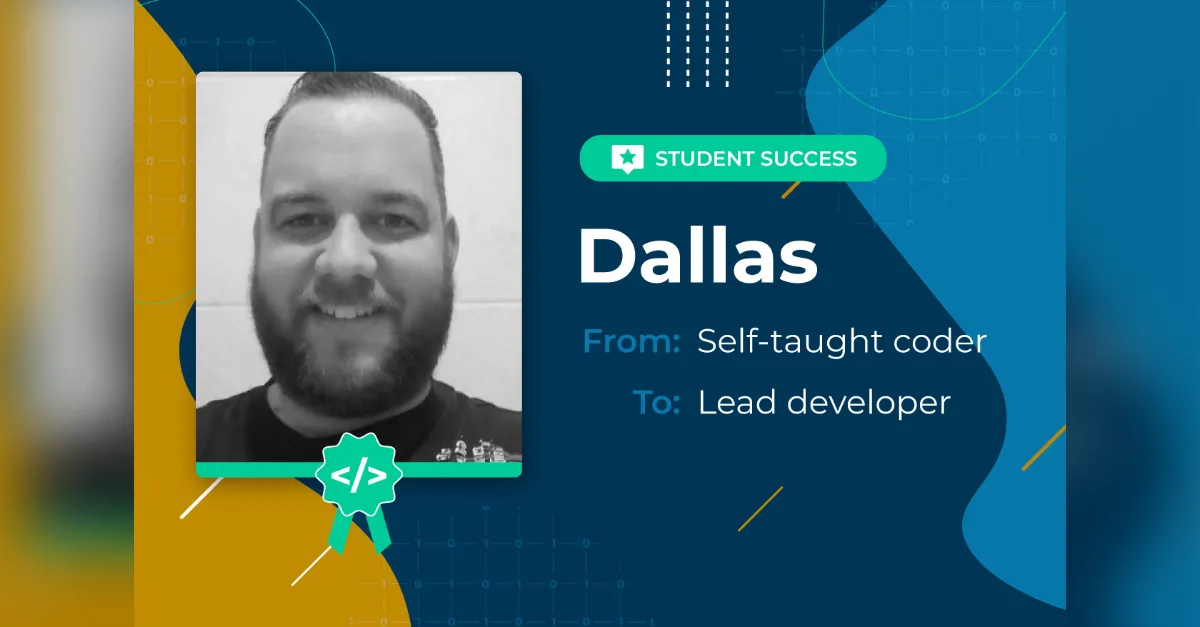
Dallas: From self-taught coder to lead developer
After teaching himself how to code, Dallas wanted to take his programming skills up a notch. He now works as a lead developer for a company. Read his full story here.
Dallas Goldswain, a HyperionDev graduate, has been programming since the age of 4. He’s always been curious about how computers work, starting off with learning how to make simple games on his dad’s computer to keep himself entertained. He then familiarised himself with a wide variety of computers, from the ZX Spectrum to Apple Macs.
After 15 years of working in software development, Dallas was inspired by none other than HyperionDev CEO, Riaz Moola, to sign up for a course. Soon after completing his Software Developer course with HyperionDev, Dallas went on to start his own tech business, dallasLabs, which specialised in delivering software and technology solutions using open source software.
I consulted to various companies, bringing solutions to non-technical founders. I started this company after attending various meetups where non-technical companies and founders were expressing a need for technology resources.
Thereafter, Dallas moved on to other ventures. He now works as the lead developer for a non-tech company. He is involved in developing their internal systems so they can move away from third-party software.
Dallas’ HyperionDev course led him towards these varied career opportunities. He says the following about his course:
The structured learning of the course combined with practical training resulted in the development of new skills. I was then able to offer a wider variety of software solutions to clients.
Specifically, Dallas appreciated the value in the personal 1-on-1 mentorship offered by HyperionDev. He believes that personal mentorship prepares new candidates for teamwork and remote work, both of which are in-demand in the industry.
Given his developer experience, Dallas offers this piece of advice for anyone looking to switch to a career in programming:
Write a lot of code in many languages to understand the different paradigms. The most important skill though, is problem-solving. Learn how to solve problems and create solutions using software. It’s a cliché, but there is no language better than another; instead, learn how to choose the right tool for the job.
Keen to start your own business in tech? Register for a free trial and see if the Software Engineer Bootcamp is right for you. Alternatively, you may want to upskill or change careers by signing up for the online bootcamp in Full Stack Web Development or Data Science. You can also trial one of these courses for free. If online learning is not your thing, you could enrol in an immersive face-to-face Web Developer or Software Engineering course at one of the HyperionDev campuses in Cape Town or Johannesburg.
Student Success Stories
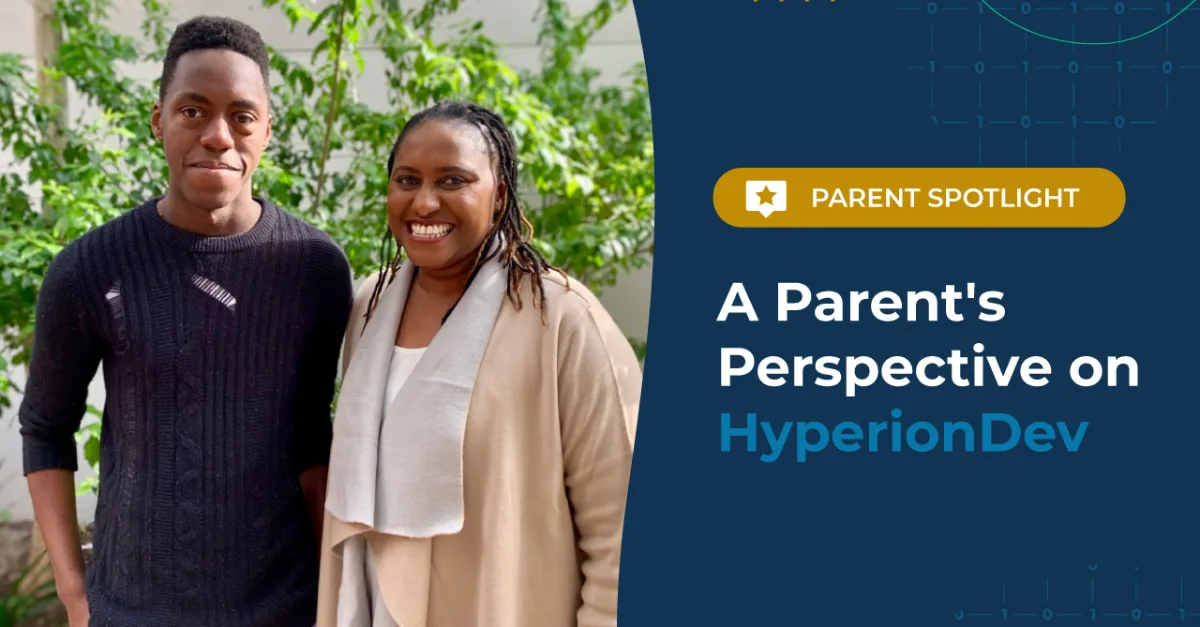
Tha: a mother’s perspective on her son’s coding course
Read about Tha Khumalo’s experience of her son, Vusi, moving from a traditional university to a Software Engineering bootcamp at HyperionDev. Was this the right decision? How has Vusi’s life changed? Read their full story here.
Tha Khumalo knows what she’s talking about. She explains that there’s a typical phase in your twenties during which you dabble with a wide variety of options, including your career, what you plan to study and even your relationship partner, but what many people don’t realise is that this decade forms your foundation. She says:
Often your twenties determine what you’re going to do with the rest of your life. Not everyone has the luxury of following their passions at a later stage.
This is why Tha is happy her son, Vusi, found HyperionDev and their Software Engineering bootcamp. Tha has a master’s degree and works in HR consulting. Before enrolling on a coding course, Vusi, her youngest son, was enrolled at Stellenbosch University in his second year of Entrepreneurship and Innovative Management, but he wasn’t engaged with the course. Says Vusi:
There was a massive amount of reading and regurgitation. I had problems remembering all the information and then putting it across in the same way I had read it. That’s why I love my coding bootcamp – everything is applied. The course is so hands-on. Also, I love technology, and this is a way to find out how tech works behind the scenes.
Check out Tha and Vusi’s story on how they are enjoying the online mentorship and learning experience with HyperionDev.
Mom Tha loves the fact that the bootcamp gives her son an industry-relevant certification. In the recruitment industry in which she works, she sees that IT candidates, especially skilled ones, are in short supply. In addition, he’ll be able to make his mark in so many different industries with just this one qualification. It’s a joy for her to see her son so excited about his work. Tha puts it like this.
My son has finally found studies he is passionate about. I find the constant feedback he receives boosts his confidence and his resolve to continue with the programme. He is really dedicated to finishing his tasks. Many young students don’t have the discipline to manage their work when not in formal institutions, but the online processes and mentor enable Vusi to exhibit that discipline and push himself harder.
Vusi confirmed that the learning process is very supportive and the resources are in-depth. He states:
If you have any issues, there is always support online.
So where does he see himself ending up? Potentially building apps, he explains. He has many ideas for innovative apps and he’s keen to transform this creativity into a technical endeavour of some kind. The last word must go to Mum Tha, however. She says:
Just a big thank-you to the HyperionDev team. One morning I was on your website and by the end of the week my son was registered and starting a new chapter in his life. The professionalism of the organisation is unparalleled.
If you’re keen to upskill or you just want to enter the in-demand field of tech (no previous experience necessary), HyperionDev offers online bootcamps in Full Stack Web Development, Data Science or Software Engineering. You can also trial one of these courses for free. If you prefer face-to-face learning, then consider a Web Developer or Software Engineering course in Cape Town or Johannesburg. Like Vusi, start the next chapter of your life today.

Career Advice
Women in Tech: what do female developers look for in a job?
Women in Tech - what do female developers look for in a job? We look at the 2019 HackerRank Tech Report to find out what female developers, particularly Gen Z, look for in prospective employment opportunities.
What’s it like to be a woman in tech? HackerRank has recently released its 2019 Women in Tech Report. After interviewing more than 12 000 developers, fascinating insights have emerged, particularly for Generation Z female coders – those born from 1997 onwards. Let’s take a closer look at women in tech, particularly what female developers look for in a job.
Professional development + prestigious brands
Female developers rank “professional development” and a “work-life balance” as the most important aspects of a job. However, Gen Z women – those 21 and under, are “twice as likely to seek out an employer with a prestigious brand as women from previous generations”. A potential reason for this is that Gen Z women, or “digital natives”, have spent so much of their life engaging with prestigious digital brands like Apple or Twitter (remember, 25% of them had smartphones before the age of 10) that they now seek out such brands in their work life.
Here’s a graph depicting the things women look for in a tech job.
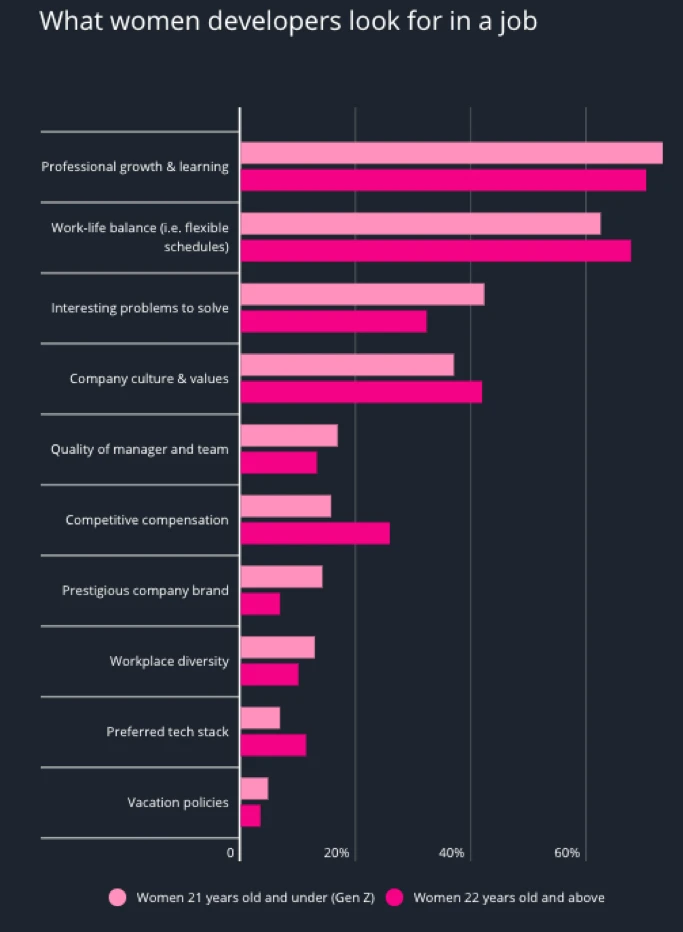
Image Source: https://research.hackerrank.com/women-in-tech/2019
A new career path
23-year-old Zita Preuss, who just misses the Gen Z label, is enrolled on a HyperionDev Full Stack Web Development course. She attends classes at their Woodstock campus in Cape Town. As a newbie developer, she, too, is looking for professional growth opportunities. Says Zita: “I’m keen for a new career path. I considered Computer Science, but I was put off by the long time commitment – three years is just too long! I needed to find a viable alternative, which led me to this bootcamp.” Interestingly, bootcamp graduates stack up well against graduates with degrees. A 2017 survey conducted by job site Indeed found that the vast majority (72%) of employers consider bootcamp grads to be “just as prepared to be high performers” as graduates with degrees.
Professional development is obviously important, but what about money? For Gen Z women, compensation is viewed somewhat differently from previous generations – it’s just not as vital a factor as it was for older women (16% of Gen Z women consider compensation important compared with 26% from other generations). For the Gen Z, it’s just lower down on their list of priorities.
The HackerRank report explains this finding as follows: “(M)ost Gen Z women currently do not have the same financial obligations that their older counterparts do, and can thus move compensation lower on their list of priorities in favor of other factors like company prestige.”
Zita doesn’t mention compensation as one of her chief priorities. However, after bartending, which she did before enrolling on her bootcamp, she’s keen “to find herself a proper career path”. Her plan is to move overseas with her bootcamp qualification after she has acquired the relevant skills and experience.
And how is she finding her bootcamp? Says Zita:
I really enjoy it, because I have the freedom to do tasks at my own pace. Plus, the environment is so friendly and welcoming. When I need help, my mentor is always available. Because it’s such a practical course, you get to try out a lot of the coding yourself.
Zita is sure to graduate from her bootcamp with in-demand skills that companies want. According to the HackerRank report, JavaScript, Java and Python top the list.
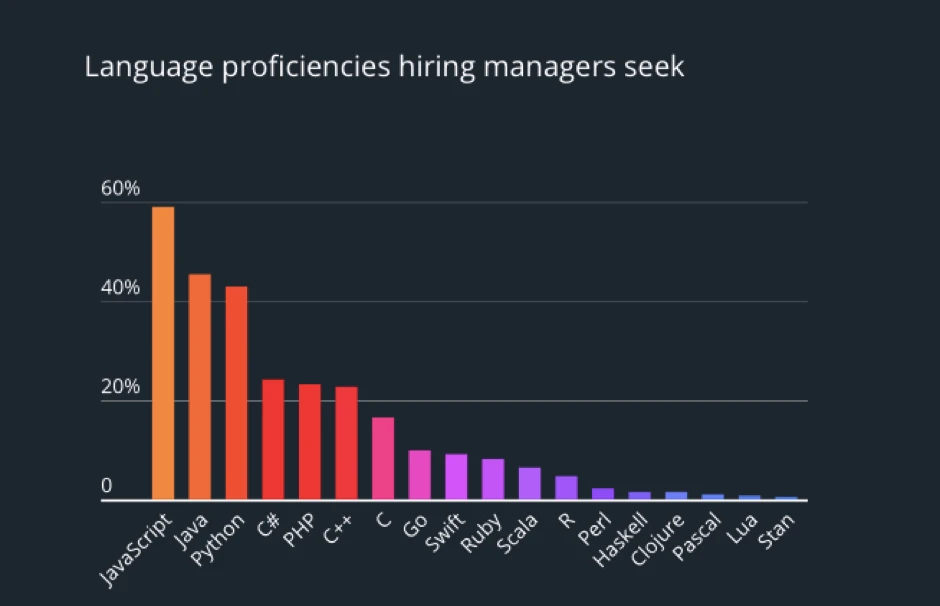
Image Source: https://research.hackerrank.com/women-in-tech/2019
Luckily for Gen Z women, the majority of them entering the workforce know Java and Python, while about 50% are proficient in JavaScript. Here’s a graph showing the languages Gen Z women and men know.
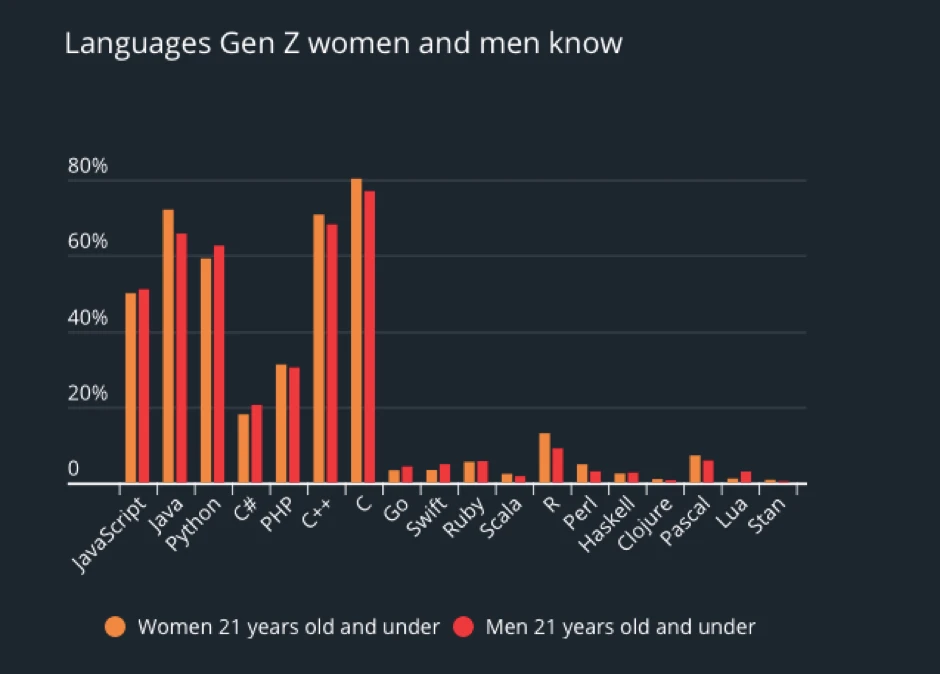
Image Source: https://research.hackerrank.com/women-in-tech/2019
Perhaps part of their skill proficiency comes from the fact that Gen Z women are coding at a younger age than generations before them. Almost a third of women in this generation learned to code before they were 16 years old. For previous generations, only 18% of women learned to code at such a young age.
The good news is that HyperionDev offers a Software Engineering course that covers Java and Python, and their Full Stack Web Developer courses incorporate JavaScript, among many other languages and frameworks. You can enrol to do the course online or on-site at one of their campuses in Cape Town or Joburg. Part-time and full-time courses are available. If you’re a woman who wants to enter the tech field, now is the time to make your dream a reality.
Student Success Stories
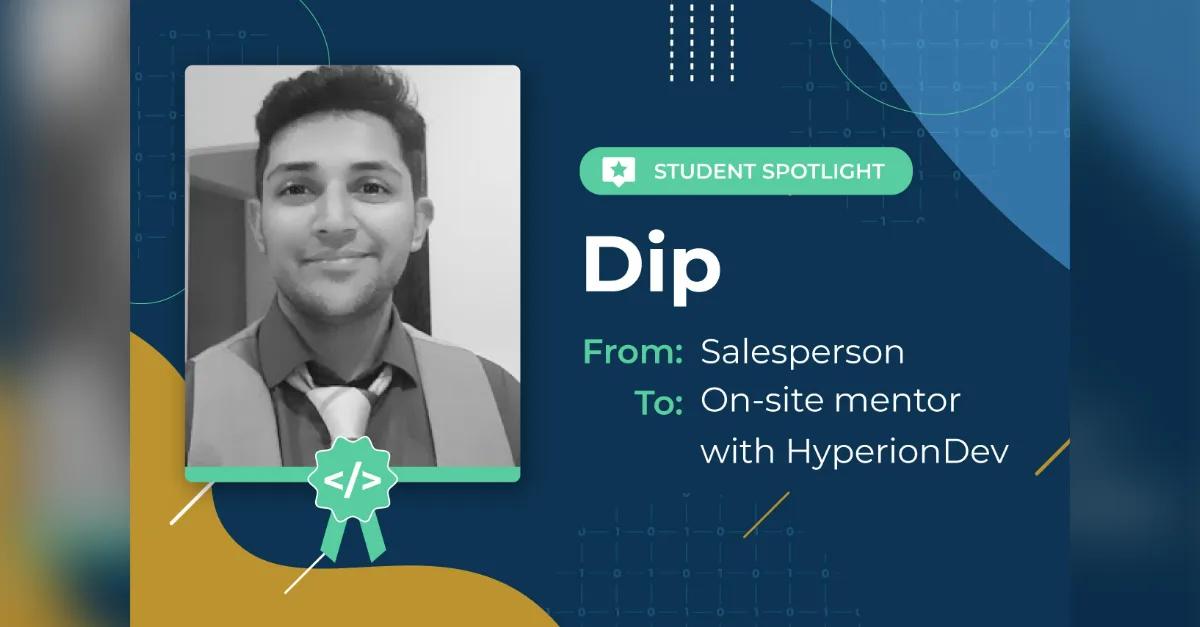
Dip: From salesperson to on-site mentor with HyperionDev
After completing his own Mobile Development Bootcamp, Dip decided to become a HyperionDev mentor himself. Read his full story here.
Dip Rawal, a Johannesburg based sales professional, looking for a drastic career change decided to sign up for a Mobile Development Bootcamp with HyperionDev. After years of experience, he saw little long-term growth in the retail industry; however, the demand for mobile developers, particularly Android with Java skills, was clearly climbing. It was the ideal time to deep dive into the lucrative and fulfilling world of programming. It wasn’t the first time that Dip had decided to enrol on a course. How did his HyperionDev course compare with previous courses he’d taken? He says:
Other courses have frequently included too much theory. I’d be asking, “Why am I learning this?”, but my experience with a HyperionDev course was totally different. They get you building projects from the start – you’re learning by solving problems. I’d say it’s 95% practical work. Basically, I chose HyperionDev, because it was code focused. I wanted hands-on actual coding stuff and that’s precisely what was delivered.
Now, Dip is working as a mentor in HyperionDev’s Johannesburg campus teaching the full-time and part-time Software Engineering and Web Development on-site courses. Here’s why he chose to work at his alma mater.
Their vision is to skill-up individuals to get them working in the economy. I was very keen to be part of that vision. I also think their content is great and I wanted to play my part in delivering their awesome content to students.
Each student is assigned a mentor when he or she enrols on a HyperionDev course. When it comes to learning coding, mentorship is particularly useful for learning best practice coding. This means you’re likely to avoid common stumbling blocks.
Dip’s own mentoring experience on his bootcamp was a very positive one. He says:
I could solve about 50% of the stuff myself, but when it came to the trickier parts, my mentor nudged me in the right direction. Also, I could ask my mentor something at any hour, and I’d be sure to receive a quick reply. Mentors are expected to respond within 48 hours for part-time students and 36 hours for full-time students.
In fact, his mentoring experience proved vital in shaping how he approached the mentoring of his own students who are learning coding. His philosophy is to guide rather than merely to instruct students.
I try to let them find the answers rather than just telling them what to do. Solving tasks should aim to be open-ended.
Dip loves it when his students “finally crack the code”. He says that one student even referred to it as “the proudest moment of his life” when he got the hang of some coding. So what’s his advice for newbie programmers?
My advice to students is just to persist. Everyone gets stuck at times, even in the real world. Just because you can’t solve a task immediately doesn’t mean you’re not a software developer – keep persisting. And don’t be afraid when you see code. It’s all about using your toolbelt (or programming fundamentals) to solve something.
If you’re keen to upskill or you just want to enter the in-demand field of tech (no previous experience necessary), HyperionDev offers online bootcamps in Full Stack Web Development, Data Science or Software Engineering. You can also trial one of these courses for free. If online learning is not your thing, you could join a face-to-face Web Developer or Software Engineering course in Cape Town or Johannesburg. Start your career change today.
Student Success Stories
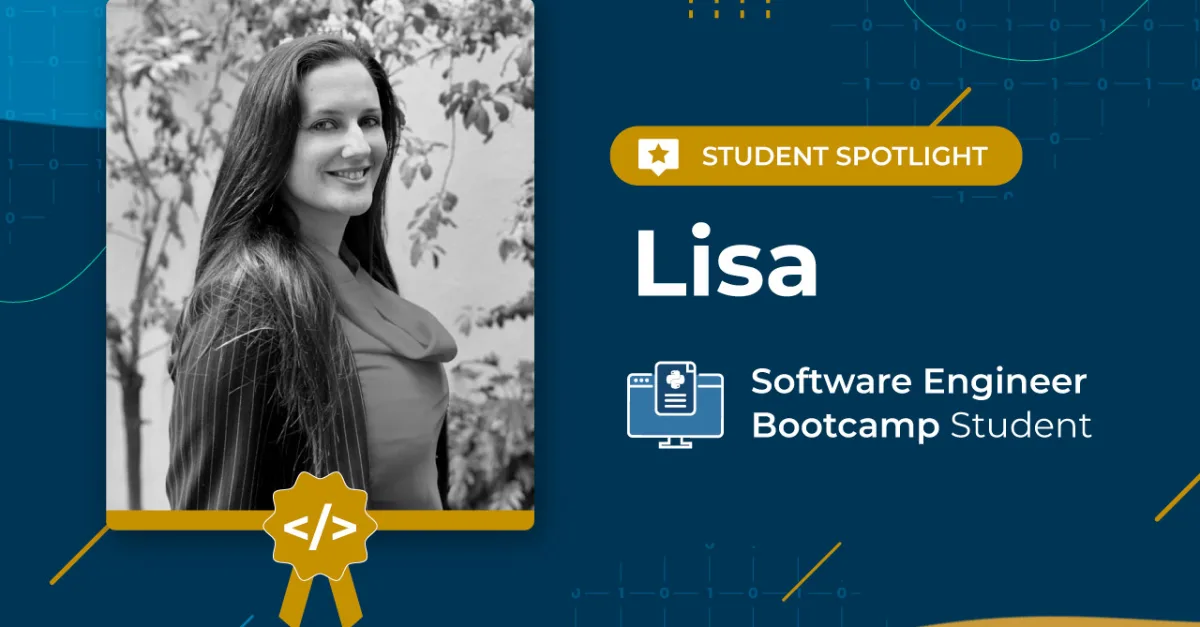
Student Spotlight: Lisa Kelbe – Software Engineer Bootcamp Student
After completing an MSc in Biochemistry, Lisa decided to take her education further. Find out how she’s experiencing her HyperionDev Software Engineer Bootcamp.
29-year-old Lisa Kelbe, from Cape Town, is currently enrolled on the on-site HyperionDev Software Engineer bootcamp, which includes Python, Java, Object Oriented Programming and machine learning. It’s a career at the heart of the digital economy, with endless scope for growth. Lisa had previously completed an MSc in Biochemistry. Here are her reasons for choosing this particular coding course.
“I know most companies need programmers, so I’m keen to develop these in-demand skills. Also, I want to travel and I know there are overseas work opportunities for those with programming skills. Lastly, I want to make a meaningful contribution in my field. Computer science is growing in every industry and biology, one of my fields, is no exception to this.”
As far as her actual course goes, Lisa is finding the experience a very positive one. She sums it up like this:
“The tasks get progressively more challenging as you add more programs, but the pace is perfectly suited to your ability.”
And of course all HyperionDev courses include both personalised mentorship and code review. A code reviewer helps with knowledge transfer to the author of the code. The code reviewer analyses the code for correctness, readability, documentation, efficiency, etc. Lisa really enjoys the code reviewing process at HyperionDev. She says:
“It’s great, because it showed me alternative ways of solving programming challenges. I’ve also found my code reviews to be very supportive, because I can then see if I’m on the right or wrong track.”
Check out Lisa’s story on how she enjoys her HyperionDev on-site campus experience in Cape Town.
Lisa studies on-site at HyperionDev’s Woodstock campus. Here she has access to her 1:1 mentor, Thabang Bhili. As far as the learning experience goes, she describes it as “personalised”. And it seems that she experiences the best of both worlds. Says Lisa:
“Although I like working things out for myself, it’s also ideal to check in with a mentor to find out whether I’m on the right track.”
Where does Lisa see herself in five years’ time? She acknowledges that the future in computing offers endless possibilities, specifically those offered by AI or Artificial Intelligence. She says:
“I want to biochemically map pathways in cells in drug development. Chemical reaction mapping is an emerging field within biology. The knowledge and skills I’ve picked up at HyperionDev will definitely help me reach that goal.”
If you’re keen to upskill or you just want to enter the lucrative and in-demand field of tech (no previous experience necessary), HyperionDev offers online bootcamps in Full Stack Web Development, Data Science or Software Engineering. You can also trial one of these courses for free. If online learning is not your thing, you could enrol in an immersive face-to-face Web Developer or Software Engineering course in Cape Town or Johannesburg.
The last word needs to go to Lisa. Would she recommend her coding course to others? Her response is in the affirmative. She says:
“I would recommend HyperionDev to pretty much anyone who wants to further their knowledge of coding, even if you’re a beginner. It’s an excellent course, because, in a relatively short time, you will come out with a firm understanding of many concepts.”
News & Announcements
May 28, 2019
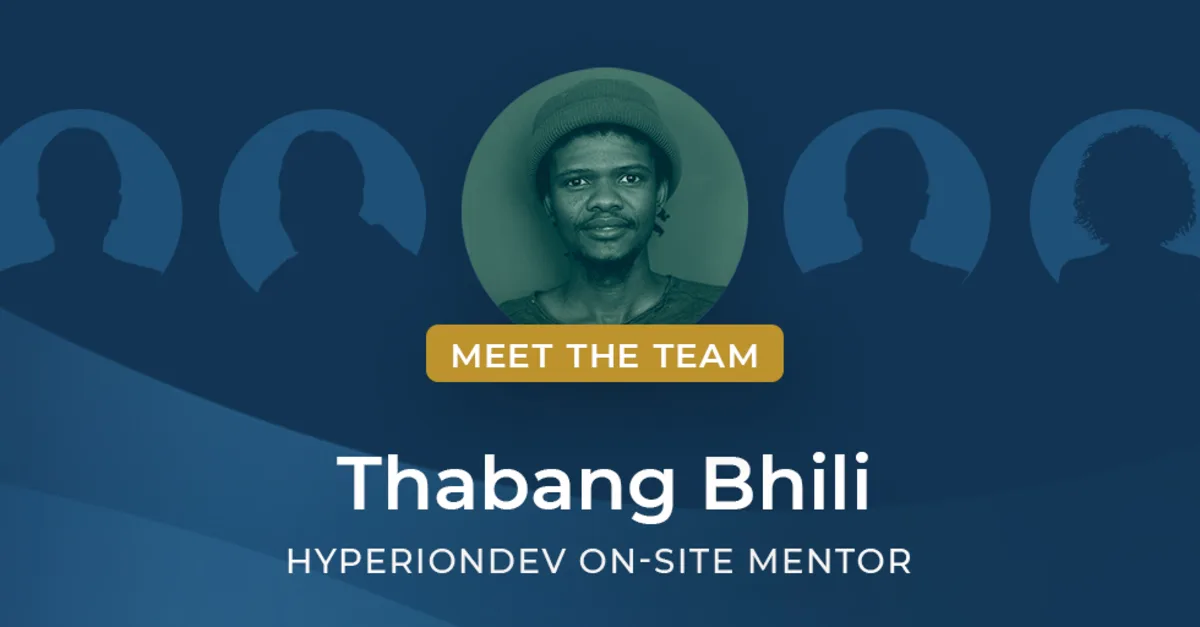
Meet the team: Thabang Bhili
Meet the team and find out about code reviewing and mentoring from HyperionDev’s team member Thabang Bhili, who is an on-site mentor for the Cape Town campus.
If you enrol on a HyperionDev Web Development or Software Engineering bootcamp at one of their on-site campuses, either in Cape Town or Johannesburg, you’ll have access to your own code reviewer and personalised 1-1 mentor. Let’s meet the team. Thabang Bhili does code reviewing and mentoring for HyperionDev’s on-site bootcamp in Cape Town; let’s find out what he does day-to-day.
Before becoming an on-site mentor and code reviewer for HyperionDev, Thabang graduated from the University of Cape Town with a double major in Computer Science and Business Computing. He then went on to do data analysis for research institutes, software engineering for two non-governmental organisations, as well as mentoring at the Community Development Forum. It was only after these job experiences that he became involved in code reviewing for the HyperionDev online bootcamps in Mobile Development and Software Engineering. What does code reviewing entail? A code reviewer needs to consider the following – code quality, code defects or errors and if there are new or better solutions to the problems at hand.
Professional code review and feedback is certainly part of Thabang’s day-to-day tasks, but it’s not all that he does. He says:
When it comes to mentoring, it’s very important to me that I understand a student’s goals and what he or she wants to achieve from the bootcamps. I find it very fulfilling to work collectively towards achieving those goals. Sharing knowledge and exchanging ideas is productive and mind broadening for both the mentor and the student.
So what kinds of students make good coders? According to Thabang, two things are particularly important.
Firstly, when it comes to learning, it’s integral to love what you do or at least to learn to love it. Secondly, temperament is integral: you need patience and the correct temperament to make the most of the less stimulating foundational work. Once that’s been mastered, you’ll have the ability and skill to think like a coder and, ultimately, to become a good coder. Learning the fundamentals is a key building block to more advanced concepts.
Thabang also points out that the students’ motivation levels tend to be very high on the HyperionDev on-site programs. This makes for an excellent class dynamic. But perhaps this has more to do with Thabang’s skills as a mentor. He says:
Of course ability is important, but to be a good coding mentor it’s necessary to understand people. Working with people comes naturally to me – perhaps because I have a history of working and leading in mass organisations. Some of my students even refer to me as their “friend”.That’s a consequence of the genuine connections we have created.
In his spare time, Thabang enjoys the good things in life like a good beer with friends over jazz or deep house. He enjoys playing chess, talking about ideas and participating in activist spaces.
HyperionDev offers both full-time and part-time on-site bootcamps. These programs merge a world-class mentor-led online learning environment with face-to-face classes. It’s the best of both worlds. You have access to the physical campus to attend group lectures, meet your programming colleagues and have in-person guidance and support; simultaneously, you have the opportunity to submit work through the online platform that will be graded by a professional code reviewer. And while you’re not on campus, you can enjoy the support of live chat, email, phone and video call. You’ll also receive post-bootcamp career support in the form of career coaching, intensive interview preparation and access to lucrative hiring networks. Says Thabang about the on-site experience.
Students have access to a mentor who exposes them to different programming paradigms and approaches. The goal is to get the mindset right, including thinking like a programmer in order to ultimately become one.
To find out more about HyperionDev’s on-site bootcamps in Software Engineering or Full Stack Web Development, schedule a call with a HyperionDev career consultant today.
Student Success Stories
Anneke: From Teacher to Front-end Web Developer
After teaching in schools for 9 years, Anneke couldn’t ignore her passion for coding. She is now a front-end web developer in the UK. Read her full story here.
Anneke graduated from UCT with a Bachelor of Music in Education, as well as a PGCE (Postgraduate Certificate in Education), and taught in schools both locally and internationally for 9 years. However, she found she couldn’t ignore her passion of becoming a web developer. She says:
I always had a love for computers and gaming, and became more and more inquisitive over the years about how websites and software development work. I decided to take a leap of faith and leave my comfort zone in teaching, and start studying programming.
Anneke came across HyperionDev online. Aside from the positive reviews, she felt comforted that she would be rewarded with a certificate at the end of her bootcamp. She also knew she’d be assigned a one-to-one mentor for when she found herself in a coding corner – a not uncommon experience for a newbie developer. Throughout a HyperionDev course, a personal mentor is there to review your code and be there if a student ever feels stuck.
I was allocated an amazing mentor. Valerie was always so kind and patient, and there to help whenever I needed her. Having the one-to-one mentorship was one of the reasons why I chose to do my course with HyperionDev, and Valerie has been an absolute star and amazing teacher.
Anneke enrolled on HyperionDev’s Full Stack Web Developer Bootcamp. She acknowledges it was a jump in the dark, but explained she felt comfortable making the leap due to her relationship with Wessel Bosman, her brother-in-law.
He’s an extremely talented and knowledgeable software developer, working in the UK. Through talking to him and watching him, my passion grew to a point where I actually wanted to take it seriously and start pursuing a career in web development. He, together with my family, gave me the guts to take a leap of faith and move into the tech world.
Where’s Anneke now? She’s currently a junior front-end web developer at Pole Star in the UK, even though she still hasn’t yet completed her bootcamp. (Due to time constraints, she is yet to finish her bootcamp, although she is close to achieving this goal.) She started applying for jobs during her bootcamp and due to her good foundation in JavaScript, which her company required at the time, she got lucky.
She says about her job experience:
For the first 2 months I was the only front-end web developer, so the pressure was on and the experience gained was profound! I have mostly been modifying and building onto existing code to ensure a pleasant and visually appealing user interface for users. I absolutely love working for this company, and have been offered support and welcoming arms from the very beginning. I am very blessed to be a part of this awesome, talented team and the amazing things we build together.
Anneke acknowledges she couldn’t have done her current job without her HyperionDev training. HyperionDev courses are structured to include several practical assignments, as well as various niche capstone projects, where students can apply their learning, allowing them to build up a portfolio of their work while studying.
The coursework has definitely helped prepare me, and the knowledge I have gained from studying full-stack has also helped me understand the back-end and how it works together with the front-end, which is crucial for my job. I loved being exposed to different languages and frameworks. Being thrown into the deep end however is the best way to learn, and Google very quickly becomes your best friend!
Anneke has really carved out a new life for herself. Her one piece of advice to someone looking to move into a new career in programming would be the following:
Take a leap of faith and do it! If the passion is there, go for it. In today’s ever-changing, tech-orientated world, what have you got to lose? Be a part of the change!
Want to be a web developer like Anneke? Register for a free trial on our Full Stack Web Developer Bootcamp and switch careers within 6 months. Alternatively, you can enrol on an immersive, face-to-face Full Stack Web Developer course.
Career Advice
Infographic: CS degrees vs bootcamps
If you’re thinking of entering the lucrative field of technology, what’s the best route of study to take? Here we consider CS Degrees vs Bootcamps - how they differ with respect to salaries, course content, duration, dropout rates and time taken to land a job.
If you’re keen to enter the in-demand tech field with its excellent salaries, you need to ensure you have the appropriate skills. You could upskill via a Computer Science degree or a Bootcamp, but which one would better serve your needs? We analyse these two educational routes by looking at course content, potential salaries once you’re finished studying, duration, dropout rates, and more. Take a look below for a comprehensive infographic on CS degrees vs bootcamps.
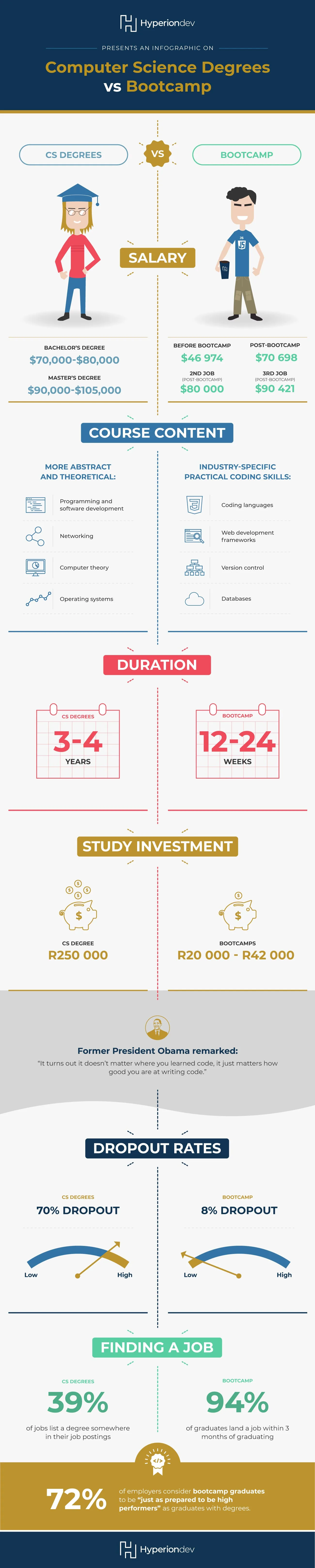
Career Advice
In a world of job automation is programming safe?
We know that automation is likely to impact on many jobs. But what about programming? In a world of job automation is programming safe? We discuss what kinds of coding skills will see you holding onto your job for many decades to come.
As we head towards 2020, it’s more than reasonable to ask whether your job will still be around in the next decade or two. Job automation is happening across a vast range of fields. Breast cancer detection, for example, can be done via neural networks, which have been trained to pick up cancer signs from past viewing of tens of thousands of mammographic images. Even the creative fields aren’t safe, take Magenta, for example: a machine learning library from Google that can computer generate new music. In a world of automation is programming safe? We look at the likelihood of programming remaining an in-demand skill.
Hitting hard
Let’s start by looking at where job automation is likely to hit hard. Bookkeepers, for example, have a 97.6% chance of being automated. In contrast, mental health and substance abuse social workers have only a 0.3% chance of being automated, because their jobs require high levels of original thinking, negotiation and helping others.
What distinguishes one job from another? It seems four variables are at play: does your job require that you come up with clever solutions, do you have to personally help others, does your work require negotiation and, interestingly, does your occupation require you to squeeze into small spaces (i.e. jobs that are routine, repetitive and predictable)? Here are four graphs depicting these results.
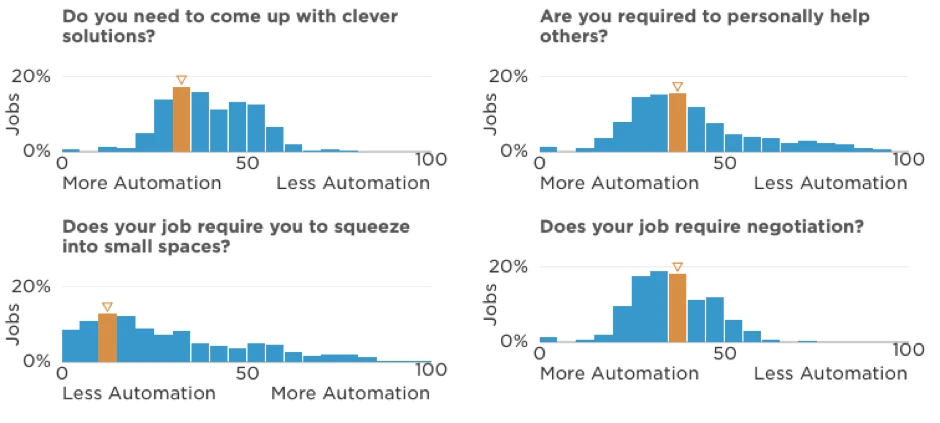
Image source: https://www.npr.org/sections/money/2015/05/21/408234543/will-your-job-be-done-by-a-machine
If you want to calculate the chance of your job being automated, check out the ‘Will Robots Take My Job’ site. Software developers seem safe with a 4% probability of automation and a projected growth of 19% by 2024. However, over time, within the next two decades specifically, there is a 31% chance of automation.
There is some risk
Mario Peshev, the CEO of DevriX and a digital consultant, on the Forbes website says: “A certain portion of the software development industry will become automated and obsolete to some extent”. This is more likely to happen where elements are repetitive or could be bundled together. But, the software development industry “isn’t going anywhere,” especially where custom work and innovation is required.
A joint project between Microsoft and Cambridge University called DeepCoder is suggestive of this future, particularly where repetitive programming is found. DeepCoder can search a body of code to build a specific project to spec. As the system practises, it gets smarter, learning which bits of code work best together and when to replace a snippet of code with another.
But the future isn’t too bleak. Although systems like DeepCoder have some code development potential, this isn’t going to take away the jobs of developers, according to Armando Solar-Lezama of MIT. Rather, a combination system is likely to develop: developers will focus on more complex tasks while the more tedious aspects of code development will be automated.
So what kinds of software developers will be in high demand over the coming decade? Here we list three attributes:
Flexible
Programmers who embrace flexibility are in a stronger position. This would include being able to develop custom features, integrations, tailored admin, and user areas that are specifically adaptable for given industries.
High-performing
You will need coders who can help with a variety of performance issues as they relate to software applications – for example, where you are bundling together a number of tools or solutions, or where there is a massively large volume of users or data.
Knowledgeable about security
In any application, there is always a relationship between security and freedom of use. The more secure an application, the more steps or restrictions it includes. So ‘off the shelf’ solutions are, as a general rule, either super secure or usable but vulnerable. However, if you want something highly secure and usable, you would require a customised solution and people capable of implementing this.
There is a growing demand for the job role of cyber security specialist. From 2016 to 2026, the Bureau of Labor Statistics anticipates a 28% increase for work in this category. That’s faster than the average growth for all occupations in the US.
In conclusion, think about the future – what will smart homes, transport networks and the work environment look like? As technology continues assisting us in our day-to-day lives (and environments), you will need people who are able to design and implement it. Even if we think of a world with automation handling 90% of the tools, components and libraries out there, you will still need millions of software developers who can support, extend and integrate these solutions. Job automation is likely to hit hard, but software developers appear relatively safe.
If you’re keen to change careers or upskill, consider enrolling on a HyperionDev online bootcamp in Full Stack Web Development, Data Science or Software Engineering. You can also trial one of these courses for free. If online learning is not your thing, you could enrol in an immersive, face-to-face Web Developer or Software Engineering course in Cape Town or Johannesburg. Python is included in the Software Engineering and the Data Science bootcamp.

Career Advice
Big salary increases in tech in South Africa
South Africans can expect, on average, a salary increase of approximately 7% in 2019. However, in tech, salaries fare much better with predictions of increases above 10% in 2019.
I’ll buy you a diamond ring my friend if it makes you feel alright
I’ll get you anything my friend if it makes you feel alright
Cos I don’t care too much for money, and money can’t buy me love’ (Beatles song)
We all know money can’t buy you love, but it sure can buy you a whole lot of other things. Not all South African salaries are on the up, but the good news is that tech salaries certainly are. We look at which tech skills are in demand, and how you can enjoy a slice of this lucrative pie.
Not all doom and gloom: tech salaries in South Africa
The average South African can expect a year-on-year salary increase of 7% from 2018, according to online job aggregator Adzuna, which recently published their 2019 salary report. The stats are based on analysing more than 100 000 online job listings. Although the increases are inline with some predicted inflation rates in South Africa, they are still way below expected price hikes in other areas, such as electricity, predicted to be 14% higher this year than last year, petrol, medical aid membership (for example, some Discovery schemes will cost 9% more), and school fees, states Business Insider.
However, it’s not all doom and gloom. Here’s a graphic depicting wage increases in the various sectors. Of the 10 sectors analysed (not all are listed below), IT came out top with wage increases predicted to be above 10%.
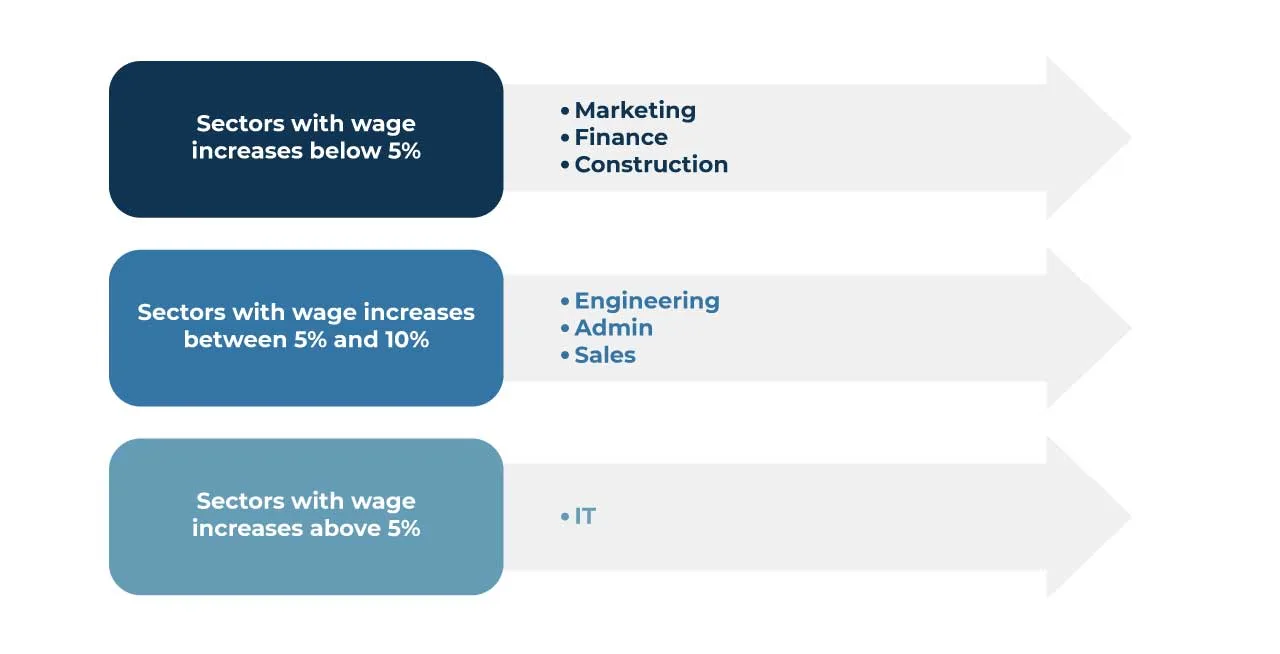
Image Source: https://businesstech.co.za/news/business/305576/these-are-the-best-earning-professions-in-south-africa/
Jesse Green, South Africa’s Adzuna manager, says: “As AI rises in business and society, the demand for employees with tech skills and knowledge continues to skyrocket, and the salaries for these jobs reflect the same principle”.
Web developers earning 15% more in 2019
If you’re wondering which tech salaries in South Africa are the highest, you may want to consider web development. These specific skills, states the Adzuna study, earned developers 15% more than they were getting in 2019. Here’s a table showing the highest-earning professions in South Africa. You can see how many of them require tech skills, including ‘php developer’, ‘web developer’, ‘designer’, ‘developer’, ‘net developer’, ‘software developer’, ‘analyst’, ‘technologist’ and ‘java developer’.
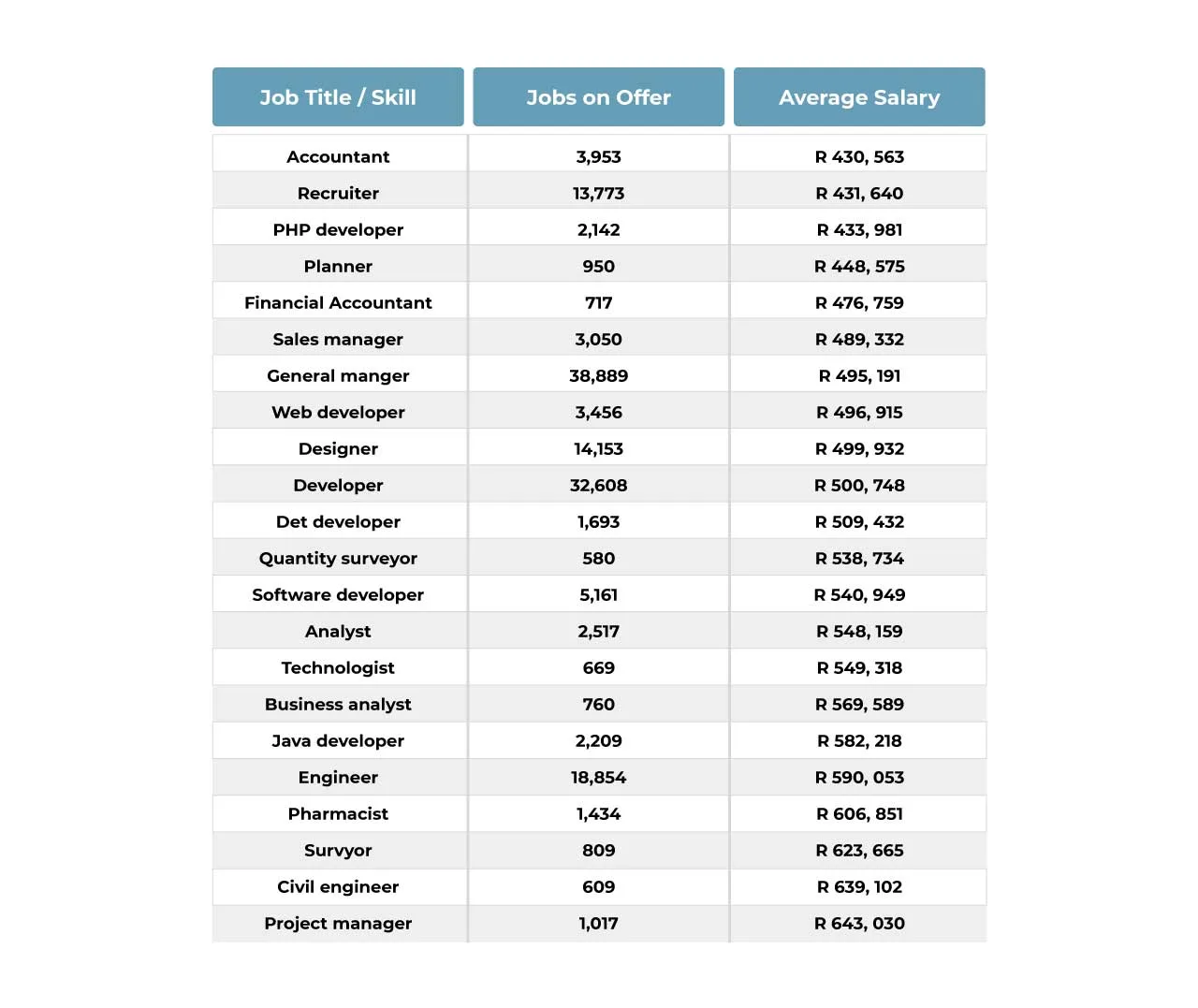
Image Source: https://businesstech.co.za/news/business/305576/these-are-the-best-earning-professions-in-south-africa/
Highest-paid programming languages
It’s worth finding out which programming languages offer the highest salaries. OfferZen, a South African recruitment company, has conducted some research in this area. You can see that, on the whole, those who know Python and Ruby earn the higher salaries.
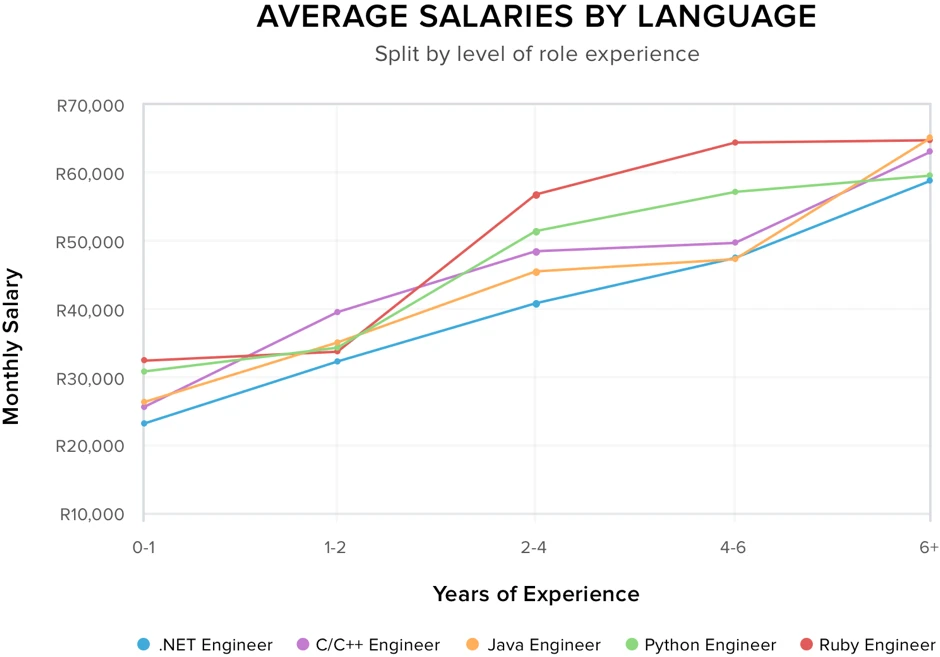
Image Source: https://www.offerzen.com/blog/developer-salaries-for-different-programming-languages
It seems that Ruby and Python developers earn between 15% to 45% more than other developers assuming they all have the same level of experience. Python and Ruby tend to be less commonly-taught languages than some of the others, states OfferZen, and scarcity obviously creates higher demand.
In conclusion, tech salaries in South Africa are enjoying significantly higher increases than other salaries in different industries. If you’re keen to change careers or upskill, consider enrolling on a HyperionDev online bootcamp in Full Stack Web Development, Data Science or Software Engineering. You can also trial one of these courses for free. If online learning is not your thing, you could enrol in an immersive, face-to-face Web Developer or Software Engineering course in Cape Town or Johannesburg. Python is included in the Software Engineering and the Data Science bootcamp.
Still have questions?
Contact our Admissions Team, and a real person will get back to you.