
Our latest insights
Read the latest insights

Career Advice
Top 5 open source projects on GitHub in February
Used by over 31 million developers, GitHub is a place for developers to collaborate on projects. Here we list the top five open source projects on GitHub in February 2019.
GitHub is a globally recognised software development platform and is popular amongst developers when creating and sharing coding projects. The platform is home to over 31 million developers. Most of the developers, 80% in fact, come from outside the United States. With so much action, what are the top five open source projects on GitHub in February 2019?
Firstly, just a quick recap: GitHub is a site where developers can store their projects and work with other like-minded individuals. It’s clearly an excellent place to collaborate, which happens via Pull Requests that let you notify others about changes you’ve pushed to a GitHub repository. Interested parties can then check out these changes and propose potential modifications (read here about how to create a Pull Request). Also, like Microsoft Word or Google Drive, you can maintain a history of your code – with new iterations, you don’t lose previous versions.
So without further ado, here are the top five open source projects on GitHub in February 2019.
Interestingly, the most popular repository this month is a collection of full-stack resources for developers. The goal is to make you a more proficient developer – included are timeless classics and inspiring resources. There’s also a list of must-read books and articles, as well as many other resources including stuff on developer environments and tools, debugging, interviewee resources, databases, and much, much more. The repository is very comprehensive. And of course you can also contribute your own recommendations.
This project is an intriguing one. The goal is to train a NSFW (Not Suitable For Work) Image Classifier via a collection of scripts, which will categorise tens of thousands of pulled images according to these categories:
- Porn
- Hentai
- Sexy
- Neutral – safe for work neutral images of everyday things and people
- Drawings – safe for work drawings
This project requires Java runtime environment knowledge, as well as the Linux command line tools.
If you’re interested in getting involved in e-commerce, this project might be just the thing you’re looking for. Fescar is an easy-to-use, high-performance, Java based, open source distributed transaction solution. Contributors are welcome to join the FEATS project. You need to check out CONTRIBUTING about how to contribute to this project.
Here’s a cool 2019 February GitHub project – a repository of awesome podcasts which are helpful for software engineers and programmers. You’ll find stuff on .Net, Agile, Android, C++, relevant career interviews with developers and CEOs, Data Science, Machine Learning, Devops, Python, etc. It’s a fantastically long list, so there’s sure to be something that grabs your attention. In true GitHub style, you can also add new podcasts to this extensive list.
React is a tool for building User Interface (UI) components. In essence, it’s a JavaScript library created by Facebook. This GitHub project is an app that will help you learn the fundamentals of React. You need to install this application locally – there’s a guided tutorial, as well as exercises. Once more in the GitHub tradition, if you see any inconsistencies as you go through the exercises or if you have an idea about how to make the overall tutorial better, you can open a PR or Pull Request.
We’ve mentioned the top five open source projects on GitHub in February 2019. You can also check out the trending repository on GitHub to see what the community is most excited about on a daily basis. To brush up on your coding skills, consider enrolling on a HyperionDev bootcamp in Full Stack Web Development, Data Science or Software Engineering. You can also trial one of these courses for free.

Career Advice
Top 5 online coding bootcamp scholarships
Funding your bootcamp to change career to tech shouldn’t have to cost you an arm and a leg. Check out our list of the top online coding bootcamp scholarships.
Coding bootcamp tuition can range from $9,000 to $21,000, according to Course Report, although online coding bootcamps are more cost effective. For this kind of bootcamp you can enrol for as little as $3,000. To find the required financing, you may want to consider online coding bootcamp scholarships. Many schools offer such scholarships, particularly if you belong to an under-represented group, such as women or persons of colour, in the tech industry.
Remember, there’s no harm in asking your preferred bootcamp provider about scholarships – the worst thing is that you’ll be met with a ‘no’. Scholarships are often based on a student’s background, merit or need. Here we’ll list some of the top online coding bootcamp scholarships.
This coding bootcamp offers face-to-face programs in Software Engineering and Data Science in a variety of locations, including NYC, Brooklyn, Washington DC, London, Atlanta, Seattle, etc, as well as online courses.
They offer a variety of scholarships aimed at fostering diversity – women, minorities and veterans are encouraged to apply – as well as merit-based scholarships. Their Lifelong Learning Scholarship starts at $1,000 with a rolling admissions process. There’s also a Houston Heroes scholarship for all veterans and their family (to transition into the civilian workforce) for their face-to-face course at their Houston campus. It’s valued at $5,000.
- HyperionDev Merit Scholarship
HyperionDev offers the following online coding bootcamps: Full Stack Web Development, Data Science or Software Engineering. They all take place part-time with your own personalised mentor. You can also trial one of these courses for free.
HyperionDev is always on the lookout for those deserving a little extra help. Perhaps you’re one of them. They want to assist people who are passionate about becoming developers, because they know there is a high demand for these skills in the job market.
If you’re someone who possesses grit, determination and a will to succeed, you might be the ideal candidate for a HyperionDev Merit-Based scholarship. To be in line for this scholarship, schedule a call with one of their Course Consultants.
Fullstack Academy offers an immersive web development bootcamp (as well as other courses) with campuses in New York City, Chicago as well as online through their platform. The courses range from 13-week to 28-week courses.
The school offers a variety of scholarships including partial tuition for their remote immersive students. To qualify for this scholarship, you need to state why you’re interested in a software engineering career and you’ll have to collect references on a Facebook campaign page. There are also a variety of needs-based scholarships as well as those aimed at women and veterans.
Located in San Francisco, this all-woman school offers a variety of programs, such as Software Engineering and Full Stack Web Development. Students are eligible for $1,500 off their Software Engineering Program once they’ve completed the Prep course. Alternatively, learners can complete an Online Python course and are then eligible for a $695 scholarship off further tuition.
In addition, there’s the Hackbright Phenomenal Woman Scholarship, which offers $8000 to two phenomenal women who demonstrate incredible technical ability and dedication to pursuing a software engineering career. Scholarship applicants will be evaluated based on a technical work sample and performance on the technical interview based on a rolling admissions process.
General Assembly offers courses in web and mobile development, product management, data science and more, online and in-person, across 15 campuses on 4 continents.
The school offers a variety of scholarships including a scholarship of $10,000 towards their Web Development Immersive program. They also offer two full scholarships, $14,950 each, for women. Plus, there are various scholarships through their Opportunity Fund. Upon acceptance to a course, students should ask their admissions consultant for a fellowship application if interested.
In conclusion, we’ve listed some of the top online coding bootcamp scholarships. Here are other excellent ideas for funding your bootcamp. If you’re keen to change careers this year, don’t let finances stand in your way. Where there’s a will, there’s a way, and scholarships might just be your ticket to getting there.

Data Science
Top 5 machine learning libraries in Python
There is a wide variety of machine learning libraries available for data scientists working with Python. Here are our top five Python ML library picks.
The Python programming language is widely used in data analysis and machine learning, and that means there are plenty of machine learning libraries available for data scientists working with Python.
Machine learning libraries and frameworks are designed to make it easier to implement machine learning models. You can use them to streamline the process of acquiring data, training models, making predictions and refining your future results.
Which of the available libraries should you be relying on when working with data? Here are our top five picks:
NumPy stands for Numerical Python. It was originally an extension for Python called Numeric, developed by Python creator Jim Hugunin and several other contributors. In 2005, data scientist Travis Oliphant incorporated extra features and modifications into Numeric, to create NumPy.
NumPy is open-source software with more than 500 contributors. It’s one of the most fundamental packages, and is part of Python’s SciPy Stack. Some features of NumPy include:
- Support for large, multi-dimensional arrays and matrices
- An extensive collection of high-level mathematical functions to operate on these arrays
- Linear algebra capabilities
- Tools for integrating C, C++ and Fortran code
The Pandas package is designed to work with labeled data and relational data. It makes data manipulation, aggregation and visualisation quicker and easier. Panda currently has over 760 contributors.
Matplotlib, like NumPy, is part of the SciPy Stack core package. It’s a Python plotting library, which can be used to produce figures in hard copy and interactive formats. This library makes it easy to generate publication-quality visual representations of data – including bar graphs, scatterplots, histograms and more – using just a few lines of code.
Matplotlib was written by John D. Hunter, who was succeeded by Michael Droettboom and Thomas Caswell before his death in 2012. The library has an active development community with more than 580 contributors.
This Python library is considered one of the best libraries for working with complex data. Scikits are additional packages of the SciPy Stack, designed to help you with specific functionalities (like image processing or machine learning facilitation). Scikit-learn is ideal for machine learning. It’s known for high performance, quality code and quality documentation.
The Scikit-learn package makes heavy use of SciPy’s math operations. It’s open-source and has a contributor base that’s around 840 strong.
The Natural Language Toolkit, or NLTK, is a platform used to build Python programmes that work with human language data, for use in statistical natural language processing (NLP).
NLTK is an open-source library written by Steven Bird, Edward Loper and Ewan Klein. It was originally written for use in teaching and research in the fields of linguistics, cognitive science and artificial intelligence.
NLTK has a functionality that allows for a lot of different operations. These operations act as building blocks, making it easier to build complex research systems. The platform has nearly 200 contributors.
Learn more about Python and data science
HyperionDev runs a Data Science Bootcamp that will introduce you to Python, its various applications and most useful machine learning libraries. The online bootcamp covers the following:
- Introduction to programming (with Python)
- How to define functions to solve problems with data
- Object oriented programming
- Natural language processing
- Working with relational data
- Data analytics, exploration and visualisation
- Supervised and unsupervised machine learning
This comprehensive course will also explore the uses of data science libraries including NumPy, Pandas and Scikit-learn. This is an opportunity to build your data science skills and launch a career in the lucrative, in-demand data science industry.

AI Engineering
How AI is being used to stop Netflix account sharing
A new AI system to help curb Netflix account sharing has just been unveiled, and this is just one fascinating example of how AI and data science are revolutionising business.
Netflix account sharing is a sneaky way of allowing more people to access Netflix and view content without paying for their own accounts. While it’s not considered an above-board thing to do, many people simply don’t see any harm in sharing their streaming accounts. In fact, a recent survey showed that 35% of young adults in the Millennial age group admit to sharing their account login details with multiple users outside of their homes – not only for Netflix, but for other popular streaming platforms like Hulu and Amazon as well. As a result, these streaming services are of course losing a lot of potential revenue.
Now, Netflix is harnessing the power of artificial intelligence to help them crack down on account sharing. Video delivery software and solutions providers Synamedia recently unveiled an AI system created to track down any accounts that share their login information with others.
How it works
The Synamedia software works by analysing geolocation data. (Geolocation is the identification of a device’s real-world geographic location.) The AI analyses this data to determine which accounts are logged in at any one time, and where they are logged in from. By doing this, they can pick up discrepancies and identify which users are sharing their credentials. These accounts will then be flagged.
This AI can identify not just location, but location type as well (e.g. home, office or vacation destinations). This helps the company to figure out whether businesses are using the streaming service to make money (for example, viewing parties in public venues like bars and restaurants).
Ultimately, the aim is to stop Netflix account sharing and convince more users to become paid subscribers. However, customers who want to continue sharing (and paying for) Netflix services for their other family members, or even for close friends, can opt to pay for a premium additional fee that covers multiple users at different locations.
Data science is changing the way we do business
This is just one innovative example of how collecting and analysing data can help modern businesses to be more efficient, offer more targeted services, and generate more revenue. For example:
- By analysing geolocation data captured via mobile devices or wearable technology, marketers can see which advertising efforts are attracting attention, and which types of consumers they’re attracting.
- AI and predictive analysis can be used to analyse a consumer’s location history and personalise location-based offers based on that history.
- “Geofencing” can be used to create a zone around a business for advertisement targeting; so advertisements for that business will appear on mobile phones and devices within that zone.
- Brands can even use weather data to advertise specific products and services based on the weather conditions in their location.
A closer look at data science
Data science is the use of statistics and scientific systems to extract meaningful information from large amounts of complex data. Data scientists use AI and machine learning to analyse huge amounts of raw data, and use these analyses to provide businesses across many industries with valuable information and insights.
Qualified data scientists are in high demand, so if you’re thinking of entering a career in this fascinating field, now is the perfect time to take the plunge.
HyperionDev now offers a comprehensive 6-month Data Science Bootcamp that covers the fundamental concepts in data science. This includes programming with Python, as well as data analytics and visualisation, machine learning and artificial intelligence.
The course takes place online, which makes it easy to learn at your own pace. The curriculum also includes one-on-one mentorship and career coaching, so you’ll be better equipped to enter the industry after completing your bootcamp.
Try the free bootcamp trial, or register for the next course starting on 5 February. You’ll get to practise real-world data science, with applications that are just as exciting and relevant as Synamedia’s Netflix account sharing solution.

Career Advice
Why you should learn to code in South Africa
Read about why you should learn to code in South Africa. Key reasons include a high demand for developers, the rise of the gig economy in South Africa and a thriving tech startup scene in major cities.
Speaking at the IMB South Africa annual Think Johannesburg conference, Bridget van Kralingen, the senior vice president for global industries, platforms and blockchain at IMB said that everyone needs to become a coder. Here’s a sobering statistic from McKinsey: about 50% of all jobs could be automated by existing technology, states an Investec article. With these predictions, it makes sense to learn programming or coding skills, but how and where should you do this? We look at why you should learn to code in South Africa.
Not enough developers
South Africa doesn’t have enough developers to build a digital economy, states Quartz. Despite hubs in Cape Town and Gauteng for startups and tech innovators, there is a developer shortage. James Manyika, director of the McKinsey Global Institute, explains that the kind of jobs being automated are not just those requiring physical work but also what he calls “knowledge work” – cognitive tasks like image recognition and data analysis. Think about new jobs that have arisen in the South African and in the global context – uber drivers, 3D printing technicians, social media managers, web designers, etc.
The dire need for programming skills is apparent if one looks at Careers24, one of South Africa’s top recruitment websites, with approximately 680 000 searches performed annually. Shaun Clarke, brand manager of Careers 24, explains on MyBroadband that there is consistent demand in the IT and engineering fields. In IT, vacancies exist in these fields: software developers, .NET developers, IT project managers, QA analysts, system administrators and Java developers.
The gig economy set to rise in South Africa
South Africa is likely to follow the global trend of a rising gig economy, according to Amanda Arumugam, senior associate at Bowmans on BusinessTech. What is the gig economy? It’s a freelance, flexible, on-demand labour market as opposed to the traditional nine-to- five concept of work, explains Arumugam. The idea is that workers are paid for each ‘gig’ they do such as a delivery, writing a blog post or designing a component of a piece of software. The focus is on independent contractors and short-term workers.
In the UK, the gig economy is pegged at around 15,6%, in the US that figure is at 34% with the expectation that it will rise to 43% by 2020. “South Africa will, no doubt, follow suit,” says Arumugam. And remember this: gig workers can often work where they want – e.g. remotely. Think about earning in dollars or pounds while living on rands. (Read more about the advantages of remote work and which companies you want to work for.)
Thriving tech startup scene
According to a Wesgro and Cape Innovations and Technology Initiative report, which interviewed tech startup funders, the Western Cape is perceived as the best place for technology startups, reports IOL. Lifestyle was a key factor mentioned by these entrepreneurs, especially when compared with tech hubs across the continent.
But Gauteng might still catch up. According to a 2018 Ventureburn Tech Startup Survey, Gauteng is home to 55% of tech startups, ahead of the Western Cape’s 37%. However, Western Cape startups tend to be more successful with a higher percentage turning a profit: 36% versus 22% in Gauteng. The bottom line, it seems, is that both cities offer a thriving tech startup culture and South African developers are in a position to plug into these innovation centres.
In conclusion, this article has mentioned a number of key reasons why you should learn to code in South Africa, including a high demand for developers, the rise of the gig economy in South Africa and a thriving tech startup scene in major cities. If you’re keen to find out more about various options – online courses versus computer science degrees – check out this piece. HyperionDev offers the following online coding bootcamps: Full Stack Web Development, Data Science or Software Engineering. You can also trial one of these courses for free.
Student Success Stories
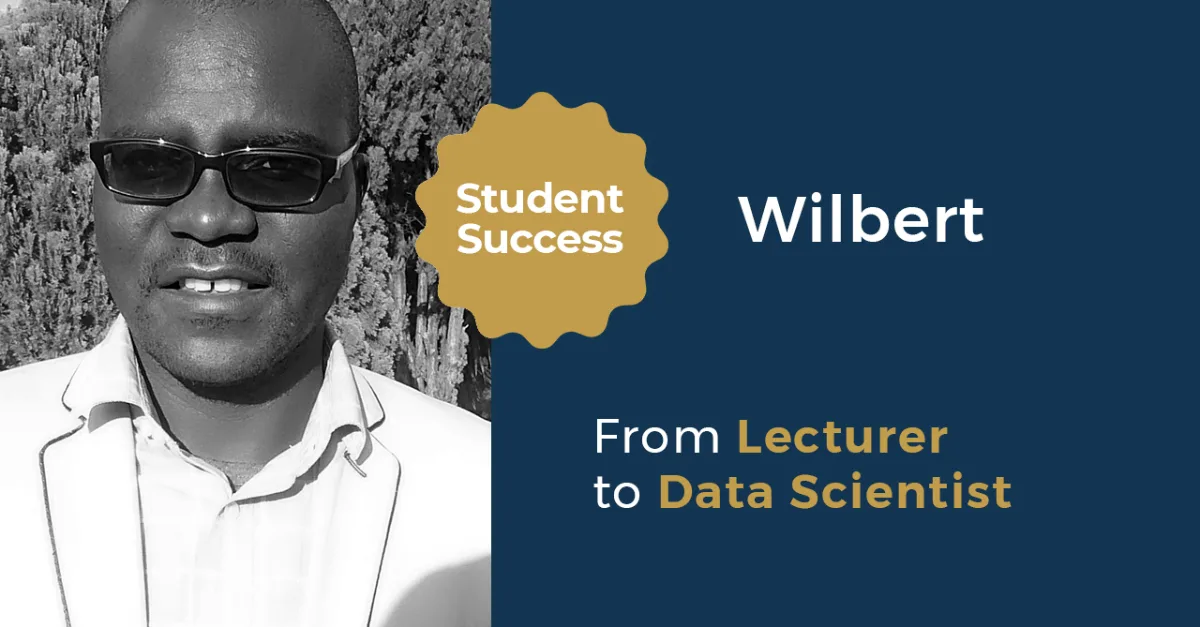
Wilbert: From Lecturer To Data Scientist
Wilbert has previously worked as a lecturer, analyst and data specialist over the last 10 years. He realized that he wasn’t marketable enough to apply for…
Wilbert has previously worked as a lecturer, analyst and data specialist over the last 10 years. He realized that he wasn’t marketable enough to apply for roles as a data scientist, due to a lack of Python skills. Interactions with several recruitment agencies made him aware of the fact that if he wants to become a data scientist, he would need to pursue Python further. That’s when he turned to HyperionDev.
“HyperionDev offered Python [in its data science course] which was ideal since Python is now the dominant data science programming language coupled with several libraries such as R, SAS, Knime, Weka, Orange etc.”
Data science is on the rise with developments such as machine learning and AI (Artificial Intelligence). In essence, the field of data science consists of taking large sets of raw data and converting it into actionable solutions for a business. What made Wilbert decide he wanted to pursue this particular industry as a career?
“I realized that the new sexy job in the world is data scientist and machine learning engineer. Coupled with my current educational qualifications, being a data scientist was a noble idea so I was excited to see where HyperionDev could take me.”
Currently, Wilbert is working as a Principal Consultant in Data Science for EOH in Johannesburg, South Africa. He is developing machine learning models for credit scoring and coaching and mentoring junior colleagues. He also offers data science consultancy services to several clients in the telecommunications, retail and financial industries.
“Within months of completing my HyperionDev course I had landed a job at EOH in Data Science, earning over 40% more monthly than what I was earning before I took the course. The course prepared me incredibly well for this role with EOH; the course’s practical projects in Python improved my set of tech skills, making me marketable to any company as a data scientist”
Wilbert applauds the 1-on-1 mentorship aspect of HyperionDev’s online courses. He says,
“My interactions with my mentor were fantastic and personally, I enjoyed the program. The mentor was always available to assist me, consistently sending me some additional notes and resources if I ever needed it.”
Want to become a data scientist like Wilbert? Register for a free trial on our Data Science Bootcamp and see if a career in this field is right for you.

Software Engineering
Here’s what you need to know about object oriented programming
If you’ve been doing your research on what’s happening in the world of coding and how to go about becoming a professional dev, you will most likely have heard of object-oriented programming. In this article, we look at what object-oriented programming is, and how it’s done.
If you’ve been doing your research on what’s happening in the world of coding and how to go about becoming a professional dev, you will most likely have heard of object-oriented programming. Before we delve into what this means, it may be useful to think of object-oriented programming as the coding version of building a Lego structure piece by piece according to a diagram. It’s a kind of “paint by numbers” way of coding that plans first and codes later. In this article, we look at what object-oriented programming is, and how it’s done.
What is object oriented programming?
Let’s start with a simple definition. According to Margaret Rouse, “object-oriented programming (OOP) is a programming language model organised around objects rather than “actions” and data rather than “logic.” So what is an object? The easiest way to answer this question would be to look at a real-world example.
Let’s consider a “clown” as a real-world object for instance. As a real-world object, it shares two characteristics with other objects – state and behaviour. A clown for example, has a state (a name, a colour, a voice, a smile) and behaviour (laughing, jumping, frowning). Being able to identify these states and behaviours in real-world objects is a very practical way of beginning to understand what object-oriented programming is.
In simple terms, a program is a logical procedure involving logically different objects which communicate with each other according to the rules defined in that program. In other words, a program takes input data, processes that data and produces output data. And as Kelly Eliason explains: “Objects are able to pass, receive messages or process information in the form of data.”
How does object oriented programming work?
When developing with object oriented programming (OOP), the application and everything about how it works, must be plotted out in a series of steps through mind-mapping and diagrams. The first question that every dev must answer is what the application or program must be able to do and how it will function. They will need to answer important questions around who will use the program, how they will access it, how much control they will have over the data in the system and how data will be stored in the system. This can prove very time-consuming, but this step is essential.
Another consideration that the dev will make is which classes will need to be included in the program. Examples of a class include users, schools, colours, sizes etc. These classes will make up a system, which the dev will organise into a class diagram. Doing this enables the program to make more visual sense. Once the planning is complete, the dev begins the coding process. This method can be compared to building a house from blueprints.
Three different authors and their take on the benefits of object oriented programming:
- Robert Half: Object-oriented programming is a very practical way of coding that will become second nature once you get the hang of it. It’s a technique that allows devs to break their programs down into bite-sized problems that can be solved one object a time. Devs have to become natural problem-solvers, so object oriented programming is a great way to sharpen this skill.
- John Papiewski: Object oriented programming is a great tool for devs in the long run because it forces devs to consider where the glitches and gremlins will pop up and how to solve them, before the cording work has even begun. In the long run, this makes sure that programs work better, have more features and are easier to read and maintain.
- Green Garage: Object oriented programming makes working in a team so much easier than other methods. Each dev in the team can work independently once the modular classes have been worked out. This allows for a great degree of parallel development, which might otherwise not be possible.
- Kelly Eliason: The majority of programming languages using object oriented programming will “dump or destroy unused objects or classes” in order to free up system memory. As a result, this ensures that the program runs as fast and efficiently as possible.
According to Robert Half, “ Thanks to the ubiquity of languages like Java and C++, you can’t develop software for mobile unless you understand the object-oriented approach. The same goes for serious web development, given the popularity of OOP languages like Python, PHP and Ruby.” It’s a great route to follow if you’re thinking of developing mobile apps, although its application extends to other mediums as well, including software engineering. Four of the most popular object oriented programming languages are Java, Python, Ruby and C++.

If you’re ready to kickstart your career and learn how to master object-oriented programming, you’ve come to the right place. Try our software engineering bootcamp – it’s the perfect foundation for building a great career.

Student Success Stories
Khethani: From Business Management Graduate To Strategic Consultant at IBM
Khethani completed a degree in business management and struggled to find a job in his field, so he decided to join a HyperionDev bootcamp.
After Khethani completed his degree in business management, he was struggling to find a job in his field. Following his passion and interest for IT that started in high school, he decided to do the Certified Software Developer MicroDegree with HyperionDev. He chose this specific course as it offered three programming languages he really wanted to add to his “programming toolbox”:
“I took a chance and decided to do the [course] as it offered Java, which I already was familiar with, and 2 other languages I wanted to learn: Python, which is used in data science, and C#, which I was always interested in.”
During his course with HyperionDev, Khethani loved the practicality and flexibility of the content and curriculum.
“I loved that it was hands on. It wasn’t a bunch of theory shoved down my throat, but it was practical work and I had to develop actual applications. I love that I was given freedom to do it my own way, which I truly enjoyed.”
HyperionDev courses are structured to include several practical assignments, as well as various niche capstone projects, where students can apply their learnings, allowing them to build up a portfolio of their work while studying.
Throughout the course, a personal mentor is there to review your code and be there if a student ever feels stuck. Khethani in particular created a special bond with his mentor:
“Honestly the mentor I had was amazing. So much so that we’re still in contact up to today. He is so knowledgeable about development and constantly motivated me and helped me throughout the course.”
Today, Khethani is working as a strategic consultant with IBM, the global IT company known for its innovations and achievements in computer software and client services. He works on a variety of projects, ranging from Cognitive Development and application development, to architecture and analytics. The range of day-to-day responsibilities Khethani has shows how diverse a career in software development is.
He offers this piece of advice to aspiring developers:
“Don’t give up. It gets extremely tough. Take a step back, get a fresh perspective, and more often than not, you’ll get a solution.”
Register for a free trial in HyperionDev’s Software Engineer Bootcamp and master Python and Java skills like Khethani.
Data Science
8 skills you need to become a data scientist
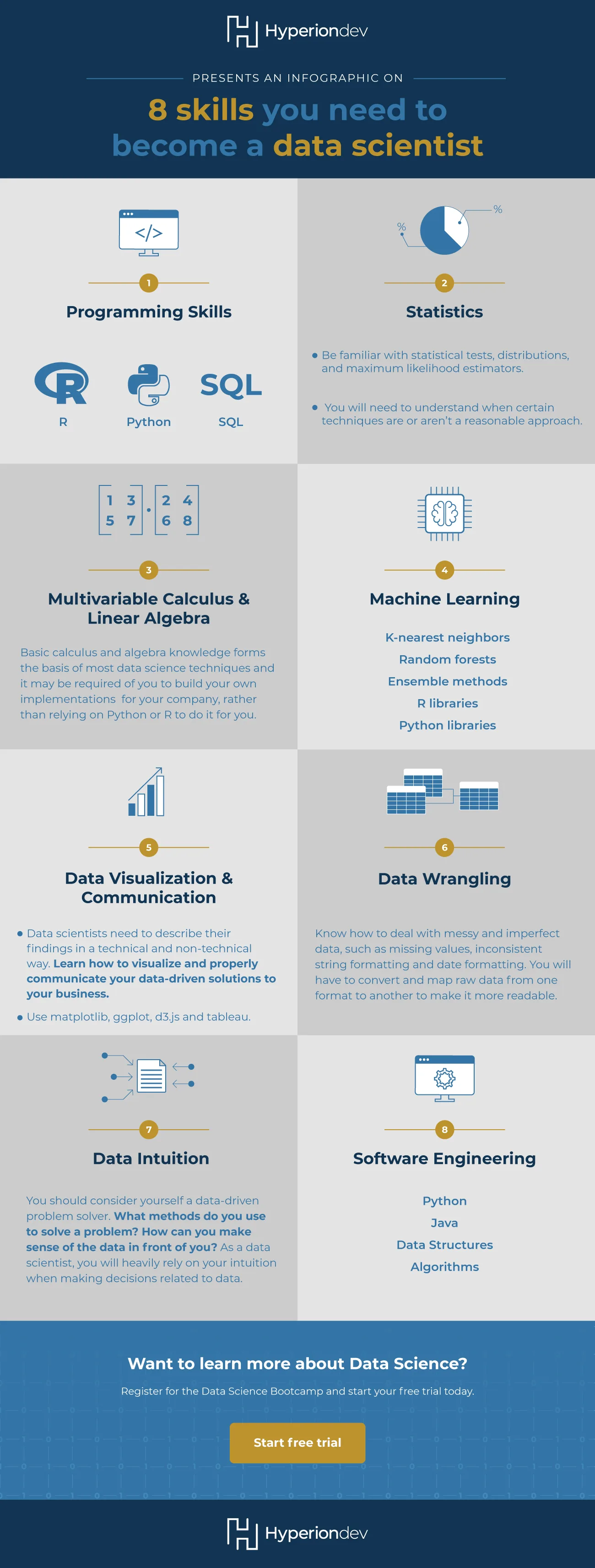
This clear infographic outlines the key skills you need to become a data scientist. Find out about programming languages, data wrangling, data intuition and visualization.
Data Science is the most promising job this year, according to the 2019 report released by LinkedIn. The criteria for determining which careers hold the most promise include salary, number of job openings, year-over-year growth and the possibility of promotion. The median base salary for data scientists is $130,000 and there are more than 4000 jobs openings in the US, which translates into a year-over-year growth of 56%. If you’re keen to make 2019 your year of upskilling, check out our infographic below to see the skills you need to become a data scientist. At a glance you’ll find out which programming languages you’ll learn, what data wrangling and data intuition entail and why data visualization and communication is so important in this field, as well as other important Data Science skills.
HyperionDev offers an online bootcamp for Data Science – learn the necessary skills, at your own pace and with your own personalised mentor to launch yourself into this exciting career.
Student Success Stories
Xavier: From Motor Mechanic to Software Developer
Xavier did HyperionDev’s Software Developer and Full Stack Web Developer bootcamp and is now working as a IT Consulting Developer.
Xavier completed his diploma in computer programming in 2010, yet struggled to land a job in tech and found himself working as a motor mechanic instead. He acknowledged that if he wanted to pursue a career as a developer, he needed to study further as his current diploma didn’t seem to meet recruiters’ expectations.
He pursued HyperionDev’s Certified Software Developer and Full Stack Web Developer course. Today, he’s working as a developer for an IT consulting company. Read more of Xavier’s road to success below.
What inspired you to take HyperionDev’s Certified Software Developer & Full Stack Web Developer courses?
My journey to get into tech was actually quite difficult. I tried to start my career in 2010 after graduating with a diploma in computer programming. Most employers wanted work experience. Then I heard about the CiTi program in partnership with HyperionDev and they were offering coding programs. This really jump-started my IT career.
Was your reason for choosing a course at HyperionDev related to changing careers or upskilling?
It was a mix of both – I really wanted to both upskill as well as learn new languages, such as C# and Python. I really wanted to add to the knowledge I had gained during my computer science diploma.
What work were you doing prior to your course?
I was in the mechanical industry working as a motor mechanic. And I realized one day that I shouldn’t be working there and so I decided to make a change. A career in coding seemed way more fulfilling than my mechanic job.
You completed your diploma in computer programming in 2010. What made you decide to pursue a course with HyperionDev in addition to your diploma?
I knew that if I had more experience and studied more programming languages, this would provide me with a better chance in starting my career in IT.
How long did it take you to get a job in the industry after graduating from your course with HyperionDev? Where was the job?
It only took me about 2 weeks and I found a job with Pepkor IT. I was really excited to see how quickly I was able to find a job in programming especially since it took me so long to get my career in IT started after I completed my studies.
You currently work as a web developer at Pepkor IT. What is your average day like?
I work as part of the operations team and we provide other companies and clients tech and web page support. We have frequent meetings with clients to determine their needs and once we determine what they are looking for, we help them fulfill their goals.
How would you say this course with HyperionDev has prepared you for this role?
The course with HyperionDev provided me with the foundation of programming – knowing why you do what you’re doing. It taught me the basics and knowledge of coding. Not to mention, the documentation was awesome.
Tell us about your experience of the personal mentorship at HyperionDev.
I had Sox as my mentor and he was really cool and helpful when I needed him. If I had trouble with any of the content or tasks, he would guide me in the right direction.
What is your favorite thing about coding, programming and web development?
I really enjoy being able to create something out of nothing. The creativity aspect behind coding allows you to build anything and create your own little world.
What advice would you give to people wanting to become developers?
I would tell them that it’s not the code or the languages you need to know. It’s more about the principles and understanding the basics. If you’re able to just read the code you’ll be set for life.

Career Advice
Top 6 pre-bootcamp tutorials
If you’re wanting to upskill into tech in 2019, then you may be considering enrolling on a bootcamp. Here’s a list of the top 6 pre-bootcamp tutorials in Software Engineering, Full-Stack Web Development and Data Science.
It’s always a good idea to prepare well before embarking on a new journey. If you’re thinking of changing to a career in tech and enrolling on a bootcamp this year, then check out these pre-bootcamp tutorials. Your path towards becoming a developer will be much smoother if you can hit the ground running. Here’s a list of pre-bootcamp tutorials for Web Development, Software Engineering and Data Science.
Web Development: pre-bootcamp tutorials
If you’re keen to become a web developer, you’ll want to learn HTML, a markup language, CSS, a style sheet language, and JavaScript (JS) for starters. JS is a powerful tool for creating complex web applications. The State of the Developer Nation report, which analysed more than 21,700 developers in 169 countries in 2017, found that JavaScript is the most popular programming language, used by 9.7 million developers.
Here are two pre-bootcamp tutorials for web development.
Programming for Entrepreneurs – HTML and CSS
This 1.5 hour tutorial will take you through the basics of web development. No prior knowledge is needed, so it’s perfect for someone new to coding. You’ll be better able to talk and understand web concepts. In fact, once you’re done, you may wish to consider listening to some web developer podcasts. Here we’ve listed 10 of the best podcasts for web developers aimed at covering all skill levels and interests.
This tutorial is aimed at beginners and will take you through the basics including operators, loops and functions, etc. It consists of one page with easy-to-use navigation. However, on the downside you won’t get a lot of chance to practise with this important language.
Software Engineering: pre-bootcamp tutorials
Software engineers create the technologies that we interact with every day, from the app that wakes you up in the morning to social media and music platforms. Judged 2018’s best job by the U.S. News and World Report, software engineering is an excellent career option.
Two pre-bootcamp tutorials for Software Engineering include:
Software Engineering Introduction
This quick, text-based tutorial is suitable for those wanting to enter the software development field. Topics include: the Software Development Lifecycle, Software Project Management, Software Design and Coding, etc. An hour or two should allow you to cover the material on offer.
Software Engineering Essentials
This edX tutorial is more advanced. It introduces the basic concepts of object-oriented software engineering. You’ll cover project management techniques for developing complex software systems. You’ll also find out about the different phases of a software project. Before enrolling on your bootcamp, it might be worth listening to this material for free.
Data Science: pre-bootcamp tutorials
If you’re keen to become a data scientist, then you should definitely check out Python – the language of choice for many data scientists. Why is Python used so widely in data science? One important reason is that powerful statistical and numerical packages exist in Python for data analysis (such as PyBrain, NumPy and MySQL).
Here are two pre-bootcamp tutorials worth exploring:
This free tutorial is offered by Udemy. No programming experience is required and you’ll learn some of the basics of Python. It includes 4.5 hours of video and some articles. It’s particularly aimed at those learning Python for the first time. The good news is that Python is one of the easiest coding languages to learn.
The downside is that the course is pitched at a beginner level and if you’re wanting to become a programmer, you’ll obviously need to dive deeper. In addition, if you get stuck, you’ll have to work out the solution for yourself.
GitHub is a place for developers to collaborate on projects; however, you can also find more than 500 free programming books that cover more than 80 different programming languages on this popular repository hosting service. The resources are frequently updated by collaborators. Here’s a GitHub project that lists free learning resources for data science and big data related concepts, techniques, and applications. Each entry includes the expected audience for the book (beginner, intermediate, or veteran). Although it may suffer from subjectivity, it does still provide some indication of how difficult the book is.
In conclusion, we’ve listed six pre-bootcamp tutorials. You could also trial one of the HyperionDev courses for free as a pre-bootcamp tutorial. HyperionDev offers the following online coding bootcamps: Full Stack Web Development, Data Science or Software Engineering.
Software Engineering
What can you do with Python? Top 3 Python applications
These popular Python applications are just three examples of what makes the language so useful: Python can be used for web development, data science & scripting.
Python is a high-level, general purpose programming language, which is used for web development and also serves as a support language for developers. Common Python applications include websites, web frameworks and desktop apps.
Python is also currently one of the most in-demand programming languages on the market, which makes it an important one for aspiring developers to learn.
Real-world Python applications
If you’re new to the language, you’ll probably be wondering what you can use it for. Here’s a look at three of the most popular Python applications.
- Web development
Python is primarily used to create back-end code for websites. Web developers find there are several key benefits to coding in Python:
- Easy to learn – Python is relatively short compared to other languages, which makes it easier to work with and debug.
- Efficient – With Python’s syntax, a developer can build more functions using fewer lines of code.
- Flexible – Python wasn’t created to meet one specific need, and this means it’s integrated with several other languages, rather than being driven by templates or specific APIs.
- Open source – Python is a crowdfunded, open source platform, which means it’s free, and can be implemented or modified however the developer wants. It’s a great way for companies to keep development costs low.
- Relevant – Python development is trending where the IoT (Internet of Things) is concerned. The IoT is opening up exciting new opportunities for Python programmers, allowing them to build devices and games using Python, and connect real-world objects to the Internet at low cost.
- Data science
Python is also widely used in data mining and analysis, scientific computing and machine learning. It’s an essential language to learn for anyone looking to start a career in data science.
The language is well-suited for repetitive tasks and data manipulation tasks. It can be used to pull large amounts of data, run repeated automated analyses, and produce data visualisations (like maps and charts).
There are also a number of well-known machine learning libraries and frameworks available for Python, including the popular scikit-learn and TensorFlow libraries.
There is a rapidly growing demand for machine learning developers and data scientists on the job market right now, which is certainly driving up Python’s popularity.
- Scripting
Scripting means writing small programmes designed to automate simple tasks that would otherwise need to be done manually. Python can be used as a scripting language for software and web applications, as well as being a programming language. It’s useful when it comes to saving time and making everyday processes more efficient.
Unlike “shell scripting”, Python can be embedded whole as a scripting language within a larger software system. This means it can enable multiple specific functions, making scripting that much easier for programmers.
These popular Python applications are just three examples of what makes the language so versatile and useful.
Become a Python software developer
The HyperionDev Python Software Developer course is a three-month part-time course that you can complete online. The course will introduce you to the major tools needed to develop effective programs to solve computational problems using Python.
This course is ideal for those who already have a basic knowledge of programming, but it does begin with a refresher of Python, to help you build on your skills.
After this “snake charming” portion of the course, you’ll be able to start testing your knowledge practically with challenging real-world problems. You’ll also have access to one-on-one mentorship for ongoing support during your learning journey.
The Software Engineer Bootcamp and Data Science Bootcamp also focus heavily on Python, and will help you get to know your way around common Python applications..
Sign up today and find out what makes Python one of the most in-demand programming languages in the world.

Career Advice
Where to study IT in South Africa: online courses versus computer science degrees
Tech careers in South Africa offer excellent salaries and are in high demand. If you want to study IT in South Africa, how should you do it? We look at various options, including online versus degrees, as well as the top courses in South Africa.
South Africa’s IT spend is on the up. In addition, the demand for IT skills continues to outstrip supply, claims the ICT Skills Survey. High demand occupations include the following: software developer, applications programmer, web developer, ICT security specialist and database designer among others. With this in mind, we look at where you can study IT in South Africa, and how online courses compare with Computer Science degrees.
Study IT in South Africa: online courses vs. degrees
Let’s say you’ve decided you want to go into tech. Now what? You need to make an important decision: do you want to pursue a Computer Science degree or study tech skills online? An online course, or bootcamp, states Business Insider, aims “to take in students with minimal coding knowledge and shoot them back out a few months later as employable software engineers”.
This is a key difference between an online course and a CS degree – namely, time taken to complete the course. A bootcamp is likely to be much shorter than a degree, which will generally take three to four years. Remember, there is loss of income, or opportunity cost, during a longer study period.
Either way, once you’ve completed a tech degree, you can expect to see a hike in your salary. A Stack Overflow survey compared salaries in the US between Computer Science graduates and those who had picked up their expertise via bootcamps. Those with a PhD or Masters in Computer Science earned the most ($122,219 and $118,803 respectively), but bootcamp graduates (who had completed an ‘Intensive Program’) came in at 3rd place with an average annual salary of $112,493, which was above that of undergraduate degrees in Computer Science. The average salary for IT professionals in South Africa is R42,673 per month, according to MyBroadband’s 2018 IT Salary Survey.
Other key differences between online courses and degrees include duration and the course content itself. Degrees have a longer duration, approximately three to four years, compared with a bootcamp, which can be a couple of weeks up to six months. As far as course content goes, bootcamps tend to teach industry-specific coding skills, whereas a university Computer Science degree is likely to be more abstract, focussing on things like how computers are able to solve problems for programmers”. It’s a more theoretical than a practical approach – consequently, you might not learn how to actually code in real-life scenarios.
Now that we’ve covered the main differences between online courses and degrees, where can you study IT in South Africa?
Top Online Coding Courses in South Africa
This school offers online as well as face-to-face tuition, in the Western Cape. They include a wide variety of courses, including PC Engineering, Web Design, SQL, Programming courses, AutoCad, Social media and MS Office. Programming courses cover C#, Java, Python, Android and C++. School of IT focuses on the practical side of programming and IT.
HyperionDev offers three online coding bootcamps: Full Stack Web Development, Data Science or Software Engineering. You’ll be paired 1:1 with an expert mentor as you work your way through industry-aligned course content. With next-day code reviews, on-demand feedback and direct referrals to their handpicked hiring partners, you’ll be well on your way to landing your tech dream job.
GetSmarter offers a variety of online short courses in tech, including IT management, Internet of Things, Blockchain Strategy, Digital Marketing Analytics, Cybersecurity and Artificial Intelligence.
Top Computer Science Degrees in South Africa
- University of the Witwatersrand (WITS)
This BSc in Computer Science teaches the fundamental mathematical and scientific principles behind computer science. Students will learn about computer networks, database systems, operating systems, artificial intelligence, formal languages, software design and data structures.
- University of Pretoria
The Computer Science Department offers two three-year degrees, the BSc (CS) and BSc IT. The BSc (CS) degree covers computer science fundamentals by offering a wide variety of computer science and mathematical courses. The BSc IT degree covers different application environments – including Data Science, Genetics, Geographical Information Science, IT and Enterprises, IT and Law, IT and Music and Software Development – from which a student chooses one. There are also fundamental and core modules.
- University of Cape Town
The School of IT at University of Cape Town incorporates both Computer Science and Information Systems. You can choose to major in Computer Science in a Science degree, Information Systems in Commerce, Informatics in Humanities or Business Computing in Science.
- Rhodes University
Rhodes University offers an undergraduate degree in Computer Science, a BSc in Information Systems, and a four-year BSc in Software Development.
In conclusion, a tech career offers multiple opportunities and high rewards. If you choose to study IT in South Africa, decide whether a CS degree or online course suits your needs better. At HyperionDev you can enrol on the following online coding bootcamps: Full Stack Web Development, Data Science or Software Engineering. You can also trial one of these courses for free.

Data Science
Three paths to your first data science job
To succeed in your first data science job, it’s important to make sure you have a solid foundation in programming and maths, and an understanding of machine learning.
HyperionDev recently announced the launch of the exciting new Data Science Bootcamp, a 3-6 month online course that provides aspiring data scientists with the foundation they need to land their first data science job.
Data science jobs are lucrative and highly in demand. This is a career path that can open up many exciting opportunities, while still giving you a very stable income with room for growth. It sounds like a dream come true – but is it a good fit for you?
To make sure you’re cut out for a career in data science, you need to have an interest in (and a good understanding of) three key elements: programming, mathematics, and machine learning.
Programming
You need a good programming foundation to work with data, and you must be able to code proficiently in at least one popular programming language. Python is a good place to start, and the HyperionDev Data Science Bootcamp will give you a solid introduction to working in Python.
It also helps to get familiar with the more widely used data science libraries and packages available online.
Once you have a good grasp of programming, you’ll also need a good understanding of statistics and other mathematical concepts to help you interpret the data. This leads us to the next key element in becoming a data scientist.
Mathematics
Data analysts work extensively with numbers, which means it’s important to have a strong foundation in math to be successful in this field.
Here are some examples of how you’ll need to apply math to your work in data science:
- Translate real-world problems into mathematical expressions
- Manipulate algebraic expressions to solve equations
- Display different types of functions on a graph
- Understand the relationship between a function’s graph and its equation
To begin with, it’s recommended that you have a sound knowledge of college-level algebra. To advance further, start looking into multivariable calculus and linear algebra as well. These will help you get to grips with the next of our three key components.
Machine Learning
Machine learning allows data scientists to make predictions based on huge amounts of data, by relying on AI. It’s important, as an aspiring data scientist, that you get to understand the three main types of machine learning: these are supervised, unsupervised, and reinforcement learning.
Your understanding of mathematics will also tie into this; machine learning is based on a foundation of statistics, multivariable calculus, and linear algebra.
Foundational and advanced topics for data scientists
Here are the essential topics you’ll need to cover, in order to build up sufficient math, machine learning and programming knowledge needed for a data science career.
Foundational topics:
- Object oriented programming: Structure your code into object-oriented design patterns, so it can be easily reused, tested and shared.
- Debugging: Learn how to identify and fix problems in your code.
- Statistics: Apply the right statistical tests in order to interpret data and compare different types of data.
- Probability: Determine the likelihood of an event, to help you draw accurate conclusions about data.
Advanced topics:
- Data structures: In some cases, certain data structures work better than others; understanding different structures will help you to choose the most efficient one and optimise your programming.
- Algorithms: If you know which algorithm to apply in which situation, you can get results faster and more efficiently.
- Software design patterns: Once you get comfortable with software design patterns, you can easily create robust, reusable code.
- Multivariable calculus/ linear algebra: These advanced math skills will help you to understand how machine learning works.
Where to begin?
If you’re not sure what your first step should be, we recommend enrolling in the next Data Science Bootcamp, scheduled to begin on 5 February.
The curriculum covers many of the essential programming, math and machine learning topics:
- Introduction to coding with Python
- Object oriented programming and functions
- Natural Language Processing
- Storing and querying relational data
- Data exploration, analytics and visualisation
- The fundamentals of machine learning and AI
You’ll also receive post-bootcamp support after completing the course, which includes assistance with updating your CV and preparing for your first data science job interview.

Software Engineering
These are the 3 most popular programming languages for hacking
Ethical hackers or Penetration Testers are employed by the top corporates in the world to make sure that their security systems are airtight. Their skills are highly sought after. Thinking of building career in data security testing? Then read on, because these are the top programming languages for hacking.
Hackers. They are those hooded figures stooped over computers, scanning endless lines of code across multiple screens in dark dingy basements surrounded by discarded takeaway boxes, right? Well, if you’re talking about hackers in the movies, then yes. But in reality, hackers may be less clandestine than you think. Of course there are hackers who steal identities and information in order to blackmail people, and infiltrate databases to wreak havoc or take revenge. But we’re more interested in ethical hackers or Penetration Testers, many of whom are employed by the top corporates in the world to make sure that their security systems are airtight. Ethical hackers infiltrate systems and networks to expose threats and vulnerabilities that malicious hackers may exploit. Their skills are highly sought after. Thinking of building a career in data security testing? Then read on, because these are the top programming languages for hacking.
Python
The first thing that stands out about Python is its simplicity. It’s one of the most popular languages amongst university lecturers and is a great way to introduce newbies to the world of coding. According to Nicholas Tollervey, Python is the optimum programming language for aspiring coders because it “tries to do the expected thing and will complain if you, the programmer, attempt to do something clearly wrong.” Python also uses common English words for various concepts, making it an intuitive language to learn. It also allows for rapid development and testing, which is essential for ethical hackers.
One of the main reasons why tech author, Anchit Sharma agrees that Python is a great tool in any hacker’s toolbox, is its flexibility. It is used all over the world to build everything from web applications to bioinformatics. One of the biggest benefits you’ll have as a Python developer is access to support. There’s a massive global Python community that devs can tap into and learn from.
Java
Java enables devs to write computer instructions using English-based commands rather than numeric codes. It’s an easy language to understand , and is thus referred to as a “high-level” language. Most devs will have at least some knowledge on Java, given its popular use in the Android operating system. There are lots of websites and apps that simply won’t work if you don’t have Java installed, which is why it’s so important for hackers to have a basic understanding of how it works.
There are a wide range of industry sources that estimate that over 95% of enterprise desktops run Java and in the US, 88% of all computers are running Java. Most sources list Java as being the top programming language in the world, or somewhere within the top 5. The stats are pretty convincing – it makes sense to learn a language that’s being run on the majority of the world’s computers. As an ethical hacker, you’ll need to have your finger on the pulse of the times.
C++
There’s no denying it – C++ is for serious developers. And when it comes to hacking, this programming language takes no prisoners. C++ is a low-level language that makes resources like RAM and system processes immediately available to hackers, which is incredibly useful “in cases where such resources are not adequately protected by the program the hacker(s) are trying to compromise.”
C++ can takes years to master so before you choose to invest in a long-term education plan, you might want to consider completing a bootcamp or short course so you can determine whether it’s for you or not. Of course if you’re sure that ethical hacking is where you’re headed, C++ is a worthy investment. Anchit Sharma refers to C++ as the “mother of all programming languages,” because it is highly portable and often used on multiple platforms. C++ is often used in the building of software for Linux and Windows. It is also used for Exploit Writing, which is a type of development that involves the writing of code in order to take advantage of certain bugs in a system.
Ethical hackers work hard to make sure that the security systems of the world’s most important networks are absolutely impenetrable. Think about banks, insurance companies and hospitals, all of which rely on massive databases to operate. With the upsurge in big data and cybersecurity hacks, these kinds of companies are investing in Penetration Testers more than ever to protect their data. Ethical hackers may use the same methods used by malicious hackers, but with the permission of their employers and for the purpose of defence rather than attack.
Sound like something you’ve always dreamed of doing? Enrol in a Python, Java or C++ course – our mentors are standing by to teach you everything you’ll need to know to master these top languages.
News & Announcements
January 11, 2019
Announcing the new Data Science Bootcamp from HyperionDev
The comprehensive, accredited Data Science Bootcamp from HyperionDev is a brand new addition to the choice of mentor-led online coding courses on offer.
The coding education specialists at HyperionDev are pleased to announce the launch of the Data Science Bootcamp, a brand new addition to the choice of mentor-led online coding courses on offer.
What is data science?
Data science, also called data-driven science, is a field that uses statistics and scientific systems to extract meaningful information from large amounts of complex data. By analysing this raw information, data scientists can provide businesses in many industries with valuable insights which will affect their future decision-making.
Demand for data scientists
As many businesses are becoming more data-driven, there is a high demand for qualified data scientists. There is also a skills gap in the market, which means there are many opportunities for newly qualified data scientists to fill the available roles.
The online 6-month bootcamp is designed to help you to fasttrack your way into a sought-after position as a data scientist.
The Data Science Bootcamp curriculum
HyperionDev has created a comprehensive course that will introduce learners to all the fundamentals of data science. The curriculum covers the following topics:
- Introduction to programming with Python
- Object oriented programming and functions
- Natural Language Processing
- Storing and querying relational data
- Data exploration, analytics and visualisation
- The fundamentals of machine learning and AI
- Post-bootcamp support including CV assistance and interview preparation
Why choose an online bootcamp?
Online bootcamps allow you a degree of flexibility that on-campus courses don’t. With HyperionDev, you can learn on the go, and complete the learning at your own pace.
The content covered in the bootcamp is up-to-date, relevant and industry-aligned, allowing you to step into the industry with confidence. With next-day code reviews and on-demand feedback, you’ll be able to learn and grow quickly, practising real-world data science as you go.
You’ll also benefit from personalised mentorship and career coaching as you work your way through the course. You’ll have one-on-one support and feedback from a full-time qualified coding mentor, an expert educator who will help to enrich your data science knowledge.
Your bootcamp experience doesn’t end with graduation. After completing the course, learners also get guidance on putting together CVs and preparing for job interviews in the tech industry. We also provide direct referrals to our hiring partners. With this added support, most graduates are able to start their new careers within 6 months of graduating.
Try a no-cost bootcamp trial
Before you commit to purchasing a course, you can complete the free bootcamp trial course at no cost. This will give you a feel for the bootcamp structure, before signing up for the full certified Data Science Bootcamp.
Next bootcamp begins 5 February
The next Data Science Bootcamp is scheduled to start on 5 February 2019, with a duration of 3 – 6 months depending on your learning preference. Sign up and make this the year you launch an exciting new career in the world of data.
Student Success Stories
Gina Fabienne: From office manager to web developer
As an office manager, Gina was tasked to develop two online stores. From that moment, she fell in love with web development.
Gina Fabienne has performed various roles in her work experience, from au pair to office manager. During her time as an office manager, Gina was tasked to develop two online stores for the company she was working for. From that moment, she fell in love with web development and the rest is history.
“After [I built these online stores], I was hooked and wanted to get into development and help companies grow their businesses through their websites and ecommerce stores. I also knew that development was set to grow in the coming years and I wanted to be where the market and money was going.”
Gina has always had a passion for websites and improving them. She sees a website as the customer’s first impression of a business and wants to help businesses develop their online presence.
Currently, Gina works as a Junior Web Developer at Cartmell & Cartmell Communications, a web design agency. Gina’s daily responsibilities consist of communicating with clients, which range from corporate sites to learning management systems. She loves getting her work done and feeling accomplished at the end of the day. So, how has HyperionDev helped prepare her for this role?
“HyperionDev gave me the confidence and ability to assess problems. Working through the tasks by myself with the help from a mentor during the bootcamp taught me how to work through my current work tasks by myself and only ask for help when I’m really stuck.”
Gina’s favorite parts of the course were learning how to solve problems and coming up with solutions for the tasks, while enjoying the research and learning new skills. She has this piece of advice for budding developers:
“Programming takes a few tries before understanding sets in and that’s okay! There will be some good days and some difficult days, but pushing through it and making it is worthwhile. That achievement of completing a course and getting into a dream career that you are passionate about is worth all the hard work.”
Want to be a web developer like Gina? Register for a free trial on our Full Stack Web Developer Bootcamp and switch careers within 6 months.

Data Science
The top 4 languages for machine learning
While artificial intelligence itself is not a new field, engineers are breaking new ground in this industry with the advent of what can be called the Fourth Industrial Revolution. In this post we look at what machine learning engineers do, as well as the top 4 languages for machine learning.
Machine learning engineers are at the forefront of global innovation. They are the coders who are tapping into how much machines can learn about human behaviour in order to automate processes and make life in the 21st century easier, so we can do more with our precious time. Needless to say, there is an unprecedented demand for machine learning engineers all over the world, with lucrative job opportunities abounding. While artificial intelligence itself is not a new field, engineers are breaking new ground in this industry with the advent of what can be called the Fourth Industrial Revolution. In this post we look at what machine learning engineers do, as well as the top 4 languages for machine learning.
What do machine learning engineers do?
The onset of the digital age and innovations in artificial intelligence led many to believe that machines would replace humans in jobs. So far the opposite has been true. Machines are “learning” automated skills so that humans can fill more complex positions that require the kind of lateral thinking that can’t be reduced to code (for now). According to Indeed, the demand for jobs in artificial intelligence has more than doubled over the past few years. Currently, machine learning engineer is amongst the top three in-demand jobs in the tech industry.
Machine learning engineers are the ‘brains behind the bots’ (so to speak). At the most basic level, they are developers with a particular skill-set and knowledge that enables them to build programs that “enable machines to take actions without being specifically directed to perform those tasks.” In their own right, machine learning engineers are algorithm experts. Machine learning engineers could be employed in a number of industries. They are the minds behind innovations like self-driving cars or retail-management systems that “know” their customers’ shopping behaviour and lifestyles intimately.
Top 4 languages for machine learning
- Python
Its reputation for simplicity puts Python at the top of the list of languages used by machine learning engineers. With syntaxes that are easy to learn, Python makes implementing AI algorithms a breeze. When compared to languages like Java, C++ or Ruby, Python involves a shorter development time. Python also features a number of libraries, which make tasks easier – these include Numpy and Pybrain. As Christina Voskoglou states: “Python leads the pack, with 57% of data scientists and machine learning developers using it and 33% prioritising it for development.”
- Lisp
According to GeeksforGeeks, Lisp is one of the oldest languages used for development in AI and was invented by John McCarthy, the father of AI in 1958. Lisp is also a flexible and prolific tool for prototyping and the “easy dynamic creation of new objects, with automatic garbage collection.” While some coders choose to bypass it for newer languages, there are others who believe that it forms a good foundation for newbies who want to learn how to navigate their way through the basics.
- R
As tech journalist, Jessica Davis asserts, R remains one of the most popular languages for machine learning amongst newcomers to the industry and stalwarts alike. Like its predecessor, Lisp, it is a relatively older language and was developed in the 1990’s as an open source language with roots in “statistics, data analysis, and data visualization.” As Davis explains, new generation analysts have appreciated the fact that R can be downloaded and used for free, and that there are downloadable packages that can be used for customisation.
- C and C++
If you are a new coder with aspirations to build a career in machine learning, C and C++ may not necessarily be your first port of call but it may be the language you’ll want to learn to gain a specific set of skills. As computer science and engineering specialist, Animesh Srivastava explains:
“Artificial Intelligence (AI) in games (29%) and robot locomotion (27%) are the two areas where C/C++ is favoured the most, given the level of control, high performance and efficiency required. Here a lower level programming language such as C/C++ that comes with highly sophisticated AI libraries is a natural choice.”
Learn and adapt as you build
A number of sources on the topic of which languages for machine learning are the best, list the four languages mentioned above. However, they also conclude more importantly that the language you learn will depend greatly on what you are trying to build. Python for example, is a popular language for fraud detection programmes, while C and C++ are frequently used for sentiment analysis tools. R and Lisp are both used for robot locomotion and speech recognition systems. There simply is no black and white answer when it comes to which one to choose. As a new developer, you may want to seek the advice of a mentor who may be able to point you in the right direction if you think machine learning is the industry for you.
Just starting out? We offer a number of bootcamps on the majority of the languages mentioned in this post, as well as on data science. Not 100% sure? We offer a free trial – start there, and let’s make it happen!
Student Success Stories
Joel Barnard: From tour operator to junior software developer
After working as a tour operator for three years, Joel turned to programming and fell in love with it straight away.
Joel was working as a tour operator for three years when he realised that he wasn’t really happy working in the industry; tourism was frustrating, stressful and overall unfulfilling. In his search to find a career more rewarding, he turned to programming and fell in love with it straight away.
“I found that I really enjoyed it and started obsessively studying as much programming as I could in my free time, sometimes spending up to 8 hours on Saturdays and Sundays and about 3 – 4 hours on weeknights learning programming.”
His passion for programming led him to HyperionDev, where he felt that the curriculum of the Certified Software Developer MicroDegree would take his programming to the next level. What solidified his decision to go with HyperionDev?
“I liked the concept of a mentor helping me learn to program. Being completely self-taught at the time I thought I would benefit from having someone look at my code daily and correct any bad habits I had picked up while teaching myself.”
HyperionDev’s personal mentorship is structured to guide students so they never feel stuck on a piece of code. The on-demand code review also ensures students’ code is professional, accurate and efficient, while aligned to industry standards.
Two months after completing his course with HyperionDev, Joel had found a job as a Junior Software Developer at MIP Holdings, where he has various responsibilities, ranging from debugging new code to developing new functionalities for systems.
“The three months I spent studying with HyperionDev took me from being a beginner to someone who actually felt like they could be a software developer.”
Joel has some advice for budding developers:
“Don’t be scared to throw yourself in the deep end. Find a project that interests you and just do it. You will learn more about real world programming while working on your own projects then you will any other way.”
What’s next for Joel? HyperionDev may have inspired him to pursue a future career in AI (Artificial Intelligence):
“My favorite part of the course was definitely the Python section and the K-means algorithm that we had to come up with ourselves. It has gotten me interested in pursuing machine learning and Artificial Intelligence as a future career path.”
If you’re interested in switching to a career in tech like Joel, register for your free trial and check out if the Software Engineering Bootcamp is right for you.

Data Science
Data scientist salaries in South Africa
If you’ve been keeping your eye on the job listings in the tech world, you may have noticed that there has been a definite upsurge in the number of available positions for data scientists. In this post, we look at data scientist salaries in South Africa.
If you’ve been keeping your eye on the job listings in the tech world, you may have noticed that there has been a definite upsurge in the number of available positions for data scientists. We imagine if you’re a rookie coder, the title itself may be intimidating enough to have you running for the hills. But in reality, data scientists are simply coders with a very specific set of skills that can be fostered with regular and consistent practice and theory application. In this post, we look at data scientist salaries in South Africa.

Source: KDnuggets
What is a data scientist?
Data science is a relatively new field, that has emerged along with the advent of big data, which is a term used to describe large sets of data that have the potential to reveal never-seen-before insights on human behaviour and consumer trends. The “bigger” data becomes, the more complex it is to mine, manage and interpret so that businesses can make more informed, insight-driven, strategic decisions. This is where a data scientist comes in.
One way of putting it is that, “A data scientist takes raw data and marries it with analysis to make it accessible and more valuable for an organisation.” In other words, a data scientist takes raw information and interprets it in a way that can derive meaning for a business and help it to gain deep knowledge about its customer base. As Tech Central suggests, a data scientist is part mathematician, part computer scientist and part trend spotter.
According to the Guardian, the industries that are leading the pack in terms of hiring data scientists are the finance, retail and e-commerce sectors. Progress is being made in other arenas including telecoms, transport and oil and gas.
Data scientists are in serious demand
Stella Ndabeni-Abrahams, deputy minister in the Department of Telecommunications and Postal Services (DTPS) has stated that the South African government aims to train a million young people between 2019 and 2030 to become data scientists. Although this goal has come under criticism by some analysts who claim that it is unrealistic, it highlights the very relevant point that there is a major skills gap in South Africa as well as the world, when it comes to data science.
According to ITWeb, “globally, the shortfall for data scientists is projected to be between five million and 10 million.”
This staggering figure is corroborated by Forbes contributor, Louis Columbus who advises that data scientists are among the top emerging jobs on Linkedin. According to Columbus: “Data scientist roles have grown over 650% since 2012. Currently, 35,000 people in the US have data science skills, while hundreds of companies are hiring for those roles.”
Data scientist salaries in South Africa
At this point, you’re probably wondering how lucrative this industry is, so let’s take a closer look at the potential earnings of data scientists in South Africa.
The following statistics were provided by PayScale:
Entry-level:
The average pay for an entry-level data scientist in Cape Town is R356,971 per year.
The average pay for an entry-level data scientist in Johannesburg is R446,432 per year.
Mid-Weight:
The average pay for a mid-weight data scientist in Cape Town is approximately R596,513 per year.
The average pay for a mid-weight data scientist in Johannesburg is R693,620 per year.
It’s interesting to note that on average, data scientists will earn up to 14% more in Johannesburg, South Africa’s commercial hub, than in Cape Town.
Data scientists are mathematicians, there’s no doubt about it. You need to be able to wrap your head around stats and figures in your sleep. But there are important soft skills that every data scientist needs – critical thinking, communication, problem solving and a highly developed sense of intuition for predicting market trends. Have you got what it takes?
Kickstart your career with a Data Science bootcamp – we can’t wait to show you everything we know.
Tutorials
CSS tutorial 3: colour values
This CSS tutorial will show you how the different colour values work when styling your web page, covering RGB, HEX & HSL values, as well as saturation & lightness.
Cascading Style Sheets allow you to set the colour of your website text, background and borders. This CSS tutorial will show you how the different colour values work, and how to apply them. We’ll cover RGB, HEX and HSL values, as well as saturation and lightness. Understanding colour values will help you to enhance the appearance of the websites you build, and follow your clients’ brand identity.
A quick note before we get started: When coding CSS colours, always use the USA spelling, i.e. color. Whether you use UK/ SA or US spelling standards in your text will depend on your client’s preference.
RGB values
RGB stands for Red, Green and Blue – the three primary colours for web and digital design. RGB value indicates the red, green and blue intensity that make up a specific colour. Each of these three intensity values sits on a scale of 0 to 255 – 0 being the lowest intensity, and 255 being the highest.
As an example, set up a simple HTML folder and document as you have done in previous tutorials. Enter the following code, with two short paragraphs of “dummy text”, as follows:
When you view your web page in the browser, it will look like this:
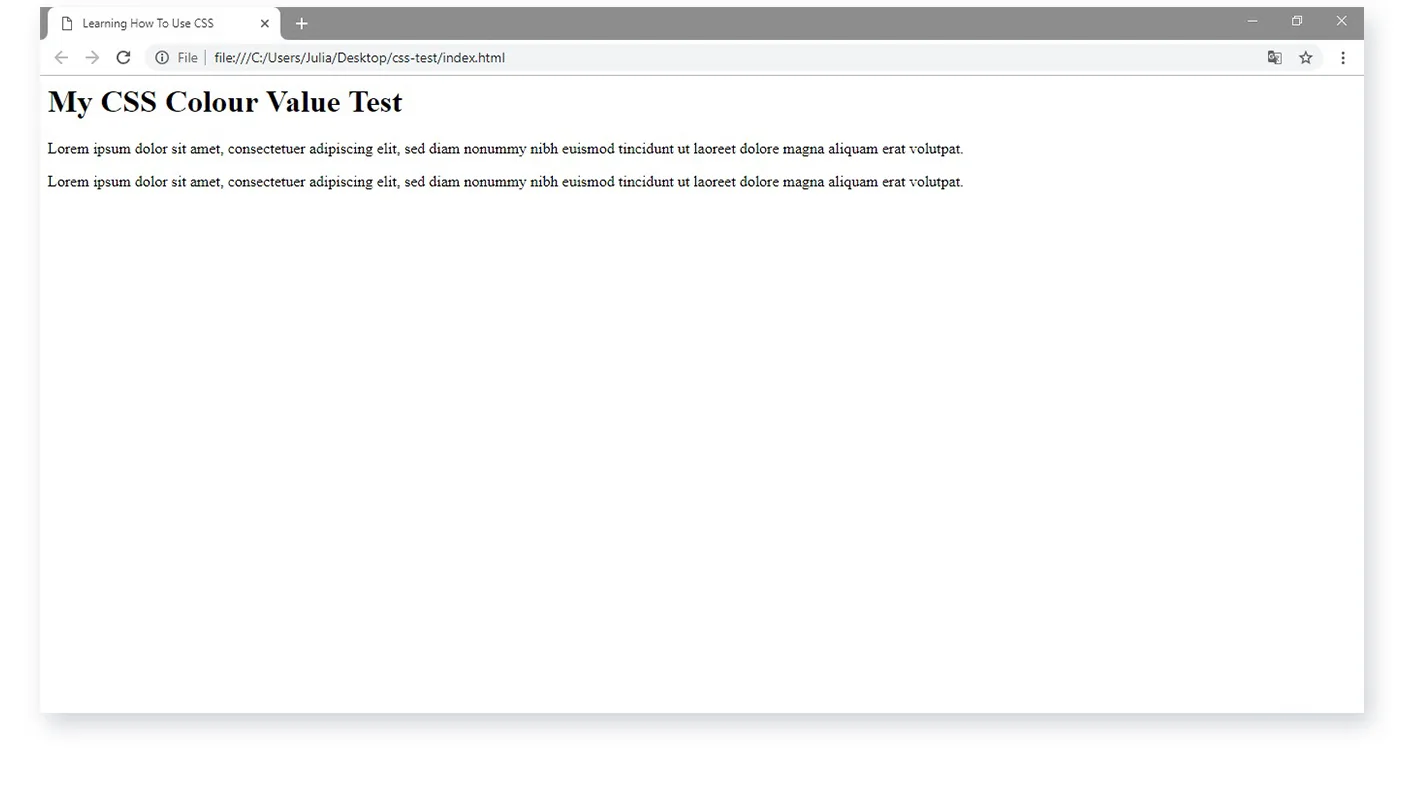
Now, you can add a style to each heading and paragraph in your document. Your code must appear in the opening tag of the text you want to style.
Add a different RGB colour value to your heading and both paragraphs, as follows:
When you refresh your browser, you’ll see the changes reflected in the text.
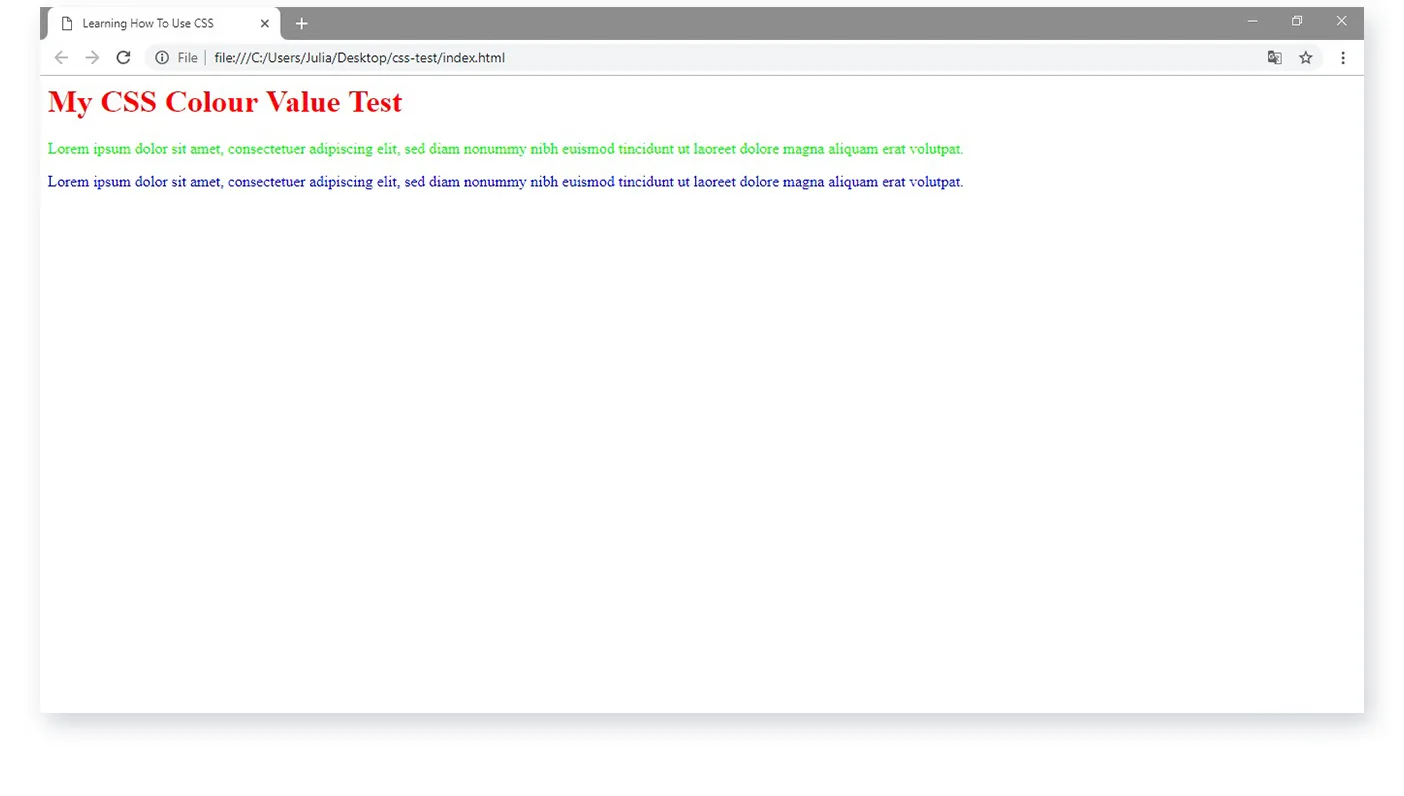
See more RGB values here for future reference.
HEX values
HEX or hexadecimal values sit on a scale from from 00 to FF, with 00 being the darkest and FF being the lightest (e.g. the three primary colours red, green and blue combine to make “white light”).
The code is known as a hex triplet, representing three separate RGB values that specify the intensity of the component colors: (#RRGGBB). The code begins with a hash sign (#) followed by six hex values, or three pairs of hex values.
For example, to code the colour black, you would use the HEX code #000000 which is the equivalent of the RGB code (0, 0, 0). The colour white would have a HEX value of #FFFFFF, the equivalent of RGB (255, 255, 255).
Similarly, to code the colour red, you would use the HEX code #FF0000. The RGB value is (255,0,0). Green would be #00FF00 (0, 255, 0) and blue would be coded as #0000FF (0, 0, 255).
Edit your code to include HEX values instead of RGB values, as follows:
Your refreshed web page will reflect the colour changes.
These are quite simple examples, but when you’re looking for a very specific colour, you can use a colour picker tool to find the code for the perfect shade.
HSL values
HSL stands for Hue, Saturation and Lightness.
- Hue is a degree of colour on the colour wheel, which goes from 0 to 360 degrees. On the colour wheel, 0 is red, 120 is green and 240 is blue.
- Saturation can also be described as the intensity of a colour. It is written as a percentage value: 100% is pure, fully saturated colour. 50% is a shade of grey; the colour is half as intense but still visible. 0% is completely greyed out, meaning the colour is no longer visible.
- Lightness refers to how much light you want to give a colour. It is also written as a percentage, with 0% being black (no light), 100% being white (full lightness), and 50% sitting halfway in between at neither light nor dark.
So for example, a fully saturated shade of blue would be coded using the following HSL value: (240, 100%, 50%).
Edit your HTML page to include three different shades of blue, with different levels of saturation and lightness:
Your refreshed page will show the three different shades of blue:
For easy future reference, you can check out this list of HSL values online.
Background colour
You can also set the background color for HTML elements, using the syntax background-color.
Add three different background colours to your code. Use one RGB value, one HEX code and one HSL value.
You will see the background colours have been altered once you refresh your web page:
Background colours and text colours can be written using RGB, HEX and HSL codes, but there is also a variety of pre-defined CSS colour names readily available to use. Here are some existing examples, which you can add to your headings, paragraphs and backgrounds:
You can see an extensive list of pre-defined colour names and codes here.
Take your CSS knowledge further
If you’re looking to apply your knowledge of HTML and CSS to a professional coding career, you might be interested in registering for an online web developer bootcamp. These online courses can be completed in just six months, with qualified mentors to make your learning journey easier and more rewarding.
Career Advice
Top 10 sites for programming questions
Coding can be difficult and lonely at times. Here are the top sites for asking those programming questions when you get stuck. You’ll be able to link up with other developers to get the support you need.
Learning to code is difficult – it can also be lonely. Coding students will go through a number of psychological stages, states The Footnotes, a career portal website. These include: The Honeymoon (the first magical introduction to coding), The Cliff of Confusion (when you start getting stuck and need help), The Desert of Despair (you’re really stuck – this can be a fairly long stage), and The Upswing (when things start coming together). Bearing this in mind, we’ve listed the 10 top sites for programming questions that may come up during these phases. Link up with other developers to get answers to your questions or the support you need to carry on programming.
This is a great place to start. The site attracts over 50 million developers on a monthly basis. Ask your programming questions here and you’re almost guaranteed that a helpful developer will come along and help you out. The site hosts questions concerning multiple programming languages, platforms and services. The top languages covered include JavaScript, Java, C# and PHP. There’s an up-vote system to ensure answers arrive quickly, as well as are moderated efficiently.
Bookmark this site for your coding questions. Make sure to read the FAQs before submitting a post – many questions have been asked and answered before. There are also other Reddit communities you could check out including AndroidDev or SoftwareEngineering.
This is a Q&A site on any topic. The good thing about Quora is that many of the responses are from experts; however, the site deals with a vast range of topics and not just those related to coding and software development. After you’ve signed up, you can either ask or answer questions.
This paid site hosts a team of highly-acclaimed technology experts, available 24/7. “Whether disaster comes in the form of a small issue or an enterprise outage, get online help from expert consultants who are ready to provide fast, actionable solutions for each and every problem,” states the site.
This is a Q&A community where users vote on posts to ensure that the more helpful answers are easier to find. It consists of 133 Q&A communities including Stack Overflow, mentioned above, Software Engineering, Game Development, etc.
With over 3.5 million users each month, including employees of companies like Microsoft, Sun, Oracle, and more, CodeProject prides itself on bringing “industry and the developer community together”. The site includes separate forums focussing on programming languages, development platforms and web services. It also features articles, beginners’ tutorials, discussion boards, the lounge (for members only), the newsletter and community services.
This is a great resource if you’re a newbie programmer. Here you can learn the basics of Java, Android and iOS programming – as well as many other topics. The site includes categories like “recent topics”, “hot topics” and “best topics”.
This service from Google offers multiple communities where people with similar interests can congregate and discuss issues. You can even create your own group based on your specific programming interests.
Featuring a tech Q&A section as well as an opportunity to find projects, Nerd Digest offers advice on a wide variety of issues such as UI Design and UX, Software Engineering, SEO and Business Intelligence, etc.
This online community for programmers and web developers has over 650 000 users. Members have access to thousands of programming tutorials, code snippets, forum topics, and more.
In conclusion, we’ve listed the 10 top sites for programming questions. If you’re keen for more support while learning to program, consider enrolling on a HyperionDev bootcamp in Full Stack Web Development, Data Science or Software Engineering. You can also trial one of these courses for free.

Software Engineering
Best software engineering bootcamps for 2019
If you’re keen to become a Software Engineer, find out the best Software Engineering bootcamps for 2019. We list the four best ones.
If you’re keen to become a Software Engineer in the upcoming year, you’ll need to know the best Software Engineering bootcamps for 2019. Voted top job in 2018 by the U.S. News & World Report, a global authority in rankings and consumer advice, Software Engineering involves creating the technologies that we interact with every day, from the app that wakes you up in the morning to social media and music platforms. The good news is that The Bureau of Labor Statistics notes that the employment of software developers is projected to grow 24 percent from 2016 to 2026, much faster than the average for all occupations. So what are the best Software Engineering bootcamps for 2019?
You can become a Software Engineer via Flatiron school either face-to-face or online. Their in-person course lasts 15 weeks and takes place at one of their campuses, including NYC, Washington, D.C., Houston, Atlanta, Seattle and London.
The three-week curriculum modules include Programming Fundamentals, Web Frameworks, JavaScript and Front-end Frameworks. During this time you should not plan for other activities. Their website states: “Students find it extremely difficult to have any other commitments during their studies such as a part-time job.” The tuition fee is $17,000.
The HyperionDev Certified Software Engineering bootcamp takes place online and lasts between 3 to 6 months. The bootcamp is structured to let you start coding as soon as possible and the practical activities ensure you master your newly-acquired Python, Java and machine learning knowledge. The curriculum covers the following: Introduction to Programming, Introduction to Software Engineering, Data Science and Algorithms and Post Bootcamp Support.
You’ll be paired 1:1 with an expert mentor as you work your way through industry-aligned course content. With next-day code reviews, on-demand feedback and direct referrals to their handpicked hiring partners, you’ll be well on your way to landing your Software Engineering dream job. With HyperionDev, you can enrol on a free bootcamp trial at no cost (and learn Python) before you purchase a course to assess how the learning program works for you. The upfront fee is approximately $1164.
This software developer course runs over 12 weeks. It’s full-time and takes place at their campus in San Francisco. Their goal is to teach you the skills needed, whether that’s in back-end engineering, iOS development or big data, to do what you want to in tech. Their course includes good software design and best-practices, algorithms and data structures, as well as code readings. The course curriculum covers Ruby and Object-Oriented Design, Ruby II + Test Driven Development, SQL + AR, The Web + Rails I, and Rails II + JavaScript I.
The interesting thing about their approach is that they don’t charge tuition until you have secured a job as a developer. Once placed, the total for the course is $28,000. However, if you’re under 22 without a college degree or lack US permanent residence, then you’ll need to pay $17,000 upfront.
Hack Reactor offers full-time (12 weeks), part-time (9 months), in-person or online software engineering bootcamps. Your course will cover tech (such as React, ES6 and Blockchain) as well as Computer Science fundamentals so that you can pick up new languages, libraries and frameworks. The teaching methodology incorporates pair programming, where you collaborate at pairing stations with another student on projects. The tuition fee is $17,980.
In conclusion, we’ve covered four of the best Software Engineering bootcamps for 2019: Flatiron School, HyperionDev, App Academy and Hack Reactor. If you’re keen to change careers in 2019, check out one of these schools. Let us know of any other Software Engineering bootcamps you’d recommend in the comments.

Career Advice
What is a coding bootcamp?
If you’re interested in changing careers or extending your available skills, you may be interested in a coding bootcamp. But first, what is a coding bootcamp? We discuss various coding bootcamp options, including in-person and online bootcamps.
Jen, 26, went straight from school to a job. “My family just didn’t have the money to pay for my tertiary education,” she explains. “And I had a friend who told me about this vacancy in the company she was at. I ended up working for a mobile phone company at their help desk. I picked up a fair amount of tech along the way, but the job had a ceiling both with respect to advancement and salary. Because I was in no position to give up my job – I needed the salary – I decided to study part-time and online, which is why I signed up for a coding bootcamp. It was the best decision I ever made and I’m now involved with coding for a small software company – it’s so stimulating and the salary is much better!” But what is a coding bootcamp? We’ll explain the types of coding bootcamps, as well as their benefits and limitations.
Coding bootcamps have seen a huge uptick in numbers. According to Course Report’s 2018 coding survey, there will be a 20% growth in students to an estimated 20,316 graduates in 2018 (up from 16,687 in 2017) in the US. 1,846 of these students graduated from online coding bootcamps – that’s a 173% growth rate in the number of students attending online coding bootcamps between 2017 and 2018. If you’re thinking about changing careers and enrolling on a coding bootcamp, should you sign up for an online or face-to-face course?
Coding bootcamps: online vs. in person
One of the biggest benefits of online learning relates to flexibility (in-person coding bootcamps tend to be full-time). You get to fit in your bootcamp work around your other obligations. This means that you can carry on working and earning money while studying. You can schedule your studying and calls with your personal mentor for evenings or weekends. In addition, your risk is much lower and once you’ve gained the skills, you can start applying for other jobs while still being employed.
Particularly for non-traditional students, flexibility in an online bootcamp holds a major appeal. According to a report from the American Council on Education, which was quoted in Ed Tech magazine, non-traditional students tend to be older than 25, working full-time and, financially independent, with some of them likely to be parents. In essence, they are early- to mid-career adults seeking career growth or change – and they are the ones who value flexibility the most.
What can I expect from my online coding bootcamp?
Jen explained that the workload on her online coding bootcamp was pretty intense. “I found myself working about 20 hours per week,” she explains. “I did most of it on the weekend, because I preferred to give myself a good long stretch of working time.” Jen’s experience was not unusual. Most online coding bootcamps require 5-30 hours per week.
Tip: Download some apps to ensure greater productivity during your “learning times”. Be Focused, for example, makes you get more done by breaking up projects into tasks and then scheduling breaks, so you’re forced to work for a certain number of minutes before checking your phone. It utilises what’s known as the Pomodoro Technique, which is a time management method, to break work into 25 minute intervals with short breaks between.
The online coding experience mirrors the in-class experience. It’s frequently structured closely around a set curriculum with mentor-guided learning. “Almost 90% of all developers say they have taught themselves a new language, framework or tool outside of their formal education,” states 2018’s Stack Overflow Developer Report. However, this option better suits those who have prior coding experience, because you’ll need to set up your own curriculum without the assistance of a mentor. Also, think about whether you’ve stayed motivated in the past when you’ve given yourself a project or self-study experience. If you’re going the self-study route, you might want to augment it with a MOOC (Massive Online Open Courses). However, know that these courses tend to have less than a 15% completion rate.
Regarding duration, coding bootcamps range from 4 to 104 weeks with an average of 14,3 weeks, according to Course Report. Most courses are in the 12 week range. Online bootcamps tend to be longer at an average of 15.4 weeks and cheaper, with an average cost of $11,100, though prices vary widely.
In conclusion, we’ve covered what is a coding bootcamp, including in-person and online options. The bottom line is that if you’re keen to upskill or change career, a coding bootcamp is good way to achieve this. At HyperionDev you can enrol on the following online coding bootcamps: Full Stack Web Development, Data Science or Software Engineering. You can also trial one of these courses for free.
Still have questions?
Contact our Admissions Team, and a real person will get back to you.