
Our latest insights
Read the latest insights


Student Success Stories
Student Success Story: Nhlakanipho – From Unemployed to Junior Developer
Learn more about how HyperionDev graduate, Nhlakanipho, turned her life around and went from unemployed to working as a junior developer in a booming industry. With HyperionDev, you could be next.
Nhlakanipho felt a deep sense of hopelessness. He had been unemployed for a prolonged period of time and was lost on how to escape his current situation.
“I was unemployed and dissatisfied with everything. I was depressed and had no hope of a better future.”
But he knew he had a passion for programming. With a keen interest and intrigue, Nhlakanipho decided to start looking up ways to learn how to code. He says:
“I wanted to develop skills for an in-demand job because I know that most companies need programmers.”
Nhlakanipho enrolled in HyperionDev’s Software Engineering Bootcamp and chose to study full-time online.
Cultivating a skill for code
Nhlakanipho approached his course and each task with determination. As he progressed through each task, his passion and energy reignited. The more work he completed, the better his knowledge base and skills became, and the more confident he felt. He says:
“The final projects changed my perspective and made me realize what I am capable of if I put my mind to it.”
HyperionDev’s expert code review on every piece of code he wrote only fuelled his newfound passion. He says:
“The code review really took my coding to a new level. It’s the same process that happens in the industry.”
With personal support and a curriculum that stimulated his desire to learn and natural curiosity for code, Nhlakanipho was destined to succeed as a HyperionDev graduate.
Entering the working world
When Nhlakanipho completed his bootcamp, he joined the HyperionDev Graduate Programme and received assistance from our career guidance team. He says:
“I received a lot of support from the team, especially Fika, who was always available to advise me. I’d like the thank her for that.”
The team helped Nhlakanipho set up an industry-aligned and job-ready CV and Linkedin Portfolio. To help him prepare as he entered the working world, Nhlakanipho did mock interviews with the careers team too. He says:
“I was able to highlight my skills and passions by helping set up an extensive LinkedIn account and CV.”
Soon, Nhlakanipho was sought out on Linkedin, and it was time to attend a real interview. Although he was nervous, his skills and confidence going into it enabled him to jump any hurdles and pass the test.
“There were some questions that made me sweat in my boots, so I had to apply some of the skills that I got from the career service to approach the question in depth.”
Onwards and upwards
Today, Nhlakanipho is a Junior Developer at Whozhoo. He is happy in his new position, enjoying the abundance of work in the lucrative tech industry, and earning more than he expected. He says:
“My dream job was made possible through the course because it grew my potential and provided me with the skills to do it”
Nhlakanipho hopes to grow within his new company and has eyes on becoming a Senior Developer. In the next five years, he hopes to establish his own cybersecurity company.
For budding coders and programmers that don’t know where to start, Nhlakanipho has some simple advice:
“Start at HyperionDev – you will thank me later.”
—-—-
If you feel inspired by Nhlakanipho’s story and feel ready to embark on your own journey toward a fulfilling career in the tech industry, consider registering with HyperionDev here.
Who knows, your success story may be next.
Student Success Stories
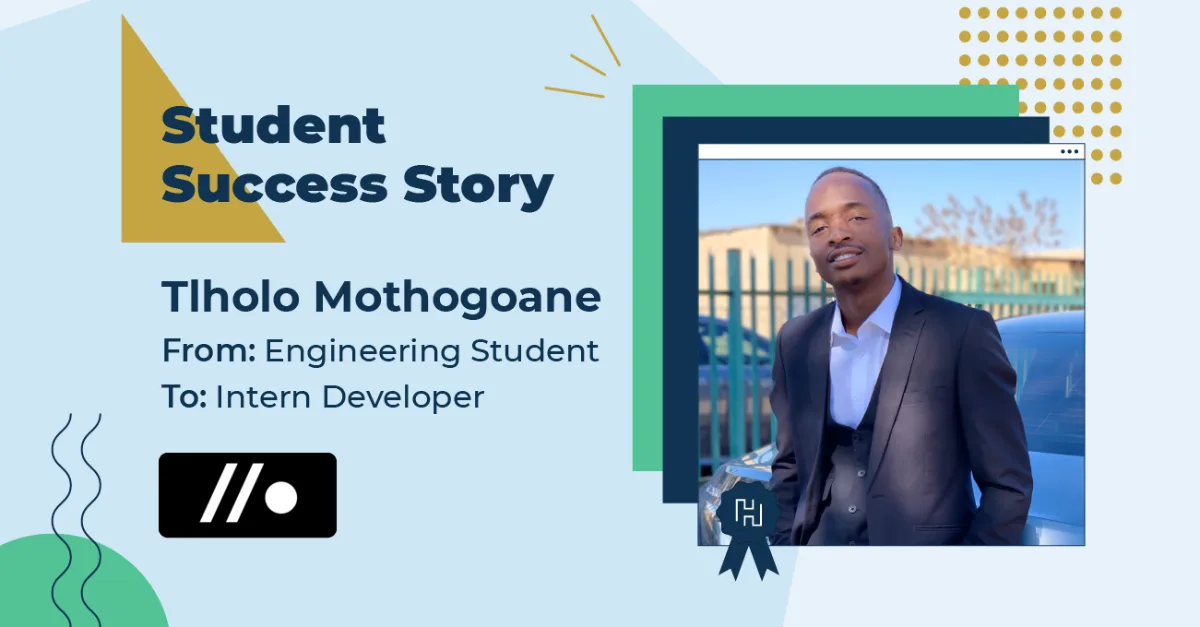
Student Success Story: Tlhologelo – From Engineering Student to Intern Developer
Tlhologelo Mothogoane was pursuing a mechanical engineering degree when the programming bug bit. This led him to our Software Engineering bootcamp, and now he’s a HyperionDev graduate enjoying a lucrative career in tech. Find out more about his success story.
Tlhologelo Mothogoane from Vereeniging was studying mechanical engineering before the Covid-19 pandemic. Sometime in 2019, he completed a beginner’s online Python course, and it was set on pursuing code as a career. When the world went into lockdown, Tlhologelo chose to use the time wisely, so he sought a way to gain a solid foundation in programming to kick-start his tech career.
After searching online, he found HyperionDev’s Software Engineering Bootcamp. His parents were apprehensive because they wanted him to have a stable career in mechanical engineering. They were unsure about Tlhologelo’s potential career in programming. However, as soon as lockdown regulations relaxed, he convinced his parents to let him enrol to do the bootcamp on-site, full-time.
“I wanted to develop skills for an in-demand job because I know that most companies need programmers. I wanted to travel, and I know that with my programming skills, I will have a lot of work opportunities overseas.”
Tlhologelo’s bootcamp experience
During the bootcamp, Tlhologelo benefitted from HyperionDev’s team of expert code reviews, who gave him feedback that gave him the skills to learn any programming language. He also credits the bootcamp with teaching him how to resolve issues in his coding through developing a programming mindset:
“The code reviewing process was great because it showed me alternative ways of solving programming challenges. The code review really took my coding to a new level. It’s the same process that happens in the industry.”
He credits the challenges during the bootcamp with improving his coding skills. For example, one of his tasks was to create a game with Pygame. He found this challenging at first but became more confident in his abilities once he found a solution and overcame the challenge.
Bridging the gap between education and employment
HyperionDev not only gave Tlhologelo the tech skills he needed to be a successful programmer, but the Career Services team also helped him prepare for the jobseeking process. They helped him spruce up his CV and provided him with the opportunity to complete two mock interviews, which improved his confidence.
One day Tlhologelo saw a vacancy on LinkedIn for a remote intern developer position at German-based Lucid Studio. He applied and landed the job after completing a quiz and two follow-up interviews, one with the senior developer and then with the Lucid Studio team. In this position, he completes tasks assigned by the team and fixes bugs in existing code. Besides fulfilling the duties of his job, he also has side projects in the works:
“I created a Church app which I’m still working on. I used Laravel, tailwindcss, mysq, and PHP. I learned a lot building this app; building a fairly large app alone really teaches to you solve problems, research, and think out of the box.”
Tlhologelo’s future
Tlhologelo’s success story is not over. In the next five years, he hopes to gain experience and work overseas in a more senior position. He aims to solve problems, as he believes that this is how his programming skills improve, which in turn improves his self-esteem regarding his career.
He emphasises his gratitude for the skills needed for a well-paying job because now he can provide for himself and his family. His advice to people with similar career aspirations is to narrow down to the niche tech career they want to pursue and then focus on that aspect. When asked what he thinks about the coding’s potential to improve the world, Tlhologelo said:
“It already has; there has been a lot of life-changing technology that makes life easier for most people and, in the future, I don’t see this changing. I see more technology and innovations that would help a lot of people.”
————-
If you feel inspired by Tlhologelo’s story and feel ready to embark on your journey toward a fulfilling career in the tech industry, consider registering with HyperionDev here.
Who knows, your success story may be next.
Career Advice
Top 5 Highest Paying Programming Languages
There are hundreds of coding languages used in the creation of software. Some coding languages are better favoured than others. To find out the highest-paying languages, read this blog.
With a digitising economy, programming skills are vital, and people who choose to gain them can expect a lucrative career path. Anyone who knows anything about programming knows that there are hundreds of coding languages out there, but some of them are more useful and relevant than others.
We’ve compiled a list of some of the most in-demand programming languages that businesses everywhere need. If you’re a software developer, or if you aspire to be one, these are languages you’ll want to ensure you add to your repertoire. Here are the highest-paying languages for programmers.
1. Go
Go, which was released by Google in 2009, has become one of the more popular open source programming languages out there. The Google brand is known for its industry-leading innovations, and Go is no exception. The language is optimised to run on multicore processors, networked systems, and large computation clusters.
Go is usually requested as a skill for DevOps engineer positions, according to Indeed, and is also commonly requested for full-stack developer jobs.
Did you know? Go started out as an experiment. Google engineers Robert Griesemer, Rob Pike, and Ken Thompson were looking to create a language that was simpler and quicker than the other popular languages available at the time, and Go was the result.
Developer demand: Go is currently holding steady at #12 on the PYPL index worldwide list, with a slight upward trend of +0.2% compared to a year ago, indicating a growing demand for developers in the years to come.
Average salary: The average salary for a Go developer is currently estimated at $112,854 per year.
2. C#
The C# language was developed by Microsoft in 2000 and is used in most of their products, including desktop applications and Windows 8/10 applications. It’s also the application of Microsoft’s .NET software framework.
This language can be used to develop a range of apps, from small desktop programmes to major web portals and web services.
Did you know? C# can be run on different non-Windows platforms (like Linux) without changing the source code. It can even be run on the Xbox 360 platform, using a special framework.
Developer demand: C# is fourth on the PYPL Index, garnering a 1% increase in worldwide demand and trend over the past year.
Average salary: C# developers can expect to earn an average of $108,894 per year.
3. Python
Python is a high-level, versatile language that has grown rapidly in the past few years. In fact, Python has become the most popular programming language in the world. In a study by Jetbrains, 85% of programmers used Python as their primary coding language in 2020.
Python is especially sought after in the machine learning and data analytics fields. Data scientists who are skilled in Python stand to earn well. The language is also used by DevOps engineers and full stack developers.
Did you know? Python is named after the television show “Monty Python’s Flying Circus”, and many tutorials for the language include jokes from, or references to, the show.
Developer demand: According to a data analysis from Future Learn, Indeed.com has over 14,000 job listings as of 2022, nearly double the number of listings for Java, and this trend is set to continue throughout the years to come. The PYPL (Popularity of Programming Language) Index lists Python as #1.
Average salary: Payscale estimates a yearly average of $87,812 for Python data scientists, but salaries vary depending on the position.
4. Java
Java is a very well-established programming language, which allows developers to “write once, run anywhere” (WORA). It’s relatively simple to learn and is widely used and favoured by big multinational companies. In fact, all apps developed for Android devices are Java-based.
Did you know? Java earns first place as the most searched language in Europe, South America, Africa, and Australia.
Developer demand: On Indeed.com, Java job listings have increased to over 80,000. It remains #2 on the PYPL Index, with a 1.3% increase in worldwide trends in the past year.
Average salary: The average salary for a Java developer is estimated at $78,604 per year.
5. R
R is another of today’s programming languages closely associated with machine learning. It’s a data processing and statistical analysis coding language which was originally developed in the 1960s.
Today, R is popular with data scientists around the globe, thanks to its huge number of data analytics libraries. The language is often requested for machine learning, data warehouse, and software engineer positions.
Did you know? R users can improve the software’s code or write packages for R that are suited to specific tasks. R packages offer advanced algorithms, graphical interfaces, and improved data mining techniques, allowing users to dig deeper and analyse more.
Developer demand: R is at #7 on the PYPL Index. While its demand hasn’t grown worldwide, it’s still considered a relevant and vital computer language across the globe.
Average salary: The average annual salary for an R programmer is currently estimated at $69,004 per year.
Kick-start Your Future in Programming
Are you eager to launch a fruitful and lucrative career in the booming tech industry? Learn the world’s most popular programming languages online in one of HyperionDev’s coding bootcamps, and develop the skills you need to earn big. A world of success is at your fingertips.
Editor’s note: This post was originally published on 06 July 2018 and has been updated on 14 June 2022.

Career Advice
Learn Programming Faster with These Top Tips
Anxious about the looming recession? With a heavy reliance on technology, programming is one way to ensure your employability no matter the state of the economy. Check out these top tips to learn programming fast and secure a position in the industry.
By now, you’ll have noticed that there are murmurs of a global recession all over the internet. Nobody can predict an economic downturn with absolute certainty, but we can gain insight into the fear surrounding its plausibility.

Google Trends indicates that global interest in the term “recession” has grown quite significantly in recent years. In fact, the search volume was greater more recently than it was during the last recession in 2008.
Yet while the potential for economic downturn looms, one industry is unlikely to face an extreme dry spell – and that’s technology. In an increasingly digital world, nearly every business relies on the tech industry to operate. This means that there is abundant opportunity for programmers, no matter the global economic standing.
If you’re ready to fortify your skillset in preparation for a potential economic downturn, here are seven tips to help you learn to code as quickly and efficiently as possible:
Know the Terminology
When you are getting started with programming, there are many different terms and phrases to learn that can be daunting to beginners. But the quicker you learn the terms and coding jargon, the better off you will be when beginning your first steps down the programming path. For example, while most individuals won’t know what it means for a tool to accept logs from any Node.js app, you will need to. There are plenty of terms you will need to become proficient in to succeed as a programmer. And the best way to start familiarising yourself with complicated terms is to read through a glossary.
Practice, Practice, Practice
Reading, watching videos, and taking classes are awesome for the development of theoretical programming knowledge. But learning how to code requires a lot of practice. The more you practice you can fit in, the faster you can build up your skills. The only way to truly become a programmer is to program, so be sure to set aside a good chunk of time to do exactly that. Be warned, though: it won’t be effortless or easy. Trial and error will be a common method, and it will be frustrating at times. But the more you practice, the better you will get.
Utilize the Fundamentals
While the fundamentals might seem overly simple or obvious, they are still incredibly important to know and will be crucial to any coding projects you undertake. If you rush through learning the basics, you may pay for it later in your development as a programmer. Understanding the fundamentals will form the foundation for building more complex skills. An example is harnessing the benefits of pseudocode, a way to learn code in a more theory-based process. This will help you grasp the critical and logical thinking skills required for all the techniques in programming.
Don’t Be Scared to Ask for Help
Learning programming can be a painstaking process, and falling into a rut or struggling with something for long periods is not uncommon. Luckily, there is an extensive network and coding community at your fingertips. Instead of spending hours trying to solve a problem that you may never be able to, why not ask for help? There are several forums and message boards that are full of people willing to help you with your programming-related problems. But if you feel you need more consistent guidance as you develop your coding skills, HyperionDev offers expert and personal code reviews for every code you craft. We also have a student community Discord channel where budding programmers can connect and collaborate on code.
Watch Tutorials
Reading about how to do things or teaching yourself are suitable, but sometimes it’s easier to watch and learn. Online tutorials will help you visually witness the process as a whole, which you can then retain and replicate more effectively. Most of the time, teachers in these tutorials will also talk you through their problem-solving methods. This almost feels like you are working on the problem or issue together instead of tackling it alone. There are thousands of coding tutorials on YouTube, so there is a good chance you will be able to find what you need. One of the most effective ways to learn to code faster is to enrol in an online course. HyperionDev offers extensive and industry-aligned bootcamps for software development, data science, and web development.
Use Games
Learning to code through trial and error or watching tutorials works for many people, but they aren’t the only way to learn programming. If traditional methods aren’t keeping you engaged while you’re learning to code, you might want to look into using a game as a part of your learning process. There are several online games out there that will help you learn coding and programming while having fun at the same time. Many coding games also have different “levels”, making them accessible for all.
Don’t Rush Yourself
When learning something new, the last thing you want to do is rush through tasks or set too-high expectations. If you force yourself to rush, you might miss specific steps and hamper your learning process. Sure, you will have deadlines and requirements if you code or program for your job, but when you are learning, feel free to take your time and truly understand what you’re doing before moving on to the next task. After all, the best learning happens when you’re enjoying the process.
We hope that these practical coding tips can help you learn programming more efficiently and reach your goals – whether those involve gaining a hobby or securing a career in code. If your goal is the latter, HyperionDev offers in-depth coding and coding bootcamps that will get you job-ready in as little as three to six months. Our online courses are designed to take you from beginner to job-ready, helping you enter the rewarding tech industry with confidence.
Editor’s note: This post was originally published on 23 August 2018 and has been updated on 09 June 2022.

Student Success Stories
Student Success Story: Daniel – From Matric to Developer
HyperionDev graduates are as diverse as they come. This Matric student had zero coding experience before jumping into his coding bootcamp, but that didn’t stop him from becoming our latest student success story. Read about Daniel’s journey.
Not many people can say they discovered their true passion as a young age, but Daniel Lee Kahts is one of them. He was still in high school when he realised that coding was what fuelled and interested him. But instead of opting for a traditional university degree, Daniel opted for an accessible and practical alternative. When he found HyperionDev, he started on his journey, choosing to study online, full-time.
“I decided to take on a bootcamp to upskill my knowledge whilst learning all the fundamentals needed to start a career in coding.”
Sculpting a Coding Skillset
Daniel approached his software development course with determination and zeal. The more he learned and the deeper his knowledge base grew, Daniel found that he was heading in the right direction. His favourite course content included machine learning and advanced coding.
While the bootcamp presented many challenges, Daniel overcame his obstacles and was able to gain a strong foundation for his coding techniques. As a result, he was able to not only hone his skill but create an entire programme from machine learning and Python. He earned a 99% average on his tasks, setting up his confidence to enter the lucrative tech industry.
Crafting a Career in Code with our Graduate Programme
The HyperionDev Graduate Programme and Career Service Team helped set Daniel up with all the necessary tools he needed to find his desired job position. With this assistance, Daniel was able to set up an industry-ready GitHub portfolio and CV.
Daniel found a position through a headhunter and approached the interview with confidence. Finding his skills and the qualifications he garnered from his bootcamp more than enough for the position, Daniel landed his first job as a developer for Tech.co.za. He says that he is earning his expected salary.
In addition, Daniel now applies his newly acquired skills to boost his performance at work. He says:
“I use HTML, CSS, PHP, and Python skills that I learned through HyperionDev every day in my job role.”
Looking Toward the Future
Daniel has high ambitions for his future in tech. In the next five years, he hopes to further hone his skills and become a successful machine learning specialist.
He gives thanks to HyperionDev for helping guide him down his chosen path. He says:
“HyperionDev helped me progress through my coding journey by showing me the best and alternative ways to do certain coding problems. They also have a great syllabus that guides you through each chapter step by step and prepares you for the next challenge”
—————————
If you feel inspired by Daniel’s story and feel ready to embark on your own journey toward a fulfilling career in the tech industry, consider registering with HyperionDev here.
Who knows, your success story may be next.
Student Success Stories
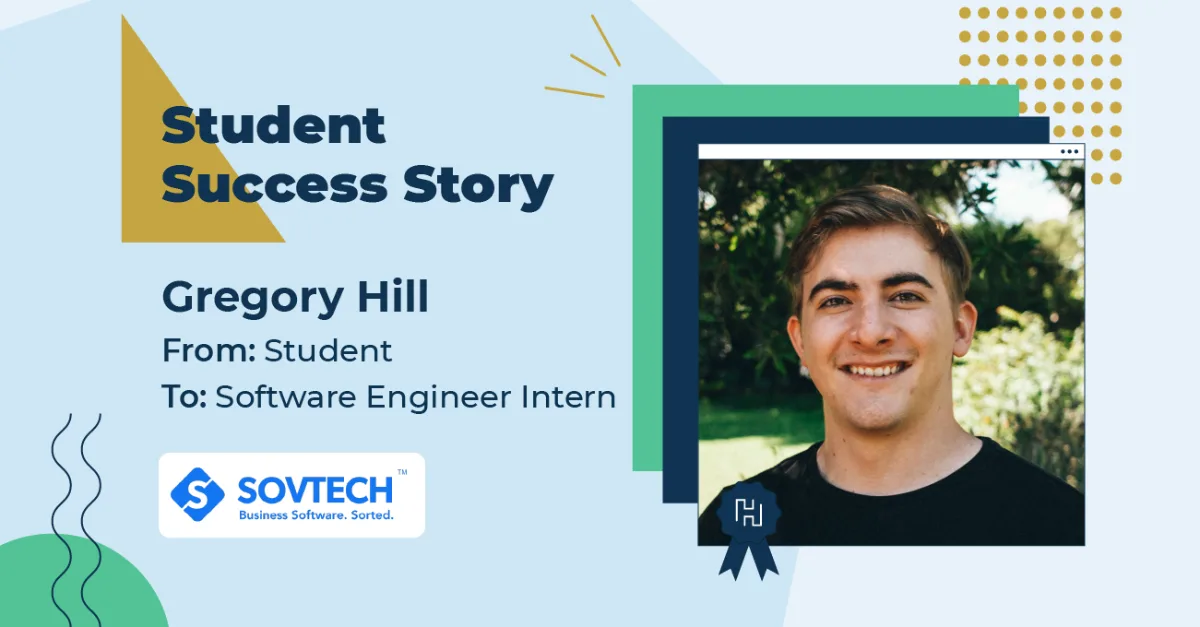
Student Success Story: Gregory – From Student to Software Engineer Intern
At the infancy of your career, choosing a path can be daunting. This student opted for guidance into the working world and took HyperionDev’s Software Engineer Bootcamp. Read about his journey to student success here.
Gregory Hill just graduated with honours in Information Management from the University of Johannesburg. While he enjoyed his studies, he found that the course content he was most interested in was only touched upon. But instead of finding a job he wouldn’t be happy in, Gregory decided to follow the path of his passion by enrolling in one of HyperionDev’s coding bootcamps. He says:
“I pursued my BCom undergrad in Information Management, which promised to be the connector between the business side of technology and the practical side of it. Throughout my degree, I found my software development modules the most exciting but, unfortunately didn’t receive the opportunity to go in-depth. The course content, at the time, was very outdated. So, after completing my honours I decided to dive deep into software development and found HyperionDev.”
Instead of being complacent after a traditional university experience left much to be desired, Gregory was proactive about chasing his passions. He chose to further his expertise and deepen his skill set by enrolling in our Immersive Full Stack Web & Software Engineering Bootcamp. Gregory studied online full-time, and, with his dedication, perseverance and zeal, he flourished.
Cultivating Success with Code
Gregory’s aspirations in programming only increased the more he progressed through his bootcamp. He says:
“I truly believe that software underpins the future, creating enormous value for both society and businesses. I also love the fact that, although challenging, software development has a creative aspect to it.”
While the course proved challenging, and Gregory had to face some tough obstacles along the way, his ambitious nature helped him pave the way toward victory. The course content inspired both his work ethic and determination, ultimately fueling his drive. He says:
“The course taught me concepts that some computer science graduates haven’t learnt in their entire 3-4 year degrees. Tech changes constantly, and this course teaches very relevant concepts and tools. This has been a huge benefit to me as I’ve been able to pass technical interviews and easily onboard onto any tech stack a particular company may be using.”
Turning Code into a Career
Gregory is currently completing a graduate programme in software engineering at the worlds leading software development company called SovTech. He collaborates and works with a small agile team to develop and maintain software for clients.
Gregory heard about the role through HyperionDev’s expansive network. Our integrated Graduate Programme and Careers Services assisted him in preparing for industry interviews and setting up a job-ready LinkedIn profile and CV. From there, Gregory was able to apply with confidence.
Meeting his salary expectations and satisfying his passion for software engineering and continuous learning, Gregory is realising his dream career. He says:
“I see myself continually learning and experimenting with new technologies and potentially leading the technology strategies of a company.”
He isn’t planning on stopping anytime soon.
“[In five years’ time,] I see myself as an extremely competent developer with the ability to apply tech in ways that solve huge and valuable problems.”
For all those looking to start a career in code or fortify their future with the invaluable skill set gained from HyperionDev bootcamps, Gregory has some advice. He says:
“It’s not easy. Learning to code requires strong dedication, persistence and self-motivation. It’s a marathon, not a race, and it doesn’t end after the bootcamp. You’ll always be learning and have something to learn. So, if you’re not the type who loves to be curious and is able to teach themselves, then don’t do it.”
Hope for the Future
This is only the beginning for code. Computer science is increasing in popularity, demand, and dependency. The future is steeped in technology, and the world requires more skilled coders.
Gregory has high hopes for the future of tech in the business sphere. He says:
“I believe that technology will help people achieve more, solve problems nothing else can, making lives easier and more efficient so that we can all spend time on what truly matters.”
And with HyperionDev at his back, he’s excited for what is to come.
“It’s empowered me to think like a solutionist. To be able to pick up and use bleeding-edge technologies to solve complicated and challenging problems in a new way.”
—————
If you feel inspired by Gregory’s story and feel ready to embark on your own journey toward a fulfilling career in the tech industry, consider registering with HyperionDev here.
Who knows, your success story may be next.
Software Engineering
10 Steps To Become a Developer
Tech skills like software development are in high demand across the business world. Learn how to become a developer with these ten steps and enter the tech industry with confidence.
In today’s economic climate, coding skills are not just relevant but highly sought after. Qualified personnel such as website developers, data scientists, and software engineers are in-demand in almost every established business worldwide. But entering this lucrative field isn’t an easy feat. That’s why we’ve compiled a list of the top 10 steps you can take to become a developer.
Step 1: Decide your definitive goal
You cannot embark on a journey without a destination or general direction in mind. You need to have a point of focus to help light your way. Your first step is to get clear on your goal, whether you’re looking to switch careers and gain a foothold in the tech industry or become a software developer in a leading company and raise your salary. Once you’ve decided what exactly it is you’d like to achieve, you’ll be able fill in all the touchpoints between where you are and where you want to be, which will help propel you forward.
Step 2: Dive into the research
Now that you’ve decided your what, you need to discover the how. If you’re set on becoming a developer, you need to understand what a developer does and what is required to achieve that position. There are numerousmyriad branches of development that one can go into, each requiring a unique set of skills. You’ll also need to learn a coding language, such as Python or JavaScript. If you have a specific company you’d like to work for, research what computer language they utilise. Ask professional software developers what their journey was like and what coding tips they may have for you.
Step 3: Start studying
There are many ways to learn software development, but one of the most efficient and beneficial ways is to gain your certification with an acclaimed institution. HyperionDev offers industry-aligned courses that take budding developers from novice to expert in mere months. Our bootcamps are designed to help fast-track your learning with practical courses that are part or full-time, online or on-campus. With a range of courses on offer, we can support your dream to become a developer with the utmost efficiency.
Step 4: Put your skills to the test
Learning the skills and languages of software development is only the beginning. Knowledge is like a muscle, and it needs to be trained and challenged to grow. Keep up with digital trends, test new theories and techniques, and keep learning. Sites that are useful for this include Stackoverflow and CodeWars.
Step 5: Learn from the experts
Reading the code others have constructed is a huge benefit in the industry and can help you develop your technique and gain inspiration for future projects. Fortunately, with HyperionDev, we set you up with a personal code reviewer who provides constant feedback and checks every bit of code you craft. If you’re ever stuck, you can ask questions. Make the most of your learning experience and receive guidance from experts in the industry.
Step 6: Join a community of developers
Receiving assistance, advice, and inspiration from others is paramount in the tech industry. Joining a community of like-minded individuals can help you gain true success in the developing realm. For example, HyperionDev has a Discord channel where our students can network with others in the field to support their progress.
Step 7: Cultivate a strong portfolio
To enter the working world and tech industry with confidence, you need to have a strong portfolio filled with many successful projects. When you undertake one of HyperionDev’s bootcamps, we help you build applications and showcase your new skills through our capstone project, which can be added to your portfolio.
Step 8: Join our grad programme
Finding a job can be just as difficult as gaining the skills required to enter the working world. Luckily, at HyperionDev, we’ve got you covered. Our specialised graduate programme is designed to help set you up for a job, meet alumni and network with prospective employers and others in the industry.
Step 9: Do mock interviews with our career services team
Interviews can be daunting, and it’s especially important that you feel calm, comfortable, and confident within yourself and your skills before beginning the hiring process. HyperionDev’s dedicated Career Services Team is set up help you do just that. We assist you in gearing up to land your dream position with mock interviews and portfolio refining.
Step 10: Time to apply
Search for relevant job positions and apply to as many as you see fit. Go through the hiring process and remember to ask questions about the position to ensure it’s the right fit for you. If you’ve completed the previous steps successfully, there is no doubt that you will soon land an attractive job offer. Accept the role that best suits you, and don’t forget to continuously keep learning and keep up to date with the industry’s best practices.
————-
Becoming a developer is no easy feat, but the journey is rewarding. So go forth with motivation, passion, and a willingness to never give up. If you’re looking to enter the lucrative tech industry or simply prepare for a successful future with in-demand development skills, HyperionDev has the course for you. Check out our coding bootcamps and experience what code can do for you.

Career Advice
Recruiting tips: How to nail your virtual interview
The ability to operate efficiently in a remote or hybrid environment has become crucial for success in order for employees to navigate a fast-paced, ever-changing environment. Here are some tips to prepare and make sure you put your best foot forward.
In a post-pandemic era where the majority of tech companies have transitioned to adopting a hybrid or fully remote working policy, it’s not only technical skills that are in demand. The ability to operate efficiently in a remote or hybrid environment has become crucial for success in order for employees to navigate a fast-paced, ever-changing environment.
So, you just received a first interview request for a role and company you’re really excited about, congrats! What now? Here are some tips to prepare and make sure you put your best foot forward.
Be on time and connected
This might be the most straightforward tip of them all, but companies that operate remotely or have teams based in other locations, need their employees to be on time and available for virtual meetings. When the recruiter schedules the first interview, make sure you familiarise yourself with the platform and double-check your sound, video and connection speed before the interview starts (that means the day before, not 2 minutes before the time!) so you can troubleshoot any issues and make sure you start the interview off on a positive note.
Do some research
This is applicable to most roles and industries, but any tech-based company worth working for will have a decent online presence. Check out their LinkedIn, latest blogs/news and other social media to see the latest on their products/services/partnerships or other developments. If you get the opportunity to ask questions, this is a great way to show that you’re informed and up to date as well as your interest in the future employer.
Use the time wisely
Most first interviews are quite short and can range anywhere from 15-45 minutes, depending on the level of the role. This goes by surprisingly quickly and there is a lot the interviewer would want to cover, so try as best as you can to listen to what the interviewer is asking so you can provide relevant information without spending too much time on your high school subjects or what your cat was up to last night. You want to make sure you leave time to ask your questions as well!
In order to have a productive conversation within a limited time frame, think about and communicate clearly about what you have to offer and what you’re looking for in order for you and the first interviewer to decide whether it’s a good idea to invest time in next steps.
Key items to think about:
- What are you really good at? What key skills do you have that match the role or that you can bring in addition?
- What are you not good at? What are you not interested in? The interviewer might not ask this from you, but knowing what you’re not passionate about is helpful in exploring a new role to know if it’s a good match for you.
- What is important to you in a role? Does this role ‘tick’ your main boxes? Not every role is perfect, so asking questions about work-life balance or flexible hours, growth opportunities, team structure and management, salary potential, benefits etc. can help you weigh up the options and decide if it’s worth moving forward with the process.
While the interviewer will guide the questions, an interview is always a two-way conversation, so make sure you use this time well to get the most out of it.
Be available and flexible
Make sure that during the interview process you’re available on email/phone for the hiring team to contact you and arrange the next steps. Fast and efficient communication in a remote environment is key to success. If you know you’ll be stuck in meetings/have planned time off, give the recruiter a heads up so it’s easier to coordinate between teams. It might seem old-fashioned, but a quick thank you note after an interview goes a long way to not only thank the team for their time and express your interest in the role but indirectly reminds them to schedule you for the next steps (hopefully!) without sounding pushy.
Be yourself
A company worth working for will be open to hiring candidates that can bring their whole selves to work. In a remote environment, the home office and who you are outside of work is now blended with what you do for a living, so often the hiring team would want to know a bit more about you. This means that you can be professional and still show your personality, passions and interests in the interview. In checking out the company’s public persona and tone of the brand, you should also get a good idea if it aligns with the type of company culture that you’re looking for.
These are our top tips for making sure you nail your next interview – sending good thoughts and lots of good luck!
———————
If you’re interested in a career that makes an impact, join the HyperionDev team in our mission to close the global tech skills gap. View our job openings here.
Student Success Stories
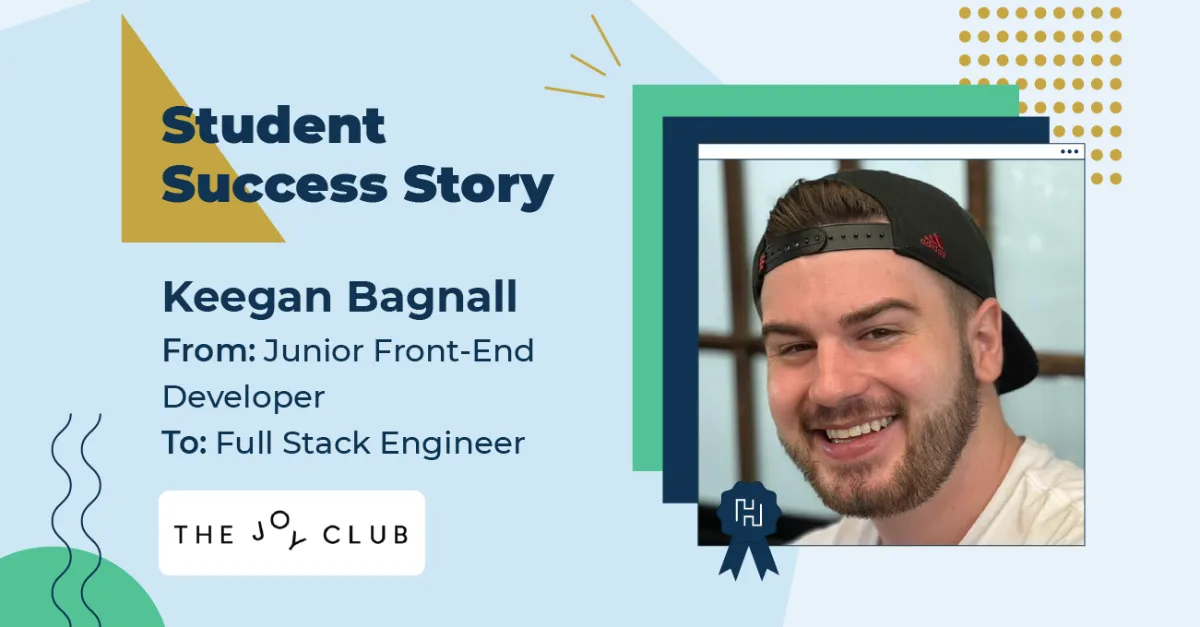
Student Success Story: Keegan – From Junior Front-End Developer to Full Stack Engineer
Read up how HyperionDev graduate Keegan Bagnall achieved his desired career outcomes when completing one of our coding bootcamps.
Keegan Christopher Bagnall graduated with a bachelor of computer science degree in 2020. But while searching for the software engineering jobs he was really interested in, he realised his degree didn’t cover the necessary skills required to enter the lucrative tech field. Keegan then found a front-end developer job but couldn’t shake the feeling that he should be in full-stack engineering instead. Rather than waiting for change to happen, he decided to be proactive about creating the life he wanted. He says:
“I enjoyed my position a lot but found that, after a few months, the challenges that I initially faced were starting to diminish. This made me want to expand my skills to progress my career and become a full-stack software engineer instead of only a front end engineer.”
To turn his dream into a reality, Keegan began searching for courses he could take to improve and deepen his skillset. One of the more highly-recommended institutions was HyperionDev:
“I looked into what the most effective way to learn software engineering skills would be, and coding boot camps were highly recommended.”
Gaining the Tools of the Trade
Keegan was set on evolving his skills base with the utmost efficiency, so he enrolled in HyperionDev’s Immersive Web Development and Software Engineering Bootcamp. He decided to study online full-time for a total of 6 months. The reason for his choice? He says:
“I wanted to develop skills for an in-demand job because I know that most companies need programmers.”
And so, Keegan was fast on his way to becoming a qualified web developer and full stack engineer. He says:
“The course at HyperionDev taught me the fundamentals of web development while also introducing me to various technologies that are commonly used in the industry, which made getting into the industry a lot easier.”
Soon after graduating and receiving his certificate from HyperionDev, Keegan was sought out by a recruiter on LinkedIn. He was offered a chance to apply for his desired job position. With his newly acquired skill set and expertise, and with the help of HyperionDev’s Graduate Programme, Keegan got the job.
A New Career Path in Code
Now, Keegan works as a successful full-stack engineer at an amazing start-up called the Joy Club. He gets to apply the skills he learned with HyperionDev in his work every day. But his aspirations don’t end here. He hopes to continue studying and improving his skills.
“I wish to progress as a software engineer and gain more experience to become a team lead or senior developer one day.”
And how is he aiming to achieve this? He says:
“I aim to improve my current skillset and learn as much as possible from my more experienced colleagues to improve myself as a developer.”
Keegan encourages all budding and beginner coders to go after their dreams, extend and expand their expertise, and never give up. For those thinking about starting a course, he says:
“I would advise people who are just getting into code not to be afraid to ask questions. Everyone has to start somewhere, and you should take the opportunity to ask as many questions as you can when learning to code. It will help make you a better developer.”
The world of code is only growing. There are a wealth of work opportunities for programmers in the tech industry, but also in the business realm as a whole. If ever there was a time to dive into the world of tech, it is now. Just as Keegan says,
“I feel strongly that there are numerous opportunities for code to create applications that can have a real-world impact on people’s lives and improve society in many ways as a whole.”
————————
If you feel inspired by Keegan’s story and feel ready to embark on your own journey toward a fulfilling career in the tech industry, consider registering with HyperionDev here.
Who knows, your success story may be next.

Student Success Stories
How To Succeed: Advice From Our Graduates
HyperionDev’s graduates provide budding coders and those looking to learn in-demand tech skills with advice on how to succeed as a programmer in this blog.
Tech skills are highly sought-after in almost every business sphere. Many believe that a graduate’s success is rooted in their chances to find and secure a decent job. However, at HyperionDev we believe that our alumni are achieving their dream careers because of their commitment to strengthening their value proposition with the industry-relevant skills they gain through our coding bootcamps.
HyperionDev graduates receive expert code review, personalised feedback from experts, industry-aligned course content, and support from our Career Services team. With a plethora of resources at their disposal, our graduates are able to make the career progress they have in mind and they are here to share their tips with you. Here’s our latest round-up of how budding coders can succeed in today’s fast-paced world:
–
Coding in the modern working world
Computer, coding, programming, and general tech skills are already in high demand across the globe, and this interest is set to grow. In fact, the demand for software developers increased by 25% between 2020 and 2021, and a further 70% of all job positions require basic digital skills to perform.
However, despite the expanding need for skilled tech employees, the global developer population grew by a mere 2.4% in 2020, a far cry from what the economic sector requires. As of today, over 87% of executives agree that they are experiencing a tech skills gap.
While these statistics may seem glum, they imply a wealth of opportunity for those willing to gain the vital tech skills needed to enter the industry. If you want to break into a lucrative economic sphere and fortify your future, learning coding is the answer. Take a look at our graduates’ advice and see if this is the chance you’ve been waiting for.
–
Advice from our graduates
So, what do our alumni have to say about their experience, and what advice can they provide for budding coders?
_

For Sonny Dube, it’s that joining a HyperionDev bootcamp “is the greatest decision that you will ever make. Software is slowly eating up the world, and the demand for software developers will forever be high. So I would advise people who want to code to actually take the chance and become software developers.” Your dream career isn’t so far out of reach.”
Graduate Kyle Julies says, “Programming is one thing that can easily be learnt if you so desire. Generally speaking, [you don’t need] an educational institution or a company to learn programming. The resources to learn are available to you, so take advantage of them! But if you find that you are enjoying it, consider taking a HyperionDev course to develop your skills further. The after-bootcamp support will be a big help for seeking a job in the field.”


Victor Obed Machimana came from a completely different background to IT. For those in a similar position, she says, “You don’t need to have any programming background. All you need is to love studying and have enough will, patience and passion for this.”
The last nugget of advice comes from graduate Simphiwe Nkabinde. He comments on today’s economic climate and how coding will help you fortify your skills for a successful future. “There’s never been a better time to start a career in software development. There’s a healthy level of competition in the job market, high demand for developers and plentiful opportunities all over the world.”

0–
How HyperionDev’s bootcamps sculpt a path into the tech industry
HyperionDev graduates of our acclaimed bootcamps have experienced the benefits of gaining industry-aligned tech and coding skills.
Each of our specialised courses is designed to teach students the foundational skills of code and programming and help them adopt a coding mindset that will propel them towards success.
Along with this knowledge base, our students receive one-on-one code review for every piece of code they write and access to a community of peers and industry experts who can chip in whenever needed.
In addition, graduates from HyperionDev’s bootcamps gain access to our extensive career programme, where we help them develop their CV and an industry-ready portfolio. The career programme also enables graduates to practice their pitch through mockup interviews. Our tried and tested methods have enabled graduates to land jobs at respected companies, including ABSA, SweepSouth, FinTech, Takealot, Mohara, SovTech, VMG Software, Explore AI, Old Mutual and many more.
With these tools to assist them in carving their own path towards a rewarding career, our graduates achieve genuine and sustainable success. What’s more, only 19.6% of our alumni came from an IT-related field or background prior to taking one of our bootcamps. This just goes to show that our bootcamps are accessible to all, your level of experience is irrelevant.
–
With a growing technological gap and accessible alternatives to traditional university degrees, making a career change is now easier than ever. If you’d like to join our graduate list, enter one of the leading industries in the world and cement your career in success, enrol in one of HyperionDev’s bootcamps today. See where coding can take you. Imagine what you can do with code.
Student Success Stories
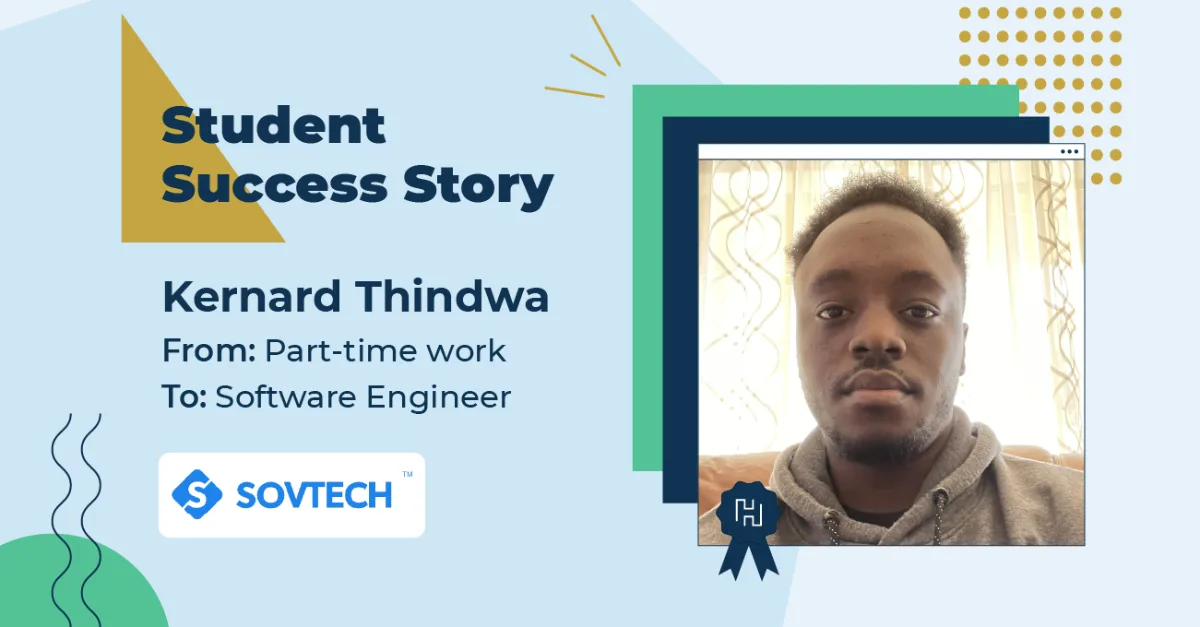
Student Success Story: Kernard – From Part-time Work to Software Engineer
Kernard wanted to change his career and seek work overseas. He knew that in-demand programming skills would help him do this, so he registered for HyperionDev’s Software Engineer Bootcamp to give him the edge he wanted. Read about how this decision changed his life.
Kernard Thindwa was working a part-time job, trying to improve his tech skills on the side by watching YouTube tutorials. After some time, he realised that this was not enough to achieve his career goals. This realisation resulted in his registration for HyperionDev’s Software Engineer Bootcamp, and it changed Kernard’s career path.
00
Kernard’s bootcamp experience
Before starting the Software Engineer Bootcamp, Kernard was set on upskilling to earn a better salary. He knew that programming skills were in demand and would give him a competitive edge in the international job market.
Kernard saw the Software Engineer Bootcamp as a way of gaining essential tech skills and as a test to see if he had a true passion for software engineering. Kernard believes that the bootcamp exceeded his expectations and says,
0
“Being able to pick up a programming language in a relatively rapid manner and having the foundational skills that are applicable to almost all languages has proven to be instrumental in achieving some of my career goals, I am now able to jump into a new language and build amazing things relatively quickly.”
0
Benefits of the on-site bootcamp
Kernard decided to complete the bootcamp on-site rather than online and feels that he benefited greatly from the collaborative learning experience. The peer-to-peer and mentorship model of the on-site bootcamp focuses on teamwork, problem-solving, and communication. Reflecting on the experience, Kernard says,
0
“I was also exposed to and was able to develop new skills, such as thinking programmatically, being able to solve problems, and analytical skills to better pick apart a large project (problem). I learnt to break assignments down into smaller more manageable tasks which then speed up the process of completing the tasks and project, which is crucial to being a competent software engineer.”
0
Kernard’s experience as a HyperionDev graduate
After graduating from the Software Engineer Bootcamp, Kernard signed up for the HyperionDev Graduate Programme, which helped him secure the job he has today. The programme taught him how to compose a professional CV, optimise his LinkedIn profile, and allowed him to do three mock interviews. These career development sessions helped Kernard land his job as a Graduate Software Engineer at Sovtech, an affiliated partner of the HyperionDev Graduate Programme.
Kernard nailed the interview process for his career at Sovtech. First, he had to submit a video answer to a question about non-fungible tokens (NFTs), followed by a technical assessment with a 3-day deadline. Once they reviewed the assessment and saw the quality of his work, he had two formal interviews, which led to a job offer that met his salary and career goals. Speaking about his role at Sovtech, Kernard says,
0
“My responsibilities currently involve building world-class applications from scratch, maintaining and updating existing applications and improving on the functionalities and performance of existing applications.”
He uses TypeScript, JavaScript, ReactJS, NextJS Strapi, and Postgres in his role as a Graduate Software Engineer. He uses the tech skills he learned in his bootcamp daily, and his job encourages him to get out of his comfort zone and learn more about programming. He credits HyperionDev with helping him get into a programming mindset and not shy away from challenges but rather identify opportunities for problem-solving.
In the next five years, Kernard sees himself using code to build unique products and solve complex problems. He aims to become a software engineer for an innovative, industry-leading company. Kernard’s advice for people who want to learn to code and enter the industry is that they need to be willing to face challenges with dedication and perseverance. He believes that you can become a better software engineer only by challenging yourself. When asked about the future of code, he said,
0
“I think that code will change the world for the better by having code that works well or even better with hardware such as Biotechnology, building prosthetics that help those who cannot walk finally do so, and DNA sequencing which could help us finally cure some of the most challenging diseases out there. This can all be achieved with code.”
0
If you’d like to see what Kernard is up to, follow his Instagram @steelosuave.
0
———————–
If you feel inspired by Kernard’s story and feel ready to embark on your own journey toward a fulfilling career in the tech industry, consider registering with HyperionDev here.
Who knows, your success story may be next.
Software Engineering
6 Coding Acronyms Used By Software Developers Everywhere
Before embarking on your career in software development, it is imperative that you know the 6 most frequently used coding acronyms. Knowing these will simplify your learning journey as you gain sought-after skills in technology.
Software development is full of acronyms. Who has time to say full phrases or explain concepts in between gulps of coffee and the construction of software? We’ve compiled a list of some of the most frequently used coding acronyms in software development to get you up to speed.
1. API: Application Programming Interface
This is the art of building something extensible in software development. It’s the foundation of standard procedures, types, tools, GUI interaction methods, and database access rules that programmers building applications using API can use. In other words, the API developer simplifies the process for other app creators.
Good examples of API programming include the Android APIs, where developers making apps don’t need to know how to talk to the phone’s gyro sensor or have a technical understanding of the chip that the device is using. They use a set of standardised instructions created by Google and the Android Open Source Project (AOSP) to talk to these components quickly.
2. IDE: Integrated Development Environment
The jack-of-all-trades of coding software—a compiler, linker, debugger, text editor, and project manager all in one. The IDE is the software in which you write your code and have tools that help you implement it and test your code once it’s all put together. It also keeps your source code files in one place, and some even offer to throw in version control.
3. SDK: Software Development Kit
These packages are tools given to developers by a platform designed to help create software for their ideas. It usually contains a set of libraries, documentation for the APIs included, and a framework for creating software—and, in some instances, even a bundled IDE.
The Android SDK includes many Android APIs for developers to use, as well as an emulator, so they can test their apps on virtual Android devices. Along with an IDE called Android Studio, this enables developers to make apps for Android with all the extra libraries and tools they need. SDKs can also come with libraries to interact with hardware and other applicable tools. Click here for Android Studio SDK downloads.
4. UI (User Interface) and UX (User Experience)
These two terms are listed together because, more often than not, if one is changed, the other is affected. UI refers to the interface or the portion of the software that interacts with the end-user. In most cases, this will be a window on-screen, with buttons, text, and other assets, for desktop apps or an app UI on a cellphone. Generally, any software that provides some method to interact with a user has a UI. So “Good UI” typically means ‘does it look attractive and engaging?’
UX, on the other hand, refers to the user’s experience using the application. “Good UX” refers to an understandable flow through the UI and the options exposed to the user. Are the essential options in your program easy to see? Are actions that are less obvious explained? Do the button labels or icons make sense for what they do? Addressing these types of question is an integral aspect of the UX process. An example of a popular UI with good UX is Wordle because it uses psychology to gain users. “Bad UX” often relates to “bad UI” in that if your programme looks unattractive or confusing, the user will generally have a difficult time navigating it. Although, that isn’t always true. Bad UI can have great UX and vice versa too.
5. OOP: Object-Oriented Programming
This is an alternative to other programming paradigms in which functions are executed on an event basis. OOP considers “objects” which are manipulated, each object containing attributes (constituent data variables) as well as methods (procedures to modify the attributes). A class is the ‘blueprint’ for what’s being designed, and objects embody the class blueprint. OOP supports class inheritance, where instances of an object in a derived class can be “a type of” the base class. The inheritance means that a derived class can inherit the base class’s methods and instance variables or modify them as needed.
6. SSH: Secure Shell
This isn’t a paradigm but rather a protocol. SSH allows you to conduct remote shell sessions on servers or remote clients in an encrypted fashion. The need for this arose with other remote terminal services like telnet and rlogin, which transmit passwords and sensitive data in plaintext. SSH lets you remotely access computers and servers from another computer. SSH is standard with client-server architecture connections and works on insecure networks such as the internet, where unencrypted data could be freely intercepted. Good examples of this are the ability to remotely access your Linux home server to check its status and perform console tasks when you’re away from home or in cloud computing when you run your code on large remote machines.
—————
If these coding acronyms excite you and you want to learn more, or even if you want more programming tips, our bootcamps are the ideal starting point.
We believe that anyone can code, even if you’ve never tried coding before. Our bootcamps are designed to help you to succeed, with personal expert code review and full career development support. HyperionDev is dedicated to helping you develop top coding skills so that you’re job-ready in less than a year.
Want to start learning the very basics, totally free of charge? Click here to check out our trial, where you can kick-start your journey towards a certification in data science, full-stack web development, or software engineering.
Editor’s note: This post was originally published on 27 November 2015 and has been updated on 26 April 2022.

Software Engineering
Top 5 Characteristics of a Good Coder: Coding Skills You Should Cultivate
See if you have the coding skills needed to succeed in the tech industry. If you have these top five characteristics, it may be a sign that you’d thriving in a coding career. If you have these traits, enrol in one of HyperionDev’s online coding bootcamps today.
By now, you’ve probably heard about all the exciting rewards that come with learning to code. Programming is a modern skill that fits into any career, enriches your existing skillset, and opens up new career opportunities with remote work, high pay, and incredible mobility. The rapidly digitising economy means that coding skills are not just applicable to the tech industry but are also increasingly paramount in other fields.
You might aspire to become a programmer yourself – but how do you know for sure if you would be any good at programming?
Well, there’s no exhaustive list of requirements to become a programmer. In fact, we believe very strongly that anyone can develop strong coding skills, no matter their age or background. But there are a few attributes and attitudes that we think would make learning programming and overcoming its challenges much easier.
Here are five qualities that show you would be a natural at coding.
00
1. Curiosity
If you have a natural curiosity for how stuff works and like to fix things through trial and error, then you’ve got at least one trait that’ll give you an advantage as you develop coding skills. Being curious and experimental is a must for programmers.
We might live in the age of StackOverflow, quick Google searches, and other resources you can consult at a click – but the ability to look at obstacles, figure out what causes them, and create innovative solutions on your own is invaluable. After all, what happens if you encounter a problem no one has ever solved before, or if you’re working on a project and can’t reveal anything about it?
This experimental attitude also means you’d be more likely to discover new technology stacks, programming languages, and techniques that make your job easier and your code more efficient. If you can show you’re proficient in several different programming languages, you’ll be able to take high-paying senior-level roles that garner plenty of benefits.
00
2. A quick grasp of structure and logic
At its core, programming is fundamentally logic-based. As any experienced programmer will tell you, the difference between a programme failing and it actually working can come down to a single missing semicolon or misspelt variable name. Every language has a particular set of rules for syntax, style, and structure – and the smallest error may result in code simply not running at all.
The ability to grasp structure and logic quickly might not be mandatory for beginner coders (practice is often far more powerful than talent), but it certainly does make using a language to solve difficult problems that much easier. It makes learning new tech stacks and languages a breeze. The more you know about programming, the more you can earn.
00
3. Objectivity
Being oversensitive or overprotective of your work can pose significant problems for the quality, security, and reliability of the code you write. Good coders don’t hang onto their code at all costs: they keep what’s useful and throw away code that no longer serves its function, even if it took weeks to write. Good coders know that there are always more efficient, better ways to do things, and so they are happy to throw out their own work and adopt another programmer’s code if it does the job better. Better code isn’t a slight against you; it’s an opportunity to learn and improve.
00
4. The right mindset and attitude
Just like a salesperson needs charisma, relatability, and people skills, so too do programmers need their own set of traits and values. Some of these ‘good coder’ values are:
Patience – A problem isn’t solved immediately. Developing your coding skills will take lots of trial, error, and time. A good coder has to be able to keep their cool and understand that rushed code is usually bad code.
Self-discipline – Coding is often an iterative process that goes through definite phases, such as planning, writing pseudo code, and creating programs in steps. Having the self-discipline to sit down and focus on individual tasks one at a time is an invaluable trait that you’ll need to cultivate to develop your coding skills.
An eye for detail – Code can be finicky and often requires you to pay attention so that you write code right. This value goes beyond just knowing the structure and rules of a programming language. It involves finding ways to make it better and more efficient.
Tenacity – Programs almost always fail before you can get them working – and even when code does run, bugs and errors are quite common. The trick is not to give up. Many people fear failure, but excellent programmers are excited by it.
00
5. An appetite for learning
New programming languages, technology stacks, and techniques are always emerging in the fast-evolving tech industry. A good programmer needs to remain aware of the latest coding practices and tools to ensure their code is lean, efficient, and up-to-date. People who take their self-education and upskilling seriously usually thrive at coding. As a developer, you want to continuously improve your coding skills via self-learning or online bootcamps.
00
——————-
If you want to start learning how to code and begin a journey towards your high-paying tech career, our bootcamps are the ideal starting point.
We believe that anyone can code, even if you’ve never tried coding before. Our bootcamps are designed for you to succeed, with personal expert code review and full career development support. HyperionDev is dedicated to helping you develop top coding skills so that you’re job-ready in 6 months or less.
Want to start learning the very basics, totally free of charge? Click here to check out our trial, where you can learn the essentials of data science, full stack web development, or software engineering.
00
Editor’s note: This post was originally published on 19 August 2020and has been updated on 26 April 2022.

Career Advice
Top Tips to Avoid Bugs in Your Code
Debugging is the bane of a programmer’s work. Gain access to tried and tested tools and techniques that make debugging easier.
Coding errors in software programming manifest unforeseen issues and interrupt the user experience. We call these errors ‘bugs’, and they’re not always very obvious. Debugging is when programmers seek to find bugs before users do, optimising the user experience.
Whether you’re new to programming or you’ve got years of industry experience behind you, bugs and their downsides have likely been a nuisance to you at some point. There are, however, some nifty ways in which you can avoid bugs and even debug code that’s already been impacted by this notorious programming problem.
Here are a few tips and programming tools that HyperionDev recommends to reduce the occurrence of bugs:
0
1. Code review
Before one tests new code for the first time, it is crucial to review it thoroughly. Sometimes one will only spot a coding error after several sessions of reviewing code. Firstly, code should be reviewed by the programmer, then by a peer, and lastly, it should be reviewed by an expert.
GitHub is an excellent platform to have one’s code reviewed by peers and experienced programmers. HyperionDev’s bootcamps all include personalised code review, which provides detailed feedback on submitted code.
2. Split different sections of the code up
While code can be helpful and provide exciting opportunities, too much code can slow a programme down. One of the best tips for code efficiency is to keep your code minimalistic. More code also means more opportunities for bugs. HyperionDev recommends keeping problematic code separate from “healthy” code. This practice ensures that bugs don’t spread to other sections of the programme.
3. Constantly rewrite the unit test
The unit test isolates a small section of the code to test its functionality. This is a valuable programming tool and can help identify and avoid bugs. However, when fixing bugs identified in previous unit tests, it is essential to debug the code and rewrite the unit test before the next round of testing.
4. Review compiler warnings
Compiler warnings are an essential part of the debugging process. It is crucial for developers to consider all compiler warnings and review the concerns raised therein. It is recommended to treat all compiler warnings as errors, particularly at the start of a programming project.
5. Focus on delivering simple programming
As with everything, sticking to the KISS principle (keep it simple stupid) is a guaranteed method of delivery code that is free of bugs. This includes simplifying code and not trying to add too many complex elements. Writing simple, straightforward code also makes the debugging process much more manageable.
6. If it ain’t broke, don’t fix it
There is a saying in the coding world that goes, “The good programmers write code; great programmers steal code.” Coders do not seek to reinvent the wheel, but instead rely on existing libraries, especially if they are well-tested. This is an excellent programming technique to avoid bugs, as the code in these libraries should be reliable and clean.
__________
Code review is such an integral part of the programming process. If you’re looking to learn code, make sure you have access to quick and reliable code review. HyperionDev offers a choice of online and on-site coding bootcamps, which include 48-hour code review feedback from experienced code reviewers. This means you can work through your coding tasks quickly and efficiently without feeling stuck.
Your code reviewer will assess your code’s accuracy, style, and efficiency to make sure it’s in line with industry standards. Then they’ll provide you with actionable feedback. Code review is a great way to ensure you avoid bugs when programming and produce high-quality code that works like a dream.
Interested in joining HyperionDev? Secure your future and enrol for a coding bootcamp here.
Editors note: this article was originally published in January 2019.

Software Engineering
Five coding myths debunked
HyperionDev debunks five common coding myths for anyone looking to deepen their career in software development. In this article, we give coding tips for overcoming the fears that these myths may create.
If you’re dreaming of becoming a software developer, you’ve probably encountered some hurdles along the way. Whether it’s people who tell you that learning Python takes several years, or it’s personal insecurity, overcoming the blocks in your path to success requires learning, as well as unlearning.
To help you unlearn some of the beliefs that may be holding you back from achieving your dream, we’ve listed and debunked five of the most common coding myths in software development.
Myth 1: You need to be a child genius to excel at programming
Often, people will say that the best programmers naturally excel at maths and start coding from a young age. This belief is incredibly discouraging for adults with no coding knowledge who are interested in becoming programmers. And, to be frank, it simply isn’t true.
Coding is the culmination of logic and writing. It involves writing instructions for a computer to follow. Therefore, problem-solving skills are far more critical than maths when it comes to coding. If you passed maths at a high school level and are willing to learn, you have enough logical skills to become an expert coder.
More than half of our students have only a higher diploma or high school education, yet a whopping 84% of our graduates achieved their intended goals within six months of completing a bootcamp.
As for age, the Africa Developer Ecosystem Report for 2021, the global average age of developers is 36. It’s never too late to start. HyperionDev equips adults with no prior coding knowledge with all the skills they need to become developers. This goes to show how possible it is for adults without prior experience in tech to make a career change toward software development.
Myth 2: Only people with university degrees in software development become programmers
Traditionally, university degrees were career-specific and required for most jobs. Times have changed, and having proof of skills is far more critical nowadays. There are several avenues to choose from as you develop new skills—and while a university degree remains one such method, it is no longer the only way.
One tried and tested path to successfully upskilling in code is completing an online software development bootcamp. HyperionDev’s graduates are a testament to this. Our students have gone on to become junior developers within weeks of graduating, and some even get employment while completing their courses. This proves that recruiters and companies are looking for skills and a solid portfolio rather than a certain degree.
Myth 3: It takes 10,000 hours to become skilled at programming
The popularisation of the so-called “10,000 hours” rule from Outliers by Malcolm Gladwell has caused people in various industries to believe that they need exactly that to be proficient in a skill.
While there is merit to Gladwell’s claims, the Stack Overflow’s 2021 Developer Survey results show that 35% of participants have only been coding professionally for 4 years or less. The results also showed that over 40% of participants learnt how to code online, and you can too.
In 3 to 6 months, depending on if you decide to enrol as a full-time or part-time student, HyperionDev’s highly practical bootcamps will equip you with the coding skills necessary to confidently walk into your first software development job and succeed in your career.
Myth 4: Learning to code is expensive
This one is founded on the second myth in this series. Because of the belief that a degree in Computer Science or Software Development is needed to become a developer, there is a belief that learning to code is expensive. Yes, traditional university degrees are pricey, but they’re not the only option to achieve the intended outcome. Coding bootcamps are affordable, and many providers offer payment plans to suit every budget.
HyperionDev offers upfront payments at a discount or monthly payments. We also offer scholarships and have partnered with financial institutions to finance up to 100% of the cost of a bootcamp.
Myth 5: Tech jobs are boring because you have to sit in front of a computer all day
This is a common myth perpetuated by movies: the computer geek sitting behind his screen tapping away on a screen with old pizza boxes strewn around his desk.
Don’t be fooled. The 50 Best Jobs in America 2022 report, published by Glassdoor, found that the top 12 jobs are in tech. Full Stack Engineer came in at number 2, Data Scientist at number 3, and Software Engineer holds 8th place. The report looked at salary, job demand, and job satisfaction factors.
Many of the jobs in tech involve training, marketing, dealing with people, or organisational skills. For example, an Analytics Manager uses an understanding of the industry, customers, and tech knowledge to make multiple business decisions such as which products to sell to which customers. And a front-end engineer uses code but also deals with a wide variety of people, from customers to content writers.
Tech work is as varied as you want it to be. Every company uses tech and needs tech-savvy people in their workplace.
Hopefully, we’ve cleared up any coding myths that have been blocking you from pursuing a career in software development. If you’re ready to embark on your journey to a lucrative career in the tech industry, find out more about HyperionDev’s coding bootcamps here.
Editors note: this article was originally published in June 2018.

Student Success Stories
Graduates’ Success: How 26 students cracked the code to launching a tech career
26 HyperionDev graduates found exceptional job placements in March. These graduates’ success is supported by the career services team and their career development opportunities. Read more about what HyperionDev offers graduates.
Many people believe that graduates’ success is defined by their career prospects. While tech skills are becoming increasingly relevant and crucial in today’s job market, many people with these sought-after skills do not know how to get job placements or even where to find them.
HyperionDev graduates have a leg up in this regard. Not only are they exposed to industry-leading code review and quality course content during the bootcamps they enrol in, but the Career Services team assists them in finding a placement at their dream company.
00
How HyperionDev’s Graduate Programme supports student success
HyperionDev’s Graduate Program and Career Services platform aid bootcamp graduates at every step of the jobseeking process. The Graduate Programme takes place over 90 days post-bootcamp and is run by the Career Services team. It offers three levels of career development support to ensure graduates’ success in securing job placements.
The programme is free to all HyperionDev graduates and provides technical career readiness, alumni networking, and an introduction to the tech industry. As part of the programme, graduates will be taught how to optimise their CV, write an engaging cover letter, excel during interviews, and build a portfolio that makes them stand out from the crowd.
Following the technical side of career development, graduates will be introduced to fellow alumni, allowing for independent networking. The connections made during alumni networking often lead to job placements and sometimes even the commencement of collaborative projects. Graduates are also introduced to HyperionDev’s hiring partners, which allows them to network with potential employers.
One graduate, Amy Marais, said the following about the Graduate Program:
00
“I believe the post-bootcamp support that HyperionDev offers is unmatched. Because of my really good LinkedIn profile, I was able to attract the attention of multiple CEOs and recruiters, who then reached out to me to either set up an interview or to have me send through my CV. These CEOs and recruiters were from Cape Town, Johannesburg, and even Singapore.“
0
Graduates’ success in finding job placements post-bootcamp
The efficacy of HyperionDev’s Graduate Program is seen in its results. Within 6 months of graduation, 95% of graduates achieved the career goals they set for themselves when enrolling in their bootcamp. On average, graduates report increasing their salary by 23%.
Many HyperionDev graduates learnt all their tech skills from their respective bootcamps alone. Over 50% of graduates held only a higher certificate or high school education, and less than 20% had work experience in an IT-related field before enrolling in the bootcamp. This is what makes graduates’ success stories even more impressive.
In March 2022, 26 HyperionDev graduates found job placements at top tech companies. These companies include:
- Mohara
- Sovtech
- Code infinity
- OneNebula
- Flux Full Circle
- SYSPRO
- &Wider
- Logix design and development
- HyperionDev
One graduate, Kyle Julies, who works at VMG Software, says that HyperionDev’s prestige also helps its graduates to find job placements:
00
“I discovered VMG Software through HyperionDev. My employer already knew of the value of HyperionDev because they’ve hired their graduates in the past, and that might have assisted me with getting an interview.”
00
If you are keen to upskill with an institution that will also help you secure job placement post-graduation, register for a HyperionDev Bootcamp today. Who knows— you could be our next student success story!
Student Success Stories
Student Success Story: Chris – From Operations Manager to Full Stack Engineer
Chris Joubert wanted to leave Customer Support to fulfil his dream of becoming a Software Engineer. He chose to build on his coding knowledge to start creating projects. For Chris, HyperionDev’s online Software Engineer Bootcamp was the best choice.
Chris Joubert worked in Customer Support but felt unfulfilled in his work. He felt he had no room for further growth in his career and was determined to reap more satisfaction and a higher salary from his work. To achieve this goal, Chris began researching his options. His sentiments and action led him to HyperionDev’s online Software Engineer bootcamp.
With a bit of coding knowledge and the determination to upskill for his imminent career shift, Chris was confident in his ability to learn new tech skills. He wanted to learn the inner workings of the software engineering industry and thought that a reputable online coding bootcamp would put him on the best footing.
00
Chris’s journey to HyperionDev
One of Chris’s aims for the bootcamp was to receive support as he transitioned to a career in software engineering. He recalls the challenges of finding his first job as a developer without previous formal experience. Chris had previously worked on freelancer platforms, but many tech companies did not recognise his gigs as work experience.
00
“The experience I built up as a freelance coder/tutor on Fiverr was not something a lot of companies wanted to consider as “official”, so I decided to sign up to make sure I get the basics covered and gain a better understanding of what’s expected / best practice.”
However, Chris notes that his greatest challenge was conquering his fears and overcoming the misbelief that he could not achieve his goals. His confidence had been knocked in the corporate environment he had formerly worked in, where one manager called him out for having a positive attitude.
The confluence of these factors created a situation where Chris felt like he could not succeed and did not fit in. He no longer felt challenged in his workplace and decided that it was time for him to make a change by enrolling in the bootcamp and changing his career.
When asked about this time in his life, Chris says,
“I went through a personal journey of self-discovery and soon found out my only limitations were the ones I created for myself.”
As his self-belief evolved, so too did his career prospects.
00
How Chris’s life has changed since graduating from HyperionDev
Chris currently works as a Full Stack Engineer for Red Fund and says that his salary exceeds the expectations he had before starting the bootcamp. He plans to work at Red Fund for many years to come and enjoys the team he is working with. Working at Red Fund has expanded Chris’s tech skills and project management systems:
00
“I’m personally utilising flow charts to help visualise functionality and databases. When you’ve got a new project like this, it can be tricky to keep track of everything and what needs to be connected. So building up your guides for yourself on how everything is connected can help you hit the ground running.”
Chris is now developing a new system from scratch. While the details are still under wraps, Chris predicts that the system will revolutionise its target industry once released, and he is passionate about its potential. At last, Chris feels he is being rewarded for his enthusiasm.
00
Chris’s advice to future Software Engineers
Chris firmly believes in the power of coding to change the world in diverse ways. He wants to use tech skills to work towards positive change by developing prosthetic limbs that do not feel like prosthetics but feel like one’s own limbs. He wants to do more work in this field, similar to Elon Musk’s Neuralink.
Due to his belief in the possibilities that coding offers, Chris is passionate about encouraging people to learn more tech skills. He says that understanding the basics is essential, and from there, one should start trying to create and develop their project to build their portfolio for prospective clients and employers.
Chris’s advice for people who wish to become software engineers is:
“If the companies you want to work for use a framework, then learn to use that framework and make something with it to demonstrate to them. Nobody cares about the number of certificates anyone has. It’s about the experience that shows you can do the work.”
00
——————
If you feel inspired by Chris’s story and would like to journey into the fulfilling tech industry yourself, start your journey with HyperionDev here. Who knows, your success story may be next.
News & Announcements
April 6, 2022
HyperionDev’s Learnership Programme: A light in the dark for SA’s unemployment crisis
In an increasingly digitising economy, standing out from the crowd with critical tech skills is essential. To address the global tech skills shortage, HyperionDev is launching a world-class, industry-relevant and highly practical learnership programme.
In today’s post-pandemic climate, standing out from the crowd with critical skills is becoming increasingly important. South Africa’s unemployment rate has hit a record high of 35.3%—the highest level since Statistics South Africa’s first Quarterly Labour Force Survey in 2008. This means that 7.9-million people remain jobless. So, how do we, as a country, rectify this?
HyperionDev’s Business Development and Relationships Manager, Rudi Mdima believes that “The private sector needs to play a bigger part in pulling our people out of unemployment, and learnerships focused on sought-after skills are the way to do it.”
HyperionDev’s 2021 Tech Graduate Futures Report shows 87% of executives are experiencing a tech skills shortage. Exacerbated by the COVID-19 pandemic and Great Resignation, many industries rely on coding and highly skilled tech talent to remain competitive in the digital age. Yet, it is these very skills that are so scarce in South Africa.
To address the tech skills shortage, HyperionDev is launching a world-class, industry-relevant and highly practical learnership programme to service the South African market and African landscape. This work-based learning programme provides world-class tech skills for in-demand careers and leads to a National Qualifications Framework (NQF) registered certification.
Starting in June 2022 and running online for 12-months, the programme will enable participants to earn a National Certificate in Information Technology specialising in Systems Development. The curriculum is strategically structured with 30% theory and 70% practical tech studies. During the second half of their learning journey, learners will be placed with employer partners and given real-world exposure and outcomes-aligned tasks to complete, overseen by their assigned mentors.
On completion of the learnership, graduates will have the confidence and skills base to tackle junior roles in IT systems engineering, desktop support, IT support, computer or network support, business analysis, or database administration. These sought-after skills fortify modern businesses in an ever-evolving digital economy.
Graduates are also put through HyperionDev’s bespoke 90-day graduate programme, available on all of HyperionDev’s full bootcamps. The programme is designed to maximise graduates’ candidacy for job opportunities, and covers three levels of focused career development phases, namely: technical career readiness, alumni network, and introduction to the industry. By the end of the programme, graduates are equipped with the real-world skills needed to help them attain in-demand careers or to strengthen their position within their current company.
For HyperionDev Employer Partners, the learnership presents an opportunity to build and maintain a strong and future-proofed pipeline of key talent and young professionals. Mdima says, “Employer partners will also be in a position to apply for and take advantage of mandatory and discretionary grant funding from the Sector Education and Training Authority. Plus, they will benefit from tax deductions under Section 12H of the Income Tax Act, as well as B-BBEE points depending on the percentage of the organisation’s staff that are registered on the programme, along with bonus points should unemployed learners be absorbed.”
Learnerships are a win-win for everyone involved, with the biggest wins including being able to help the Government tackle the unemployment crisis in our country, improving South Africans’ livelihoods and closing the global tech skills gap.
00
If you would like to find out more about our learnership programme and how this would benefit you as our employee partner, visit https://www.hyperiondev.com/corporate-services or reach out to our Partnerships team at partnerships@hyperiondev.com.
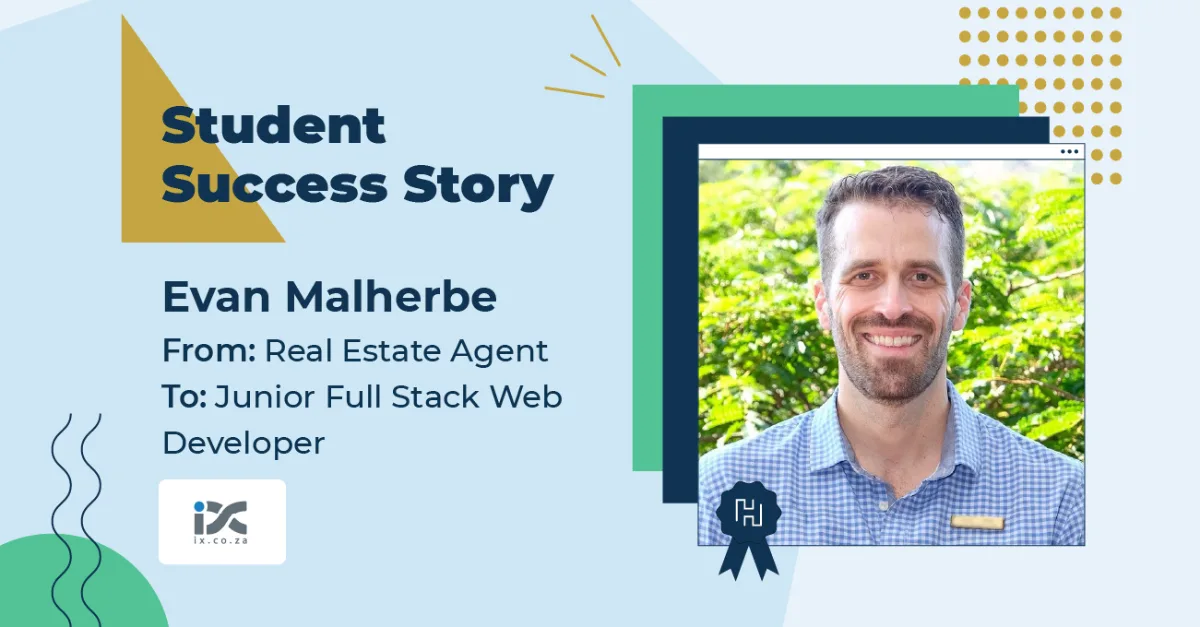
Student Success Stories
Student Success Story: Evan – From Real Estate Agent to Junior Full Stack Web Developer
Ever considered a radical career change? Evan did, and making it happen was simpler than he thought. Here’s how this real estate agent changed the trajectory of his career with an online full stack web developer course.
Evan Ernest Malherbe was unsatisfied in his position as a real estate agent. He had difficulty earning a decent salary and found little joy in his work. In fact, during his years of employment as a real estate agent, he felt he never found fulfilment. That all changed when he decided to enrol in HyperionDev’s Full Stack Web Developer Bootcamp.
“I have spent my working life moving from one job to another every few years and could never find something that I truly enjoyed and found intellectually challenging. I had dabbled with some html and css several times over the years, but never seriously. After growing disillusioned with my last job, I spoke to my parents, and they suggested I look into “building websites” again. “
The advice Evan garnered from his parents resulted in some careful research of his options. He came across multiple offerings for studying web development online, but none were quite as well suited as HyperionDev’s Full Stack Web Developer bootcamp.
00
“I had read about bootcamps and that they were a valid way to learn to code without having to do a 4-year degree in Computer Science, so I started doing some online research. I quickly figured out that HyperionDev was easily the most prominent and well-respected name in the industry. I read lots of reviews and decided that this was definitely the way to go. While I would have preferred to do the bootcamp in person, I live in Durban and so I decided to do the online one, but full time, so that I could finish in 3 months. Best decision ever!”
00
The course of code
Evan worked incredibly hard during his online web developer course. Each session provided more value than the last, and he was quickly able to scale his skillset. Soon, he was achieving his goal one step at a time. Evan says:
00
“I was happiest when I would finally succeed in fixing a bug or getting some tricky code to work perfectly after many hours of struggle. There is no better feeling than that! I also felt extremely proud of myself when I sent my final task in for review. What a challenging and rewarding experience this has been!”
00
Entering the job market
Evan’s hard work and determination – in tandem with the newfound sought-after skills he developed – landed him a foot in the door of the lucrative tech industry. He says:
00
“I landed a job as a Junior Full Stack Web Developer at iX Online Motoring within 8 days of finishing my bootcamp! I ran into a former boss of mine, and he asked what I had been doing lately, so I told him about the bootcamp and that I had just finished. He seemed very impressed that I had learned to code in React. He said that he has actually been looking for a new developer who knows React and asked me to contact his HR lady the following day. I have since realised that Hyperion set me up for success by teaching me a highly sought-after stack (the MERN stack) that many companies are looking to change to because of its advantages. My skills are in high demand!”
00
The Career Support Programme
Evan says that he received immense support and guidance from HyperionDev, helping him garner his first job role.
00
“The tasks for getting my technical CV created and setting up my Linkedin account were very valuable. I know for a fact that my developer portfolio website and Github account with all the little projects I had done during the bootcamp definitely helped me land the job”
Evan even has his eyes and heart set on a successful future. In five years’ time, he hopes to achieve greatness as a web developer. He says:
00
“I see myself learning a ton of new things in the first while, but specifically, I’m looking forward to applying what I know to actual client websites in a professional environment. It’s so satisfying to see how the skills I learned in the bootcamp are actually exactly what I need in the workplace! I expected to have to learn tons of new things or change the way I coded in order to succeed, but that hasn’t been necessary. I started building a website on day one and haven’t stopped!”
00
Advice for the future generation of coders
The tech industry is only expanding, with the relevant skills growing in demand. For all the budding programmers, web developers, and coders, Evan says:
00
“I would say that while the skills are absolutely in demand from companies, you need to understand that this stuff is challenging! The resources have never been more readily available to learn to code, but it is pretty tough. I think the high salaries in this field are justified because not everybody can do this kind of work. Having said that, you never know until you try!”
00
——————–
If you feel inspired by Evan’s story and would like to journey into the fulfilling tech industry yourself, start your journey with HyperionDev here. Who knows, your success story may be next.
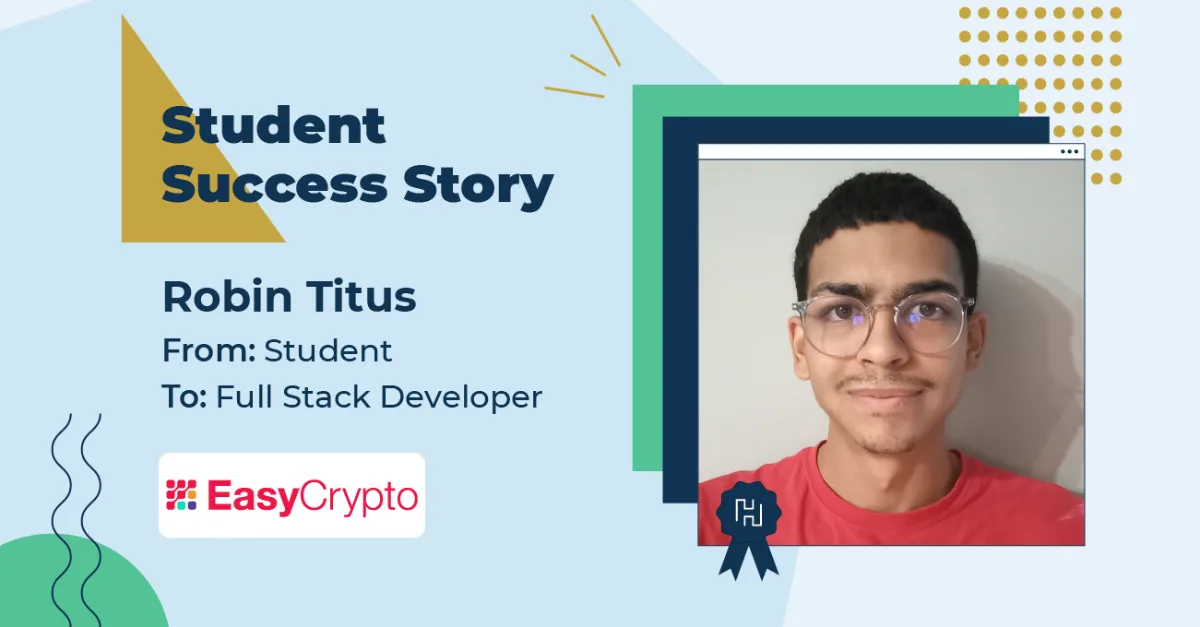
Student Success Stories
Student Success Story: Robin – From Student to Full Stack Developer
No matter how far into one career path you may be, it’s never too late to revolutionise your work and follow your passions. This is Robin’s philosophy, demonstrated by his decision to switch from finance to software engineering.
Robin Titus held a degree in finance. After receiving his BCom Investment Management degree from the University of Pretoria, he enrolled in an advanced finance course. However, after spending his spare time learning code by himself, he soon realised that programming is where his real passion lies.
“I came to the realisation that I was actually more interested in tech than in finance. While studying for that course, I spent my free time coding an app as a hobby by following YouTube tutorials. I eventually decided to withdraw from that course and switch to tech.”
Robin wanted a complete career change and a chance to fortify his future. He applied for a software development position but was recommended to complete a course first. That’s when he discovered HyperionDev.
00
And the online learning began
Robin enrolled in HyperionDev’s Software Engineering Bootcamp, studying online full-time. He completed his course with determination, zeal, and perseverance.
Soon, Robin was able to make the career change he worked so hard to achieve. He says:
“The HyperionDev Bootcamp helped me develop and curate applicable skills in a manner that is in-demand and relevant to the tech industry. This particular bootcamp also allowed me to change career paths much sooner than I anticipated.”
Having developed the skills and techniques required to enter the industry with confidence and adopt a solution-driven and problem-thinking mindset, Robin was able to land his new job with ease.
He is now employed as a Full-stack Developer at EasyCrypto.
00
The Graduation Programme and Career Support
Robin was able to create an industry-aligned and relevant CV and portfolio with help from the bootcamp’s applications. He says:
“During the Bootcamp, some of the career-related tasks were quite helpful (i.e. using Git to create an online GitHub portfolio and the task related to creating a tech-specific CV).”
But it was his new certification from HyperionDev that allowed him to seal the deal. As Robin says:
“When I connected with a former university friend on LinkedIn, he saw that I completed my HyperionDev Bootcamp and told me about the role.”
Robin was even able to display his skill set and talent due to one of the tasks during the bootcamp. His newly developed app helped elevate his success. He says:
“I made an app which I called Table4. It is available to download on both the App and Play store. Basically, if you are with a large group at a restaurant (where more than one person is going to pay the bill), you can use this app to split the bill (among the people paying).”
The next step
Now, Robin has his eyes set on the future. He has big plans to become an application and software developer rooted in achievement in the next five years.
0
“I would like to have published a commercialised app. One that I could actually run as a business.”
But what has given him such confidence and determination? HyperionDev’s Software Engineering Bootcamp equipped him with the necessary tools to take on the tech world. Robin says:
“I now have in-demand tech skills and the ability to make any kind of app I can imagine. I saw a tweet that said, “Learning to code is like learning magic”. I agree.”
Robin’s advice for budding programmers and coders is one cemented in both honesty and positivity.
0
“I did not know how things would work out when I decided to make the change, but I have no regrets today. And most people in the tech industry are very friendly. I really enjoy the atmosphere at the company I am currently working at.”
——————–
If you feel inspired by Robin’s story and would like to journey into the fulfilling tech industry yourself, start your journey with HyperionDev here. Who knows, your success story may be next.

Student Success Stories
Student Success Story: Charles – From Musician & Teacher to Junior Developer
Charles Knighton-Pullin was a professional musician for 20 years but wanted to make a career change. He had previous coding experience and wanted to equip himself with the skills to become a developer. This led him to HyperionDev’s Immersive Full Stack Bootcamp.
Professional musician and teacher, Charles Knighton-Pullin’s life was flipped upside down when Covid-19 hit and the events industry took a massive knock. He had been a high school music teacher and played gigs at night. He was searching for a more stable income and wanted to change his career.
This is what led him to enrol for HyperionDev’s Immersive Full-Stack Bootcamp. Charles had previous coding experience and wanted to upskill so that he could find a job as a developer. Speaking about his experience of the bootcamp, and how it prepared him for his new career, Charles says:
00
“I think it gave me a great grounding… and overarching education, if you will. There are loads of online resources, but it’s extremely difficult to know where to begin when you have little knowledge. It also gave me a good overview on what to expect.”
Charles’s new career path
Since graduating from HyperionDev’s Immersive Full-Stack Bootcamp, Charles has started working at Gotbot, a company that specialises in Chatbots. He first worked there for six months as an unpaid intern while completing the bootcamp and has since been promoted to Junior Developer.
Gotbot develops chatbots for social networking platforms that provide customer service based on analytics from client information. In his role as a Junior Developer, Charles uses various stacks to develop chatbots.
While his first role at the company did not meet Charles’s salary expectations, he has since started to reap the rewards of his investment and he feels the role is both rewarding and enjoyable.
0000
“It’s difficult to quantify and look back at a single “thing”, but I would say that the entire shift has been rewarding. The people I work with have been amazing and have had faith in my abilities to create products for the company.”
Reflections on the bootcamp
Charles enjoyed the module on Java the most and found the full stack REACT/NODE section to be the most challenging. He resolved to try his best and did well in the module.
He did so well, in fact, that the HyperionDev Team awarded him student of the month. Charles says that he is amazed by the skills he has now and the web applications he is able to build, as he previously did not think he would ever be able to create stable applications.
Charles’s five-year plan includes becoming a backend developer in a senior position:
00
“For now, I’m just taking it one day at a time. I think if you aim to make progress each day, you will find yourself in that position in time. That’s just my personal experience in life.”
The power of coding
Charles credits HyperionDev’s Immersive Full-Stack Bootcamp and his job at Gotbot with helping him to overcome his self-doubt and gain confidence as a developer.
In his opinion, coding skills provide limitless opportunities, as code offers numerous improvements to different facets of life, such as making connections between people and advancing medicine and science.
Charles’s advice to people who want to learn to code is:
00
“You need to go on to youtube or speak to a friend and see what someone in this industry actually does. I’ve tried to motivate a friend or two to take the plunge, but in the end, It’s your decision. You should know what you’re getting into. I think it can be an awesome career shift for the right person or potentially even just an amazing hobby.”
____________
0000
If you feel inspired by Charles’s story and would like to journey into the fulfilling tech industry yourself, start your journey with HyperionDev here. Who knows, your success story may be next.
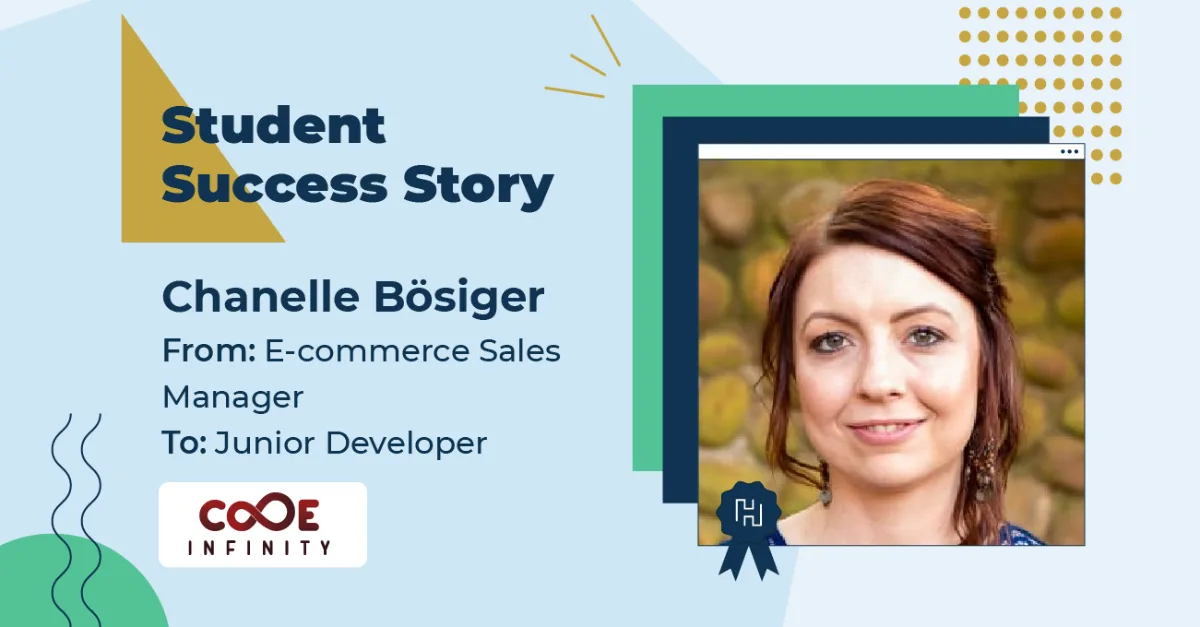
Student Success Stories
Student Success Story: Chanelle – From E-commerce Sales Manager to Junior Developer
Learning to code with HyperionDev was a career catalyst for Chanelle Bösiger. Read more about how she went from unemployed E-commerce Sales Manager to Junior Developer in just 6 months.
In April 2020, Chanelle Bosiger lost her job as an E-Commerce Sales Manager at The Safari Store, an online safari attire and accessory store. Sadly, due to the COVID-19 pandemic, The Safari Store was implicated financially as it relied greatly on the tourism industry. But instead of losing hope, Chanelle decided to view her circumstances as a catalyst for her career path.
Chanelle was ready for a complete career change, one that enabled her to continue working remotely. She knew programmers were in-demand, and she craved the stability that resulted from being highly skilled. That’s when she chose to pursue her interest in technology by learning code with HyperionDev.
oo
“I developed a strong interest in coding while building my husband’s architectural website on WordPress. At the time, I was job hunting after being retrenched from my career in the tourism industry.”
Back To Learning
Chanelle enrolled in HyperionDev’s Full Stack Web Development Bootcamp in the hopes that her experience with problem-solving and communication would help her along her way. And it did. Studying online, part-time, Chanelle mastered her bootcamp and graduated with flying colours.
oo
“The Full Stack Web Development Bootcamp has given me the opportunity to gain exposure and an understanding of a number of coding languages and technologies. These skills, along with the assistance offered by The Career Services Team at HyperionDev, have equipped me with the necessary tools to pursue a career in development.”
Mastering the Web Development Bootcamp
After completing learning code with HyperionDev, Chanelle felt ready and capable of starting a career in website development. Breaking out into the industry can be daunting to do alone, so Chanelle reached out to The Career Services Team at HyperionDev and applied to one of the job positions the team posted. With their unmatched support system, she could partake in the job interview with confidence.
oo
“The Career Services Team at HyperionDev has been extremely helpful in preparing me for a career in development. They have assisted me in setting up my application documentation and improving my LinkedIn account, and building a social network. They arranged a mock interview for interview preparations, arranged career expos and meetups, and were always happy to support me with queries regarding possible positions.”
With the help of the Career Services Team, Chanelle was hired as a Junior Developer at Code Infinity. In her current role, she applies many of the concepts and techniques she developed while learning code with HyperionDev.
oo
Following Her True Calling
During her Full Stack Web Development Bootcamp, Chanelle achieved the accolade of being named HyperionDev’s ‘student of the month’.
oo
“I was awarded student of the month via a LinkedIn post in April 2021 where my work was recognised by the HyperionDev team. Through dedication, discipline, and collaborating with HyperionDev team members and fellow students, I successfully graduated from the bootcamp and am now able to build web applications that I didn’t think I would be able to when I started this journey.”
Now, Chanelle wishes to continue upskilling herself so that she can achieve a higher career level within the website development industry. For all those who don’t think they can take on a career in code, Chanelle has this to say:
oo
“If you have an interest in coding, do it! Learning how to code is an amazing experience, and you will constantly surprise yourself with what you are capable of. If you are thinking about switching careers, it is daunting to take that first step, but you will not regret it once you do.”
——————————
oo
Develop Your True Potential
If you feel inspired by Chanelle’s story and would like to embrace the many opportunities that await you once you harness the power of code, you can start your journey with HyperionDev here. Who knows. You could be our next success story!
Student Success Stories
Student Success Story: Victor – From IT Support Technician to Full Stack Software Engineer
With our online web development course, Victor upgraded his skillset to become a full stack software engineer. Read more about his story here.
When Victor Obed Machimana started thinking about taking an online web development course, he had no programming history. Having worked as an IT support technician at a clinical company, his day-to-day duties involved on-site and remote technical support. While he worked this job, his days were blending together, and he began to feel discontent with his work. That’s when Victor made the decision to change the course of his career path by upskilling with an accessible solution: HyperionDev’s online Web Development bootcamp.
o
“Even though I liked what I did in my previous job, I quickly realised that it was becoming a monotonous routine and the pay wasn’t that great either. I wanted something more diverse and creative. So, after looking up courses that HyperionDev offered and doing a bit more research, it became obvious that web development was something that I wanted to do.”
What made this solution so accessible for Victor was that the bootcamp could be sculpted around his existing lifestyle. He had the choice to study part-time while he worked, but in the end, he opted for a full-time learning commitment. Victor was ready for a complete career change, and he was dedicated to making that happen in a matter of months. Victor wanted to increase his salary and brighten up his career, and he was willing to put in the work and upskill for an in-demand job. At the start of his bootcamp, he had no history in programming, but with the help of expert code review and practical skills development, his progress was fast and lasting.
o
“When I enrolled at HyperionDev, I had no programming history. But thanks to their mentoring programme, I was able to quickly learn in a way that I wouldn’t have in a traditional classroom. Every lesson came with a hands-on project and that really helped with my learning curve. Learning by doing is really the best way to learn.”
We agree with Victor – learning by doing really is the best way to learn. That’s why all HyperionDev bootcamps have an emphasis on practicality and industry-relevant skills. The tech industry is constantly evolving, and our courses are too. We ensure all our content is up-to-date and applicable to the day-to-day demands that you’d likely find in a programming role. With expert code review, our students work 1-on-1 with experienced programmers who provide individualised feedback on every bit of code.
o
“The code reviewing process was great because it showed me alternative ways of solving programming challenges. The process was very supportive and helped me to identify when I was on the right (or wrong) track. Having expert coders review my work really took my coding to a new level. It’s the same process that happens in the industry, and I learn in the same way today.”
Victor’s current role is Full Stack Software Engineer at OneCart, an online grocery delivery service that serves South Africans. After his online web development course, he made lateral shifts in his career and continued to learn by doing.
oo
“Working with an amazing team of intermediate and senior software engineers has helped me to improve my back-end and front-end skills and my problem-solving skills. I’ve also learned new tech stacks like MySQL, serverless, typescript and more thanks to the company’s support system that purchases courses for employees to improve their skills.”
But even with all the advancements he’s made in his career, Victor’s first online web development course with HyperionDev was his foot in the door to a booming industry that’s geared toward growth. To this day, Victor uses the skills and techniques he developed during his time learning at HyperionDev.
oo
“In my current position, I’m responsible for managing and developing the company’s eCommerce website and in-house web tools, such as administration software and web apps. HyperionDev definitely equipped me with all the necessary skills that I needed to land this job and the skills that I use in my daily work.”
According to Victor, “Code has a big impact in the world that we live in today, and the demand for coders/programmers is only growing wider. Code is in almost everything that we use: our phones, laptops, cars and even house appliances.” With an ever-evolving world and a continuously digitising economy, tech skills are more sought-after than ever.
—————–
If you feel inspired by Victor’s story and would like to journey into the fulfilling tech industry yourself, start your journey with HyperionDev. Industry-aligned coding bootcamps are the best way to become a job-ready developer in months rather than years – with an added layer of career development and job-search support.
Enrol now to join one of our online and on-site coding bootcamps, which will teach all the hands-on developer skills you need to do real developer work. Who knows your success story may be next.
Student Success Stories
Student Success Story: Simphiwe – From Student to IT Systems & Full-Stack Web Developer
Our online software and web development courses have been the catalyst for many students’ success stories. Read more about Simphiwe’s rise to success in creating a career as an IT Systems & Full Stack Web Developer.
On the hunt to develop real-world, practical skills to propel him forward in his career, Simphiwe found HyperionDev’s Immersive Bootcamp. He always knew he would find a career path in the tech industry, so Simphiwe signed up for a full-time online student position and zealously completed his course in a few months. Now, Simphiwe is finally doing the job he has always dreamed of. But let’s look back on his journey to getting there.
00
Simphiwe started his educational expedition studying engineering. However, after graduating, he wished to equip himself with practical tools to join the tech industry. Having been a tech enthusiast for as long as he can remember, Simphiwe found HyperionDev’s IT System and Full-Stack online bootcamp and knew it was the direction he needed to take.
0
“I’ve had an interest in technology, coding and programming from a very young age. I used to tinker with any computer or digital device I could get my hands on. After doing a college engineering course, I was looking for an educational institution where I could acquire practical, real-world skills in software and web development. I stumbled across HyperionDev’s website while browsing the net. It was just what I was looking for: an institution that offered skills-centred courses in software and web development. After doing a lot of background research about HyperionDev and the type of education they provided, I was sure that it was the path I wanted to take.”
While engineering certainly helped shape his mindset and sculpt a strong path in technology, Simphiwe knew he had to delve deeper into the realm of computers and coding to gain an invaluable skillset that would be a catalyst for a successful future.
0
“Through my course, I had the amazing opportunity of exploring a variety of technologies used in software and web development. This enriched my understanding and comprehension of programming concepts that were sometimes difficult to grasp and apply. I developed a greater capacity to learn and explore other technologies.”
Simphiwe soaked up as much as he could during his full-time Bootcamp experience. Not only did he receive hands-on, immersive skills, but he also gained personal confidence and empowerment. With his knowledge, portfolio, and industry know-how, he was able to access and apply to competitive positions. Not only did he apply for jobs, but he also got offers too. Today, Simphiwe works as a full-stack application developer.
0
“The tech skills I’ve gained from my Bootcamp have been useful at every stage of the development process. I often refer back to my Bootcamp notes and the projects I’ve worked on during the Bootcamp to help me solve some of the problems I come across while working. The understanding of programming concepts that I have gained has also helped improve my communication skills, which is very important when working in a team.”
Simphiwe says that the HyperionDev Graduate Program and Code Review helped him both with his interview and job position going forward. But his journey isn’t over yet. In the next five years, Simphiwe hopes to further his education and become a senior member of a tech firm.
0
“In years to come, I see myself as a senior developer fulfilling a tech lead role. I would also love to be part of an exciting startup project at some point in my career.”
Simphiwe holds a positive outlook on the future of tech. He encourages budding coders and programmers to chase their dreams. It’s never too late to start.
0
“There’s never been a better time to start a career in software development. There’s a healthy level of competition in the job market, high demand for developers and plentiful opportunities all over the world.”
————–
This software and web development course helps students succeed
If you feel inspired by Simphiwe’s story and would like to journey into the fulfilling tech industry yourself, start your journey with HyperionDev here. Who knows — your success story may be next.
Still have questions?
Contact our Admissions Team, and a real person will get back to you.