
Our latest insights
Read the latest insights


News & Announcements
December 31, 2022
HyperionDev Announces Three New Partnerships in England
Leading online coding bootcamp provider HyperionDev announces three new partnerships in England with the DfE, The University of Manchester and University of…
Leading online coding bootcamp provider HyperionDev announces three new partnerships in England with the DfE, The University of Manchester and University of Nottingham Online
- The UK Department for Education (DfE) will fund over 1,400 places in the latest edition of HyperionDev coding bootcamps. Enrolment deadline is 25 November 2022 – visit skills.hyperiondev.com
- HyperionDev is further partnering with The University of Manchester and University of Nottingham Online to issue limited certifications to students
- Switching to a career in the cloud has been shown to significantly improve individual earning capability, with the average tech job paying 80% more than the average UK salary (source: technation.io)
- HyperionDev already delivers bootcamps in partnership with the University of Edinburgh
- HyperionDev is due to announce more partnerships with other Russell Group universities
HyperionDev, one of the largest global providers of online coding bootcamps, is now working with three major education bodies in England: The Department for Education (DfE), The University of Manchester and University of Nottingham Online in a bid to bridge the widening tech skills employment gap in England.
Through its partnership with HyperionDev, the DfE is offering over 1,400 potential learners the chance to enrol in a government-funded online coding bootcamp. With half the places already taken, the deadline to apply for the remaining 700+ is 25 November 2022. Applicants should be over 19 years old, live in England, have the right to work in the UK and be available to study from December 2022 to March 2023.
These coding bootcamps in Data Science, Software Engineering and Full-Stack Web Development, which can be completed within just 16 weeks, give learners a non-degree certificate from HyperionDev – with limited certifications issued in partnership with The University of Manchester and University of Nottingham Online.
Riaz Moola, founder and CEO of HyperionDev says:
“According to the UK government 2021 report ‘Quantifying the UK Data Skills Gap’, 48% of UK businesses were recruiting for roles requiring data skills. Of those, around 46% are struggling to find suitable candidates, meaning that there is a huge skills gap in this area. In the current economic crisis, the ability to code could significantly improve present and future employees’ salary expectations. I strongly believe that accessible tech education is the future of upward social mobility for tens of thousands of people across the globe.”
In a competitive job market, skills such as coding have become crucial both for young people and for experienced professionals looking to reorient their careers. According to Tech Nation’s “People and Skills” 2022 report, tech salaries in the UK are on average nearly 80% higher than non-tech salaries. This reality has increased demand for bootcamps such as those designed and delivered by HyperionDev, which has expanded its operations significantly to keep up with the demand for its services.
The HyperionDev programming bootcamp courses are targeted at individuals who are looking to give their careers a boost, explore other career paths or to keep up-to-date with the latest job market requirements. They can generally be completed within three to six months and have been designed to help learners become fully-fledged developers, whether they are from a tech background or not. All students have a specifically designated mentor to help them adapt their level to the courses and advise them on their future professional development.
Professor Danielle George, Associate Vice President Blended and Flexible Learning at the University of Manchester says:
“Our new partnership with HyperionDev will make a significant contribution in addressing the national digital skills gap. Learning to code through bootcamps aligns with our Flexible Learning Strategy and our commitment to prepare young people for an increasingly digital, interconnected and intercultural world.”
University of Nottingham Online is an initiative from the University of Nottingham that will focus on reaching a new set of online learners, running alongside its existing in-person courses.
Sarah O’Hara is the Chief Executive Officer for this initiative, and she highlights:
“We are delighted to be partnering with HyperionDev to offer coding bootcamps. Coding skills are in high demand across the UK and this unique opportunity allows anyone, regardless of their background, to gain these skills and boost their career aspirations.”
In Spring 2022, HyperionDev joined forces with the University of Edinburgh – another Russell Group university – to offer three flagship online coding bootcamps. As of November 2022, nearly 3,000 students have already completed a trial bootcamp with many of the candidates on track to complete one of the three courses. The company, which was first launched in 2012, is due to announce future agreements with more Russell Group universities in the UK, and other groups internationally.
_________________________________________________________________________
Editor’s note: This post was originally published on 14 November 2022.
Student Success Stories
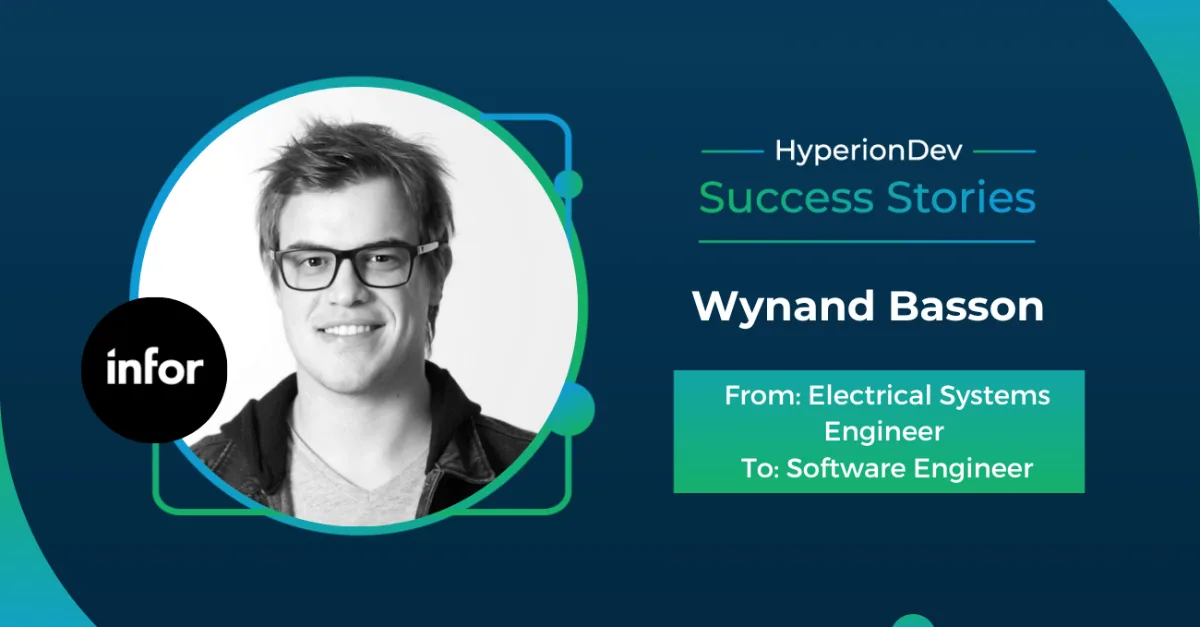
Student Success Story: Wynand – From Electrical Systems Engineer to Software Engineer
HyperionDev Graduate Wynand Basson left his job as an electrical engineer at Eskom to enrol in our Software Engineer Bootcamp. Today he’s stationed in Utrecht where he works at the forefront of global cloud computing solutions. Read his story here.
HyperionDev graduate Wynand Basson is currently living his dream life in Utrecht in the Netherlands. Coming from a background in electrical engineering, he was motivated to make a career change to tech by four of the industry’s top benefits: earning a better salary, developing skills for an in-demand job, working remotely from wherever he wanted, and being able to travel. This is his inspiring success story.
The spark that ignited the tech flame
Just a few years ago, Wynand was studying Electrical and Electronic Engineering at the North West University in Potchefstroom. It was during this time that he was introduced to different programming languages, including C++ and Java, and he decided he wanted to know more.
However, it was only once he worked as an electrical systems engineer at Eskom, a job and industry that he found stifling, that he decided to switch careers and follow his dream by enrolling in our Software Engineer Bootcamp.
Studying online, part-time, he says the flexible nature of bootcamp – combined with a good dose of hard work – gave him enough time to juggle both commitments. Today he works for Infor, a global leader in business cloud software products for companies in industry-specific markets.
Coding bootcamps are about more than just learning to code
Wynand enjoyed the challenge of his bootcamp and how each step in the programme fortified his confidence that he’d ultimately succeed in a career in tech. He was also excited by the huge variety of technologies he learnt, such as Python, Java, SQL, HTML, and CSS, and how it gave him a deeper understanding of object-oriented programming and machine learning.
For him, the most challenging part of the bootcamp was the supervised and unsupervised machine learning tasks students have to complete towards the end of the course. How did he cope? Wynand says:
“I overcame this with some guidance from my mentor and by reminding myself of what success would look like.”
Working in a high-tech environment right now, Wynand says the best part is that the skills he picked up with HyperionDev are easily transferrable to other technologies and coding languages. This has been put into practice at Infor, where everyone works in 4Gl, the company’s proprietary coding language.
He found the bootcamp code review process extremely useful, not only because it showed him alternative ways of solving programming challenges but also because it took his coding to a new level – something that often only happens once you’re on the job.
When he graduated, HyperionDev helped him create an awesome developers portfolio with Github, where he can showcase his favourite coding projects to potential employers. One of these is a video game he built using Unreal Engine and C++.
The world is Wynand’s oyster
Wynand currently has an enviable position as a software engineer at Infor, where his main responsibilities include app development and maintenance and completing admin tasks related to enterprise resource planning solutions. In just 18 months, he went from associate software engineer to software engineer, opening up dozens of exciting and promising job prospects and career paths.
His dream job is working for Guerrilla Games (the Amsterdam-based studio behind the critically acclaimed Killzone and Horizon franchises), but whether that pans out or not, he’s committed to always working for software companies that use cool technologies to make a positive difference in the world.
How does he think code could change the world for the better? He says:
“I think that, with code, we are only limited by our own creativity. The spectrum of possibilities ranges from financial software to video games to biomedical engineering to dating sites to factory automation, just to name a few. In my opinion, the world is, for the most part, better because of it.’
Follow Wynand’s exciting career in tech at his Github portfolio.
———————–
If you’re inspired by Wynand’s story and feel ready to embark on your own journey toward a fulfilling coding career, sign up for a bootcamp by registering with HyperionDev here. Who knows, your success story may be next!

Student Success Stories
Meet Our Mentors: Alfred, Kirsten, and Darren – From HyperionDev Graduates to HyperionDev Coding Mentors
HyperionDev coding mentors are student success stories in their own right. See how they help our students pass bootcamps with flying colours and read up on their journeys since becoming HyperionDev graduates.
Mentoring programmes have a huge impact on learning outcomes and are seen as one of the best paths to success among tech learners. The reasons are that one-on-one mentors are able to guide and facilitate learning while keeping students engaged. They can fast-track learning and act as experts by their side.
Meet three of our top coding mentors based in Johannesburg, and see how they make all the difference to the HyperionDev learning experience.
Alfred Ndlovu – From Legal Intern to Data Scientist and Mentor
Alfred Ndlovu was studying law at UNISA and, as a side project, was involved in creating an app that would allow SMEs to draft, manage, and review contracts. It was during this time that he stumbled upon our scholarship offer for people who had an idea for the next great thing in tech, and he was accepted into our Data Science Bootcamp, which he studied online, full-time. Incidentally, Alfred pitched his legal app idea, called Profred, to BeChangeMaker Africa while he was enrolled in his bootcamp. And out of 500 startup companies that applied, his team made it to the top five.
Before becoming a HyperionDev mentor, Alfred worked as a legal intern and was involved in building legal chatbots that would help people understand the law better. Signing up for bootcamp was a logical move as the knowledge he gained helped him complete this side project. Speaking of side projects, he is currently developing a machine model that will predict flight prices. Impressive!
As a current full-time mentor, Alfred is involved with reviewing code and assisting students with machine learning. He loves helping students achieve their goals but also enjoys challenging himself and continuously learning new stacks and tools.
Passionate about AI, machine learning, and data analysis, Alfred has set his sights on learning more about data engineering and upskilling in natural language processing so that he can build the kind of models he has always dreamt of. He says the best thing about being a mentor is that you learn along with your mentees.
How does he think code could change the world for the better?
“ Software is already changing the world, and most repetitive jobs, such as verifying documents for errors, are going to be automated. Using AI will help us be so much more productive.”
Follow Alfred’s exciting career in tech on his Github portfolio.
Kirsten Forrester – From Technical Sales To Mentor and Software Engineer
After graduating from Wits with a BA in Industrial Psychology, Kirsten Forrester worked in technical sales at a company that specialises in biometric access control and time and attendance solutions. Here she became fascinated by the development team’s daily operations and started to learn the programming language Python. This led her to fall in love with coding and enrol with HyperionDev, where she attended the Software Engineer Bootcamp onsite, full-time.
Thanks to her HyperionDev qualification, she landed a position as a mentor and has since moved on to work full-time as a junior software engineer for us.
Looking back to her time as a mentor, Kirsten says it taught her the importance of third parties being able to look at your code from an unbiased perspective. To her, future-proof code is preferable to code that’s banged out as quickly as possible, and it’s important to always think of future developers when designing solutions.
A typical day as a mentor would consist of doing synchronous reviews (grading tasks) and asynchronous code reviews (calls/meetings to assist students in real-time). She also spent a lot of time on Discord, helping students with their queries.
What advice does she have for other graduates interested in following a coding career and becoming mentors? She says:
“Mentoring provides an awesome opportunity to practise for code reviews of your future colleagues’ work. You will also have to deal with others’ style of coding a lot in your career, and mentoring teaches you to deal with and read different styles of coding.”
Follow Kirsten’s exciting career in tech on her Github portfolio.
Darren Noortman – From Pipeline Engineer To Software Engineer And Mentor
Darren Noortman started his HyperionDev journey by attending our Software Engineering Bootcamp doing the online, part-time course. Getting there wasn’t easy. Despite obtaining a Government bursary to study software development at two private colleges, delays in payouts meant he had to find another path. He stumbled upon HyperionDev bootcamps, saved up, and today he is one of our most valued mentors.
Unlike many mentors who switch careers from unrelated fields, Darren does have a background in tech. He initially worked as an IT Technician, then did an internship as a pipeline engineer at a visual effects and animation studio. Around that time, Darren developed a keen interest in programming, so he sought out the best in the business to help him level-up his skills.
Speaking about bootcamp, Darren says he loved the machine learning course – a notoriously tough one! He says doing extensive research and asking his own mentor loads of questions is what got him through it. While studying, he appreciated the fact that he didn’t have to waste time and money on topics – such as the history of computers – he’d never use in the workplace. While he initially found the notion of studying programming daunting, HyperionDev’s constant guidance gave him the confidence to develop any application he could think of. As a side project, he is currently developing an e-commerce website for his brother’s business.
Working as a mentor Darren is responsible for reviewing students’ work and for guiding them through their courses. He uses his tech skills daily, teaching different coding concepts, which he finds hugely rewarding.
Asked about how his bootcamp made a change in his life, he says:
“HyperionDev has given me a second chance in my career. I thought I would never work in this field after being kicked out of both of my colleges. There are many people in the same boat that want to pursue this field but cannot afford to go to a college or university for three years. HyperionDev is truly closing the gap in the demand for coding education.”
Follow Darren’s exciting career in tech on his Github portfolio.
————————-
If you’re inspired by our mentors’ success stories and feel ready to embark on your own journey toward a fulfilling career in the tech industry, consider registering with HyperionDev and enrolling in one of our bootcamps here.
Who knows – your success story could be next!

News & Announcements
November 15, 2022
Top-Ranked SA University Introduces Coding Bootcamps
To equip South Africans with the skills needed to make the career move to tech, HyperionDev has partnered with Stellenbosch University’s School for Data Science and Computational Thinking in providing bootcamps in Data Science, Web Development and Software Engineering.
Southern Africa’s largest tech education provider is partnering with Stellenbosch University to future-proof careers
Globally, 44% of people working in non-tech occupations have pivoted into tech jobs1. This figure is set to further increase as the career landscape evolves and automation makes some work redundant2. “Locally, with vacancy volumes reflecting growing demand for tech professionals3, coupled with tech skills featuring prominently on the country’s critical skills list4, South African working professionals should consider making a change now to future-proof their careers,” says Riaz Moola, Founder and CEO of HyperionDev, southern Africa’s largest tech education provider.
To equip South Africans with the skills needed to make the career move to tech, HyperionDev has partnered with Stellenbosch University’s School for Data Science and Computational Thinking in providing bootcamps in Data Science, Web Development and Software Engineering.
The School’s Director, Prof Kanshukan Rajaratnam, explains that these bootcamps form part of the institution’s mandate to build capacity in data science and computational thinking through education and training. “Given the ubiquitous nature of data and technology, today’s learners need to position themselves to take advantage of opportunities that will present themselves in the Fourth Industrial Revolution. It is for this reason that we have partnered with HyperionDev to accelerate what learners and the School can achieve.”
He adds that by working together, Stellenbosch University and HyperionDev are able to teach students tech skills as they are being introduced in the industry and as a result, meet employer demand.
“Coding bootcamps are considered the quickest and most efficient way to adopt tech skills and speed up the time it takes to switch careers since qualifications are earned in between three to six months,” shares Moola. “Typically, those who participate in bootcamps are able to change jobs within three months and emerge with an average annual salary increase of R44,148.00.”
He also points out that, since obtaining a traditional university degree cannot be juggled with a full-time job, the partnership means that those who are already working now have an opportunity to gain these skills and alter their career path.
Starting in October 2022, each online bootcamp will equip students with the theoretical knowledge and practical experience required for 21st century careers:
The Software Engineer Bootcamp is structured to include training in Python, Object-Oriented Programming, and Natural Language Processing (NLP). These skills enable graduates to work with software, hardware and other computer systems in a wide range of industries and jobs.
The Data Scientist Bootcamp teaches popular programming languages such as Python, scikit-learn, NumPhy, Matplotlib, and pandas, in addition to the fundamental concepts of machine learning and AI.
The Full Stack Web Developer Bootcamp offers coaching in both front- and back-end web development including HTML, CSS, React, JavaScript, and the MERN stack, amongst others. Competency in these areas can be used to launch a multi-role developer career, allowing graduates to work in a variety of jobs.
Moola notes that for many potential students, financing studies presents a huge challenge. “However, HyperionDev will offer access to study loans, a partial needs-based scholarship, payment plans, or discretionary discounts. After all, everyone should have access to quality education to increase their chances of employment both now and in the future.”
“There has never been a better time to gain these skills to participate in the future of technology!” concludes Prof Rajaratnam.
For more info on the partnership please see full video HERE.
_______
Footnotes
- https://www.mckinsey.com/Business-Functions/People-and-Organizational-Performance/Our-Insights/Overcoming-the-fear-factor-in-hiring-tech-talent
- https://www.weforum.org/reports/the-future-of-jobs-report-2020/in-full/chapter-2-forecasts-for-labour-market-evolution-in-2020-2025#2-1-technological-adoption
- http://cj-marketing.s3.amazonaws.com/CJI_Executive_Summary.pdf
- http://www.dha.gov.za/images/PDFs/47182-2-8-CriticalSkillsDHA.pdf
Student Success Stories
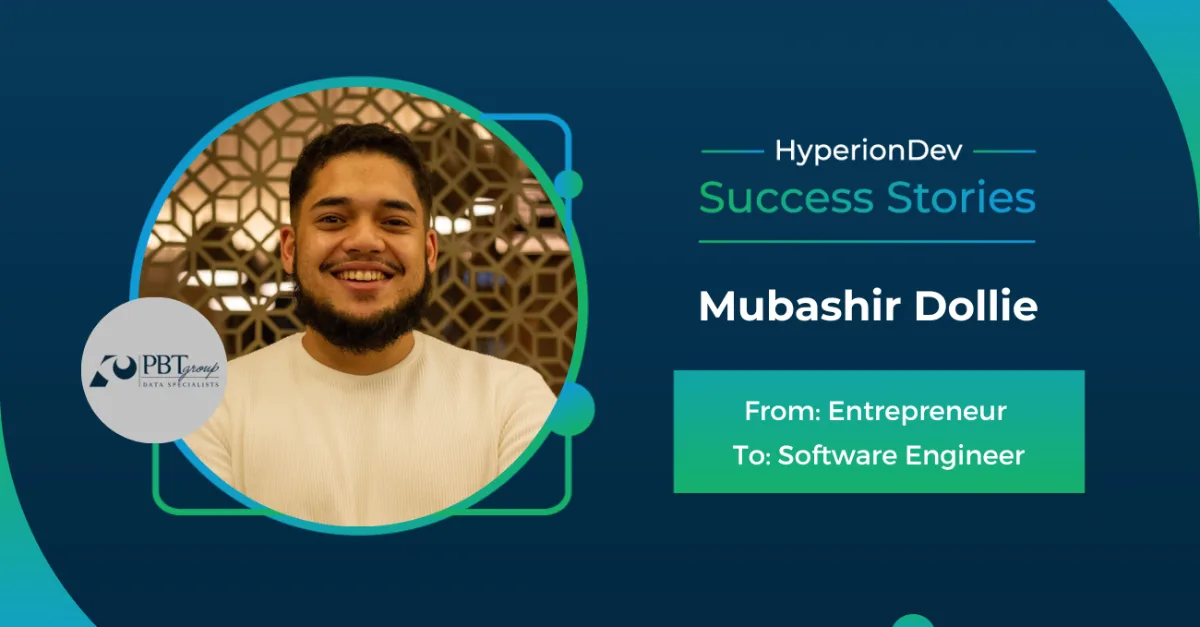
Student Success Story: Mubashir – From Entrepreneur To Software Engineer
HyperionDev graduate Mubashir Dollie went from small business owner to software engineer by completing our Full Stack Web Development bootcamp. This gave him the in-demand skills to take on a leading job in the FinTech industry. Follow his remarkable journey.
Just two years ago, Capetonian entrepreneur Mubashir Dollie was one of the many small business owners who was forced to close during the Covid-19 lockdowns. But, looking back, it turned out to be a blessing in disguise. Mubashir used the time he suddenly had on his hands to research his career options. Once he realised that software development suited him to a T, he started looking for an affordable and quick path to qualification.
Today this HyperionDev graduate is a software engineering consultant in the FinTech industry, and life could not be better. Let’s take a look at his inspiring success story.
Taking the leap and switching careers
Mubashir was a successful entrepreneur, running his own furniture manufacturing business and being responsible for a large team of workers. Although he loved being a business owner, during the first lockdown, his business grounded to a halt. Mubashir realised that to be able to support himself and his family, he had to spread his wings. He was looking for a career that allowed him to be creative without the stress and responsibilities of being a small business owner. He says:
“The Covid-19 pandemic had opened my eyes to the fact that we need an array of skills if we want to not only survive but also to get ahead in life.“
During his research, he found that the skillset required to work in software development was right up his alley. His online learning searches led him to HyperionDev, and he signed up for the Full Stack Web Development bootcamp, which he elected to complete on-site on a full-time basis. We asked him what made him decide to go with HyperionDev, and he said:
“The huge number of success stories, the global recognition of the certification, the curriculum, the services offered, the mentors, the network platform, and the free coffee, amongst other things, were what led me to choose HyperionDev.”
Making a fresh start in a new industry
Within two months of completing the bootcamp, he landed his first full-time job as an intern and software developer. Since then, he’s moved on to a permanent position as a software engineering consultant at the PBT Group, a data specialist company that counts Capitec as one of its clients.
Mubashir’s role is DevOps Engineer, working closely with the backend team. He explains that while the hard technical skills he learned at the bootcamp are what got him in the door, it’s his soft skills that keep him going. These are skills such as thinking like a developer, communicating technical concepts, understanding technical requirements, and learning on the go.
The hard and soft of bootcamp
Mubashir lights up when he speaks about his bootcamp experience, especially our mentorship programme and peer-learning model. He says being in close contact with his mentor ensured he grasped concepts, overcame obstacles and absorbed thinking patterns at lightning speed. Learning along with his peers meant he had access to a vibrant shared platform where ideas, solutions and concepts could be discussed and debated.
While many of our graduates go to lengths explaining how they enjoy learning programming fundamentals and doing capstone projects, Mubashir takes a broader view. For him, it was about so much more than just coding. The course taught him how to communicate technical ideas and concepts to non-technical people and how to overcome the barriers and obstacles that the industry is renowned for.
Having these skills and ‘thinking like a developer’ on top of working in tech stacks such as AQL, Azure, and .Net – and having the hard skills needed to manage both front-end and back-end web development – is what sets HyperionDev bootcamp graduates apart. Our Career Services team also assisted Mubashir with mock interviews, drawing up a winning CV, and managing his portfolio. No wonder he landed a top job in just two months!
Nothing’s going to stop him now
Mubashir is taking everything he learnt during his bootcamp into his new role and beyond while being committed to learning new technical skills as he gains experience. We asked him if he had advice for others considering a coding career. He says:
“Do it and get it done as quickly as possible. The barriers to entry into this lucrative industry are really low. If you’ve got the attitude for it, there’s nothing that will stop you from achieving your goals.”
__________________
If you’re inspired by Mubashir’s story and feel ready to embark on your own journey toward a fulfilling career in the tech industry, consider registering with HyperionDev here.
Who knows, your success story may be next!
Career Advice
Bootcamp or University? Find Your Best Path to Programming
We compare the benefits of learning to code with a traditional university education and coding bootcamp. If you’re looking to start a career in tech, read this to determine your ideal path to programming.
While there’s no denying an all-round education obtained from a university is the perfect fit for some, many people don’t have the time and money to go this route when learning to code. This has created a clear demand for more affordable, accessible, and effective learning models – such as bootcamps – that provide focused, intensive courses dedicated to teaching practical, job-ready skills at a fraction of the time and cost.
But are bootcamps popular, and are as effective as traditional degrees? Stats from CourseReport show a 306% growth rate in online coding bootcamp enrolment, with an estimated 79% of graduates finding a job in their field. HyperionDev beats that record, with almost 80% of our graduates getting placed in the tech industry within 6 months of completing a course with us.
We take a look at the practical benefits of bootcamps and how the outcomes compare to a traditional university education.
1. Graduation time
Most people don’t have the time to dedicate to the three or four years required to graduate from university. Bootcamps, on the other hand, are intensive and often immersive training programmes designed to provide aspiring tech developers and professionals with the skills they need to code professionally and that forms the foundation to continue to learn as they work.
Globally, the standard bootcamp programme length is three months. However, whether you study full-time or part-time will determine the length, as will the amount of material learnt and the pace of instruction.
2. Tuition costs
Students can expect to pay R66,000 for their first year of a three-year BSc Computer Science degree at a leading SA university. Add to that annual residence fees that start at R52,000, and it’s clear this is not a path for all.
Coding bootcamps, on the other hand, are far more affordable than even the cheapest university, offering a range of payment plans, more accessible credit and lending, and they are more experimental with arrangements – such as income sharing agreements or free-until-you-work deferred payment systems – that would be far too risky for universities to adopt.
3. Self-study requirements
There are three ways to learn to code and become a developer. Get a university degree, self-study, or attend a coding bootcamp. All are perfectly good paths to a career in tech – and all of them require some self-driven study. University students need self-study to put what they’ve learnt into practice. Others will try to learn coding from scratch themselves, without any structural support. But coding is a highly technical job entailing complex data structures and algorithms – despite what self-taught coders on YouTube say.
Bootcamps are seen as a more structured version of self-teaching. There’s the benefit of a well-designed course with a clear goal combined with opportunities for students to learn from each other by, e.g. joining online communities and forums for coders where they can bounce questions and get advice on a variety of coding issues.
4. Learning outcomes
Ten years ago, you needed a Bachelor’s just to get a foot in the door. Today, with the sheer overwhelming number of graduates out there, a bachelor’s degree isn’t the distinguishing accomplishment it once was. Simply put, many companies are increasingly preferring work experience and industry knowledge over college or university degrees.
Bootcamp graduates finish with a portfolio, an online presence, industry-applicable skills, interview skills, and more, often giving them the edge over their university graduate peers.
As former President Obama said, “It turns out it doesn’t matter where you learned to code, it just matters how good you are at writing code.”
5. Earning potential
Bootcamps were created in response to a huge global demand for skilled developers. Formal education systems cannot keep pace with the changing nature of work, resulting in many employers not finding enough workers with the skills they need.
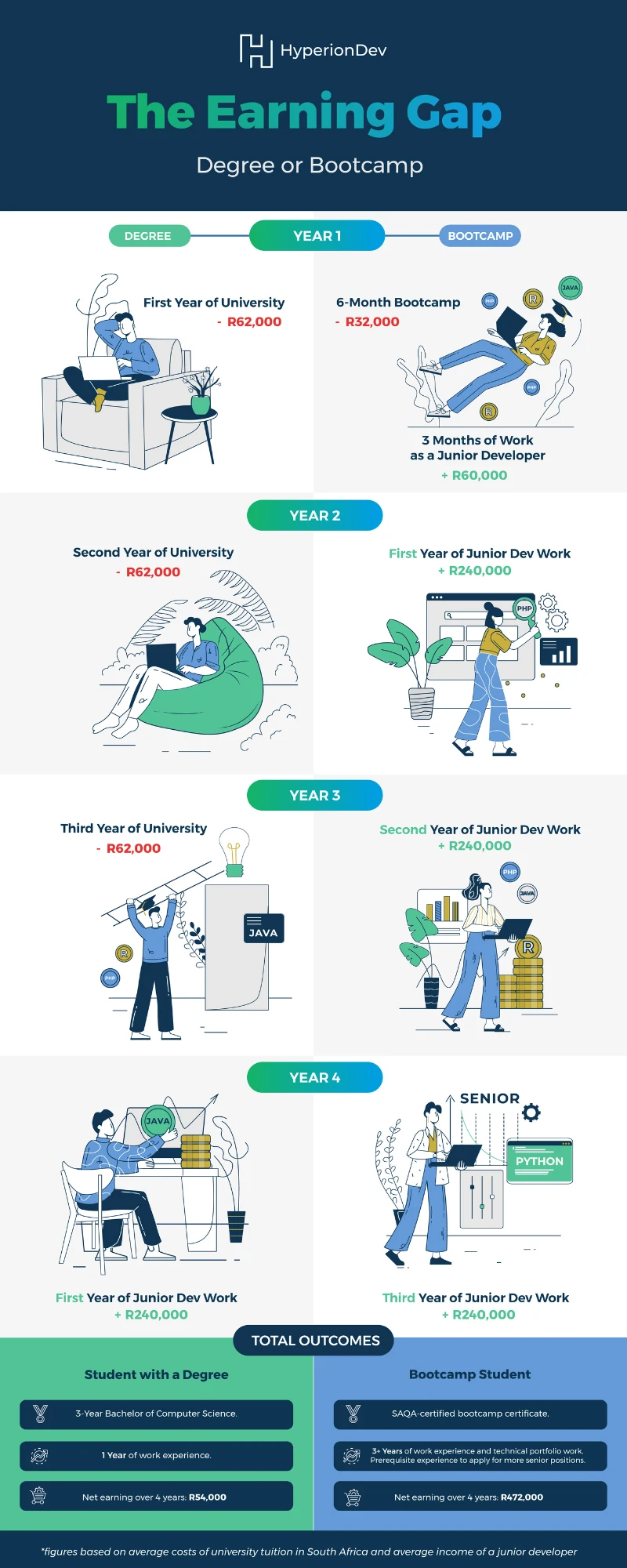
Going to university will cost you more than just the fees you need to pay; you’re also paying for the lost time you didn’t spend working and the lost opportunity from not having those work years on your CV.
Here’s what this might look like:
[Sources: Average Cost of University Tuition; Average Income of a Junior Developer]
In the world of work, a faster start to your career means greater opportunity and more time to earn, which directly equates to higher earning potential. Faster career progression and an early start to earning means bootcamps are the better choice for many.
6. Location flexibility
A PwC report, the Voice of the Student Survey, showed that almost half of all South African students (49%) prefer virtual learning, while 38% prefer hybrid learning formats, and 13% prefer in-person classes. Yet, the higher education industry significantly lags behind the corporate world when it comes to digitalisation.
Traditional university education often requires in-person attendance, whereas bootcamps often provide a choice. While most bootcamps feature a predominantly online learning focus, HyperionDev also offers in-person courses in Cape Town and Johannesburg, meaning you can learn from anywhere at a pace that suits you.
7. Personal mentorship
Most undergraduate degree programs will give you a weekly tutorial session and perhaps a course convenor you can chat with. One-on-one oversight is usually limited to the most advanced degrees or projects, for example, writing a thesis or dissertation.
On our bootcamps, you get 1-on-1 expert mentorship from day one. We believe that coding mentors are essential for your development and learning. Our mentors help you to learn coding best practices, give you constructive feedback, and allow for individual attention.
8. Specialisation
Beginners starting out on a computer science degree usually learn the basics of programming over a wide range of applications. But what if this doesn’t fit your tight work schedule, doesn’t interest you, or you don’t see it being useful in your future career?
On a coding bootcamp, you dive straight into your field of interest. You can focus entirely on learning the exact skills needed for your chosen career goal, be it software engineering, web development, or data science. Bootcamps are also practical, with capstone projects and code submissions rooted in real-world applications and business needs. Thanks to smaller classes and online learning, bootcamp students also tend to learn coveted soft skills such as teamwork, communication, and time management.
9. Learning requirements
Universities are great places to have an extensive and detailed exploration of subjects you’re passionate about. Unfortunately, there’s one problem: the credits system.
To obtain a degree requires you to meet a minimum number of credits for your program. Often this means you’re forced to take ‘arbitrary’ subjects just to meet your credits list. And while Organic Chemistry and Geometry are interesting, there’s no reason you should be forced to take one of them for a year just to get your degree in Computer Science.
Bootcamps, in comparison, stick to a specialisation and teach core values for the job: you don’t need to take unrelated subjects just to get enough credits to graduate.
10. Theory and practice
Deep diving into theoretical concepts is useful and informative, but if you want to switch careers and have limited time and money, you probably don’t have the luxury of spending four years doing exhaustive research. In this case, learning practical skills quickly – such as the ability to create working websites, programmes and data models – is far more valuable.
And that’s what bootcamps do best. They don’t require 4,000-word essays or 4-hour exams testing your memorisation skills; instead, they focus purely on job-relevant skills that you can use to find work and build real programs, websites, and applications.
Join the 4IR
The Covid-19 pandemic drove us all online, but the Fourth Industrial Revolution (4IR) will keep us there. Evolving technologies and trends such as AI and IoT are changing the way we work, live, and learn.
Coding bootcamps, along with the expansion of university-bootcamp partnerships, are at the core of this acceleration – quickly showing their power and value to a public that wants a risk-averse, job-ready translation to a tech career.
—————–
Our bootcamps provide personalised 1-on-1 mentorship in a tightly structured learning environment that teaches you everything you need to know to start creating the next big app, amazing websites, and powerful machine learning or data algorithms in less than six months.
Apply now to start your journey to learning how to code and get the inside edge on starting your tech career.
Editor’s note: This post was originally published on 02 September 2020 and has been updated on 03 November 2022.
Student Success Stories
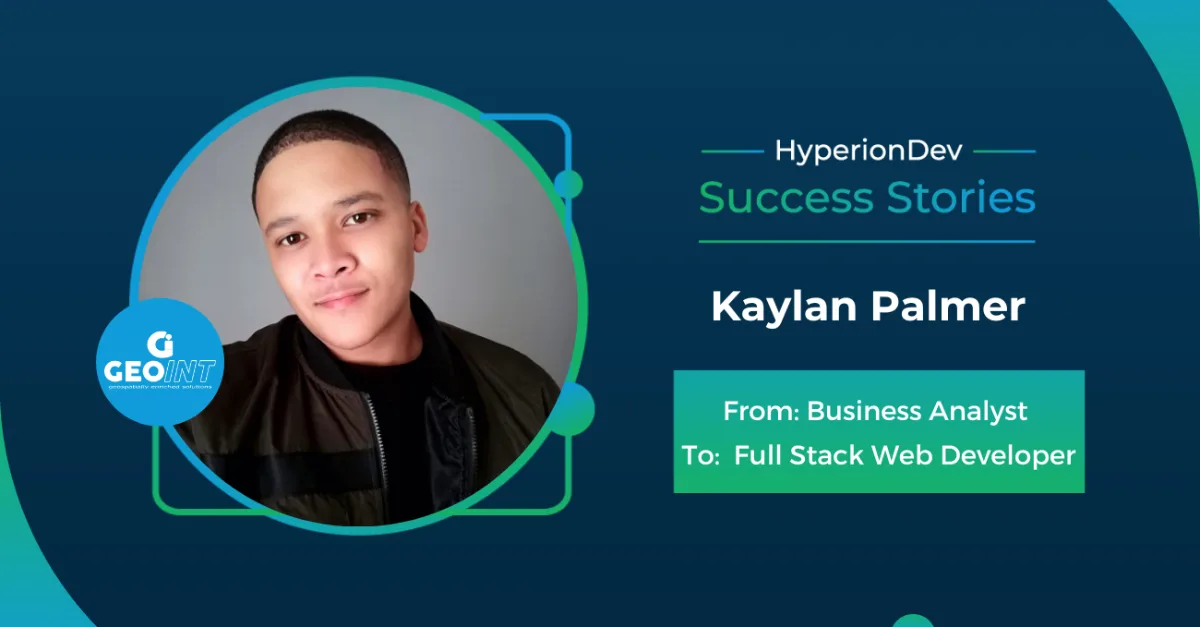
Student Success Story: Kaylan – From Business Analyst to Full Stack Web Developer
HyperionDev graduate Kaylan Palmer went from a job as a business analyst to completing two bootcamps: Software Engineering and Full Stack Web Development. This gave him the in-demand skills to take on a leading job at a location intelligence company. Follow his remarkable journey.
Johannesburg-based Kaylan Palmer is a double HyperionDev graduate. In fact, his professional life has been a continuous journey of learning and growing, learning and growing – a process that has enabled him to finally switch careers and do the kind of work he really enjoys.
Not too long ago, he was working as a business analyst intern at FNB, where he was exposed to both the business and technical sides of operations, which sparked his interest in software development. He googled his options, found HyperionDev’s bootcamps, and the rest is history. Let’s take a closer look at this go-getter’s journey.
All paths lead to tech
During his internship at FNB, Kaylan created a simple solution to automate one of the support tasks. His mentor at the time suggested he look into software development, as he clearly had a knack for it. That’s when he signed up for our Software Engineering bootcamp. Upon completion, he immediately moved over to the Full Stack Web Developer bootcamp. He completed both courses full-time, online.
Kaylan says the courses gave him the technical skills needed to develop quality software and web applications and, on the soft-skills side, great technical project management discipline. It also allowed him to explore and discover talents within himself that would have otherwise remained dormant.
All this hard work resulted in him landing a job as a developer and support specialist at a geospatial and location intelligence company, Geo Intelligence Corp. Here he has been involved in several projects in both frontend and backend roles. He has also been given the huge responsibility of advancing the technical front of the company to meet its objectives. He says:
“The combination of the two bootcamps gave me an edge as a new techie and allowed me to make tremendous strides in my career.”
Building on bootcamp tools
Looking back at HyperionDev’s bootcamps, Kaylan says he most enjoyed the capstones projects and learnt the hard way how “overcoding” (the act of programming unnecessary details) can become a problem.
The tools and skills he learned are currently helping him with product development and maintenance, and technical support tasks. He says Javascript, Python, and SQL help him in his day-to-day tasks and projects at various scales. He also performs multiple support tasks that involve data distribution, in-house and client deployments and updates, and management of API-delivered services. The stack he mainly uses is PERN (Postgres, Express, React, and Node) with Nginx and Docker.
As far as development tasks are concerned, he is involved in building web applications, for both internal use and for external clients, as well as maintaining and improving existing applications – all of this with the support of an amazing team.
As a side project, Kaylan has developed a service asset management system – a plug-and-play helpdesk with a user-friendly interface and a database-agnostic backend. He has also built web map applications, including one for the Cape Town Marathon.
Asked how learning code has empowered him to achieve his personal and professional goals, he says:
“I’ve been able to upgrade my lifestyle and do the things I’ve always wanted to do, like travel and become self-sustainable. I’ve found a career path that inspires and allows me to set bigger goals for myself.”
The future looks bright for this double HyperionDev graduate
Kaylan’s journey of learning and growing is not going to end any day soon. His dream is to one day build an innovative tech company that journeys from a startup to a multimillion-dollar business; one that will make waves in the geospatial tech industry and contribute to the advancement of society and its safety.
His advice to others thinking about learning to code or changing careers to become developers?
“Figure out what kind of developer you want to be and research the industry you would like to go into before choosing which tech stack to learn. Remain curious and eager to learn because this profession is a lifelong learning experience.”
Because of their broad knowledge and flexibility, full-stack developers are in big demand across the tech industry. Kaylan’s decision to change careers to one that is coveted across the globe has, along with his solid background in software engineering, provided him with one of the most sought-after skill sets in the industry right now.
———————–
If you’re inspired by Kaylan’s story and feel ready to embark on your own journey toward a fulfilling coding career, sign up for a bootcamp by registering with HyperionDev here. Who knows, your success story may be next!
Student Success Stories
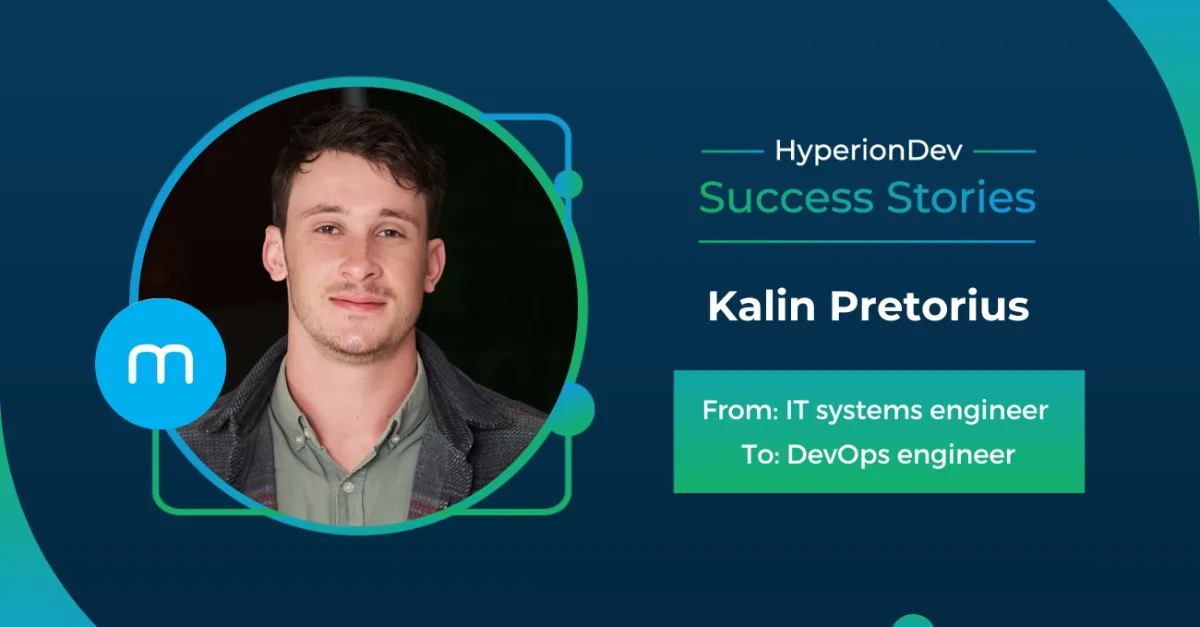
Kalin Pretorius – From IT systems engineer to DevOps engineer
Finding his job as a systems engineer and administrator stifling his creativity and prospects, Kalin Pretorius enrolled in a Software Engineering Bootcamp. Now he’s another successful HyperionDev graduate working in the tech industry. Read his story.
Capetonian Kalin Pretorius is one of many HyperionDev graduate success stories. No stranger to the IT industry – he previously worked as a systems engineer – Kalin attended our Software Engineering Bootcamp on an online, part-time basis. It provided the exact boost he needed to take his career to the next level without having to pack it all in and start from scratch. We caught up with him to find out more about his journey to realising his dreams.
Taking the step
While being employed as a systems engineer at Technolutions, a tech innovator in the education industry, Kalin was focused on network and systems engineering and administration. However, he always yearned to explore the software side of things and wanted to expand his skills to not only make a complete career change but develop the skills needed for in-demand programming jobs.
Unable to drop everything and pursue a degree in computer science, he researched courses he could do while still holding down a job. That’s when he came across the HyperionDev bootcamps – it was the perfect solution.
He chose software engineering to build on his existing knowledge and because it would enable him to work creatively with software, hardware, and other computer systems in a wide variety of industries and jobs. As a software developer, you are placed at the heart of the digital economy, with endless scope for growth, which is exactly where he wanted to be.
Managing a bootcamp while working full-time
Kalin’s background in the IT industry meant he was no stranger to online courses, and he used his spare time before and after work, as well as on weekends, to complete the course. He says:
“The bootcamp was perfectly structured and provided me with a clear outline of what I needed to do to complete it.”
The subjects he felt immediately drawn to were the programming language Python, data science, and machine learning. In fact, it has sparked his interest in data science, a field he plans to conquer next. Pressed to give us a downside of bootcamp, he admitted he found learning Java somewhat boring, but at the same time difficult to fully get his head around.
As with most of our graduates, the code review process was invaluable. Kalin says it showed him how to solve programming challenges in different ways while alerting him to whether he was on the right or wrong track.
Life as a software engineer
Straight after graduating from the HyperionDev bootcamp, Kalin landed a job as a DevOps engineer at the eCommerce platform, OneDayOnly. Just over a year and a half later, he made a move to a DevOps engineer position at Mobiquity.
He says the interview process to join the Amsterdam-based digital consultancy was grueling. It consisted of five interviews, starting with HR, two technical tests, a culture-fit assessment, and finally, an interview with the Director of Engineering. Turns out, Kalin had all the skills needed.
Now Kalin works in tech stacks including Azure, Terraform, Ansible, and Python. He tells us the coolest project he’s been involved with is migrating a platform over from a third-party cloud platform to Microsoft Azure.
A future without limits
Kalin builds APIs and web apps in his spare time and urges other people thinking about learning code to start by tackling a project that they find interesting – and sticking with it until it’s done. He says:
“Sooner or later you’ll get to the bottom of the problem and have that gratifying ‘a-ha’ moment.”
On a personal level, learning code has helped him sharpen his problem-solving skills. It has made him rethink what can be achieved with software development, and how important it is to the modern world.
Committed to continue studying and acquiring industry-specific skills, Kalin hopes to become a solutions architect in the cloud infrastructure space within the next five years. We can’t see anything stopping him!
———————
Follow Kalin’s exciting career in tech on his Github portfolio. If you’re inspired by his story and feel ready to embark on your own journey toward a fulfilling career in the tech industry, consider registering with HyperionDev here.
Who knows, your success story may be next.

Web Development
What You Need to Know to Create a Mental Health App
Got an idea for a mental health app? We show you the different types of mental health apps, their most important features, and the tech tools and stacks you need to know to build one. Read on to discover the programming languages and skills you need to develop a mental health app.
October is World Mental Health Awareness month. It’s a great time to shine a light on how the tech community has stepped up and helped create dozens of useful mental health apps. One of the great benefits of this development is it has helped lift the perception of mental health as a serious illness, into its acceptance as a vital aspect of overall health. Plus, this kind of telehealth is popular for being less expensive, available 24/7, and provides the user with anonymity.
We take a look at the types of functionality the most popular mental health apps employ to help users, and programming languages and tech stacks you need to build one yourself.
Mental health apps and how they help
There are generally three categories of mental health apps – the first of which is used to support people with mental health disorders. These apps use proven treatment methods such as cognitive behaviour therapy (CBT), to help those suffering from a specific illness, such as ADD, eating disorders, drug addiction, obsessive-compulsive behaviours, etc. Some examples of apps that follow this route are Recovery Record for eating disorder support, and UCSF PRIME for people with schizophrenia.
The second category is mindfulness and mood mental health apps, or mental self-improvement apps. These tend to focus on de-stressing, mood management and overcoming negative thoughts. Leading the pack in this field is Headspace, which has reportedly been downloaded by more than 30 million users worldwide.
Lastly, there are multi-purpose mental health apps. A prime example is TalkSpace, which connects patients to licensed therapists and mental health professionals. It helps users via different types of therapy support, such as individual therapy, couple sessions, and psychiatry.
Planning your mental health app
The kind of mental health app you are going to develop will guide how complex and feature-rich your app will be. As a starting point, these are elements to keep in mind.
Registration and patient profile
Registration should be seamless and can be via social media or by entering personal details. From here the user will move on to create their profile. To deliver a personalised experience you’ll have to capture, at a minimum, their age, gender, interests, issues, occupation, and demographic info.
Content and design
Content elements such as tutorials, animations, video and audio integrations, and text-based information will enrich your app’s content. For design, use soothing colours with lots of white space and remove any content that does not directly support user tasks.
Monitoring
Monitoring is essential for both doctors and patients and can be done via passive or interactive monitoring. Tools can help with tracking symptoms, moods, and behaviour. Users who self-monitor are more likely to stay motivated and engaged.
Notifications and reminders
A calendar can schedule and trigger notifications for appointments, sessions, events, milestones, and keeps users motivated and on course. Users can be reminded to do daily check-ins, journalling and to schedule breaks.
Dashboards
Mental healthcare professionals need a dashboard where they can manage patients and from where they can directly respond to them via audio, video, messaging, or live chats. Dashboards for users must clearly show their progress towards their goals and put relevant content at their fingertips.
Other things to consider
- Decide on your monetisation strategy – paid, freemium, ads, or in-app purchases.
- Conduct comprehensive functionality and usability testing and employ machine learning algorithms to analyse user behaviour and add features that will enhance user experience.
- Ensure you follow the Health Professions Council of SA’s telemedicine rules, as well as relevant POPI guidelines to guarantee appropriate data protection standards.
Tech stacks you’ll need to develop a mental health app
Generally speaking, a mental health app developer will use programming languages like PHP, Python, or Node.js in the back end, and JavaScript, React.js, or Angular for the front end. React Native is a popular cross-platform solution for building apps for both iOS and Android as it is faster and uses a single coding language.
For databases, PostgreSQL and MongoDb are popular choices. AWS hosting is preferred for its scalable cloud computing capabilities and support. For a more indepth look, here’s a list of technologies and programming languages commonly used for building mental health apps:
- Hosting: GoogleCloud, AWS, Microsoft Azure
- Databases: PostgreSQL, MongoDb, MySQL
- Services: LoadNija (testing), Jitsi (streaming), MySQL (database)
- Backend: Django (Python), Laravel (PHP), Node.js, Spring Java
- Web front-end: React.JS, Vue.js, Angular
- Mobile app front-end: Flutter, React Native
3rd party integrations:
- Payment gateway: PayPal, Braintree, Stripe
- Geolocation: Google Maps, Core Location API
- Calendar: Google Calendar, Zoho, Nylas
- Social sign-ups: SAML, OpenID
- Chats: Sendbird, Stream, Vonage
- Messaging: Amazon S3 Bucket
- Video sessions: Now, Twilio, Agora
- Push notifications: OneSignal, Firebase Cloud Messaging, Push.io
- AI integration: Microsoft Bot Framework, Dialogflow, PyTorch, RASA
_____________
Inspired to learn to code and create your own mental health app? Then get started with the most important tech stacks and programming languages that will give you all the tools you need.
Our Software Engineer and Data Science Bootcamps are the perfect place for coding beginners to start learning the programming language Python. Then, to master Node.js, JavaScript, React.js, and MongoDB, we recommend you sign up for the Full Stack Web Developer Bootcamp.
Apply now and start your journey to becoming a developer.
Student Success Stories
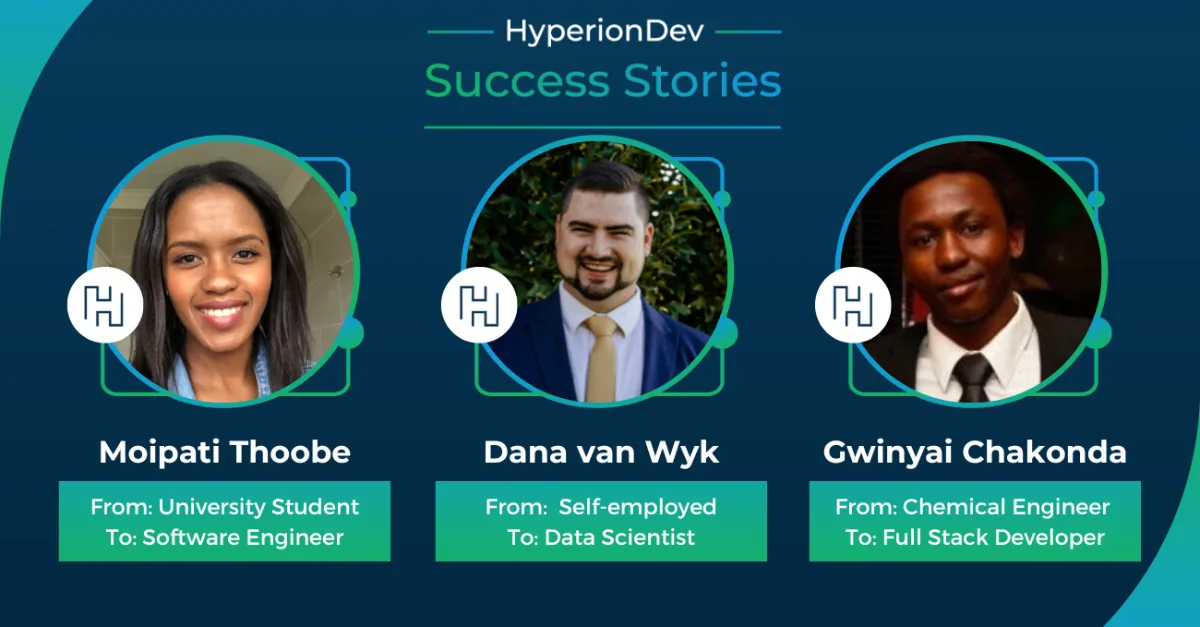
From HyperionDev Graduates to Mentors: Meet Our Team
Meet three top HyperionDev graduates who became bootcamp mentors. See how personal mentorship makes all the difference in getting students over the finishing line.
When students sign up for a HyperionDev bootcamp, they’re assigned a personal mentor to help them overcome any hurdle. Many of our mentors are previous HyperionDev graduates themselves, meaning they have a thorough understanding of the courses and are perfectly positioned to help students navigate the obstacles along the way.
Our mentors help students with a variety of tasks via live chat, email, online tutorials, and one-on-one video calls. One of their most important responsibilities is reviewing students’ code using our world-class code review process, and providing comprehensive feedback to ensure no one falls through the cracks.
Here are three of our current mentors – Moipati, Dana, and Gwinyai – and their stories of going from HyperionDev graduates to coding mentors.
Moipati Thoobe – From University Student to Software Engineer
HyperionDev coding mentor Moipati graduated with a degree in Information Science and, rather than join the workforce, decided she wanted to expand her skillset by improving her programming. So, right after graduating, she signed up for the immersive Full Stack Web and Software Engineer Bootcamp.
Taking an immersive bootcamp was an excellent choice as it focuses heavily on practical skills development. It’s an in-depth, advanced coding course that prepares students for careers as multi-role developers and is regarded as a powerful alternative to traditional computer science degrees.
Moipati particularly loved the code review process at bootcamp and was surprised to learn how comprehensive it was. She also immersed herself in the capstone projects, and although she found them challenging, they enabled her to walk away with a portfolio of real-world work to show employers. She has also since created a social media app using the MERN stack.
She credits the HyperionDev support team and mentorship she received for helping her stay on track and meet deadlines as tasks became more complicated. As a mentor herself now, she is excited to teach students how to build web applications and be part of their coding journeys. Her typical day at work involves code reviews, helping students master complicated tasks, and handling Discord queries as they come up. On learning to code, she says:
“The best advice I received is that ‘Google is a developer’s best friend’. But I also learned not to be overly reliant on the internet and that the best way to learn is to try things for myself. I am excited to share this with my mentees.”
Follow Moipati’s exciting career in tech on her Github portfolio.
Dana Du Preez van Wyk – From Self-employed to Data Scientist
Dana from Somerset West spent a decade in different industries, including fibre and construction, but he never found his work fulfilling. One day he decided it was high time he did what he truly wanted to do – work in tech. He packed his bags, moved to the US, and, while living and working in Mississippi, completed the HyperionDev Data Science Bootcamp online full-time.
On his return to SA, he worked as a self-employed foreign exchange specialist, but because he couldn’t use his bootcamp coding skills in that role, he was more than happy to make the switch and join HyperionDev as a mentor.
During his bootcamp, he worked with HyperionDev mentors who taught him that there are dozens of ways to solve a problem. This encouraged him to “stick with it” even when it seemed there was no solution. That, and mastering machine learning – notoriously one of our bootcamps’ most demanding courses – has given Dana the confidence to take on more challenging tasks.
He’s a particular fan of Python, which he regards as a fundamental building block that opens up a world of coding possibilities. He admits he’s somewhat addicted to learning new coding languages and has his sights on the HyperionDev software development course next.
The best part of working in a coding community? Dana says:
“I used to work with people who hated what they were doing. Unmotivated people, people who would rather be doing anything else. I was one of them, I needed change, and this bootcamp offered me the opportunity to do that.”
Gwinyai Chakonda – From Chemical Engineer to Full Stack Developer
Capetonian Gwinyai Chakonda studied full stack web development full-time at the Cape Town campus. A former chemical engineer who had lost all curiosity and excitement for his field, he was motivated to study coding by the desire to earn a better salary and work in an in-demand industry.
Today he works as a HyperionDev mentor, where one of his favourite jobs is reviewing student code and working in MERN stack. He says the coolest part of being a coding mentor is learning ORK – short for “objectives and key results”, a popular goal-setting framework used by companies to facilitate growth and improvement.
What Gwinyai loved most about bootcamp was talking to lecturers and colleagues onsite, competing on the leaderboard, and getting a perfect score in a code review. That, and working with the MERN stack efficiently enough to build and deploy a full-stack web application.
As a mentor, Gwinyai is involved with student support and code reviews. He credits these interactions for giving him confidence in his ability to learn new things, set goals and, through perseverance, achieve them. He is currently the sole developer on the Blackdiasporas.com project and hopes to one day own his own software development company and invest in startups. We can’t see anything stopping him.
The best thing about being a coding mentor? Gwinyai says:
“Supporting students is remarkably satisfying and enhances your own understanding. I would encourage all HyperionDev graduates to consider becoming mentors.”
———————
If you’re inspired by their stories and feel ready to embark on your own journey toward a fulfilling career in the tech industry, consider registering with HyperionDev here.
Who knows, your success story may be next.

Web Development
Popular Platforms Built Using Python
Python is fun to work in but is also loved for its scalability, reliability, flexibility, and clean code. Here’s why programmers love python and some of the most popular platforms this programming language has enabled.
Guess what Google, YouTube, Facebook, Netflix, Instagram, and Amazon have in common? They are all built with the programming language Python.
Known as the “Swiss Army knife” for programmers because the coding language is so easy to learn and use, Python was developed by Dutch programmer Guido van Rossum in 1991. Van Rossum made Python open source, earning him the title of Benevolent Dictator For Life (BDFL) from the Python user community.
“Invariably, you’ll find that if the language is any good, your users are going to take it to places where you never thought it would be taken.”
GUIDO VAN ROSSUM
Python’s place in the world of programming languages
Since going open source, Python has expanded and improved, allowing programmers to learn to code in a variety of styles, including structural, object-oriented, and functional programming styles. It is often referred to as the “batteries included” language thanks to the standout Python Package Index (PyPI, pronounced pie-pee-eye), a repository of software that helps you find and install software developed and shared by the Python community.
According to Statista, Python is among the top five most used programming languages among developers worldwide in 2022, while Github developers put it at no. 1 most popular.
And it’s gathered more accolades this year. The 2022 Stack Overflow Developer Survey showed that Python is a close second among programming languages developers most want to learn. The survey also revealed that being able to put Python on your CV immediately enables programmers to command a higher salary.
10 famous websites built using Python
According to BuiltWith, approximately 833,456 websites worldwide currently use Python (2,122 websites in South Africa). And that’s three decades after its first release. Here are some of the biggies built with Python (some, in part), and the top reasons why:
- Google – for their data analysis, machine learning, and artificial intelligence

- Youtube – for simplifying streaming, uploading, downloading, and sharing

- Facebook – for production engineering and easy interaction with their APIs

- Netflix – for its ability to scale and handle massive amounts of traffic

- Uber – for backend functionality and rendering data-rich visualisations
- Reddit – for its clear code and allowing for fast development

- Instagram – for its simplicity and ability to host millions of daily users

- Spotify – for backend services, speed, readability, and data analysis

- Dropbox – for file hosting and deploying new product features at speed

- Amazon – for its ML algorithms that power the recommendation engine

Top reasons why Python is so popular
Python is fun to work in but is also loved for its scalability, reliability, flexibility, and clean code. And did we mention it’s free? With frameworks like Django and Flask, it’s a great option for quick and simple back-end web development. Here are more reasons why developers love it:
- Easy to learn and a great entry language for coding beginners to grasp relevant basic programming concepts no matter what language you use.
- Large collection of libraries (pieces of reusable code) you can incorporate into your code to manipulate images, administrate databases, and perform equations.
- Highly extensible – you can extend Python to other programming languages within your Python codebase to use with other software, and add functionality.
- Strong community who contribute to its ongoing development and provide Python tutorials, forum discussions, and video content. They also create libraries and plugins that enable developers to do more.
For these reasons and more, Python forms the backbone of thousands of websites and applications we use daily, including enterprises such as Google, Facebook, YouTube, and Reddit.
Thanks, in part, to its great tools for data analysis and visualisation, it is also a favourite in maths and scientific computing, education, banking, and video games. Python has also proven itself to be one of the most efficient programming languages for machine learning (ML) and artificial intelligence (AI) solutions.
————
It’s clear, Python isn’t going anywhere. Its strong support for integration with other languages and tools, extensive standard libraries, and the fact that it can be learned quickly makes it a must-have skill for anyone thinking of becoming a developer.
If you’re keen to learn Python online, HyperionDev’s Data Science and Software Engineering bootcamps are a popular choice. See why by signing up for our trial, or apply for a bootcamp and upskill in tech today.
Student Success Stories
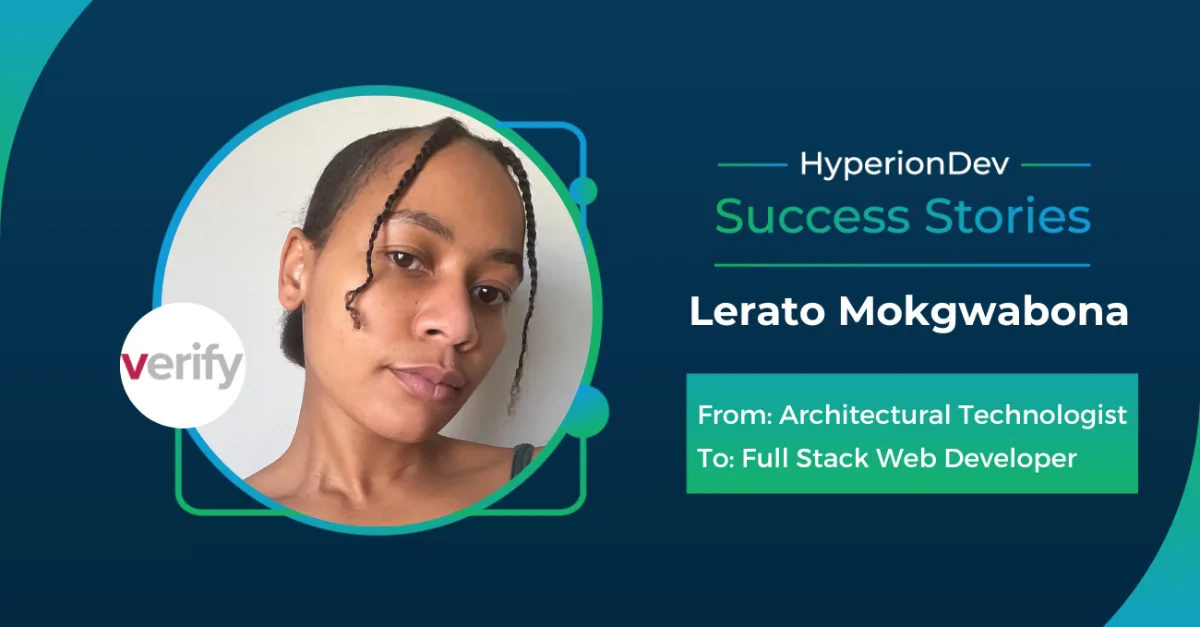
Student Success Story: Lerato – From Architectural Technologist to Full Stack Web Developer
HyperionDev graduate Lerato was in her fourth year of studying architecture when she realised her calling was in code. She completed our Full Stack Web Development bootcamp and has landed a rewarding job as a front end developer, where she now combines creativity with technology.
HyperionDev graduate Lerato Mokgwabona was in her fourth year of studying architecture when she decided she wanted to follow a different career path – one that involved programming. She didn’t waste another minute and instead enrolled to do our Full Stack Web Developer bootcamp online, full-time.
Her motivation sprung from wanting to be part of the digital nomad workforce and her inherent love of solving problems, coding, design, and art. This made migrating to the world of front-end web development an easy and natural step.
Today she’s thriving as a front-end engineer at a leading IT services company. Here’s her journey to doing what she loves most.
From designing houses to designing websites
Once Lerato discovered the world of technology and saw just how broad it is, she began seeing new opportunities that intrigued her hugely. She was especially drawn to UX and UI design roles, but the more she learned, the more she realised that she would have to master the technical fundamentals before getting to the creative part.
Our bootcamp courses in HTML, CSS, JavaScript, Node.js, MongoDB, Express, and React enabled her to do that. In just three months, she went from being a novice to understanding both front-end and back-end web development and being able to build dynamic data-driven web applications. But there’s more to it. Lerato says:
“Learning how to programme improved my problem-solving skills. I’m now less afraid of tackling challenges that might seem too big for me.”
More than just code
During our bootcamps, students are set on a sharp learning curve to master the fine art of coding in pursuit of their respective careers. During her studies, Lerato found the enthusiastic student support on HyperionDev’s Discord channels extremely helpful when confronted with what seemed like insurmountable coding problems.
She is especially grateful to her mentor, who coached her and encouraged her to stay positive while job hunting. Our career services team also prepared her for interviews and helped her create an impressive LinkedIn profile. Lerato says:
“I was advised on how to use Linkedin effectively to attract recruiters, and I was able to land my first tech role through the social media platform.”
Life after the bootcamp
Lerato landed a job in tech as a Microsoft EEIP AppFactory Intern for a debt collection company. Here she worked with the ASP.NET tech stacks for mobile and web applications while also being involved with website design. At the end of her internship, she was offered a hybrid full stack designer role where she could use some of the tech stacks she learned in her bootcamp.
Lerato currently works for Verify Dynamics, a company involved in the information technology and services industry. She has a hybrid role, responsible for UI design and building the front end for web applications. When it comes to design, she prefers Figma, a collaborative web application used in interface design.
Keep on coding
Lerato hopes to one day run her own start-up where she can build virtual platforms that are accessible to everyone; platforms built with the user in mind and that meet their needs. She urges those interested in tech not to base the decision on what they could earn but on how they can use code as a catalyst to reach their career goals and do work that they enjoy.
She warns about stagnation, urging other young coders to continuously network and get involved in side projects, such as building demo web applications.
When asked how code can change the world, she said:
“I hope code doesn’t cause us to neglect the real world but improve the way we live in the real world. I believe tech could achieve that if money isn’t the driving factor but solving people’s needs is.”
____________
Follow Lerato’s exciting career in tech on her Github portfolio. If you’re inspired by her story and feel ready to embark on your own journey toward a fulfilling career in the tech industry, consider registering with HyperionDev here.
Who knows, your success story may be next.
Student Success Stories
From HyperionDev Graduates to Coding Mentors
HyperionDev coding mentors are tech success stories in their own right. See how they help our students pass bootcamps with flying colours and read up on their journeys since becoming HyperionDev graduates.
One of the benefits of HyperionDev’s bootcamps is our coding mentorship programme. Because learning code is not a one-size-fits-all process, the HyperionDev team focuses as much on people as we do on teaching tech. From the very beginning, each student has access to a coding mentor who ensures our students learn to code the way professionals do right from the get-go.
You might not have known that many of our mentors are previous HyperionDev graduates, so they know the courses inside and out. This puts them in a great position to track students’ progress and deepen their understanding of putting code into practice.
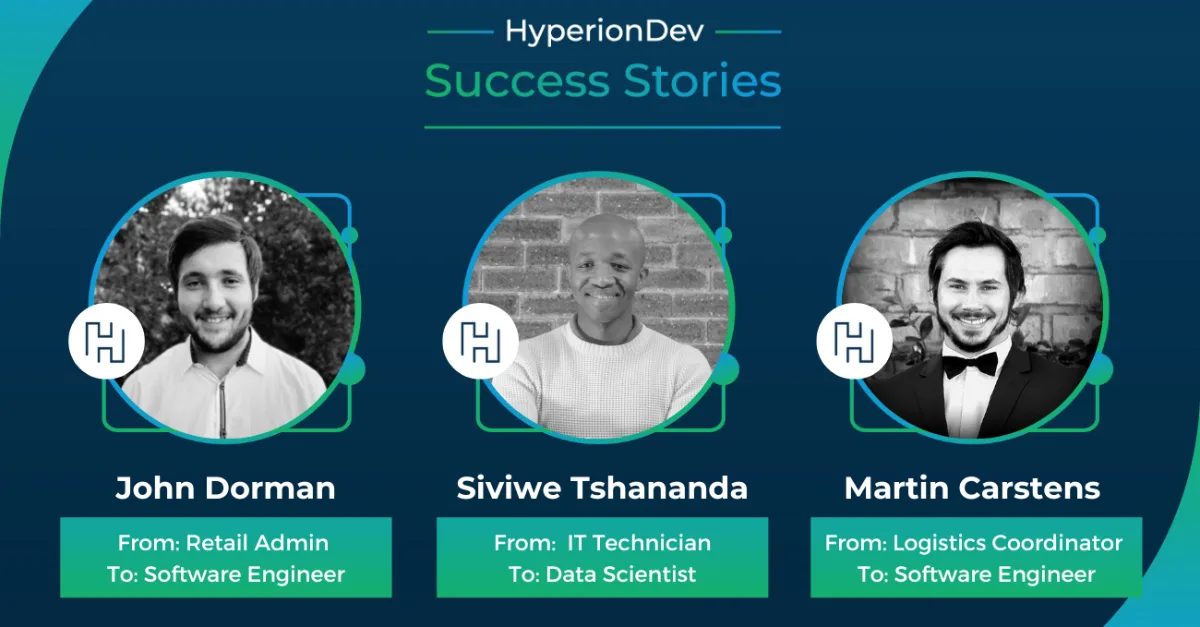
Meet three of our top mentors from Cape Town, Martin Carstens, Siviwe Tshananda, and John Dorman, and see how they have excelled with HyperionDev.
Martin Carstens – From Logistics Coordinator to Software Engineer
Martin switched careers from working in logistics and as an import and export coordinator to following his dream of working in tech – where his heart was all along. He signed up for the immersive Full Stack Web and Software Engineer Bootcamp, studying online full-time. After finishing first in his class, he was approached by HyperionDev to become a coding mentor.
With a natural affinity for computer science, Martin started by building advanced models of Excel and creating websites from scratch. Through the knowledge gained during his bootcamp, he could evaluate the websites he had built and improve them.
As a HyperionDev mentor, he primarily uses MERN stack – the combination of technologies used to create a web application. Building on this knowledge, he is currently upskilling himself by learning more coding languages so that one day he can work on building startups.
What does he love most about his coding career? That’s easy; he says:
“That moment when you know you are on the right track and simply can’t stop, even if it means coding until 3 am. I get that extra dopamine rush when I finally solve the missing piece of the puzzle about why the code wasn’t working.”
Follow Martin’s exciting career in tech on his Github portfolio.
Siviwe Tshananda – From IT Tech to Data Scientist
Siviwe enrolled in our online part-time Data Science Bootcamp. At the time, he was studying electrical engineering while working full-time as an IT technician but found being confined to fixing existing systems stifled his creative side. He managed the demands of the bootcamp by tracking task submissions and through one-on-one sessions with his mentor.
Now a mentor himself, Siviwe has immersed himself in the role while staying on top of new tech developments. He especially enjoys developing new strategies for improving the learning process to ensure students complete their courses. He’ll monitor and respond to student queries as they come in, helping them master tricky projects and keeping them motivated.
Siviwe, who one day wants to introduce coding to his village community in the Eastern Cape, says working as a HyperionDev mentor comes with many advantages:
“What I like most is waking up happy to go to work and doing cool stuff with cool people working towards the same goal.”
Follow Siviwe’s exciting career in tech on his Github portfolio.
John Dorman – From Retail Admin to Software Engineer
John is a former HyperionDev Software Engineering Bootcamp graduate who left an unfulfilling job in retail administration to pursue his dream of working in tech. He chose software development because it puts you at the heart of the digital economy, with endless scope for growth. It is precisely the skills he needs to fulfill his dream of working in Europe in the not-too-distant future.
What John found most rewarding about HyperionDev’s software engineering bootcamp is that it’s structured to allow students to start coding as soon as possible. Tasks are designed in such a way as to not only teach you the skills but show you how to put them into practice using machine learning and Python. In April this year, John was named Student of the Month for his boundless energy and passion and for always going the extra mile and looking for new ways to learn.
In his current role as a HyperionDev mentor, John handles student submissions, reviews them, and provides feedback. He also conducts live one-on-one sessions with students to help them master complicated problems.
And the coolest thing about code? John says:
“Code can do a lot to help improve the world, such as using AI to help solve world hunger by identifying places where food can be grown and help improve the way food is transported so it reaches the right people.”
Follow John’s exciting career in tech on his Github portfolio.
—————
If you’re inspired by their stories and feel ready to embark on your own journey toward a fulfilling career in the tech industry, consider registering with HyperionDev here.
Who knows, your success story may be next.

Student Success Stories
Kiyam’s Journey: From Biotech Student to Salesforce Developer
Traditional tertiary education works for some, but not for all. While Kiyam was studying biotechnology, he realised he wanted to do things differently. So, he enrolled in a Software Engineering Bootcamp. Now he’s another successful HyperionDev graduate working in the tech industry. Read his story.
Capetonian Kiyam Burgess has joined the ranks of the tech industry as a HyperionDev graduate. He recently achieved his dream of becoming a software engineer by completing our online Software Engineering Bootcamp. But, he didn’t always have a clear image of this dream in mind.
Initially, Kiyam went down a traditional tertiary education path, only to find that what he was studying wasn’t really “him”. This path was studying biotechnology at the University of the Western Cape.
“I love science and the idea of working in a lab to find ways of bettering society. But I realised that my solutions weren’t that of a scientist, but of someone who thought like a programmer.”
He left UWC and did a TEFL course while researching skill sets, only to find that his strengths are perfectly suited to those of a software engineer. While looking for an institution to study at, HyperionDev caught his eye. He took the online test, passed it, and immediately enrolled.
Changing his life with a HyperionDev bootcamp
Kiyam’s move to a coding career was inspired by a number of factors. He wanted to work in a profession where he was guaranteed a better salary and knew part of that was acquiring the skills needed for in-demand jobs such as software engineering. This would additionally enable him to work from anywhere in the world – an attractive benefit for Kiyam.
Studying part-time online, Kiyam learnt how to work with hardware, software, and computer systems used in various industries and jobs. He gained an understanding of popular languages such as Python and Java, object-oriented programming, and machine learning. Most importantly, Kiyam learnt how to use these skills to create apps and programmes that are real-world solutions. He says:
“The coding languages gave me a solid foundation and understanding of how to code (in my own way). The course helped sharpen my critical thinking skills, which is very important for a career in software development.”
HyperionDev’s career services team also helped Kiyam create a professional, on-trend CV and set up his LinkedIn profile – which he believes helped him land his current job. He credits his HyperionDev code reviewer for not just giving him solutions when he didn’t understand a concept but for guiding his thought processes to find a solution on his own.
Through the skills acquired at the bootcamp, Kiyam tried his hand at building apps that help people in everyday life. One was an app that helped his granny calculate student marks efficiently; another was an app his friends used when playing games and picking teams.
Life as a Salesforce Developer
Kiyam currently works remotely as a Salesforce Developer for Micronetbd Inc., a New Jersey, USA-based Salesforce partner company that helps grow small and midsize financial services companies.
Kiyam says the coolest thing about working with Salesforce – the leading vendor in the global customer relationship management (CRM) applications market – is continuously “stretching” his mind and finding solutions to problems through planning and research.
Using Apex programming, Java, MySQL, HTML, CSS, and JavaScript, he is responsible for developing and implementing features that fit clients’ needs and that they use as part of their organisational infrastructure. Kiyam sees his work as a Salesforce developer as a way to learn new things – especially in the B2B industry – and develop new ideas for apps that help companies simplify processes and grow.
Is code the solution to many of life’s challenges? Kiyam thinks so. He says:
“Code and software are constantly getting better and improving the lives of those that use it. Not only does code make life easier for businesses and society, it moves the world forward.”
—————
If you’re inspired by Kiyam’s story and feel ready to embark on your own journey toward a fulfilling career in the tech industry, consider registering with HyperionDev here.
Maybe your success story is next.

Software Engineering
10 Reasons to Learn Python in 2022
Python is one of the most popular programming languages to date. If you want to become a developer, you can easily learn to code with Python. Discover the top 10 benefits of this coding language in 2022.
Whether you’re an advanced polyglot programmer or are just starting to learn how to code: there are many reasons why you should add Python to your list of things to learn in 2022.
Python is one of the most popular programming languages of the year – and it has been for a few consecutive years. It’s commonly used within web development and software engineering and by some top companies worldwide, including Google.
This article lists the top 10 benefits of learning this highly versatile and in-demand language.
1. Ease
In our experience with thousands of students, we’ve picked up that Python – taught in our Immersive, Software Engineering, and Data Science bootcamps – is one of the easiest languages to learn. But, don’t just take it from us. Software Engineering Stack Exchange, a Q&A site for coders, indicates that learning Python is an ideal first step for newbie developers.
What makes Python so accessible is that it reads similarly to English, which eliminates a lot of syntax-learning stress for coding beginners. Python also inhabits easy-to-grasp commands, and when you have the basics down, you can focus on application development.
There are many other programming languages for beginners who wish to learn to code, but Python is considered one of the most accessible.
2. Popularity
The TIOBE index is a trusted indicator of the popularity of various programming languages. The index determines the popularity of a language by analysing various factors, including
- Number of skilled engineers in the language,
- Courses offered in the language, and
- Third-party vendors using the language.
According to the TIOBE index, Python was awarded the title of “programming language of the year” because it gained the most points compared to other languages.
Today, Python is one of the best coding languages to learn for career growth.
3. One-stop shop
Python is a multi-use programming language. It’s so versatile that coding beginners can create a diverse and impressive portfolio using Python alone.
There’s a Python framework for most things, including web apps and data analysis. In fact, many apps you may use on a daily basis were built with Python, including Pinterest and Instagram.
There are also multiple open-source libraries and modules, as well as excellent online coding bootcamps for Python, which makes Python exceptionally accessible.
4. High salaries
According to Daxx, the average Python developer salary in the US is $108,598, which makes them the best-paid software engineers. How’s that for an incentive?
Average Python Developer salaries compared to other languages:
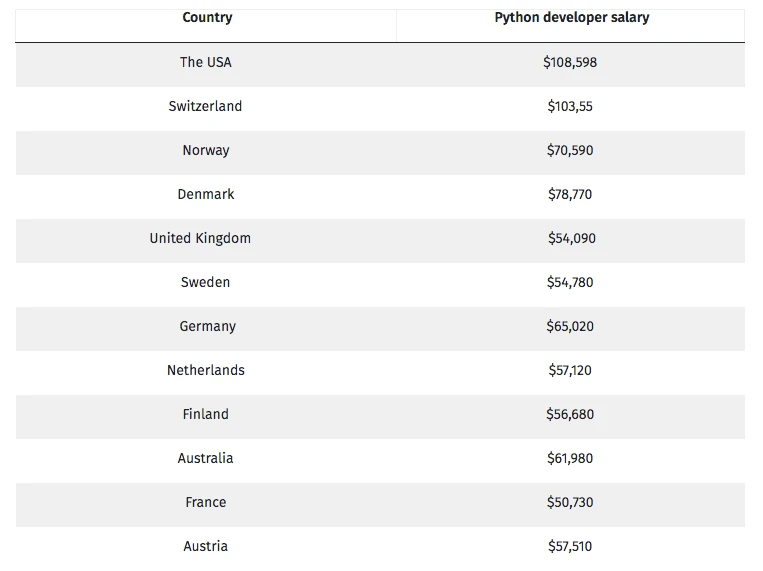
5. You’re interested in data science
If you’re interested in entering the lucrative field of data science, you should learn Python. Why is Python used so widely in data science? One important reason is that powerful statistical and numerical packages exist in Python for data analysis (such as PyBrain, NumPy, and MySQL).
Anyone comfortable with the Python programming language can use it as a tool to organise, process, and visualise data. And, with Data Science fast becoming one of the most rewarding careers in the tech industry, learning Python can fortify your career prospects for the future.
6. Machine Learning
You’ve almost definitely heard of Machine Learning (ML). But, to remind you of the basics, ML combines programming and statistics to build algorithms that allow computers to learn tasks they haven’t explicitly been programmed to learn.
Python modules like Scikit-learn, Tensorflow, and Theano support ML so that you can do cool things like spam detection and fingerprint identification.
Our future is heading towards a dependency on ML. And with the increase in popularity and demand comes an influx of employment opportunities within the sector. Learning a programming language like Python can secure your role in this bright and rewarding industry.
7. It’s powerful
Here are some of the incredible things you can do with Python:
- Automate the boring stuff
- Build web applications and websites from scratch
- Take advantage of micro frameworks like Flask and Bottle
- Develop GUI (Graphical User Interface) applications
- Do scientific and numeric computing
- Automate your browser to do social media posts at specific times
- Make robotics possible
- Bring your dreams to life (at least in some cases)
8. IoT
Python is one of the top four languages for building IoT, or Internet of Things, solutions.
IoT is really about connecting things to other things via the internet – think smartwatches and security systems.
Since our society is driving towards an automated future, understanding how IoT works is quickly becoming one of the most highly sought-after skills in tech.
9. Large community
When you’re learning a new language, a thriving online community is a genuine advantage to help you out when you get stuck. The Python community has a massive online resource at Python.org. You can receive free weekly emails, download various resources, or chat via IRC (Internet Relay Chat).
10. Demand
Python appears to be the fastest-growing language, particularly in high-income countries such as the US, UK, Germany, and Canada.
In 2022, its demand is only increasing without any expectation of slowing down.
From excellent salaries and ongoing demand to the versatility of this language, Python is undoubtedly one of the most powerful programming languages to learn in 2022 and beyond.
—————–
If you’re keen to learn Python online, HyperionDev’s Data Science and Software Engineering bootcamps are a popular choice. See why for yourself by signing up for our trial, or apply for a bootcamp and upskill in tech today.
Editor’s note: This post was originally published on 12 February 2019 and has been updated on 16 September 2022.
Career Advice
The Easiest Programming Languages for Coding Beginners
Grasp one of the many programming languages popular in the tech world and kickstart your journey to a lucrative career by learning to code today.
With the high demands of the tech industry only expanding, one of the most effective things you can learn for a fruitful career is a programming language.
Today’s technological environment is jam-packed with complex computational paradigms that are daunting to beginners. But, of course, some languages are easier to learn than others. And, with a bit of time and practice, certain coding languages can start to feel like second nature.
Let’s take a look at some of the most accessible programming languages for beginner coders.
HTML
HTML is considered the simplest programming language to date and could be your best starting point when learning how to code. This language is most commonly used in web development and has a number of commands that are contained between brackets. The language’s function is based around structuring as it tells a website how to stylistically present information.
HTML is incredibly basic. While it still has a place, it’s hardly used as a primary coding language anymore. However, if you’re just getting started on your journey to code, this could be a great place to begin as you’ll receive direct and instant feedback, and a basic understanding of how coding languages work.
CSS
Coming in at a close second is CSS. If stylistic editing and front-end development are more in line with your career desires, then Cascading Style Sheets (CSS) is an ideal programming language for those who wish to learn to code.
From colour pallets and fonts to entire page layouts, CSS is used to sculpt and refine the visual aspect of a page. It also functions in conjunction with HTML to better grasp the screen display.
Python
While this programming language is still considered relatively basic, it is among the most popular to date. In 2021, the recognised job application site Indeed.com saw Python crop up in over 70,000 full-time job descriptions. In fact, this popular language is even used by mega-corporations like Google and Netflix.
With Python, you don’t need to use as many lines of code as other languages require for the expression of certain concepts. You can achieve more in less time since its function is straightforward, and the language itself consists of many well-known English words to keep you on the right path. And, to make this in-demand language all the more accessible to you, both our Software Engineering and Data Science bootcamps can help you learn Python in a matter of months.
JavaScript
Don’t confuse JavaScript for Java. Both are in hot demand, yet they are two distinct languages. Here’s the primary delineator between the two: JavaScript pertains to scripting needs, whereas Java pertains to programming needs. JavaScript crosses all platforms and isn’t too difficult to learn, making it one of the central pillars of the internet when it comes to programming languages.
Since it comes pre-built in all browsers, you don’t need to download anything to start figuring out how JavaScript works. Java primarily derives from “C-language” coding and has a level of flexibility to it. It can be harnessed and utilised for both front and back end development, making it versatile and useful in a multitude of landscapes. In the professional realm, JavaScript is one of the highest-paying programming languages to hone.
Java
Having circulated the world of programming since 1995, Java is a forefather to development while remaining a timeless tool in refining the web and expediting innovations in software. Video games, applications used on mobile devices, websites, and more are all programmed using Java.
Think of it as a C++ addendum. The language makes use of objects and classes to relay commands. For beginners, Java is ideal, as it’s been on the web for a long time.
You’re Almost There
Learning a coveted programming language is only the first part of the process. Once you’ve mastered one set of coding paradigms, you will want to put that knowledge to use and design an application or website. To achieve this, you’ll have to practically refine your newly developed code, put it through its paces, and ensure its effectiveness and functionality.
Interestingly enough, no matter the programming language you choose to learn first, it can be translated to another programming language. This just goes to show how exciting and expansive today’s web innovations are, and there is a wealth of lucrative opportunities for those willing to spend a little time and learn a coding language or two.
——————-
Our coding bootcamps are one of the most efficient ways you can upskill and learn to code. Whether you’re interested in web development or data science, our online courses could be the bridge that connects you to a prosperous career in tech. Discover HyperionDev’s online coding bootcamps to start your coding journey today.
Student Success Stories
Student success story: Lee – From high school student to Junior C# Developer
One of HyperionDev’s graduates studied full stack web and software engineering while working full time in IT. He did so well in his first course that he went on to study data science with a full scholarship too. Now he’s a Junior C# Developer. Read his success story.
Some techies are made, others are born. Johannesburg native Lee Kaplan is one of those born into the industry, with a clear vision of what he wanted to do from an early age: become a full stack developer.
His journey into the world of coding started the minute he left school. He took a job in the IT industry to keep the pot boiling and signed up for HyperionDev’s immersive Full Stack Web and Software Engineering Bootcamp. He opted to do it online part-time, completing assignments after work and whenever he had a spare minute.
We asked him what moved him to become a developer. He says:
“I’ve been interested in a career in coding and development since I was young. It’s something that I’ve always been very eager to learn. When I discovered that learning it part-time while working was possible, it was a no-brainer to go with HyperionDev.”
While his passion for software development ensures he’ll always be in a job he loves, this field of work comes with other attractive benefits too. One of those benefits is that a coding career gives him the opportunity to work anywhere in the world.
An investment in his future
While Lee was naturally drawn to the broad field of IT, his passion for development is what drove him to upskill with HyperionDev. The advanced skills focus of the Full Stack Web and Software Engineer Bootcamp provided an ideal launching pad to pursue a multi-role developer career. With that comes the exposure to a wide range of jobs, including software engineering, data management and full stack web development.
Lee found the best part of the bootcamp was the fact that he learned so much more than just coding. He acknowledges that he gained valuable soft skills that are needed in the workplace, such as collaborating with others, managing your time, and knowing when – and not being shy – to ask for help.
The downside?
“The most difficult part was staying motivated and to keep pushing when I felt I was falling behind. Reminding me of my future goals kept me going.”
As part of all HyperionDev bootcamps, students receive code reviews, a software quality assurance activity that Lee found super useful because it helped him identify whether he was on the right (or wrong) track.
Lee passed the HyperionDev Full Stack Web and Software Engineering bootcamp with an impressive 97% average. On completion, HyperionDev offered him a full scholarship to study data science with Python, which he’s currently doing part-time.
Putting knowledge into practice
Thanks to the skills acquired at the HyperionDev bootcamp, Lee took on a side project where he wrote a web-based app that manages invoices for small businesses. To execute it, he kept all the information about clients and invoices in a SQL database. He wrote with ReactJs and ExpressJs, which communicate with the SQL database. The simple yet effective app can generate an invoice that users can view and edit. He found the process of having an idea and knowing how to build it using code hugely rewarding.
With his HyperionDev graduate certification in hand, Lee started looking for a new job. He scoured the recruitment boards and quickly landed an interview with Fidelity Group , a company specialising in telecoms in the UK, for a junior C# developer position. C# is a programming language created by Microsoft as part of its .NET framework.
Although the interviewing process was gruelling, consisting of an informal, then formal interview, followed by a technical interview and test – all done remotely – he was hired and recently started working at the integrated security solutions provider.
Onwards and upwards
For Lee, finally putting his knowledge into practice has opened up a new world of possibilities. Along with that, the support he gets at work is invaluable, and he loves the fact that others are keen to help him learn.
“I can see myself growing from a junior to a senior developer very quickly. Because of my knowledge from the bootcamp, I find it easy to pick up on new skills and languages, which I think will help me greatly as I climb the ladder.”
——————–
Follow Lee’s exciting career in tech on his Github portfolio. If you’re inspired by his story and feel ready to embark on your own journey toward a fulfilling career in the tech industry, consider registering with HyperionDev here.
Who knows, your success story may be next.
Student Success Stories
VMG Software Successfully Hires Two HyperionDev Graduates
Imagine being so impressed with HyperionDev’s graduates that you employ two of them when you only planned on filling one position. That’s what happened when VMG Software was scouting around for new talent to join their development team. Read their employer story.
Imagine being so impressed with the calibre of graduates coming out of HyperionDev that you employ two of them when you only planned on filling one position!
That’s exactly what happened when the MD of VMG Software, Alan Green, was scouting around for new talent to join their development team.
For some background, VMG Software – VMG is an acronym for Vehicle Management Group – is a Cape Town-based software development company. They provide the independent retail motor industry of South Africa with comprehensive and easy-to-use Dealership and Workshop Management Software (DMS/WMS).
VMG’s hunt for new talent
In 2019, Alan was looking for young, recently-graduated talent to join their development team and was introduced to HyperionDev. He was instantly impressed with our brilliant level of communication and efficiency, and even more so by our carefully curated list of potential candidates.
After some intense scrutinising, the VGM team narrowed down the original list to five strong recent graduates. HyperionDev facilitated the interviews, and although they were impressed with the level of education, VGM decided to take it a step further and put them through the grinder that is the technical test.
Putting candidates through their paces
All five candidates passed with flying colours, leaving Alan and his team with the difficult task of choosing the single graduate who would ultimately join VGM as a developer. This turned out to be an impossible task. Alan explains:
“We were only looking for one, but the calibre of talent sent to us made it difficult for us to choose a single one, so we settled on two!”
A rewarding job with a rewarding future
Three years on, and both HyperionDev graduates are still with VGM – and they’re thriving. Both have had salary increases, and they have expanded their knowledge and grown their expertise along with the company. Alan has only praise:
“I am not sure what exactly Hyperion does differently, but it shows in their output. Thank you, HyperionDev, for helping development companies like ours find the right talent for our needs. We appreciate it deeply, and we look forward to inviting new talent from HyperionDev in the months and years ahead.”
Be the next employer success story
Once a student has graduated from HyperionDev, our support does not end there. We provide all our graduates with post-bootcamp support to help them land their dream job. This includes career coaching, keeping them informed on trends in the job market, and expected salary scales. We also introduce them to industry experts, internships, projects, as well as graduate placement programmes that can further their knowledge and keep them connected.
If you’re an employer looking to fill your technical vacancies, contact HyperionDev today, and we’ll introduce you to our latest shining stars. We have a great track record of assisting employers across the country – from Amazon and Absa to Takealot and Discovery – in finding the best candidates for their technical job openings.
Plus, we’d love to feature you as our next great employer story!
Student Success Stories
Student Success Story: Molato – From Systems Developer to Python Software Engineer
This HyperionDev graduate went from a systems developer at the SANDF to a top job as a Python software engineer at Daemon tech consultancy in London. Read more about Molato’s success story.
Molato Paul Sekgobela from Pretoria is a HyperionDev graduate who recently completed the online Data Science Bootcamp on a part-time basis. He is just one of our many local success stories featuring students who went on to realise their dreams of working abroad (and bringing in the big bucks) in the tech industry.
Unlike many students who come from unrelated fields, Molato does have a background in tech; before becoming a HyperionDev graduate, he was a systems developer in the South African National Defence Force (SANDF). He explains what drove him to study further:
“I felt that I had learnt as much as I could, and there was little room for further professional development. I needed a much bigger challenge, and what better way than to be in the private sector and grow while being exposed to different industries.”
Why study data science at HyperionDev?
Molato explains that developing the skills for an in-demand career brings job security because almost every company needs programmers. Plus, there’s the chance of travelling the world when you have the skills to become a data scientist. And with that comes the opportunity to earn more.
Fitting in a Data Science Bootcamp while working full-time was easier than Molato anticipated, thanks to support from both HyperionDev and his supervisor at SANDF. He managed to set aside five hours after work and 16 hours over weekends to ensure he completed all the courses.
At the same time, he was involved in a work project that required data analysis and insights as well as the skills to build his own dataset. He explains:
“I had great support from my supervisor as I needed to develop my skills in data visualisation as part of a work project. I was given time to complete assignments to avoid falling behind as my success at bootcamp meant success in the project.”
He was drawn to data science as his field of specialisation because of his passion for AI and machine learning and his ambition to become a machine learning engineer one day.
The pros and cons of bootcamp and the value of code review
Molato liked the practical aspects of the projects he completed at bootcamp, such as building models and training them. And while he found machine learning quite challenging, once he got to grips with it, he thrived.
He was especially impressed by the code reviewing process, which taught him alternative ways of solving programming challenges.
“The code reviewing process was very insightful because it showed me whether I was on the right (or wrong) track. It took my coding to a new level.”
Putting data science to work
For Molato, studying data science helped him upskill and grow his technical knowledge in Python while preparing him for technical interviews. This helped him easily transition from the public sector to his new role as a Python software engineer at Daemon in the UK, a job he found via his impressive LinkedIn profile.
Upon completion of the data science bootcamp, HyperionDev career services team helped Molato polish his LinkedIn profile and build a Github portfolio, two essential tools in helping IT specialists find work in the industry. At the same time, the graduate programme prepared him for the demanding technical interviews that always come with IT placements.
He now uses the tech skills he developed during coding bootcamp to perform:
- Data analysis
- RESTful API building
- Machine learning
- Python and Django
- Building data sources (datasets, Database, CSV, XML).
The tech stacks he mostly works in include Python, Django, POSTGRES, Pandas, and RESTFul APIs. But the coolest thing about his new job is working in virtual environments, which he regards as excellent practice for software development. And yes, the salary increase has been great, too.
Lots of room for growth in the future
We asked Molato how he sees himself growing in his new job and the tech industry. He says:
“I see myself becoming a tech lead or a senior engineer at some point in my career. I would also like to share my expertise by helping others advance their tech careers. My philosophy is very much ‘Each one teaches one’.”
Where does he want to be in five years, and how has learning to code impacted his life? Molato sees himself leading a team of engineers in machine learning and computer vision and starting a foundation that teaches youth to code.
As for coding, he is a complete convert. He says:
“Learning to code has given me the confidence to do more and continuously invest in myself. Code encourages one to be innovative and think outside the box; it pushes people to think of problems and solutions. A coder sees a problem and a solution. The more coders the world has, the more solutions to human problems there will be, making the world a better place.”
–——————-
Follow Molato’s exciting career in tech on his Github portfolio. If you’re inspired by his story and feel ready to embark on your own journey toward a fulfilling career in the tech industry, consider registering with HyperionDev here.
Who knows, your success story may be next.

Career Advice
Inspiring Female Tech Leaders in South Africa
Who are the top women in tech in South Africa? We profile three of South Africa’s most successful women in tech, how they got there, and how they’re using their skills to change our world one line of code at a time.
From the way we live, work, and innovate – science, technology, engineering, and mathematics (STEM) drive the economy and create our future. Yet, according to WomenInTech, in South Africa, women hold a mere 23% of all tech jobs in the country.
Luckily several initiatives are working towards closing the gap, and among them are educational institutions such as HyperionDev that actively encourage women to learn the magic of code so that they, too, can enter the lucrative and exciting world of technology.
To inspire more women to enter the world of IT, we profile three of South Africa’s most successful women in tech today, how they are using their skills to change our world, and their top life lessons.
Dr Mmaki Jantjies
Capetonian Dr Mmaki Jantjies is on a mission to disrupt the South African educational system. A computer scientist with a passion for how technological innovations can improve society, she has a CV the length of the Hubble space telescope’s code – and the experience to execute it!
After completing her Honours in informatics at the University of Pretoria, she moved to the UK where she studied for her Master’s degree in computing at Oxford Brookes University, followed by her PhD in computer science at the University of Warwick. She is a research member at the United Nations University that merges ICT with global sustainable development goals.
How she’s making a difference
Dr Jantjies holds the prestigious Group Executive of Innovation and Transformation role at TELKOM and is an Associate Professor in Information Systems at the University of the Western Cape (UWC). Here her research focuses on developing mobile learning software systems in STEM subjects that will be accessible in all South African languages.
Concerned with how few women have access to careers in tech in SA, she encourages her students to join the Mozilla and UN Women technology clubs for young girls. In these tech clubs, young girls from Cape Town township high schools can learn ICT skills and are encouraged to take the leap into a career in tech.
Casting her net wider to help women across Africa, she co-founded Peo ya Phetogo (PYP), a non-profit dedicated to digital skills development among our youth, schools, teachers and communities.
Life lesson
“Being able to impact society through education and research on technology is the most fulfilling experience as you always see the impact of the change you bring in your greater society.” (Interview for STEM mentor article at UWC)
Lindiwe Matlali
Gauteng native Lindiwe Matlali is a multiple tech industry and business leader award-winner who holds a number of board memberships and has been – and still is – involved in both grass-roots and government-level initiatives that aim to inspire Africa’s next generation of innovators and entrepreneurs.
She started out by studying BCom economics and statistics at UCT. After a decade of working, she completed a course in executive education and data analysis with Harvard Business School. She is currently studying towards her Masters in Technology Management from Columbia University in New York, as well as a Graduate Certificate in Entrepreneurship and Innovation at Stanford University.
She has won multiple awards, among them Excellence in STEM from the Charlotte Maxeke Institute, Social Innovator of the Year by the Schwab Foundation, and was named one of the Mail & Guardian 50 Powerful Women in SA in 2021.
How she’s making a difference
Her exposure to some of the world’s leading educational institutions has led to an exciting position with the Presidential Commission on the Fourth Industrial Revolution (4IR), which aims to help the government seize opportunities presented by the digital industrial revolution.
The venture we’re most impressed with is her role as founder and CEO of Africa Teen Geeks, an NGO that teaches kids how to code. Teen Geeks is the largest computer science non-profit organisation in Africa and has one clear goal: to educate, inspire and equip young people with skills, resources and experience to pursue STEM careers and close the opportunity gap through quality education.
Life lesson
“An integral part of empowering women is showing them that tasks traditionally labelled as ‘women’s work’ are complex and important and hold many of the same technical challenges as anything men do.” (Knitting Is Coding Ted Talk for TEDxBeaconStreet)
Thembiso Magajana
Thembiso Magajana is a self-confessed technophile from Gauteng who spent a decade in the financial sector before she found her true calling in code. It was a conversation with her then six-year-old niece who wanted to be the world’s next Steve Jobs – and being dismayed at how few black women there were in tech – that inspired her to leave the world of finance. Within months she was fully immersed in creating pathways for South African township youth to be part of the 4th Industrial Revolution.
Unlike our other tech heroines, Thembiso has no formal education in technology. However, when she decided she wanted a future in IT, she spent her free time reading Computer Programming For Dummies, watching Youtube tutorials, and studying various online coding and IT courses. Soon she was teaching her niece and friends basic coding in her sister’s garage, with limited wifi and only one laptop between them. That inspired her to launch Social Coding. Her background and training in finance has stood her in good stead, helping her secure funds and creating multiple revenue streams for her nonprofit.
How she’s making a difference
Thembiso’s passion and drive have catapulted her into one of South Africa’s most recognised female tech movers and shakers. She has been recognised as a World Economic Forum Global Shaper and is an accomplished TEDx Speaker. In 2019 she was named one of the 50 most inspiring women in tech by @InspiringFifty SA, a non-profit that aims to increase diversity in tech by making female role models more visible.
Her nonprofit, Social Coding, is where she has made a huge difference to thousands of disadvantaged girls and women. The technical workshops cover software development and design thinking and teach girls to be initiators, conceptualists, shapers, and drivers of innovative and strategic problem-solving.
Life lesson
“Teach one girl to code and she’ll teach 22 more because women are by nature change agents, and by doing so, we’ll solidify the economy of our nation for years to come.” (In conversation with GirlCode)
——————
Could you be next?
Looking at these amazing women, two qualities stand out: they are all dreamers and doers. They did not take ‘no’ for an answer, nor were they constrained by gender stereotypes when it comes to working in a field that ignites their imagination and passion.
If their journeys have inspired you and you dream of a tech industry career, you have come to the right place. Apply for a bootcamp, and who knows, we may be featuring you in our next series of top inspiring SA women in tech!

Student Success Stories
Student Success Story: Daniel – From Recruiter to Sales Engineer
This HyperionDev graduate completed our Full Stack Web & Software Engineer Bootcamp and now works at a top London tech company. Read the story of his transition here.
Originally from Columbus, Ohio in the US where he studied political science, Daniel Montague is a true traveller and entrepreneur. After learning how to teach English as a foreign language through the University of Texas, Austin, he embarked on a life of travel and work which took him to the far corners of Taiwan, China, and Mexico.
In 2016 he came to South Africa and started his own international recruitment agency, recruiting teachers and placing them in teaching opportunities around the world. However, the Covid-19 pandemic put an abrupt stop to that, and Daniel found himself in need of yet another career change.
Making the switch to a career in web development
He had always been interested in technology, and considering that careers in IT are in high demand across the globe, he launched himself into HyperionDev’s full-time online Immersive Full Stack Web & Software Engineer Bootcamp. He loved the intensity of the course but admits that, towards the end, things got really tough. Yet he pushed through, keeping his eye on where he wanted to go with a HyperionDev graduate certificate behind his name.
“I wanted to develop skills for an in-demand job, because I know that most companies need programmers.”
He’s right; developers enjoy some of the highest paying careers in the world, with the freedom and skills to find work remotely and internationally. After graduating from HyperionDev, Daniel found a whole new world had opened for him. He initially worked at JP Morgan as a software engineer, but when he saw a position at Ezoic in London, he applied. After three rounds of interviews and two technical evaluations, he was hired.
Ezoic is a Google award-winning tech platform that provides machine-learning and data-driven solutions for website owners. It turned out to be a perfect fit.
Life as a sales engineer
Ezoic’s sales engineers have their work cut out for them. They provide high technical insight to Ezoic’s UK Sales’, support, and success management team and liaise between the digital sales team, the software development team, and directly with website owners. Describing his day-to-day work, Daniel says:
“I do a lot of DevOps. I have to communicate effectively about code to those less knowledgeable and know the ins and outs on how thousands of websites work and go through our system.”
Daniel works mostly in JavaScript (JS), one of the most popular tech stacks of 2022. Because engineers use a single language through the stack, they have the opportunity to reuse code across the entire application, thereby decreasing needless reinvention.
Daniels says the coolest things he’s learnt while working for Ezoic are the intricacies of Domain Name Systems (DNS) and the ever-changing world of Chrome Dev tools.
From web developer to greater things
We asked Daniel how he sees himself growing in his new job and in the tech industry as a whole. He says:
“I love my company and see myself staying for a while. I’ve been given the opportunity to switch to a development role, but I did that at JP Morgan and find my current job as a sales engineer to be more suited to my personality.”
Daniel has also seen a huge jump in his salary from his days as a teacher and recruitment specialist. Where does he see himself in five years?
“I see myself as a circle lead or developing side roles inside the company as we continue to grow.”
The value of knowing code
When asked for advice for others who are interested in becoming HyperionDev graduates, Daniel highlights the importance of knowing how to code:
“You don’t have to become a developer to get into tech, but learning to code is extremely valuable. It’s brought me a ton of new opportunities which would have been more difficult to be part of.”
———————
If you feel inspired by Daniel’s story and want to follow his journey in tech, visit his GitHub portfolio. And if you’re ready to embark on your own journey toward a fulfilling career in the tech industry, consider registering with HyperionDev here.
Who knows, your success story may be next.

Student Success Stories
Student Success Story: Esethu – From Medical Administrator to Business Analyst
Learning how to code and becoming a data scientist has allowed this HyperionDev graduate to present statistical data in a way that solves real-world problems.
How did a young girl from Port Elizabeth, who studied professional cooking and financial management, end up in her dream job as a business analyst at the innovative tech company Quikr?
Turns out it’s because of her life-long love of maths and statistics. In fact, HyperionDev graduate Esethu Pakela has dreamt of becoming a data scientist ever since she left school. In her job as a medical administrator at Mercantile Hospital, her former employer encouraged Esethu to study further and this was the final push for her to take the leap and study an online, part-time course in data science with HyperionDev.
Studying while holding down a full-time job may seem daunting to some, but not for Esethu. She explains:
“I found the bootcamp flexible enough to do course work after hours and on weekends. Booking a code review session was also hugely helpful in getting valuable input when doing assignments.”
Were some subjects a little tough to master? Esethu says the intricacies of artificial intelligence and machine learning presented a steep learning curve. Undaunted, she expanded on HyperionDev’s coursework by watching videos to get her head fully around these tricky subjects.
Why study data science?
Becoming a data scientist was not only a passion for Esethu; she was laser-focused on the opportunities that come with working in the tech industry. Importantly, she now has the chance to earn a much better salary than she did as an administrator. But it’s also about developing her skills in an in-demand career field and creating a better work-life balance.
“I wanted to work remotely. I love being able to control my own time, and to work from wherever I want, be it in a beach hut or a cafe. It has also opened up the world to me because my skills are in demand across the globe, in all industries.”
Esethu’s ambitions include presenting at IT conferences and educational institutions and doing Ted Talks. She is also passionate about encouraging more women to join the tech space. Her ultimate goal is to become a world-renowned business intelligence tech guru. We can’t see anything stopping her.
The stepping stones to success
As a Hyperiondev graduate, Esethu’s part-time data science bootcamp included learning how to code and mastering the world’s most popular programming language, Python. She also learned everything there is to know about data science libraries such as NumPy, pandas and the Python framework scikit-learn. Essential skills that go hand-in-hand with coding are understanding how to use the best software and techniques to read visual and statistical data and present it in a way that solves real-world problems.
“These skills helped me land the job I’m currently in where I’m able to wrangle large data sets and present them in a visual format to my company’s decision-makers,” she says.
HyperionDev’s code review process was also a pivotal part of her studies, checking how one small change can affect the bigger picture. For Esethu, it also taught her alternative ways of solving programming challenges and showed her whether she was on the right track or not.
Putting good code to good use
Interested to know how studying data science and becoming a HyperionDev graduate has set the groundwork for her current job as a business analyst at Quikr? Esethu explains that working primarily in Python, Excel and MySQL enables her to perform these KPIs:
- Analyse and evaluate current business processes the company has and identify areas of improvement.
- Research and review up-to-date business processes and new IT advancements to improve systems and processes.
- Use business intelligence to produce business models that assist business growth.
- Create initiatives depending on the business’s requirements to align with key metrics and investor storytelling boards.
- Update, implement, and maintain databases.
- Assist in creating good sales funnels for customers and partners.
- Prioritise initiatives based on business needs and requirements.
From part-time student and medical administrator to full-time business analyst
Esethu says HyperionDev was instrumental in ramping up her CV through webinars and the company’s career advisor’s reviews and support. In no time, she reached over 500 connections on LinkedIn, which caught the attention of Quikr’s CEO, who then reached out for an interview. The rest is history.
Learning to code is about more than just programming
Esethu is a firm believer that code will change the world for the better by establishing higher levels of automation and convenience in all industries. She says:
“Learning to code has taught me resilience. It has taught me to overcome imposter syndrome and trust myself more. Professionally, learning to code has helped me to expand my knowledge and continuously gain new skills and expertise. If a challenge presents itself in my job, I automatically open up myself to research the solution or learn the techniques to solve it.”
Was it easy? Esethu is frank: “It’s not easy, but it’s worth it! Do it!” Check out her Github portfolio to keep an eye on HyperionDev graduate Esethu’s journey through the fast-changing world of IT.
—————————
If you feel inspired by Esethu’s story and are ready to embark on your own journey toward a fulfilling career in the tech industry, consider registering with HyperionDev here.
Who knows, your success story may be next.

News & Announcements
July 13, 2022
Our HyperionDev Career Expo was a great success
HyperionDev's Tech Career Expo 2022 hosted in June was the most successful one yet! An exciting lineup of industry partners and employers presented at this event. Find out who they were.
The past month of June has seen our biggest and most successful Tech Career Expo yet! A special notice of appreciation and gratitude to everyone who attended and participated in this 2-day event hosted on the 29th and 30th of June. We are very proud and excited about the line of industry partners and employers who presented at this event.
Here are the guest speakers who shared their invaluable insights:
Francios Van Louw from SOCO_ED

Francios Van Louw is a South African entrepreneur with a passion for marketing, branding, the youth market and all things tech. Having worked in the marketing and content creation industry for over a decade, he founded Just Brands Africa in 2013 – a company of which he is currently also the managing director.
SOCO-ED is an adaptive online learning platform, used by the likes of Stellenbosch University, Central University of Technology and other independent educational institutions and is fast becoming the preferred online educational solution for many leading educational institutions in South Africa.
With Van Louw’s keen interest in the youth market and by following a consumer-first approach, SOCO_ED is set to disrupt and change the way learners view and engage with education on digital platforms.
Paula Macnab from Yellow

Paula Macnab – Head of Brand and Communications
Yellow‘s purpose is to make life better for customers living in Africa.
Through a digital technology platform, Yellow enables a distributed network of sales agents to serve rural households with life-changing products and services.
Rachel Joffe and Kevin Da Silva from Entersekt
Rachel Joffe – Talent Development Coach @ Entersekt.
Rachel is hugely passionate about people’s development and having an impactful relationship with the world around her. Since she entered the talent management and development space in 2007, she has been refining her skill set so that she can best support the teams she works with, in changing lives. Rachel is dedicated to working with people and organisations that strive for positive, solution-focused approaches and are not afraid to employ non-traditional methods in working towards their mission.
Kevin Da Silva– Technical Talent Specialist @ Entersekt
Kevin is an Experienced Team Lead with a demonstrated history of working in the staffing and recruiting industry. he is Skilled in Local Area Network (LAN), Sales, Databases, Management, and Recruiting. And is Strong information technology professional with a National Diploma focused in Management from Cape Peninsula University of Technology.
Entersekt was born with bright ideas and big dreams of solving the problem of fraud consumers have to deal with on a daily basis. Over time, a secure, simple, and user-friendly experience became increasingly important. This helped to crystallize the company’s vision: to make the digital world not only a safer place for all but more user-friendly too.
As the business continued to grow, the knowledge gained from working with financial institutions, technology partners, and industry experts proved invaluable in establishing Entersekt’s core offering: a single authentication hub that allows consumers to transact securely and easily on any digital channel, from any device. Today, Entersekt touches the lives of more than 65 million people across 50 countries – and counting.
What sets us apart? By remaining honest, humble, and authentic in our approach, we’ve become known as one of the few globally trusted fintech companies to consistently deliver on their promises, without fail.
Bakuena Ntshasa from Bandbook
Bakuena Ntshasa as the co-founder is involved in all aspects of consumer intelligence and shopper behavioural research. His focus is mainly on sales, product and systems innovation, business strategy, product strategy, and general management of the rest of the teams. One of his most important responsibilities is to help ensure that Brandbook remains a high-performing team focused on delivering value back to its users and clients at all times.
At Brandbook they unlock your brand’s capability to know what shoppers are buying and why. All with a click of a button.
Daniel Montague from Ezoic

Daniel Montague is a HyperionDev, Full Stack Web Development Bootcamp graduate. He has gone on to be a Software Engineer for JP Morgan in the United States and is currently a sales engineer with Ezoic in London.
Ezoic uses AI to help sites gain the most out of ads they place. We also help with SEO and other Core Web Vitals. As the first Google Certified Publishing Partner, we have great ties to Google and other big players in the tech world.
Wahlied Cole from Scoothero and Quikr

Wahlied Cole is an Experienced Director with a demonstrated history in the logistics and supply chain industry. He is Skilled in Negotiation, Operations Management, Import, Freight, and Retail, and is a Strong professional with a SMDP focused in Management from Stellenbosch University/Universiteit Stellenbosch.
Scoothero – The first food, grocery and delivery network marketplace ecosystem.
Quikr– The most cost-effective same-day delivery partner in South Africa from as little as R50 per order.
Zahed Rassool – RRZ Innovations

Zahed Rassool AKA ZEE is an apple-loving (yes the tech), fun-going, semi-authentic, family-driven, young professional. He is the type that aims way too far and believes that he can always embed himself as part of the solution. The type that makes promises that his team needs to fulfil. He was Voted best daddy by his firstborn and the current rock-paper-scissors Champion at RRZ. A serial entrepreneur that debugs his way through life.
RRZ Innovations consists of a team of talented individuals who share the same dream. We pride ourselves on our efficient software design, quick workflow, excellent service and professional outlook on business relations. RRZ Innovations has grown to employ an elite group of developers and designers who regard customer satisfaction and great software as part of their core values. You will always receive top-quality products from us and you can rest assured that we deliver on time.
Starting off developing simple Content Management Sites (CMS) for a small group of clients we found that we were quickly growing and ended up venturing into .Net and biometrics. This led to an influx of clientele. Our hunger for new challenges combined with excellent software and great hands-on service ensured the return of many of our clients as well as an influx of new clients through word-of-mouth. Some of our main income is generated from assisting and consulting for other Software Development companies that do not have the manpower or expertise to complete projects on their own, as well as the development of custom Business Management Software (BMS).
We have many products in the Public and Private sectors which include Municipal Productivity, Websites, Webapps, Hosting and Native Mobile Applications in iOS, Android and BBOS10.
RRZ has made great strides in the advancement of municipal productivity as well as business management systems while creating a stable platform to help educate newcomers in the field of graphic design, website design and information technology.
——————
Our Career Services team provides post-bootcamp support to keep our graduates in the loop and informed of the updated trends on the job market, expected salary scales, introductions to industry experts, information about available graduate placement programmes, industry projects, jobs, internships and a whole lot more.
We also give graduates holistic career development, from their CV and technical skills, to networking, events, and industry introductions. Providing our graduates with the skills, support, resources and mentoring to engage with industry and the job market. Through our Graduate Programme of intensive career support and development, we prepare our graduates to be job-ready for the tech industry.

Student Success Stories
Student Success Story: Rudolph – From Sales Executive to Data Scientist
HyperionDev’s graduates are an inspiration to any student aspiring to become a developer. This student’s success was a result of his dedication to gaining invaluable data science skills. He went from sales executive to data science, and you could do so too.
Rudolph Visagie was unfulfilled in his role as a sales executive. He knew his passions lay elsewhere but didn’t know how to begin the search to find what he truly wanted to do in life. While working a full-time job, Rudolph completed a programming degree through UNISA. He enjoyed the basic concepts the course provided, but he didn’t feel confident enough to enter the working world as a developer yet. He wanted more. That’s when he decided to join HyperionDev. He says:
“My previous job wasn’t in my field of interest and was mainly a way of financing my studies through UNISA. The role did not have many growth or upskilling opportunities other than being promoted to a more senior position. I had a rough idea that I wanted to go into tech, I just wasn’t sure exactly what until I came across HyperionDev and tried out the Data Science Bootcamp. After the trial, I decided that the course was the way to move forward.”
Taking steps toward success
Rudolph enrolled in HyperionDev’s Data Science Bootcamp, studying part-time online. He still worked a full-time job, but the ease and flexibility of the course schedule allowed him to complete the tasks in the time that suited him best. He says:
“The nice thing about studying this part-time is that I could work on this when I had the time at night and over weekends. The lessons were simple to follow and understand, helping me gain the knowledge that I would need to solve problems and helping me learn at a relatively quick rate.”
Rudolph excelled in his course work, approaching every task and challenge with determination and a keen interest in learning more. Soon enough, he completed his bootcamp with flying colours. What Rudolph really found valuable and unique about HyperionDev’s offering was the focus on practicality. He says:
“[I enjoyed] the simplicity of the theory and how quick it was to work through. Some concepts in this course are explained within a couple of lessons compared to an entire semester in a university course/module.”
Paving a way for a new career
When he became a HyperionDev graduate, Rudolph joined the Graduate Programme and garnered assistance from the HyperionDev Career Service Team. After reviewing and refining his CV and cover letter and training him for the real world with mock interviews, the Career Service Team sent him an email with the details of a potential job position.
With a professional and industry-ready portfolio on GitHub, as well as an abundant pool of knowledge and skill, Rudolph was able to land the job. He now works as a Data Scientist for Brandbook, earning his expected salary. He says:
“The course helped me fast track myself into a data science position. The course is set up in such a way that it focuses on realistic problems that you would need to solve in the work environment. This way of learning helped me in the technical interview to stand out from the other candidates and thus ensured that I got the offer over the other people.”
Continuing the journey
In the next five years, Rudolph hopes to expand his skillset and eventually become a manager. He says:
“I would ideally pick up as much information and knowledge as possible within the next couple of years and then eventually start running teams below me.”
He continues to be happy and fulfilled in his current job role and thanks HyperionDev for setting him on his course toward sustainable success. For those considering a career in code, Rudolph says this:
“Learning to code is hard work and takes time to start thinking like a programmer. The basics are the building blocks to start doing more complex things. You will never stop learning because there are always new technologies being released.”
———————-
If you feel inspired by Rudolph’s story and feel ready to embark on your own journey toward a fulfilling career in the tech industry, consider registering with HyperionDev here.
Who knows, your success story may be next.
Still have questions?
Contact our Admissions Team, and a real person will get back to you.