
Our latest insights
Read the latest insights


News & Announcements
February 24, 2022
Employee Story: Ronald Munodawafa – Quality & Support Manager
This HyperionDev employee ensures the coding university stays true to the promises it makes. Here’s how.
Our HyperionDev employees prioritise student support. It’s what makes our students thrive. And when it comes to the bootcamps we offer, we always make sure they’re high quality. We’ve promised to provide accessible learning opportunities that equip our students with the skills they need to enter the working world and shine.
At HyperionDev, we know that support ensures student progress, and it’s the quality that nurtures their success. Ronald Munodawafa is our Quality and Support Manager, and he’s done a spectacular job in keeping our bootcamps first-rate and our students supported throughout their learning process. With a background in computer science, Ronald knows what students need when it comes to learning tech skills. Here’s a little more about this HyperionDev employee who ensures HyperionDev stays true to all the promises we make.
oo
What do you enjoy most about working with HyperionDev?
I appreciate the company’s culture. It values efficiency, commitment, and responsiveness to change. Many individuals and organisations are averse to change. It’s different as a HyperionDev employee; we see change as an opportunity to grow.
What’s the heart and soul of your role?
I’m the Quality and Support Manager. I ensure our product offerings run smoothly at their core so that we deliver on all our promises. Our team takes pride in the quality and effort that goes into the personalised support we provide to our students and our clients.
What motivates you to come in or log in every morning?
I’m motivated by a challenge, and I live for the “difficult problems.” When I discover a major issue that needs to be resolved, I really shine. People have placed their trust in us, and their future depends on our work. Because of this, I’m committed to making sure our students start and end their journey with us in the best possible way.
Tell us a bit about your professional development whilst working with HyperionDev.
I come from a computer science background. Despite my exposure to business courses, I only had a hazy idea of how businesses could run efficiently. But at HyperionDev, I learned what simplicity and innovation mean in the face of difficult challenges.
Which of the 4 P’s (Purpose First, Progress Always, Problem Solving, People First) resonates with you most and why?
‘Progress Always.’ Never settle for 100% – because that’s actually 70%. If you reach 100%, go back to the drawing board, find what you’ve ignored, and improve it. And always move forward because being at the top is only temporary.
How is HyperionDev different from other places you’ve worked?
Everyone on the team is here because they love what they do. HyperionDev employees share a combination of cohesion, focus, and prioritisation – rare qualities to see in a team. It’s because of this that they’re always exceeding expectations.
What makes you feel PROUD to work for HyperionDev?
Being Quality and Support Manager means that I’m part of the Education Division. They’re a highly intelligent and hard-working team. Pretty much everyone I’ve worked with at the company does their best to ensure the team wins at the end of the day.
What’s a fond memory you have of working at the company?
Everyone gets imposter syndrome. It means they don’t pursue opportunities where they could learn and deliver. A couple of times, some of our graduates came across technologies they were unfamiliar with and froze. But after brief, reflective discussions with them, they pulled up their socks and rose to the occasion. It didn’t matter where they started. They realised that they had it in them to excel in whatever space they were in and could learn anything if they really wanted to.
Is there anything else about your journey at HyperionDev you’d like to share with us?
Being a HyperionDev employee has made me a well-rounded and competent professional. Rather than narrowing down as a specialist, I’ve developed a more holistic view of my role. Not just at HyperionDev, but in the tech education industry overall.
———–
oo
At HyperionDev, we’re always looking for talented professionals to join our team. Whether you’re a project management pro, a high-achieving sales executive, or someone who has a passion for teaching newcomers as they learn to code for the first time, there’s a place for you in our diverse and international team. As a HyperionDev employee, you’ll enjoy more than just fulfilling and challenging work with a fast-growing, internationally scaling start-up – we provide medical insurance, extensive remote working allowances, a generous leave policy, and real avenues for career growth, experimentation, and promotion.
Do you think you could be our next star HyperionDev employee? Visit our career page to see all our available positions and apply to join our team today!

Student Success Stories
Student Success Story: Busisiwe – From Financial Accountant to Data Analyst
Flexible and quick data science courses are paving the way for a seamless career change, improving job satisfaction, and facilitating skill expansion. This accountant grew her salary by adding data science to her skillset.
Busisiwe was qualified as a financial accountant, but she was unsatisfied in her career. Even though she was skilled and capable, the job market in her industry was overly saturated and competitive. With a desire to increase her salary and switch up her career, Busisiwe started looking into different ways she could upskill.
“The monotonous routines of Accounting were a bore, and the market has become quite saturated and highly competitive. The firms were hiring based on favouritism and not based on skills contribution or experience anymore.”
Busisiwe needed a more stimulating career that would provide better growth opportunities. She wanted to use the skills she already had but improve by gaining data analysis experience. Busisiwe identified a gap in her industry and took the leap to get qualified as a data scientist to fill it.
00
o
That’s when she started her career in code
The leap came in the form of HyperionDev’s Data Science Bootcamp. Through her course at HyperionDev, Busisiwe bettered her data analysis skills and can now use these highly sought-after skills practically.
Now, Busiswe isn’t only reading data; she’s coming up with the solutions that actually integrate that data. She finds this type of work deeply fulfilling and can see her role’s value for her company and team.
o
Through the Data Science Bootcamp, Busisiwe cultivated a solutions-based mindset
o
“The bootcamp opened me up to a completely new way of thinking. I wasn’t just looking for problems and identifying the red flags anymore, I was actually building the tools necessary to reach a solution. Learning to code in programming languages has helped me become a solutions-based person and it’s been an awesome journey.”
Busisiwe wanted to enter a field that was fair – where your performance is based on tracked outcomes rather than peddling the corporate ladder. She also wanted to solve real-world solutions. And by upskilling in code, she did.
Finally, Busisiwe feels like she’s adding value to her company. Her work informs the business’s automated processes using machine learning algorithms. By improving efficiency and working towards effective, data-backed solutions, Busisiwe has created a career path that she can thrive in.
o
“Now I’m able to use code even for the simplest things. I can understand what I’m looking at when I accidentally click the inspect button when browsing the Internet and have an idea of what’s happening on a website’s backend.”
HyperionDev’s graduate programme even got Busiswe hired.In this stage of her journey, the HyperionDev team helped her design a stunning CV that attracted prospective employers from all over the world. She found her current position through HyperionDev’s mailing system and is now a full-time data analyst.
Busiswe’s journey hasn’t ended there. She still wants to upskill and plans on doing HyperionDev’s software development course next. Her dream is to become a data scientist at Google someday, and we’re helping her get there.
o
“With 0 coding experience, the bootcamp helped turn me into a semi-pro. With a bit more experience, I’ll become an expert.”
Maybe you’re ready to follow in Busiswe’s footsteps. Our bootcamps will grow your mindset and skill-set and expand your job horizons. Within months, you could be earning more while working your dream career. No previous experience is required.
As Busisiwe says, “Give it a shot, you have nothing to lose and everything to gain.”
o
———————
Start your tech journey with HyperionDev
Enrol now to join one of our bootcamps and jumpstart your journey into tech. Our flexible, self-paced bootcamps prepare you for everything you need to know to take the leap and begin a career in code.
If you feel inspired by Busisiwe’s story and would like to journey into the fulfilling tech industry yourself, start your journey with HyperionDev <here>. Who knows, your success story may be next.

Student Success Stories
Student Success Story: Vanessa – From Mathematics student to Software Engineer
Explore how Vanessa reimagined her career path from super-smart student to supreme software success.
Vanessa was once a mathematics student, who wanted her love for problem-solving to answer to a higher purpose. She decided to reimagine her career path and join HyperionDev’s online Software Engineer Bootcamp part-time, to propel her toward an entirely new and promising future. Let’s explore her journey in making a 180° turnaround from super-smart student to supreme software success.
___________
Vanessa recognised that a part-time bootcamp would coincide with her work schedule. She was happy to stay on track with her day-to-day obligations and learn an exciting new skill.
“I wanted to earn a better salary – I was looking for a complete career change. I wanted to develop skills for an in-demand job, because I know that most companies need programmers. I wanted to work remotely – I love the idea of being able to control my time and being able to work from wherever I want. I wanted to travel, and I know that with my programming skills, I would have a lot of work opportunities overseas.”
Vanessa felt that her analytical thinking would not in itself benefit her as far as making a living goes, but that in coupling it with a software engineering skillset, she could help unleash her full potential.
“I wanted to have some object-oriented coding experience before my job interview because this is ultimately how software systems are built. The bootcamp yielded exactly that!”
Vanessa progressed through her bootcamp, benefitting from the code review provided and took an interest in version control. After seeking employment on LinkedIn, Vanessa found a vacancy and secured a role as a software engineer at Entelect. She has added a new understanding of the Spring Boot and Angular frameworks to her skillset and has learned how to build a database. She was happy to have improved on what she was earning in her capacity before entering the tech industry.
“I hope to become a great software engineer who is able to read multiple people’s code and collaborate well with a team when working on the same code base.”
Having shaken her imposter syndrome, Vanessa is now setting her sights on becoming a technical team lead. In successfully finding her place in the world of code, she now has the wisdom to impart that may add value to your story going forward.
“It truly is worth it! It may seem very daunting and scary, and at times it will be hard, but it’s so worth it for how relevant your skillset will be – you will never be out of demand, and you will always be able to negotiate your salary because you won’t be stuck in one place!”
Vanessa believes possibilities are endless in using code to make the world a better place, curing cancer or addressing world hunger.
____________
Start your coding journey with HyperionDev
Have you been thinking about learning to code, or following your passion for technology into a new career, just like Vanessa did? Industry-aligned coding bootcamps are the best way to become a job-ready developer in months rather than years – with an added layer of career development and job-search support.
Enrol now to join one of our online and on-site coding bootcamps, which will teach all the hands-on developer skills you need to do real developer work.

Career Advice
Top 5 In-Demand Tech Careers for 2022
Tech-based careers offer the students of today lucrative opportunities for tomorrow. Here are the top 5 most in-demand tech careers of 2022.
As nearly 900 000 matric students work towards completing their final exams, it is vital for them to start planning for their future. As with any career, students need to bear in mind how likely it is that they will be employed after completing their studies and whether traditional university is the right path for them.
This is according to Riaz Moola, CEO at HyperionDev, who says that thanks to the rapid digitisation of almost all aspects of our lives, tech-based careers offer the students of today lucrative opportunities for tomorrow. “Currently there is a skills gap in the technology sector in South Africa, which is reflected in research by PWC which reveals that 87% of local CEOs are most concerned about this shortage.”
As the school year draws to a close, many matriculants are wondering what to study next year. With this in mind, Moola lists his top five tech careers for matriculants to consider pursuing studying for in 2022:
1. Java developer
Average annual salary according to Payscale: R375 315
A Java developer uses the Java language to create high-functioning web applications, software and programs. Java developers have long enjoyed high-ranking status, rated as the number one job of 2021 by the global recruitment website Glassdoor. “Java is still one of the most popular programming languages in the world, reflecting both the growing demand for experienced Java programmers and the ubiquity of companies using Java for all kinds of tech applications,” asserts Moola.
The roles and responsibilities of a Java developer will vary greatly depending on the company and specific position. Here are some typical responsibilities: Designing, implementing, and maintaining Java applications that are often high-volume and low-latency, required for mission-critical systems, delivering high availability and performance, contributing in all phases of the development lifecycle, writing well-designed, efficient, and testable code to name but a few.
2. Software engineer
Average annual salary according to Payscale: R371 699
Software engineers are generalised developers, making all kinds of software to suit business’s needs. “They have always enjoyed incredible pay, boundless career opportunities and solid job security,” states Moola. “Software engineers are highly agile, thanks to their transferable skills and deep knowledge of one or more programming languages.”
Some of the responsibilities of a Software Engineer will be to: analyse user requirements, write and test code, refine and rewrite it as necessary and communicate with any programmers involved in the project. They will research, design and write new software programs (e.g. business applications or computer games) and computer operating systems, evaluate the software and systems that make computers and hardware work and develop existing programs by analysing and identifying areas for modification.
3. Data Scientist / Data Engineer
Average annual salary according to Payscale: from R428 554 to R449 030
“Data is the internet’s new gold rush, which is why companies want to understand their core data and key customer insights to unlock more efficient systems and bigger profits,” says Moola. “Data scientists and data engineers are the answer to that better business.”
There are more similarities than differences between data scientists and data engineers, he points out.
“A data scientist uses data analysis tools to manage, analyse, understand and draw conclusions from complex data. Data engineers, on the other hand, are responsible for the setting up, maintenance and management of data systems. They don’t just know how to work with data, but also understand the systems and processes that this large-scale analysis requires and how to work with these technologies. These two roles share the number three spot due to their international demand and high job security.”
A data scientist’s role combines computer science, statistics, and mathematics. They analyze, process, and model data, then interpret the results to create actionable plans for companies and other organisations.
4. Enterprise Architect
Average annual salary according to Payscale: R867 986
The career of an enterprise architect is one of the best tech jobs in the world because of its combination of staggeringly high pay and huge job opportunities and security.
“Enterprise architects typically occupy more senior positions and are responsible for making sure that a company’s business strategy uses the right technology systems to achieve its goals,” comments Moola who says that this highly technical role makes it a prized career.
An enterprise architect is responsible for the upkeep and maintenance of an organisation’s IT networks and services. As an enterprise architect, you would be responsible for overseeing, improving and upgrading enterprise services, software and hardware.
5. Full-stack web developer
Average annual salary according to SalaryExpert: R730 841
Full-stack developers have officially passed their single-stream counterparts (front-end and back-end developers) to claim the fifth most desirable tech job in the world.
“Full-stack developers work in both front-end and back-end development, building the visuals of websites and applications, as well as the nitty-gritty coding that allows them to work as intended,” explains Moola. “Full-stack developers are highly prized because of this dual specialisation and multi-role capability, making them highly in demand, both locally and internationally.”
A Full-stack Web Developer is responsible for the coding, design and layout of a website according to a company’s specifications. As the role takes into consideration user experience and function, a certain level of both graphic design and computer programming is necessary.
From student to industry-ready in a matter of months
Today, students can take advantage of online coding bootcamps which can be viewed as alternative credentials, says Moola. “They are a fast-paced career accelerator that can quickly land participants a job as a software engineer or data scientist, rather than a traditional university degree which takes years to complete.”
HyperionDev bootcamps are deliberately structured to be both affordable and accessible, with many ways to pay and save on essential tech skills education. “We believe coding should be accessible to everyone, everywhere,” adds Moola. “That’s why we’ve partnered with financial services institutions so that students can finance their coding bootcamp and start their coding journey as soon as possible.”
We provide our students with the skills and career support they need to enter any of the top tech careers in South Africa and globally. Our intensive coding bootcamps combine personalised support from expert code reviewers with industry-aligned practical training to give students exactly what they need to start building software, applications and websites. Enrol now to secure your seat in a HyperionDev coding bootcamp.

Career Advice
Why every lawyer should learn how to code
As the legal world starts to evolve, a lawyer's skillset needs to keep up with the changes and the adoption of tech.
The world has never seen industries evolve faster than the present day. We’re seeing industries such as healthcare, finance, transportation, and tourism embrace the opportunities that come with the Fourth Industrial Revolution.
However, there is one cornerstone field that is lagging behind: Law.
The legal profession’s basic toolset hasn’t changed much since the quill and inkpot. While many firms remain behind the times, it is inevitable that change is on the horizon.
New technologies and increased competition are forcing the legal industry to slowly remake itself. While traditional law firms have been slow to adapt, it is these more overt inefficiencies that a new crop of start-upsand law firms are aiming to exploit.
Are you a legal professional interested in learning to code? Get in touch here.
Where tech and law unite, progress is inevitable
In the past decade, Legal Tech has slowly become a lucrative investment domain of its own. Legal Tech has gradually moved toward offering holistic technology solutions instead of focusing on hype and buzzwords. Many investors are choosing to focus on automation, productivity and orchestration-oriented software products.
Private equity and venture capital investors have been very active when it comes to Legal Tech. The top three areas of Legal Tech investment were contracts management (with 44% of firms investing), matter management (42%), and governance, risk, and compliance technologies (37%).
The global Legal Tech market generated revenues of USD 17.32 billion in 2019, with incumbents generating USD 16.75 billion of the total. The Legal Tech startup market generated USD 570 million in 2019 and is forecasted to reach USD 2.49 billion by 2025, growing at a CAGR of 27.82 per cent from 2020 to 2025.
Legal Tech startups
Internationally, Legal Tech startups such as Clio, a cloud-based practice management platform designed to provide legal client management remedies are taking off. The company’s platform accelerates the process of tracking, billing, administration, client communication and facilitates day-to-day operations, enabling clients to manage cases in a hassle-free manner.
Locally, two innovative Legal Tech startups, Legal Lens and BriefCo, held by Cycad Group have received an undisclosed amount of funding from Imvelo Ventures, a local venture capital firm founded by Capitec Bank and Empowerment Capital Investment Partners.
Why lawyers are actually well suited to coding
On the surface, coding and law seem to be worlds apart. But the core of being a lawyer is actually quite similar to the core of being a programmer. If you have the skills and mindset to be a great lawyer, you’re likely already equipped with the tools you’ll need to learn to program.
Like law, coding is based on logic and reasoning, and is about finding solutions to practical problems. While the long-running debate on whether lawyers should learn to code and whether it should be taught in law schools continues, it’s becoming increasingly apparent that having at least some knowledge of coding is useful as a lawyer. While you don’t need to become a full-on programmer, having some coding skills might give you a competitive advantage in the legal field. What’s more, many lawyers are more suited to it than they realise.
Why learning to code is invaluable as a lawyer
Learning to code can help lawyers to better understand the realm of the possible when it comes to tools that can help their practice. By knowing what you can do with the tools you have and knowing what kind of tools are available to you, you can be a better member of interdisciplinary teams. And, if you’re hiring actual coders to customise programs for your firm, you’ll have the language to be able to ask for (and get) what you want.
As a lawyer, you have the opportunity to upgrade yourself and further develop your repertoire by learning new skills which complement your logical thinking and improve your legal skills. Coding can drive your career to the next level and make you a formidable force in the world of law. For instance, lawyers involved in the world of tech, responsible for roles that include Patent Prosecution, IP Licensing and IP Litigation can benefit massively from having a coding context so as not to be on the outside looking in.
In an increasingly data- and tech-driven legal industry, embracing innovation is key to future-proofing your legal capabilities. Digital technology has changed law in the same ways that other technologies have, which is to say that it’s streamlined aspects of law such as automation as well as making the ability to scale your work easier.
Computer science skills that could be particularly valuable include:
- Coding languages to help you mine data, like Python or SQL
- Algorithms for problem solving
- Privacy and cybersecurity
- Cloud computing to better understand the cloud and how it can help your practice
- Scalability to allow solutions to handle different loads of work
- Database design for information organization
How to approach learning to code
Learning to code as a lawyer doesn’t mean dropping out of your practice to devote yourself full-time to building complex software. It shouldn’t be an all-or-nothing focus (i.e. being either a complete coding Luddite or an advanced lawyer computer programmer). Most lawyers should approach programming with the goal of at least becoming “coding literate” – becoming fluent in the language of coding, to the extent that best serves them.
Preparing for the future
Tomorrow’s lawyers will be the people who develop the systems that will solve clients’ problems. These legal professionals will be legal knowledge engineers, legal risk managers, experts in design thinking, and more. You too can develop new ways of solving legal problems with the support of technology. In many ways, the legal sector is undergoing the digitisation that other industries have gone through, and because it’s very document-intensive, it’s actually an industry poised to benefit greatly from what technology can offer.
If you’re looking to explore coding as a lawyer, there are courses that can help make the process easier and more effective. If you want to start by building your Legal Technology knowledge base, HyperionDev can get you there with part-time coding bootcamps that can be done remotely and will allow you to continue to do what you do best. Evolve your skills here.
Student Success Stories
Student Success Story: Amy – from Sales Consultant to soon-to-be Software Developer
“Learning how to code and becoming a software developer has allowed me to find a new medium through which I can express myself creatively."
At the end of 2020, Amy had just finished her Bachelor of Commerce undergraduate degree and was working at the i-store as a Sales Consultant. Amy knew she wanted to further her tech skills, and decided to enrol in a BCom Information Systems Honours degree at UCT.
As part of the entrance exam in early 2021, Amy was asked to answer a number of basic questions to gauge her competency. Simple enough, right?
The only problem was that she was required to hard-code the solutions to the questions. She says:
“At that point, I had never been exposed to coding and so could not complete the entry exam. I spoke to one of the professors and she recommended that I do a coding course and then re-enrol for the year 2022. I did the usual Google search for good coding courses/bootcamps and that’s how I landed on HyperionDev.”
Time to get coding
That’s when Amy decided to enrol in a HyperionDev Full Stack Web Development Bootcamp. For Amy, her coding bootcamp was intended to be a slight detour en route to her Informations Systems Honours degree. However, it didn’t quite go as planned.
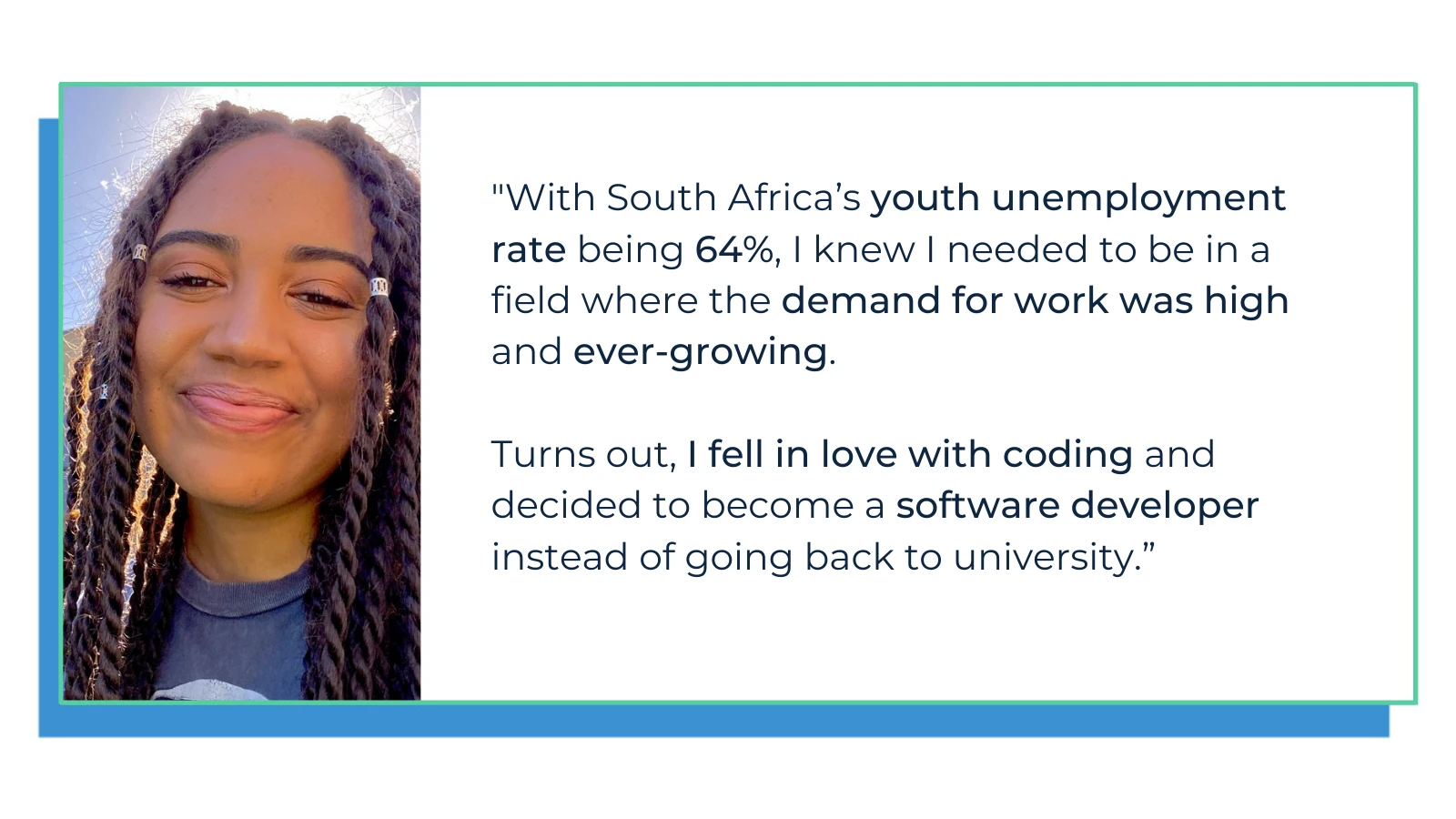
Amy tells us that the Full Stack Web Developer bootcamp really helped her become job-ready, in the sense that she was taught relevant and up-to-date material. She knew that she wanted to land a job that met the average salary on PayScale, once she completed the bootcamp.
Amy was able to meet all of these goals within the span of a month, post-bootcamp. Amy will be starting as a Graduate Software Developer at Mpilo Technologies in February 2022.
Taking flight through the HyperionDev Graduate Program
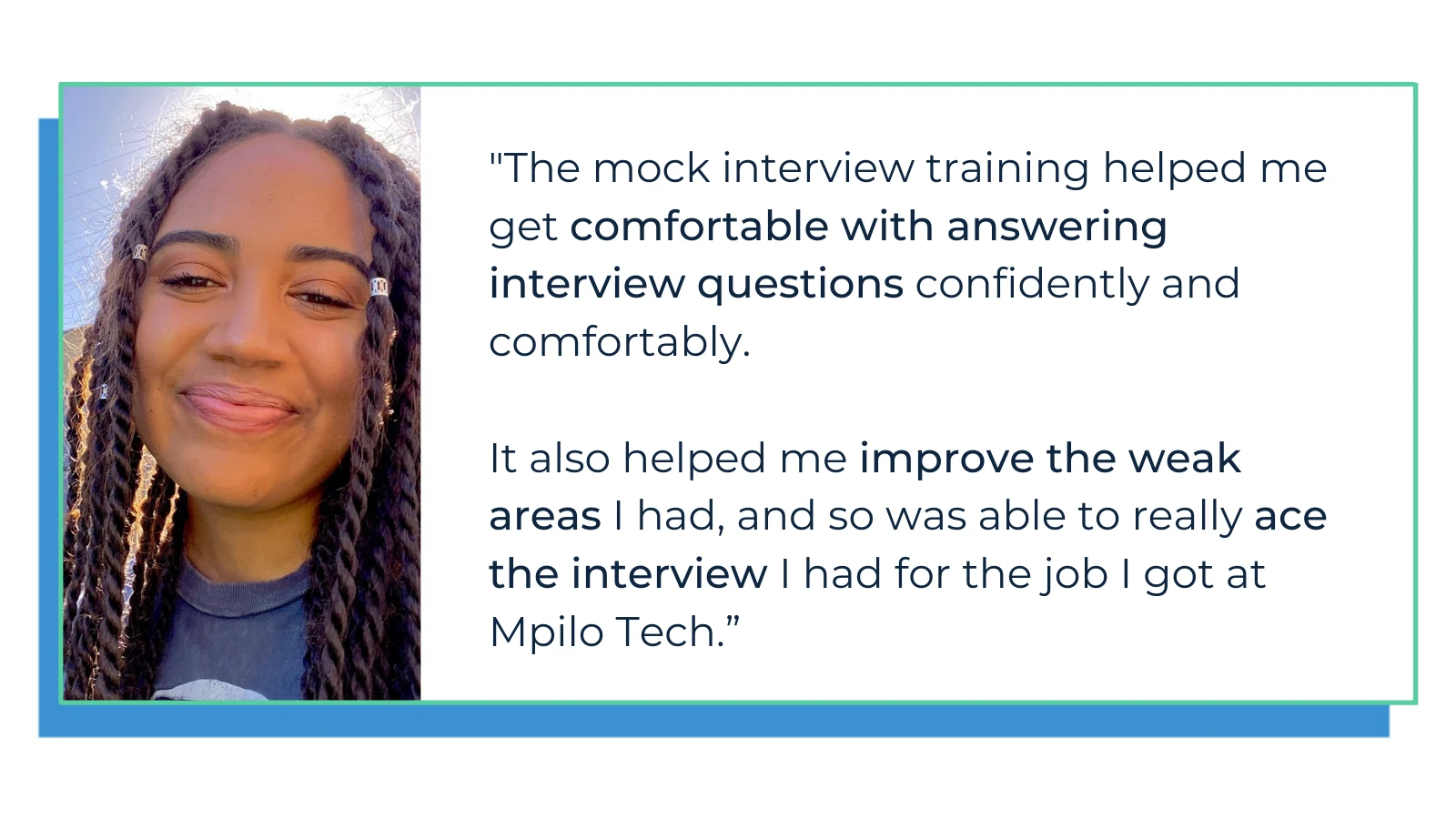
For Amy, she shares that the HyperionDev Graduate Program really helped her to prepare for her first tech job. She says:
“I believe the post-bootcamp support that HyperionDev offers is unmatched. Because of my really good LinkedIn profile, I was able to attract the attention of multiple CEOs and recruiters who then reached out to me to either set up an interview or to have me send through my CV. These CEOs and recruiters were from Cape Town, Johannesburg, and even Singapore.“
Looking back on her HyperionDev bootcamp journey, Amy is incredibly proud of everything she’s been able to achieve.
“I naturally have a deep love for knowledge, so when I was able to successfully figure out a tricky task requirement I felt very fulfilled and optimistic. Being able to apply what I learnt in a specific task was a very fulfilling feeling. It’s also always very fun for me to see how an idea can get executed into the browser and become a working application that people can use.”
Unlocking the power of code
Amy feels excited to work alongside individuals who also have a passion for software and web development. The tech industry is ever-growing and changing, and Amy looks forward to being a part of it to hopefully inspire other young South African girls to be part of this exciting and in-demand industry.
“I think code gives individuals the extraordinary ability to create what doesn’t exist. Look at Facebook for example. That was simply an idea, but code is what gave that idea functionality. And now, we live in a world that quite literally revolves around the code people have built. Instagram, TikTok, Youtube, Twitter, LinkedIn, Google, robots, TV’s, smartphones , smartwatches (and the list goes on) have all been built through code.
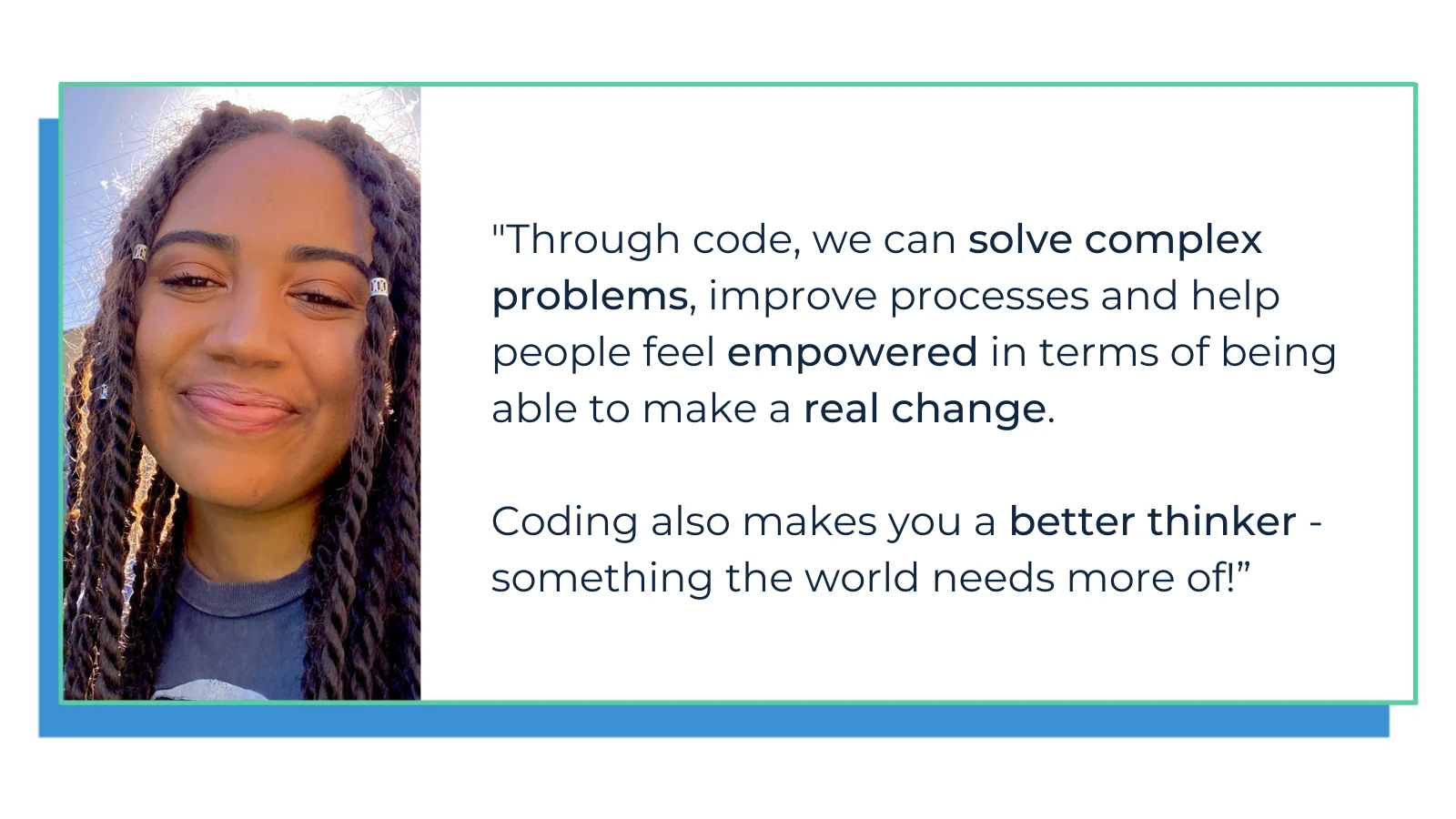
Amy hopes to inspire other individuals, especially young females in joining the tech industry. She explains that she likes to take things one step at a time. Within the next year, she’d like to be a prominent voice and face for aspiring young developers.
“Learning how to code has allowed me to find a new medium through which I can express myself creatively. Learning how to code and becoming a developer, has greatly improved my quality and standard of living. I am now able to help my younger brother achieve his own personal goal of starting his own business, by creating his website for him. It feels good to help the people I love, achieve their own dreams!”
Discover your own potential
Have you been thinking about learning to code, or following your passion for technology into a new career, just like Amy did? Industry-aligned coding bootcamps are the best way to become a job-ready developer in months rather than years – with an added layer of career development and job-search support.
Enrol now to join one of our online and on-site coding bootcamps, which will teach all the hands-on developer skills you need to do real developer work.

Career Advice
How South Africans Can Seize Job Opportunities in Tech
SA's tech sector is becoming an important contributor to our GDP, and now is the time for locals to take advantage the job opportunities.
The South African tech ecosystem is thriving. This is reflected in the latest African Tech Ecosystems of the Future 2021/22 report by fDi, which ranked South Africa highly when it comes to recognising tech innovation and having an established digital start-up ecosystem.
The tech industry holds huge potential for SA
Caissa Veeran, head of partnerships at HyperionDev, Southern Africa’s leading provider of tech education, says that South Africa has one of the largest ICT markets in Africa showing extraordinary technological leadership in mobile and security software fields, as well as the online banking services environment.
“Several international corporates operate subsidiaries in South Africa boasting the likes of IBM, Microsoft, and Intel. This is because the country is the regional hub and supply base for neighbouring countries.”
“Although our tech sector is developing, it’s becoming an increasingly important contributor to South Africa’s GDP, and now is the time for locals to take advantage of it when it comes to job opportunities,” she says. “Tech companies rely strongly on skilled resources in order to grow their businesses to adapt to new technologies that are emerging, however the supply is not meeting the demand as the current skills being developed are not suitable.”
Veeran says that this can be addressed by preparing for today and tomorrow through skills development programs that cater for current and emerging technologies whilst being accessible and affordable. “The supply needs to meet the demand as change is happening fast.”
This has been recognised by the government which has embarked on extensive skills development programs aimed at training one million young people by 2030, in robotics, artificial intelligence, coding, cloud computing, networking.
Upskilling South Africa is everyone’s responsibility
South Africa’s unemployment rate ranks among the highest in the world, says Veeran. “What is especially concerning is how many young South Africans are unemployed. According to Stats SA, the unemployment rate for those aged 15 to 34 years is a staggering 52%, meaning one in every two young people in the country don’t have a job.”
Although the tech industry holds job opportunities, Veeran explains that there are various challenges South Africa is faced with, such as the current lack of access to technology, connectivity, education, and the high cost of data, all of which have severely restricted the number of young people equipped to enter the tech industry, particularly in rural areas.”
To mitigate this there’s a lot of work to do at grassroot level to provide South African youth with access to good quality education that is accessible and is affordable, she adds. “This is something that needs to be addressed by organisations, schools and universities who need to increasingly work together to improve access and the quality of education, update the current curriculum and highlight the dynamics and the ranges of careers in the technology world.”
Veeran believes that companies also have a role to play when it comes to addressing job creation and specialised skills development. “All the efforts that go into basic skills development is wasted if there are no entry level jobs available for graduates to earn experience in these fields. Employers also need to focus on a continuous data rescaling and upskilling for existing employees to keep up with cybersecurity, AI programming and data science, for example.”
EdTech is paving the way
HyperionDev has released its 2021 Tech Graduate Futures Report which revealed that more than half its students only have a higher diploma or high school education. “Our focus and mission are on the democratisation of education and providing access to all. This result is proof that anyone can graduate from our coding bootcamps with a job-ready level of coding expertise, regardless of their educational background, or where they come from,” says Veeran.
Subsequently, she points out that almost 80% of graduates found a new job within six months of the bootcamp with the largest proportion becoming professional software engineers and full-stack developers. “However, it’s important to note that only 19.6% of graduates came from an IT-related field meaning that anyone can take up a career in tech if they wish.”
“Our graduates also increased their salary by 23%, with 55% of graduates completing a bootcamp whilst working a full-time job,” she adds.
The reality is that 85 million jobs may be displaced by a shift in the division of labour between humans and machines by 2025, whilst 97 million new ones may emerge, that are more adapted to the new division of labour between humans, machines, algorithms. 2025 is just three years away. The future is knocking at our doors,” she says.
“Considering the opportunities that are currently available in the tech space in the country, the time is now for South Africans to be upskilled and armed with the tools to participate in the jobs of today and tomorrow,” Veeran concludes.
Do you want to learn more about the HyperionDev coding bootcamps? Chat to one of our Admissions Consultants here.

Student Success Stories
Student Success Story: Mark – From Musician to Software Engineer
Mark saw the music industry take a really big knock. Mark has always been interested in coding and wanted to learn more about it.
When the pandemic hit, Mark saw an opportunity. He managed to find a silver lining in the difficult times we all faced and used the time to explore a different career path. As a full-time musician and mixing engineer, Mark saw the music industry take a really big knock. Mark has always been interested in coding and wanted to learn more about it. He also recognised it as an opportunity to learn new, relevant skills and see where it would take him.
Getting started with a HyperionDev Bootcamp
Doing the Full Stack Web Developer Bootcamp part-time, Mark had sufficient time to do both the work required in the bootcamp as well as other responsibilities that he had during that period. He feels the time allocated to the bootcamp was easy to manage with other responsibilities.
“The course did exactly what it described and that was to accelerate me into a position where I can start to apply and enter the tech industry. I believe that I gained a very solid foundation to enter the tech industry as an intern/junior developer.”
Mark feels that his HyperionDev coding bootcamp really prepared him with work ready skills, specifically through the expert code review.
“The code reviewing process was great, because it showed me alternative ways of solving programming challenges. It was very supportive, because I knew I was on the right (or wrong) track. The code review really took my coding to a new level. It prepared me for the working world as it’s the same process that happens in the industry.”
Making the career move
After completing his bootcamp, Mark was eager to get started with his first job in the tech space. Mark worked with HyperionDev’s Career Services team to improve his CV, Linkedin profile and digital portfolio.
“I expected the interview process to be much more stressful, but the process was very well structured. The HyperionDev Graduate Program really helped me a lot to prepare myself to find a job. It is well worth it to stick with the program.”
Mark currently works as an Associate Software Engineer at Mohara. His responsibilities include mostly front-end work such as building user interfaces and adding functionality. He tells us that he’s lucky to be working on projects that mostly use the skills that he learned and developed in the course.
“I am really enjoying learning about the company structure and all the different roles within the company and how they all tie together. Regarding development, I’ve learned about new libraries and seen new ways to approach tasks, some of it still a bit above my expertise which has been an amazing learning experience.”
This is only the beginning
Mark is motivated to learn as much as possible and would like to specialise in time, explaining that he would love to be able to branch out into different roles in the long run such as design.
Mark’s hopes and goals in the tech industry are to enter a senior role as a designer or project manager. He recommends doing research about the industry and talking to people.
“I can start to really plan my future and structure goals professionally because there is a whole new world that has opened up which I am very excited to explore.”
Mark believes that tech is becoming more integrated in the world as time passes and that smart and efficient tech solutions can have a variety of positive impacts on the world.His advice for those considering making the change? Just do it!
“Do research about the industry and talk to people. I think the biggest thing I realised is that it really is an industry with its own rules and it can be very accommodating to so many people. Once you know a little bit more of what to expect, try to visualise yourself and the skills that you have in that role and focus on how to use that to your advantage.”
Why not start your own journey?
Have you been thinking about learning to code, or following your passion for technology into a new career, just like Mark did? Industry-aligned coding bootcamps are the best way to become a job-ready developer in months rather than years – with an added layer of career development and job-search support.
Enrol now to join one of our online and on-site coding bootcamps, which will teach all the hands-on developer skills you need to do real developer work.
Career Advice
Online vs on-site coding bootcamps: which one is best for you?
If you’re keen to enter the lucrative field of tech this year, you’ll need to upskill. We compare online vs on-site coding bootcamps.
You’ve decided this is the year to enter the tech industry. Of course, that means you need to upskill, but what is the best way to go about achieving this career goal? Online vs on-site coding bootcamps: which one is best for you? Here are some factors worth considering.
What can you expect: online vs on-site coding bootcamps?
As expected, online coding bootcamps are longer and less expensive than their in-person equivalents, according to Course Report. In the US, the average in-person tuition fee is $11,900, whereas the average online bootcamp is $11,100. As far as duration goes, coding bootcamps range from 4 to 104 weeks, but, on average, you’re looking at 14,3 weeks for an on-site coding bootcamp compared to 15,4 weeks for the online version.
Consider your learning style
Are you someone who loses motivation quickly? Do you prefer working alone or with others? These are some of the factors you need to consider when choosing between online vs in-person bootcamps.
If you like working alone and are organized and very self-motivated, an online course could work well for you, states an article in Medium. With a HyperionDev online bootcamp, however, the good news is that you won’t be left completely alone. You’ll be assigned your own personal mentor who will guide you through learning best practice coding by giving you feedback and helping you out when you get stuck. Though an online bootcamp will require a degree of internal motivation, you are able to progress at your own pace.
Alternatively, if you lose interest quickly and you prefer working in a team or a classroom environment with like-minded individuals, then an in-person course could be the right option for you. You’ll progress at the group’s pace, but you will have more face-to-face support. It’s also likely that an in-person course is more structured, with regularly scheduled lectures and classes.
Here is a breakdown of what your days on campus would look like:
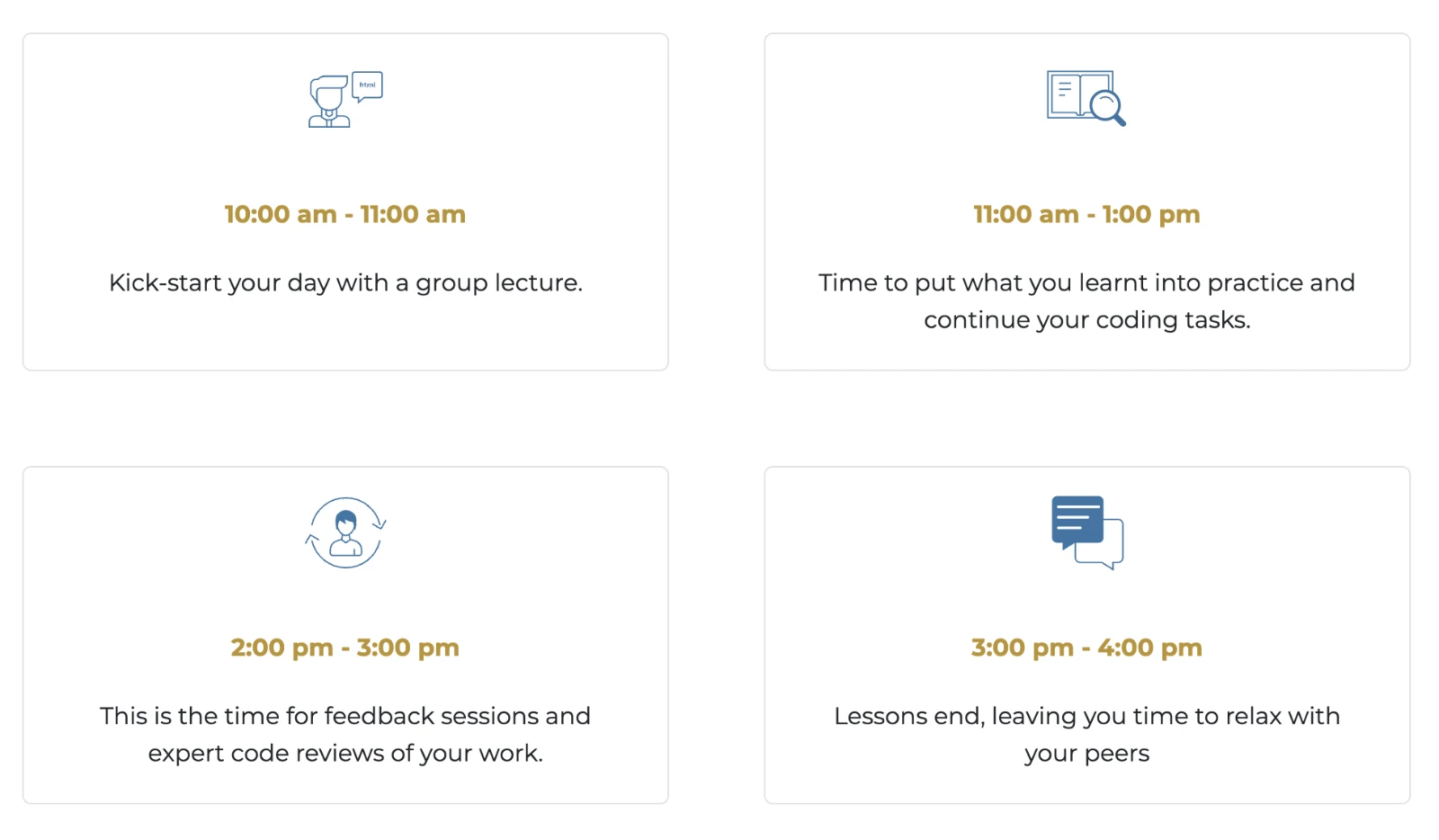
Online coding bootcamps tend to be more flexible and part-time (in-person coding bootcamps are likely to be full-time). With an online coding bootcamp you get to fit in your course work around your other obligations. This means that you can carry on working and earning money while studying. You can schedule your studying and calls with your personal mentor for evenings or weekends. Most online coding bootcamps require 5-30 hours per week. In addition, your risk is much lower and once you’ve gained the skills, you can start applying for other jobs while still being employed.
Here’s a summary of online vs on-site coding bootcamps:
Online Bootcamp:
- Own pace and location
- Less social interaction
- Good self-discipline and self-motivation
- Greater flexibility
- Experience working on your own – great for future programming projects
- Lower cost
- You’re more on your own when stuck, unless you have your own personal mentor
On-site Bootcamp:
- Interactions with other students and the instructor
- Classmates can motivate and encourage you
- Greater structure
- Experience working on a team – this is useful for your future coding projects
- Higher cost
- Limited by location – you can’t do it anywhere in the world
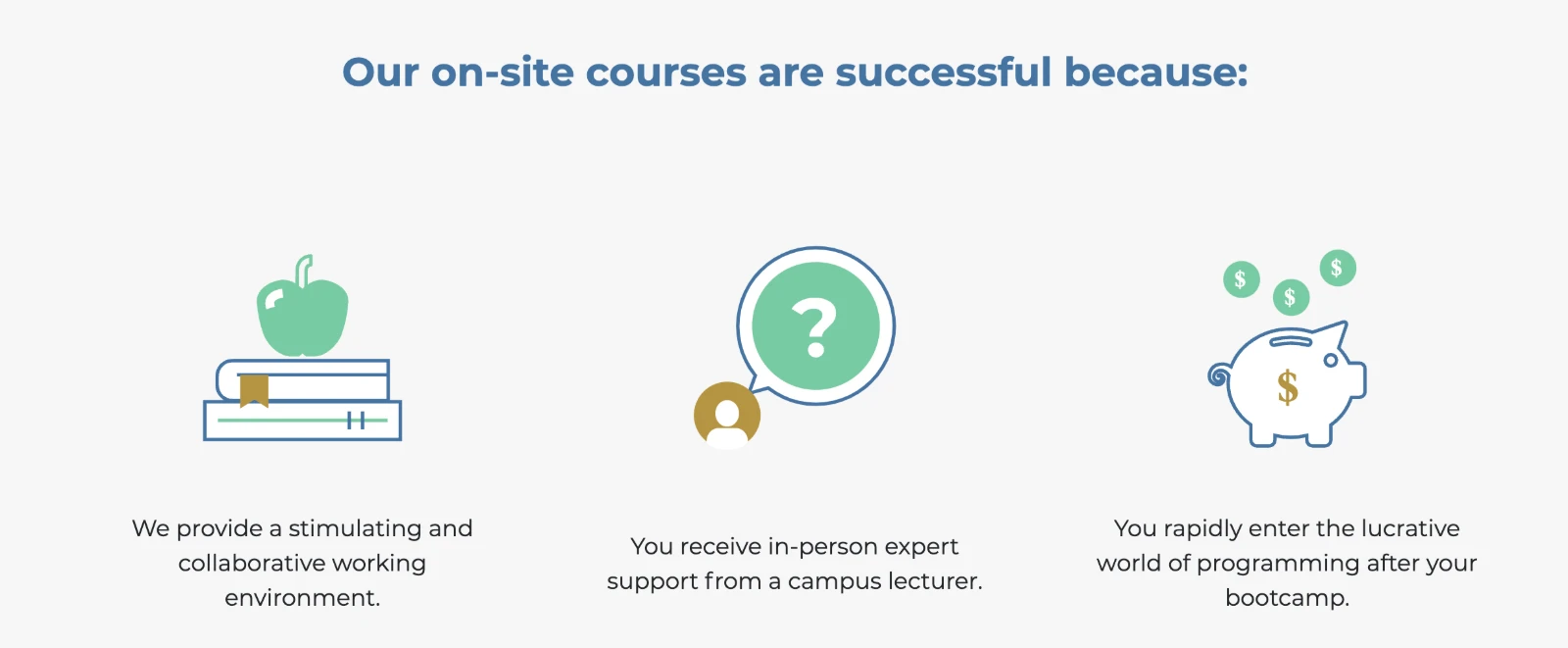
Whether you choose a HyperionDev online bootcamp or an on-site bootcamp, you will still receive the incredible benefits of our industry-standard content, expert code review and access to the HyperionDev Graduate Program.
If you’re keen to upgrade to a tech career this year, consider carefully which of these options best suits both your learning style and your resources. At HyperionDev you can enrol on the following coding bootcamps: Full Stack Web Development, Data Science or Software Engineering.

Career Advice
What’s Next After Matric? Explore Your Career
It can be hard to decide exactly what to do after Matric. There’s lots of contradicting advice, so here's a breakdown.
Finishing Matric isn’t easy – and it’s not just the exams we’re talking about. There’s huge pressure on matriculating students to know what they want to be, and to have it all figured out. If you’re stuck and wondering what to do after Matric, you should know that there are many options for you, even in these uncertain times. In this blog, we take a look at all the things you can do after Matric, and give you advice on their pros and cons.
Taking the University Route
This is probably the most common answer you’ll hear if you’re wondering what to do after Matric. It’s easy to see why so many people advise it: on paper, universities offer a formal, in-depth education, where you can study for your career specialisation and graduate with a recognised degree from a reputable university.
The sad truth is that university remains out of reach for thousands of students.
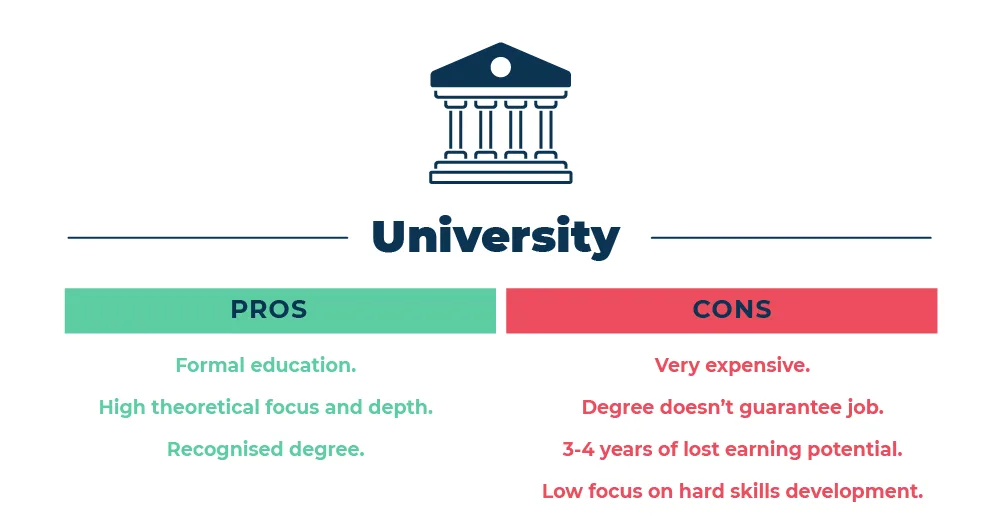
Many South African youth are simply unable to afford a university education. According to Statistics SA, 51% of youth aged 18–24 claimed that they did not have the financial means to pay for their tuition. This is a problem, because every year tuition fees continue to rise by up to 25%; in South Africa, the cost of going to university has skyrocketed, with an undergraduate degree costing on average between R30,000 and R70,000 per year.
Many South African youth are simply unable to afford a university education. According to Statistics SA, 51% of youth aged 18–24 claimed that they did not have the financial means to pay for their tuition. This is a problem, because every year tuition fees continue to rise by up to 25%; in South Africa, the cost of going to university has skyrocketed, with an undergraduate degree costing on average between R30,000 and R70,000 per year.
All of this is happening as COVID-19 and the global shutdown forced universities to do online courses and restrict in-person learning. Ask yourself, would you pay R70,000 for just Zoom calls?
Then there are two other issues. Firstly, while you’re studying, your career development is on pause. So when you graduate, chances are you’ll apply for a job without having the two or three years’ experience the vacancy requires. Secondly, this time is lost earning potential: by the time you graduate after 4 years, you’d be over R700,000 in total income behind someone who started working after a one-year study program, like a bootcamp – and that’s without mentioning the debt a lot of students accumulate during their studies.
Besides, there are plenty of things that make a bootcamp better than university.
Gap it on a Gap Year!
A gap year is a lot of fun. It’s a good opportunity to push the reset button and find out what kind of person you are outside of high school cliques and small town boundaries.
If you have the money to take a whole year off, that is.
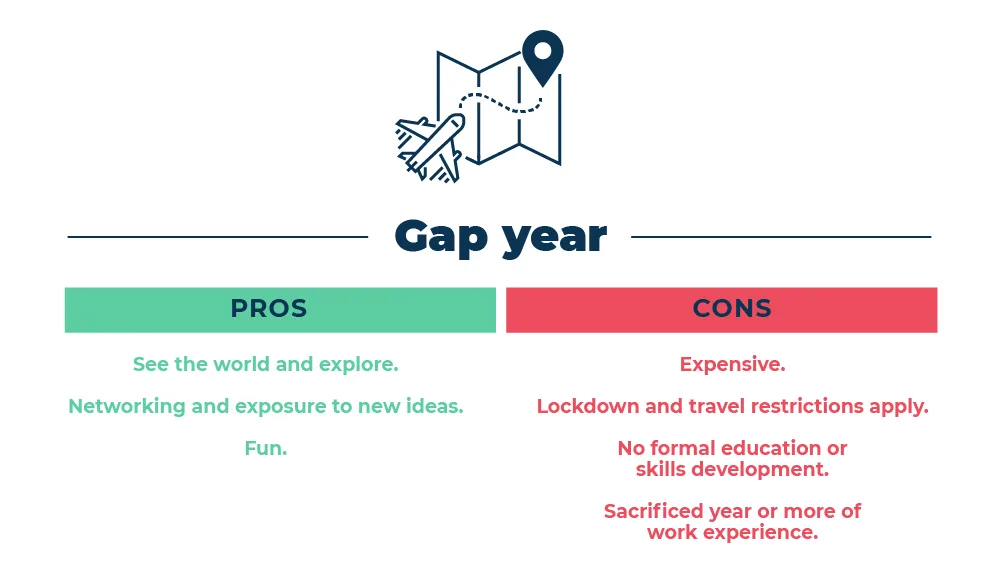
Gap years fall into the same trap as universities: they’re fun and tempting, but they carry significant financial costs – and that’s without considering the outright bans and uncertainty that COVID-19 and global travel lockdowns have introduced. Then there’s the painful reality that gap years aren’t what you see on Instagram. Often your options for fun stuff like sightseeing, snorkeling, and travelling are limited or impossible because of the expense. Then, if you do take work to make some money to do fun stuff, the work is entry level and the pay is shockingly low.
There’s also the fact that once your gap year is over you won’t automatically have transferable skills or qualifications that you can use to find a job. If you are thinking of a gap year, you should also be thinking about what short skills development programs – like bootcamps – you can do to ensure that “finding yourself” isn’t a sentence that ends with “in a very difficult career position”.
Thinking about College?
The trades are a great industry to end up in, if you’re thinking about what to do after Matric. They offer steady work and reasonable pay, and let you develop skills that you can use anywhere in the world.
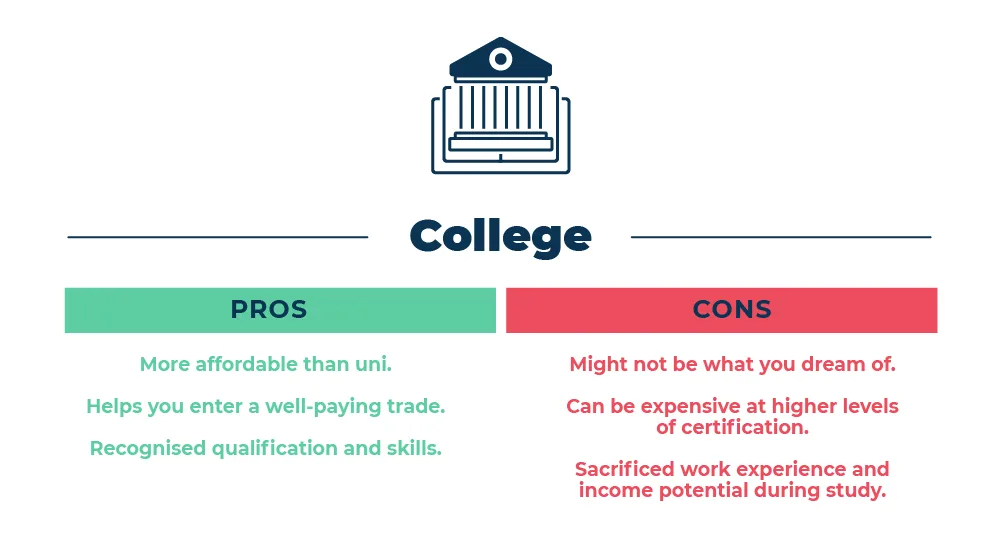
Colleges and technikons (and similar technical schools) teach you hands-on skills in these fields, and also give you an industry-recognised qualification when you graduate. They’re also reasonably priced and follow a practical structure, so that you don’t get lost in endless impractical theory. Best of all, the technical skills you learn (such as electrical engineering or plumbing) usually feature on critical and scarce skills lists, meaning you have options and demand for your skills wherever you go.
However, these aren’t the most glamourous jobs: the trades can involve hard or dangerous work, and while the supply of work is consistent, it’s also a pressured environment that features a lot of travel and on-site work.
The realities of entering the world of work
Making your own money right away is always at the top of the list when thinking about what to do after Matric. It brings you more freedom, choice, and helps you to start building your career with valuable work experience.
With the number of graduates and degrees in the jobs market these days, hiring managers are on the lookout for people with a proven track record of professional success. Companies realise this too: it’s easier to hire someone who has the experience than to take a risk on a fresh graduate who might need extra training.
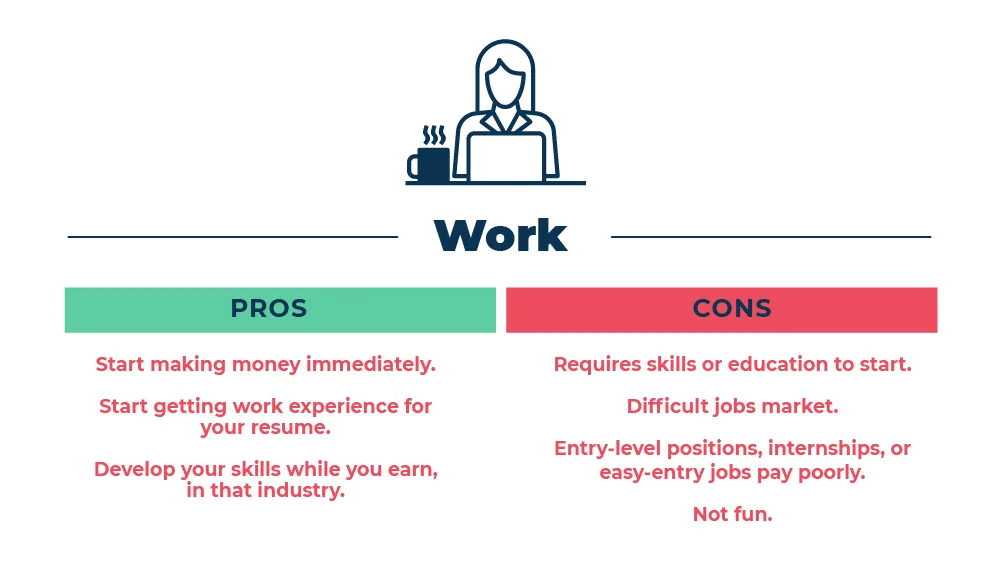
However, there are several problems with the advice of “just start working”.
Many jobs require some sort of certification for you to be eligible, or at least some proof that you have the relevant qualifications and skills to do the work.
Plus, if you find work that doesn’t have a lot of eligibility clauses and requirements for certificates or degrees, chances are you’ll be competing for those jobs with thousands of other applicants – and the jobs market is incredibly tough at the moment for these kinds of jobs. Approximately 8.2 million (40.1%) of South Africa’s 20.4 million young people aged 15 to 34 are not in employment, education or training of any sort, according to the latest figures released by Statistics SA in the Quarterly Labour Force Survey (QLFS), and the official unemployment rate increased (from its 11-year peak) by 1.0 percentage point to 30.1% in the first quarter of 2020 compared to the fourth quarter of 2019.
If you’re looking to get a job after school, the reality is you’ll need the skills – or education – to stand out from the crowd.
Why Not Consider a Bootcamp?
A coding bootcamp offers it all: you can develop in-demand, transferable tech skills; you can fit education into an active career or travelling itinerary; and you can build a demonstrable portfolio of practical work experience without needing to sacrifice years of time and lost earning potential, or having to pay hundreds of thousands of rand in tuition.
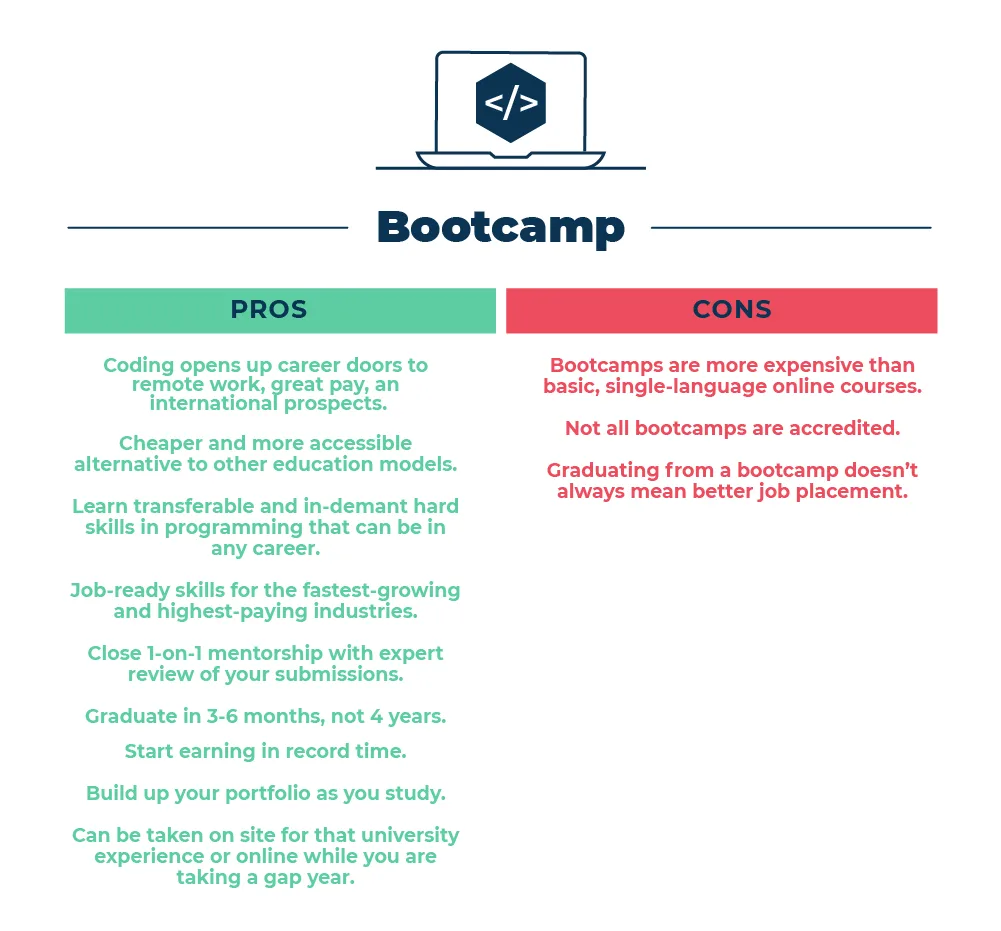
The most valuable thing about a coding bootcamp is that you’ll learn the technical skills that thousands of industries are fighting over, as they move their businesses remote, their stores online, and make their operations digital. Knowing how to code and work with technology is key to a career that is both worldproof and futureproof: so you’ll be able to work whenever, wherever, and no matter what global events break out.
Are you uncertain about what to do after Matric? Why not try our coding bootcamps? Our bootcamps are designed for you to succeed, with full dedicated mentorship, expert code review, and full career development support. Best of all, you can start learning right now, without even needing your matric or any previous coding experience. Get in touch with an Admissions Consultant to learn how we’ll help you build your future with essential tech skills.
If you want to start learning the very basics of coding, totally free of charge, then click here to apply now, where you can learn the essentials in data science, full stack web development, or software engineering.
Student Success Stories
Student success story: Luke Glendining – From Support Consultant to Software Engineer
Luke Glendining was a Support Consultant wanting to make a career change. Here's how he became a Software Engineer.
Luke Glendining was working as a Support Consultant, but had always wanted to develop future-proof, in-demand skills in order to secure his future in the tech industry. He decided to enrol in an online part-time Full Stack Web Development Bootcamp with HyperionDev, allowing him to make a massive move into a career as a Software Engineer. In our latest Student Success Story, Luke tells us about how he fell in love with coding, and where this journey has taken him so far.
Discovering a love for code
I have always been extremely passionate about technology and code. I love being able to have a creative idea that can be put into working systems and can change peoples lives for the better, purely by being able to write and understand code.
For me it was never about the money, it was about following my passion and desire to be a developer so that I can be happy and do exactly what I want to be doing in my life. Knowing this helps to make work feel less like work and more like a hobby that I get paid to do!
My decision to enrol in the Full Stack Web Development bootcamp with HyperionDev was based on the realisation that the career I was in, although it was in the IT industry, was not the career path I wanted to follow. I started coding in the evening after work almost a year prior to enrolling in the course with Hyperion Development. This aimed to fuel my desire for coding and would ensure that I enjoyed it as I wanted to pursue it as a full-time career. Near the end of last year (2020), I decided to enrol in the bootcamp and start out on the journey to changing careers.
My experience with HyperionDev
The HyperionDev coding bootcamp taught me how to take my basic coding skills to the next level. I was able to build challenging and amazing projects that can be used in the real world. This gave me the confidence to continue raising the bar when it came to improving the code I write, writing clean code, refactoring as well as taking on a new challenge to build things that were a few levels up from where I was at the time. This has yielded amazing results in terms of my understanding of how code works and has given me great confidence in my ability to write code and to build complex and useful systems that can have useful applications in real life.
Below is one of the first projects that I took on soon after learning how to code. It is built using HTML5 and CSS3 and is a front-end build only. This build really helped me gain a good grasp and understanding of how to structure HTML elements on a web page as well as how to position and style them using CSS.
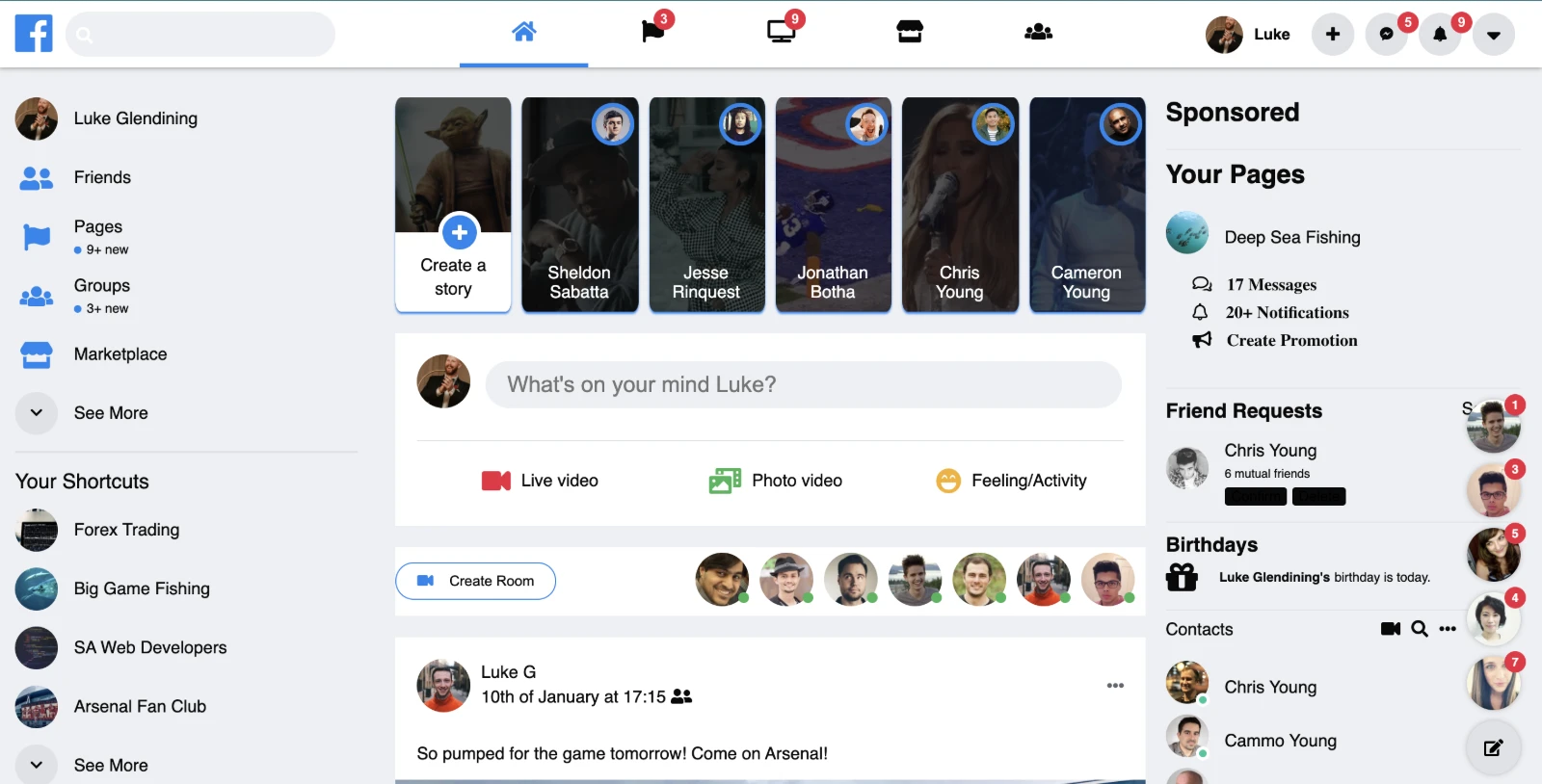
Being exposed to code and websites that were people’s businesses and income, and having to manage those websites availed me to another avenue of IT: being able to write the code and develop the websites that were so useful and beneficial to society such as e-commerce and learning platforms. My passion for code grew the more I was exposed to the code running on the servers I used to work on. This sparked a true passion and desire and I knew that I needed to take the leap of faith, believe in myself, and start out on the journey to changing and bettering my life, which stemmed from self-belief and a strong desire to change careers and become a Software Engineer.
Entering the world of work
I currently work at Map2Tech as a Software Engineer where I write clean code that is scalable, easy to read and can be understood by other developers. We build complex systems that require a high level of coding knowledge and an in-depth understanding of how code works in order to be able to meet the project requirements. The skills that I learnt in the bootcamp helped me tremendously as the tasks were practical and gave me hands-on experience with building systems that allowed me to hit the ground running when entering the working world of Software Engineering.
The mock interview training I received in the HyperionDev Graduate Program was excellent and it really helped me gain experience with regards to what to expect in real interviews. The code reviewing process was very supportive, because I knew I was on the right (or wrong) track.
The most challenging part of the bootcamp is the learning curve and how quickly you need to learn and understand topics in order to be able to implement them when creating real-world applications. I overcame it by not giving up when I struggled with a topic and to tenaciously work through the problem systematically and with a high level of focus until I was able to move forward and solve the issue.
My advice for future coders
The advice I’d give to people thinking about learning to code is this: code every day and learn something new every day. Be curious about why things work the way they do and try to understand the system and what is working under the hood. Don’t just focus on the syntax or learning a new and popular framework, try to gain a deep understanding of how everything works together. Continue reading about best coding practices as well as how to write clean code and how to refactor your code. Another very important part of Software Engineering is version control, learn Git and understand how it works and become proficient with using it.
Good luck!
Start your tech journey with HyperionDev
Have you been thinking about learning to code, or following your passion for technology into a new career, just like Luke did? Industry-aligned coding bootcamps are the best way to become a job-ready developer in months rather than years – with an added layer of career development and job-search support.
Enrol now to join one of our online and on-site coding bootcamps, which will teach all the hands-on developer skills you need to do real developer work.

Career Advice
10 Everyday IoT Devices Powered by Code
Here are ten unexpected and useful examples of IoT-enabled everyday objects that are making our lives more interesting.
We all too often overlook the masterpieces code creates that serve us in ways unthinkable by those who lived 100 years before us. The “Internet of Things” is seamlessly woven into our everyday lives, with IoT-enabled products in every corner of the modern home. Here are a few unexpected and useful ways that everyday objects use programming and connectivity to make our lives easier (or at least a lot more interesting).
1. Coffee Makers
A smart coffee machine that you can programme from your smartphone is a real dream come true on those hard-to-wake-up mornings. Appliances like Smarter Coffee can be controlled via your mobile device, to give you a caffeine boost on demand. You can start brewing your next cup based on time or geo-location, schedule several cups in a row to wake up your whole household, and even select your preferred strength. What a smart way to start the morning!

2. Athletic Wear
Wearable tech now plays a big role in the way we monitor our daily health and fitness levels. IoT-enabled activewear is becoming more commonplace, with smart clothing items being programmed to help you achieve your fitness goals. Some notable examples include running socks with pressure sensors to monitor your running style, workout gear that monitors your heart rate, breathing and movement, and even a “smart sports bra” that uses AI to track your workout stats and conditions. In this way, code serves some of the most natural aspects of human need. It helps to make progress measurable and keeps us in the know of what our bodies are up to.
3. Cooking Appliances
Smart kitchen devices are here to help you get cooking down to a fine art. These IoT-enabled cooking gadgets are ideal for time-sensitive or temperature-reliant tasks. Think connected crock pots, fryers, sous vide cookers and even digital, Bluetooth-enabled meat thermometers. Ever wanted a personal chef? Well no need to hire anyone, code is doing it for you.
4. Light Bulbs
That’s right, even the humble light bulb can be programmed to run code. The Philips Hue LED light bulb is one great example of this; the bulbs feature a bridge that allows you to connect them to your mobile device, and then customise the lighting in your home remotely. More and more companies are focusing on the idea of “smart lighting”, with applications ranging from security and convenience, to ambience and mood lighting with customisable colour and brightness settings. It’s fascinating that code can set a mood that aligns with where we’re at emotionally or simply conserve energy. No more hunting for that light switch in the dark.

5. Baby Accessories
Young, tech-savvy parents are choosing coded baby wear to ensure their little ones’ safety. Smart onesies, socks and hats now come with built-in sensors to track a baby’s heart rate, temperature and breathing. Programmable changing pads monitor a baby’s weight and relay collected information about growth and development to the parents. Digital pacifiers create a time-stamped log of a baby’s temperature, which helps parents to monitor and treat common illnesses. All in all, IoT-enabled baby care helps to relieve some of the anxiety that comes with looking after a tiny human.
6. Teddy Bears
Your child’s cuddly night-time protector just got a whole lot smarter, with biosensors that help to monitor activity levels, heart rate, temperature, posture and even oxygen saturation. Teddies and other soft toys can now be programmed to keep track of a growing toddler’s biometric data. This allows mom and dad to stay in the know between visits to the doctor. There’s much to be said about the intuitive, omniscient nature of the technology code is able to create.

7. Water Bottles
Staying hydrated is important, and easy to lose track of, especially when you’re busy. Water bottles like H2OPal and Hidrate Spark offer a smart solution. I0T-enabled Water bottles that leverage the power of code work with apps on your smartphone, which will notify you about your hydration levels based on your physical activity, the amount of water consumed in a certain period of time, and other key statistics (depending on your choice of bottle). This is great news for your daily wellbeing, whether you’re outdoors being active, or working at your desk for long periods of time.
8. Showers
There’s nothing quite like a refreshing shower to perk you up, and now your bathroom appliances can be programmed to give you a fully customised shower experience. Smart shower systems like U by Moen can be controlled via mobile devices or voice commands. You can easily control temperature, scheduling and timing, to ensure your whole family gets a hot shower in the morning, without wasted water, or a fight for access to the bathroom. We tend to see code as something opposite to what it is to be human. And yet we see that it can be a language of harmony and order that produces a gentler way to live.

9. Family Photos
IoT-enabled photo frames take the concept of a digital photo frame one step further. Forget the hassle of loading photos manually from your laptop – these frames are coded to automatically sync with an app on your phone, which will choose your photographs for you. You can also allow your family and friends to add their own shots to the app. Wi-Fi-enabled digital photo apps like Aura run each photo through a series of algorithms before displaying it, so you don’t have to worry about blurry, low-res shots or inappropriate pics.
10. Ice Cubes
A clever, if somewhat quirky, application that code has made possible in retail, the “Smart Cube” from Martini is a Bluetooth-enabled ice cube that uses liquid sensors to anticipate when bar patrons will need a drink refill, and communicates this to the bar staff in real-time. This nifty gadget is designed to reduce crowds and queues, while improving sales.
It’s amazing to think just how many common objects in our homes, offices and favourite hangout spots can be programmed to run code in unexpected ways. If you want to learn how to create cutting-edge code that allows you to build software and apps like these, visit HyperionDev and discover just how far this innovative industry can take you.
Editors note: this article was originally published in July 2018.

Software Engineering
October 8, 2021
Is code the new cupid?
Dating apps have revolutionised the love game. Discover how code has made this possible and exactly what goes into creating digital chemistry
Once upon a time, in order to find a connection, one would have to perhaps count on a friend introducing them to a mutual friend or kindling a spark at a get-together. This limited past generations to their local dating pool of acquaintances, unlike today where code has opened up much more choice and opportunities to meet new people. Today we look at how code opens up many opportunities to meet like-minded individuals we are genuinely attracted to.
Once upon a time…
In 1965, a Harvard student co-founds Operation Match. It was used by more than a million daters in the 1960s. In the same year, with increased sophistication (100 questions and an IBM 1400 Series computer), New York City’s first computer dating service, Tact, opened. Despite thousands of customers, a co-founder believes computer dating is a fad and leaves the company.
Fast forward to 2004, 40 years later, four Harvard students launched what would become OKCupid. The site allows users to submit questions that others can weight as important or not. OKCupid’s popularity allowed the company to correlate interests to dating actions. In 2012, a little-known startup called Tinder was launched, and an entirely new demographic of people took to online dating.
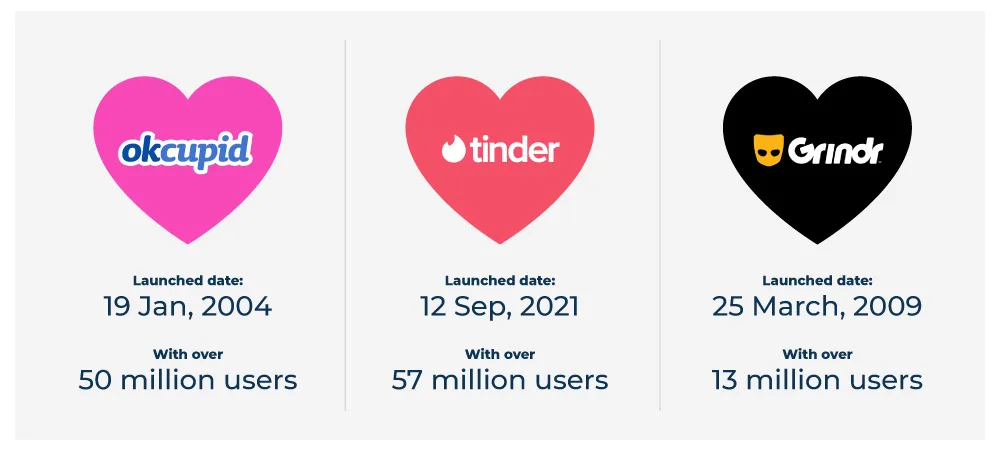
Whatever taboo that remained of internet courtship quickly fell to the wayside when technology-discerning 20-somethings started swiping in 2012. Just as Grindr opened the floodgates for the gay community, Tinder did for single millennials. Since its release, the app has garnered over 50 million swipe-happy users in more than 190 countries.
What the dating app industry looks like today
In the Online Dating segment, the number of users is expected to amount to 489.9 million users by 2025.
According to the Pew Research Center, between 2013 and 2015, online dating usage has tripled among those between the ages of 18 and 24. Dating services also welcome an untapped market, increasing millennial spending power, and young people delaying life milestones, as well as working longer hours. Users are also able to safely screen their potential partners. Tinder assists with this by having users ‘verify’ their images with a selfie needing to be taken that will validate the other photos that are chosen.
Each app has its own competitive advantage or spin on the dating game: With its monthly subscription fee, Match.com attracts people willing to put their money where their mouth is. Tinder pairs potential hookups based on a mere glance and swipe of a photograph, making it simple and user-friendly. Bumble uses a similar format to Tinder, but with a twist: only women can send the first message. The League is an elite dating app focused on accomplished, ambitious young professionals.
When it comes to the most popular apps by audience size, Tinder, Plenty of Fish, Match.com and OkCupid lead the pack. The biggest player in the online dating game, the Match Group, dominates 25% of the market share.
Alluring algorithms
Make no mistake: nothing about the Tinder algorithm is random. You might think that the profiles you are seeing are just a random bunch of people that fit your age and gender preferences and live relatively close. In fact, Tinder wants to match as many couples as possible and designs its algorithm to put certain profiles in front of you. Of course, you’re free to swipe right to your heart’s delight and ignore the people Tinder recommends, but the algorithm penalises you for swiping left too much. So how does Tinder decide whose profiles to show you?
The Tinder algorithm allocates every user a personalised “desirability” score, to represent how much of a catch any particular person is. Users are then sorted into tiers based on their desirability score, and that is, in essence, the algorithm: you get presented with people who are approximately on your level of attractiveness when you swipe.

There may be an element of superficiality to an algorithm like this. Then again, the question is perhaps, are the users seeking something based on looks alone that would call on an algorithm like this? After all, if it’s the human being one is interested in, this algorithm would ultimately make no difference.
The heart and soul of dating technology
So how did code build the dating industry? Many languages are used to make all the magic and romance happen. The technology stack for apps like Tinder includes JavaScript, Python, HTML5 as programming languages, and the AWS Mobile platform to build and test apps. To identify user location, Tinder utilises a smartphone’s GPS or data from the wi-fi network connection.
Apps such as Tinder share personal user data with around 45 other Match Group companies, such as Hinge, OK Cupid, and Plenty of Fish among others. The company shares user data with third parties for purposes such as analytics, advertising and payment processing.
Augmented/virtual reality, artificial intelligence, chatbots, machine learning… How will our kids meet online in the future? And how could this contribute to making a better society? Online dating is set to evolve into an experience closer to what we do on social networks. It will definitely enhance the experience and make it more authentic and closer to a real-life experience. Existing dating apps, based on simple images, are still very static for a generation that swears by video, so the next decade will see apps emerge with more content, more curation, and new ways of presenting this content.
It’s amazing to think that the most authentic human connections can be born from lines of code that seek to serve the true nature of love and the way we romantically relate. If you’d like to be part of the revolution, why not make a date with code? Learn more here.

Software Engineering
October 8, 2021
How code brought food to our fingertips
Our ancestors spent most of their time finding food. Thanks to code, food now finds us. Read more about how #CodeDidThis.
Tech has revolutionised many industries, but when it comes to the food industry, it’s really savoured success. Nowadays, you can get just about any meal, anywhere, at virtually any time.
This, however, wasn’t always the case. For more than a thousand years, there wasn’t so much as take-outs, let alone all the other advancements tech has brought to the table for the food industry (pun deliciously intended). It wasn’t until King Umberto of Naples, Italy demanded to have a pizza pie delivered that the food industry enjoyed its first big idea.
The following year, a Bombay businessman started a lunch delivery service through which he provided lunch to blue-collar workers all over the city. Since then, the food industry developed a hunger for ingenuity. Let’s dig into just how tech has evolved the food industry.
Cooking up a revolution
The day smartphones were able to connect to the internet is the day the food industry truly experienced a digital awakening. At the time, restaurants were still taking care of their own deliveries, but customers would order via an app such as GrubHub or Just Eat.
What came next was more logistical support for restaurants, with apps not only providing the platform but also an intuitive, integrated delivery system. Examples of this type of business include Uber Eats, Spoon Rocket, and Rappido. In this model, restaurants don’t have to develop their own apps or even grow their own delivery sides; the app does it for them. As of 2020, Uber Eats was supporting around 600,000 restaurants. Internationally, the app has 66 million users. Now that’s a mouthful.

Have your code and eat it
The global online food delivery services market is expected to grow from $115.07 billion in 2020 to $126.91 billion in 2021 at a compound annual growth rate of 10.3%. In South Africa alone, there were at least 6,400 active food delivery drivers in 2020.
It’s amazing to think that code is the reason someone is waiting at your door with a steaming hot pizza. Not only that, but the fact that code is used to build apps that can predict what we want and offer all kinds of suggestions.

Powerful algorithms are able to discount prices during off-peak hours in order to increase sales. Lower prices allow lower-income customers to order delivery, when they may have previously been priced out of the market. There are so many other algorithms fine-tuning the value offering coming from the food industry for consumers world over.
How code is redefining the future of food
We are now close to approaching the next stage of development, which is the introduction of ghost restaurants. This idea proposes restaurants that only have kitchens. In other words, they are focused on delivery, rather than on offering up a dining experience. You may be questioning the efficiency of this model, as it’s general knowledge that, in most cases, restaurants earn more when customers consume on the premises. They order drinks and desserts, pay for the service, which sometimes doesn’t happen when you order online. But, focusing your cost on an efficient delivery system can help save real estate costs, staff, insurance, among other factors. Also, the restaurants have more time and resources to bring in new strategies to make their system more efficient.
Food delivery apps are the tip of the iceberg because the food industry is also getting accustomed to grocery delivery apps, restaurant booking apps, meal planner apps, and food by drone delivery. Ultimately, our core needs are being met in more and more dynamic ways, thanks to code. At the end of very long lines of code awaits a fresh meal to be enjoyed. The food industry has also been galvanised by these innovations in the wake of the pandemic, with more efficient ways for food to reach consumers.
Who knows – we may be teleporting food around the globe in the next 10 – 20 years. The possibilities are endless. The power of code is evident and this is your opportunity to possibly be the cause of the next world-changing piece of technology. We at HyperionDev relish in the opportunity to connect you to a world of coding possibilities with coding courses that’ll tantalise your tech tastebuds. Check them out here.

Software Engineering
October 6, 2021
How code took us to the moon
It’s 1969. It’s lift-off. And it’s up to code to help these astronauts cross the galaxy and land on the moon.
Only thousands of lines of code made thousands of kilometers to the moon possible. One small step for man. One giant leap for software. And just by the way, behind that small step for man was, in fact, a woman.
Margaret Hamilton wasn’t exactly supposed to invent the modern concept of software and land men on the moon. After all, it was 1960, unfortunately not a time when women were encouraged to do high-powered technical work. Hamilton, a 24-year-old with an undergrad degree in mathematics, had acquired a job as a programmer at MIT, and the plan was for her to support her husband through his three years at Harvard Law. But the Apollo space program materialised and Hamilton began working on an epic feat of engineering that would help change the future of what was at the time thought to be humanly – and digitally – impossible.
Today, we explore the vital role code played in getting us into space as well as the many other places it could take us in the future.
The birth of code
The original document laying out the engineering requirements for the Apollo mission didn’t so much as mention the word software, MIT aeronautics professor David Mindell writes in his book Digital Apollo. “Software was not included in the schedule, and it was not included in the budget.”
As Hamilton and her colleagues programmed the Apollo spacecraft, they were also hatching what would become a $400 billion industry.
Once the code was solid, it was shipped off to a nearby Raytheon facility where a group of women threaded copper wires through magnetic rings (a wire going through a core was a 1; a wire going around the core was a 0). Forget about RAM or disk drives.
Without code, Neil Armstrong wouldn’t have made it to the moon. And without the software created by Hamilton, Eyles, and the team of MIT engineers, the computer would have been a dud. Software engineering, a concept Hamilton birthed, has found its way from the moon landing to nearly every human endeavor.

Where code is now
The code created for the Apollo mission is now available on Github. The code might be alien to most modern programmers, but features comments that provide a sense of what these pioneers were trying to achieve. The total weight of the whole program is slightly bigger than 2MB. Isn’t it fascinating that such a tiny piece of code could take us so far?

Programming languages like C and Java are now primarily used to operate the rovers exploring Mars. Space missions have become more ambitious and so has the code used to make it all possible. It’s hard to imagine what may be achievable in the decades to come. What will code look like in the future? Where could we go? What could we achieve? The possibilities are out of this world.
The future of code
The most important trend in programming for the foreseeable future will be using machine learning and artificial intelligence to automate much of coding. AI and machine-based learning can automate coding and help programmers write faster and better code. When combined with IDEs – software used by programmers when they are writing code in a specific platform, such as Visual Studio etc – it can save companies a lot of time and money.
Programmers will still need to learn new languages over the next decade. But watch this space because change is the only constant in the coding game. Doesn’t a career in coding seem quite attractive now?
Thanks to one space mission, the sky’s the limit for programmers, now and into the future. As coding becomes the most in-demand skill to have, the pace of human progress is increasing exponentially. Why not be part of the revolution? If you’re interested in a career in coding, your lift-off can happen right here.
News & Announcements
September 30, 2021
Why Upskilling Is Key to Future-Proofing Your Business
Forward thinking companies should be upskilling their employees in order to remain competitive, urges HyperionDev’s Caissa Veeran.
It is expected that by 2025, 85 million jobs globally may be displaced as a result of technology. However, as we continue to adopt technology into our work lives, 97 million new roles have been predicted to emerge. With this in mind, forward thinking companies should upskill their employees in order for their businesses to remain competitive, urges HyperionDev’s Caissa Veeran.
Currently, South Africa is faced with a skills gap. This is reflected in a 2020/21 survey released by XpatWeb that shows the demand for ICT skills remains steady, with 13% of respondents indicating that they struggle to source skilled professionals to drive their operational demand to transition into the digital economy.
The survey revealed that the most sought-after jobs include IT Application Developers, Data Analysts, Data Scientists, Software Developers, Software Engineers, IT Program Managers, and Network Architects.
With this in mind, upskilling on-the-job is a sustainable option to bridge this skills gap through ongoing training and development programs, especially as many long-established and experienced employees are running the risk of becoming obsolete.
It is also often simpler to address the skills gap by training the existing workforce rather than recruiting a new candidate. However, after the economic fallout from last year’s COVID-19 pandemic, many employers may be tempted to shelve employee upskilling plans for the future. It is important to note that although upskilling can seem costly, it provides a significantly higher return on investment.
Learning code is a win for all
The best place to start when it comes to future-proofing a company is to upskill employees with coding skills. Even providing non-technical employees with the chance to learn code gives them the opportunity to advance in their current roles or uncover new areas they may have an interest in or aptitude for. This makes it more likely they’ll stay with the company as their professional goals evolve.
In addition, it assists with arming employees with skills such as problem solving. Although many think that this is a soft skill, it’s one that’s best practiced through learning to code. That’s because part of learning to code is learning how to think like a programmer and defining a problem, breaking it down into smaller pieces, and exploring various possible solutions.
By understanding what developers, engineers, and data scientists do, non-technical roles will be in a better position to work with them to co-create solutions or products, ultimately benefiting the business
Equipping your employees with coding skills prepares them for the future of work and gives leadership a greater opportunity to fill future talent gaps internally. It’s a win-win.
Coding is everywhere
All sectors of the economy need programmers. As the healthcare industry leverages data to improve, it will result in more efficient operations and better patient outcomes. Agriculture and the blossoming agri-tech sector need talented coders to help solve the complexities of food supply. In finance, programming is useful in setting up electronic trading systems, pricing derivatives and creating tools to analyse data. Finance professionals rely on programming languages like Python for risk management, pricing, and trade management programs
As marketing continues to expand into the digital realm, employers look for candidates with programming skills. Product managers, in particular, often blend marketing with technical skills as they design and create new products.
But nowhere is coding more needed than in artificial intelligence (AI), as man and machine join forces to work in simpler, quicker and more cost-effective ways. As the digital landscape rapidly changes, the focus of today’s world is around AI. The need for AI engineers exists in all fields, as artificial intelligence is one of the fastest-growing areas for high-tech professionals.
Upskilling retains and retrains staff
In order to create a robust upskilling program, employers need to devise a strategic plan. This can be done by building a long-term view of the company’s skills requirements, mapping out the current workforce’s strengths and gaps, as well as identifying the skills in which employees could be trained. The goal is to be proactive and stay ahead of future demands to get an edge over competitors.
Learning and development is the critical link in employee retention. It signals that the employer values its people and is invested in their success. An employer who doesn’t focus on upskilling is certainly going to lose out.
No matter the industry, job roles and the skills required to do them are rapidly being redefined. Additionally, technology is advancing so fast that linear career paths are a thing of the past, with employees of today constantly trying new roles and learning new skills. As such, companies should be looking for ways to future-proof their staff in these uncertain times and make their business less vulnerable to external shocks.
Caissa Veeran is the head of partnerships at HyperionDev, which provides online and one-on-one coding bootcamps that accelerate students’ entry into a fulfilling tech career. She is passionate about being part of evolving the educational landscape, not only through delivering knowledge, but more importantly by assisting students to develop skills that keep them future-fit and improve their employability.

Career Advice
The 10 most in-demand tech careers of 2021
There's never been a better time to start a career in tech. Here is a definitive list of the top 10 tech careers in SA and the world in 2021.
Every year, we gather hiring reports and take a look at the tech industry to figure out which are the best developer jobs and most in-demand tech careers. We took a look at reported data from one of the world’s largest jobs platforms, Glassdoor, and carefully considered their reported data for the 50 highest earning and most in-demand jobs in the United States and in the United Kingdom. After close analysis of this data, here are the top 10 most in-demand tech careers in SA and the world in 2021.
In our estimation, these aren’t just the best and most in-demand tech careers in SA and the world in 2021, they’re also the best jobs out of almost all professions. Outside of a few outlier careers, these (and many, many other) tech jobs dominate the top 50 ranked careers in the world according to pay and vacancy availability – making tech-based jobs the best idea for any person who wants to find a vocation that pays well, has great security and opportunities, and which will bring them a rewarding and fulfilling career.
Without further ado, here are the Top 10 most in-demand tech careers in the world in 2021.
10 . Mobile Engineer
- 8th best job in the US
- Average annual salary in the US: $94,301
- 4,631 listed vacancies in the US
- 6th best job in the UK
- Average annual salary in the UK: £50,602
- 960 listed vacancies in the UK
- 4.2 / 5 average job satisfaction rating
People are using their mobile devices and phones more and more, and it shows in this year’s global career rankings. Mobile development has always been a strong career field, but for the first time, the title of Mobile Engineer has made it on the Top 10 list of best jobs in the world, ranking 8th in the US and 6th in the UK for the best job. Mobile engineers build applications, programs, and software for mobile devices, a key role in today’s ever-connected and increasingly remote and mobile workforce.
9. Information Security Engineer
- 6th best job in the US
- Average annual salary in the US: $110,000
- 5,621 listed vacancies in the US
- 18th best job in the UK
- Average annual salary in the UK: £50,276
- 677 listed vacancies in the UK
- 4.2 / 5 average job satisfaction rating
The intense growth of online activity over the last two years has meant one simple thing: millions more people, businesses, and organisations coming online. All that activity generates extremely valuable (and/or very sensitive and private) data. People want this data secure and private; they want their accounts, credit card information, and photographs safe and secure.
The job of an information security engineer (also called a cybersecurity engineer) is simple: identify, manage, and prevent risks, threats, and vulnerabilities in software, networks, and systems, and develop and implement software and solutions that prevent the many dangers of online activity (for example, hacking, ransomware, malware, and so on). It’s no surprise then that Information Security engineers have made it onto our list again in 2021: a strong contender on last year’s list, this role is ranked 6th in the US and 18th in the UK for best job.
8. DevOps Engineer
- 5th best job in the US
- Average annual salary in the US: $110,003
- 6,904 listed vacancies in the US
- 16th best job in the UK
- Average annual salary in the UK: £50,184
- 2,040 listed vacancies in the UK
- 4/5 average job satisfaction rating
DevOps Engineer once again reprises its place in the rankings for top careers in the world. Rated the #2 best tech job in our 2019 rankings, and #5 in our 2020 rankings, this career has been ranked as the 5th best job in the US and the 16th best job in the UK by Glassdoor in 2021.
What is a DevOps engineer? Simply put, it’s a software developer who also knows how to do server configuration and management, and therefore doesn’t rely on a system administrator for an operating system, platform and hardware support. DevOps engineers therefore take on more senior, high-level responsibilities in the developer world, straddling deployment and network operations as well as scripting and coding.
7. Back end engineer / back end developer
- 16th best job in the US
- Average annual salary in the US: $90,757
- 3,001 listed vacancies in the US
- 4.3 / 5 average job satisfaction rating
Back end engineers serve an important role in today’s increasingly digital business world. With millions of businesses, organisations, workers, and people relying on online web applications to do their work, shop, connect, and find entertainment, back end engineers have enjoyed a revitalised demand in the jobs market, now rated the 16th best job in the US. These tech professionals specialise in building the ‘back ends’ of web pages and applications: whenever you see a button, enter your security details, buy things online, or interact with a website’s functions, a back end engineer is a person who made that work.
6. Front end engineer / front end developer
- 19th best job in the US Front End Engineer
- Average annual salary in the US: $81,360
- 6,978 listed vacancies in the US
- 11th best job in the UK
- Average annual salary in the UK: £40,741
- 1,935 listed vacancies in the US
- 4.2 / 5 average job satisfaction rating
Front end developers are the yin to a back end engineer’s yang: they build all the visual elements, buttons, wireframes, and layouts that a back end engineer uses for their work. This tech specialisation has been a consistent top performer in our annual global rankings of best jobs in the world, rising from the 5th best job of 2019, to the #1 best job in 2020. This year is no different: with the extremely rapid growth of digital platforms, online economies, and remote businesses, front end engineers have been ranked as the 19th and 11th best jobs in the US and UK respectively.
Generally, front end engineers use their knowledge of a range of different coding languages and tech tools (such as HTML, CSS, JavaScript and various APIs) to write code to display websites on a user’s internet browser.
5. Full-stack web developer/ full-stack engineer
- 4th best job in the UK
- Average annual salary in the UK: £45,000
- 1,264 listed vacancies in the US
- 4.4 / 5 average job satisfaction rating
Ranked the 4th best job in the UK by Glassdoor, full-stack developers have officially passed their single-stream counterparts (front end and back end engineers) to claim our 5th best job tech in the world. Full-stack developers (also called full-stack engineers) take on responsibilities and work in both front end and back end development, building the visuals of websites and applications as well as coding the ‘back end’ that allows them to work as intended. Full-stack developers are highly prized because of this dual specialisation and multi-role capability, making it a highly in-demand role for any would-be developer.
4. Enterprise Architect
- 4th best job in the US
- Average annual salary in the US: $131,361
- 10,069 listed vacancies in the US
- 2nd best job in the UK
- Average annual salary in the UK: £71,392
- 1,517 listed vacancies in the UK
- 4.2 / 5 average job satisfaction rating
The career of enterprise architects takes 4th place on our list of best jobs in the world in 2021 because of its combination of staggeringly high pay and relatively extensive job opportunities and security. Enterprise architects typically take up a more senior position in businesses and tech organisations, generally second only to the CIO or CTO.
Enterprise architects are responsible for making sure that a company’s business strategy uses proper technology systems architecture to achieve its goals, and take on the upkeep and maintenance of that system’s IT services and networks. This highly technical role is the 2nd best job in the UK and the 4th best job in the US according to Glassdoor’s rankings, making it a highly prized career and easily in our Top 5 tech careers in the world in 2021.
3. Data Scientist / Data Engineer
- 2nd best job in the US
- Average annual salary in the US: $113,736
- 5,971 listed vacancies in the US
- 17th best job in the UK
- Average annual salary in the UK: £45,542
- 934 listed vacancies in the US
- 4.2 / 5 average job satisfaction rating
The incredibly rapid growth of Big Data over the last decade has only accelerated over the past two years. In the wake of the global pandemic and international mass digitisation of business, entertainment, work, and play (and almost all human activity), data is the internet’s new gold rush. Businesses understand that generating, managing, and understanding the core data and key insights of their customers is an exceedingly powerful way to unlock wider margins, better profits, more efficient systems, and bigger business. Data scientists and data engineers are their way to that better business.
There are more similarities than differences between data scientists and data engineers.
A data scientist uses data analysis tools, software, and statistics to manage, analyse, understand, and draw useful insights from complex data. Data engineers take up the more hands-on setup, maintenance, and management of the systems that track, manage, store, and analyse this data; they need to have a great knowledge of data systems and the integration of both hardware and software into a company’s data needs. They don’t just know how to work with data, but also understand the systems and processes that this large-scale analysis requires, and how to work with these technologies.
Data engineers were the 20th best job in the UK according to Glassdoor; Data scientists took the 17th best job in the UK and the 2nd best job in the US. On our list, these two roles share the #3 spot, due to their international demand and high job security.
After all, to these tech specialists, data is data: they have the tools and expertise needed to work across almost all industries and fields, making data one of the fastest-growing fields on the jobs market
2. Software engineer
- 9th best job in the US
- Average annual salary in the US: $110,245
- 40,564 listed vacancies in the US
- 4.3 / 5 average job satisfaction rating
Software engineers are a generalized developer role, typically making all kinds of software for all manner of business, entertainment, and computer needs. Software engineers do all manner of jobs, thanks to their transferable skills and deep knowledge of one or more programming languages. This places them at #2 on our list of best tech careers in the world in 2021.
Software engineers have always enjoyed incredible pay, boundless career opportunities, and solid job security. This role took the #9 spot in our 2020 rankings of best tech jobs in the world, having been ranked the 6th and the 7th best job in the world by Glassdoor in 2019 and 2020.
1. Java developer
- Best job in the US
- Average annual salary in the US: $90,830
- 10,103 listed vacancies in the US
- 4.2 / 5 average job satisfaction rating
A Java developer does exactly what it sounds like: uses primarily the Java language to create high-functioning web applications, software, and programs. Java developers have long enjoyed the top ranking job of the world, rated as the #1 top job of 2021 in the entire world by Glassdoor, an improvement from its 2020 ranking of second best job in the world. Java is still one of the most popular programming languages in the world, reflecting both the global demand for experienced Java programmers, and also the growing ubiquity of applications and companies using Java for all kinds of tech applications and features. This year, Java developers are our #1 best tech career in the world.
Our human-led coding bootcamps teach you all the job-ready tech skills you need to enter any of these top 10 tech careers in South Africa and across the world. Our intensive coding bootcamps combine personalised coding education support from our expert code reviewers with industry-aligned practical skills training to give you exactly what you need to start building software, applications, websites, and other tech applications.
Best of all, you’ll get all the help you need in preparing for and launching your job search with our Graduate Program. With our technical CV writing assistance, portfolio creation help, mock interview training, career coaching, and networking springboard, you’ll graduate with an unrivalled edge to find your high-paying, in-demand tech career.
Enrol now to secure your seat on our intensive coding bootcamps.

Career Advice
What are the expectations of a junior developer?
The expectations of a junior developer do not include moving mountains - at least not in your first few months. Here’s what you can expect!
So you’ve just landed your first job as a Junior Developer. You’re likely feeling excited, nervous and maybe slightly overwhelmed at the prospect of being an actual developer. The first thing to remember is that companies offer Junior Developer jobs because they see it as an investment for long-term growth as opposed to an immediate payoff.
The promise that lies in building you into a formidable developer is where the demand for Junior Software Developers forms. That means you can relax (a bit!) and anticipate an exciting immersion into real-world experience. This leap from a bootcamp or short course is sure to massively fast track your progress. We’re going to take you through the timeframes that you’ll encounter as a Junior Developer and precisely how to approach these periods.
Starting out as a junior developer
Different companies look for different skill-sets. You may be expected to be a “specialist generalist” and have broad knowledge and experience with using a number of languages and libraries. Alternatively, you may be expected to be a specialist in one language like Python or Ruby.
The best idea is to throw yourself in the deep end, and let go of the notion that you have to know everything and get everything right. After all, if you got everything right, the experienced developers that guide you wouldn’t have a job to do.
Your best hacks are to be transparent – being vulnerable enough to indicate where you’re getting stuck or where you’re not understanding something. That will be both sincere and appreciated. People will be eager to help because everyone knows what it was like to start out. Be proactive and do your level best. Coworkers notice that passion and will always be happy to offer a helping hand.
If you need to know more, plug into the dev community and ask for help, contact your lecturers or connect with a senior developer and ask questions. Read widely, set your Google alerts to flag the latest news on relevant topics, and stay in touch with what’s going on in the world of code. A proactive approach to learning the ropes can make the difference between a Junior Developer who gets overwhelmed and goes back to the drawing board, and the type who acknowledges their shortcomings and makes up for them by having a deep curiosity and a good mix of humility and confidence.
Your first three months as a junior developer
As a Junior Developer, you’ll be tasked with small and relatively simple bug fixes like typos or fixes that generally only involve a few lines of code. You may also be expected to attend and contribute to company development meetings and assist the development manager with many aspects of software design and coding. The hack here comes down to an attitude of willingness. Stay open-minded and it will fill up with all you need to know.
During your first three months, your employer will be sussing out much more than your ability to code. Do you put in minimal effort to get the job done or resort to quick fixes? Or are you conscientious about even the smallest tasks and make sure you double check your code? Hopefully, you’ll adopt the latter approach because in the long run, developers who scrutinise their own work, ask for second opinions and draw on the experience of those around them, are the ones who advance to senior level and build viable careers.
According to Tom Kleingers, the owner of web architecture consultancy, Evanston Avenue: “The best Junior Developers find solutions to issues by using the tools at their disposal.” Being resourceful is key. Even when you don’t have all the answers, it’s important to develop a sense of ownership over your work and make use of the tools and knowledge available to you.
Your first year as a junior developer
As Ken Mazaika explains, during your first year, you’ll grow accustomed to something called “sprint planning.” This term describes a process whereby a traffic manager or dev team leader will receive build jobs, bug fixes and coding work as well as deadlines for when these tasks need to be completed. Once these tasks have been assigned, the team will meet to assign tasks to devs.
In the beginning, as a Junior Developer, you will be assigned the easier, quicker jobs with shorter lead times. Don’t underestimate your importance in the work cycle – your role is to solve problems quickly so that more senior developers can solve the longer term problems.
Give yourself a few months to settle in and get comfortable with the processes. Then, challenge yourself and ask to be assigned a task that’s a bit more complicated than what you’re used to. Be proactive about your growth as an employee and don’t be afraid to test your limits. Sometimes getting ahead is all about taking a few calculated risks.
Eventually every Junior Developer wants to know what they can do to level up their career and become a senior – and that’s another topic entirely. However, one key hack is to get a mentor and stick to them like glue. The final piece of advice is to simply put in a few extra hours of learning and you’ll remain one step ahead.
Are you wanting to make a move into the world of tech? Our expert-guided approach helps people develop job-ready, practical coding skills and start their career in tech in as little as 3 months. Our focus on practical experience and human-led learning means that you’ll make fast progress and learn to write code at the level that real developers do.
Enrol in a HyperionDev bootcamp with just a few clicks.
Editors note: this article was originally published in January 2019.
Student Success Stories
Student Success Story: Brandon – from student to full stack developer
With the hands-on jobs skills development of his HyperionDevbootcamp, Brandon has become a professional full stack developer.
Before becoming a professional full stack developer, Brandon Lee was a student. Captivated by a love for technology and programming, he bounced from short course to short course, enriching his technical portfolio with an impressive and growing number of developer skills. Soon he bounced into his HyperionDev Full Stack Web Developer bootcamp, where he cemented his skills, started a tech internship, and soon landed his first full-time position as a full stack developer. We asked Brandon about his journey in coding, how he started out learning programming, and what it took to officially kick-start his career.
Brandon Lee’s start in coding and development is a familiar one in coding circles: it all began with a computer and a heap of curiosity. Right from the first moments he touched a computer, he was fascinated. He wasn’t sure how it all worked – how a black-and-white box and lines of words could make so many amazing programs, games, and websites; he just knew he wanted to find out.
“Ever since I got my hands on a computer at the age of 13 I was intrigued by Command prompt and HTML. I could only make very basic commands and websites, but it was the start of something beautiful.”
His love for computers and technology really took off in high school, when he started building his own programs and projects.
“I really got into software engineering in Grade 12, when I got my hands on a Microsoft C# book. This led to me making many WPF and Xamarin projects (which I would often restart halfway through because I felt I could do better). I started learning more and harder things: animations and fonts, colour schemes, even inserting information into a database and displaying the data back. Seeing all these things I made myself actually work made me so happy.”
Brandon kept developing his tech skills after high school, learning the critical fundamentals of coding through a combination of short courses and self-driven learning. With coding books, online learning, and a voracious appetite for tutorials, he picked up a range of coding skills, including C#, object-oriented programming, database management, and more. Pretty soon, he heard about HyperionDev from a student who was taking a bootcamp of their own. Driven to take the next step and officially kick-start his tech career with the ‘job-ready skills’ bootcamp, he decided to sign up full-time to learn full stack web development.
For Brandon, signing up for a HyperionDev bootcamp and finally becoming a full stack developer was about career choice and freedom.
“I love the idea of being able to work from wherever I want, and being able to control my time. I’d also love to travel, and I know that with my programming skills I’ll have a lot of work opportunities overseas. I decided to take this bootcamp as it’s practical and a good way to get your foot in the door for this career. ”
The bootcamp gave Brandon exactly the sort of hands-on, skills-focused developer job preparation he was looking for – with an added layer of personalised learning support and expert feedback that helped him to learn industry-grade techniques.
“HyperionDev made it much easier for me, as there were a lot of real life projects, and great support with good feedback on each coding task. “
He summed up his experience with our learning and support structure quite succinctly:
“Just needs one word: Great! Seriously, the code reviewing process was very supportive. It showed me alternative ways of solving programming challenges. It took my coding to another level.”
Soon after graduating from his full stack developer bootcamp, Brandon started an internship, which soon led to his new career as a professional full stack developer.
“Right now, I work at NewEra Agency and I’m a full-stack developer but mainly focus on backend development using the MERN stack. In five years’ time, I definitely see myself closer to a formal position at Microsoft.”
For Brandon, his long and gradual journey in learning to code was all worth it – and he strongly encourages others who are thinking about learning to code to take the leap.
“Do it! It’s exciting and worth the risk!”
Are you looking to take your passion or curiosity for tech, and add a wide and deep range of professional, job-ready developer skills to it in just a matter of months? Our expert-guided coding bootcamps will teach you industry-aligned, practical coding skills and knowledge to start your developer career, just like Brandon. In as little as 3 months, you could start your first tech job as a professional full stack developer, software engineer, or data scientist.

News & Announcements
September 17, 2021
Employee Story: Melissa Gozongo – Admissions Consultant
Melissa helps students of all walks of life find direction that will lead to the most rewarding career outcomes possible.
Work done with a sense of passion doesn’t feel like work. It’s fun. It’s inspired. It’s what sits at the core of our purpose at HyperionDev – to enable entry into a fulfilling tech career. To achieve that, we examine the strengths of every student and then recommend guidance on a course direction that best utilises their talents and interests.
That’s where a HyperionDev Admissions Consultant comes in. They guide students on how to excel and achieve their educational and career goals.
Melissa has an outstanding gift for knowing how to do precisely this – help students of all walks of life find direction that will lead to the most rewarding career outcomes possible. She understands that every student who leverages HyperionDev’s dynamic offering is a unique individual with their own goals and passions.
We asked Melissa about what moves her in working at HyperionDev and what keeps her motivated to bring every student’s dreams to life.
What do you enjoy most about working with HyperionDev?
I enjoy working with a group of amazing individuals that are always willing to offer a helping hand, that are fun and purpose-driven.
What’s the heart and soul of your role?
My colleagues and I enjoy helping people change their lives, and what better way to do that than through education? It’s all about getting feedback from students, all those sharing their experiences, to those landing their first job – and knowing that I had a hand in the process is gratifying!
What motivates you to come in every morning?
It’s knowing that each day, there will be a different student with a different story to tell and I have an opportunity to help them get a step closer to achieving their goals.
Tell us a bit about your professional development whilst working with HyperionDev.
I have grown so much working as an Admissions Consultant. Each day I learn something new and I am motivated to continuously work on improving myself professionally. Thinking outside of the box and having a problem-solving mindset is what my role involves and what keeps it exciting.
Which of the 4 P’s (Purpose First, Progress Always, Problem Solving, People First) resonates with you most and why?
People First. I am always working with the mindset of how I can help my students, how I can make the process easier for them.
How is HyperionDev different from other places you’ve worked?
At HyperionDev, I truly believe we live our values in that each and every person knows their duties and do not need to be reminded. We work as a team and always look at ways to better ourselves while working towards one goal.
What makes you feel PROUD to work for HyperionDev?
I am proud to work at HyperionDev because I believe in our Bootcamps and I know the entire team works towards delivering world-class service.
At HyperionDev, we’re always looking for talented professionals to join our team. Whether you’re a project management pro, a high-achieving sales executive, or someone who has a passion for teaching newcomers as they learn to code for the first time, there’s a place for you in our diverse and international team. As a HyperionDev employee, you’ll enjoy more than just fulfilling and challenging work with a fast-growing, internationally scaling start-up – we provide medical insurance, extensive remote working allowances, a generous leave policy, and real avenues for career growth, experimentation, and promotion.
Do you think you could be our next star HyperionDev employee? Visit our career page to see all our available positions and apply to join our team today!
Career Advice
Software Development Creates Opportunities for SA’s Youth
As jobs are becoming available in the tech space, it is vital to bridge the digital skills gap in South Africa.
Youth unemployment has hit a record high, with 64.4% of those aged 15 to 24 unemployed, according to Statistics SA. As more and more jobs are becoming available in the tech space, it is vital to bridge the digital skills gap in South Africa to minimise the youth unemployment rate and improve the livelihoods of young people in the country.
This is according to Riaz Moola, CEO at HyperionDev, South Africa’s leading provider of tech education, who says that the rise of the Fourth Industrial Revolution has resulted in an influx of digital job opportunities.
“However, locally this demand far exceeds supply, leading to a severe skills gap.”
This is reflected in the Institute of Management Development’s (IMD) Digital Competitiveness Ranking which ranked South Africa at 60 out of 64 countries in 2021. The report measures the capacity and readiness of the same economies to adopt digital technology, with South Africa’s overall top weaknesses listed as digital and technological skills, as well as higher education achievement.
With this in mind, Moola points out that a viable career for local youth to consider is to become a software developer. Here are his top reasons why:
Software development has a relatively low barrier of entry: Programming is far more accessible than most other conventional careers. For example, law, medicine, accounting, and engineering require expensive degrees, years of study, and intensive exams or industry body registrations to accreditations to work in that profession.
“Programming, on the other hand, offers a range of far more accessible education paths such as mentor-led bootcamps and online courses,” adds Moola. “Plus, the ability to write good code and being able to prove your experience in creating highly functioning programs are far more valued by prospective employers than degrees.”
Software developer skills are future-proof: COVID-19 and the national lockdown highlighted the importance of tech skills. “As brick-and-mortar shops and traditional industries ground to a halt, the tech space thrived with internet use, online and digital services skyrocketing.”
“Chatbots, websites, online stores, and new customer platforms became essential, however, they need whole teams of trained professionals to keep them running smoothly,” Moola explains. “In short, the world relies on software developers more than ever, meaning job security in this industry is relatively stable.”
Demand for programmers outweighs the supply: He adds that even before COVID-19 forced hundreds of businesses to turn to online and digital services to keep their operations going, the tech industry was a growing force.
“To this day, the demand for professional programmers far outstrips the supply, and with more and more businesses going online, that demand is only set to increase.”
Moola points out that the high cost of traditional tertiary education remains a challenge for many in South Africa.
“As such, to assist local youth to realise their dreams and improve their livelihoods, HyperionDev has launched student funding assistance and scholarship programmes which are already helping hundreds of students start their rewarding careers in the tech sector,” he says.
“As the digital world is constantly evolving, it offers a world of opportunities for South African youth from all walks of life,” he adds.
“However, it is vital that all players in the country provide as much support as possible to provide them with much-needed accessible education to forge future-proofed career paths,” Moola concludes.
If you’re thinking about starting your career in tech, or switching careers to a highly-paid developer role, our bootcamps are the ideal way to accelerate your job-ready skills development and fast-track your career start. Our in-depth student assistance, expert code review, and focus on practical capstone projects equips our graduates with the critical software engineering, data science, and web development skills they need to start their careers.
Learn more about HyperionDev’s world-class, affordable, and beginner-friendly coding bootcamps.

Career Advice
How to stand out from the crowd as a new developer
HyperionDev alumnus and developer, Mordi, shares the two fundamental things that helped him in his journey to a fulfilling tech career.
Mordi Goldstein is a HyperionDev graduate and professional full-stack developer working at Simply Anvil. In this HyperionDev Alumni article, he shares his insight into the difficulties that new developers face when starting out their career journey and provides two simple solutions for overcoming these challenges.
—
What are the skills that will take you from just starting out learning to code, to working as a professional developer?
It’s a deceptive question. Of course, knowing how to code is an obvious part of the answer. However, it’s so much more than that, especially with the growing number of people who are (or are becoming) software engineers and developers. So, how can you stand out from the crowd as a junior developer or someone who is learning how to code?
There are many skills (other than actually knowing how to code) that are important for success in this industry. In this article, I will focus on the two which I believe are critical for new (and even experienced) developers: testing and continuous learning. These two things can be the difference between good and great.
Let’s take a closer look at each.
Tip #1: Testing
The secret to writing high quality code is testing. Yes, it’s not a well-kept developer secret that testing can be viewed as the most boring part of coding, but I guarantee that it is the most valuable, as it can save you a lot of potentially wasted labour and time.
Writing your tests before you write the code forces you to think through the problem you are trying to solve: what you need to solve it, how it will work, and what success looks like.
Testing is crucial for high-quality code. What’s more, if you or someone else ever needs to revisit a piece of code you’ve written, it will be much easier to figure out what’s happening in the code and how to work with it.
More importantly, the benefits of good testing practices go far beyond your coding. Learning what metrics define success and continuously testing for those, enables you to iterate and improve quickly. This process can be extremely valuable in situations other than coding, and it often lies at the heart of success for people and companies. Simply put, testing won’t just force you to write better code; it’ll force you to become a better problem solver.
Tip #2: Continuous Learning
Learning how to code is not a once-off process. You can’t complete a course or bootcamp and think that you now know everything you need. Success in coding is a product of continuous, never-ending learning. This learning can take shape in different ways.
One of the most important aspects of learning is being curious. Reading blog posts, listening to podcasts, following social media, watching YouTube videos, and exploring new and interesting topics – these are all great ways to keep learning and honing your abilities.
The world – and especially the tech world – is changing quickly. Being a software engineer who has their finger on the pulse of what’s happening around them makes you a great asset.
However, remind yourself that you are not expected to be an expert in everything. It is totally normal to get stuck on a problem and to have to work hard (or work with others) to solve the problem.
Asking questions is a vital part of learning. It is important to ask questions and get advice from those around you and, at the same time, it is critical to learn how to problem solve. Jumping to ask for help as the first response every time you get stuck is the wrong approach. However, being able to combine the grit required to work hard at solving a problem with the humility required to ask for help is incredibly valuable. Don’t be afraid to ask questions; just don’t stop learning how to think for yourself.
Stay curious and keep learning
There are, of course, many possible ways that young developers can stand out as they start their coding careers. However, good coding practices, networking, and all the other go-to tips you’ll hear are rooted in these two simple things: continuous learning and testing.
Software development is a fascinating field and I am obsessed with the feeling of building, creating, and solving problems. I started my coding journey in May 2020 with online courses and YouTube videos. I quickly became obsessed with coding! I did theHyperionDev part-time web development bootcamp which was a game-changer for me. After the bootcamp, I completed another online data science course until I could find a job.
Shortly thereafter, I started an internship, which is now a full-time, permanent job. Being a developer encourages you to think, problem solve and collaborate. It can be competitive and standing out from the crowd can be challenging – take it from me, learning how to test and how to learn are two skills that can help you stand out from the crowd.
—
Are you like Mordi? Passionate about technology, interested in learning to code, and eager to get into the exciting and rewarding tech career space? Our bootcamps are the ideal place for you to do just that. Our expert-guided approach helps people develop job-ready, practical coding skills and start their career in tech in as little as 3 months. Our focus on practical experience and human-led learning means that you’ll make fast progress, with experts on hand 24/7 to help write code at the level that real developers do.
Enrol in a HyperionDev bootcamp with just a few clicks.
Share your words with our wide network of graduates, students, and industry tech professionals. Write for our blog and get your voice heard.
News & Announcements
August 26, 2021
Employee Story: Tevin Pitts – Student Progression Associate
Meet Student Progression Associate, Tevin Pitts, whose mission it is to help students and make sure their voices are heard.
Our bootcamps would not be what they are without the thousands of students who have come through them. They are everything to us; they are our focal point in our mission to bring affordable and accessible modern tech skills education to the world. Without our people, we’d fall apart.
Since joining our ranks almost a year ago, Student Progression Associate Tevin Pitts has led the charge on refining and revolutionising how we hear, support, and engage with our HyperionDev community. Tevin brings nearly a decade of excellence in customer service and support experience to HyperionDev, and it shows: he has driven hundreds of positive reviews and success stories, helped countless students with difficult problems, and recently won our Employee of the Month “Kudos” Award.
We asked him some questions about his professional experiences, what his job responsibilities are, and what it’s like to work at HyperionDev.
What do you do at HyperionDev?
I’m a Student Progression Associate and I fulfill an integral role in ensuring the continued success of our fast growing student base.
What’s the heart and soul of your role at HyperionDev?
Being the custodian of our Student Success Division is such a pleasurable experience. I’ve been working in the Customer Facing and Education sector for the past 10 years and along the way I’ve learned that understanding my client’s needs, being consistent, honest and knowledgeable provides world-class service. It’s always been my nature to assist, solve and help others progress. Having these contributing factors has allowed me to deliver tasks exceptionally well and support our students’ progress at an adequate pace.
Making a true difference in the lives of our students motivates our Team to strive for excellence in everything we do. My colleagues aren’t just my coworkers: I’ve made some good friends along the way.
At HyperionDev we believe that education shows us the importance of hard work and, at the same time, helps us grow and develop.
What motivates you to log on in the mornings?
Being praised for a job well done – and believing in the work I do – motivates me to log on to work in the mornings. I like knowing that I’m appreciated, because I give every deliverable my all, and I also like knowing that the work I’m doing is producing results that matter to people everywhere.
What do you enjoy most about working at HyperionDev?
There are so many wonderful things about working for HyperionDev. My favourite is probably the flexibility I have with my hours. I also love the company culture and enjoy working with a team of highly skilled and hardworking individuals. At HyperionDev we maintain a transparent work culture. The team is personable, professional, and strives for excellence, the rare type! What’s great is everyone working at HyperionDev was meticulously selected to fit the company culture as this is an essential key to employee engagement, performance, and productivity.
Tell us a bit about your professional development whilst working with HyperionDev.
My journey at HyperionDev thus far has been ever-changing, I’ve been granted the opportunity to contribute to various interdepartmental processes and deliverables, from Student Success to Technical Support, and Education to Marketing.
There has not been a single day where I haven’t learned something new. At HyperionDev, we are not only doing a day-to-day job but we are constantly learning, developing, and improving our departmental processes and personal careers.
Working for a company that values my input, allows me to share my ideas and creativity has surely taken me out of my comfort zone. There is no room for complacency! I’m inspired to always put my best foot forward and to think out of the box, not only for myself but for our students and the importance of their futures.
How do you ensure that you keep yourself upskilled + knowledgeable in your field of expertise?
As our working environment is also a learning one, it’s essential that I constantly keep myself informed and updated with the latest tech tools and how to provide world-class service to our clients, students, and prospects. We live in a digital world and this allows me to get all the information I need right at my fingertips! In short: Taking professional development courses, the use of online resources, attending webinars that align with my field of work, and the insight from my seniors and mentors is such an important factor in helping me excel in everything I do at HyperionDev.
Which of HyperionDev’s core values resonates with you most & why?
I would have to say the value of ‘People First’. Happier employees work harder and smarter to achieve personal, departmental, and organizational goals.
What’s a fond memory you have of working at the company?
At HyperionDev we celebrate many wins, and one of those wins was raising 200% + in our CrowdCube social impact investment crowdfunding campaign.
Also, being a couple of months into the company and achieving the employee of the month award (as we call it Monthly Kudos). This was a great achievement and being recognized at such an early stage within the company, was truly a remarkable feeling.
How is HyperionDev different from other places you’ve worked?
Working at HyperionDev has changed my life, my outlook, my goals, and my vision for improving my professional career.
Having a highly skilled leadership team that meets you more than halfway on your professional and personal journey is such a key aspect that not many companies can offer. This speaks volumes of what it is like to work for a start-up company.
Being an employee at HyperionDev has allowed me to create a balance between work and my personal life. All my contributions are noticeable. The team has a close working relationship, although it is virtually, we’re always finding ways to connect!
What makes you feel PROUD to work for HyperionDev?
We have a core mission at HyperionDev and that is “to close the global tech skills gap by enabling education that is an accessible alternative to traditional university degrees” – Our Team truly stands for this and we work smart to maintain our core goal.
We celebrate our people, our students/clients and we are dedicated to making a change in the EdTech Sector. We work smart, we give back, we’re optimistic, we produce quality products and services, we respect our business practices and therefore we are known as one of Southern Africa’s Largest Tech Education Providers.
Go HyperionDev!
At HyperionDev, we’re always looking for talented professionals to join our team. Whether you’re a natural ‘people person’ with a flair for support and success, a passionate educator, or a project management pro, there’s a place for you in our diverse and international team. As a HyperionDev employee, you’ll enjoy more than just fulfilling and challenging work with a fast-growing, internationally scaling start-up – we provide medical insurance, extensive remote working allowances, a generous leave policy, and real avenues for career growth, experimentation, and promotion.
Do you think you could be our next star HyperionDev employee? Visit our career page to see all our available positions and apply to join our team today!

Career Advice
What’s the difference between a HyperionDev bootcamp and an online course?
When deciding to kickstart your coding journey, there are so many options available. So, bootcamp vs short course - what's the difference?
If you want to learn to code and start your tech career, you’ve no doubt been flooded with countless options in your search for the best way to do it. So, in this piece, we’ll be comparing a HyperionDev bootcamp vs short course; what’s the difference between a bootcamp and an online course, and which should you take? We’ll explore the differences and determine which one is right for you.
Before diving into the details, let’s take a high-level look at the key differences between a HyperionDev Bootcamp and an online short course.
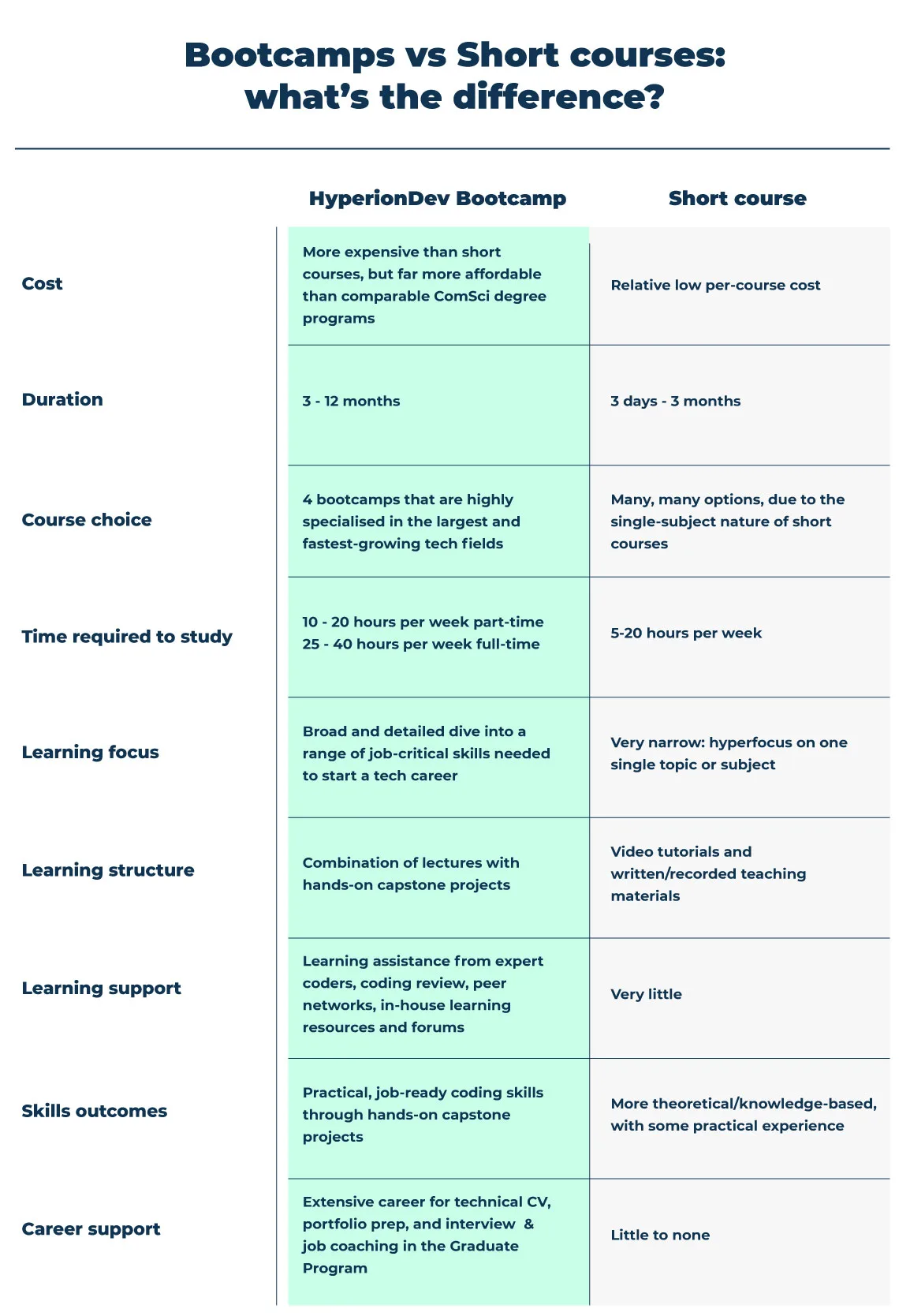
Learning and skills development: Bootcamp vs short course
There are many, many short courses out there, so it’s difficult to pin down exactly what each one teaches. In general, the focus tends to be more narrow and focused on one specific skill. A short course might teach you HTML, or database management through SQL, or how to style your web pages in a certain way through CSS – but it will typically teach only that one subject, with little to no overflow into areas covered by other, topic-specific short courses.
Coding bootcamps, on the other hand, teach a far broader range of technical skills that range from entry-level functions to more advanced techniques. This wide range of subjects usually features several hands-on exercises and practical capstone projects, aimed at helping students practice real coding techniques they’ll be using in an actual developer job.
The aim of an online bootcamp, states Business Insider, is “to take in students with minimal coding knowledge and shoot them back out a few months later as employable software engineers”. And that’s exactly what HyperionDev’s bootcamps do, and have done, for thousands of students [link to success stories page].
HyperionDev offers four coding bootcamps, each specialising in a highly in-demand area of the tech industry. These include:
- Software Engineer Bootcamp
- Web Developer Bootcamp
- Data Scientist Bootcamp
- Immersive Fullstack Web Developer and Software Engineer Bootcamp
Learning duration: Bootcamp vs short course
A short course is made for developing a specific skill, and so in general they’re much faster to complete than bootcamps. Depending on their level of difficulty and their scope, a short course can take anywhere between 3 hours and three months to complete.
This usually means that in order to develop a well-rounded skill set you will need additional short courses, more time, and more money. For example, you might complete a short course in MongoDB – however to become a full stack developer, you’d need to take more courses to learn Express, React, Node.js, Linux, Apache, MySQL, or PHP to be able to do the job.
Bootcamps take slightly longer than a short course because they roll all necessary career-critical skills into one curriculum. Bootcamps can take anywhere from 3 months full-time for single-stream specialisations (e.g. web development or data science) to 12 months part-time for highly advanced, multi-specialisation bootcamps (such as our Immersive Full Stack Web and Software Engineer bootcamp).
That being said, bootcamps are still a faster way to develop tech skills than the traditional computer science degree.
Time and effort requirement: Bootcamp vs short course
Short courses are typically designed for module-centred learning in short, digestible bursts or for a relatively deep and concise dive into a single topic or area. This means that a short course will ask you to spend anything between 1 hour to 20 hours per week on them.
Bootcamps tend to require more time, due to their immersive, hands-on nature, and their progression from beginner fundamentals to advanced techniques.
At HyperionDev, bootcamp students typically require up to 20 hours a week for a part-time bootcamp, and up to 40 hours a week for a full-time bootcamp.
Learning structure and focus: Bootcamp vs short course
When it comes to the content that short courses teach and how they teach it, it’s simple and hyper-focused. Short courses would cover all or most of a single subject or topic, teaching the most critical parts of that material.
This is great for people who have an existing skill set and want to expand it with specific new skills, taught as concisely as possible.
Similarly, short courses have a learning structure that sticks to the essentials, with very little supplemental material or additional learning outside of the core focus area.
This learning is typically done completely on your own and in short bursts, making it more suited to self-driven learners.
In contrast, a HyperionDev coding bootcamp focuses on a range of career-critical, job-ready skills. They start with the fundamentals of coding and other critical tech skills, and work towards increasingly more technical and advanced concepts. In this way, a coding bootcamp develops the well-rounded and extensive skill set that today’s tech companies and start-ups are looking for.
Learning and career development support: Bootcamp vs short course
In general, coding bootcamps offer far more learning and career development support than an online course. Online courses focus purely on teaching the subject matter. They can be cheap, but that low cost comes at a price: many online short courses offer little to no personal learning assistance or support outside of their learning material.
In contrast, bootcamps feature multiple, rich layers of student learning support. At HyperionDev, for example, students get full access to a support network of expert code reviewers and access to a community of fellow peers who are on the same coding journey.
What’s more, our student support doesn’t stop at graduation: with our HyperionDev Graduate Program, graduates get extensive career development support, including technical CV assistance, help creating their developer portfolio, and detailed career and interview coaching.
If you’re thinking about starting your career in tech, or switching careers to a highly-paid developer role, our bootcamps are the ideal way to accelerate your job-ready skills development and fast-track your career start. Our in-depth student assistance, expert code review, and focus on practical capstone projects equips our graduates with the critical software engineering, data science, and web development skills they need to start their careers.
What’s more, we do it in a fraction of the time and cost of traditional computer science programs, and with all the intensive student support and career development assistance that many short courses simply don’t offer.
Enrol in a HyperionDev coding bootcamp today!
Editors note: this article was originally published on Jan 11th, 2019.
Still have questions?
Contact our Admissions Team, and a real person will get back to you.