
Our latest insights
Read the latest insights

Student Success Stories
Student Success Story: Thabiso – from waiter to full stack developer
We asked Thabiso what it was like to go from coding newcomer to job-ready developer thanks to his coding bootcamp.
For Thabiso Hlatshwayo, the tech industry offered a gateway to increased career opportunities and job security. As a developer, he could work in a career that would always need his skills, and would allow him to forge his own career. The online HyperionDev Software Engineer Bootcamp gave him the opportunity to do just that.
Preparing for the future
While working as a waiter in Gauteng, South Africa, he had the opportunity to complete some training in systems development. This opened the door to an internship as a full stack developer, where his new-found passion for programming deepened.
The more Thabiso learned about the opportunities in the tech sector, the more attractive the industry became.
“I wanted to develop skills for an in-demand and well-paid job, because I know that most companies need programmers. I wanted to work remotely – I love the idea of being able to control my time and being able to work from wherever I want.”
However, to make the jump to full, professional full stack developer from his intermediate-level understanding of coding, he knew he needed in-depth practical tech skills to break into the industry. That’s when he decided to enroll for a full-time HyperionDev Software Engineering bootcamp.
Taking the next steps
For Thabiso, the bootcamp was all about growing a job-ready set of skills for his newfound love of coding at an accessible, affordable institute that would prepare him for real developer work.
“I decided to take a bootcamp because I fell in love with coding, ever since my high school days. What actually made me take a bootcamp instead of going to university was two things. One, I knew that a bootcamp offered what I needed. I only needed to learn new programming languages. Two, at home we were not financially stable. So a bootcamp was the more accessible option. I have always wanted to be a developer – this is a step towards that.”
In just a few months, Thabiso graduated from his bootcamp, and soon found work as a professional developer. He now works as a full stack developer at Kartoza, a role that allows him to use the skills he learnt on his HyperionDev coding bootcamp.
“I did a short internship at Condurre, and now I’ve just started a new role as a full stack developer at Kartoza. In my daily work I use Django, React JS, React Native, and Node JS, MySQL, SQLite, Python for data visualisation.”
Learning to code wasn’t easy, Thabiso admits. It took hard work and long hours. Lucky for him, the HyperionDev coding mentorship structure helped him to make consistent progress. He also got regular expert review of the code he wrote and programs he was creating, so that he could know how his code stacked up against the code written by industry professionals.
“I feel like having a mentor is one of the best things, because you are not forcing yourself to struggle alone just to understand what’s going on. My mentor was there whenever I wanted help: he helped me with everything on the bootcamp, and he even made me trust in myself. The code reviewing process was very supportive – it really took my coding to a new level.”
Thabiso loved the challenge of his HyperionDev coding bootcamp, which allowed him to deepen his love of programming and his interest in becoming a full stack developer.
“Learning Python was my favourite part of my bootcamp. Right from the first level of my bootcamp, I felt like Python was for me. It’s easier to read Python code, but it gets complicated as you learn it in more detail. The most challenging part of the bootcamp was the Machine learning tasks. It was tough, but I did additional research and watched tutorials. That’s how I overcame the challenge.”
What the future looks like as a Full Stack Developer
Now that he’s officially started his career as a full stack developer, he has big plans for his personal and career futures.
“I hope someday I can be appointed as the group manager, and I see myself opening up a company in the IT industry someday.”
And if you’re thinking about learning to code, or considering taking that first step towards starting your own career in tech, Thabiso has two pieces of advice: go for it, and keep at it.
“Coding is a bit like playing a challenging game: the first stages are easier, and it gets harder as you progress. However, coding is fun and challenging! You will get used to the difficulty, with experience. Try it and test yourself!”
Our online and on-site coding bootcamps focus on teaching you the hands-on tech skills you need to start your new career in tech, just like Thabiso did. With our best-in-class expert code review, you’ll get the intensive support you need to graduate from your bootcamp as a job-ready developer in as little as three months.
As Thabiso (and hundreds of other successful graduates) proves, our coding bootcamps will help you to reach your desired goals, whether it’s upskilling to world-proof your career, or switching you whole career to developer role.Best of all, our bootcamps fit your schedule, so that you can learn part-time or full-time to fit your work responsibilities or future career goals.
Enrol in a HyperionDev coding bootcamp in just minutes here.

News & Announcements
August 16, 2021
HyperionDev bootcamps: Everything you need to know!
What is a bootcamp? Do I need coding experience to learn to code? We gathered the FAQs we get from students exploring our bootcamps.
So you’re thinking about learning to code, or want to join our coding bootcamps. Maybe you’re a student just leaving school, and are exploring your options. Maybe you want to switch careers, and join the high-paying, opportunity-rich tech industry. Or perhaps you just want to learn some essential tech skills to build cool apps, websites, or programs.
Whoever you are, you have questions – and we have answers. Here are the answers you’re probably looking for, in our most common HyperionDev FAQs (Frequently Asked Questions).
These are by no means all the questions we get from students just like you. If there’s something you need to know, but can’t find in these HyperionDev FAQs, please don’t hesitate to contact one of our friendly Admissions Consultants, or join one of our monthly informational Open Day sessions, where you can participate in live Q&A sessions with our staff, educators, and mentors.
Q: What is a coding bootcamp?
A: A coding bootcamp is a fast, affordable, and accessible way to learn critical, job-ready coding skills to find work at a fraction of the time and cost of other comparable courses & degree programs. With a coding bootcamp, you focus on learning real developer skills, so that you can start building real programs and finding paying tech jobs as quickly as possible.
Q: What kind of coding courses do you offer?
A: We have a number of different bootcamps on offer. These include:
- The Full Stack Web Developer bootcamp introduces the learner to web development essentials before teaching the technical specifics of building feature-rich web applications. To complete the learning path, you will focus on using frameworks to develop fully functional web applications.
- The Software Engineer bootcamp takes you beyond coding to teach you how to think like a software engineer. You will construct software in various programming languages to solve specific real-world problems.
- The Data Scientist bootcamp empowers you to master the tools, techniques and knowledge required to work with data and become a qualified data scientist.
- The Certified Immersive Full Stack Web and Software Engineer bootcamp is our most advanced bootcamp. It teaches you rich and varied skills set across both software engineering and full stack web development, giving you freedom and flexibility in starting a multi-role developer career.
Q: How is the immersive coding bootcamp different from your other coding bootcamps?
A:The immersive bootcamp is by far our most advanced coding bootcamp. It teaches you core and advanced principles of both software engineering and full stack web development in a greater level of detail than our other bootcamps.
Q: Are your coding courses for students coming out of high school, or for working professionals?
A: Our on-site and online coding courses are for both working professionals and students coming out of high school. We have online part-time courses that are perfect for those with a full-time job, but we also have full-time courses for school leavers who are looking for a more hands-on, in-depth experience.
Q: I don’t have any background in coding, IT, or computer science. Can I still take your bootcamps?
A: Of course! Our bootcamps are beginner-friendly, and designed to accommodate even students who have never tried coding before. Many of our students successfully switch careers to programming after taking our courses, even if they were absolutely new to programming when starting out. With the personalized support we provide, all you need is discipline, persistence, and a willingness to work hard and learn to code.
Q: For those who want to take an online course, do they still have the same chance to gain the knowledge as those doing on-site?
A: Yes, our online bootcamps and on-site bootcamps teach the same curriculum and will give you the same set of job-ready developer skills. These different options have been designed to cater for students with different learning needs and styles. You can study however you want, and be confident that you’ll graduate as a job-ready professional developer.
Q: How long are your coding bootcamps?
A: It depends on what you’re studying and your chosen method of learning. A bootcamp can be completed in as little as 3 months, with our most intensive or part-time options taking up to 12 months. You can take as long as you need, with learning options individually tailored to your education goals and career needs.
Q: Are your bootcamps certified or accredited?
A: Yes! We are registered as an accredited training provider with SAQA via the MICT SETA.
- Our latest Accreditation Certificate with MICT SETA is available here.
- A previous Accreditation certificate with the SETA is available here.
- The Certified Full Stack Web & Software Engineer bootcamp is currently accredited with 30 credits that are aligned under the National Certificate in Information Technology Development, NQF Level 5 (SAQA ID: 48872).
- All of our coding bootcamp programs contain content, learning, and career support that goes beyond the unit standards currently available under SAQA in order to best position graduates of this programme to secure their careers in tech.
Q: What kind of computer or laptop do I need to start my coding bootcamp?
A: Our coding courses are designed for low bandwidth and entry-level PCs, so you don’t need a super computer or high-end machine. We recommend using a device with at least 2gB of RAM and at least 80gB of hard drive space.
Q: I’m at school/college, or have work and hobbies. Can I learn part-time?
A: Yes! Our bootcamps have full-time and part-time learning options to give you flexibility in how you learn to code and prepare yourself for a career in tech. With our part-time bootcamps, you can learn at your own pace and on your schedule.
Q: What is your student support like?
A: We offer comprehensive student support throughout your coding bootcamp, with career development support after you graduate through the HyperionDev Graduate Program. During your bootcamp, you’ll get personalised guidance as you learn to code, with expert feedback from our team of reviewers, community access to learning resources on our Reddit community, 1-1 video calls, and more. After graduation, our career support experts will help you prepare your technical CV and developer portfolio, give you job search coaching and mock interview training, and help you to connect with our network of hiring partners and industry contacts.
Q: I’m looking for funding or financial assistance for my bootcamp. Should I enroll first or apply for funding before registering?
A: You can apply for funding with our student financing partners when you sign up for your coding bootcamp. You can learn more about that here:
Q: Do you think building up a portfolio of work can be as promising to employers as previous work experience or degree?
A: Absolutely! We encourage our students to always work on side projects alongside their bootcamps, as these then build up and form part of their portfolio and accumulated experience once they have completed the course. During your bootcamp, you’ll work on several capstone projects, which require you to build real working programs, software, and web pages using what you’ve learnt during the bootcamp. Our post-bootcamp support and Graduate Program also help you to set up your portfolio, GitHub account, and technical CV so that you have plenty of proof of your skills to show off to potential employers.
Q: In terms of practical experience, do students collaborate on projects or are projects just for individual students?
A: Our bootcamp projects are assigned to students individually, but you will have plenty of opportunity to work collaboratively with other students during your bootcamp, including on your post-bootcamp larger paired project.
Q: Are there any discounts or course specials for your coding bootcamps?
A: We frequently run promotions and discounts on our bootcamps, for example during Black Friday. The details of these promotions are advertised on our social media pages and through our mailing lists, so please be sure to subscribe and follow along!
Our coding bootcamps are the best way to become a job-ready developer in months rather than years – with an added layer of career development and job-search support that will help you land your dream role in the fields of software engineering, web development, or data science.
Our coding bootcamps are the best way to become a job-ready developer in months rather than years – with an added layer of career development and job-search support that will help you land your dream role in the fields of software engineering, web development, or data science.
Enrol now and join our online or on-site coding bootcamps, which will teach all the hands-on developer skills you need to do real developer work and get hired in as little as 3 months.
Didn’t find the answers you were looking for in these HyperionDev faqs? Get them now by chatting to an Admissions Consultant, or by signing up to attend our Open Day.
Student Success Stories
Student Success Story: Matsobane – from Engineering Trainee to Solutions Analyst
Thanks to his part-time Software Engineer bootcamp, Matsobane was able to confidently grow in his career as a Solutions Analyst.
When Matsobane Makhura was retrenched from his hardware engineering job, he knew it was time to find a career that wouldn’t be at risk. With the lockdown expanding and thousands of businesses turning to online platforms, remote teams, and digital services, he realised that becoming a software engineer would give him the job security he was looking for – he just needed the practical skills and hands-on programming experience to make his career switch. That’s when he signed up for his HyperionDev Software Engineer bootcamp.
Today, Matsobane works as a professional Solutions Analyst for FNB. We asked him about his journey in learning to code, and what it was like to make his career switch through HyperionDev’s coding bootcamps and tech skills development.
Matsobane had some experience in tech, but knew he would need to take his skills one step further in order to secure his tech career. He signed up for his online part-time HyperionDev Software Engineer bootcamp in order to upgrade his career skill set alongside working his full-time job.
“In the beginning of 2020 I was blessed enough to join the FNB Grad Program to get hands-on experience of the IT world. I joined a wonderful team that gave me the opportunity to do some Research and Development in the AML world using cool tech. My co-worker inspired me to then take a leap of faith to learn the core basics of frontend development, and I then wanted to feed my curiosity and learn more about Software Engineering. That’s when I signed up at HyperionDev.”
Like many of our students, Matsobane knew that the tech career space offered attractive salaries and benefits, vast work opportunities, and the ability to work across the world (often remotely). That’s what he envisioned for his own future.
His part-time online Software Engineer bootcamp was a challenge, but one that taught him all the job-necessary coding skills his career would need.
“I think I had a lot of fire to just prove to myself that I can program. The bootcamp has opened my eyes to what I want to achieve in the next 6 months. Also, the code reviewing process was very supportive, because I knew I was on the right (or wrong) track, and my mentor gave me many real-life tips that I can use in my next role.”
Thanks to the practical experience Matsobane had in building real web apps and portals, he is now confidently pursuing his new career as a Solutions Architect at FNB. In the future, he hopes to build software tools that will help South African youth and people from all walks of life. If you’re considering learning to code or getting into technology, Matsobane has one thing to say: go for it.
“HyperionDev is such an awesome platform. If you want to learn to code and find a new career, you should go for it. Just be patient with yourself and understand that this is just the beginning. Be kind to yourself and listen to your hunger to know more: it will open new doors for you.”
Are you thinking about upgrading your career to one that offers security, international opportunities, and some of the highest salaries in the world? Our coding bootcamp is the most accessible, affordable, and fastest way of doing just that. Our online and on-site coding bootcamps will teach you practical, job-ready developer skills to make working programs and projects and start your tech career in as little as 3 months – like Matsobane and hundreds of other successful HyperionDev graduates.
Our flexible learning options mean you can balance your life, work, and coding education – and with our beginner-friendly course curriculum, you don’t need any prior coding experience whatsoever to sign up and start learning.
Enrol now to secure your seat on Southern Africa’s leading coding bootcamp.
AI Engineering
Computer Vision: the Algorithms Driving the Technologies of the Future
Computer Vision, a branch of AI, aims to program computers to perceive and understand visual information similarly to humans.
Artificial Intelligence (AI) is drastically changing the way in which we live, work, communicate as well as interact with the world around us. One of the rapidly growing fields within AI that is driving exponential technological development across industries is Computer Vision.
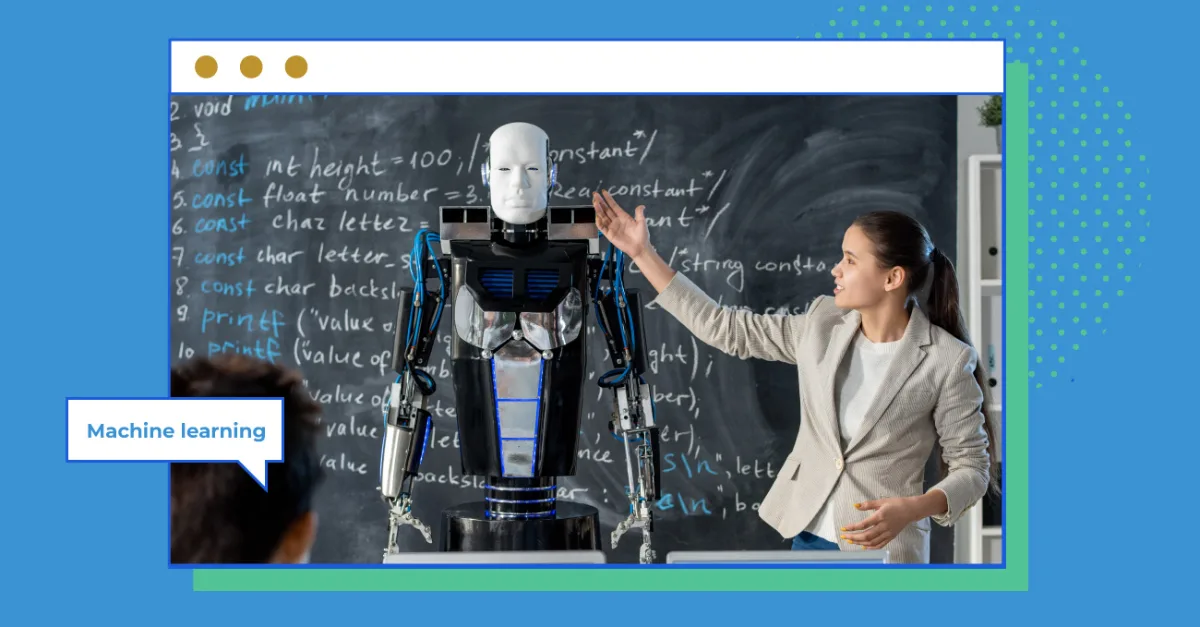
Computer Vision aims to program computers to perceive and understand visual information in the same way that humans can. In essence, Computer Vision researchers aim to make computers do what humans do effortlessly with their eyes – see and understand the world. It is this kind of technology that makes autonomous vehicles, robots and image searches and many other advancements in tech possible today.
Understanding the field of Computer Vision
So what exactly makes the field of Computer Vision so complex? If we as humans can perceive information from the world around us, surely we can easily replicate this in machines. However, this is precisely what makes it so difficult. Since we are able to process visual information without thinking, we do not know what algorithms to program into our computers to make them “see” like us. This is different from a problem like playing chess, where there are a set number of rules and pieces to move. Although all the possible moves are very difficult to keep track of for a human, it is trivial for a computer, and as a result, a computer called “Deep Blue” beat the world’s best chess player, Garry Kasparov, as far back as 1996.

Computer Vision is a different problem though – we do not know what the “rules” for seeing and understanding are, and therefore cannot code explicit knowledge into our programs. As a result, many modern Computer Vision techniques rely on analysing patterns arising in large amounts of visual data (such as photographs and videos) using a method known as “Machine Learning.” And through this process, we hope that computers will learn the “rules” to vision by themselves.
There are numerous Computer Vision systems in use today, and many more related technologies due to be released in the near future. Here are a few examples:
Making Sense of all the Visual Data on the Internet
The explosion of images and videos on the internet, via services such as social media and YouTube, is making Computer Vision increasingly relevant as there is a need to develop automated algorithms to organise and understand the vast amount of images and videos out there.
State-of-the-art Computer Vision algorithms are employed every time you search for an image on Google, for example. Initially, the search engine retrieved images based on their textual descriptions. However, Google’s algorithms now analyse the actual pixels of an image to return the best results whilst also filtering out indecent content. Similarly, Facebook has face recognition algorithms which help to identify and tag people in photographs. This facial recognition software is very similar to the face recognition systems that are also employed in airports and security systems.
Enabling Autonomous Robots and Vehicles
Computer Vision algorithms are used extensively in driverless vehicles and autonomous robots, as this technology enables them to perceive and understand their surrounding environment.

One of the key problems in autonomous navigation is Semantic Image Segmentation. To avoid obstacles, robots need to know precisely where objects are. The task of Semantic Segmentation involves labelling every single pixel in an image with its object category to provide this fine-grained knowledge to robots. There’s actually an online demo of such a system, where you can try out your own images.
3D Reconstruction
Another complex problem within the Computer Vision field is that photographs are only a two-dimensional representation of the world. As humans, we are easily able to understand the differing depths of various objects, as well as their relational depth to one another. A prominent branch of active Computer Vision research is devoted to the field of 3D reconstruction – which involves recreating three-dimensional representations of the world (and this is a field of Computer Vision which does not make much use of Machine Learning but rather theory from optics and mathematics). 3D reconstruction algorithms allow robots to build detailed 3D maps of the environment which they are exploring. If you are interested, there is source code for an open-source reconstruction engine.
Helping the partially sighted to see
If we can program computes to see the world around them, then we can use these algorithms to augment those who have impaired vision. These “smart specs” are equipped with cameras and a portable onboard computer and help to enhance the vision of the partially sighted by highlighting salient objects in the environment. These glasses are currently undergoing field trials and will be on sale in the United Kingdom in 2016.

Interested in learning more about the explosive field of AI and computer vision? Our Data Science Bootcamp is a great place to start. Our mentor-led model teaches you job-ready, practical data analysis, programming, and analytics, that you’ll need to start working as a data scientist in as little as 3 months. What’s more, you’ll receive ongoing support in preparing for and finding your first job in our Graduate Program. Enrol for your part-time or full-time online coding bootcamp.
Editors note: this was originally published on 8 November 2017.

News & Announcements
July 22, 2021
Employee story: Roberto Gallotta – Senior Digital Designer
Every business has to have a great marketing team – and that team needs a senior designer with world-class creative skills.
Great design and branding is about much more than simply looking great and having a good colour palate. It’s a holistic, ongoing process of experimentation and iteration that covers everything from perfecting tiny icons and kerning, to translating technical information into visuals that enlighten, entertain, and inform.
Senior Digital Designer Roberto Gallotta is the person who makes that happen at HyperionDev. With a degree in Brand Building and Management from Vega and a postgraduate degree in Entrepreneurship from UCT, Roberto brings nearly a decade of professional branding and design expertise to HyperionDev’s look and feel. His wide range of talents spans visual design, conceptualising web pages from scratch, perfecting UI/UX, and creating beautiful videos and animations. His work gives our brand a face and a voice – sometimes literally, if you’ve watched any of the adverts he has lent his voice to in the past few years.
We asked him some questions about his professional experiences, what his job responsibilities are, and what it’s like to work at HyperionDev.
What do you enjoy most about working at HyperionDev?
What I love most about HyperionDev is the sense of camaraderie we all share. We all share this mission of being a leader in tech and education in South Africa and the world, which makes every win – small or big – noticed. You are appreciated and valued for going the extra mile.
What’s the heart and soul of your role at HyperionDev?
Working as the senior digital designer means that I ensure that the HyperionDev brand is portraying the high-end work that we do through visual and animated aesthetics. I work closely with content creators and the performance team to take words and bring them to life for social media, PR, adverts, and our website. I make it my mission to make sure that our brand looks amazing and stands out from our competitors, showing users why HyperionDev is the best choice for them when switching to a career in tech.
I also have also been dubbed the cheerleader of the marketing team, making it my mission to spread positive vibes to the rest of the team. I do what I do, because I’m passionate about creating a positive workplace culture, helping employees with their professional development and resolving office problems.
What motivates you to come in or login in the mornings?
What motivates me everyday is that I have the platform to push boundaries and create artwork everyday that inspires people to want to make the career switch to tech. I do this through always thinking about the box, putting my feet in the shoes of our users, and delivering content that makes them surprised and excited about HyperionDev.
What’s a fun fact about you?
I’m actually green-red coloublind, which is probably why I love working with the blue tones of the HyperionDev branding. Some may say this is a BIG ISSUE that the lead designer is colour blind, but I see it as an advantage, because I create artwork and communication that is accessible to people who otherwise would be excluded and can’t see our communications.
Tell us a bit about your professional development as an employee at HyperionDev.
I started off as a midweight designer back in 2018, when we first went through a rebrand, taking the company from orange and grey to blue and gold. With the company believing in me and my abilities, I’ve been given the space to grow and learn from every task I do.
I have grown to love User Experience design, and animation, where making a design is not about how pretty it looks, it’s more about how best a piece of content can be received by a user. This is mostly applied on our website, where I ensure that the images used represent our audience in the best way, and guarantee that our information is delivered in the way that’s easiest to understand. Working at HyperionDev has also allowed me a lot of career experimentation: I’ve worked as a director on a HyperionDev commercial that aired on TV in 2020, and have flown across the country to meet and interview students for testimonials.
How do you ensure that you keep yourself upskilled & knowledgeable in your field of expertise?
Working as a digital designer in a saturated market, you always have to upskill yourself. I’ve done it through teaching myself animation, where I can take static designs and bring them to life with motion. I’ve done a UX course, to better understand how users think and how to deliver wireframes and high in mockups to developers. I’m also in the process of starting the HyperionDev Full Stack Web Developer bootcamp because, as we say, tech is the future, and I would be silly not to ride that train.
Which of HyperionDev’s core values resonates with you the most, and why?
Problem Solving. I believe that with every roadblock, there is a way to jump over it. It takes a little bit of thinking smart, but anything is achievable. It’s almost like designing an infographic: it’s a step-by-step process of thought, where you need to understand the problem at hand, and you brainstorm different ways to build over the roadblock. A quote I like to say to myself when faced with a problem is “1 ounce of self doubt is a mile away from your successes”. You have to be confident in your abilities, no matter how long it takes; be easy on yourself and your solutions will come to you.
What’s a fond memory you have of working as a HyperionDev employee?
Some of my best moments were when the team would get together for drinks and play board games at the office (before the big lockdown). It was so fun and we’d get a little silly, dance to music, and have the best time. I have made many close friends at HyperionDev.
How is HyperionDev different from other places you’ve worked?
HyperionDev makes me feel appreciated and trusted in what I do. Other companies I’ve worked at have been very corporate. Here, I’ve been given the freedom to explore my creativity and implement my ideas.
What makes you feel PROUD to be a HyperionDev employee?
I feel proud of what we do: giving people an alternative way to learn coding skills. Tech is the future and we should all be a part of it.
At HyperionDev, we’re always looking for talented professionals to join our team. Whether you’re a master of beautiful design, a project management pro, or someone with a passion for teaching newcomers as they learn to code for the first time, there’s a place for you in our diverse and international team. As a HyperionDev employee, you’ll enjoy more than just fulfilling and challenging work with a fast-growing, internationally scaling start-up – we provide medical insurance, extensive remote working allowances, a generous leave policy, and real avenues for career growth, experimentation, and promotion.
Do you think you could be our next star HyperionDev employee? Visit our career page to see all our available positions and apply to join our team today!

Career Advice
10 Tech Trends That Will Shape the Next Decade
Technology is what writes the human story. From quantum computing and nanotechnology, to AI and Green Tech, here are 10 tech trends that will define the next decade.
Right from the invention of the wheel and the spear, technology has shaped human history – and the Digital Era is no different. Technology continues to have a formidable impact on the way we live, work, socialise, and exist. You only need to look at the device you’re reading this on and the internet that’s bringing it to you to see that fact in action. Let’s take a look at the ten most exciting technologies that are sure to have an effect on our future and society that may even dwarf that of the Industrial Revolution.
Here are the top 10 tech trends that will define the coming decade and beyond.
Tech trends
1. Quantum computing
Quantum computers are essentially a different kind of super computer, which uses qubits instead of binary to transmit a far greater amount of information in the same space. What this does is allow for a whole new level of advanced computers which can solve in seconds problems which would take our current computer technology thousands of years.
With such computers on the market, everything we do with computers would have to change overnight. The applications for quantum computers are limitless; its ability to solve even the most complex problems means it could do work that’s nearly impossible without millions of dollars in supercomputers, such as unfolding and predicting protein sequences in medicine.
Quantum computers aren’t still fully out of the lab and experiment chamber just yet, but with the world’s biggest tech companies (including IBM and Google) reporting significant breakthroughs, it’s only a matter of time until these advanced quantum computers change the face of computing itself.
Tech trends
2. Autonomous vehicles & self-driving technology
Cars and transport are a central feature of human civilization – and with advances in AI, visual recognition software, and computer technology, the era of autonomous vehicles is all but here.
AI and autonomous guidance are safer and more efficient than human drivers, and they can save time, money, and resources on existing transportation methods. Tesla recently published driver data demonstrating the life-saving results of its automated driving and safety technology:
‘For those driving without Autopilot but with our active safety features, we registered one accident for every 2.05 million miles driven. For those driving without Autopilot and without our active safety features, we registered one accident for every 978 thousand miles driven. By comparison, NHTSA’s most recent data shows that in the United States there is an automobile crash every 484,000 miles.”
Tesla report
Automated navigation systems can plot more efficient courses to save time and fuel, saving millions of dollars and tonnes of CO2 emissions per year. In some cases, this advanced technology can increase and decrease engine throttle and speed against wave and wind action to save fuel.
The impact of self-driving cars goes beyond just safety and efficiency; it could disrupt work and create whole new personless industries. Just imagine loading your Uber app onto your Tesla, and setting it to ‘taxi’ mode when you get to work, so it goes out and earns a living while you do?
Tech trends
3. Space travel, space tourism, and the new space race
On the surface, the news and hype around space travel doesn’t seem like much more than a few billionaires fulfilling personal fantasies of going to space. However, it would be a mistake to ignore the significance and world-changing potential of the world entering another space race.
The first space race brought remarkable advancements to the human race, including LEDs, CAT scans, cell phone cameras, modern athletic shoes, modern water purification, wireless headsets, freeze-dried food, smoke detectors, portable laptops, and many more. With new attention being thrown on space travel once more, and companies making this travel cheaper and more versatile, we could see the development of technology that we haven’t even thought about yet.
What’s more, it won’t cost taxpayers billions of dollars this time around: Space-X, Blue Origin, Virgin Galactic, and other private companies are subsiding and refining the tech needed to get to space, both reinventing space travel and creating a whole new industry of space tourism in the process. One day, going into space (or even to a base on the Moon or Mars) could be as easy as booking a plane ticket today.
Tech trends
4. Intelligent spaces and places
As the world grows, our cities will only get bigger. The UN predicts that 68 percent of the world’s population will live in urban areas by 2050. So what do we do about the many social, environmental, and economic challenges that our cities will face? The answer: Smart Cities.
With the spread of ICTs and digital technologies, our cities will become more connected than ever before. We’ve already seen the power of tech automating home and office spaces, which result in more efficient, better living spaces by automatically managing lighting, heating, and water. As tech becomes ever more ubiquitous, our cities will become smarter, more efficient, and more sustainable.
Smart cities could be much more pleasant, efficient, and economic places to live within a decade, if tech is used to better manage our public spaces. Smart cities could, for example, keep traffic flowing, even at the heaviest peak hours. They could manage resources more efficiently, by avoiding wasteful lighting or unnecessary garbage collection timings. And they could make cities safer, more connected places to live for humans, as tech both connects us and allows us to better track, investigate, and prevent common urban crime.
Tech trends
5. CRISPR and gene engineering
CRISPR is a technology that allows researchers to edit genes – or even ‘switch on or off’ genes without altering their sequences. In the past few years, this truly revolutionary technology has made huge strides, giving the world much promise for breakthroughs in the treatment of HIV, Ebola, RNA viruses, and cancer.
CRISPR represents a significant stride forward in the curing of illnesses that are otherwise impossible to treat with conventional medicine. What’s more, it’s breakthroughs have whittled down both the cost and time requirements for gene editing, meaning that the ability to experiment with new treatments is open to a far greater number of laboratories.
The benefits and results of CRISPR will be life-changing for millions of people across the world, as doctors and scientists are taking tentative steps towards experimental therapies and treatments that could solve serious illnesses, such as Alzheimers, Parkinsons, autoimmune diseases, genetic conditions, diabetes, and many, many more.
Tech rends
6. The intersection of Virtual Reality and Augmented people
Wearable technology and virtual reality are already on our wrists and in our homes. However, as the technology driving these advances steadily improves, and intertwines with technology for human augmentation, we could see the stuff of science fiction become as common as the phones in our hands.
A monkey with a Neuralink chip installed in its brain was able to play pong without its hands, using just its mind. This is a simplistic start, of course, but it holds great promise for people suffering brain injuries. With this technology, doctors could restore sight, sound, or movement to people with spinal or brain damage, or could allow people with missing limbs to use robotic, digitally-driven prosthetics as naturally as a natural human hand or leg.
Tech trends
7. 3D printing
The advancements of 3D printing have allowed it to become relatively portable and accessible, so that the average person can design and print sold objects without needing an industrial warehouse and specialized equipment.
This tech is so much bigger than printing statues and spare parts for your appliances at home, however. 3D printing employed a macro scale could mean houses that are faster, cheaper, and easier to produce – and as the lines separating different fields of science blur, 3D printing and medicine could intersect and leading to breakthroughs in bioprinting where new organs, skin, and tissue can be made in a lab to help heal the sick.
Who knows? One day you could even affordably bioprint a fillet steak for your dinner.
Tech trends
8. Nanotechnology
Since the invention of the scanning tunneling microscope in 1981, the world of nanotechnology has grown from science fiction to science fact. Today, nanotechnology is making steady progress, with experiments demonstrating promising results across a wide array of applications, including administering drugs and medicine in very specific places, diagnosing illness with microscopic graphene rods, treating bacterial infections with gold particles, healing wounds, and repairing cells.
As the coming decade reveals better (and even smaller) technology and more refined manufacturing processes, we could see nanotechnology taking a pivotal role in medicine delivery and medical treatment.
Tech trends
9. Green technologies
Green tech came about as a direct response to the challenges of climate change and global warming. Just as the issues of the changing climate across the world are multifaceted and varied, so too does green tech cover a wide range of applications and industries. Right now, green technology is being used to solve crises in energy, clean water supply, and carbon pollution, but it’s also being used to improve and refine other industries to be more efficient, sustainable, and environmentally friendly.
The climate challenges that humans face will likely only grow more severe as time goes on and population growth and resource depletion intensify, but with the rapid advancement of technology so will our capability to tolerate and reverse these climate effects. In the next decade, green tech is sure to be a frontrunner for the most important technologies on the planet.
Tech trends
10. AI and intelligent assistants
AI and intelligent assistants are already in our homes and hands, with Siri, Alexa, Cortana about as well known as any celebrity. However, with the significant advancements in AI, machine learning, and cloud computing, the role these assistants will play in our homes and lives will only grow more pronounced. These technologies won’t just become more sophisticated (we’ve already seen how an intelligent assistance could make you an appointment at a local hair salon), but AI and audio synthesis technology become more advanced, they could talk to you (and sound just like a real person), create complex software applications for you, or even write your blog articles for you.
–
With the rapid wave of digitisation and technological advancement happening across the globe, it’s clear that there are some massive and life-changing breakthroughs heading our way. All of these advancements rely on one thing: tech skills. Whether it’s new world-saving green technologies, sophisticated new AI, or medical technology that changes the way we think about illness, the ability to work with technology will be a vital part of this new future, world, and economy.
Our online and on-site mentor-led coding bootcamps put practical tech skills into the hands of those who need them, so that they can start real developer and engineer work in months rather than years. With our modern curriculum and project-based syllabus, you can start building a portfolio of working software, websites, or apps that will demonstrate your tech proficiency and launch your career in web development, software engineering, or data science in as little as 3 months.
Secure your place in the future of these tech trends by enrolling for your coding bootcamp today.
Student Success Stories
Student Success Story: Kyle – from IT Admin to Desktop App Software Developer
Kyle Julies signed up for the HyperionDev Software Engineer bootcamp and now works as a professional desktop app software developer.
After 3 years of working in administration-related roles in the IT sector, Kyle Julies decided that he wanted something more. He wanted a career he would love: a career that brought challenges and new learning, that paid well, and which held many opportunities for growth and work across the world. Kyle had always loved programming, and so – with the world becoming increasingly digitised and software-dependent – he decided to make a career out of it. He signed up for the HyperionDev online full-time Software Engineer bootcamp.
Now, just after graduating from his bootcamp, Kyle has successfully started his career as a desktop app software developer at VGM. We asked him about his experiences on his software engineering coding bootcamp and what it was like changing careers to become a software engineer.
Starting a bootcamp: Kyle’s search for something more
Before signing up for a HyperionDev bootcamp, Kyle had worked in a number of IT roles, spending 3 years as a database administrator, a systems administrator, and an IT infrastructure specialist. However, he quickly realised that he didn’t truly enjoy this administrative-orientated work, and wanted something more challenging and fulfilling: being an actual developer who conceptualises and builds the projects his old career had him merely manage. He joined his HyperionDev bootcamp specifically because he hoped it would give him the job-ready software engineering skills to make the career switch he was aiming for.
“My main reason for joining the HyperionDev Software Engineer bootcamp was to switch fields within the IT industry. Before I started my Software Engineer bootcamp, my primary career role was working as an Oracle Database Administrator, with lesser focus on Linux Systems Administration.”
“I’ve always enjoyed programming [and I had] informal programming experience through university and self-study. Therefore, programming was not new to me when I started the bootcamp.”
“With all this in mind, I left my previous job and started the software engineering bootcamp full time. Though it was a bit of a bold move (especially since HyperionDev offers a part-time program so that you can keep working full-time), I was confident that it would not take too long to find employment.”
What it’s like to switch careers to tech
Soon after graduating, Kyle found an opportunity through our HyperionDev Graduate Program to work as a developer for VMG Software (a software provider that specialises in dealership and workshop management). With the job-search support that comes standard with all of our bootcamps, we helped Kyle prepare for his application and interview.
“I discovered VMG Software through HyperionDev. My employer already knew of the value of HyperionDev because they’ve hired their graduates in the past, and that might have assisted me with getting an interview.”
“I was assisted by the careers team in refining both my CV and Linkedin profile, and I was offered mock interview training”
After a lengthy process involving multiple interviews, Kyle was hired.
“I am now officially employed at VMG Software as a desktop app software developer. I work on an application that installs and runs locally on computers/laptops.”
“For most of my work, I focus on working on bug fixes and implementing new features that clients request. The Git version control system is something that I constantly use in my role, which I learned during my Software Engineer bootcamp.”
Kyle’s HyperionDev bootcamp experience
Thanks to its major focus on practical skills and job-readiness development, the HyperionDev Software Engineer bootcamp gave Kyle the skills he needed to make his entry into professional software development.
This was because of close mentorship, which he was able to consult the few times he was stuck on a problem, as well as the practical skills focus. During the bootcamp, you make working programs and projects that are just like the ones you would build in the real developer world.
“When I did have questions, my mentor Imraan Meyer assisted me with any questions that I had. I liked the code review system in place. It was very easy for me to submit tasks. However, the best part of the bootcamp for me was probably the capstone projects related to the project management system. They were quite challenging too: It took a lot of time and effort. Using the internet to find resources helped a ton!”
“It was definitely a challenge trying to create a cohesive program that interacts well with a database.”

His bootcamp is only the start of his career, which Kyle sees growing to new heights as he gains professional experience as a software developer.
“Personally I’m not fond of the “where do you see yourself in x years” question, primarily because I don’t have a systematic path laid out, with a clear and precise end-goal. However, there are general goals that I would like to achieve, such as: being afforded many opportunities to choose from at any given point (i.e. being in high demand), having the option of working overseas, and having a flexible work schedule with freedom to easily change working hours.
Kyle’s advice for people who are thinking about learning to code or start their new career as a developer is simple: don’t hesitate.
“ Programming is one thing that can easily be learnt if you so desire. The software/programs and resources to learn are available to you, so take advantage of them! And if you find that you are enjoying it, consider taking a HyperionDev course; the post-bootcamp support will be a big help for finding a job.”
Have you been thinking about learning to code, or following your passion for technology into a new career, just like Kyle did? Our 1-on-1 mentored coding bootcamps are the best way to become a job-ready developer in months rather than years – with an added layer of career development and job-search support that will help you land your dream role in the fields of software engineering, web development, or data science.
Apply now to join our mentor-led online and on-site coding bootcamps, which will teach all the hands-on developer skills you need to do real developer work and get hired in as little as 3 months.

Career Advice
What Is No-Code & What Does It Mean for the Future of Coders?
No-code is a relatively new technology in the world of coding. We take a look at where it fits into the future of coding.
Coding can be complicated. For total newcomers (and even established programmers) it can be time-consuming and difficult to make your lines of convoluted code work just right to produce the beautiful, highly functional website or application you’ve been dying to create.
However, as technology has become more advanced, a new way of producing code-based applications and products has emerged: no-code.
What is no-code?
Put simply, no-code refers to technologies or platforms that allow you to produce websites, applications, or software without ever writing a single line of code. These tools and platforms use a variety of accessible, easy-to-use features to make app creation simple, including video tutorials, drag-and-drop interfaces, ready-to-go templates, and AI that does the coding work for you. In a rapidly digitising world that’s held back by a growing global tech skills gap, no-code technology is a giant leap forward: it allows non-technical people to create striking, functional apps without weeks of work, multi-developer teams, and years of learning numerous difficult programming languages.
- The power and potential of no-code tools
For the average person who wants to make cool apps without endless struggle, no-code is a powerful tool. Here are some of the great things about no-code technology:
- No-code saves time and money
The do-it-yourself style of no-code lets you save on costly development by simplifying the whole development process. You can prototype, build, publish, and manage your app or website in days rather than months, because your project is built on modules that already work.
- No-code keeps things simple and small
No-code allows you a quick and easy way to implement a wide range of app features, without needing specialist knowledge or having to build everything from scratch. You don’t need a front-end developer, back end developer, Fintech guru, ICT Security genius, and database wizard just to get your storefront, website, or mobile app up and running.
- No-code improves access and inclusion
Creating apps and software used to be reserved strictly for those who had the time, money, or skills to get them built. With no-code, access to the means of app production is truly democratised: anyone can build anything, without needing to spend years on a computer science course or thousands of dollars on a dev team.
The downsides of no-code
Just like with any other tool in existence, no-code has more than a few downsides that you should keep in mind if you’re considering them over traditional coding techniques and tools. Here are just a few of them:
- No-code tools can often be very limited
Pre-built templates and pre-selected features can severely limit what you can build. After all, drag-and-drop resources and GUIS can’t do it all, and with no-code tools you can often only do what’s already been done.
- No-code doesn’t teach transferable skills
Coding is about more than just writing code. As many programmers will tell you, the act of writing code is usually only a part of the job or problem at hand. Often, more time is spent figuring out what the problems are, determining the best solution, and mapping out what code and tools will be needed to solve the problem. What’s more, what you learn on one no-code platform might not apply on another.
- No-code often requires a data connection to the tool server
Many no-code technologies become a middle man over your program, requiring you to go through them (and have an active subscription and connection to their platform!) to manage and update your app; this layer of “convenience” actually prevents you from having direct and immediate control over your creation. Often, it’s far simpler and less risky to build, publish, host, and manage your software or website yourself – especially when some no-code platforms don’t let you own your source code.
The future of no-code
Of course, the rise of a new, exciting technology cannot happen without some Luddite-style worry that it will destroy industries, take jobs, and replace established professions. You really shouldn’t worry, however: this new tech is more a new tool to assist and simplify coding, rather than an outright replacement.
While no-code solutions will no doubt grow as they become more available and accessible to businesses and new coders looking to save time and money, they aren’t an outright replacement for skilled, informed developer work. No-code is a powerful tool that democratises the access and resources to make your own tech, but even the most advanced and feature-rich examples cannot beat the freedom and limitless possibilities of knowing how to use and write the code that they’re made from.
At its heart, no-code demonstrates the difference between coding and engineering. It simplifies the ability to transfix ideas into digital forms, but they’re no replacement for the innovative problem-solving and solution-oriented perspective of engineers and developers. If you’re a technically minded person, or thinking about learning to code and build your own projects, your best bet is to know how to code proficiently, and how to think like a programmer or engineer. These no-code solutions then become another tool in your already considerable arsenal.
Our bootcamps teach hands-on, job-ready programming and engineering skills, so you can work with data, build complex software applications, and create amazing, high-grade websites from scratch. They’ll also help you have a better understanding of what options are available to you in professional developer work, so that you can develop a wide range of industry-quality programs without wasting any time, effort, or money.
Apply to join one of our online and on-site mentor-led bootcamps by clicking here.

Data Science
What is the future of data science?
Businesses around the world are realising the value of data science, but what does the future of data science look like?
We generate massive amounts of data each day: from where we go and what products and services we use, to who we communicate with and what media we consume. All of this information can be used by companies and organisations to better understand their consumers and optimize their business strategies and practices. With the increasing volume of data that’s now available, more and more businesses from almost every industry are realising the value of data science.
In fact, the last two years have proven to everyone across the world how powerful data is when it is used ethically, effectively, and for the betterment of people. The COVID-19 outbreak showed us all how vital data and data science are when it comes to understanding how the virus spread, predicting infection spikes, and vaccine research and rollout,
As Artificial Intelligence Luminary Andy Veluswami says, “What excites me about data science are the sheer possibilities. It’s like solving a puzzle, but a puzzle that’s meaningful and that has real-world implications, and that…can really help change the world.”
So what is data science, and exactly why is it so powerful for the future of almost every person, business, and industry on the planet? Let’s take a look.

Source: kdnuggets
What is data science?
Data processing. Algorithms. Computer science. Machine learning. If you were to ask a data scientist what their job entails, the answer might be a combination of these elements. For those of us who like to keep things simple, TechTarget defines data science as “the study of where information comes from, what it represents and how it can be turned into a valuable resource in the creation of business and IT strategies.”
A practical example of this in action would be Buxtunco, a data science company that records what certain customers are doing at particular locations. By using data, Buxtunco can help businesses choose the most potentially profitable location for their stores on the ground.
Another example would be how data is being used by hospitals to determine why certain people are readmitted. Data can go beyond knee-jerk assumptions to grant useful insights into the actual hidden problems of public health, including whether there are correlations between readmission and socioeconomic data points such as income, physical address, crime rates, and air pollution.
With more industries becoming increasingly data-driven, it’s likely that the field of data science will undergo some drastic changes to fit the changes within the industry.
Here are 3 changes that we predict for the coming years.
Prediction #1: Diversification of data science job titles
Data science is a growing field with hundreds and thousands of jobs being created each year. In the US alone, it has been predicted that there will be 11.5 million jobs in data science and analytics by 2026. In South Africa specifically, the data scientist role is understood to be one of the most secure and lucrative jobs you can get, and one that has only grown in demand as a result of the COVID-19 pandemic.
Right now, the job title of data scientist is an umbrella term for a range of different jobs, including data engineering, full stack data science, jobs that entail running reactive SQL queries, research and as one Quora contributor puts it, “100 other things.” In the future, job titles may diversify to describe more accurately what each “branch” within data science entails.
This diversification will enable better recruitment processes and hiring accuracy because companies will be able to narrow skills down to a specific business need (and therefore job position) and recruit for that particular set of skills.
Prediction #2: Learning on the job
Executive recruitment company, Burtch Works predicts that the data scientists of the future will be at the forefront of the world’s technological progression. Big data in a sense, is the key to decoding human behaviour, and the more we understand about ourselves and the world around us, the “smarter” the world will become in terms of the innovations that humans can catalyse.
For this reason, the data scientists of the future will need to be ongoing learners. Data science is not a two-step, learn-and-apply process. It’s a learn-apply-repeat process, and the most influential scientists in the industry will need to ensure that their skills and knowledge remain up to date and marketable in today’s evolving society.
Prediction #3: Greater focus on ethics
As Andy Veluswami explains: “Teaching a machine how to do mathematics, we’ve done that. But teaching a machine good manners, we haven’t done that yet. Once we start getting there, and we already are, we’re going to start making a lot more progress.”
The world is just discovering the impact that big data is having on everyday life and realising its potential for the future, and as it discovers the good, so too will it discover the pitfalls of how this data is used. Ethics will play a major role in the future of data science, as issues around privacy, and the freedoms of movement and speech continue to spark debate in the field.
Whose data can be used, and when? How do we know if a person has consented to share their data? In what ways can data be used for nefarious or harmful purposes? These are the questions the regulatory bodies, lawmakers, and professionals within the industry should be looking to answer.
Data science is an evolving field, driven by new technologies, research, and questions around how and when to collect and analyse data. It has become so much more than crunching numbers – and today’s data scientists will have to adapt to these changes and new trends if they’re to keep ahead of the curve of Big Data’s rapidly evolving future.
Interested in becoming a data scientist? Our Data Science Bootcamp is a great place to start. Our mentor-led model teaches you job-ready, practical data analysis, programming, and analytics, that you’ll need to start working as a data scientist in as little as 3 months. What’s more, you’ll receive ongoing support in preparing for and finding your first job in our Graduate Program. Apply for your part-time or full-time online coding bootcamp by clicking here.
News & Announcements
June 23, 2021
Tech in Africa: Why Diversity & Inclusion Are Key to the Future
Africa’s rapid digitisation and ICT growth have established it as a formidable contender for the next global tech hub.
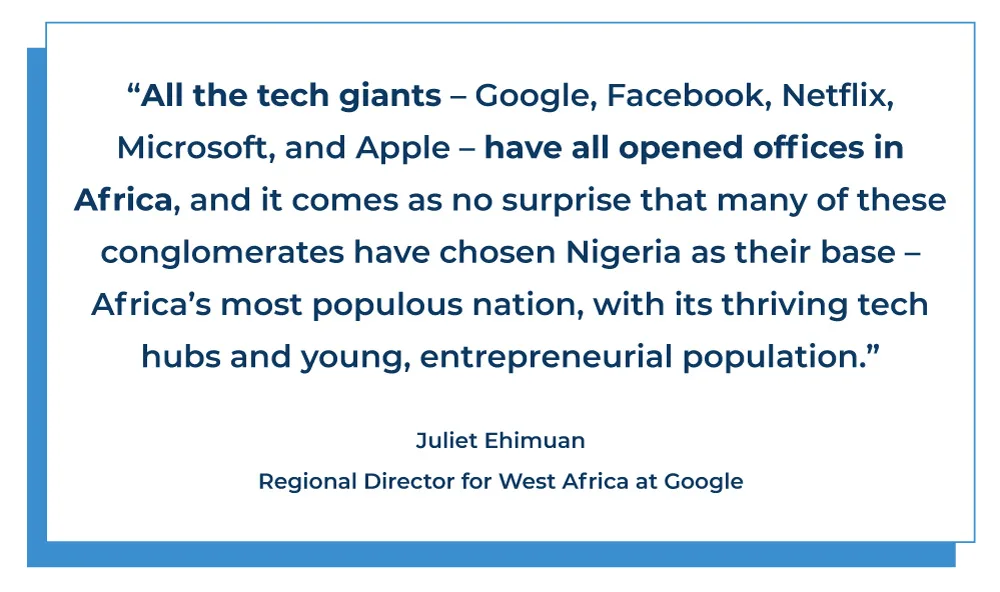
Forget outdated stereotypes of the “Dark Continent”. In recent years, Africa has become a blazing beacon of Silicon Valley replicas, bustling tech hubs, and explosive digital growth.
There’s no doubt that Africa’s future is bright, given its rapid digital development in the past decade. But how much promise does Africa hold as a future international tech hub? What are the challenges that stand in the way of that dream? And what should our societies, governments, schools, and development agencies be focusing on to maximise this potentially multi-billion-dollar promise of growth?
In this article, we’ll take a look at Africa’s status as a new home for some of the world’s biggest tech companies, its significant improvements in availability and access to tech, and the biggest challenges that our continent needs to address to ensure its brightest future.
Africa’s promising rapid tech growth
Africa’s many problems are widely known: barely a week goes by where headlines don’t draw attention to the civil unrest, regional instability, famine, economic downturn, and poverty that affects swathes of the continent.
However, behind the media doom and gloom is a surge of heavy investment and economic refocus that is at the heart of Africa’s rise in the tech space. In the past decade, Africa has made tremendous progress across a range of sectors that serve as the foundation of its new-found international tech hub status.
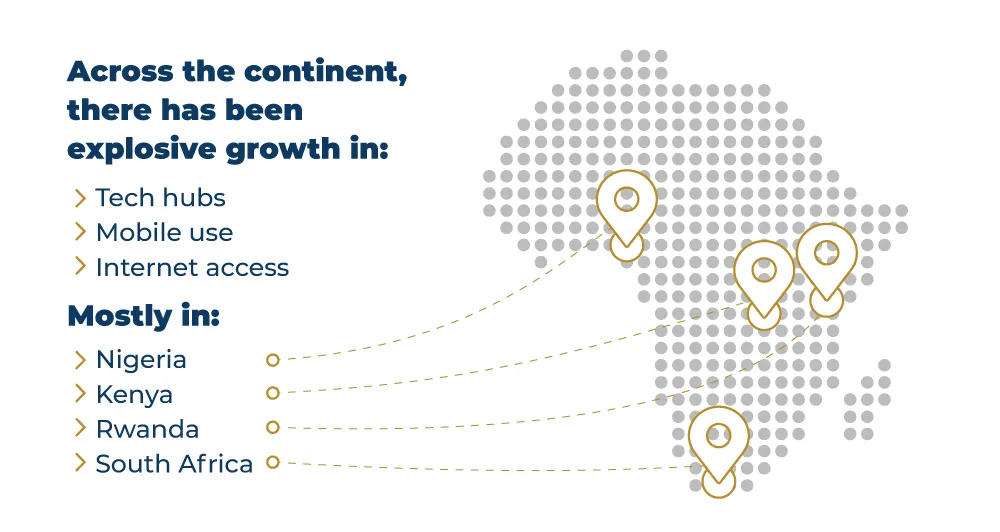
Rwanda is among the leaders in fast-growing ICT development. Today, the country’s internet penetration stands at over 52.1%, compared with a dismal 7% in 2011, while mobile phone penetration has grown to over 80.6% from 33% in 2010, according to the nation’s Ministry of ICT and Innovation.
Kenya is no different: active internet and data subscriptions totaled 42.2 million in 2018, while broadband covers more than 45% of the population, according to official figures. Meanwhile, in Nigeria, phone access grew from just 200,000 subscribers in 1999 to 133 million in 2020, and teledensity went from 63% to 107% in just the last decade.
These are trends we’re seeing across the continent. Reports show nearly half a billion people now subscribe to mobile services in sub-Saharan Africa, with more than 272 million Africans now connected to the internet on their phones. In fact, from 1999 to 2004, Africa was the world’s fastest-growing mobile phone market: subscribers jumped from 7.5 million to 76.8 million in that period, an annual growth rate of 58%.
The rapid proliferation of connectivity on the African continent is a driving force for its wide scale digitisation. Today, much investment and economic interest and activity has been put into African states, resulting in an extraordinary growth of tech hubs- places where coders, web developers, graphic designers, hackers, and entrepreneurs can come together to create new digital products and set up businesses, all championed by young people. According to African investment firm Africa Prudential, these hubs have directly led to NGOs, venture capitalists, investors, donors, and technology providers all over the world looking to explore and tap into the vast human capital in the African market.
Diversity, inclusion, and the African perspective
This new foundation of tech ubiquity and access means that Africa will have advanced technological and technical capabilities to solve its many pervasive issues.
However, as Africa builds these hubs and repositories of technological excellence, there will be an increased need to ensure that diversity and inclusion are the very soul of these initiatives. Diversity and inclusion have always been seen as a powerful way to drive more efficient, innovative solutions, by drawing on the wide experiences and backgrounds of many different people; Africa is no different.
A focus on diversity would avoid the many issues that arise from simply importing European, Asian, or American perspectives and solutions for an entirely different African context of wholly different problems. At the most basic level, Africa’s people are best aware of the problems they need to address, and so to exclude them from these discussions would be to waste time, energy, limited resources, and risk misdiagnosing (or outright exacerbating) the biggest issues.
The promise and potential of Africa’s youth
Accessibility and inclusion are no good if they don’t include Africa’s young talent (and their fresh, on-the-ground perspectives of Africa’s issues). In Africa, nearly 60% of the continent’s population are below the age of 30, and they are a central, critical part of what has made the continent a ‘darling’ of the tech world.
Inclusion of the youth will also help to solve a serious issue plaguing Africa’s development: youth unemployment. In South Africa alone, youth unemployment stands at a staggering 46%. This demonstrates that modernisation and digitisation of the continent will do nothing for her people if they’re left behind by a system that doesn’t prepare them to be a part of that growth.
However, it’s not simply enough to give these people jobs, especially with the threat of automation to low-skill, low-education labour. Africa’s tech future needs a new system of education that focuses on skills development and job-readiness, in a way that’s accessible, affordable, and time-sensitive. After all, if Africa’s growing labour force are not properly upskilled to take advantage of this digitisation, it’ll only worsen unemployment and exacerbate the growing global tech skills gap.
Better access to a modern education
Across rural Africa the issues of low-quality, poor education are well known. However, even in the revitalised tech hubs, there persists an outdated reliance on expensive in-person education that takes years just to prepare someone for an entry-level job.
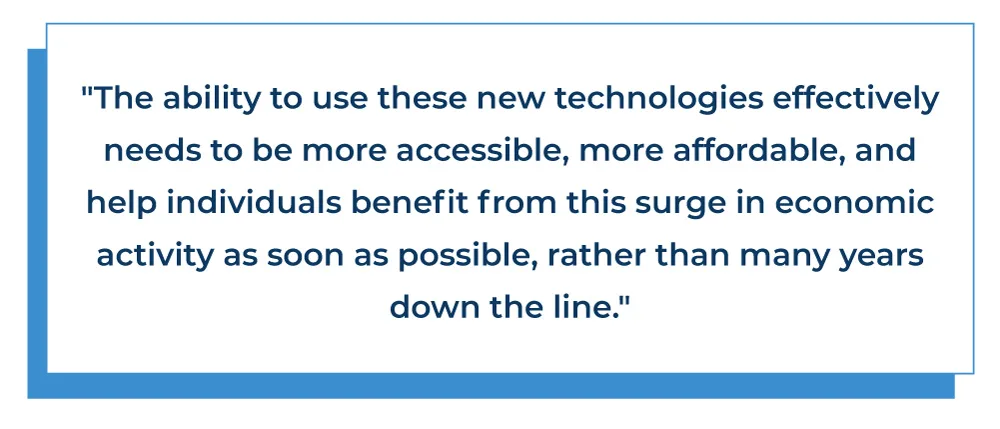
To best prepare Africa’s young workforce for this wave of digital work, and take advantage of the tremendous progress made in connection millions of people, education models should instead be:
- As accessible as possible, via the internet and mobile devices;
- Designed to take into account limited access to computers/devices;
- Accessible on even low-bandwidth and limited internet connections;
- Focus on practical skills development to to get them jobs as soon as possible;
- Cheap – rather than require tens of thousands of dollars;
- Time sensitive – rather than require four years of study just to get an entry-level position;
- Open to all, in a way that takes into account limited access to decent primary and secondary education.
Africa’s many issues have kept it at a serious global disadvantage for many, many years now. However, with the massive wave of digitisation happening across the continent, it’s clear that Africa is a serious contender for the title of the Next Big International Tech Hub. If Africa’s governments can address the core issues that we’ve outlined above, and truly help young Africans learn the skills they need to be included in this wave of transformation, it would accelerate Africa into the digital limelight, and uplift many millions of her people.
Our bootcamps are keeping a finger on the pulse of these African issues, and many other problems across the world that contribute to the growing global tech skills gap. Click here to find out more about our 1-on-1 mentored approach to teaching Africa’s future tech leaders job-ready essential tech skills for the new African context.

News & Announcements
June 16, 2021
SA’s youth unemployment rate: what we should be doing about it
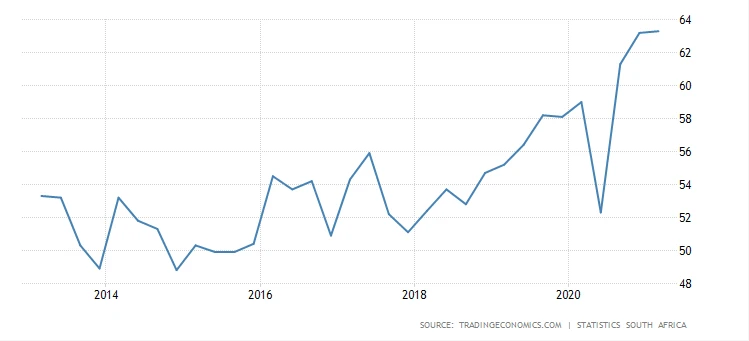
In Q1 2021, the official youth unemployment rate officially hit 46.3% in South Africa. Here's what we should be doing about it.
Youth unemployment has long been one of South Africa’s most pressing and complex challenges, and in 2021 it only got worse.
The South African government recently shared the results of the 2021 Quarterly Labour Force Survey and it paints a bleak picture for the state of unemployment in the country, specifically amongst the youth. As of Q1 2021, the official unemployment rate among youth (15-34 years) was 46.3%.
The COVID-19 pandemic is widely understood to have negatively impacted employment opportunities for young South Africans; however, the severity of this social issue is also due to many other systemic factors, such as our broken and outdated education system, which leaves matriculating students at a disadvantage in the globally online world.
What the president had to say
In his most recent weekly letter to the public, President Cyril Ramaphosa weighed in on the topic as he reflected on Youth Day and the role of young people in South Africa. The president claimed that the government’s current top priority is to create training and employment opportunities for young people, as well as systems of support that help them to succeed in these opportunities.
President Ramaphosa’s open letter stated:
“Everything that we do as a government contributes towards improving the lives of young people. Tackling youth unemployment requires accelerating economic growth, particularly in labour-intensive sectors, and building the capability of the state to fulfil its developmental role.”
The president’s letter addressed the Presidential Youth Employment Intervention, which reportedly began a few weeks before South Africa’s national lockdown last year and is soon to be fully implemented.
Ramaphosa wrote that:
“The Presidential Youth Employment Intervention was built on the understanding that to address the youth unemployment crisis requires innovative thinking and strong partnerships across society. Its ultimate objective is to find models that work, whether in skills development or active labour market policies, and to scale these models rapidly to reach as many young people as possible.”
“Most importantly, it recognises that young people must be at the centre of any effort to boost youth employment. Young people are our greatest asset, and our greatest weapon in this fight.”
The president outlined two Presidential Youth Employment Intervention initiatives that the government believes will help to combat youth unemployment.
- The Presidential Employment Stimulus. This is a fund that “aims to create new jobs, provide support for livelihoods and protect existing jobs in vulnerable sectors”
- A National Pathway Management Network. This is an initiative that helps young job seekers to view and access opportunities and “receive active support to find pathways into the labour market”
The untackled challenges
On paper, the Presidential Youth Employment Intervention initiatives seem to hold promise. However, they fail to address some key issues that are at the root of our youth unemployment crisis, ultimately misdiagnosing the problem. The answer to youth unemployment isn’t merely to give young people money or temporary jobs, because this ignores the fact that the systems that prepare these youth for jobs are ‘training’ them for shrinking low-skill and high-competition positions in labour or services. Instead, the President’s response should consider these key contributors to the worsening crisis:
- Outdated education systems
The unemployment crisis is deeply connected to our outdated education models. There is a disconnect between what the knowledge, skills, and training that traditional secondary and tertiary education providers offer and what the labour market and employers actually need.
According to Stats SA, “…the young work-seekers are not well educated and do not possess sufficient skills and previous work experience demanded by employers in the labour market. The economy demands skilled and experienced work-seekers, which makes it difficult and lessens the chances for young people to find employment, which ultimately results in some losing hope of ever finding a job.”
- The serious role of poverty and other social issues
Many young people who are struggling to find employment are also reckoning with other complex socio-economic factors, predominantly issues of poverty. These challenges can greatly hinder their ability to take part in necessary training and employment opportunities.
In a recent BizNews article, three researchers weigh in on this, saying that:
“Evidence repeatedly shows how many barriers and challenges young people face as they leave the education system and begin to find their way towards a job, and perhaps even a career. These barriers are not only related to the labour market or education system. They also include issues such as food insecurity, income poverty, and care responsibilities, among others. Each of these limit the ability of young people to look for work.”
- Supply versus demand
Skills and training aside, young people’s ability to find work is contingent on the availability of employment opportunities, and therefore an existing demand for employees. In essence, job placement statistics speak more to demand than supply.
On this, the same three researchers shared with BizNews that:
“A young person’s ability to find a job doesn’t depend only on their skills but also on whether the labour market is creating sufficient demand for employees. No matter how well a programme trains and supports a young person, if there are limited jobs, young people are unlikely to be employed.”
What is needed?
We don’t have all the answers, but based on the complex set of challenges that we face as a country when it comes to youth unemployment, it’s clear that what’s needed is a multidimensional approach that accounts for South Africa’s many social and economic factors.
- A fresh take on education
Young people need to receive training that has a strong practical focus, is industry aligned, and that is actively connected to relevant organisations in the public and private sectors.
- Continuous training
We need to focus not only on simply placing someone in a job, but ensuring that they are placed into a meaningful career pathway that also provides continuous training and growth opportunities. In this way, we can ensure that our workforce continues to upskill, while also having the security of employment.
- Meaningful support
It’s not enough to merely train young people and place them in a job, especially when many of them are coming from a position of poverty. Young job seekers need intensive social and financial support from both government and the private sector to ensure they can thrive in education, training and early employment.
We believe that our model of combined online education with personal mentorship and a focus on job-ready skills for an increasingly digital world are at least part of the answer to the crisis of youth unemployment. Our ability to offer accessible, affordable tech education that gets job seekers ready to work in as little as 3 months (rather than 4 years in comparable degree programs) truly empowers youth not just to find work in the rapidly growing global tech industry, but to learn transferrable, in-demand skills that set them up for a lifetime of fulfilling work and career growth.
As a tertiary education provider in South Africa, we’re committed to ensuring that we’re doing our part in solving the youth unemployment crisis in our country.
Read more about our methodology and vision here.
Student Success Stories
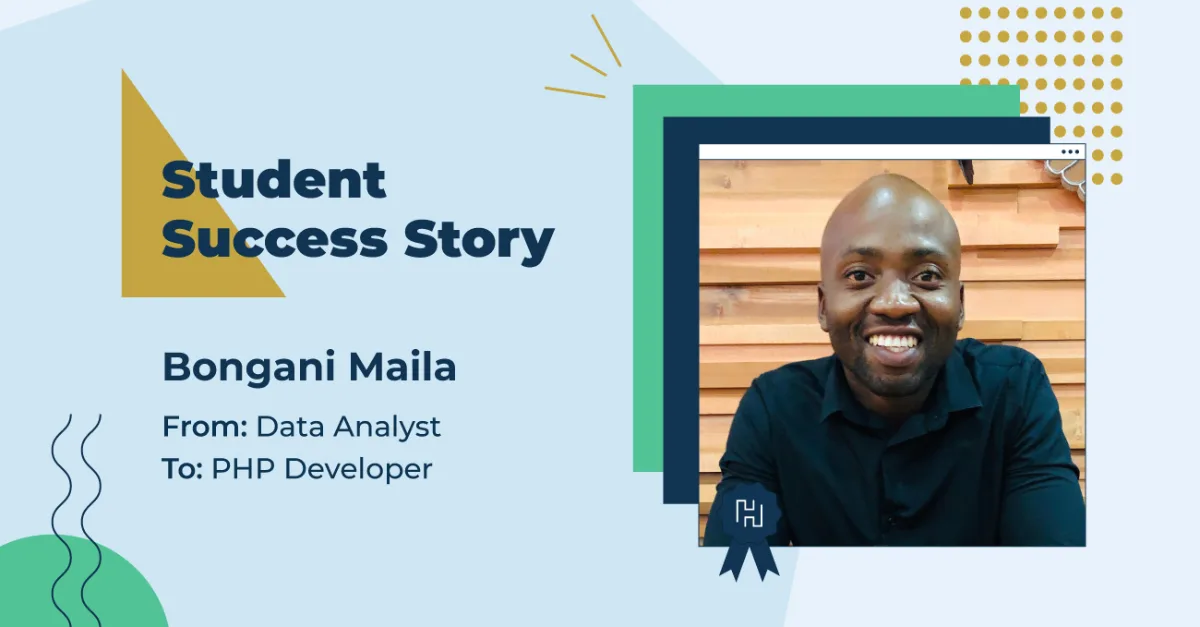
Bongani’s Journey: From Data Analyst to PHP Developer
Bongani Maila just landed a job as a professional Full Stack PHP Developer. We asked him about his coding with HyperionDev.
Practical skills are a critical part of finding a rewarding and fulfilling job. This simple fact is especially true in the world of modern work, where skills that are needed to work with digital technology, software, and highly complex platforms are key to keep operations running smoothly.
Bongani Maila knew that developing these skills would be a crucial part of securing future job opportunities in a high-paying and stable career. So he signed up for a full-time online HyperionDev Full Stack Web Developer bootcamp. On this intensive, mentor-led bootcamp, Bongani was able to learn job-ready skills to build working web and software applications, and start working as a professional full stack developer.
Just a month after graduating from his HyperionDev Full Stack Web Developer bootcamp, Bongani landed a job as a Data Analyst, before eventually finding his new role as a Full Stack PHP developer at The MCG group.
We asked him a few questions about his journey in learning to code, why he decided to learn the skill set to change his career path, and what it was like to learn web development on a HyperionDev coding bootcamp.
Was taking a bootcamp about upskilling and improving your current job prospects or about making a drastic career change?
It was more of improving the skill set I currently have. I’m always looking to hone these skills; at the moment I’m still doing my IT diploma as well.
Why did you decide to sign up for a coding bootcamp and learn to code?
I wanted to develop skills for an in-demand job, because I know that most companies need programmers. For me it was all about solidifying what I currently know, and HyperionDev looked like a great place to start. It was a no-brainer, really.
Where do you currently work and what is your role?
I work for The MCG group and I’m a full stack PHP developer. It’s a permanent position, which I landed after being approached by a recruiter.
What were you doing or where did you work before your HyperionDev Full Stack Web Developer bootcamp?
Before I started my bootcamp I was working as a general foreman for my younger brother’s company, GTP Holding. Fortunately for me, a month after graduating from HyperionDev I got a job as a data analyst, then 10 months later I got my current job as a developer.
Tell us more about your decision to change careers. What made you want to switch over to a new job?
It was more about breaking into the industry as a developer and building a solid foundation. I’m still building but getting closer to where I want to be.
Tell us about your experience of the 1:1 mentorship at HyperionDev.
Imraan Meyer was my personal mentor. He is probably the coolest mentor you could have: he always made time for me, and would help me whenever I got stuck. We’d have calls for hours even! Without him it would’ve been really difficult.
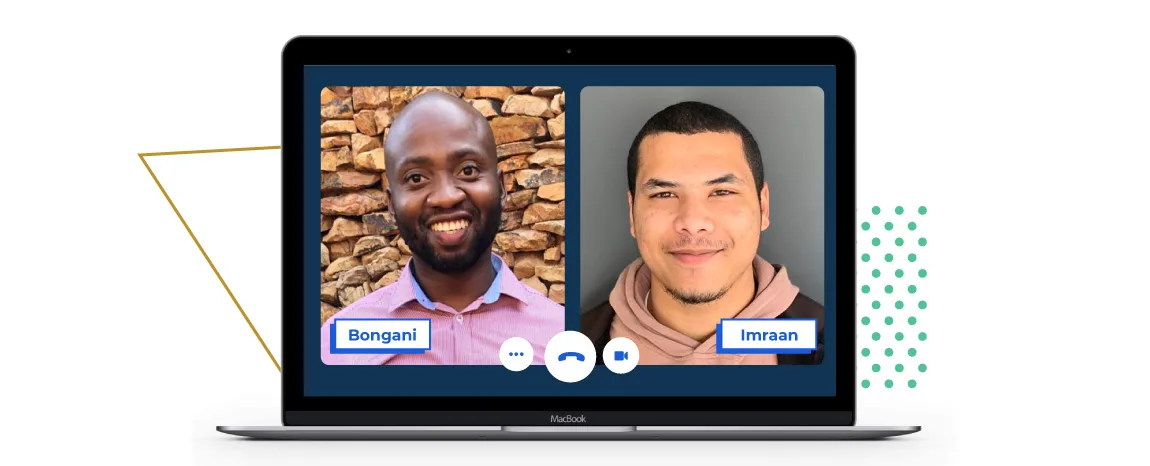
Tell us about your new job. What are your new responsibilities, and how do you use what you learned on your coding bootcamp?
My role is more of maintaining the systems which are currently in place. My typical work involves adding small features, maintaining the database, and completing requests made by our clients.
What was the interview process like?
It was quite a lengthy process that included 3 interviews and 2 tests. It took quite some time and energy, as you can imagine.
What did you learn at HyperionDev that helped you in your current job as a PHP Developer?
I still use the same methods and coding structure my mentor (Imraan Meyer) taught me. By far the most useful things I learnt were JavaScript and databases. Although I don’t use MongoDB, it gave me an idea of how databases work.
Which tech stack(s) do you mostly use in your work and what is the coolest thing you learned in your new role?
For most of my work I use the LAMP stack. I’m still in the learning process as a PHP Developer, however, everything about the job has been great so far!
What part of your coding bootcamp did you enjoy the most?
The code reviewing process was great, because it showed me alternative ways of solving programming challenges. However, I really enjoyed the hands-on capstone projects where you have to build programs yourself. They were hard, but they were really nice to do.
What was the most challenging part of your HyperionDev Full Stack Web Developer bootcamp, and how did you overcome it?
It was probably the last project. Trying to figure out how to make everything work. My mentor would give me ideas on ways I could get solutions to the challenges I was facing. He talked me through it and then gave me a chance to do it by myself, which was a great way to learn without feeling alone.
What are your hopes and goals for your tech career in the future?
I wish to grow into a senior developer someday, and to become a mentor to junior developers coming along. I went through the same process so it would be nice for me to give back some day.
What advice would you give to people who are thinking about learning to code or changing careers to become developers?
Try it! It’s hard at first but once you get it you’ll fly. I live by the quote “Begin as you wish to go on”.
Thinking about your own change of career, or been dreaming of entering the tech sector to earn an amazing salary doing challenging, fulfilling work? Our online and on-site coding bootcamps are the best place for you. Our mentor-led bootcamps focus on teaching you practical, job-ready skills to make working programs and projects in web development, software engineering, or data science in as little as 3 months.
The flexible learning options mean you can balance your life, work, and coding education – and graduate ready to work. Best of all, you don’t need any prior coding experience whatsoever; and our new 90-day Graduate Program will support you as you land your own tech job after your bootcamp, just like Bongani did.
Find out more about our affordable, accessible coding bootcamps by clicking here.
Software Engineering
The rise of DevOps: Everything you need to know about the DevOp world.
In this guest article, HyperionDev graduate Kalin Pretorius shares his experiences as a professional working in the DevOp field.
Kalin Pretorius is a HyperionDev Software Engineer bootcamp graduate and a former IT Operations specialist who now works as a professional in the DevOp field.He shares his experience of transitioning into the DevOps world as well as his tips and suggestions for those considering a DevOp career.
I first learned about the Software Development Lifecycle in 2020, when I completed my HyperionDev Software Engineer bootcamp. It made me realise how important software development has been in the modern world; it also introduced me to new ways of thinking, and solving problems, and it made me rethink what can be achieved with software development. Since then, I’ve transitioned from a IT Operations focused background to the world of DevOps.
Currently, I’m a DevOps engineer at a leading eCommerce platform in South Africa, and as the eCommerce industry has grown over the past few years (and with the acceleration of online services due to the global pandemic) the demand for skilled DevOps Engineers has increased. I thought I would share everything I’ve learned about DevOps, so that more people discover this burgeoning, rewarding career field for themselves.
Understanding DevOps
DevOps is a culture more than it is a job title. DevOps is essentially a set of practices that combines Software Development and IT operations. The aim is to shorten the software development life cycle and provide continuous delivery of software.
As the demand for Software Engineers increased and Agile Development practices took rise, there was a need to increase efficiency and improve delivery time of software. DevOps culture is all about a shared understanding between developers and operations, and sharing responsibility for the software they build.
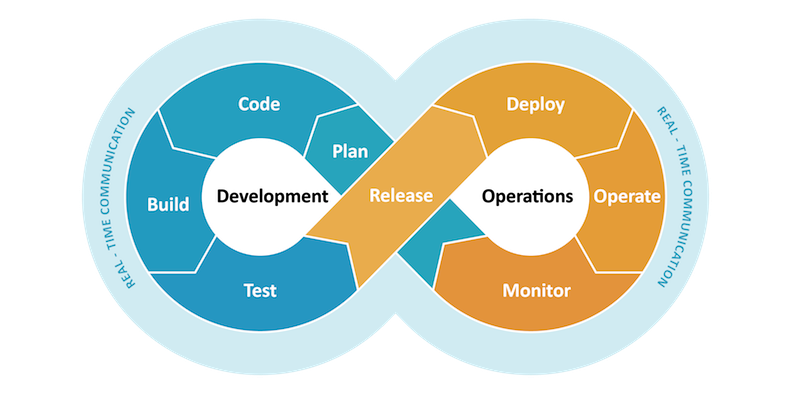
The practice of DevOps is nothing but a set of philosophies, practices, and tools that help an organisation to deliver better products faster by facilitating an integration of the development and operations teams. That means increasing transparency, communication, and collaboration across all teams like Development, IT,Operations, and the rest of the company.
Today, DevOps is a rapidly expanding field of software development: since 2016 more than 70% of small- to medium-sized businesses have adopted DevOps Services.
How to thrive in DevOp world
Here are some of the most important skills that a DevOps engineer needs:
- Good communication and collaboration are the most important skills to have. Team work makes the dream work.
- Knowledge of various DevOps tools and technologies. A strong understanding of Linux would be advantageous in any IT field.
- The management of various DevOps practices such as the source code, configuration, and most importantly Continuous Integration/ Delivery (CI/CD).
There is a lot of innovation taking place in the world of DevOps.The most exciting technology at the moment is containers and container orchestration – tools such as Docker and Kubernetes have revolutionised virtualisation technology.
The great thing about a career in DevOps is that anybody with a diverse background of IT can move to a DevOps-focused role. Even if you are experienced in Networking or System Administration, DevOps feels like a step into the future, with Cloud Computing, Automation, and the SDLC becoming your new playground.
Perhaps the best way to thrive in DevOps is by practicing your skills and joining an active community. Your best friends should be Google and Reddit, where you’ll find a multitude of articles, blog posts, tutorials, and learning resources about DevOps. If you’re looking for a fantastic starting point, then a great book I would recommend is “The Phoenix Project”, by Gene Kim.
The fields of IT and software development have been in constant change for decades. DevOps is no different. If you’re looking to get into DevOps, constant learning and experimentation should be your main focuses – expect things to not stay the same, and be ready to evolve as a professional with the times. The only constant is change. It’s a marathon, not a sprint. Keep learning and working, and you’ll find that DevOps is a phenomenally rewarding field to work in.
Interested in writing for us, to share your thoughts, experiences, and expertise with the HyperionDev community? Reach out to us here and we’ll get you published.
News & Announcements
June 8, 2021
HyperionDev Secures £2.5M in Africa’s Largest EdTech Series A
Southern Africa’s leading tech education provider secures over £2,521,000 (R50 million) in Africa’s largest edtech Series A fundraise.
Southern Africa’s leading provider of tech education secures Africa’s largest edtech Series A fundraiser, raising over £2,521,000 (R50 million) in just 12 weeks through combined private investments and public crowdfunding. This milestone will help the Facebook and Google-backed coding bootcamps specialist drive its planned UK, US, and global expansions, and enable over R3.5 million in full scholarships for students in need.
Through an innovative combination of public crowdfunding and private investment, coding bootcamps provider, HyperionDev, has raised over £2,521,000 (R50 million) in an edtech Series A fundraiser.
This combined funding strategy attracted over 1,500 investors from more than 20 countries, culminating in one of the largest ever edtech Series A fundraises in Africa. HyperionDev’s public investment crowdfund on crowd investment platform CrowdCube was particularly successful: from its original goal of raising £750,000 (R15 million) in 31 days, the company was swarmed with public interest, surpassing its target in just 5 days. Within 14 days, HyperionDev’s campaign raised £1,866,123 (R37,250,000).
Founder and CEO of HyperionDev, Riaz Moola, said:
“This incredible milestone will directly benefit thousands of students across the globe who are looking for an accessible and affordable way to learn job-ready, practical developer skills in months rather than years. In the past 12 weeks, we’ve welcomed over 1,500 new stakeholders. We believe that our coding bootcamps are the best way to close the growing global tech skills gap, and with this wave of support we are one step closer to fulfilling our mission in the US and UK markets.”
The HyperionDev Series A milestone will mark the next stage of its planned expansion into UK and US markets on the back of the company’s success in Africa, including 640% revenue growth since 2018, a 254% growth in active users during lockdown, and more than 100,000 student registrations.
This fundraising success will also directly enable over £175,000 (R3.5 million) in full coding bootcamp scholarships for deserving students. In addition, the campaign included investor scholarships and investor awards to the value of £700,000 (R13,850,000), with new stakeholders donating free bootcamps and discounted courses to students in need.
Moola continues:
“This has been our biggest campaign to date. The reaped rewards will allow us to give back over R3.5 million in full coding bootcamp scholarships for students in need. What’s been particularly great is our investors’ generosity and belief in our vision for accessible education. These investors were promised a reward of a free or heavily discounted bootcamp with their investment; many of them have chosen to donate their bootcamp reward to students. It’s been amazing to watch so many people get on board with this social impact investment and make real change to the lives of South African youth.”
Many South African youth are simply unable to afford a university education. According to Statistics SA, 51% of youth aged 18–24 claimed that they did not have the financial means to pay for their tuition. This social issue persists in an environment where tertiary education fees rise by up to 25%; in South Africa alone, the cost of going to university has skyrocketed, with an undergraduate degree costing on average between R30,000 and R70,000 per year.
The increasing inaccessibility and high cost of university bodes well for the edtech sector and HyperionDev’s future, which continues to dominate the education alternatives sector. Today, the global tech education & assessments market is estimated to be valued at around $300 billion.
Moola concludes:
“I strongly believe that accessible tech education is the future of social upliftment and mobility for thousands of people across the globe. In South Africa, there are far too many people who do not have the skills or opportunities to find well-paying, decent jobs.
Our focus on close mentorship and developing practical, job-ready skills to get students ready for real developer work in months rather than years proves that people are hungry for a world-class education that helps them build their future, without having to sacrifice years of study or spend thousands of dollars to do so. We are thrilled to see that this initiative has raised the bar for Africa’s digital future, bringing us one step closer to closing the global tech skills gap for good.”
For more information about HyperionDev’s award-winning coding bootcamps, visit www.hyperiondev.com
News & Announcements
June 8, 2021
Is Digital Education Truly Closing the Global Skills Gap?
It’s easy to assume that digital education is revolutionising the world, as internet access and online courses become more ubiquitous.
Mariken Jansen van Vuuren is an education and marketing specialist, and HyperionDev’s Head of Product and Brand Marketing. She draws on nearly a decade of marking strategy and branding expertise to help us in our mission to close the growing global tech skills gap.
In today’s era of web accessibility, it’s easy to assume that everybody has access to digital education, and with good reason. In Africa alone, internet users have grown from just 4.5 million in 2010 to over 100 million, and those are only the users that can be verified.
However, despite this sharp increase in internet access , there are still challenges to accessibility: in many cases, learners are forced to share devices, have limited access to often low-bandwidth connectivity, or are hindered by the unfamiliar challenges of virtual learning presenting new challenges.
There is no singular simple solution that will close the growing tech skills gap. What is needed is a deep and nuanced understanding of exactly what challenges and hurdles lie ahead.
The biggest challenges in digital education
The past year of global lockdowns has shown the world the true power and flexibility of online learning. However, this method of learning still has many challenges that educators and course creators will need to overcome if online learning is to become the primary method of receiving a world-class education.
- Unregulated courses and quality concerns.
Creating an online learning experience isn’t difficult in the age of ubiquitous online courses, democratised media, and drag-and-drop web builds. Anyone with sufficient internet access and some basic technical knowledge can now create a course online. - While there are benefits such as allowing for niche learning and a variety of approaches, it can also mean that courses are not adequately regulated and don’t offer recognised certifications. As a result, learners question the value and validity of courses, and job-seekers often lack the tools they need to step confidently into a new role.
- Minimised face-to-face interaction.
While many online learning systems include peer interaction and two-way learning, most online courses are delivered in siloes. We can’t underestimate the importance of access to lecturers and personalised support in this virtual environment, especially in highly technical subjects like computer programming. - Online systems are often demanding.
Most online learning platforms inevitably require more effort from students compared to traditional learning. Whether a student is submitting an assignment, getting to grips with their new digital learning environment, or accessing and categorising learning materials online, can mean more work in the short term. Also, traditional or hybrid learning approaches, typically mean access to tutors or academic advisors, which is not always the case in a purely digital learning format. - In my experience at HyperionDev, we’re constantly iterating on our learning design, process and experience in order to combat this and to ensure that we can offer students a more hybrid and supported learning approach through initiatives such as our 1:1 mentorship model.
- An increased need for self-discipline and direction.
Without regular visits to class or campus, the pressure to drive learning and participate in the education system falls entirely onto the student. . e-Learning requires self-discipline. Submitting assignments, joining quorums, and attending class are important ways to adequately prepare and pass.
The fact remains that skills gaps have, and will always be, a concern for jobseekers and a thorn in the side of entrepreneurs and industries that require specialised competencies. Of course, that is without an accessible solution. Unsurprisingly, LinkedIn released research based on a survey of over 1,200 professionals, indicating that assessing and addressing skills gaps was the most important metric for “talent developers”.
The power of online learning
The flexibility, adaptiveness, and accessibility of online learning solutions are what make it the best method of delivering a world-class skills education, while overcoming the many hurdles of traditional and in-person education.
- Self-paced learning and flexibility.
Today, even EMBAs are administered online, giving executives the opportunity to continue meeting the demands of their busy work schedules while upskilling. This reflects the reality of most post-secondary education: most adult students need to work while they learn. The flexibility and self-paced nature of virtual learning creates greater access for part-time students and indeed anyone with major commitments. - Greater accessibility for the majority.
While there are still areas where internet adoption is low, most countries in the world have some form of individual or shared access to connectivity in developed areas. This is critical in our present day context where transport barriers and social challenges like global virus outbreaks make it more difficult than ever to travel. Both of these factors demonstrate why accessible online learning remains the best way to close the global skills gap. - Crucial tech skills and digital integration.
- As the world changes, learners must become familiar with digital interfaces. Online educational systems can pave the way for easy entry and advancement in online learning by taking advantage of cutting-edge User Interface and User Experience techniques.
- Cost effectiveness.
Online learning experiences are typically less expensive to deliver and therefore consume. And while prices vary, there are many ways in which learners save on travel costs, housing, physical textbooks and stationery when their courses are run online. - Centralised learning materials and access.
Accessibility of online learning also involves a student’s access to their learning environment and materials – and online courses easily beat physical classes. Instead of trying to keep copies of important documents in one place or trying to locate books or learning materials at short notice, students can virtually access everything they need from one place, where data and assets are securely stored. This simplicity streamlines learning like nothing else. - Accreditations for guidance.
Certificates are not always an incentive for learning. In some cases, the credibility of an experience manifests in the ability to complete tasks. However, in industries such as technology, analytics, communications and project management, certification can play a vital role in qualifying job applicants. The increased demand for digital skills in particular, has subsequently increased the demand for regulation and accredited learning experiences online. While the system as a whole isn’t perfect, it is improving. - Greater investment in the e-learning space.
As the benefits of learning online become increasingly apparent, governmental programmes and stalwart institutions are now investing more in creating effective platforms. With functionality like peer-to-peer interaction, Q&As, document uploads, calendar management, and personalised dashboards, students are reaping the rewards of this investment from reputable institutions.
If we consider these benefits, and the ways in which we can address current challenges to access, there is still a viable argument for closing the skills gap using e-learning. Now, the question veers away from the efficacy of digital education to the real question: How are we making a viable contribution with online education?
How to secure the future of online learning
To truly revolutionise the future of learning will take a three-pronged approach. First, we need to create reputable learning platforms that students can trust; second, we need to futureproof this style of learning; and third, we need to create an education style that is more highly targeted towards societal impact. Here’s what we think that looks like:
- Addressing the challenges
Accessibility, accountability, time management and credibility are all key challenges in closing the gap. So, where does the most comprehensive answer lie? Immersive learning is the key to driving these changes, offering students the chance to focus on practical skills development and real problem-solving with frequent check-ins on their progress. We’ve seen the positive effects of this in our immersive bootcamps, where frequent lessons, practicals, and mentoring form a big part of the overall demands.
- Future-proofing education
Education needs to have a technical element at every level to acclimatise students to the future of work. Numerous dot coms and businesses ultimately fail because they don’t have the tech skills to effectively run and market their businesses – and this is where code plays a significant role. Big Data, SAS, and advanced analytic analysis are here to stay, and if you can’t operate in basic virtual environments, you’re going to struggle as tech progresses. At HyperionDev, we’re committed to teaching these highly technical developer skills that enable students’ careers.
- Impacting society as a whole
As learners pick up critical skills they can begin to close the skills gap that persists across the world. With skill development comes greater employment, shared opportunities, and faster advancement in the world of tech, philanthropy and development. The benefits of alleviating poverty, democratising opportunity and creating room for new digital ideas can transform societies more effectively than offline pursuits.
In a nutshell
Ultimately, immersive learning is the key to driving skills development on a global scale and should become standard practice for anyone operating in the e-learning space. As the coming era demands digital transformation and upskilling in this sector, educational bodies and conveners need to create the right environments for this learning to take place. Through key elements of user experience, support and regulation, we can begin to transform society as a whole and establish a new generation, equipped to crack the code of operating in a virtual world.
News & Announcements
May 27, 2021
HyperionDev Employee story: Serge Thomas
Our coding mentors are the heart and soul of our world-class coding bootcamps. In this HyperionDev employee story, we ask a few questions to Serge Thomas, one of our on-site mentors, about his background, his work, and what it’s like to be a part of HyperionDev.
Our mentors are what make our bootcamps such a world-class essential tech skill education. Learning to code isn’t easy: there are lots of new concepts, jargon, and technologies for newcomers to grasp. Luckily, many of our mentors know what it’s like to start learning from scratch, and many of them are even products of our bootcamps, making them naturals at helping beginner coders. Today’s HyperionDev employee story focuses on one of our friendly, expert coding mentors, Serge Thomas.
Serge came to HyperionDev with a background in freelance development, mostly in python. However, his passion for learning and teaching drove him to apply for a position helping others along the difficult road of learning to code. Today, Serge’s work as a HyperionDev mentor is a critical part of our bootcamps’ successes: he helps hundreds of people switch careers into high-paying developer roles, with a patient ear, and a smile. We asked him a few questions about what it’s like to work on our team.
——-
What do you enjoy most about working at HyperionDev?
The coworkers! Everyone I work with has passion for what they do. The energy they all bring makes it worth being here.
What’s the heart and soul of your role as an on-site HyperionDev mentor?
My team works within the HyperionDev education department. On a daily basis, we mentors are actively engaging with people to help them learn a skill that has the potential to open so many doors for them. This could be in achieving a dream in tech, or in pursuing their career goals. I find it so interesting to be part of someone’s journey and kind of tag along for the ride with them.
What motivates you to come in or log in in the mornings?
The students! The students that come onto campus have different backgrounds and personalities so it’s always interesting to engage in such a diverse environment.
Tell us a bit about your professional development whilst working with HyperionDev.
I was originally a Software Engineering student and I am currently upskilling my Web Development skills as well.
How do you ensure that you keep yourself upskilled & knowledgeable in your field of expertise?
I am always relearning, mostly through online tutorials and learning resources. It might sound like ‘tutorial hell’ but I’ve come to realise that revisiting the fundamentals keeps me sharp and solidifies the concepts.
Which one of HyperionDev’s core values resonates with you most and why?
Progress Always, Its common knowledge that programming is hard but It is not as common that mistakes are allowed in the learning stage so this resonates with me because most students don’t anticipate the amount of mistakes they’ll make and I like to get to a point with them where they realise that it’s normal to make mistakes as long as they carry on with the journey and try to move forward.
What’s a fond memory you have of working at HyperionDev?
We got donuts/doughnuts from Jena and we had a mini donut party with everyone which was just thoughtful. Donuts can cure fatigue!
How is HyperionDev different from other places you’ve worked?
I had on/off jobs before this so as my first full time job I could not have wished for a better start in my career, from my managers to my co-workers it is really not what I expected of the work environment.
What makes you feel PROUD to work for HyperionDev?
The people I work with, the energy in the Edu-department is of a genuine need to help people get a start in their career in tech. They are all so helpful and knowledgeable it kind of motivates me to try my hardest as well.
_________________________________________________________________________
At HyperionDev, we’re always looking for talented professionals to join our team. Whether you’re a project management pro, a high-achieving sales executive, or someone who has a passion for teaching newcomers as they learn to code for the first time, there’s a place for you in our diverse and international team. As a HyperionDev employee, you’ll enjoy more than just fulfilling and challenging work with a fast-growing, internationally scaling start-up – we provide medical insurance, extensive remote working allowances, a generous leave policy, and real avenues for career growth, experimentation, and promotion.
Do you think you could be our next star HyperionDev employee? Visit our career page to see all our available positions and apply to join our team today!
News & Announcements
May 20, 2021
Empowering 50 Future Tech Leaders with R3.5M in Scholarships
After a long and difficult judging process of hundreds of exceptional entries, we have picked our 2021 HyperionDev Scholarship Winners. We’d like you to meet three of our winners who have been awarded full coding scholarships.
Our 2021 social impact crowdfund scholarships have been awarded. Thanks to the support of almost 1,500 investors from across the globe, we raised almost £2 million in just 14 days – a staggering achievement that has allowed us to award more than R3.5 million in full coding bootcamp scholarships to students in need.
This social impact investment will change the lives of more than 50 students across South Africa, who have been granted full scholarships to study software engineering, full stack web development, or data science on one of our mentor-led coding bootcamps. It is our hope that these scholarships represent a bold and practical effort to close the growing global tech skills gap, by empowering youth education.
We’d like you to meet three of our scholarship winners below: Njabulo, Buzwe, and Philile.
Njabulo is a student from Port Elizabeth who is currently completing her final year at Rhodes University. She works part-time writing educational content for an edtech startup, and also volunteers for a non-profit organisation at her university. Njabulo’s exposure to the tech space has sparked a passion to learn more about the solutions that coding has to offer the South African education system.
In her own words, Njabulo says:
“My experience at both the NPO and part-time job has made me realize the huge gap that South African learners, particularly those in government schools and low income households, have with regards to access to an understandable and quality education. It is problems and solutions like these that propel my interest in Artificial Intelligence and the many possibilities it offers for humanity, all through coding.”
Njabulo will be starting her coding journey with HyperionDev Software Engineer Bootcamp later this year. When asked what she is most looking forward to in her coding bootcamp, Njabulo shared that:
“Learning and applying the skills I acquire is the most exciting part for me. I have zero knowledge on coding so I’m really curious to see where this journey will take me. I’m a natural problem-solver so this bootcamp will DEFINITELY keep me on my toes!”
Njabulo is excited to see where this coding journey takes her, as she hopes to not only develop her skills on a personal level, but to also use her coding skills to create a positive impact in society.
This is what Njabulo had to say on where she hopes her coding bootcamp will take her:
“After a year I hope to see myself not only getting exposed to the South African tech space, but also to the international tech space and its opportunities, as small of a fish as I am. Employment would be great but I’m also curious to see what I (or a group of collaborators and myself) am able to create that’ll ensure a positive impact. The tech skills I’ll acquire are not only for my personal gain and for me to hone them, but they are also for society too, in whatever space I find myself in.”
Buzwe is originally from Khayelitsha, Cape Town. Buzwe developed an interest in entrepreneurship through the Bridges for Music Academy in Langa and has since been upskilling himself through various seminars and entrepreneurial workshops. Buzwe describes himself as a “social entrepreneur at heart”.
“My entrepreneurship drive was refined by an academy called Bridges for Music in Langa Township in Cape Town which focuses on music and entrepreneurship. Bridges for Music Academy is where my skills of mindfulness, entrepreneurship and sound production were sharpened and enhanced. I had the privilege of being mentored by various active agents in social entrepreneurship in South Africa.”
Buzwe has a keen interest in cybersecurity and hopes to one day develop tools to protect consumers from money laundering scams, and to safeguard consumer data.
In line with his entrepreneurial spirit, Buzwe is excited to connect with fellow coders and coding mentors when he starts his HyperionDev Data Scientist bootcamp later this year. After his bootcamp, Buzwe hopes to work as a developer and to be able to give back to other young entrepreneurs.
“I would love to create a mini Khan Academy for pupils and those with an entrepreneurship spirit like myself.”
Our next scholarship winner Philile hopes to explore her interest in technology by developing her coding skills through the HyperionDev Software Engineer Bootcamp.
“I want to be part of the change taking place in the world. I want to look at the technological and digital progress and be proud that I am part of carrying that change. It is especially important to me because I am a young, black woman therefore being part of the tech industry will be ground-breaking and powerful.”
Philile has a clear vision of where she hopes to see herself in the future, after completing her HyperionDev bootcamp and intends to combine her passion for food science with tech skills.
“I see myself as a Junior Software Engineer at a prominent tech organization that values innovation, diversity, and quality, while upskilling and improving my knowledge with another one of HyperionDev’s bootcamps.
I would love to work my way to being a Senior Software Engineer. The ultimate project I see myself designing and creating is a food safety compliance software that maintains records of Food Quality Control, and keeps track of temperature control, pest control, hygiene and sanitation, and adherence to food safety protocols such as Haccp and ISO22000. This program would be suitable for validation and verification, and would be effective, efficient, and reliable for quality controllers and food technologists and scientists.”
Philile is excited to develop new skills through our bootcamps. She shares what she is most looking forward to during her course:
“I am mostly excited for the challenge. I enjoy problem solving and puzzling scenarios so it is only fitting for me to learn a skill that will not only uplift me but also challenge me. I am excited about learning how to take a problem, create a vision and combine it with the realities of the computer language to create a product/solution that performs all the tasks it is expected to.”
These remarkable students are just 3 out of the numerous winners selected to win a fully funded HyperionDev coding bootcamp. Njabulo, Buzwe and Philile will be joining our coding bootcamps soon and we will continue to follow them on their journey to achieving their goals.
Be sure to follow along as we have many more incredible stories to share with you as we introduce more of our scholarship winners.
News & Announcements
May 19, 2021
HyperionDev Employee Story: Julia Unite
This HyperionDev employee story explores the work of Julia Unite, our Product Marketing Coordinator. With her diverse background in education, online marketing, and public relations, Julia empowers our brand and public communications. We asked her a few questions about what it’s like to work at HyperionDev.
Our marketing team plays a crucial role in our continued rise as Africa’s leading coding bootcamp. Julia Unite is one of the newest members of this team: she brings her experience in PR and online marketing, and her expertise in educational content creation, to fine-tuning our outreach to new students. With her broad range of professional skills in making educational content, drafting course curricula, and crafting marketing strategies and adverts, Julia is a key part of making our marketing tick.
We asked her some questions about what it’s like to work at HyperionDev, what her roles and responsibilities are, and how she got to this point in her professional career.
What is your role at HyperionDev?
I’m a Product Marketing Coordinator.
What do you enjoy most about working at HyperionDev?
I’ve had a fairly unorthodox journey with HyperionDev (more on that later) and as a result have worn many different hats during my time here. I’ve really enjoyed having the freedom to explore different areas of the business and the opportunity to learn and grow through this.
What’s the heart and soul of your role at HyperionDev?
Knowing that what you’re doing is always, in some way, directly impacting someone else’s life for the better. In my role specifically, I love being able to share and promote the amazing work that the HyperionDev Team does, as well as the stories and successes of our students and employees.
What motivates you to come in or login in the mornings?
Is it cliché to say coffee? Aside from a warm caffeinated beverage, I’d have to say my team – we always find time in the day to check in with each other and/or crack a few jokes.
Tell us a bit about your professional development as a HyperionDev employee.
I’ve had a pretty interesting journey at HyperionDev. When I first joined I was part of the Education Team. In many ways, the Education Team is the heart and soul of what HyperionDev does and I really learnt a lot about our product and customers while being ‘on the ground’ and directly interacting with students. Since then, I’ve had the opportunity to work with almost every team in the company, including Education, Careers, Student Success, Fundraising, Brand, and Marketing. It’s really pushed me out of my comfort zone, and has given me a really well-rounded understanding of the company, and the EdTech space in general. I’ve ultimately found my home in the Product & Brand Marketing Team, which has been awesome. I feel as if I’ve been able to put the experience I’ve gained in the company so far to good use in this role, while also being able to learn from a really experienced, supportive and collaborative team.
What’s a fond memory you have of working at HyperionDev?
At the end of 2020 we launched a campaign to close a Series A funding round (with local and international investors) and ended up hitting 250% of our initial target. It was such an incredible experience being part of the team to pull this off. It was a challenging experience to say the least, but all in all incredibly rewarding.
Which of HyperionDev’s core values resonates with you most & why?
I’d have to say the value of “People First”. I think people are the heart and soul of any organisation, be it in the capacity of employee or consumer.
How do you ensure that you keep yourself upskilled + knowledgeable in your field of expertise?
I think learning is a lifelong commitment: no one is ever too smart to learn something new. Being in the brand and product marketing space, there is always so much creativity and innovation to be inspired by. In short: podcasts, books, industry newsletters/reports, online courses and following interesting people and brands on social media channels.
How is HyperionDev different from other places you’ve worked? We are keen to hear about the positive differences.
HyperionDev really focuses on diversity and inclusion. I have met some truly incredible, passionate, smart and inspiring people while working here.
What makes you feel PROUD to work for HyperionDev?
Knowing that we are making tech education more accessible and inclusive.
At HyperionDev, we’re always looking for talented professionals to join our team. Whether you’re a specialist in project management, an online marketing guru, or a skilled developer who is passionate about tech education, there’s a place for you in our diverse international team. As a HyperionDev employee, you’ll enjoy more than just fulfilling and challenging work with a fast-growing, internationally scaling start-up – we provide medical insurance, extensive remote working allowances, a generous leave policy, and real avenues for career growth, experimentation, and promotion.
Do you think you could be our next star HyperionDev employee? Visit our career page to see all our available positions and apply to join our team today!
Student Success Stories
Student Success Story: Lungile – From Student to Java Developer
This HyperionDev Student Success Story focuses on Data Scientist bootcamp graduate Lungile Mngonyama, who joined a part-time online bootcamp so that she could fit learning essential tech skills into her busy schedule. After graduating from her bootcamp, Lungile found a job as a professional Java Developer.
Lungile Mngonyama had always been interested in data science, and learning to use tech to empower her career, research, and job prospects. However, as a busy student studying at Wits University, it was difficult for her to find time to learn the essential tech skills she was looking for. When Lungile discovered our online part-time coding bootcamps, she was elated to be able to fit learning these critical tech skills into her spare time. She enrolled for a Data Scientist bootcamp, and now – just months after graduating from her bootcamp – she is working as a professional Java Developer.
We asked her some questions about her journey in learning to code, and about her path to success in finding a job as a professional developer.
What were you doing before your HyperionDev bootcamp?
I was a student at Wits University.
Why exactly did you decide to take a HyperionDev bootcamp, and what led up to this decision?
I have always had a strong interest in data science, but I had no noticeable skills nor knowledge in the field. So I dared myself to partake in this bootcamp with the mindset that I will have no space of giving up because of the amount I was paying. Therefore I had to gather my strength and push to learn as much as I could so it would be worth every cent.
Where do you currently work and what is your role?
I work at Discovery Limited as a Java Developer.
Tell us about your new job. What are your new responsibilities, and how do you use what you learned in your coding bootcamp?
At my new job, I mostly create new web pages and websites. My HyperionDev bootcamp was really useful for this, because it taught me to think like a programmer, how to convert human language to computer code, and the practical skills (like Object Oriented Programming) that I need to get the job done.
How did you hear about the role?
I took part in the GradHack event the company was hosting last year, and managed to bag myself employment.
How did the part-time bootcamp accommodate your time/work requirements.
It was really flexible and fit my schedule. I had multiple options for mentor sessions at different times and dates, so I could choose the time most suitable for me, considering that I was also enrolled as a student at Wits University.
What did you think about your experience on the HyperionDev Data Scientist bootcamp?
HyperionDev was a good learning environment. It has firm supporting structure with good dedicated mentors, and my journey with them has been worth more than my time and money,
What was it like getting your coding submissions reviewed by an expert?
The code reviewing process was very supportive, because I knew I was on the right (or wrong) track, and it showed me alternative ways of solving programming challenges. The code review really took my coding to a new level.
What parts of your coding bootcamp were the most challenging, and how did you overcome these?
Using Neural Networks was really fun, but a real challenge. I managed to get through it by looking for extra learning materials about this technology.
What did you learn at HyperionDev that helped you in your current job?
SQL, and the use of Object Oriented Programming. Java and SQL are two of the most-used technologies at my new job, so learning these techniques and technologies was really useful.
What is the coolest thing you learned in your new role?
Creating websites, and working on both backend and frontend code of web pages.
Was taking a bootcamp about upskilling and improving your current job prospects or about making a drastic career change?
This bootcamp was about making a drastic career change. I had little knowledge on data science and programming, but I knew that I would need practical skills if I wanted to make a switch to the rapidly-growing tech industry. It was also about chasing my personal interests and passions: I’m a practical and curious person, and I love the research process. I’m very happy that I’m now employed as a developer by one of the biggest companies.
What advice would you give to people who are thinking about learning to code or changing careers to become developers?
Come and join us. It’s a challenge worth exploring, the money is good, the challenges never end, and you never stop learning. Plus, you can work any way you choose to (remotely or on-site), and you don’t need to have big, formal qualifications to be noticed in the industry, as long as you can demonstrate your skills and get the job done.
Do you want to learn in-demand tech skills to open up career doors in your future? Our online and on-site coding bootcamps will teach you everything you need to know to become a professional developer in as little as three months, just like Lungile did. Our mentor-led hybrid learning model combines close student support and expert code review with a focus on practical skills to make you job-ready in software engineering, web development, or data science, in just months. Best of all, our bootcamps understand that your life can get busy: you’ll be able to study flexibly and with freedom, so that you can fit your future tech career into your full-time job, uni course, or family weekends.
Apply now to secure your seat on Southern Africa’s leading coding bootcamp.
Student Success Stories
Student writer: I created Not Uber-Eats. Here’s how it happened.
HyperionDev Alumnus and Software Engineer bootcamp graduate Jake Owen shares his experiences in creating his own start-ups and projects, in particular the alternative e-food service site not-ubereats.co.za, which helps hundreds of local businesses and is attracting thousands of visitors a month.
Jake Owen completed his software engineering bootcamp with HyperionDev in 2020 and after graduation, he went straight into a 6-month internship with a startup called SapphireGem Tech. More recently, he has decided to pursue his entrepreneurial passion through his own venture: a startup called Not-UberEats.
Jakes shares his thoughts and insights on his journey so far.
My name is Jake Owen and I completed a 6 month software engineering bootcamp with HyperionDev in 2020. I have been coding now for roughly 18 months and I’ve discovered I love learning about new technologies. I find myself constantly generating ideas for things to develop using tech. I have always had an entrepreneurial mindset and have had a go with different startups. However I have realised that the world is full of problems and injustices, and that these are the areas worth focusing on. I feel a good business is not solely concerned with profits, but rather people: it prioritises people and their wellbeing over profit. This is the kind of business I want to be involved in.
My latest venture is Not-UberEats. This is a directory that lists all the restaurants in Cape Town offering independent delivery or pick up options. The concept was conceived as a result of enterprises like UberEats and Mr Delivery charging restaurants a steep 30% commission fee on every order made through their platforms. We wanted to create something to circumvent these high fees and help restaurants sustain their income during the pandemic. In the process, this helps stimulate the already struggling South African economy. That was the thinking behind, ‘Not-UberEats’. The overall goals being to make a difference and support local vendors.

The site was originally built by my business partner, Randy Singh using Gatsby, Contentful CMS and hosted on Netlify. For styling he used the React Bootstrap library. I set it up in South Africa and now we have not-ubereats.co.za. I am constantly going to Randy for help with the site and he is always incredibly kind, patient, and happy to help. I owe a huge thanks to him for all he has done.
We have approximately 60 restaurants in our directory with more being added all the time. Within our first month we managed to get over 1000 visits on the site. A large portion of these users came simply via word of mouth, with the rest generated from a very basic Facebook campaign we ran for a week.
The journey so far has been challenging and fascinating. It has taught me so much about these new technologies and has given me a good grasp of the full stack process. Every day there is unchartered territory to be explored in this industry . An added bonus has been the wonderful response from the tech community and the encouragement from our peers and users. Many people have reached out to connect and I’ve loved meeting so many awesome people within the tech world.
That being said, any new venture also comes with its challenges. Our challenge currently is figuring out the way forward for Not-UberEats. At present, it is a non-profit and we are looking for a way to maintain this approach while ensuring it is also sustainable. We will keep working on and improving the site and we need to find a way to fund this. As a result we are exploring opportunities for investors and startup capital to make this dream a reality and become a proper NPO.
The absolute best advice I can offer to someone wanting to embark on a project like this is: just start. Build a basic version and get it online to gauge how people respond to it. This is a great way of measuring how viable the project is and how it will be received. A surprising takeaway from this journey has been to see how, if you build something and put it online, people all over the world will check it out. And if they like it, they will actually begin to use the product or service. Having said that you won’t know this unless you just get going!
Do you have an interesting tech story, personal journey, or tech insights that you’d like to share with our thousands of students and developer alumni? Get in contact with us here.
If you want to start your journey to a new career in tech, our bootcamps are the best place for you. Our mentor-led bootcamps focus on teaching you practical, job-ready skills to make working programs and projects in software engineering, data science, and full stack web development. Best of all, you can balance your life, work, and coding education with our accessible learning structures, so that you can fit a future in tech into your schedule – and graduate ready to work in as little as three months.
Apply for your spot our coding bootcamps here.
Student Success Stories
Student Success Story: Max Deale – from Audio Engineer to Full Stack Developer
Thanks to his HyperionDev Web Developer bootcamp, Max made his career switch from Audio Engineer to Full Stack Developer, working as a HyperionDev coding mentor along the way. In this HyperionDev student success story, we asked him about his coding bootcamp experience and how transitioned into the tech industry.
In this HyperionDev student success story, we wanted to find out more about Max’s journey from Audio Engineer to Full Stack Developer, his experiences on his Full Stack Web Developer bootcamp, and how he went from engineer, to HyperionDev coding mentor, to professional developer. We asked him about his experiences on his HyperionDev coding bootcamp, and what it taught him on the path to starting his new career as a full stack developer.
Tell us about the new job you found. What new role are you starting?
I’ll be a Full Stack Developer at Sovtech. It’s a permanent position.
What did you do before your HyperionDev bootcamp?
I was working as an Audio Dubbing Engineer. It was a job that I kept doing full-time while finishing my web developer bootcamp.
What drove your decision to switch careers?
I discovered my passion for tech, and the more I learned about coding and the tech industry the more I realised how many great opportunities and growth it held.
And what made you decide to take a HyperionDev bootcamp?
I knew that going into the tech industry, I’d need certification for job market credibility.
How did HyperionDev’s skills help you in your current job?
I learned a really solid foundation of skills from my coding bootcamp – it taught me skills in both full stack web development and software development.
How would you say HyperionDev helped you in starting your tech career?
Well for a start, HyperionDev hired me as a coding mentor.
Tell us about your new role. Which tech stacks do you mostly use in your work?
The job mostly uses the MERN stack and Typescript, but the work has also allowed me to develop new skills, in other technologies and stacks, like GraphQL and DevOps.
How was your experience of your on-site coding bootcamp at HyperionDev?
It was great! The bootcamp has really good mentors. The on-site interaction makes the experience more personal, detailed and therefore more valuable. The code reviewing process was very supportive, because I knew I was on the right (or wrong) track. Plus, the code review really took my coding to a new level.
What was the most challenging part of the bootcamp, and how did you overcome it?
Finishing the bootcamp at the same time as working a full-time job. I honestly have no idea how I did it.
What are your hopes and goals for your tech career in the future?
I’d really like to start my own company and create a YouTube channel.
What advice would you give to people who are thinking about learning to code or changing careers to become developers?
Always aim to help and teach others, and to stand out from the crowd. This will help you tremendously.
Our bootcamps teach you vital programming skills that will advance your career, bring you better job security, or even help you start a new career. Through our blend of hands-on, practical skills development, expert code review, and 1-on-1 mentorship, you’ll learn job-ready, practical skills in web development, software engineering, or data science in as little as 3 months. Best of all, our bootcamps fit your schedule, so that you can learn part-time or full-time to fit your work responsibilities or future career goals.
Find out more about our affordable, accessible coding bootcamps by clicking here.

Career Advice
Tips for a 5 star LinkedIn profile
With nearly 90% of recruiters using LinkedIn for their talent search and hiring, you need a great LinkedIn profile if you want to stand out in the crowded digital jobs market. Here are our top tips for a 5-star LinkedIn profile.
LinkedIn has become the leading digital base for job seekers, professionals, recruiters, and companies across every imaginable industry. The proof is in the numbers: the platform boasts almost 720 million users, over 55 million registered companies and at least 1 billion user interactions per month.
It comes as no surprise that LinkedIn has become one of the most valuable resources for job seeking. In addition to LinkedIn’s impressive user stats, it’s reported that 87% of recruiters actively use the social media site to find and engage with potential employees.
In this new era of digitised job seeking, the LinkedIn profile has become a virtual, all-encompassing CV that represents who we are as professionals. It is therefore more important than ever to ensure that you are correctly harnessing the potential of LinkedIn to access employment opportunities.
There are a few simple steps you can take to ensure that the way in which you use LinkedIn, including how you optimise your profile, are setting you up for success.
Here are some of HyperionDev’s top tips for a 5-star LinkedIn profile:
1. Your headline is prime real-estate – use it!
When recruiters are browsing profiles, the first thing they will see is your profile headline. Your headline also appears with your name whenever you post, comment, or interact with the LinkedIn community.
You don’t have to limit your headline to just your role or position. This space is your opportunity to give a clear and concise idea to viewers about who you are, what your key skills are, and what you are currently involved in or looking for.
This is also your chance to engage potential employers if you are actively seeking employment. In this case, it’s beneficial to include your current role, the role you are interested in, and a brief overview of your skill set.
Including skills-related keywords in your headline, as seen above, will also increase your chances of appearing in a LinkedIn search result relating to said skills. You can also immediately flag your interest and availability to recruiters by seeding this header space with keywords like “seeking” or “looking for employment”.
2. Tell a story with your summary
The summary section of your profile is where you can get into more detail about yourself and what you have to offer. You can share your passions and interests (in relation to your field of work) and any specific skill sets that you have. Try to make the summary personal, interesting, and informative rather than just a list of your previous work experience and skills.
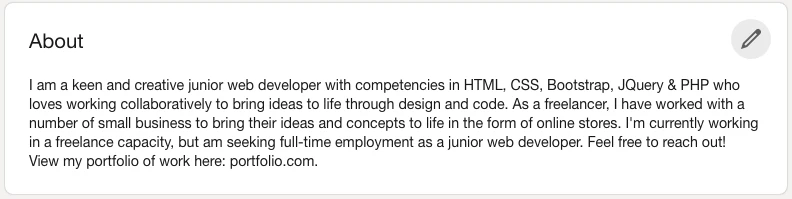
Remember: recruiters and hiring managers are looking at hundreds of profiles a day, so try to avoid generic buzzwords and overused phrases. Get creative!
3. Focus on your achievements
Rather than listing your roles and responsibilities from a previous job, narrow it down to the highlights and your specific accomplishments. Simply detailing a list of your past jobs’ responsibilities doesn’t actually give an indication of how successful you were in that role.
It also helps to include ‘action words’ such as ‘responsible for’, ‘grew’, ‘reworked’ or ‘optimised’ at the beginning of each sentence. For a lot of employers, it’s important to see a ‘track record of success’. Where possible also try to include key metrics that quantify what you achieved as well as any key stakeholders that you worked with.
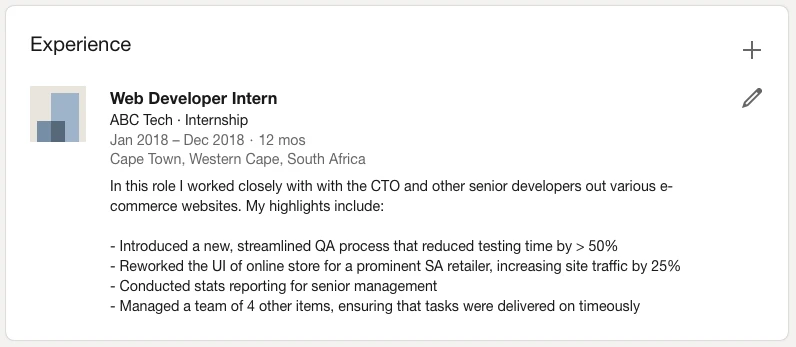
Think about it this way: there are probably a lot of other candidates with similar qualifications and/or experience, so how can you stand out?
4. Nurture your network
LinkedIn is still a social network, albeit a professional one, and the point of the platform is to help users to grow their professional networks. So what’s the best way to expand your network?
- Sync your email contacts list with your LinkedIn profile – this can help to reconnect with old colleagues and friends.
- Research relevant thought leaders and industry experts to follow (LinkedIn also suggests these for you based on the industry you are in).
- Connect with other alumni, lecturers, teachers or mentors from any institutions you have been part of.
- When making an in-person contact, follow up with the connection on LinkedIn.
- Joining groups that are relevant to your industry and what you do.
- Share posts and content that interests you and interact with other users’ content with your own thoughts and insights.
Lastly, try to include a personalised message that explains your intentions when requesting a connection, especially when you don’t actually know the person. This makes the request seem more intentional and is a great conversation starter.
5. Substantiate your skills
Including a list of skills in your profile gives weight to what’s been said in the headline, summary, education, and work experience sections of your profile . Here are a few ways you can really highlight your skills, achievements, and expertise:
- Endorsements.
Your connections are able to endorse certain skills that you have listed on your profile, so be proactive about reaching out to teachers, mentors, colleagues, managers etc. to endorse your skills. These endorsements hold extra weight if the endorser is also skilled in the same area.
- Skills assessments.
LinkedIn offers short online tests that allow you to verify your skill sets. By doing these skill assessments, you will receive a ‘Verified Skills’ badge on your profile. Providing evidence of your skills and abilities strengthens your personal brand, makes you a more appealing hire and is more likely to get you hired.
- Recommendations.
While skills endorsements provide a snapshot of your professional competencies, a recommendation speaks to who you are as a person and what it’s like to work with you. You can add a ‘Recommendations’ section to your profile and request these from former colleagues and managers.
Your LinkedIn profile is only as powerful as you make it, so invest some time into optimising your profile and presence on the platform. If you’re a past or current student interested in making your LinkedIn profile the best it can be, we are launching an exclusive HyperionDev Alumni LinkedIn group for HyperionDev alumni. This group will be used to share industry tips, job opportunities, networking events and more. If you are interested in joining, email careers@hyperiondev.com.
Your professional development matters to us. Our HyperionDev bootcamps will prepare you with practical coding skills, and once you’ve graduated as a job-ready developer, our recently revamped Graduate Program will ensure that you’re also equipped with the necessary soft skills to kick start your coding career. Our post bootcamp support offers mock interview training, CV and LinkedIn profile reviews, as well as networking events to connect with other alumni and the wider tech community.
Don’t just take our word for it: read what HyperionDev alumni Michael and Craigen have to say about their post-bootcamp journeys.
Student Success Stories
Ndamulelo: from Student to Start-up Founder
Thanks to the skills he learnt on his HyperionDev Software Engineer bootcamp, Ndamulelo Namadzvho was able to finally pursue his dream of building his own app and education start-up to change the lives of students in need. Here’s how his coding bootcamp helped him on his journey to becoming a start-up founder
Ndamulelo Namadzavho had always wanted to build something important that would help South African youth by improving their access to education and learning resources. There was just one thing standing in the way of his making his passion a reality: he needed the skills to create his vision.
He decided to join a HyperionDev software engineer bootcamp, where he hoped to learn how to build his own software, so that he could turn his edtech dream into a reality. On his on-site full-time Software Engineer bootcamp, Ndamulelo was thrust into an intensive learning environment that taught him critical, practical developer skills at an incredibly fast pace. Through hard work and determination, Ndamulelo graduated from our bootcamp in well under three months, built his own app, and founded his education start-up, ClassApp. Now, Ndamulelo helps hundreds of students to improve their school marks – a long-time passion which he hopes to grow into helping millions of students pass school with the best grades possible.
We asked him about his HyperionDev coding bootcamp experience, and what it taught him on the path to creating his own tech start-up.
Tell us about the app you developed using the skills you learned on your bootcamp. What does it do?
It’s called ClassApp. I developed it as an E-learning system that helps learners at highschool to improve their results. We offer grade 12s educational resources (like video lessons and previous exam papers) and task assessment to improve their marks.
Where did you get the idea to start your own tech company and create ClassApp?
There are lots of problems with our education system, and I think one of the biggest ones is mentorship. Kids respond very well to teachers who care, teachers they like. I asked my favourite teacher at school, “How can we make sure that every student in the country gets taught by you?”. ClassApp was the answer. I think I’ve always known I wanted to make ClassApp. HyperionDev taught me how to make it myself.
I think a lot of people get distracted because they want to go for a job working for someone else. But if you have these skills, you can do whatever you want. With just a laptop and an internet connection you can really achieve anything – and that’s what made me take the leap with my passion in ClassApp.
What did you do before your HyperionDev bootcamp and starting ClassApp?
Before my HyperionDev bootcamp I was studying software development at TUT. For me, there was too much focus on hardware on my program than I wanted. I knew what I wanted to do: I wanted to develop and build things that help people. I knew I wanted to make ClassApp happen. But I needed hard skills for software engineering to create the app. I found out about HyperionDev, spoke to an Admissions Consultant, and started my bootcamp. I haven’t looked back since!
Where do you see ClassApp going? How do you hope it will change the world?
I’m aiming for 100,000 students in 2 years, but my main goal is to prove to people that this works. We are currently assisting around 107 Matrics, mostly science students. First and foremost, I want to improve learners’ immediate results. I want to improve Grade 12 results – but the way you do that is by starting at the very beginning with Grade 8.
In ClassApp’s future I see it being a platform that makes education easier for everyone. It will be a platform that has all the things students need in their education. In the future, I want students to be able to find tutors, study programs, university courses, scholarships and bursaries – and even teaching or tutoring jobs – all through one single platform.
How did your HyperionDev bootcamp prepare you to start your own company and build your own app?
On my HyperionDev coding bootcamp, I learned three important things.
- First, I learned discipline. You’ve got to work consistently on your goals. You can do anything, but no one will do the work for you. You need to take advantage of your opportunities.
- Second, I learned the importance of taking initiative. Do research and plan. Go for what you want.
- Third, HyperionDev taught me all the actual practical coding skills I needed to make ClassApp a reality. I learnt Python, Java, and Machine Learning on my bootcamp, and these were key skills necessary for programming and developing ClassApp.
However, I think the greatest lesson my HyperionDev bootcamp taught me, at the end of it all, is that all you need in life is a computer and an internet connection, and the skills to use them. If you have those things, you can achieve anything.
Tell us about your experiences with mentorship on your HyperionDev bootcamp. What was it like?
My mentor, Dip, was so important. He was there to help me when I needed help, and he would help me with anything. I was learning Java, which goes hand-in-hand with Javascript. Whenever I struggled with something in the course material, Dip helped me. He even went the extra mile to help with things even outside of my bootcamp. He was there for all my questions, and helped whenever I needed something explained. It was amazing.
You took your bootcamp on our HyperionDev campus in Joburg. Tell us what was it like to learn on campus?
It was an amazing experience. I would advise anyone to work and learn on a bootcamp on-site. It’s so fantastic because you’re in the thick of it. You can get help from your mentor and your classmates. As a developer, there are times you feel lost – maybe your code doesn’t work or it’s too long – you feel alone. But working among other developers, you realise others struggle, and you can learn from them and get help with your problems.
It’s also a competitive, collaborative environment. It pushes you to write better code and be a better developer.
How did learning to code on a full-time HyperionDev bootcamp fit your life and goals?
Learning full-time was perfect for me, because I was focused entirely on learning the skills I needed to build ClassApp. The bootcamp was supposed to be 3 months full-time, and I finished it in a month – and then did some extra work on the side with other students, learning other technologies. My bootcamp was this intensive learning environment. You’re learning but you don’t feel like you’re bored at school. You’re playing as much as you’re working: you’re learning real skills, with people who share your vision.
What is your advice to people who are thinking about taking a coding bootcamp?
Go for it. Not only will you get the experience of learning, you also get the chance to build connections with other people in the industry. It’s the best pace to find people that you can collaborate with. It’s full of people who are ambitious and are working constantly to get what they want. You find other people who want to build stuff, and who give you valuable advice from all kinds of industries and backgrounds.
So I say to people, “Figure out what you want and go for it”. Focus on goals, take all the energy that you have and focus on getting what you want.
Do you have a dream, passion, or amazing tech idea, and want to learn the skills you need to make it a reality? Our bootcamps focus on making your goals and ambitions happen, through practical skills development, expert review of your code, and constant 1-on-1 mentorship that guides you as you learn to code.
With our mentor-led online and on-site bootcamps, you can learn the practical programming skills you need to work with complex data, create beautiful and functional websites, or make professional applications and software like Ndamulelo’s ClassApp. With our proven learning structure, you’ll graduate with job-ready tech skills to do what you’ve been dreaming of in just months, rather than years.
Apply for your seat on a HyperionDev coding bootcamp in just minutes here.

Career Advice
Interview Tips: How to prepare for your next virtual interview
Online interviews and virtual interviews have become an important tool for modern companies and hiring teams looking to hire new workers. Here are 10 useful interviews tips for acing your next virtual interview.
In the world of increasingly online and remote work teams, online interviews are quickly becoming the industry standard when looking to fill roles.
Today, the online interview has become a core tool for every hiring team. According to statistics from jobs platform Legal Jobs, 60% of HR managers use or have used video interviewing in the hiring process. If you’re a job-seeker in the modern workplace, you need to know how to shine in these online interviews.
But how do you prepare for an online interview, and what makes a virtual interview different from one conducted face-to-face? Here are 10 useful online interview tips for you to excel in remote job interviews.
- Make sure all your tech and equipment is working 100%
There’s nothing more important than the very basics – and there’s also nothing recruiters and interviewers hate more than having to pause (or even reschedule) an interview because of video, sound, or other technical interviews.
Familiarise yourself with the video conferencing program you’re using well in advance of your interview. Be sure you know how to share screens, split tabs, mute and unmute yourself, and where the settings for cameras and microphones are so that you can fix any problems as soon as they appear.
2. Make sure your online identity is professional
According to Legal Jobs, 76% of resume rejections are due to unprofessional email addresses. What’s more, 92% of companies use social media platforms to look up candidates.
Recruiters can (and will) look you up online. It can be difficult to separate personal social media from work accounts in the modern age where everything is connected, but try your best to ensure either that your social media profiles are work appropriate, or set to private.
3. Dress the part
You need to be in the right mental state to get the most of your interview. Even though at home, ditch the pyjama bottoms or comfortable yoga pants for something more formal and suited to a face-to-face professional interview.
It’ll help you get your head in the game and react as you would in a professional setting. Besides, you never know if or when you’ll have to stand up on camera. It’s best to be wearing something professional if that happens.
4. Take your time and engage with the interviewer
Even if you’re interviewing by webcam, you’re still talking to a person, so all the tricks of solid interpersonal communication apply. Remember to smile, maintain a positive attitude, look into the camera, and speak slowly and clearly.
In a face-to-face interview, you have the opportunity to make use of body language, gestures and social cues in order to convey your personality and develop rapport with the interviewer. What you can rely on in a virtual interview is the power of eye contact.
- Look directly into the camera, rather than at your screen, to maintain the illusion of eye contact.
- You can also drag the interviewer’s video feed into a small box directly below your webcam, and disable your own video feed on your screen.
- That way, you won’t be distracted by your reactions or what you look like, and you will be able to better focus on maintaining eye contact and engaging with the interviewer.
Finally, take your time. It can be easy to let interview jitters or nerves make you talk quickly or change subjects frequently, so remember to breathe, take and refer to notes, and take your time with your answers.
5. Set your stage
Functioning tech is just half the battle of looking highly professional in your online interview. Be sure to take your interview in a spot that has good natural lighting. It’s best to pick a spot that is away from distractions, and which is not exposed to loud noises or disruptions.
Top tip: try to face a window so that your face is well lit and avoid bright background light as this would create a shadow on your face.
If you’re interviewing at a desk, be sure to clear it of mess and clutter. Keep the background or backdrop of your interview space plain, so that you’re the major focus point of your video feed.
Finally, if you’re using a virtual background (which is a standard feature for many chat applications) make sure it’s a professional or plain one.
6. Have everything you need ready on hand
The last thing you want to do during your interview is have to rummage around for some information, or forget a crucial bit of information from your CV or work experience.
Before you start your interview, make sure you have everything you need to present yourself in the best light possible. This includes:
- A space to take notes. Writing things out slows down an interview and gives you time to think your answers through. It’s also helpful for technical or other difficult questions.
- Your research into the company or position.
- The biggest, most important positives you want to present and to stand out during your interview. This could be work accomplishments, records or awards, and any other impressive information that would put you above other candidates.
- A printed copy of your CV and/or resume. You don’t want to be tabbing between browsers, chat programs, and websites. It’s disruptive and breaks the flow of your interview.
7. Do your research
An online interview is still an interview, so it’s best to prepare the same way you would for any interview – and that includes knowing exactly who you’re talking to. According to Legal Jobs, 47% of the candidates failed the job interview because they didn’t have enough information about the company or the position they had applied to. Researching the company you want to work for is just as critical in a video interview as it is on-site.
Make sure you know everything you need to about the company you’re interested in, and that you read up on the job description and responsibilities. This information will be crucial for both the interviewer (and you) to determine whether you’d be the best person for the job.
8. Brush up on your interview basics
It doesn’t matter whether you’re talking by webcam, phone, or in an interview room: an interview is still an interview, and you should always brush up on your interview basics.
Take time before your interview to cover all the basics you would for any other interview, for example:
- Prepare and plan your answers for frequently-asked interview questions.
- Study your CV so that you can talk about all the information in it without needing to refer to your printed copy.
- Study the company’s history, latest work, and the job description so that you can talk about it without needing to open up their web homepage.
- Prepare relevant examples of your professional achievements and how these experiences would help you to excel in the position for which you’re interviewing.
9. Establish a rapport with the interviewer
Just because it’s a formal interview does not mean you can’t take some time to discuss common interests, ask the interviewer questions, and engage with them directly. This is your opportunity to stand out from other candidates!
Don’t be afraid to ask them job-relevant questions about their interests, their work, or how they fit into the team. An online interview is still a great opportunity to get their personal perspective on the company’s culture and ethos, and what sort of team you’d be working with.
10. Follow up
It’s professional and courteous to follow up with the interviewer. This doesn’t need to be long or particularly complicated: simply send the interviewer(s) a short, professional email within 24 hours of the interview, thanking them for their time and the opportunity.
Keep your thank-you concise. Only include additional resources/information if they requested it in the interview, and don’t write more than a paragraph. It is also advisable not to ask when the interviewer will get back to you about their decision.
With all of this in mind, you should be set to ace your online interview. Just remember: prepare well, stay focussed and calm, and take your time.
______________
Our HyperionDev bootcamps not only prepare you with practical coding skills, but our recently revamped Graduate Program ensures that you’re also equipped with the necessary soft skills to kick start your coding career. Our post bootcamp support offers mock interview training, CV and LinkedIn profile reviews as well as networking events to connect with other alumni and the wider tech community.
Don’t just take our word for it, read what HyperionDev alumni Michael and Craigen have to say about their post-bootcamp journeys.
Still have questions?
Contact our Admissions Team, and a real person will get back to you.