
Our latest insights
Read the latest insights


Career Advice
Five of the Best Remote Companies to Work For
The number of remote workers is definitely on the rise. Many people actually learn coding, so they can work remotely. What are some of best remote companies to work for? Let’s have a look.
A Swiss-based study found that 70% of professionals work remotely at least one day a week, while 53% engage in remote work for at least half the week. The number of remote workers is definitely on the rise. US market research firm Gallup found an increase in remote workers between 2012 and 2016, from 39 to 43 percent respectively. Many people actually learn coding, so they can work remotely. What are some of best remote companies to work for? Let’s have a look.
Started in 2005, this company is behind WordPress, Vault Press, Cloudup and others. Says the company website: ‘Everyone works from the location they choose.’ Consequently, workers are spread out over more than 50 countries. The way it operates is that you interview with Automatic and if you’re accepted, you’ll work together on a contract project lasting two to six weeks to see how you work together. Once a year the whole country meets up in different venues around the world for seven days.
Some perks include open vacation time (no set number of days per year), an allowance for a home office setup, open parental leave, paid two to three-month sabbaticals every five years and a branded laptop at your four-year anniversary.
This social media management company has a fully remote team in 15 countries, 11 time zones and 42 cities. They have a a 45-day contract period to see how things go and they are especially interested in people who have worked as freelancers or on startups.
Expect multiple Buffer international retreats every year where the whole team gets together – their most recent trip was to Cape Town, South Africa. (You can even check out their video of their latest trip here.) Additional perks include: a free MacBook, company equity and paid family leave, as well as a monthly allowance for education.
This is a fully distributed company that has over 130 employers who work remotely from more than 15 countries. They offer web-based services that help companies automate the tedious and repetitive parts of their work. Zapier has even published a book on working remotely, titled The Ultimate Guide to Remote Work, which can be downloaded for free.
Perks include 14 weeks of parental leave, unlimited paid time off and up to $10 000 for relocating elsewhere (but this is only if you’re moving away from the Northern California Bay Area), healthcare, a retirement plan, profit sharing, computer and software setup, and two annual company retreats per year.
This is an analytics company that helps businesses understand their web and mobile site visitors. Over 216,273 companies in 184 countries use Hotjar to improve their sites. Although headquartered on the island of Malta, the company operates on a fully remote basis.
Perks include the following: 40 days of planned annual leave, €4000 home office budget, €2000 per year holiday budget, €2000 per year working together budget, €1000 per year personal development budget, €200 per month working space allowance, €200 per month wellbeing allowance, 16 weeks paid parental leave, a fitbit and a free Kindle paperwhite.
David Darmanin, the CEO of Hotjar, explains the biggest obstacle to remote work: ‘The main one is lack of face time and building one-on-one rapport. We overcome this by using tools like hangouts and hipchat video… but more importantly we do company retreats every 6 months in different places around the world. Our last event was a skiing trip in Utah.’ And the biggest advantage – the ability to hire the best people from anywhere in the world.
This company offers live chat software and has its own specific culture based on the following: ‘Chill out, Help each other grow, Assume good faith, Make it happen, Practice empathy, and Speak your mind.’
Some interesting perks offered by this distributed company include an unplugged vacation bonus, where workers are given a $1000 bonus for taking at least five days off without checking in with the company. They also offer charitable donation matching. More routine perks include flexible scheduling, internet/coworking stipends, professional development budget and 12 weeks of paid parental leave.
Listed above are five of the best remote companies to work for. There are other benefits to working remotely besides the perks offered by the various companies such as:
- A Canada Life Survey found that remote workers perceive themselves to be more productive – they rank their productivity at 7.7 out of 10, compared with a score of 6.5 given by those in open plan offices.
- Studies have found that remote workers have lower stress levels.
- More time for exercise and you can wear what you like, states The Telegraph.
- It’s better for the environment. Forbes states that the average commute in the UK is between 60-80 minutes. Remote work reduces our carbon footprint and allows companies to be more green.
- And for the company, it’s likely to reduce costs – think about lower leases, reduced expenditure for furniture, equipment and office supplies.
In closing, this piece has outlined the benefits of remote work and some of the best remote companies to work for. If this kind of work appeals to you, think about signing up for one of HyperionDev’s six-month, part-time online coding bootcamps in Full Stack Web Development, Mobile Development and Software Engineering. You’ll get your own personalised mentor to help you whenever you get stuck and coding skills are always in high demand at these remote companies.
News & Announcements
August 29, 2018
EdTech startup HyperionDev raises pre Series A funding round, rebrands as CoGrammar
UK and South African-based startup HyperionDev, known for building the largest online coding bootcamp in Africa and scaling it internationally to 40 countries…
UK and South African-based startup HyperionDev, known for building the
largest online coding bootcamp in Africa and scaling it internationally to 40
countries, has announced that it closed a pre Series A round of funding earlier in 2018 of an undisclosed amount.
Following part of this fundraise, the company has rebranded as CoGrammar
while retaining the name HyperionDev for its online coding bootcamp product. This product enables students to study online to change careers to software development in under six months.
The edtech startup – incubated by the London Co Investment Fund, University of Cambridge’s Social Ventures, and Edinburgh University’s Launch.ed programmes – has disclosed that it received investment offers from four UK and US-based venture capital funds in its last round of funding. However, the final investors in this round have chosen to remain private.
This new influx of capital has enabled CoGrammar to scale to a team of 40 –
growing its team to include top startup talent from the likes of GetSmarter,
which was acquired by 2U for USD $103 million – and launch a new product of Code Review as a service.
The round of funding comes after HyperionDev won first prize in Facebook’s Innovation Challenge, securing $230,000 in funding from Facebook in addition to several grants from Google and the Python Software Foundation.

Introducing CoGrammar: Code Review as a Service
The new stream of capital enabled the rebranding of HyperionDev into CoGrammar, along with a new code review service geared towards businesses and educational institutions.

According to Riaz Moola, CEO & Founder of HyperionDev., “We are grateful for the support of our new backers which have allowed us to set our sights on tackling a more ambitious vision – setting the global standard for code review.
CoGrammar enables education brands around the world to integrate on-demand mentorship and code review into their coding education programmes at an affordable cost, making effective software development education scalable.
CoGrammar enables education brands around the world to integrate on-demand mentorship and code review into their coding education programmes at an affordable cost, making effective software development education scalable.
We make this possible through a new career path – copywriter for code – which we’ve created in the African market. From September 2018, we’ll be accepting applications for our first cohort of CoGrammars.”
CoGrammar sources, trains, and seamlessly integrates expert code reviewers into coding bootcamp education programmes globally. Human review of code is essential to ensure aspiring developers understand how to write write code that isn’t just correct, but is fluent and at an industry quality level.
Coding education providers can integrate review of their students’ work via the CoGrammar API which integrates Artificial Intelligence and a team of expert code reviewers employed by the company to review code at rapid speeds.
The education market has seen an annual growth rate of 90% since 2013, and CoGrammar is poised to become the global engine for coding education and code review, supporting millions of aspiring developers in crossing the tech skills gap.
According to Amiya Sharma, Head of Mentorship, “CoGrammar has created a new full-time career of becoming an expert code reviewer. This is a future-proofed career path with tremendous potential as programming becomes critical in every aspect of life and work.

For identifying, sourcing, and training high-potential individuals for this unique opportunity, we are launching an online train-and-recruit program on the 10th of September, 2018. This would be a recurring programme where anyone can complete free online training on coding and code review best practices, and apply to become a code reviewer with CoGrammar.”
Amiya continues, “Our first batch of applications opens on 10th September and closes on 20th September 2018. Selected applicants will go through rigorous training to ensure they can review code at an industry-aligned standard for both students and businesses.
We’ve already integrated our code review technology and experts into some of the biggest providers of online coding education, such as HyperionDev, to reach thousands of aspiring developers around the world. We’re excited to welcome more code reviewers into our team to enhance our impact manifold.” Find out more about becoming a code reviewer at www.cogrammar.com.
Backstory
In 2016, HyperionDev won the Innovation Challenge at the internet.org competition run by Facebook, securing $230,000 in funding which allowed the company to grow substantially. This followed a funding award and partnership that HyperionDev secured with Google earlier that year, making it one of the few startups financially backed and supported by both Facebook and Google.
HyperionDev offers six-month part-time online coding bootcamps are built around the individual. The coding bootcamps are designed to offer quality content paired with personalised mentorship, powered by expert code review at affordable rates. HyperionDev’s 1-on-1 mentors review coding assignments and provide expert, detailed feedback that will improve the structure, efficiency and correctness of a student’s code.
HyperionDev began with a group of Computer Science university students, who set out to solve a pressing issue at their campus: a large number of their peers were dropping out of their Computer Science degrees due to a lack of practical coding knowledge. So, they built a website to pair struggling university students with online mentors. This micro situation on their campus presented a much larger problem at hand – the global tech skills gap.
After six years of being in the industry, HyperionDev has introduced a brand new look and feel. Find out more at www.hyperiondev.com.

AI Engineering
Facial Recognition Technology: Pros & Cons
Facial recognition technology is an exciting, innovative branch of biometrics, but it is not without its disadvantages. We explore the pros and cons in this piece on facial recognition technology.
Facial recognition systems were considered the stuff of sci-fi novels and spy movies for many years, until they became an everyday reality. Is this technology ushering us into a more connected way of living, or is it an invasion of our most basic rights to privacy?
What is Facial Recognition Technology?
Facial recognition is a type of biometric technology, meaning it applies statistical information to biological data. Other types of biometrics include voice recognition, fingerprint matching and retina scanning.
Facial recognition software has the capability to identify a person, or verify their identity, by analysing a digital image of their face. The technology works by mapping that person’s facial features, and saving this unique information as a “fingerprint”. The software can compare an image of a person’s face to the information saved in the database, to confirm their identity.
Did you know? The human face has a total of 80 “nodes” that can be used in facial recognition, but it only takes 14-22 nodes to identify a person’s face.
This type of technology is mostly used for security and data protection purposes, but other uses are becoming more widespread. Let’s say you share a snap of you and your besties on Facebook. The social network’s algorithms will recognise your friends’ faces based on their own profiles, and suggest that you tag them in the photo. This is just one small example of how facial recognition is becoming part of our daily lives.
Advantages of Facial Recognition
Security: Most obviously, facial recognition systems can help to improve security for businesses, which is especially useful for those dealing with sensitive and confidential information. A biometric security system ensures that every individual entering a building or area is recognised and accounted for. Trespassers can be quickly and easily identified.
Cost-efficiency: Because facial recognition technology is automated, it also reduces the need for security guards to personally verify a match. This means businesses can save costs on hiring security staff and other security measures.
Safety: Automated security processes also mean that fewer security personnel would be put in potentially dangerous situations.
Convenience: With our personal information becoming more and more digitised, facial recognition can help us on an individual level too. Using biometrics instead of a password to secure a smartphone or laptop can keep our device safe from prying eyes. It’s also easier than memorising multiple passwords and PIN numbers.
Connection: There are some exciting possibilities for facial recognition on a social level too. Imagine meeting a room full of strangers, and having an easy, almost immediate way to find out more about them, seeing what you have in common with each one.
Of course, there’s a fine line between what some people would see as harmless or beneficial, and what some would find highly intrusive.
Disadvantages of Facial Recognition
With facial recognition becoming ever more prevalent in day-to-day life, there is a big concern about the impact it could have on personal privacy.
Exposure: Insiders speculate about potential situations like using facial recognition to determine who around you belongs to a certain cultural or religious group, or who has a criminal record. This application might make the user feel safer or better informed, but it would be invasive to those on the receiving end.
Safety: In an era where online bullying has become prevalent, this type of technology could also leave more people vulnerable to stalking and harassment in the real world.
Legislation: There are concerns that biometrics are progressing too rapidly for regulators, legislators, and the judicial system to set up standardised rules and precedents around their use. For example, in the USA, the Fifth Amendment protects people from giving up information that could incriminate them. This would include information like a password or PIN. However, a thumbprint or your face shape isn’t a piece of information you know; it’s something you are. So, is facial recognition covered by the Fifth Amendment?
An Innovative New Era for the Tech World
Despite the very real downsides to facial recognition and other biometrics, there is no doubt they are extremely exciting fields of research.
If you envision yourself coding secure, industry-leading technology like this one day, your first steps should be to get familiar with the programming languages that are most useful for facial recognition applications. These languages include Python, which is great for image processing and motion detection functions, and Java, which allows you to manually code your own functions.
Sign up for a HyperionDev coding bootcamp, to start learning all you need to know about coding cutting-edge software in Python, Java and other in-demand programming languages.
Career Advice
Is JavaScript a Hard Programming Language to Learn?
Are you thinking about learning JavaScript in 2018? You probably should be. The State of the Developer Nation report found that JavaScript is the most popular programming language, used by 9.7 million developers. So is JavaScript a hard programming language to learn? Read on to find out.
Are you thinking about learning JavaScript in 2018? You probably should be. The State of the Developer Nation report, which analysed more than 21,700 developers in 169 countries, found that JavaScript is the most popular programming language, used by 9.7 million developers. So is JavaScript a hard programming language to learn? Read on to find out.
Why is JavaScript so Popular?
What is JavaScript and why is it such a popular language? JS is a scripting language, which means it supports scripts – such languages are often interpreted (rather than compiled). In essence, this means you can make changes to your code and run it again straight away to see the effect of your changes – you don’t need to recompile the code. JS is primarily used to build and control dynamic website content like animated graphics, interactive forms and scrolling videos.
Here are some reasons why JS is such a popular language:
- It’s on every platform imaginable, including browsers, mobile and desktop applications, IoT devices, etc.
- It’s a great foundational language for newbies. Script languages are generally easier to learn than compiled languages like C++, states Business News Daily.
- Many of the world’s top websites and apps – including Paypal, Netflix, LinkedIn and Uber – all run on JavaScript, or more precisely Node.js, the JavaScript environment that executes the code.
- JavaScript frameworks— or collections of JS code libraries – are frequently used. This allows developers to perform routine tasks without rewriting code every time.
- According to The Hard Refresh, Indeed lists more than 28,000 JavaScript developer jobs, while Glassdoor lists the average JavaScript developer salaries at $72,500 per year. Not too bad!
These are all great reasons, but is JavaScript a hard programming language to learn? And how long will it take you to pick it up?
Learning JavaScript in 2018
Although JavaScript is a step up from HTML and CSS, which you can learn in under a month, you should still be able to master JS in a matter of months, not years, especially if JS is not the first programming language you’re learning. Ideally, you want to first learn HTML and CSS before moving onto JS. Remember: JS is programming and not a markup language. In JS, each command defines an individual action. While JS is more complicated than HTML, a markup language, you can actually start writing useful JS quicker than with HTML. The reason for this is that to use a markup language properly you need to know all of it, otherwise you can’t mark up pages correctly. However, with a programming language you can still write programs with the part you do know, but you do need to know that part properly.
Arielle Kimbarovsky, Digital Marketer at UX design and mobile application development agency Codal, says on the Hard Refresh: ‘One critical thing to keep in mind when learning JavaScript (regardless of your own learning needs or style) is to resist the temptation to go too fast and speed through the fundamentals… JavaScript is a language that builds on itself. This makes more involved JavaScript code a lot harder to write and understand if you don’t have a solid handle on the basics.’
The good news with coding is that you can teach yourself. ‘Almost 90% of all developers say they have taught themselves a new language, framework or tool outside of their formal education,’ says 2018’s Stack Overflow Developer Report. Alternatively, you can learn online via a mentor-led bootcamp, where you receive expert advice when you get stuck. HyperionDev’s bootcamps are an example of this kind of mentor-led learning. The Full Stack Web Developer bootcamp would cover JavaScript among other languages.
You’ll need to consider the following when deciding if you want to go it alone or sign up for a class:
- Do you have prior coding experience?
- Are you able to set up your own curriculum?
- Can you cope psychologically with feeling stuck or in despair, because you don’t understand something? If don’t like those feelings, you may well want to consider a mentor-led course.
- What are your time commitments? It’s likely that studying alone will take longer than a structured course.
- Is a network of fellow programmers important to you?
- How easy will you be able to look for work without the support of an institution?
Whatever you decide, know that there are resources out there for learning JS including:
- Developer forums like Stack Overflow, Codepen and Github.
- Online tutorial – Coursera.
In conclusion, in answer to the question, is JavaScript a hard programming language to learn? the response is ‘no’. In fact, ThoughtCo. states: ‘In many ways, JavaScript is one of the easiest programming languages to learn as your first language.’ Because it’s an interpreted language within the web browser, you can write small pieces of code at a time while testing it in the web browser as you go. If you’re keen to learn JavaScript, consider signing up for HyperionDev’s online, part-time Full Stack Web Developer bootcamp.

Career Advice
Coding for Beginners: Our Advice On What to Master First
So you’ve decided that coding is definitely something you want to dive into - the job prospects look fantastic and the industry is booming. Here’s our advice on coding for beginners, and particularly, our perspective on the fundamentals that you should aim to master as soon as possible.
So you’ve decided that coding is definitely something you want to dive into – the job prospects look fantastic, the industry is buzzing and you’re fascinated by what goes on in the backend of the internet. But what next? Firstly, every aspiring dev enters the coding arena with a different level of experience – some already have an understanding of the basics, while others are literally starting at the very beginning. Your first port of call? Be cognisant of where you are as a first-starter and be patient with yourself – learning how to code requires an investment of time and resources, especially mental ones. Put on your proverbial seatbelt, because it’s going to be an interesting ride. Here’s our advice on coding for beginners, and particularly, our perspective on the fundamentals that you should aim to master first.
Get to Grips with Frameworks and Libraries
According to Rainer Hahnekamp, one of the first things that beginner coders need to learn is that code already “exists in the form of a library or a framework.” Understanding this will save you precious hours writing a buggy version of a library instead of consulting the right, existing library in the first place. Well-known libraries include Moment.js, Jackson, Lodash and Apache Commons. What Hahnekamp argues, is that it is important for beginner coders to shift their mindset away from developing everything from scratch, to exploring and using libraries.
So what’s the difference between a library and a framework? Put simply, a library is a “file containing re-usable code that can usually be shared among multiple applications.” On the other hand, a framework “can be everything you use in application development.” Some of the most popular frameworks include: Twitter’s Bootstrap, ZURB’s Foundation, Front-end Boilerplate or Themosis.
An alternative, interesting perspective on how rookies should approach coding is presented by Alex Devero, who argues that sometimes devs are faced with the decision about whether to learn a language or use a framework instead. What Devero learnt was that if you have a specific idea in mind for what you want to build, and you’re pressed for time, a framework might just be your best bet. However, you’ll need to bear in mind that that’s not a “one size fits all” solution. Best practice is to put the time and effort into learning a language. Once you’ve mastered it, you can turn to libraries and frameworks for “shortcuts.” In the long term, becoming a dev is about getting through the initial learning process, investing in some good trial and error and along the way, learning from the experience of others.
Find a Mentor
At the beginning of your coding journey (and even years into your career), you will most likely have moments of bewilderment – moments akin to what writers go through with “writer’s block.” In those moments, devs with mentors are able to sidestep curveballs and find solutions much faster than those without mentors. Knowledge and skills transference is one of the key benefits of the mentorship – you may find that the learning process becomes so much more efficient when feedback and help is easily accessible.
Coding can be daunting, and intimidating, so having a mentor is an indispensable tool for overcoming hurdles, of which there will be many. We know it can be a bit scary – approaching a mentor can be compared to asking someone on a date. But once you get passed the initial ice-breaker stuff, you’ll find that your mutual love for problem-solving will bridge any other uncomfortable gaps. Here’s one thing you may not realise – mentors benefit just as much as mentees do. Having a mentee to assist and advise, keeps mentors on their toes and makes sure they’re always operating in beta mode. In our experience, coders who mentor are always on top of their game.
Master the Mindset
Coding requires mental stamina. Remember that. And the coding mindset is less about book learning and more about practical experience. Every experienced dev will tell you that they spent late nights pondering problems and trialing lots of solutions before they felt like they were close to creating something that worked, even at half the capacity they needed it to. Time is your most precious resource. And practice, practice, practice, has never been more relevant to the process of learning how to code. A word of advice? Develop an allergy to being too hard on yourself. The quicker you can get used to failing, the easier it will become to start succeeding. As Yi-Jirr Chen puts it: “It’s OK to fail. Coding is all about failing and fixing things, and about learning how to do things better. If you don’t build things and work on areas that you know you are weak on, you’ll never get better.”
As a coding newbie, the best advice anyone can ever give you, is to get stuck into the nitty-gritty as quickly as possible. The process of learning how to code should be an immersive one. Talk to people, ask for advice, read as much as you can and start building a support network for yourself. Thankfully, there are so many resources out there for aspiring devs, that choosing coding as a career has never held better prospects.
If you’re a coding beginner, you’ve come to the right place – our mentors are ready and willing to provide you with invaluable guidance on what your next steps should be. Connect with a mentor – we look forward to meeting you.

Career Advice
Developers in 2018: How Coding Became Cool
It used to be the case that developers were regarded as geeks who sat behind their computer screens all day speaking in tech, but that has definitely changed. Coding has become cool and the image of developers in 2018 is trendy. Here are some reasons coding has become cool.
It used to be the case that developers were regarded as geeks who sat behind their computer screens all day speaking in tech, but that has definitely changed. Coding has become cool and the image of developers in 2018 is trendy. In fact, The Harvard Business Review calls Data Science the ‘sexiest job of the 21st century’. Here are some reasons coding has become cool.
Become a Game Designer
As a coder, you can become a game designer and games are cool. Game designers are responsible for developing storylines, puzzles, challenges and level divisions in games. They may well need to collaborate with content developers, artists, programmers and other technical coworkers. However, the central figure is the designer who comes up with the overall concept of the game. The designer is responsible for setting the rules of the games and creating a particular atmosphere for the players.
According to Learn.Org, game designers need a wide range of skills including the following:
- Capacity to work in a fast-paced environment
- Excellent problem-solving skills
- Ability to strategise on the job – e.g. exploring potential moves in a game
- Vivid imagination – good games need fascinating plots, settings and characters
- Ability to collaborate in teams
- Coding skills
You Can Create Cool Stuff
Coding lets you unleash your creativity and entrepreneurial spirit. Knowing how to code means you can create a website to get your business idea off the ground. Or if you’ve had a brilliant app idea, you can make it happen. Coding is one of the easiest ways to solve practical problems without needing large machines or lots of raw materials – you only need a computer and preferably an internet connection. The end product just depends on your coding skill and how good your idea is, and not other hard-to-control factors.
Here are some fun coding project ideas:
- A web app using HTML, CSS and JavaScript – for example, a game or quiz, a calculator, a colour picker or a word counter.
- A data-driven web application like a social media site.
- Some web-based animation – although Flash and JavaScript have been used for years for creating web-based animation, this is falling away. CSS animation has stepped in to fill the gap.
The Tech Community is Awesome
One of the key reasons coding has become cool is that the tech community is great. There are many reasons to join a tech community, whether it’s online or in real life, including: interacting with like-focused individuals, increasing your visibility and chance of finding work, learning the latest tech knowhow, problem solving in real time and learning from experts.
Here are some online tech communities worth checking out:
- Stack Overflow – this is one of the biggest software communities on the internet.
- GitHub – this is mostly for version control, but it’s also a ‘Developer’s Disneyland’, because you can access the code of many world-famous apps.
- Google Developers – this is a platform created by Google to build software using Google’s products such as Google Maps.
- Developers Facebook – this is similar to the Google platform, but you use Facebook’s API and integrate your apps into Facebook.
Because The Job Demand is High and You’ll Get Paid Well
Coding has become cool because coders are in demand and the salaries are good. The average US salary for a front-end web developer, for example, is $88,680, states PayScale, with salaries rising for senior developers to $119. There is also a 20% US job growth rate up to 2022 for these developers, claims TEACH magazine.
Software Engineering is predicted to grow at a startling 24% employment growth between 2016 and 2026, according to the Bureau of Labor Statistics. In essence, tech jobs are on the rise. According to Modis, there’s an anticipated 12% growth in tech employment by 2024 (compared with 6,5% projected growth in other industries). By 2024, there will be 48,500 additional tech jobs.
There are many reasons coding has become cool. From having excellent job opportunities to solving real-world problems, coding is a skill that opens so many doors. If you’re wanting to learn how to code, consider signing up for one of HyperionDev’s six-month, part-time online coding bootcamps in Full Stack Web Development, Mobile Development and Software Engineering. You’ll get your own personalised mentor to help you whenever you get stuck.

Career Advice
Find Your Developer Niche And Stand Out
The great thing about becoming a developer is that once you’ve learnt coding skills, there are so many ways of applying them. It’s important to work out what kind of developer you want to be. This piece will help you find your developer niche. Let’s start by taking a deeper dive into the kinds of developers out there.
The great thing about becoming a developer is that once you’ve learnt coding skills, there are so many ways of applying them. It’s important to work out what kind of developer you want to be. This piece will help you find your developer niche. Let’s start by taking a deeper dive into the kinds of developers out there.
The Options: What Kind of Developer Should I Be?
There are a wide variety of different kinds of developers in high demand. Here are some of the alternatives:
Web Developers – the Creative
Of course we’ve all heard of web developers, but this developer field can be further subdivided into back-end, front-end and full stack web developers.
The front-end, or ‘client side’, is everything the user experiences, from the stunning layout to the cool buttons and graphics. The main purpose of the front-end is to deliver interactivity and to display content in an appealing way – ideally, you’re a pretty creative kind of developer if you want to follow this route. The back-end, on the other hand, does things like work out calculations, follow business logic, interact with the databases etc. Back-end developers need to get to grips with programming languages, databases and server architecture – you’re a logical, rational type. A full stack developer, however, is able to do both front-end and back-end web development.
The good news is that the demand for web developers is continuing to grow: the Bureau of Labor Statistics notes that the projected growth for this field is 15% from 2016 to 2026, much faster than the average for all occupations.
App Developer – the People Person
The average US annual salary for Android Developers is $97,986, according to Glassdoor. Because Android dominates the smartphone market – at 86% of the total market share, according to Gartner – and it’s a free and open operating system, it’s no surprise then that many developers want to start developing for the Android platform. There’s also high demand for app developers: according to an article in Forbes, the 13 top tech skills include Mobile Application Development.
What kind of developer do you need to be to become an app developer? Ideally, you would be someone who is meticulous, capable of absorbing a lot of information fast, a people person who can attend client meetings and a proficient coder in multiple programming languages, including Java, HTML5, Objective-C, C++, C#, Python and Swift.
Software Engineer – the Super Rational
As a software engineer, you’re creating software. So if you’re someone who wants to develop cool video game computer software or you want to make the software run faster on different computers or those that have different operating systems, you should think about software engineering. You’re basically using computer skills to solve problems with software and software is everywhere.
To become a software engineer, you need to be an analytical person capable of:
- Deductive and inductive reasoning
- Mathematical reasoning
- Original thinking
- An understanding of what people want from their computers
Besides the developer specialities we’ve mentioned, there are of course many other kinds of developers – such as cyber security specialists, data scientists, big data specialists, devops developers, etc. How then do you find your developer niche? In essence, it’s about getting to know yourself better.
Your Developer Niche: Getting to Know Yourself
To find your ideal career path, you need to understand both your strengths and your weaknesses, as well as your passions and your basic personality.
To work out your strengths and weaknesses, write down all the activities in which you participate every day. Studies have shown journalling is an excellent method for becoming more self-aware and reflective. Now rank each of these activities, from 1-5, in terms of competency and enjoyment. This will help you decide on your strengths and weaknesses.
In addition, try the following:
- Try something new. You won’t discover your ability to code, if you don’t try coding, for example. Think about enrolling on a free bootcamp prep via HyperionDev.
- Watch for signs of excitement, states Entrepreneur. When you do things you are good at, your excitement becomes more apparent – your pupils dilate, for example, or your speech is faster and more fluid.
- Ask others what you’re really good at. You may find yourself surprised. Sometimes we don’t perceive ourselves objectively.
And lastly, take a personality test to get a better sense of your natural proclivities or personality. Two popular tests include the Myers-Briggs, which divides people into sixteen personality types based on research by the famous psychologist Carl Jung, and the Keirsey Temperament Sorter, which separates people into various temperaments.
In closing, this piece has looked at finding your developer niche. The wonderful thing about coding is that there are so many career possibilities – and so many kinds of developers – from the super analytical to the very artistic. If you’re keen to change careers to coding, consider signing up for one of HyperionDev’s six-month, part-time online coding bootcamps in Full Stack Web Development, Mobile Development and Software Engineering.

Career Advice
Top Coding Tools for Beginners to Look Out For
Here are a few recommendations for the best coding tools, learning opportunities and resources to improve your productivity when you’re starting to code.
As a beginner in the programming world, you might feel a little overwhelmed by the thousands of coding tools and resources out there. Some will make your life much easier, while some are not especially useful, and others might actually slow you down. Finding the right tools can boost your productivity, and make your learning curve as a beginner coder more manageable.
Here are a few recommendations for the best coding tools to get you started:
Text Editors
A text editor is an essential coding tool. It’s a programme that types simple text, without the formatting of a word processor programme. With no margins or line breaks, these editors are ideal for typing up clean lines of code in a variety of programming languages.
Sublime Text is a cross-platform text editor that works for Mac, Windows and Linux. It’s a great first-time text editor for new coders, allowing for an easy transition from ordinary word processor programmes.
Notepad++ is an open-source code editor for Windows, which can support several coding languages. It includes lots of helpful features for newbies, including a built-in FTP plugin that lets you open and edit your files directly on your web server.
Brackets will appeal to Adobe fans; it’s created by Adobe and designed for seamless integration with the other products in their suite. It has minimal design but powerful features, such as a live preview functionality, and a tool that allows you to extract data directly from your PSD files. Brackets also runs across Windows, Mac and Linux.
Atom, developed by GitHub, is another text editor that comes highly recommended for beginner coders. It’s an intuitive cross-platform editor, and includes various open-source packages for easy customisation (much like WordPress themes).
Chrome Extensions
Google Chrome is the biggest web browser, and there are many extensions available for developers working in Chrome. An extension is a small software programme that you can install to customise Chrome functionality to suit your needs.
Web Developer is an extension especially for developers and designers; it adds a toolbar button to the browser, with a number of handy day-to-day development tools. With Web Developer, you can write and edit HTML and CSS, disable and enable cookies, mark links as visited or unvisited, and display important image attributes. The extension also makes it easy to outline objects on a web page.
Window Resizer for Developer allows you to resize your browser to various sizes, which is great for creating responsive designs that must run over multiple platforms (including mobile).
Lorem Ipsum Generator allows you to add dummy text to your website layout, quickly and easily.
WhatFont helps you to identify which fonts have been used on a website, by simply hovering over them.
ColorZilla allows you to copy exact colours from a website, straight onto your clipboard.
General Learning
To develop solid coding skills and fast-track your entrance into the world of development, sign up for an online coding bootcamp with HyperionDev. You can upskill with a short course in just three months, and learn an in-demand coding language like Python, Java, C# or C++.
Mentoring also plays a big role in your growth as a developer. One-on-one time with an experienced mentor is an invaluable coding tool for those finding their feet. HyperionDev provides mentoring and on-demand code review as part of the learning experience.
Career Preparation
When it’s time to market your skills to prospective employers, there are some great tools specifically designed to guide you through the application and interview process in the tech space.
Interview Cake is a website that gives you the chance to practice answering programming language-specific interview questions. It also gives you a guide to the typical interview formats used by today’s major tech firms.
Break Into Tech gives job-seekers some expert advice on creating a résumé and cover letter, as well as how to ace tech industry interviews. The system was created by a former LinkedIn and Apple employee, who also offers individual coaching calls and application reviews.
Coding tools, expertly designed courses and interview preparation resources like this give you a better chance of getting ahead in an increasingly competitive industry.

Career Advice
5 Signs It’s Time To Switch Careers
Did you know that people are likely to change careers five to seven times during their working life? Here are five signs that it might be time for you to switch careers into tech.
When your alarm went off this morning, you pressed the snooze button four times. You just couldn’t get moving. Eventually, you dragged yourself out of bed, downed two cups of coffee, sat in traffic for an hour and stumbled into the office. The cheerful hello’s of your colleagues made you want to scream and the sight of the boss resulted in your feeling ill. The thought of sitting at your desk, watching the clock inch its way forward, made you want to run out the building and just go anywhere else. Could it be time to switch careers?
According to Entrepreneur, people are likely to change careers five to seven times during their working life. Here are five signs that it might be time for you to switch careers.
1. The Company Is Driving You Crazy
It could be your work environment that’s making you see red. Perhaps it’s the limited scope of your job or you’re not being utilised to your full potential.
The National lists a number of signs that the time is right to jump ship including:
- Your skills and responsibilities are not a good match with your abilities.
- The salary, even if it’s large, is not enough.
- You’re not being used to your full potential.
- There is no room to grow.
- You feel overworked and under-compensated.
- You’ve lost your passion and enjoyment for your work.
It’s often easier to continue in a straight line than to shift direction. But think about it: you won’t know what is around the next corner if you don’t make that turn. Perhaps now is the right time to think about what you really want from a job. If your current work is not the right fit for you, it might be time to jump ship.
2. You’re Worried About Automation
Automation is likely to hit certain industries hard. If you’re in bookkeeping, for example, you have a 97.6% chance of being automated. Software developers, on the other hand, only have around a 12.8% chance. Check out this nifty guide to assess the likelihood of your job being automated. It could be time to switch careers if you’re in an industry that’s likely to be automated.
3. Economic Reasons
Besides automation, some industries get hit hard during economic downturns. Says Entrepreneur: ‘A job in finance was lucrative in 2003. By 2008, not so much. If an economic or technological change has negatively impacted your current field, a change may be in order whether you were looking for it or not.’ The good news is that software developer jobs are predicted to grow by 17% from 2014 to 2024, according to the US Bureau of Labor Statistics. This is much faster than the average for other occupations, which is at 7%.
4. Poor Match Between Your Talents And Your Job
Perhaps you’re a teacher who doesn’t enjoy high-intensity personal interactions, or an engineer who is bored by analytical work. If your talents and interests don’t match your field of work, it could well be time to switch careers.
Here are some ways to discover your talents and interests:
- You won’t discover you have a musical talent, if you never try an instrument. Attempt to try something new every week. If you want to try out coding, think about enrolling on a free bootcamp prepl via HyperionDev.
- What is easy for you to do? Ask others what you are good at – these are likely to be your talents. Think about what you loved doing as a child.
- Think of successes you have had, even if they are minor. For example, perhaps you organised a fantastic surprise party for your best friend – and it could be that you have a talent at event planning.
- Take a personality test to get a better sense of your natural proclivities. Two popular tests include the Myers-Briggs, which divides people into sixteen personality types based on research by the famous psychologist Carl Jung, and the Keirsey Temperament Sorter, which separates people into various temperaments.
5. And When Not to Switch Careers
It’s all very well to know when to switch careers, but here are a few good reasons why it might not be a good time to switch careers, according to Business Insider:
- It’s the end of the year. This has to do with hiring logistics. A lot of people who make hiring decisions are away and you’ll need to be more patient waiting for job interviews and callbacks.
- You’re house hunting. This is also a major life decision, and you won’t be able to devote enough time and care to a job AND a house search.
- It’s right before a monumental change like pregnancy or marriage.
- You’re over or under worked – this might not be a sufficient reason. Rather analyse how you’re managing your time, and then plead your case to the boss.
In closing, we’ve covered a number of key reasons about when to switch careers and when you shouldn’t make the leap. If you’re keen to change careers to coding, consider signing up for one of HyperionDev’s six-month, part-time online coding bootcamps in Full Stack Web Development, Mobile Development and Software Engineering.

Software Engineering
Is Coding Boring? Here’s Why We Think It’s Definitely Not
When we see devs in movies, they’re usually hackers who live in their parents’ basement. While this may appeal to the reclusive, caffeine-addicted sides of some of you, this image has left others asking, is coding boring? We believe that coding is anything but boring, and we’d like to tell you why.
Sitting at a desk, eyes glued to a screen, drinking cup after cup of coffee, heavy metal blaring from your headphones, eating junk food at your desk because you dare not tear your eyes away from the screen. Let’s be honest – this is how most devs are portrayed by the media. When we see devs in movies, they’re usually hackers who live in their parents’ basement. While this may appeal to the reclusive, caffeine-addicted sides of some of you, this image has left others asking, “is coding boring?” We believe that coding is anything but boring, and we’d like to tell you why.
Let’s Hear From the Devs
Growth hacker, Pavel Malos approached some developers to find out exactly what a day in the life of a coder looks like. Here’s what he found out:
For Wesley Bitomski, “Code Poet and Systems Architect,” the majority of his day is spent sharing ideas with other engineers, writing documentation, reading and debating with his colleagues. Somewhere in the midst of all that, some coding work happens. Some days are taken up by meetings that entail reporting on the work that was done and planning a way forward. In his company, management is succinctly aware that most devs try to get out of meetings and back to solving problems, so they keep meetings to a minimal. As for the rest of his day, Wesley spends his day debating about which programming language is best, and eventually agreeing to disagree. As he puts it:
“For the rest of the day, I debated the merits of JavaScript’s design with a frontend engineer while I finished up some hanging work from the prior sprint and got going on my week’s work. And the guy legitimately likes JS, and wants me to as well. The very idea of liking JS is strange and alien to me. Why would I want to do that to my brain, when the likes of Go, Scala, Racket, and Python have got my back and are far better designed? He’s a weird dude, and I love him like a brother. He probably feels the same way about me, especially the weird part and hopefully the brother part” (Source: Medium).
For coder, Edmund Elder, “sitting before the screen and writing new lines of code all day is far from reality.” He describes his work as thinking, reading and learning new things – it’s 30% work and 70% discovering new things. When he works remotely and needs to find a solution to a coding problem, Edmund walks his dogs in the forest while “thinking about threads or complex UI-handling problems” (Source: Medium).
Wes and Edmund are just two examples of developers who certainly don’t fit the Hollywood-created stereotype. They are well-balanced individuals who share a love for learning new things and solving problems. Most of all, they both have a sense of humour. The common thread is that coding is certainly not boring – its interactive, engaging and fulfilling.
Let’s Look At The Stats
A study conducted by Stack Overflow showed that out of all the developers surveyed, 73.7% ranged between feeling almost completely satisfied and being completely satisfied with their careers. This points to the fact that the vast majority of developers are confident that they have made the right decision by embarking on a career in coding.
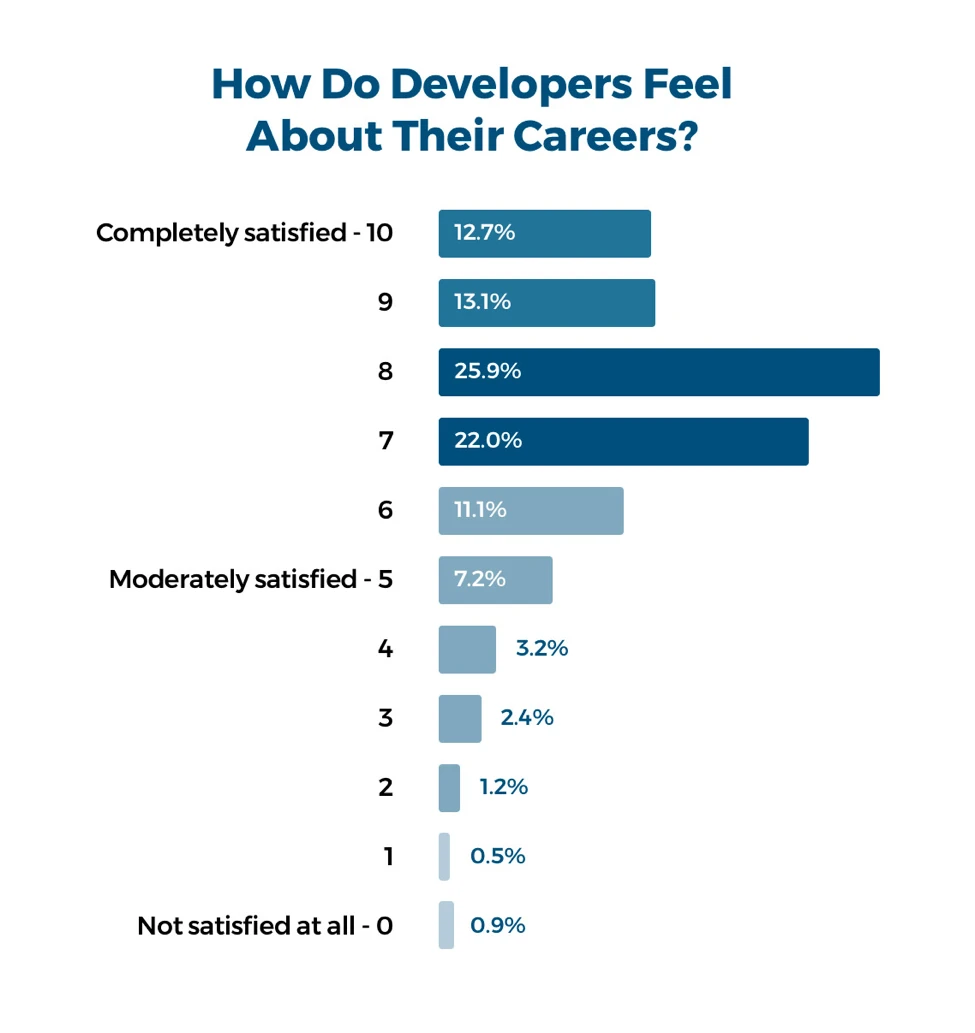
Source: Stack Overflow
The same survey showed that developers are generally also satisfied with their jobs and those who are not, are not faced with an insurmountable challenge in finding another job, due to high competition amongst companies to snatch up the best devs. With these exciting prospects, it’s safe to say that coding is a sought-after career path – it’s certainly not a boring, dead-end street. In fact, the exact opposite is true. The development industry is experiencing an unprecedented boom – if you’re considering a career in coding, there really is no better time than the present to take the leap.
Coders are Creatives
Graphic designers, animators, editors and copywriters are often thought of as being creatives. But they’re not the only ones who turn campaigns and projects into things of beauty. Coders play a big role in conceptualising and bringing projects to life. At its core, creativity is about solving problems, and that’s the essence of what coders do. Emily Kager, mobile developer at open source software company Mozilla, has a degree in neuroscience but a year after graduating, she decided to learn how to code. In an interview with Scott Morris from The Hard Refresh, Kager said: “I love that with programming you have the skills to make anything you want, and I also love getting to solve puzzles with code, thinking creatively, and using problem-solving skills every day at my job.”
So let’s throw away the age old stereotype of the coder who is driven close to insanity by his/her job. Yes, you’ll have those kinds of days – just like in every other industry, but coding is what you make of it. Not all the jobs you tackle will be the most creative and engaging, but you can take on freelance projects that speak to your passion if you have the time. Think laterally, be proactive and most importantly, keep learning – that’s the key to never getting bored and keeping your mind engaged.
Eager to learn the ropes and find out whether a career in coding is for you? Talk to one of our course consultants and we’ll give you free, practical advice on what to do next.

Career Advice
Become a Developer: Five Pros and Cons
You’re thinking of becoming a developer, but what can you expect after you’ve finished a coding bootcamp? We’ll give you the lowdown on the pros and the cons of programming.
You’re thinking of becoming a developer, but what can you expect after you’ve finished a coding bootcamp? We’ll give you the lowdown on the good and the ugly, the pros and the cons of programming. Read on to find out more.
Becoming a Developer: The Pros
1. Salary
Developers earn very good salaries. According to PayScale, a developer can earn an average annual salary in the US of $102,592 (Glassdoor pegs it at $115 000). In addition, the 2018 State of IT report states that 87% of companies expect their technology budgets to get larger or stay the same next year. That’s great news for salaries.
Here’s a list of the six top jobs and their corresponding salaries, via Indeed.com:
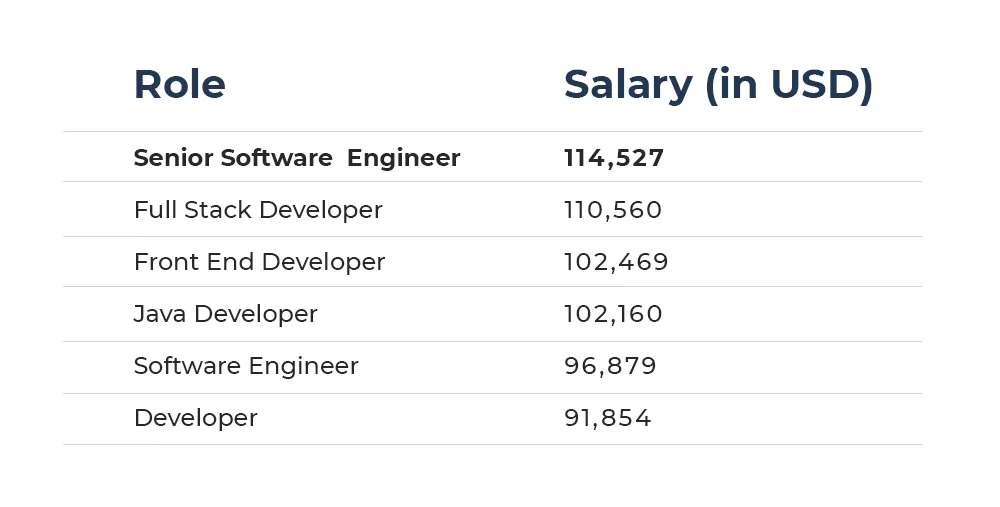
Image Source: https://www.c-sharpcorner.com/article/top-software-job-trends-in-2018/
2. Demand
According to the US Bureau of Labor Statistics, software developer jobs are predicted to grow by 17% from 2014 to 2024. This is much faster than the average for other occupations, which is at 7%. The US Bureau of Labor Statistics explains that the main reason for the rapid growth is due to ‘a large increase in the demand for computer software’.
Here’s a table containing the number of jobs available for the the top 5 programming languages, via Indeed.com.
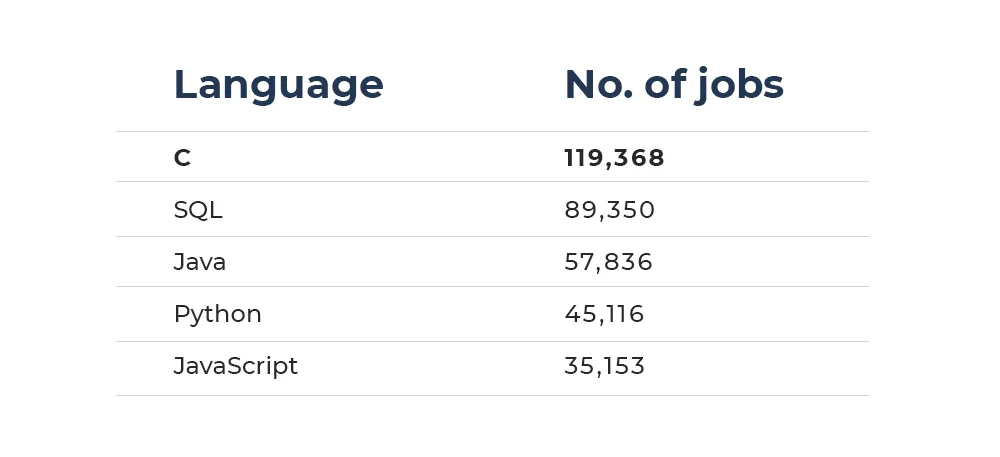
Image Source: https://www.c-sharpcorner.com/article/top-software-job-trends-in-2018/
3. Never Too Late to Become a Developer
You might think that programmers are all youngsters who have been coding away since elementary school, but that’s not true. According to the 2018 Stack Overflow Developer report, which surveyed over 100 000 developers, 25% of programmers are over the age of 35.
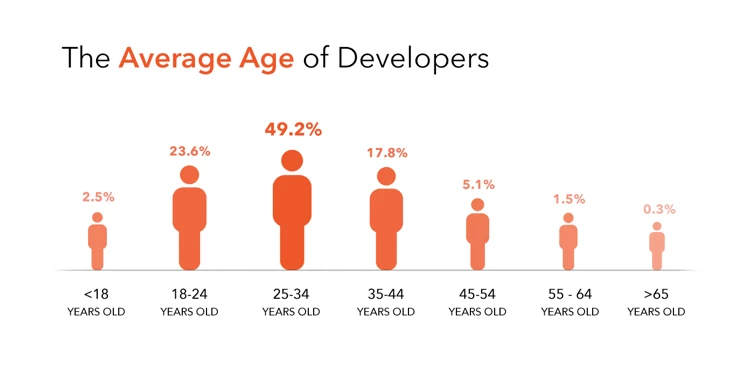
In addition, a full third of professional developers on Stack Overflowonly learned to code within the past five years, so presumably a fair number of those older developers probably learnt coding fairly recently. In fact, almost 12% of developers who work in the industry only learnt to code in the past two years. Becoming a developer can happen at any age!
4. You Can Freelance
Not only can you work from anywhere – the beach, the local coffee shop, your home – but the average freelance salary is even higher than a permanent salary: According to Glassdoor, you can expect to earn an average freelancer salary of $104,463 per annum in the United States. Enjoy the benefits of the freelance lifestyle: choose projects, clients and technologies that interest you, flexible work schedules and no boss!
5. A Combination of Team and Individual Work
T-shaped employees are often an ideal developer hire, says Stack Overflow, based on interviews with CEOs, programmers, and recruiters. According to TechTarget, a T-shaped employee refers to a person who has ‘a breadth of general knowledge and soft skills’ – this is represented by the horizontal bar of the T. The hard skills part is symbolised by the vertical part. Basically, a T-shaped individual is both a generalist (with people skills), as well as someone who has niche-topic specialities. This person is best, because many tech jobs involve a combination of team and individual work.
What about the cons of becoming a developer? Let’s look at a few of those.
Becoming a Developer: The Cons
1. Competition
Because the salary and the job conditions are good – so good, in fact, that Software Engineering was seen as the ‘best STEM job’ and ‘best Technology job’, according to the U.S. News & World Report – there will be competition for jobs. However, as mentioned, job demand is high. To separate yourself from the rest, consider completing an online coding bootcamp, which will broaden your skill set by learning more programming languages and technologies.
2. Too Much Sitting
This might not sound like a con, but it is. Business Insider reports that a sedentary lifestyle is not only bad for the heart and the waistline, but also increases the risk for cancer and diabetes. You can counteract this con by taking frequent breaks and working exercise into your schedule.
3. You’re Always Learning
This can be stressful for some people, because there’s always more to know, and different ways of doing things. Says Stack Overflow: ‘Developers are lifelong learners; almost 90% of all developers say they have taught themselves a new language, framework, or tool outside of their formal education. Among professional developers, almost half say they have taken an online course like a MOOC, and about a quarter have participated in a hackathon.’
4. Stress
It’s well-known that coding can be stressful. Says Nasreen Mahomed, a Junior Software Developer: ‘Like most jobs, the stress waxes and wanes. Live pushes are certainly pressurised times. If there are problems, you need to keep a cool head and fix it quickly. You have to be able to work well under pressure.’
5. The Hours Can Be Long
There are times when you’re rolling out a project and you’ll be required to work weekends or overtime. Also, if you run into problems and a system goes down, you may be expected to work extra time. However, if you enjoy the work, this shouldn’t be too much of a sacrifice.
In this article we’ve listed the pros and cons of becoming a developer. It certainly seems that the pros – including high salaries, potential freelance work and increasing demand – outweigh the cons. If you’re needing to learn how to code or update your coding knowledge, consider signing up for one of HyperionDev’s six-month, part-time online coding bootcamps in Full Stack Web Development, Mobile Development and Software Engineering.

Software Engineering
Mobile App Testing Strategy Tips for Startups
When it comes to mobile app testing, as a startup, there are a few fundamentals you should include in testing phase. We’ve explored them in this post.
There are over 3 million apps available via Google Play Store alone and the revenue generated by these apps has reached unprecedented heights. It’s fair to say that the mobile app development space is booming, and startups are enjoying significant market share. Launching a tech startup can be as daunting as it is riveting, especially when a big part of the business strategy rests on the smooth running of a new mobile app. When it comes to mobile app testing, as a startup, you cannot be thorough enough – although the majority of today’s most successful startups will urge you to resist the struggle for perfection, get off the ground and iterate as you go. Whatever approach you take to getting off the ground, there are a few fundamentals you should include in testing phase. We’ve explored them below.
Test the App’s UI On Different Screens
With (literally) millions of smart devices out there, there are just as many screen sizes and aesthetic factors to consider when testing a mobile app. UI is essential – in an age where appearances are everything, it can make or break your app. Try to test the app on a number of models, to see how your app will respond to changes in screen size. You can’t risk elements not aligning or images bleeding off the page. The same rule that applies to nature, applies to the world of mobile apps: adapt or die. The most highly responsive mobile apps are the ones that get downloaded the most. There are other factors to consider of course, but when it comes to looks, consistency is vital.
Test Your App On Real Devices
Emulators are a great place to start when testing a new mobile app, particularly because they’re significantly cheaper than the real thing. Emulators are software apps that mimic the hardware, OS and functionality of a mobile device. They also allow you to debug flows as you’re testing the app. According to Ahmed Hassan, senior QA and test automation engineer, you can “delve into code, file structures, and databases in real time, allowing for nuanced inspection of whatever feature you’re testing.” But there a few downsides to using emulators that make it necessary to use real devices as well.
For example, emulators cannot test each device’s unique configuration. Bear in mind that users are going to be using real devices, not emulators, so factors like battery life, GPS, connectivity issues and camera functionality will vary from device to device. Therefore, the best way to test an app is to use a series of devices. You will need to take into account which devices are used per geographic region and according to your target market’s demographics such as age, income bracket and occupation. In Africa for example, a range of more affordable smartphones and legacy devices are unique to the market and Blackberry, although redundant in most parts of the world, is still being used. Make sure you test at least 80% of the devices used by your target market and you should be good to go.
Measure Sentiment as Part of Pre-Launch Testing
One of the opportunities that many mobile app developers miss out on, is tapping into the broader consciousness and involving a test group. Vu Pham, QA Manager at KMS Technology points to the importance of emotional engagement in the recently released “Pokémon GO” game. It was imperative that before the mobile game was launched, developers ensured that it was thoroughly tested by a representative group of end users who could bring fresh perspectives to the table. This step is often neglected but it can make the difference between whether your app is used once and deleted or whether it becomes an app that forms part of the end user’s daily life.
Go Agile ASAP
Patrick Gray of TechRepublic suggests that when it comes to testing, mobile app developers should take an iterative approach from the onset rather than waiting until after the build to begin making changes. Taking an agile approach allows for progress to be made as the build continues – providing an unmatched level of flexibility. Ultimately, agile methodology allows for devs to take preventative action when it comes to diagnosing and solving glitches, rather than trying to fix them in retrospect. The agile approach to development often includes the participation of customers throughout the development phase, which in itself has its pros and cons. Collaboration is key to faster and more effective problem-solving; involve the entire development team and procure a range of opinions on the app’s functionality. It may seem like the agile approach prolongs the development process but in the long run, it could be the defining line between a buggy app and one that runs like a well-oiled machine.
Want to find out how to master Java and Android to be able to develop apps like Snapchat, Pokemon GO, or Uber? Enrol in our Mobile Developer Bootcamp today and kickstart your career in mobile app development.

Career Advice
How to Get Hired as a Silicon Valley Developer
There is a huge presence of tech companies and a large demand for developers in Silicon Valley. As an aspiring Silicon Valley developer, what skills do you need to get hired?
The allure of working as a Silicon Valley developer is universal. Every coder, from the newbie to the seasoned software architect, knows about Silicon Valley, the San Francisco technology hub. Home to the world’s leading tech companies (Apple, Google and Facebook) as well as plenty of start-ups, Silicon Valley is a dream destination for many developers looking to launch their international careers.
As an aspiring Silicon Valley developer, what skills do you need to get hired?
Meet a Need in the Job Market
Recent research by Indeed reports that overall job postings in San Francisco’s Bay Area are down compared to previous years. Job growth in Silicon Valley has been declining since 2015, so there are less positions available, and that means you’ll have plenty of competition when trying to land a role there.
Forbes lists the following positions as the current top ten jobs in demand by Silicon Valley companies:
- Software engineer
- Front-end developer
- Full-stack developer
- Product manager
- Development operations engineer
- Software architect
- Java developer
- Software test engineer
- Senior product manager
- Engineering programme manager
If you have any of the above coding and development qualifications, you’ll have a much better chance of landing that dream job in sunny California. HyperionDev has a range of online coding bootcamps available, to get you started. These flexible courses cover front-end and back-end development, as well as software engineering.
Speak the Right (Coding) Language
It’s important that you learn the most in-demand programming languages for front-end and back-end development.
According to a recent Developer Skills Report survey, most employers in tech look for developers proficient in Java and/ or Javascript. On the other hand, a growing number of developers are focusing on languages created by Silicon Valley tech firms. Go, created by Google, is the most popular, followed by Rust (backed by Mozilla) and Swift (developed by Apple). This shows how Silicon Valley technology is driving a shift in the languages prioritised by developers.
Develop Your Soft Skills
While technical skills are important, major firms also look for employees who will be strong team players. It’s important that you’re able to build a good rapport with your team members, and share knowledge with them. You may also be required to communicate with clients on behalf of the company, which makes you responsible for upholding your company’s reputation.
Good developers have sound technical knowledge, but great developers are those who are always willing to learn more. Great developers don’t just excel behind the keyboard; they’re also able to apply their problem-solving know-how to real-life situations. Top companies are looking to employ great developers, so be sure to cultivate soft skills like active listening, empathy, open-mindedness and approachability.
Up Your Networking Game
Sometimes the old saying, “It’s not what you know, it’s who you know” rings true. If you are job-hunting in a competitive area like Silicon Valley, it helps to have connections. Get to know other people in the local tech industry by attending Bay Area meetups, conferences and other networking events. You might meet your perfect employment match, or find like-minded people to collaborate with on a project – at the very least, you’ll make a few new friends in the industry.
Face-to-face connections are ideal, but not always feasible. If your location makes it difficult to attend meetups in person, you can also take advantage of digital networking options, and stay active on industry forums and chat groups.
Demonstrate Your Passion
If you’re looking to make an impact on a prospective Silicon Valley employer, it pays to have a well-rounded portfolio of work. If you can showcase your passion and skill outside of a 9-to-5 job, that’s something tech firms will notice and appreciate.
Work on notable side projects that will build your skill set and improve your employability. Build a creative app, design a piece of open source software, or take on pro-bono website work for a local NGO.
Looking for inspiration? Sign up for a HyperionDev bootcamp and get a chance to learn from an industry mentor. You’ll gain invaluable technical skills, while the mentorship process will also help you to hone your interpersonal skills, and give you some ideas for creative and productive side projects. If you’ve got your heart set on being a Silicon Valley developer, this is the place to start!

Career Advice
5 Networking Tips for Moving Into the Coding Industry
Although tech jobs are in high demand, you want to make sure your post-bootcamp options are as good as possible. Read on to find out the best networking tips for coders.
Once you’ve finished your bootcamp, you’ll want to land a job. Mark, 32, completed a Full Stack Web Developer Bootcamp and found work with a small tech startup. He says: ‘I was advised to start networking before my bootcamp finished. This was excellent advice, because I already had three offers lined up before I’d finished my final project. I chose the company that seemed to best suit my personality: laidback and informal, and so far, I really feel I’ve made the right decision for me.’ Although tech jobs are in high demand, you want to make sure your post-bootcamp options are as good as possible. Read on to find out the best networking tips for coders.
1. Five A Day
With networking, it’s obviously important that you meet new people and extend your circle of contacts. With this in mind, set yourself a goal regarding the number of people you want to contact on a daily basis who could help you move into the coding industry. In an article on The Hard Refresh, introverted Carrie Watkins states that her ‘introverted tendencies raised their quiet and unassuming heads within weeks of starting’ her project, which was to contact a number of key players in her industry. Her goal was to contact five prominent people in tech a day.
How did she get past her introverted personality? By doing the following:
- Ensuring the reach-out was about that person. She had to help the people she was contacting in some way – by, for example, giving their words a boost on social media, thanking them for their excellent work or offering them a person or an idea that would be useful for their line of work.
- Putting reminders on her calendar for the afternoon so that she couldn’t forget about her networking goal of contacting five people a day, otherwise it was too easy for her to ‘forget’ about something she found hard.
- Keeping emails short, as well as entertaining and helpful.
- Using Twitter and LinkedIn to get a little background on the person being contacted.
- Mixing it up – using a variety of ways to contact people include email, Twitter, LinkedIn or asking to meet in person.
2. Ask the Professionals
One of the key networking tips for coders is to speak to the people who specifically service the tech industry’s employment vacancies- the recruitment consultants. A good consultant should be able to provide insider knowledge about various companies, and what it’s like to work there. They should also be able to help you with the interview process and it might be easier for you to negotiate via a third party should you receive a job offer via a recruitment consultancy.
3. Social Media as a Search Engine
Think about social media in relation to searching for work – consider all the additional people to whom you’re exposed: acquaintances, old friends, friends of friends. Connections and personal relationships will always help you when looking for work. Here are networking tips for coders on how to leverage your social media connections:
- Spruce up your profile. Google yourself to see how you will appear to potential employers. Remove what doesn’t look professional.
- Add profile content and contribute to social media conversations that are relevant to coding.
- Look for 5-10 companies you would like to work for. Start following them on Twitter and Instagram. You’ll pick up a lot about their company culture and the kind of employees they want. Start tailoring your social media presence to make yourself attractive to them.
- Use Hashtagify, a free web service. You can now search Twitter subjects by their hashtags. Look up #techjobs.
- Connect potential employers on a platform like LinkedIn – it’s considered less overbearing than emailing. LinkedIn accounts are also easier to find than email addresses.
4. Face-to-Face
It can be tempting to just engage in digital networking, but face-to-face networking offers a number of advantages including the ability to read the body language of the person and react appropriately to that. This allows one to develop very strong personal connections.
Look for tech conferences, networking events and tech meetups in your area. It’s worth looking for tech events on Facebook as well. Check out this 2018 tech conference directory on the web – see if there’s anything in your part of the world. Or try The TechMap, which includes meetups, seminars, user groups, hackathons and tech events in your area.
5. Tech Online Sites
You’re looking for work in tech. This means you should frequent sites where other developers hang out. They are likely to be the first to hear about potential openings in their companies.
Two techie sites worth getting to know are Stack Overflow and GitHub. You can use Stack Overflow for research and to get solutions to your programming problems, but at the same time you can meet some of your fellow developers. Simultaneously, get set up on GitHub, where you can host and review code, manage projects, and build software alongside millions of other developers. Add your existing code to share with prospective employers or start new projects to keep yourself relevant. GitHub accounts are free, and it’s the best place to swap ideas and code with other programmers online. Both Stack Overflow and GitHub are great for building your reputation as a serious coder.
In closing, we’ve listed five networking tips for coders. If you can, try and incorporate them all. You never know which networking route will land you the best job offer. If you need to polish your coding skills before starting to network, consider signing up for one of HyperionDev’s six month, online coding bootcamps in Full Stack Web Development, Mobile Development and Software Engineering. They all include a free trial and come with mentor support.

Software Engineering
3 Video Game Storytelling Techniques We Need More of in Web Design
Web design professionals can learn some valuable lessons from the world of video game design. We look at 3 valuable video game storytelling techniques we could use in web design.
At first glance, web design and video game design appear to be two separate worlds. One is considered “serious business”, while the other is, well, “fun and games”. However, web designers and developers could learn some valuable lessons from electronic games creators and the storytelling techniques they employ to create a user experience.
Some Background on Video Games
A video game is designed around interaction with a user interface, which generates visual feedback on a video device.
Electronic games can be played on a variety of platforms, including personal computers and laptops, handheld consoles and home consoles, arcade machines, web browsers, mobile devices and more recently, virtual reality headsets.
The game “Tennis for Two”, created by physicist William Higinbotham in 1958, is widely considered to be the world’s first official video game. The game used a cathode ray tube display showing two lines that represented a side view of a tennis court, and a dot representing the ball.
Needless to say, gaming graphics and interactions have come a very long way since then! Games immerse players in painstakingly crafted worlds, and guide them through complex storylines towards the end goal.
So, what inspiration can web design professionals draw from video game design?
1. The User is the Hero
Video games put the player in the driver’s seat, giving them control over their actions and allowing them to be the hero of the story unfolding in front of them. Players have a clear mission, and their decisions will determine whether they achieve the goals set for them.
In the same way, websites can put their visitors in control of their journey through the site. For example, allowing a visitor to create their own user profile and avatar gives them a sense of control over their onsite journey from the beginning. Providing them with personalised, relatable content will help to carry this user experience through the site.
2. More Symbols = Fewer Distractions
Mobile search traffic is on the rise, with studies showing that more than half of visits to websites are now done via smartphone. Of course, mobile screens are much smaller than computer screens. It’s important to keep these smaller layouts clutter-free and clear.
Video game designers use simple visual symbols to give the user information in a way they can instantly interpret and understand. Think player character health trackers, life counters, route maps, collected prizes and achievements, etc. These symbols also transcend language barriers, making a game (or website) more widely accessible to users from different cultural backgrounds.
By using symbols instead of words, web designers can simplify and minimise navigation and directional cues, which won’t distract visitors from the main website content. This could be as simple as using a magnifying glass icon instead of the word “Search”, or a shopping cart icon to represent the check-out.
3. Smart Use of Space
Games create parameters and boundaries for the player to move around in. This “spatial storytelling” helps to direct the story and influence the player’s behaviour.
Game designers might do this by using light and colour to highlight a certain element or area of a screen, directing the player’s attention towards it. They may also use sound-based clues to direct the player. Some creators use NPCs (non-player characters) to interact with players and give them advice or direction.
Web design also needs to steer visitors along a certain path (i.e. towards conversion). This could include adding subtle visual cues to guide them towards the next click, or using a mascot character to talk them through the process of sign-up, subscription or check-out.
Good Storytellers Make Great Developers
There’s more to web design than endless lines of code. Effective, user-friendly web design requires creative thinking, and an instinct for how to guide users through the site’s “story”.
If you have a passion for code and a knack for creativity, web design could be the perfect career path for you. Sign up for one of HyperionDev’s six-month online web development bootcamps, and start honing your skills today.

Career Advice
What Kind of Companies Do Coders Work For?
Software developers work in a diverse range of industries, including media, finance, technology, healthcare, etc, as well as various sizes. What are the advantages and disadvantages of working for these different companies?
Once you’ve finished your coding bootcamp, you’ll be keen to find a job. The good news is that tech jobs are in high demand. According to a recent report from IT and networking company Cisco and market intelligence firm IDC, reported in Business Insider, the global economy by 2027 will have added more than five million jobs in information technology. With all these job opportunities around, what kind of companies do coders work for and what are the implications for coders?
According to the 2018 Stack Overflow Developer Survey, which analysed responses from 101,592 developers from 183 countries around the world, software developers work in a diverse range of industries, including media, finance, technology, healthcare, etc. And although they work in companies of all sizes, from small to very large enterprise organisations, most US software developers work in larger companies (compared with the rest of the world). More experienced developers are more likely to work at bigger companies – for example, a developer with 30 years of experience is twice as likely to work at an organisation with more than 5000 employees than someone with only 2 years of experience.
Here’s a breakdown of the percentage of developers at differently-sized companies.
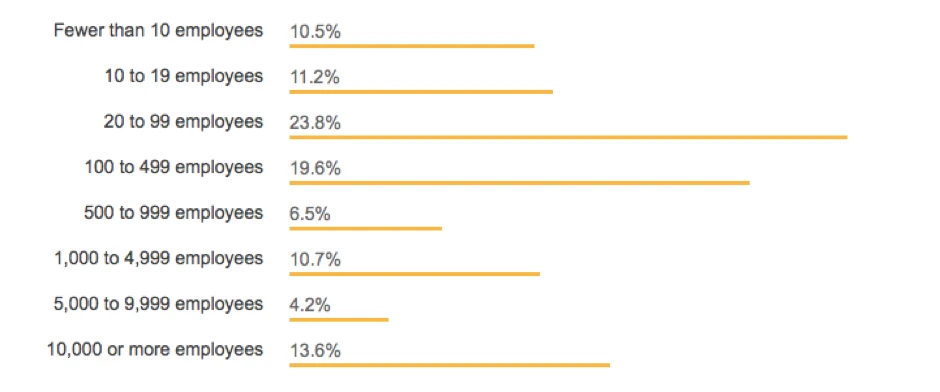
Image Source: https://insights.stackoverflow.com/survey/2018/#work-company-size
What kind of companies do coders work for? It seems all kinds, but what are the relative advantages (and disadvantages) of working for these different companies?
Large Companies
Large companies offer the following advantages (or disadvantages), depending how you view these characteristics.
- Generally, these are successful companies – that’s how they became large in the first place. This provides job security and a reliable income.
- There’s a potential to learn a lot, because there are likely to be people there who really know the systems at work and are experienced.
- You become part of a large community of people and this can be of value in future networking.
- Perks – some perks can be quirky or unusual like access to a company yacht, in-office yoga and massages, communal workout sessions and group cooking classes.
The pace tends to be slower and less risky. One of the biggest differences between working at a larger company versus a startup or smaller firm is the ‘rate at which things change,’ explains an article in Medium. At a large company you’ll likely to do the same set of tasks until you’re promoted. The job description is pretty clearly mapped out, which makes the work fairly repetitive and predictable.
What about startups? What is it like to work at one of those? Read on to find out.
Startups: What Can You Expect?
Even if the stability and salaries are likely to be lower, startups and smaller companies offer definite benefits including:
- In general, the smaller the startup, the more frequently you’ll be taking on new responsibilities. This makes it easier for you to prove yourself and move up the ladder, because there is less competition from peers.
- You’ll work more closely with senior management.
- If you have an idea or a proposal, it’s more likely to be taken on board. Basically, you’re more likely to steer the direction of the company and this gives you a sense of ownership in your work and that of the team. In addition, a startup is more likely to pivot (i.e. when the business model is not working and the team then pivots to Plan B).
- Money is likely to be tight at startups. This isn’t necessarily a bad thing, because you’ll learn to be frugal, a vital business skill. You’ll find meaning in creating rather than consuming.
- Interesting, millennials tend to thrive in startups – perhaps because the atmosphere tends to be more casual and the hours more flexible.
- On the downside, the workload can be heavier, because startups need to move quickly and there aren’t other people to take your place if you’re not around – stress and burnout are real possibilities.
In closing, what kind of companies do coders work for? All sorts. That is perhaps the best thing about becoming a developer: the multiple work environments and options available out there. If you’re interested in learning coding skills, check out one of HyperionDev’s six month, online coding bootcamps in Full Stack Web Development, Mobile Development and Software Engineering. You can try out any of these courses for a free trial before upgrading.

Cyber Security
August 1, 2018
Bug Bounty Programs in 2018: How You Can Get Involved
There is a massive rise in bug bounty programs at large companies like Facebook and Apple. What exactly are bug bounty programs and how can you get involved in this lucrative endeavor?
‘We’re in the age of the hacker,’ states the website HackerOne, a bug bounty platform that connects businesses with cyber security researchers (or bug bounty hunters). The reason is simple: there’s a massive rise in bug bounty programs at large companies like Facebook and Apple, explains Wired. So what exactly are bug bounty programs and how can you get involved in this lucrative endeavour?
Bug Bounty Programs: What Are They?
Put simply, a bug bounty program is a deal offered by companies where hackers (or computer software programmers) can receive recognition and compensations for finding bugs in your code, especially those relating to exploits or vulnerabilities. However, it’s not always easy for big software companies to find and interact with hackers and that’s where a company like HackerOne gets involved; they are essentially a kind of middleman between companies and hackers.
The basic idea is ‘to put good-guy hackers on the company’s payroll so they can find problems before the bad guys do,’ explains Business Insider. The good-guy hackers are known as ethical hackers, or white hat hackers (also known as ‘security researchers’). It’s not that the the skill set is different from malicious or black hat hackers, but the goal differs: malicious hackers are in pursuit of evil goals such as spam or cyber attacks to steal personal information, whereas ethical hackers use their skills in a lawful way to try and find vulnerabilities that need to be fixed. And remember: the internet gets safer every time a vulnerability is found and implemented.
Bug Bounty Programs: What Can You Actually Earn?
Money is definitely a big motivator. Based on the 2018 Hacker Report, the largest documented survey with 1698 respondents from the ethical hacking community, the following reasons were put forward as motivators for hacking. You can see that money wasn’t actually the biggest motivator – ‘to learn tips and techniques’ was.
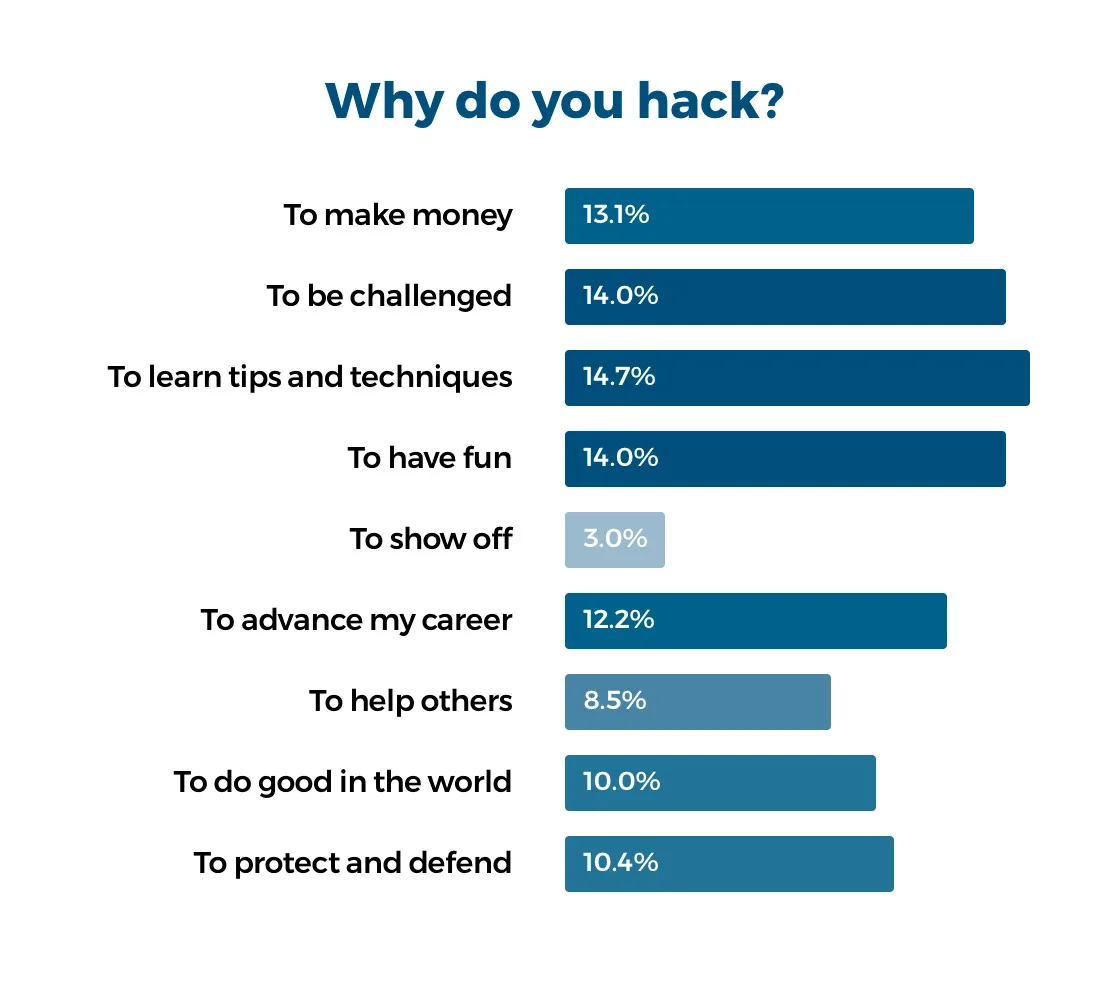
Image Source: https://www.hackerone.com/blog/2018-Hacker-Report
And what about the cash? How much can you make? It’s certainly possible, depending on which country you come from, to make more than you would as a software engineer. In the table below, the median annual wage for a software engineer was taken from PayScale for the different regions. You can see how much more bug bounty hunters are making: India shows the largest difference with researchers making an average of 16 times the median salary of software engineers in that country, whereas in Belgium hackers make an average of 2.7 times more than the median software engineer salary.
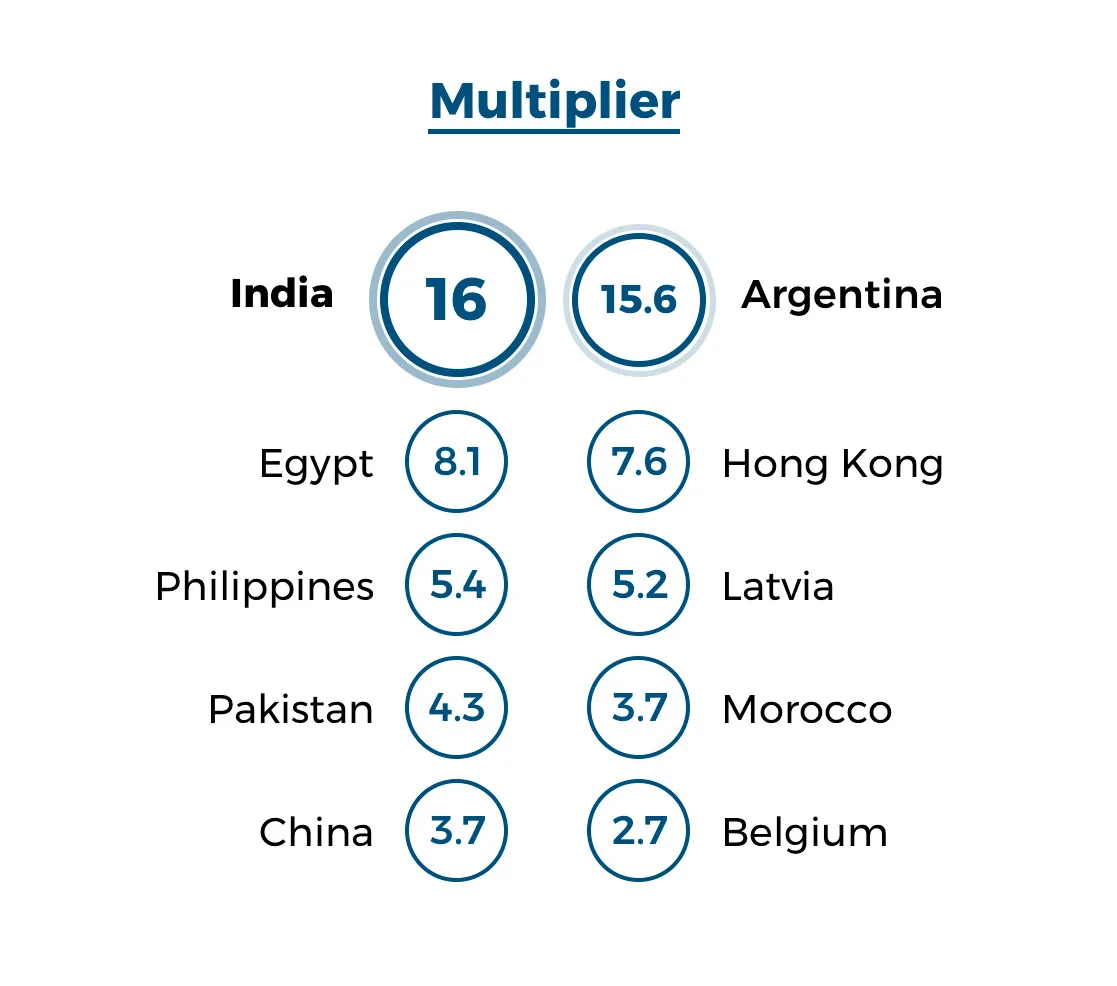
Image Source: https://www.hackerone.com/blog/2018-Hacker-Report
Rewards can range from $500 to $100 000 depending on the type of bug and the amount of time spent searching for it. One of the world’s largest bug bounty programmes is Trend Micro’s Zero Day Initiative (ZDI), states Computer Weekly, which is for Microsoft and Adobe. They have paid out over $15 million to researchers to date. Companies like Google and Apple can offer up to $200 000 as a reward for a single bug. Intel and Microsoft can offer up to $250 000. The average payout, however, is about $2000 for revealing a single security vulnerability.
So how can you get involved in a bug bounty program?
Bug Bounty Programs: Getting Involved
Here are some ideas from LifeHacker about how to become a bug bounty hunter:
- Learn coding – this seems pretty obvious, but you will need to start here. Consider an online bootcamp to acquire your skillset fast.
- Learn how web applications work. Think about looking over The Web Application Hacker’s Handbook.
- Get the right tools – e.g. Kali Linux (free), Burp Suite ($349 a year, but popular) and OWASP Zap (free alternative to Burp Suite).
- Practice finding bugs – look at Google Bughunter University (teaches you how to write vulnerability reports – a vital aspect of performing the work).
- Once you have the knowledge and the tools, check out a bug bounty board (it’s simpler than seeing out each individual company’s website) – e.g. Vulnerability Lab, Bugcrowd and Hacker One.
In closing, coding skills open up a world of opportunity, from traditional jobs in large companies to freelancing. Now you can add Bug Bounty Hunter to your skillset – there’s certainly good cash to be made, and you’ll have fun in the process, if you get involved in a bug bounty program. If you’re needing to update or learn coding, consider signing up for one of HyperionDev’s six month, online coding bootcamps in Full Stack Web Development, Mobile Development and Software Engineering. You could be the next Big Bug Hunter.

Software Engineering
What is a Software Architect?
Learn about the responsibilities of a software architect, the job demand of the industry, and what it takes to land this in-demand role.
A software architect is a software expert who provides overall direction to a development team. The software architect is able to take a complex system and break it down into a manageable model, by identifying important requirements and constraints.
When teams are working on multiple development projects for multiple clients, it’s especially important to have a software architect in charge. The architect makes high-level design choices and puts the technical standards in place, ensuring that quality stays consistent from one project to the next.
What are the Roles & Responsibilities of a Software Architect?
Simply put, the software architect’s role is to provide full technical support for a project, guiding it from the concept stage to a fully functioning finished product. This process includes working with systems infrastructure, operating systems, databases, back-end code (Java, Python etc) and front-end code (HTML, Javascript, etc).
The software architect will be expected to:
- Identify all project stakeholders
- Identify the business requirements and stakeholder requirements
- Design the system based on these requirements
- Select appropriate architecture for the system and each individual component of the system
- Select the appropriate technologies to implement each system component and the connections between them
- Provide architectural review
- Provide code review (systematic examination of source code, according to industry standards)
- Create project documentation and support documentation
- Create unified development standards, including software coding standards, tools and platforms
This “Career Spotlight” interview from Lifehacker.com will give you more insight into a day in the life of a software architect.
Is there a Demand for Software Architects?
Yes, software architects are very much in demand. They play a vital role in the successful delivery of projects, and help companies to establish good development practices and uphold high standards.
A software architect position is considered notoriously hard to hire for, because people with such well-rounded skill sets are in short supply. According to Indeed, “Software architects are the unicorns of the tech job market… likely because this job requires a rare combination of qualities: advanced technical skills and a high level of foresight and vision.”
Back in 2010, Money Magazine ranked software architect as “the best job in America”. With demand still outweighing supply, it continues to be a rewarding and high-earning position. Glassdoor.co.uk estimates the average base salary for a software architect at £65,000 a year. The job is also ranked #9 among Silicon Valley’s best-paying tech positions.
What does it take to Become a Software Architect?
Software architects are full-stack developers, meaning they must be able to perform tasks at any level of the technical “stack”. If you want to become a software architect, you must have broad technical knowledge, with an understanding of multiple programming languages and platforms.
Qualifications:
There are many courses you can take, but it’s important to choose one that’s worth the time and money you invest in it.
HyperionDev offers a certified full stack web developer bootcamp, specially designed to give you a tailored learning experience.
This six-month part-time course allows you to learn several in-demand languages:
- HTML
- CSS
- Javascript
- Node.js
- MongoDB
- Express
- React
- Python
- Django
The bootcamps also offer industry-standard code review, which is an integral part of any software architect’s job.
Mentorship:
Working with a mentor can also help you to develop your skills and advance faster. HyperionDev courses include support of full-time coding educators, which means you get real-life advice from experienced developers and architects.
Mentorship can help you to cultivate soft skills as well as technical skills. As a software architect, you need to work in collaboration with multiple people involved in each project. This includes clients, product managers and developers. Strong communication and interpersonal skills are a must. It’s important to cultivate good active listening skills, so that the other parties feel heard and understood.
Software architects must be willing to cooperate with others and be “team players”. They must be willing to share their knowledge and mentor others.
Literature:
In the world of software, your education doesn’t stop after you receive your certificate. It’s a fast-changing field that requires a lifelong learning curve. It’s important to keep your knowledge up to date, by reading articles, journals and books recommended by other professionals in your industry.
Get Started on the Right Career Path Today
If you’re planning to become a software architect, but you’re not sure where to start, HyperionDev has some excellent options to get you those must-have qualifications. Work your way through web development essentials, back-end development, and advanced full-stack development curriculums.
With flexible learning and personalised mentorship, you’ll be able to lay the foundation for a rewarding career as a software architect.

Career Advice
Tips On Finding Remote Coding Jobs After A Bootcamp
If you’ve just completed a coding bootcamp, you may feel ready and able to go out there and conquer the world. If you are, firstly congrats - you’ve taken an inspiring leap forward. But there’s work to be done if you’re going to find remote coding jobs that work for you. And it’s not all cocktails and beaches.
Working remotely. It’s the dream right? Digital nomads fill their Instagram feeds with images that look something like this: a laptop strategically placed next to a cocktail against the background of an idyllic beachscape with white sand and blue water. Pop a good filter over that and they’ve captured everyone’s ideal picture of remote coding jobs. If you’ve just completed a coding bootcamp, you may feel ready and able to go out there and conquer the world. If you are, firstly congrats – you’ve taken an inspiring leap forward. But there’s work to be done. And it’s not all cocktails and beaches.
Is Working Remotely For You?
That is indeed the question. And don’t be intimidated if you can’t answer the question right away or if you’ve jumped right into the job search without thinking about it. Now’s your chance to find out whether remote working is for you.
Ask yourself:
Do I enjoy forming relationships with the people I work with?
When you work remotely, there’s no such thing as “Friday drinks” or “lunch with the guys/girls” or having a paper jet flying competition. You won’t have the chance to immerse yourself in company culture and reap the benefits of forming relationships with colleagues. For some social butterflies, this is a deal breaker. For others, the chance to work sans office politics couldn’t come soon enough. Remember, if you choose to work remotely from a collaborative space, you will inevitably form good relationships with your freelance colleagues so there are ways to surround yourself with people who uplift and inspire you even if you’re a lone ranger.
Are you mature enough to handle working remotely?
Maturity has absolutely nothing to do with age. You can be fresh out of high-school and be able to take initiative, ask for help when it’s needed and manage your time so you can meet your deadlines. Conversely, you could be in your 40’s and still have snooze alarm syndrome. Working remotely means being a self-starter and not needing to be micro-managed. That’s a huge plus but it’s also a big responsibility. Your employer will expect you to deliver efficiently and on time. If you’re mature enough to manage your own schedule and set priorities, then you’ll be a great remote worker.
Do you have nerves of steel?
In an office, if you get stuck or the Wifi crashes or you need help with a coding dilemma, help is only a desk away. But when you work remotely, you’ve got to use your initiative to solve problems. A fellow worker may be too busy to take your call or not at their desk when your email lands in their inbox, and you may need to make decisions on demand. For that, you need to have a good head on your shoulders and be prepared to do whatever it takes to find the help you need in a proactive and constructive way.
Tips On Finding Remote Coding Jobs
1. Talk to the Decision-Makers
Felix Feng spent three months applying for jobs after coding bootcamp and learnt some important lessons in the process. One of them was that often, applying through third-party job boards means that your application gets lost in a black hole of admin. Taking a more direct, personal approach is often the key to getting your foot in the door. If you use a job board, try to find out which company the job advertised is for, then call them and get the email address for the head of recruitment, or better yet, the head of the department you want to work in, and send them a direct email to introduce yourself. Decision-makers will give you a simple yes or no. No time wasted.
2. Brush Up Your Social Media Profiles
Here’s something you can do right now. Login to your Linkedin profile and remove that cheesy-grinned, blurred profile image of you from five years ago. Replace it with a professional-looking one that says “I’m responsible, diligent and eager to get started,” as opposed to “I’m good-looking and I’ve spent a lot of time tanning in Thailand as you can see from this picture.” Make sure that all your professional details are correct – it’s all about the fine details.
3. Prepare To Put In Some Free Hours
One thing you would have learnt if you ever received sales training, is that the worst thing a prospective buyer can say is “no.” Picture yourself surviving that little hint of rejection and you’ll be just fine. Instead of waiting for employers to come to you, go to them. Email the MD or department head at the place you’d love to work for and pitch them. Invest in putting together a good CV and portfolio and volunteer to show them what you can do by means of a coding test or small pilot project in which you will participate for free. People who land their dream jobs are go-getters who’ve put in their fair share of free hours.
Working remotely is not for everyone, but then neither is the typical 9 to 5. It’s all a matter of perspective. The fact is that many developers who enjoy their own company, their own space and their own time schedule, find remote working to be absolute bliss. Think about it, weigh up the pros and cons, then take constructive action – there’s no time like the present.
Considering changing your career path or heading into the big wide world of coding? Sign up to find out more about HyperionDev’s coding bootcamps and how we can enable your next career move.

Cyber Security
5 Essential Cyber Security Tips for Bootcamp Students
In this age of technology, we are all a target for hackers. Follow these five essential cyber security tips and you should be on your way to making your digital life secure.
A few months back my father had $10 000 worth of Bitcoin stolen from his cyber wallet. How did this happen? Quite simply, he’d responded to an ‘official’ email that queried his account. No, he hadn’t sent any account details or divulged anything, but the simple act of responding to what was, in hindsight, a phishing email led to this terrible theft. ‘I felt terrible,’ he said. ‘I’m computer literate and I thought I’d never fall for a scam, but I did. Besides the cash loss, I just felt dumb.’ The first cyber security tip worth remembering, which certainly applies to my dad and should be a guiding principle for all, is this: you are a target to hackers, explains the UC Berkeley site. Don’t think ‘it can’t happen to me’; we are all at risk, particularly if you’re a bootcamp student and studying programming. You’ll be using your computer for all kinds of new things. Follow these five essential cyber security tips and you should be on your way to making your digital life secure.
#1 Tip: Keep Software Updated
It’s vital that you keep your programs and operating systems updated. This will include the latest security updates. Here are things you can do:
- For your operating system, turn on ‘Automatic Updates’.
- Use common web browsers – for example, Chrome or Firefox – that receive automatic and frequent security updates.
- Keep browser plug-ins like Flash or Java current.
- Use a software updater to ensure all your software is on on the latest versions. Here’s a list of 11 free software updaters.
#2 Tip: Practise Proper Password Management
This seems obvious, but think how often one reuses the same password for multiple programs and / or devices. This is a cyber security tip that comes via Dell who do a lot of security training with team members, and it’s especially relevant to small businesses, which are particularly at risk when it comes to security. In fact, many bootcamp graduates will end up as freelancers running their own businesses. 60% of small businesses will go out of business within six months of a cyber-attack, according to the National Cyber Security Alliance.
Here are some password tips, from Wired:
- Use a password manager – like 1password or LastPass.
- Go long: if your password is in the 12-15 character range, it’s much harder for a hacker to guess it.
- Space out special characters throughout the password. Don’t just dump them at the beginning or the end, because everyone does that.
- Don’t trust your browser to remember your passwords. It’s tempting and convenient, but the underlying security might not be so good.
- Add 2-factor authentication: this is safer. Basically, you get sent a code via your phone or some other software solution whenever you login. It offers double protection.
#3 Tip: Click with Care
Don’t visit unknown websites or download software from sources that are not trusted. These sites could easily contain malware that automatically, and without your knowledge, compromises your device. Don’t click on unexpected links or attachments.
#4 Tip: Surf with Care on a Public Wi-Fi
Although it’s tempting to surf on a free public Wi-Fi, CNBC reports on the dangers, based on a study by cybersecurity company Coronet, including the fact they they are ‘unencrypted, insecure or improperly configured.’ This makes it easier for hackers to access your devices, steal passwords, install malicious software and download your emails. Airports, with their public Wi-Fi systems, are particularly dangerous. In their study, Coronet found that the worst airport for cybersecurity was San Diego International.
With a public Wi-Fi, the two main risks are the following:
- Device – a malicious public Wi-Fi network resembles any other network, but when you click ‘accept terms and conditions’, you could be installing malware.
- Phishing – on a dangerous network, a hacker can make a mirror webpage in which you enter your details onto the hacker’s site.
If you have to use a public Wi-Fi, make sure your systems are up to date on your device, including software to protect you from malicious networks. Listen to any warnings you might receive from this software.
#5 Tip: Mobile Device
Cyber security tips are also vital when it comes to using mobile devices. Many bootcamp students may well access some of their material via their mobile phones. So how best can you ensure you use your mobile device safely and are protected? Here are some tips.
- Lock your device with a PIN or password. Don’t leave it unprotected in public.
- Apps should only be installed from trusted sources.
- Keep the operating system updated.
- Don’t open links or attachments from sources you don’t know.
- Don’t store personal information on your phone.
- Find out if your device can use data encryption – it probably can.
- Back up data.
- Use a phone locator to prevent loss or theft – for example, Apple’s Find My iPhone or Android’s Device Manager.
In closing, this piece has outlined five vital cyber security tips. They are certainly worth following. If you’re keen to access more free resources about software development, check out HyperionDev’s blog. HyperionDev also offers six month, online coding bootcamps in Full Stack Web Development, Mobile Development and Software Engineering. Each of them includes a free trial.

Student Success Stories
Musa – From Waitress to Full Stack Web Developer
Musa was working through her university vocational studies as a waitress and cashier when she was introduced to HyperionDev through a learnership in systems…
Musa was working through her university vocational studies as a waitress and cashier when she was introduced to HyperionDev through a learnership in systems development. After hearing about how in-demand a career in coding is, she was inspired to tackle a Software Development Micro-Degree and is now working as a Full-Stack Developer at EOH, an IT-service management company and one of the largest tech companies in Africa. Read on to find out more about Musa’s journey towards a career in coding.
Tell us a bit about what you were doing before you started your bootcamp.
I recently graduated from False Bay TVET College, where I did my National Certificate Vocational Level 2 to Level 4. During my university studies, I spent my time working a part-time job as a waitress. I applied for a learnership in Systems Development at Kingsway College and as part of our practical, we were sent to CapaCiTi. That is where I was introduced to HyperionDev and was inspired to do the Full-Stack Micro-Degree in Software Development.
What Bootcamp/Course did you do and why?
I did the Full Stack Micro-Degree in Software Development. I really wanted to complete this course because our lives revolve around technology and I wanted to be part of that technology.
Why did you decide to switch to a career in coding?
I decided to switch to a career in coding because I know how in-demand coding and programming skills are these days. A career in coding also pays well so it seemed like a very rewarding career path. Additionally, I know there aren’t a lot of African women in the industry so I am excited to be a part of this journey.
Has the course helped you achieve your new career goals and objectives?
Yes, the course has helped me in amazing ways. HyperionDev gave me the tools and resources that I needed to become a developer. It has helped me understand how the technology industry works and how I can be a part of it.
Tell us about your experience of the 1:1 mentorship at HyperionDev.
At first, I will admit that I found it very difficult to understand the coding, as at my university they taught us the basics and didn’t go as in-depth as HyperionDev’s curriculum did. HyperionDev gave us useful tools and resources that we could always refer to if we didn’t understand the tasks, which proved incredibly useful over the online course. As for the mentor, Sobane was always available to assist us with any questions that we encountered. The quick turnaround of his feedback helped me when I needed it the most and kept me from getting stuck in my learning.
What part of the course did you enjoy the most?
I enjoyed most projects that were related to learning a new programming language! I greatly enjoyed the projects that had me practicing and exercising my newly learnt skills in Python, Java, C#, HTML and CSS.
What advice would you give to people wanting to change careers to become developers?
People who want to change careers to become developers should know that they are in incredibly high demand! The industry pays well and it is very rewarding so you won’t go wrong with wanting to change careers to become a developer. You also have so many freedoms when becoming a developer; you have the freedom to work on what you want, when you want and where you want. A lot of companies offer flexibility in your schedule. Being a developer also lets you think out of the box and allows you to be creative and collaborative, as you work in a team of developers most of the time.

Career Advice
How Long Does it Take to Learn to Code?
How long does it take to learn to code? We explore the difference between four years and six months. Learn to code with structured online training bootcamps and personalised mentorship.
If you’re looking to enter the exciting and innovative world of web development, one of the first things you need to do is learn to code. How long will it take you to learn a new programming language?
This is akin to asking, “How long is a piece of string?” as there’s no definitive answer. Your speed will depend on which coding language you’re learning, the structure of the course you’re taking, and the time and effort you’re able to put in.
The “traditional” educational path for those learning to code is a computer science degree. A bachelor’s degree in computer science would typically take as long as four years to complete, with full-time classes being held on campus. A postgraduate degree could take up to another four years, while a master’s degree could take a further one to two years.
While a traditional computer science degree may be the right choice for some aspiring coders, others will find it too time-consuming and costly. This is especially true if you’re already working, and looking to improve your skill set or to switch careers. You may not have the time or availability to commit to on-campus classes, and you likely won’t want to wait several years before making that next career move.
Luckily, there are well-structured online learning options out there that will help you learn to code quickly and easily – becoming proficient in as little as six months.
A New Way of Learning
HyperionDev.com has created a selection of online coding courses that facilitate a quick and efficient learning curve for aspiring programmers. These are six-month, part-time courses with daily mentor support.
The bootcamps give you so much more flexibility than a full-time degree programme, allowing you to learn code in a fast, agile way. Instead of attending classes on campus, you can learn at home or on the go, making it a much more convenient learning experience.
It’s also important to note that while degree programmes teach a lot of theory, HyperionDev bootcamps put that theory into practice immediately. You’ll get the opportunity to do real hands-on, practical work, and learn from experience.
Benefits of an Online Coding Bootcamp
There are many ways you will benefit from the coding bootcamp experience:
- Courses are based on a proven educational model
- Course content is built in partnership with world-leading tech firms
- Online training allows you to learn at home, saving you travel time and expense
- You get the chance to write code that solves real-world problems
- Work is reviewed by specialist code mentors and returned with tailored feedback
- Code review prevents time-consuming struggles with error messages and bugs
- Mentorship adds a personal touch and a tailored learning experience
Mentorship and Coding
HyperionDev bootcamp courses include mentoring, with full-time specialist code educators available to help students excel.
Your mentor will build a personal relationship with you, and ensure you learn to code in an efficient, intelligent way that meets today’s industry standards. A mentor can even tailor course content to your interests, making the learning experience a more engaging one.
HyperionDev mentors are the world’s first dedicated team of coding educators.
Where Will Your Qualification Take You?
Graduating from a bootcamp will open up a variety of interesting career paths, including:
- Software development
- Web development
- Computer programming
- Database administration
- Computer systems analysis
- Computer network architecture
- Information security analysis
So, to answer our original question, how long does it take to learn to code? With an online coding bootcamp, it can take you just six months. If you’re considering switching jobs or launching your career in programming, sign up for a bootcamp in web, mobile or software development, and learn to code like a pro.

Software Engineering
Why Game Design is a Great Career Path for Bootcamp Graduates
There are many excellent reasons to embark on the career path of game design, from excellent salaries to the opportunity to do something really artistic and creative. This piece will look at why game design is a great career path, and also why it’s ideally suited for bootcamp graduates.
You’ve finished your bootcamp and you’re keen to become a game designer. There are many excellent reasons to embark on this career path, from excellent salaries to the opportunity to do something really artistic and creative. This piece will look at why game design is a great career path, and also why it’s ideally suited for bootcamp graduates.
Let’s start with what game designers actually do.
Game Design: What Can I Expect?
Game designers are responsible for developing storylines, puzzles, challenges and level divisions in games. They may well need to collaborate with content developers, artists, programmers and other technical staff. However, the central figure is the designer who comes up with the overall concept of the game. The designer is responsible for setting the rules of the games and creating a particular atmosphere for the players.
Besides the stimulating work, game design is a great career path because it offers excellent salaries. The following table looks at salaries, dependent on experience, for both game designers and lead game designers. Those salaries look pretty good!
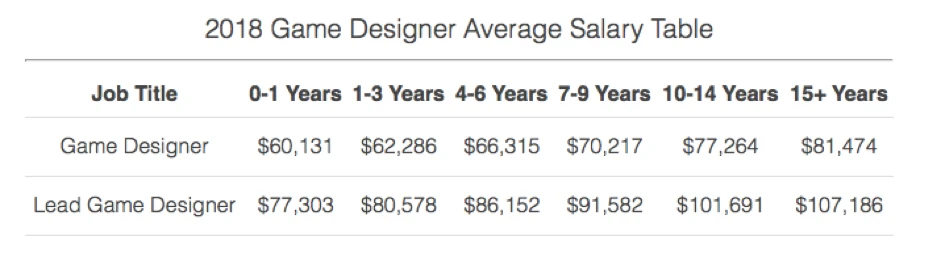
Image Source: https://www.gamedesigning.org/career/job-market/
As far as job demand goes, this seems to be on the up. Although there had been a 5.39% percent decline since 2004, this has actually reversed. The demand for game designers is now on an upward trajectory, with an annual increase of 11,59% over the next few years.
Game Design: What Kind Of Skills Do You Need?
According to Learn.Org, Game designers need a wide range of skills including the following:
- Comfortable working in a fast-paced environment
- Excellent problem-solving skills
- Ability to strategise on the job – e.g. exploring potential moves in a game
- Vivid imagination – good games need fascinating plots, settings and characters
- Ability to collaborate in teams
- Coding skills
You certainly don’t need to go to university to pick up game design skills. A lot of companies are willing to hire a developer who shows that he or she is capable of actually making games rather than showing off their university degree. Alternatively, you can ‘fast track’ your way into the industry via a coding bootcamp.
There are definite advantages to an online bootcamp including flexibility (you can fit your learning commitments around your other obligations), time spent learning vital skills (compare a six-month bootcamp with a three-year computer programming degree), and personalised mentorship. HyperionDev pairs you with your own one-to-one mentor so that you can easily get support whenever you get stuck.
But besides the skills, any game designing company will tell you that they want to see a portfolio. Game studios are careful about whom they hire and they will want to see what you can actually do – i.e. your portfolio. The portfolio will ideally include level design and modding, which refers to an alteration to a video game. You can also include links or downloads so prospective employers can actually play your video games.
Steve Bowler, the lead game designer at Phosphor Games, a studio in Chicago says on Lifehacker: ‘I would take a new entry level designer with no degree or “equivalent experience” who showed their work in creating their own game over someone with a degree who couldn’t show their work in a heart-beat.’
In closing, Bowler is honest about game design work. He says: ‘It’s one of the most mentally stimulating and rewarding fields I’ve ever worked in. It’s also caused me the most anxiety and stress. We work very, very hard making the stuff you love.’ If you’re keen to work every day on something you feel passionate about and love, game design is a great career path. And if its coding skills you lack, think about signing up for one of HyperionDev’s six month, online coding bootcamps in Full Stack Web Development, Mobile Development and Software Engineering. Your ideal career is out there waiting for you.

Career Advice
3 Reasons Why Coding is Hard (And What to Do About It)
There is no such thing as an “instant coder” so let’s smash that stereotype while we still can. What does exist however, are coders who invest resources and lots of hours burning the midnight oil, in order to master the craft. In this article we look at why coding is hard and what to do about it.
Remember that boy or girl who picked up a computer and started to build cool things with code using nothing but intuition and logic? That person that seems to understand how the internet of things works without investing time and resources into learning the ropes?
No? You won’t be able to remember that person because he/she simply doesn’t exist. There is no such thing as an “instant coder” so let’s smash that stereotype while we still can. What does exist however, are coders who invest resources and lots of hours burning the midnight oil, in order to master the craft. In this article we look at why coding is hard and what to do about it.
Learning to Code Is Like Learning a Language
C++, Java, Python, Objective-C – these are just four languages that happen to be among the most popular programming languages in the world. There are hundreds more. And learning a coding language is like learning a foreign language – quite literally. “So where should I begin?” you may ask. Learn with an end -goal in mind. Maybe you want to build mobile apps or become a game developer. Or maybe you want to start your own website-building agency or even work for Google. Whatever your end goal is, find which languages you’ll need to learn and start there.
But to make sure you manage your expectations, let’s clear one thing up – learning to code is not a straight-forward process. And perhaps that’s why so many devs fall short at the beginning of their journeys. Too many devs compare coding to other qualifications, where for example, you learn the theory, you do some practicals, you complete an internship and you get a job. That’s not how it works for coders (generally speaking). As a coder, you’ll go through ups and downs, through rabbit holes and up worm tunnels to pave your own way to a career. In other words, you may learn a language in part, then move onto the next, then dabble in some other language only to return to the first. Be flexible – it will set you in good stead to learn what you need to in order to succeed in the long term, where it matters most.
Learning to Code is Time-Consuming
Many aspiring developers walk away from a bootcamp or tutorial proclaiming that coding is a world reserved for geniuses and the whole thing is unfair. Actually, most devs who “fail” at coding, do so because they are not prepared to put in the time and research that it takes to learn. Attending a bootcamp is great place to start, but the work does not end there. Unlike other learning programmes, coding isn’t a qualification you can get and walk straight into a job, never to learn any theory again. Coding requires ongoing learning. So in conjunction with a bootcamp, you’ll want to try tutorials, engaging with other devs on github, spending time on other forums like Quora and spending time on basic trial-and-error.
Confidence vs Competence
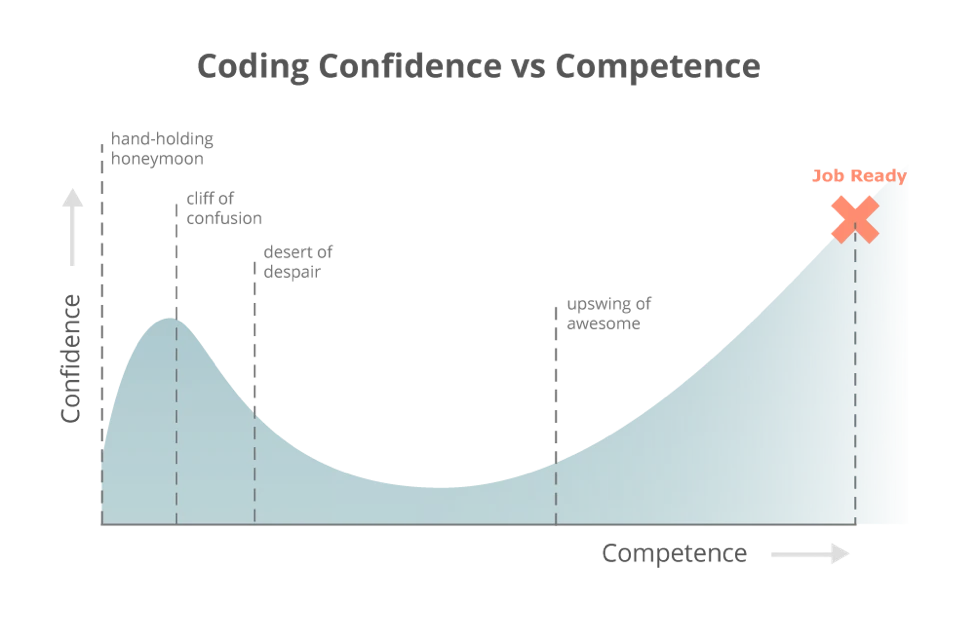
Source: Thinkful.com
Consider the above graph that illustrates a theory by Erik Trautman. The theory itself is quite involved, but the above graph is a snapshot of his main hypothesis, which is that “your confidence is highly correlated with your happiness and…the point where your confidence and capabilities match is the best proxy for the sweet spot when you’re officially job ready.”
In short, The Hand-Holding Honeymoon is the phase in which you are actively engaged with the learning process and being guided by a a mentor who teaches you things that “seem tricky but are totally do-able with their intensive support.” At this point, everyone that learns to code, believes they will be able to build cool stuff. The second phase (the Cliff of Confusion) is the proverbial “brick wall” you hit after your first bootcamp or tutorial. You try building a product only to realise that you don’t yet have all the knowledge you need. Googling it doesn’t help much because how do you describe a problem you can’t diagnose? Frustration ensues. The Desert of Despair is the emotional and mental slump that many aspiring devs fall into when resources are hard to find and moving forward seems like a slog. Many will venture no further when they hit this point. But wait, there is hope. The Upswing of Awesome happens when devs learn how to educate and empower themselves. Devs who reach this stage do so because they’ve tapped into global communities, used their mentors and poured hours and hours into trial and error. Keep pushing forward and eventually you’ll be job-ready and prepared to put in the legwork to build a viable career.
For some, building a career in coding takes months, while for others it takes years. What it comes down to is experience and hardcore grit. As an aspiring developer, you need to be prepared to experience moments of confusion, frustration and general hair-pulling craziness. But on the other side of those feelings, are feelings of satisfaction and the kind of “Eureka” moments that make it all seem worthwhile. Our tip? Start with the basics and put in extra hours – time is your most valuable commodity.
HyperionDev offers a mentor-led coding bootcamp. Start today with a free bootcamp trial including sample content and mentor support.
Still have questions?
Contact our Admissions Team, and a real person will get back to you.