
Our latest insights
Read the latest insights

Software Engineering
Choosing Between Python Web Frameworks
Python is the fastest growing programming language. There are good reasons for this growth, including high salaries, excellent job demand and the sheer number of exciting innovations that rely on Python. So, which Python Web Framework should you choose?
Python is the fastest growing programming language. There are good reasons for this growth, including high salaries (an average per annum salary of $114,490 per annum, according to Indeed), excellent job demand and the sheer number of exciting innovations that rely on Python such as machine learning, artificial intelligence (AI), big data, robotics and cyber security. “If you decide you want to build a web application, and you would like to develop it in Python, you’ll probably want (to use a) web framework,” explains Gareth Dwyer, software and operations developer at HyperionDev. So which Python web framework should you choose?
Frameworks: What Do They Do?
Frameworks are there to make your life easier. According to Coding Dojo, a framework is a collection, or library, of packages or modules that helps you build web applications that are scalable, reliable and maintainable. Frameworks make it possible for you to reuse code for common procedures or operations. They are really a repository of work compiled by previous programmers. Frameworks let you skip over the low-level details including protocols, sockets or process/thread management.
If you’re a developer, you’re generally going to write code that allows you to ‘plug in’ to the framework, explains the Python website. You’ll cut development time by automating the implementation of common solutions, so that you can focus on the logic of your application. And the good news with Python is that you’re spoilt for choice when it comes to frameworks including Django, Flask, Pyramid, Tornado, Bottle, Diesel, Pecan and Falcon. This piece will focus on Django and Flask, which are likely the two most popular Python web frameworks.
Some Things To Consider When Deciding On A Framework
When deciding on which Python web framework to choose, here are some factors worth considering:
- How big and complex is your project? A full-stack framework – e.g. Django – might be a better option if you’re wanting to develop a large system with features and requirements, but these frameworks come with limitations. A microframework might be better for a smaller project.
- How much external support are you going to need?Django, for example, has 80 000 Stack Overflow questions (and even more answers) as well as a large number of blogs from developers and users, whereas other communities aren’t as big.
Some Common Python Web Frameworks
1. Django
- Probably the most popular Python framework, and for good reason – it’s free, open-source and full-stack.
- Contains everything you need to build low- or high-end web applications.
- Features include authentication, URL routing, template engine, object-relational mapper (ORM) and database schema migrations.
- Strong community support and detailed documentation to describe the framework’s functionality.
- It’s a complete solution but it’s also somewhat inflexible. It’s suitable for standard applications – i.e. most software projects – but not for unconventional designs.
2. Flask
- Flask is a microframework, which provides a greater level of simplicity, flexibility and fine-grained control than Django.
- It has a lightweight and modular design, making it adaptable to a range of developers’ need.
- Includes a number of out-of-the-box features – e.g. built-in development server, fast debugger, integrated support for unit testing, RESTful request dispatching, Jinja2 templating, secure cookies support (client-side sessions), WSGI 1.0 compliance, Unicode-based, can plug in any ORM, HTTP request handling.
- In essence: a ‘bare-minimum’ that leaves the add-ons, or the bells and whistles, to the developer.
- For a step-by-step tutorial on how to deploy a machine learning model using Flask, read more here.
- Features include authentication, URL routing, template engine, object-relational mapper (ORM) and database schema migrations.
- Strong community support and detailed documentation to describe the framework’s functionality.
- It’s a complete solution but it’s also somewhat inflexible. It’s suitable for standard applications – i.e. most software projects – but not for unconventional designs.
Gareth Dwyer, who is also the author of Flask By Example, summarises it as follows:
‘You should probably choose:
- Django, if you’re focused on the final product. Especially if you’re working on a straightforward application such as a news site, an e-store, or blog, and you want there to always be a single, obvious way of doing things.’
- Flask, if you’re focused on the experience and learning opportunities, or if you want more control about which components to use (such as what databases you want to use and how you want to interact with them).’
In conclusion, it’s clear that a Python framework can be invaluable when it comes to developing web applications. Whether you choose Django or Flask depends on the complexity of your project and the degree of flexibility you require. If you want to learn Python and Django, consider enrolling for HyperionDev’s Full Stack Web Developer Bootcamp. Become a job-ready Full Stack Web Developer over six months and online with this mentor-led program.
Career Advice
Java vs. Python: Which Language Should You Learn in 2018
Both Python and Java are popular and in-demand programming languages, but which one should you learn first? You’d want to consider things like which language is easier to learn, which offers the better salary and whether the language is in high demand or not. Let’s take a closer look at Java vs. Python in 2018.
Python and Java, you’ve probably heard of them both. They are both popular and in-demand programming languages, but which one should you learn first? You’d want to consider things like which language is easier to learn, which offers the better salary and whether the language is in high demand or not. Let’s take a closer look at Java vs. Python in 2018.
Most Popular Introductory Teaching Language
It used to be that Java was the first language taught to new developers. No more. The Massachusetts Institute of Technology (MIT) and the University of California, Berkeley, both of which have top-ranked Computer Science departments, have recently switched their introductory courses to Python. Eight of the the top CS departments in the US have also followed this example.
Here are some reasons this could be the case:
- Python is a relatively easy language to learn. It reads similarly to English, which means it removes a lot of syntax-learning stress from coding beginners. Python handles the complexity for you. Let’s look at how you say, ‘Hello World’ in Java vs. Python, and you’ll see what we mean.
- Many of the most exciting technologies these days rely heavily on Python. These include machine learning, artificial intelligence (AI), big data, robotics and cyber security.
- It’s also great for back-end web development, video game development, desktop GUIs (Graphic User Interfaces) and Software Engineering.
- It required minimal setup to get started.
When it comes to Java vs. Python in 2018, it seems like Python is pulling ahead, but read on to find out why it’s not so clear cut.
Most Popular Language
The TIOBE index looks at the popularity of various programming languages. This is determined by looking at a number of variables including the number of skilled engineers in a particular language world-wide as well as the courses offered in that language. This information is combined with popular search engine results for the different languages on Google, Bing, Yahoo!, Wikipedia, Amazon, YouTube, etc. For June 2018, same as June 2017, Java was ranked as the most popular language.
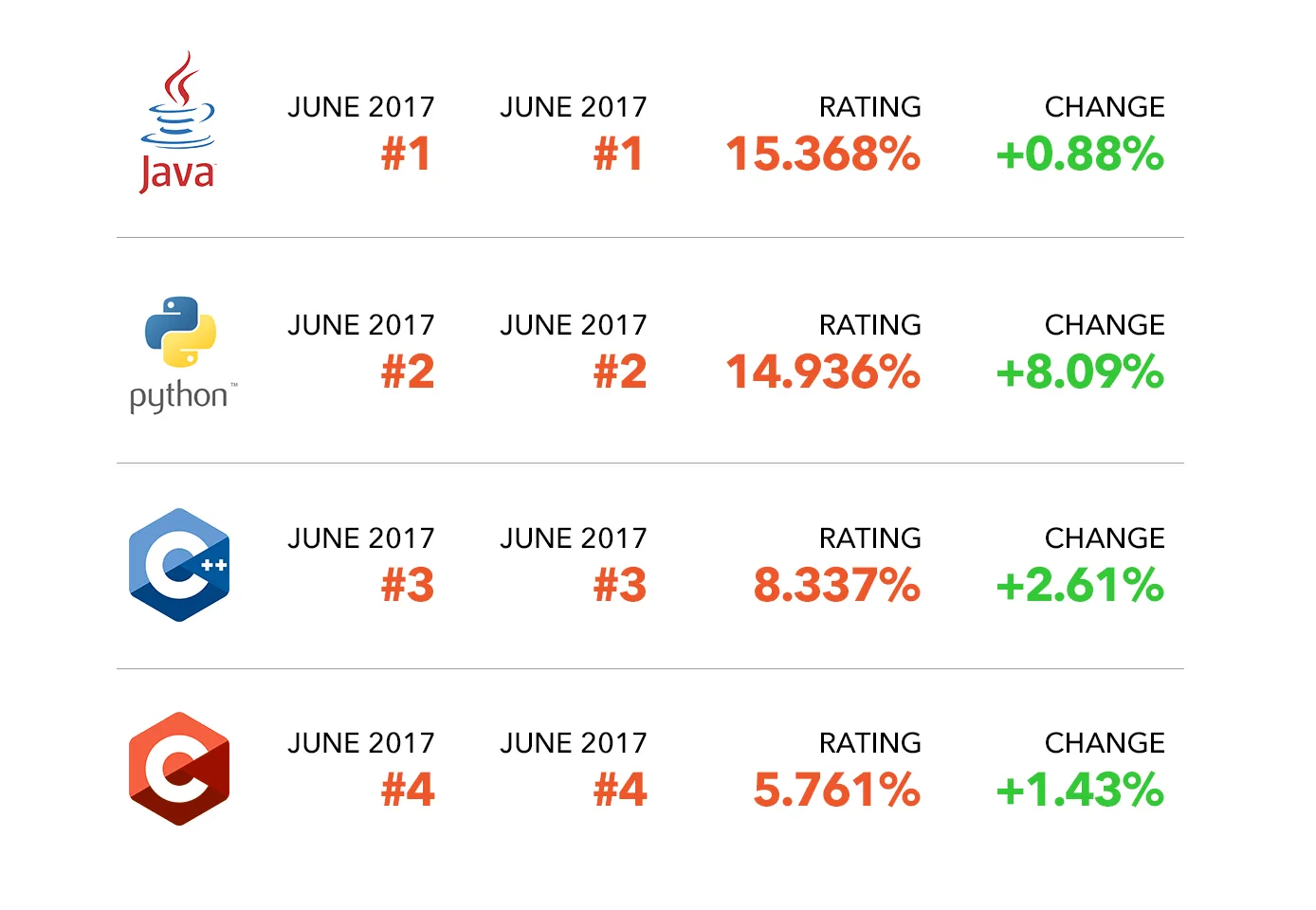
Image Source: https://www.tiobe.com/tiobe-index/
Some benefits of Java include:
- The language is over 20 years old and used by billions of devices and millions of developers.
- You can write code once and it can then run on any operating system, which makes it very scalable. Java is run on many hardware and operating systems through the Java Virtual Machine.
- Many Fortune 500 companies, up to 90%, are using Java as their server-side programming language.
- There is an excellent Java community and documentation.
So far, it seems to be a draw: both languages have benefits. Certainly Python is worth learning as a beginner and Java has massive popularity and utility. Let’s see how the languages compare if we look at job demand and salary.
Job Demand: Java vs. Python in 2018
Indeed, the world’s largest job search engine, gives one a good indication of the most in-demand jobs. Stackify took the 50 most popular jobs from the TIOBE index and searched for them on Indeed. Here are top five most in-demand languages as far as job vacancies go. Java tops the list, though Python is not far behind.
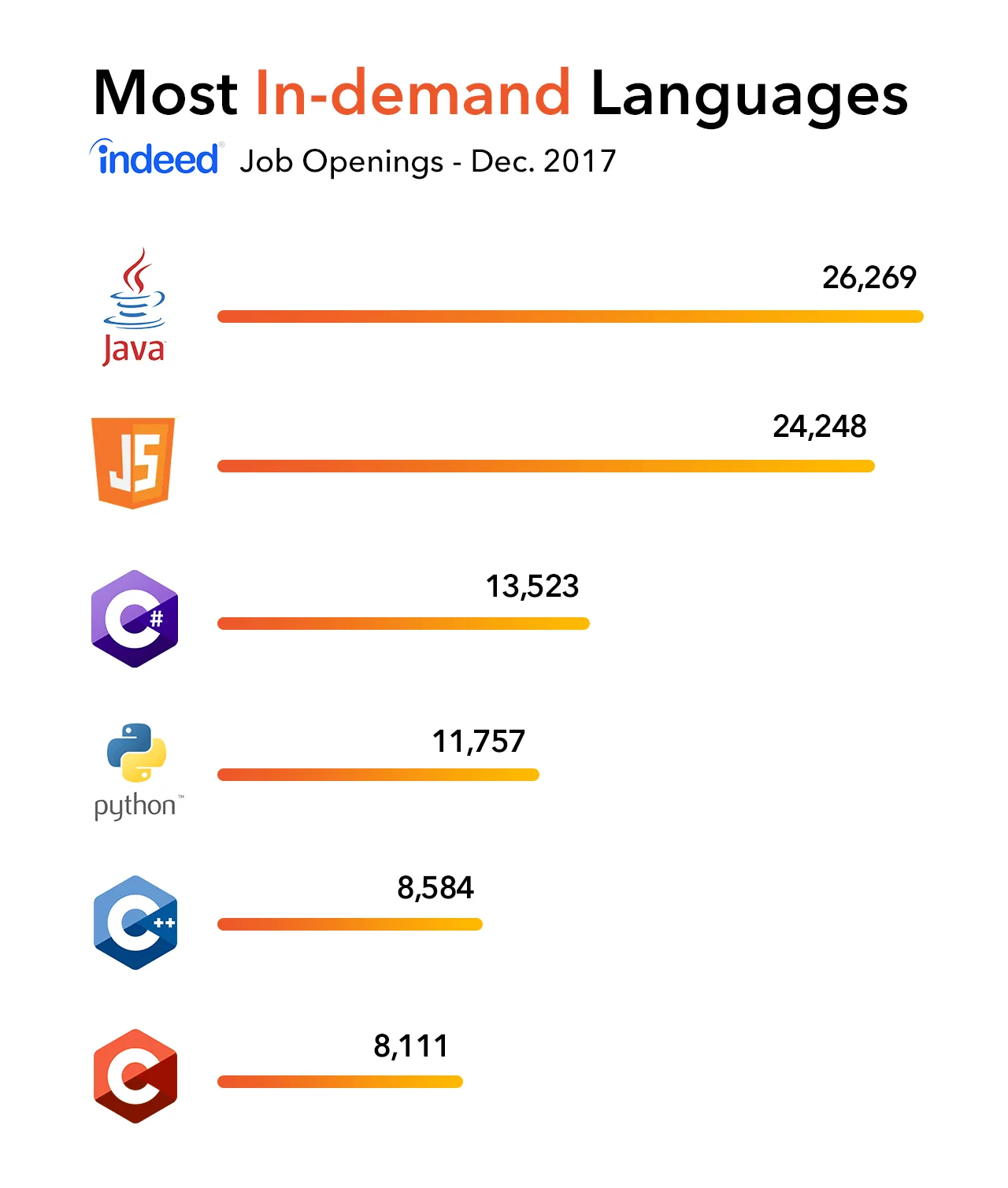
Image Source: https://stackify.com/popular-programming-languages-2018/
Salaries: Java vs. Python in 2018
How do Java salaries compare with those offered to Python developers? Read on to find out.
According to Indeed, the average Java salary in the US is $101,077 per annum, as of June 2018. This is based on salary estimates from 14,973 employees over the past 36 months. A Java developer at Apple would earn, on average, $114,212 per annum. However, a Python developer would come out with an even healthier salary of $114,490 per annum, on average. And if you secured a job at the Bank of America as a Python developer, you’d emerge with a whopping $153,895 per annum!
In closing, it’s hard to draw a definitive conclusion when it comes to Java vs. Python in 2018. Python salaries appear slightly better, but Java jobs seem to be in higher demand. Whereas Python is easier to learn, Java has a higher popularity ranking.
If you’re interested in learning Java, consider signing up for HyperionDev’s Mobile Developer Bootcamp, which is taught online via mentor support. You can become a fully functional Android developer in six months. If it’s Python you’re after, check out HyperionDev’s Full Stack Web Developer Bootcamp. Alternatively, if you’re keen to learn both Python and Java, why not sign up for the HyperionDev Software Engineering Bootcamp which covers both. Both Full Stack Web Development and Software Engineering are taught online over six months and are fully supported by expert mentors.

Student Success Stories
SwitchUp Interviews Richard Heen, HyperionDev Alum
Richard always knew he needed to advance his skills and after attending HyperionDev, he was able to enter interviews with confidence and advance his skills to a point where day-to-day projects were challenging and rewarding. Switchup content specialist, Erica, interviews Richard for a special student success story.
This interview was conducted by Erica Freedman, Content Specialist at SwitchUp
Richard Heen has been working at Intel since 2004, but knew he needed to advance his skills to move into his desired department. After attending HyperionDev, Richard, located in Arizona, USA, was able to enter interviews with confidence and advance his skills to a point where day-to-day projects were challenging, interesting and most of all, rewarding. He is grateful to the HyperionDev team for enabling him to get a new career chapter started. Learn more about why he loved this program in our interview below:
How did you decide to attend HyperionDev as opposed to other bootcamp programs?
At my current job, all of our developers are JAVA based. If I had a quick question, I could get help from the HyperionDev team. I was also able to submit questions to my mentor.
What did you study at HyperionDev?
I studied Software Engineering.
How do you feel this course of study has helped your professional career?
Talking to the development manager at work and sharing my path in this boot camp has allowed me to open doors with him and other hiring managers. I left the HyperionDev program with projects to show potential jobs and was able to answer interview questions with confidence.
Did you attend HyperionDev to attempt to change your career path, or improve the path you were already on?
I picked HyperionDev to improve the path I was already working towards. I attended to gather more knowledge and develop a portfolio of projects to show hiring managers.
What are the courses like at HyperionDev?
The courses are aimed at people with no experience in coding. Because of this, the courses start with a basic foundation and then build on skills from there. You are required to complete the assignments in order, first finishing one project before continuing on to the next assignment. The workload was partially coding and partially short answer questions.
Would you recommend this program to other students? Why or why not?
Yes, I would recommend this course to other students, but I would also suggest that with any boot camp including HyperionDev, make sure you also have local support like friends, family or coworkers outside of the help from your mentor. HyperionDev gives you projects that keep you motivated to learn the next thing to continue building your skills.
What was the application and admission process like?
I submitted my information and then a few days later had a interview to go over their process and make sure I was a good fit. They wanted to make sure I was ready for the time commitment as well as the challenge!
Did you have mentors at HyperionDev?
Yes, I did have a mentor. He was there to check my assignments and answer any and all of my questions.
How about career services? What were those like?
They do have career services, though I have not personally used them.,They offer a resume review and keep your resume on file to submit for jobs with your approval as well. I also underwent interview question preparation as well as coding question preparation.
I see you currently work as an Information Security Specialist at Intel. What does this job title mean and what does a typical day look like?
Right now my typical day is included running the day-to-day operations to create cryptographic keys. I recently started to do development work, where I update existing programs, clean them up, streamline them and add new features. I also have another coding project to enable the automatic transfer of files when they appear in a folder. Without the help of HyperionDev’s boot camp, I would still be spinning my wheels and not moving forward.
Is there anything else you would like to add?
I really liked the Software Engineering boot camp as it challenged me at the perfect speed. For those that are not into traditional school, coding bootcamps really are the answer. I wish these had been around for me when I graduated high school in the ’90s. I’m in my 40s and didn’t want to go to a traditional college again for computer science. This was a great answer for me.
Want to learn what other alumni have said about HyperionDev? Check out verified alumni reviews on SwitchUp.

Career Advice
5 Best Programming Books for Beginners
When you’re starting off in a new career in the developer world, all the information you need to know can get quite overwhelming. It’s always best to be doing some additional reading in parallel with your online course or coding bootcamp. We've rounded the top 5 programming books for beginners in 2018.
When you’re starting off in a new career in the developer world, all the information you need to know can get quite overwhelming. It’s always best to be doing some additional reading in parallel with your online course or coding bootcamp, or even when you’ve already transitioned into your new career! We’ve rounded up the best programming books for beginners, ranging from problem-solving tactics to technical books on JavaScript and Python languages.
1. Eloquent JavaScript: A Modern Introduction to Programming by Marijn Haverbeke
JavaScript is the most commonly used programming language for web development. Its ease of use and versatility make it easy to develop dynamic and interactive websites. When you’re starting off in the web development world, it’s a great idea to read up on some technical programming information regarding this popular programming language.
Eloquent JavaScript: A Modern Introduction to Programming is one of the best programming books for beginners and is even available for free to read online. This book is divided into three parts: basics of JS, how it’s used on browsers, and how to use Node.js.
Get this book here.
2. Programming Pearls by Jon Bentley

Successful developers are constantly optimizing their problem-solving skills. The second edition of Programming Pearls by Jon Bentley teaches the basics and best practices of solving problems by focusing on a range of programming tasks, such as “sorting numbers, creating anagrams, or counting the words in a block of text.” This book will assist you in learning to think like a programmer, so it’s considered to be one of the best programming books you can read when starting out in the programming industry.
Get this book here.
3. Learning Python: Powerful Object-Oriented Programming

Python is quickly becoming one of the fastest-growing programming languages. Naturally, you should add a book filled with Python tutorials to your list of the best programming book reads if you’re starting off in the programming industry. Learning Python: Powerful Object-Oriented Programming will walk you through both the basics and advanced applications of Python, while supplying easy-to-follow tutorials to guide you through your learning process.
Get this book here.
4. The Upside of Stress- Kelly McGonigal

Stressful work situations are common when working as a developer. You may find yourself working long hours trying to debug several lines of code or trying to solve many other problems with your website, user interface or back-end database. This book can help you see stress differently, in more of a positive and inspiring manner. The Upside of Stress uses real-life examples and techniques that can help you turn your overwhelming stress into optimised focus and energy.
Get this book here.
5. The Complete Software Developer’s Career Guide by John Sonmez

Once you’ve sharpened your problem-solving skills as a developer and implemented your knowledge on a few programming languages, it’s time to actually get out there and start interviewing for your new developer job. This book, The Complete Software Developer’s Career Guide, will go through a range of topics, such as the technical skills required for a developer career, the pros and cons of coding bootcamps, and how you can teach yourself how to code. Sonmez also discusses what it’s like working as a developer and how you can best advance your career in the programming industry.
Get this book here.
It’s a known fact that developers are lifelong learners. When starting a new career as a developer, it’s always a good idea to read more and educate yourself as much as possible. With so many resources out there, it’s important to read only the best programming books available, especially the technical books on JavaScript and Python. If you’re interested in studying JavaScript and Python through an online coding bootcamp, check out HyperionDev’s 6-month courses, specifically the Full-Stack Web Development course, which delves deep into both programming languages.

Career Advice
The Top Ten Tech Careers in 2018
We look at data on number of job openings, salary and overall job satisfaction ratings to bring you the top ten tech careers in 2018.
Every company is a tech company these days. This is according to Dr. Andrew Chamberlain, Glassdoor’s chief economist, who explained his position to Business Insider. ‘(T)hey all need people who know how to collect, organize, and analyze data to help them make better, more informed business decisions,’ said Chamberlain whose company recently published the 50 Best Jobs in America report. That means all companies require tech skills in 2018, but what exactly are the top ten tech careers in 2018, according to Glassdoor?
Top Tech Jobs in 2018: Staying Ahead of Automation
The Glassdoor report combines three factors to work out its top-job rankings: number of job openings, salary and overall job satisfaction rating. Not all the jobs on the Glassdoor’s report are tech jobs, but there has been a definite increase in the number of jobs in this industry: 20 out of the 50 jobs in this year’s list are in tech compared with 14 out of 50 in the previous year.
Here are the top ten tech careers in 2018. For a job to be considered, it has to receive both 100 salary reports and 100 job satisfaction ratings over the past year from US-based employees.
# 1 Data Scientist
Topping the list at number one is Data Scientist. The Harvard Business Review calls Data Science the ‘sexiest job of the 21st century’.
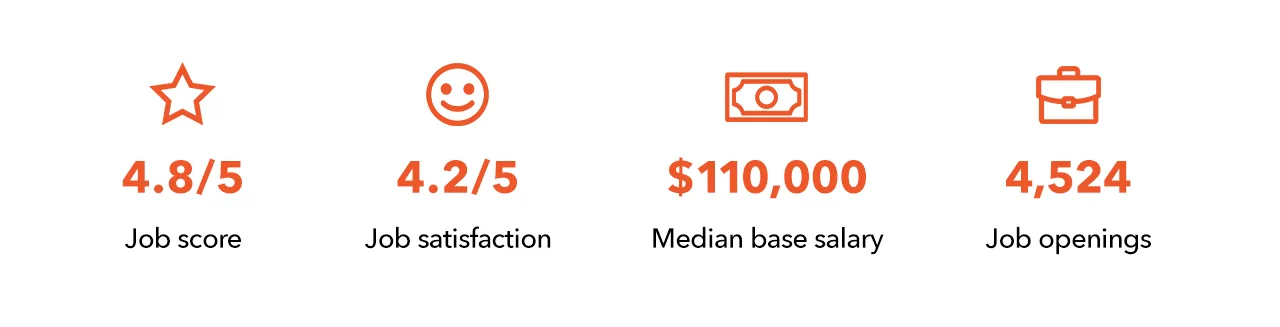
Data Scientists (and many other top tech jobs) are at a lower risk for automation, stated the Glassdoor report. Automation is likely to hit certain jobs hard. Bookkeepers, for example, have a 97.6% chance of being automated. ‘The key skills that are helping workers stay ahead of automation are creativity, judgment and flexibility,’ says Chamberlain. In tech, this would include data science, which requires creative problem-solving ability. Check out this nifty guide to assess the likelihood of your job being automated.
# 2 DevOps Engineer
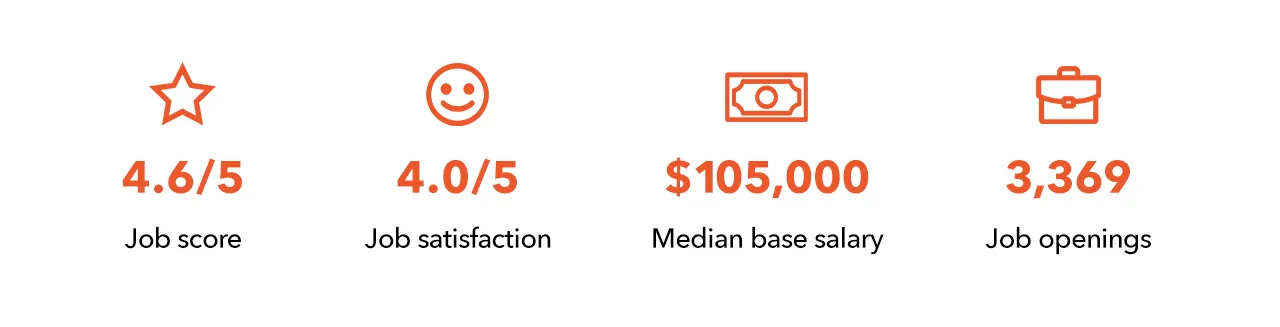
Gareth Dwyer, software and operations developer at HyperonDev, explains that a DevOps engineer is ‘a software developer who also knows how to do server configuration and management, and therefore doesn’t rely on a system administrator for operating system, platform and hardware support.’ DevOps straddle deployment and network operations as well as scripting and coding.
# 3 Mobile Developer
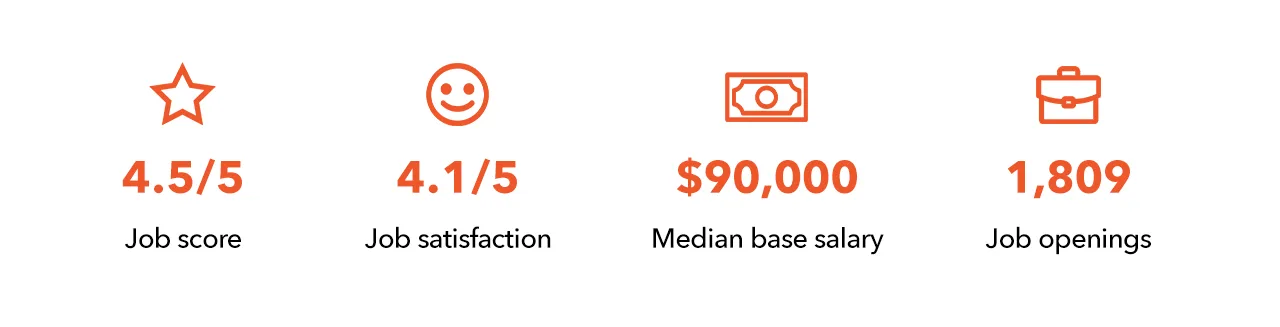
Scott Stiner of UM Technologies and part of the Forbes Technology Council says in a Forbes piece: ‘Mobile application developers will continue to be in high demand, just as they have been the past few years. The demand will become greater in 2018, though, and successful app developers should be fluent in multiple programming languages, including Java, HTML5, Objective-C, C++, C#, Python and Swift. Also, app developers with UX and UI design skills can offer much more value for project management.’
App developers are partly in high demand because app revenue is climbing hugely. Worldwide revenue growth in 2020 is projected at 188.9 billion US dollars (compared with 88.3 billion dollars in 2016).
# 4 Product Manager
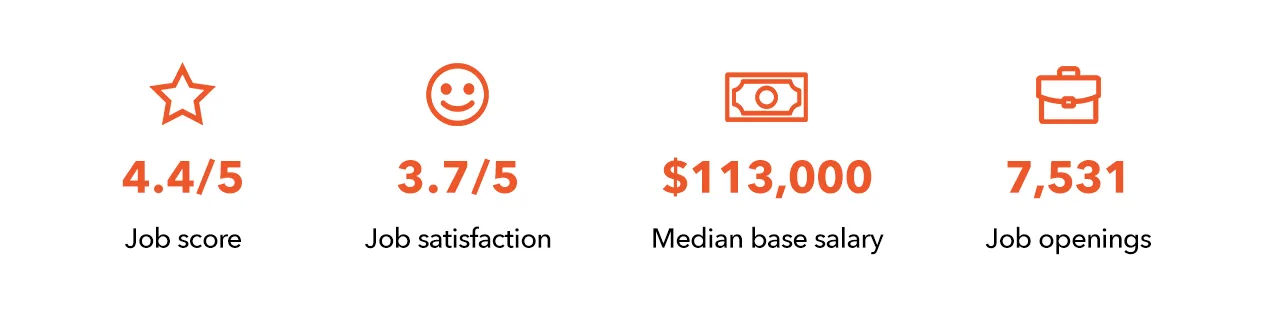
With so many new tech products on the market, companies need a technical, organised and logistics-driven employee who can manage it all. It’s essentially an organisational role that guides the strategy, roadmap and feature definition for either a product line or a product.
# 5 Front End Engineer
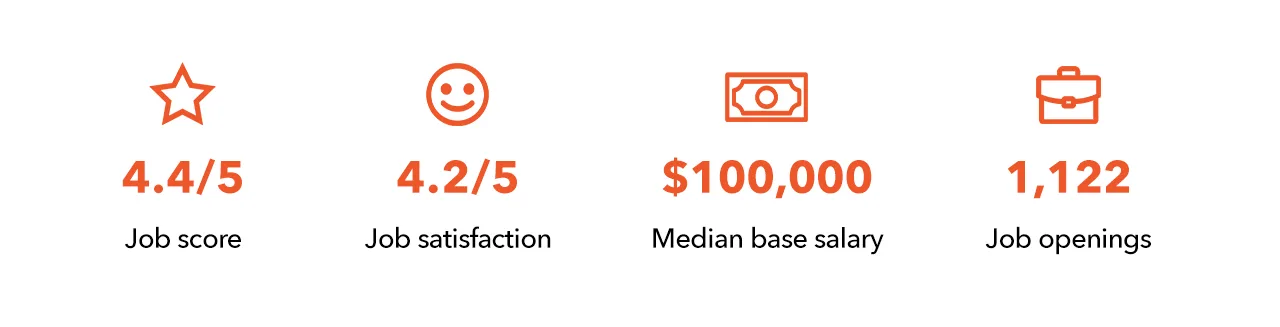
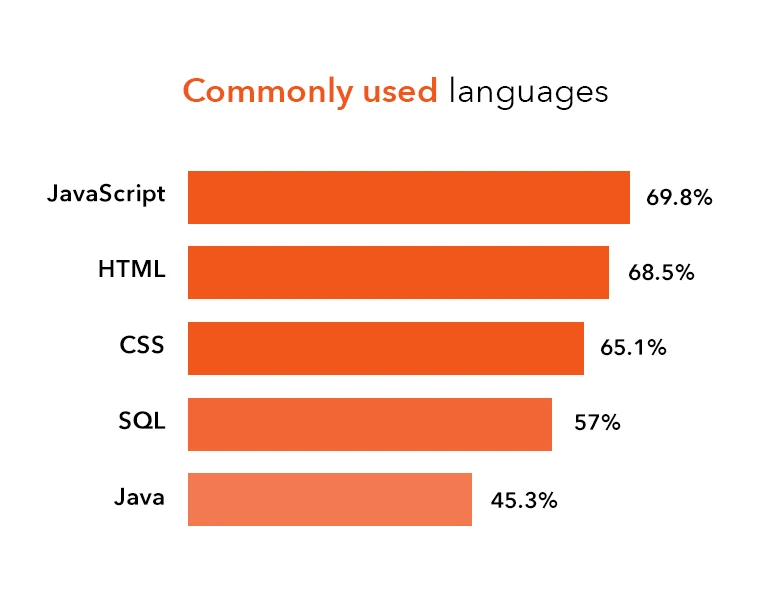
At its most basic, front-end engineers tend to write code that runs on a user’s browser, which translates into knowing HTML, CSS, JavaScript and various APIs. HTML, CSS and JavaScript are frequently used in the developer world. Check out this graph, which shows commonly used programming languages, from the 2018 Stack Overflow Developer Survey.
# 6 Site Reliability Engineer
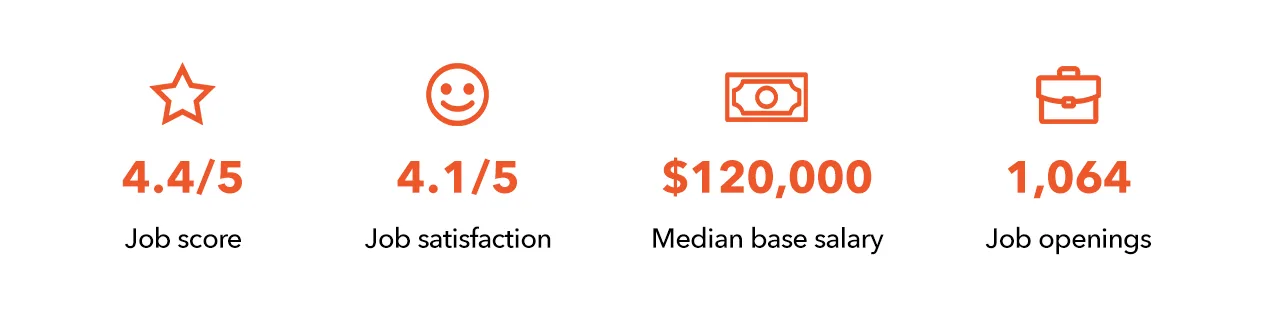
During a live push (when software goes live), things frequently go wrong. That’s where site reliability engineers come in. They spend all their time monitoring application performance, reviewing error logs and troubleshooting software defects.
# 7 Analytics Manager
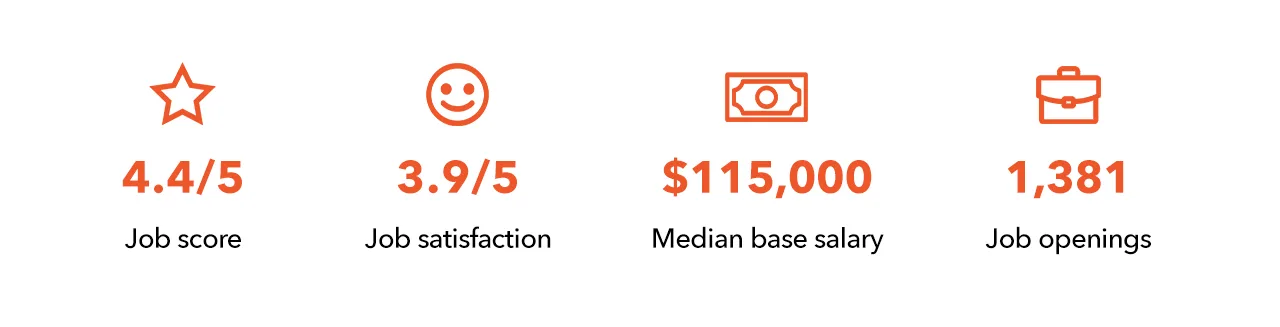
Analytics Managers, according to Social Science Careers, are business professionals who have technical skills, industry understanding and knowledge of customers in order to make informed business decisions. They will translate raw data into meaningful information – for example, which products you should put on sale for the upcoming season.
# 8 Software Engineer
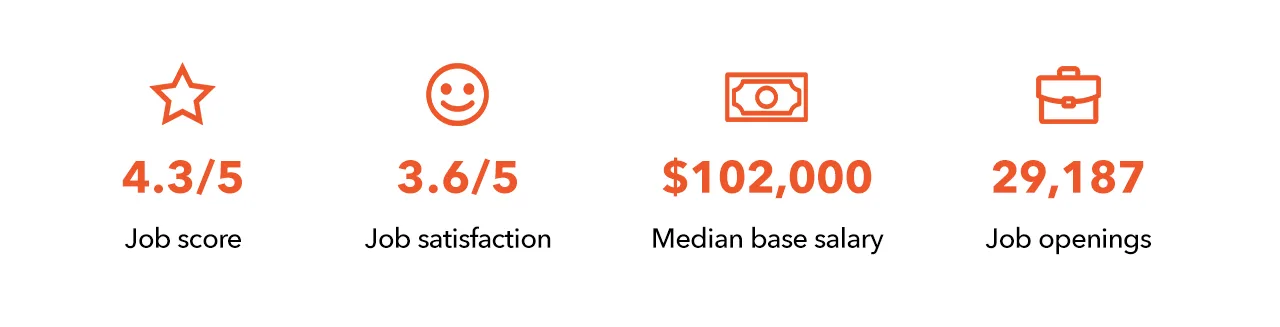
Software Engineerscreate the technologies that we interact with every day, from the app that wakes you up in the morning to social media and music platforms. ‘Software affects almost every aspect of our daily lives. You cannot go a day without encountering some sort of software; software is everywhere,’ states Dr. Melanie Willett, content writer at HyperionDev.
# 9 Hardware Engineer
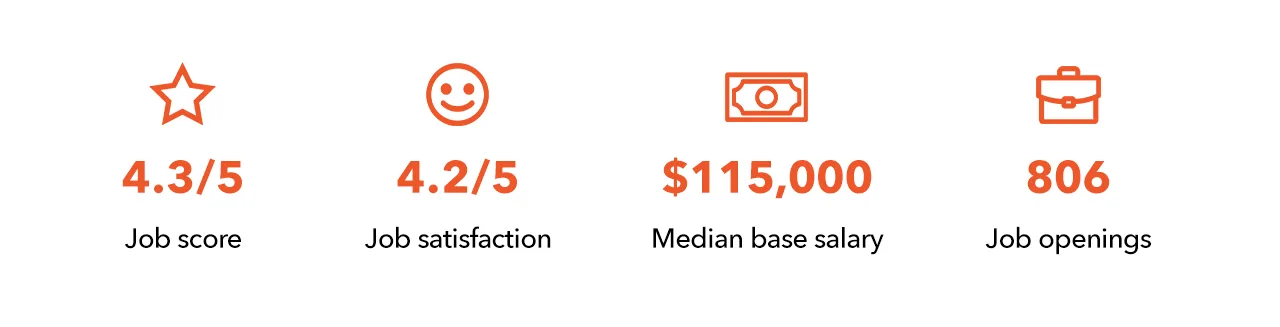
Hardware engineers typically work in research labs that build and test various new versions of computer models. Their day-to-day typically includes researching, designing and developing computer systems and their components (circuit boards, routers, etc.).
#10 Quality Assurance Manager
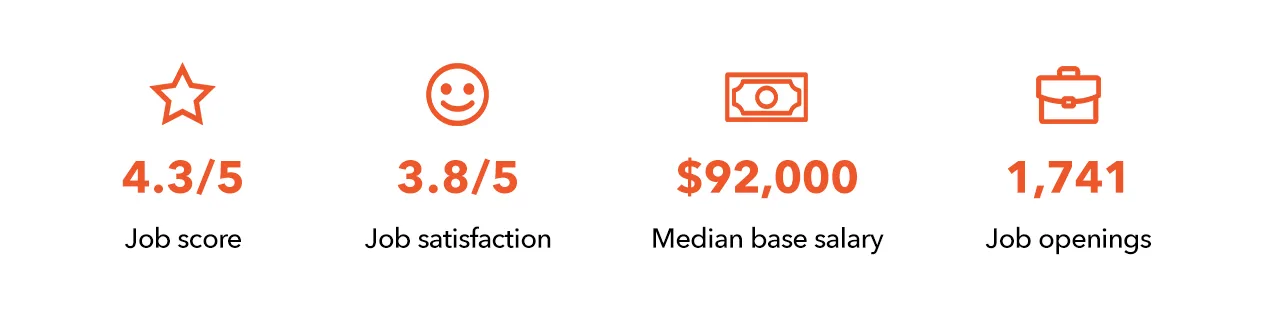
The duties of a quality assurance manager will obviously differ between industries but at its simplest, the job involves ensuring that tech products are operating as they should. Some typical duties could include determining in-house quality standards and procedures, setting customer service standards, writing management and technical reports, and training.
Conclusion
So those are the top ten tech careers in 2018. But remember, the great thing about a tech job is that there is such variability in potential jobs, from solely coding and marketing via data analysis to dealing only with customers and people. As a result, there’s sure to be a tech job that suits your aptitudes and personality. Enrol on a HyperionDev free trial to find out more about Web, Mobile or Software Development.

Data Science
Become a data scientist in 2018
Can you guess the best job in software development for the last three years? Data Scientists have experienced rapid growth in both job opportunities and salaries. We explore more on how and why you should become a Data Scientist in 2018.
Guess the best job in the US for the past three years running. It’s Data Science, according to Glassdoor, which combines three factors to work out its top-job rankings: number of job openings, salary and overall job satisfaction rating. The Harvard Business Review calls Data Science the ‘sexiest job of the 21st century’. So how can you become a Data Scientist in 2018 and what can you expect to earn in this desirable job?
A Glassdoor study states that the median salary is $110 000 per annum in the US – which means that 50% of Data Scientists would actually earn more than this! The national average is $120,931. In 2018, the demand for Data Science talent in the US is projected to be 50-60% greater than the supply. This translates into a shortage of 140 000 to 190 000 people as well as 1.5 million manager and analysts, states Medium.
This is confirmed by the LinkedIn’s 2017 US Emerging Jobs Report, which stated that the number of Data Scientist roles have grown by over 650% since 2012. Hundreds of companies are hiring these roles – including Analytics Manager, Database Administrator, Data Engineer, Data Analyst and Business Intelligence Developer, which are all included in Glassdoor’s top 50 best jobs, and are connected to Data Science – but only 35 000 people in the US have Data Science skills. How then can you become a Data Scientist in 2018? Firstly, let’s see what Data Scientists actually do.
What do data scientists do?
At its simplest, a Data Scientist analyses data for actionable insights on anything from product development to customer retention to new business opportunities. Here’s how the process works, according to a piece on Medium:
- Frame the problem: You need to work out how to translate the client’s issue into a concrete and well-defined problem. A potential problem could be, ‘How do I work out which prospective customers are likely to buy a particular product’.
- Collect the raw data to solve the problem: You will need to work out what resources (e.g. time, money) you need for this, and what data points are actually worth collecting to solve the problem.
- Process the data: Raw data frequently needs to be cleaned for various problems including errors, missing variables, corruption in the data, etc.
- Explore the data: What are the patterns, trends or correlations?
- Conduct in-depth analysis: Here you will use machine learning, statistical models and algorithms. This is probably the main part of your project, where you apply cutting-edge data analysis to come up with insights and predictions. To create a predictive model, you will use techniques from machine learning.
- Communicate the results: Here’s where you tell the story of your data, or data storytelling, to the various stakeholders. You should now have an accurate machine learning model that can predict the answer to the initial problem.
Think about how valuable these skills are for companies, which now have the capacity to collect vast amounts of data. Says Sarah Mbaka, Mentor at HyperionDev: ‘Data science is exciting, because it unites all fields. I can work in the field of medicine, astronomy or physics. So long as the field has data, they need a data scientist.’ Individuals who can organise and analyse this data for business insights are naturally in high demand.
How do I become a data scientist?
To become a Data Scientist, you’ll want to start learning Python, R and SQL, analytical languages for Data Science. On Glassdoor, 9 out of every 10 job postings ask for knowledge of one of these languages. Besides Python, other popular coding languages for Data Science include Java, Perl, or C/C++. You’ll also learn various data science libraries including Matplotlib, ScikitLearn, NumPy, and NLTK. In addition, you’ll cover Machine Learning, which gives computers the ability to ‘learn’ via statistical techniques. It’s based on pattern recognition. A machine learning example could include the recommendations offered by Netflix. You’ll also cover various data visualisation tools and how to work with unstructured data, whether it’s from social media, video feeds or audio.
To transition into this career, there are three possible routes:
- A Master’s programme – the university setting is time-consuming and expensive but also comprehensive.
- MOOCs (read about the top 20 Data Science MOOCs) – this self-taught approach tends to be scrappy and unguided. When you get stuck, you can get truly lost! On the plus side, it’s inexpensive or even free. (Read the top five questions to answer before deciding you’re up for learning to code on your own.)
- Bootcamps – these are taught by experts in the field and rely on real-life projects. They can be flexible and online. Some bootcamps offer supportive one-on-one mentorship.
Conclusion
If you want to learn data science in 2019 and enter this lucrative and stimulating field, consider signing up for HyperionDev’s online Data Science Bootcamp. You can also trial this course for free.

Career Advice
It’s Never Too Late to Learn to Code
Software Developer jobs are predicted to grow by 17% from 2014 to 2024. Is it too late to jump on the "coding bandwagon"? We explore all the aspects and advantages of learning coding at an older age.
According to the US Bureau of Labor Statistics, software developer jobs are predicted to grow by 17% from 2014 to 2024. This is much faster than the average for other occupations, which is at 7%. The US Bureau of Labor statistics explains that the main reason for the rapid growth is due to ‘a large increase in the demand for computer software’. But is it too late at [enter your age here] to jump on this bandwagon and learn to code?
Definitely not. Firstly, let’s look at demographics. 25% of programmers are over the age of 35, according to the 2018 Stack Overflow Developer report, which surveyed over 100 000 developers.
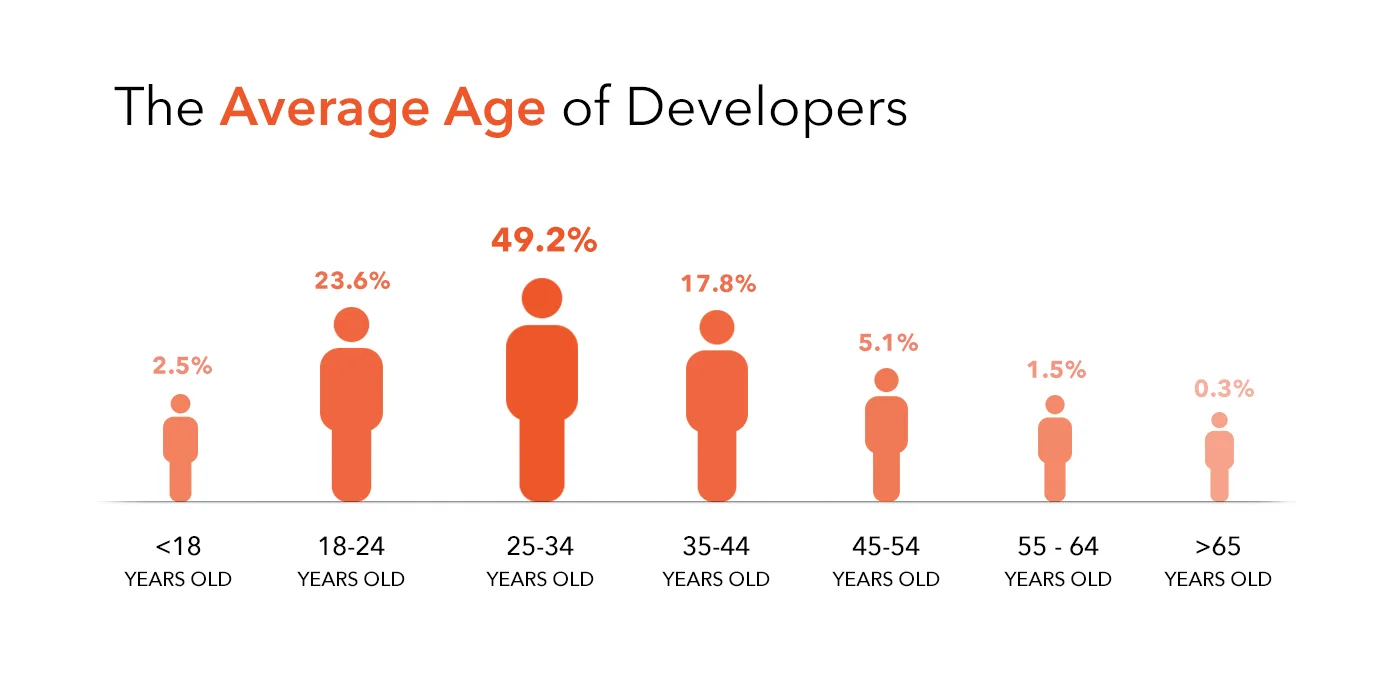
But here’s the kicker: a full third of professional developers on Stack Overflow only learned to code within the past five years, so presumably a fair number of those older developers probably learnt coding fairly recently. In fact, almost 12% of developers who work in the industry only learnt to code in the past two years.
It’s not all roses, however. The tech industry has long been accused of ageism. Mark Zuckerberg, Facebook’s CEO, said, for example, that, ‘young people are just smarter.’ And the demographics in certain kinds of companies are definitely skewed towards the younger generation. For example, Fortune notes that the median age at Twitter is only 28, and at Facebook and Google it’s 29 compared with a median age of 42.4 for the US labour force. However, other companies, such as computer hardware and business software ones, are certainly filled with many people in their 30s and 40s – for example, the median age of workers at Oracle is 38, states PayScale.
It’s clear people are learning coding at an older age and securing jobs in certain kinds of tech companies, but what’s it like to learn coding when you’re a little older? Here’s the good news: there are many advantages.
The Advantages of Learning Coding at an Older Age
Here are some of the advantages, according to a piece in Medium.
- You have experience. This is likely to translate into real-life problem-solving creds.
- Your emotional intelligence is likely to be higher. In fact, a study published in Berkeley News found that emotional intelligence peaked in one’s 60s. People in this age group appear to be better than their younger counterparts at seeing the positive in a stressful situation. This is certainly a skill for a software project where you have to work with others and things might not work out as planned. (Read more about a day in the life of a junior software developer.)
- You contribute to diversity. A study published by Indeed showed that 77% of people working for tech companies noted the importance of a diverse company.
- You understand the rewards of patience and persistence, vital skills for coding, better than your younger co-workers.
Tips for Older People Wanting to Learn Coding
Let’s look at some tips for learning coding at an older age.
- A Quora visitor advises that you join all the programming websites you can including Topcoder, SPOJ, Hackerrank, CodeChef, CodeForces, etc. Keep the same handle,or username,on all these sites. In this way, if someone Googles your username, all your profiles will be seen.
- Complete an actual project. Have a look at codeconquest for some great coding project ideas.
- Find a mentor – your mentor could of course be younger than you. ‘I firmly believe that mentorship is the best path to career success, hands down,’ says Chris Myers, a startup founder and CEO of a financial management solutions company, in Forbes. You may wish to enrol on a bootcamp or course where mentorship is built into the program – for example, HyperionDev offers online, coding bootcamps built around this idea.
- Don’t underestimate what you do know. Whatever you’d done previously should help make you a more enticing and unusual candidate – unlike the typical 22-year-old who has only studied coding and has no real-world experience. People who blend a variety of seemingly disparate skills are often in high demand, because they now have a unique professional profile – for example, a software developer who has done a fashion degree may seem like a strange profile, but is actually the ideal candidate to fill a developer role at a global retail company.
In closing, it’s never too late to learn coding; there’s no upper limit. In fact, an 82-year-old Japanese woman recently taught herself coding and created an iOS app, which has been downloaded over 50 000 times! Unsurprisingly, she learnt via mentorship. The bottom line: if you’re keen to become a developer, go for it, no matter your age.
HyperionDev offers three 6-month part-time Online Bootcamps in Web, Mobile and Software Development. Book a free trial now!
Software Engineering
Should I Become an Android Developer?
Did you know the Android operating system is #1 and controls 86% of the total market share for operating systems? We explore this and more reasons for you should become an Android Developer in 2018.
Who doesn’t love downloading a shiny new app or browsing around the app store? Clearly, many people do and this high demand is reflected in desirable salaries paid to app developers. If one looks at the average US annual salary for Android Developers, it’s $97,986, according to Glassdoor. Besides the excellent salary, there are many reasons to become an Android Developer in 2018. This article will list some of these reasons.
The Android Operating System Still #1 and Growing
The Android operating system is hugely popular – that’s an initial good reason to become an Android Developer but there are many more. Gartner’s latest research, published in 2018 about the 2017 smartphone operating system market, shows Android extending its lead to capturing 86% of the total market share. This is up 1.1% from the previous year. Also, Samsung, Nokia, Asus and LG have announced plans to launch new Android smartphones.
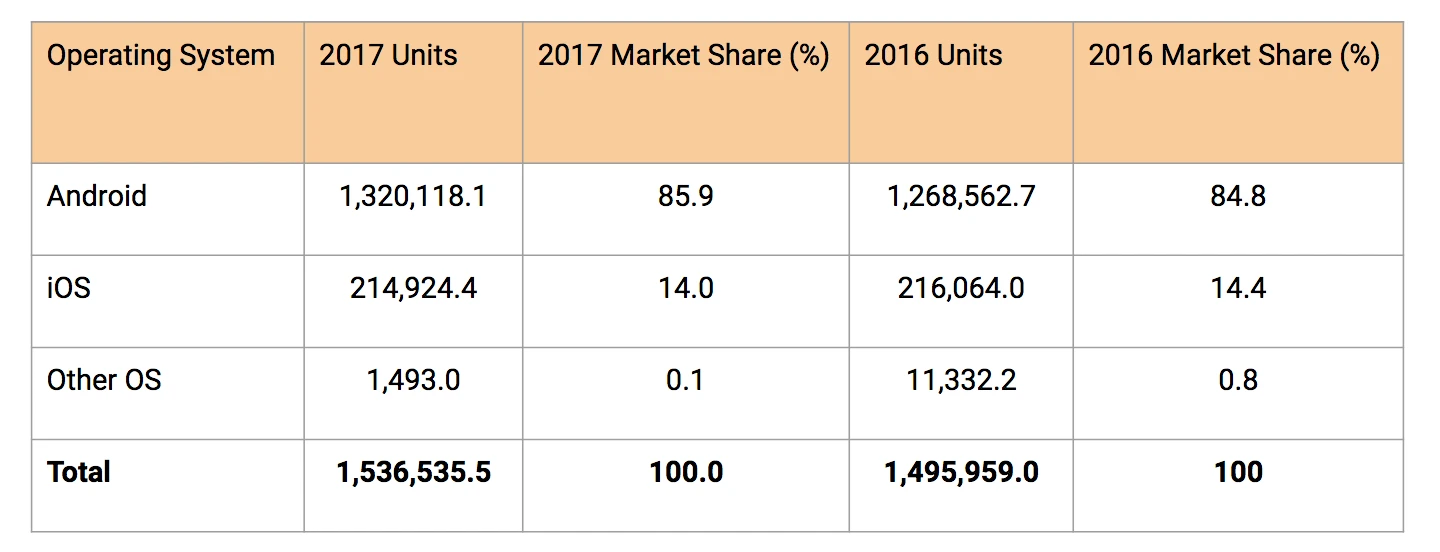
Source: Garter (February 2018)
Because Android dominates the smartphone market and it’s a free and open operating system, it’s no surprise then that many developers want to start developing for the Android platform. According to the 2018 Stack Overflow Developer Survey, which interviewed over 100 000 developers, the Android platform came out as the #1 platform developers want to learn, with 16% of developers ranking it as their top platform choice. The Operating System is what people use, whereas the platform includes the related developer tools, etc.
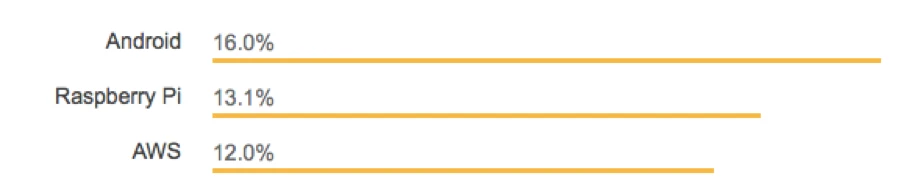
Image Source: https://insights.stackoverflow.com/survey/2018/#technology-most-loved-dreaded-and-wanted-platforms
App Revenue: Heading to the Stars
Revenue from apps is climbing hugely. Here’s a graph depicting worldwide app revenue growth in 2015, 2016 and projected growth in 2020, from The Statistics Portal.
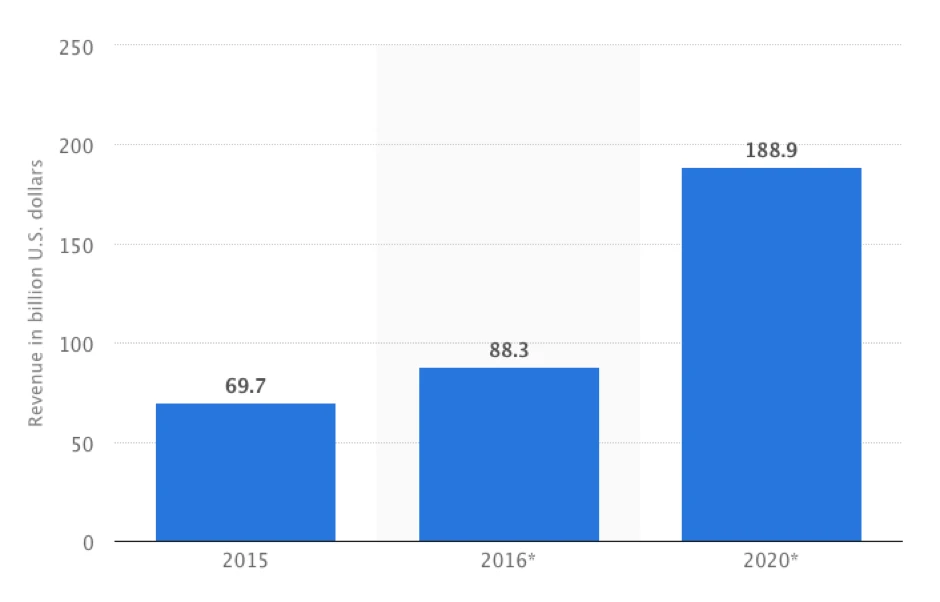
Image Source: https://www.statista.com/statistics/269025/worldwide-mobile-app-revenue-forecast/
Mobile apps are projected to earn $188,9 billion in revenue via app stores and in-app advertising by 2020. Interestingly, iOS users (i.e. the Apple platform) are much more likely to purchase apps, whereas Android app developers make their cash from in-app purchases and advertising. An in-app purchase is something you buy in a game or app – for example, a Gold Bar in Candy Crush. It’s known as the Freemium model. Moreover, it’s the most popular way to make money from apps – that’s another good reason to become an Android Developer. The way the Freemium model works is that you distribute your app for free but your revenue is generated from 0.5-2% of users who want to enhance their app experience with in-app purchases or subscriptions.
Why Developing for Android is so Cool
You may be keen to become an Android Developer, because the experience of developing Android apps is particularly satisfying. First up, it’s cheaper to develop apps for Android. There’s no annual fee unlike the Apple platform, which charges you a set fee each year. Also, the Software Development Kit, or SDK, is free. And these development tools offer advantages, because Android Studio runs cross-platform – i.e. on both Mac and Windows machines unlike iOS, which only runs on Mac. This is helpful if you have a number of people in your team, whether at the office or freelancers, and you each have different machines.
High-Demand for App Developers
According to Modis, tech jobs are on the rise. There’s an anticipated 12% growth in tech employment by 2024 (compared with 6,5% projected growth in other industries). By 2024, there will be 48,500 additional tech jobs. So which tech industries can expect growth?
According to an article in Forbes, the 13 top tech skills include Mobile Application Development. Says Scott Stiner of UM Technologies and part of the Forbes Technology Council: ‘Mobile application developers will continue to be in high demand, just as they have been the past few years. The demand will get greater in 2018, though, and successful app developers should be fluent in multiple programming languages, including Java, HTML5, Objective-C, C++, C#, Python and Swift. Also, app developers with UX and UI design skills can offer much more value for project management.’
Clearly, App Development is a career with an upward trajectory. Become an Android Developer if you’re keen on a flexible and stimulating career, which is in high demand. HyperionDev offers a 6-month, part-time Mobile Developer Bootcamp aligned to the Google Associate Android Developer certification. During this time, you’ll master Java, the basic language used in the development of Android apps is, and Android. Who knows – perhaps you will develop the next Pokemon Go or Uber. Your only limit is your imagination.

Career Advice
Can I Learn to Code on My Own?
When people decide to switch to a career in coding, there a few different options for education: self-teaching or mentor-led online bootcamps. Here are 5 questions that will help you when deciding - "Can I Learn to Code on My Own?"
Many people start working in one field only to find themselves changing careers to something completely different – for example, from restaurant owner to doctor, or from marketing specialist to web developer. If you’re keen to enter the lucrative field of coding, is this something you can pick up on your own? Here are five questions worth asking now to answer the question, ‘Can I learn to code on my own?’.
When it comes to learning coding, you can teach yourself. Says 2018’s Stack Overflow Developer Report, ‘(A)lmost 90% of all developers say they have taught themselves a new language, framework or tool outside of their formal education.’ You would then use online resources, which could include tutorials such as Google’s Python Class, or video-based learning like Udacity’s free Introduction to Computer Science. Alternatively, you can learn online via a mentor-led bootcamp, where you receive expert advice when you get stuck. HyperionDev’s bootcamps are an example of this kind of mentor-led learning.
To decide whether you’re better off doing it all yourself or whether you’d benefit from mentor-led learning, consider the following five questions, as put forward by Course Report:
1. Do you have prior coding experience?
Those with a computer science background or a knowledge of programming will find it easier to fly solo and teach themselves another language. If your knowledge is fairly minimal, you’ll learn quicker with a coding bootcamp. (Quick recap: an online coding bootcamp is a structured, mentor-guided learning platform that replicates an in-class experience. You’ll find that you need to put aside between 5 and 30 hours per week to study coding this way.)
2. Will you be able to set up your own curriculum?
If you don’t have a mentor, you’ll need to decide what you should and shouldn’t be learning. You will need to put together your own curriculum. Can I learn to code on my own? You can, if you feel comfortable drawing up your own learning plan that will meet the needs of potential employers.
However, if you don’t feel comfortable putting together your own curriculum, there are definite benefits to enrolling on a mentor-led online bootcamp. You’ll know that the structure of the course has been carefully devised to reflect the latest industry standards.
3. What is your learning style?
In the past when you’ve given yourself a project or a self-study, have you finished and stayed motivated? MOOCs (or ‘massive online open courses’) tend to have less than a 15% completion rate.
Most people learning to code will go through a number of psychological stages. Think about how you’d cope with each of these stages bearing in mind your learning style. The Footnotes, a career portal website, outlines these stages:
The Honeymoon: This is the first magical introduction to code.
The Cliff of Confusion: You’re getting a little stuck and need help. If you’re on a bootcamp, you’ll make good use of your mentor during this phase. Says Masood Gool, Lead Mentor at HyperionDev: ‘Learning to program can be a daunting task. Sometimes you may feel you’ve been thrown in the deep end. Coding mentors are there to smooth this process, provide individualised feedback and guide you along the path to success. This allows you to customise your learning path to achieve your goals.’
The Desert of Despair: This is a fairly long and lonely stage. You’re sitting alone and you’re really stuck. Again, if you chose the route of a mentor-led online bootcamp, this is the time to speak to your mentor to guide you through this hellish desert.
The Upswing: Things are now starting to come together. Enjoy it. You’ll build even more confidence with practise. Eventually, you’ll have great pride in the work you do and the code you write.
4. What are your time and commitment pressures?
You may reach the same end point whether you choose a solo study option or a mentor-guided program, that is, becoming a successful developer, but you also need to think about time. The chances are that it will take you longer if you’re doing it by yourself. It’s a matter of calculating how much it will cost you (e.g. lost salary) to take longer to qualify. Here’s a nifty Return on Investment (ROI) Bootcamp Calculator to help you visualize how your time and commitment investments will play out over the upcoming years.
5. Is a network of fellow programmers important to you?
Do you have a group of people you can consult for support or opportunities? If not, a mentor-guided online experience will help set you up with your fellow classmates who will be of use to you in your coding career.
Conclusion
Think about these questions honestly. Perhaps write down the answers to structure your thinking. Your responses should answer the question, ‘Can I learn to code on my own?’. If you decide that you’d prefer a mentor-led online course, HyperionDev offers three 6-month part-time Online Bootcamps in Web, Mobile and Software Development. Book a free trial now!
Web Development
C# Language Trends in 2018
C# is an object-oriented programming language best used for building Windows desktop applications and games, as well as developing web applications. Let's take a deeper look into the language trends for C# in 2018.
C# (pronounced ‘sea sharp’), one of the most popular programming languages in the world, was developed in 2000 by Microsoft. It’s an object-oriented programming language, which means it’s organised around objects rather than actions, and data instead of logic. C# brings together the computer power of C++ with Visual Basic’s ease of programming. It contains features similar to Java, and is designed to work on a Microsoft platform while using the .Net framework. So, what can you expect from C# in 2018?
Firstly, let’s see what you can do with C#. The quick answer is, almost anything. An article in Medium explains that C# is particularly good at building Windows desktop applications and games; however, you can also develop web applications and mobile development. It’s mostly used for large company applications – for example, processing of a bank’s transactions.
If you’re keen on becoming a game developer, C# is probably a good way to go. It uses the Unity Game Engine, which is the most popular game engine today. 34% of top free mobile games are made with this engine. It’s also used for the recently popular phenomenon, VR or Virtual Reality: 90% of all Samsung Gear and 53% of all Oculus Rift VR uses Unity.
As you can see, C# in 2018 has a wide range of uses, but how easy is it to learn? It’s a high-level language. This means the programming context is more user-friendly and more independent from the computer’s hardware architecture. This makes it somewhat easier to pick up. Many of the more complex tasks are abstracted away with C#. It’s also an easier language in which to find errors, because the code is checked by the framework before it becomes an application. You’re more likely to get the code right with C# than C++. However, it’s still a complex language that may well require more time and effort than Python, for example.
Let’s look now at some anticipated trends for C# in 2018.
Popularity of C# in 2018
The TIOBE index looks at the popularity of various programming languages. This is determined by looking at the following variables: number of skilled engineers in a particular language world-wide, courses offered in that language and third party vendors. This information is combined with popular search engine results for the different languages on Google, Bing, Yahoo!, Wikipedia, Amazon, YouTube, etc. For May 2018, same as May 2017, C# was ranked as the 5th most popular language.
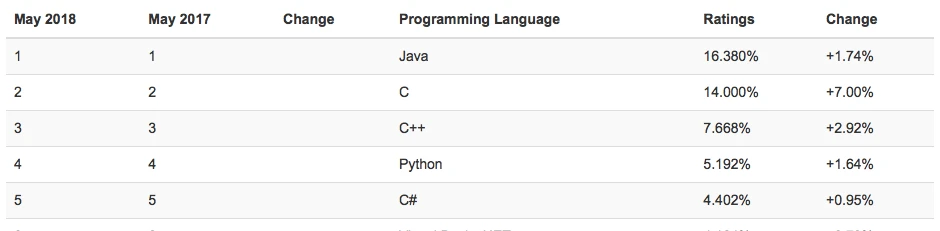
Image Source: https://www.tiobe.com/tiobe-index/
This is substantiated by the PYPL, Popularity of Programming Language Index, which assesses how often language tutorials are searched on Google. C# is at #5, according to data from May 2018. The PYPL index is useful for helping you decide which language to study or to use in a new project. Here are their top six most popular languages:
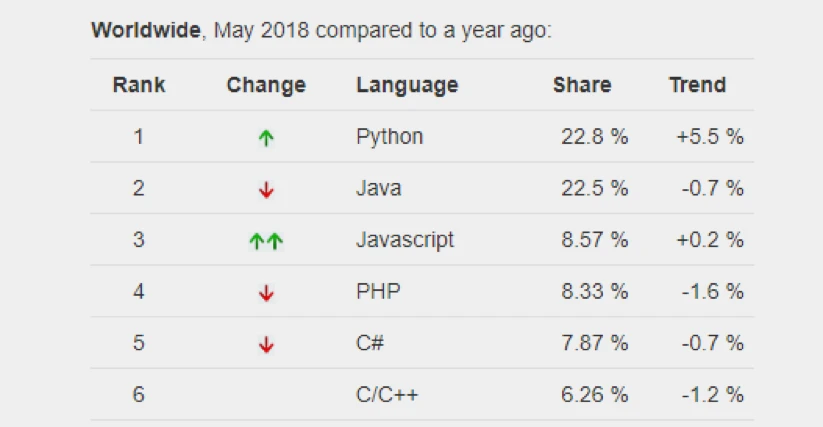
Image Source: http://pypl.github.io/PYPL.html
C# in 2018: Do Developers Enjoy Working With This Language?
Yes, they do. This year’s 2018 Stack Overflow Developer Survey, based on responses from 101,592 developers, found that when it comes to languages that are loved, which means developers want to carry on working with these languages rather than others, C# came in at #8 (60,4% of developers loved C# in 2018).
Here’s a graph showing the eight most loved programming languages, according to the 2018 Stack Overflow Developer Survey.
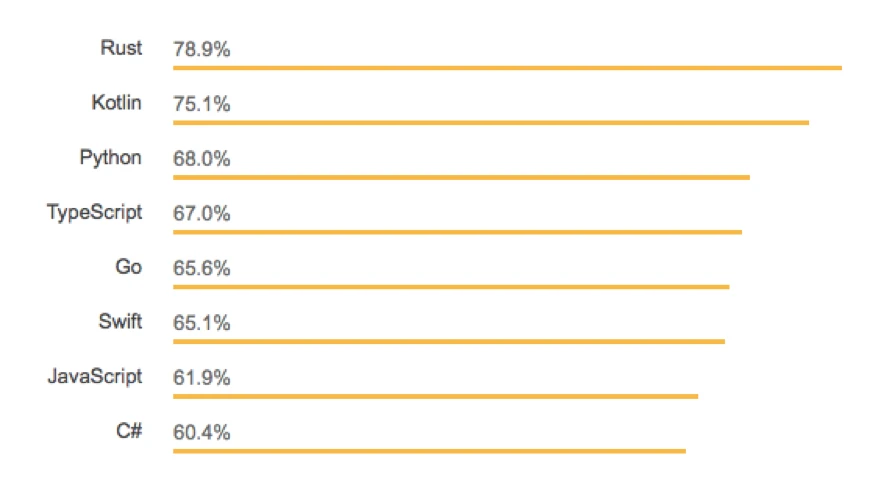
Image Source: https://insights.stackoverflow.com/survey/2018#most-loved-dreaded-and-wanted
Why might you enjoy working with C#? Here are some reasons, advanced by Stackify:
- As mentioned, it’s relatively easy to learn, particularly if you’ve done previous programming in C, Java or even JavaScript.
- Modern language features
- Versatility – C# is suitable for web, mobile, server and desktop applications
- Great developer tools – here’s a list of the best C# tools in various categories including IDEs, version control, testing, etc.
- Standardisation of skills – this makes it easier as a developer to move between teams and projects
- Open source – this results in a huge community of developers
Salary Expectations for C# Developers in 2018
According to Glassdoor, the average C# developer salary, as of April 2018 in the United States, was $79,954. The range extended from $61,000 to a high of $104,000 per annum. A C# lead developer was earning in the region of $94,939.
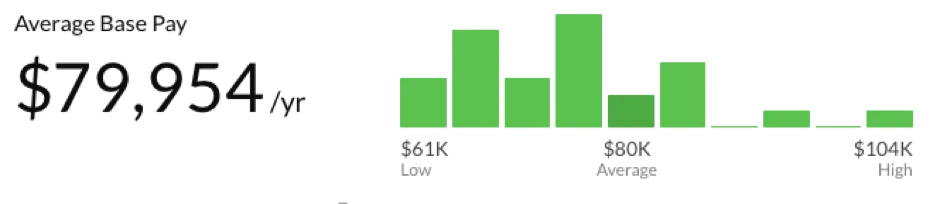
Image Source: https://www.glassdoor.com/Salaries/c-net-developer-salary-SRCH_KO0,15.htm
Demand for C# Developers in 2018
One way to calculate developer demand is to analyse job postings data. CodingDojo looked at the 7 most popular job posting ads on Indeed.com. C# comes in at #5.
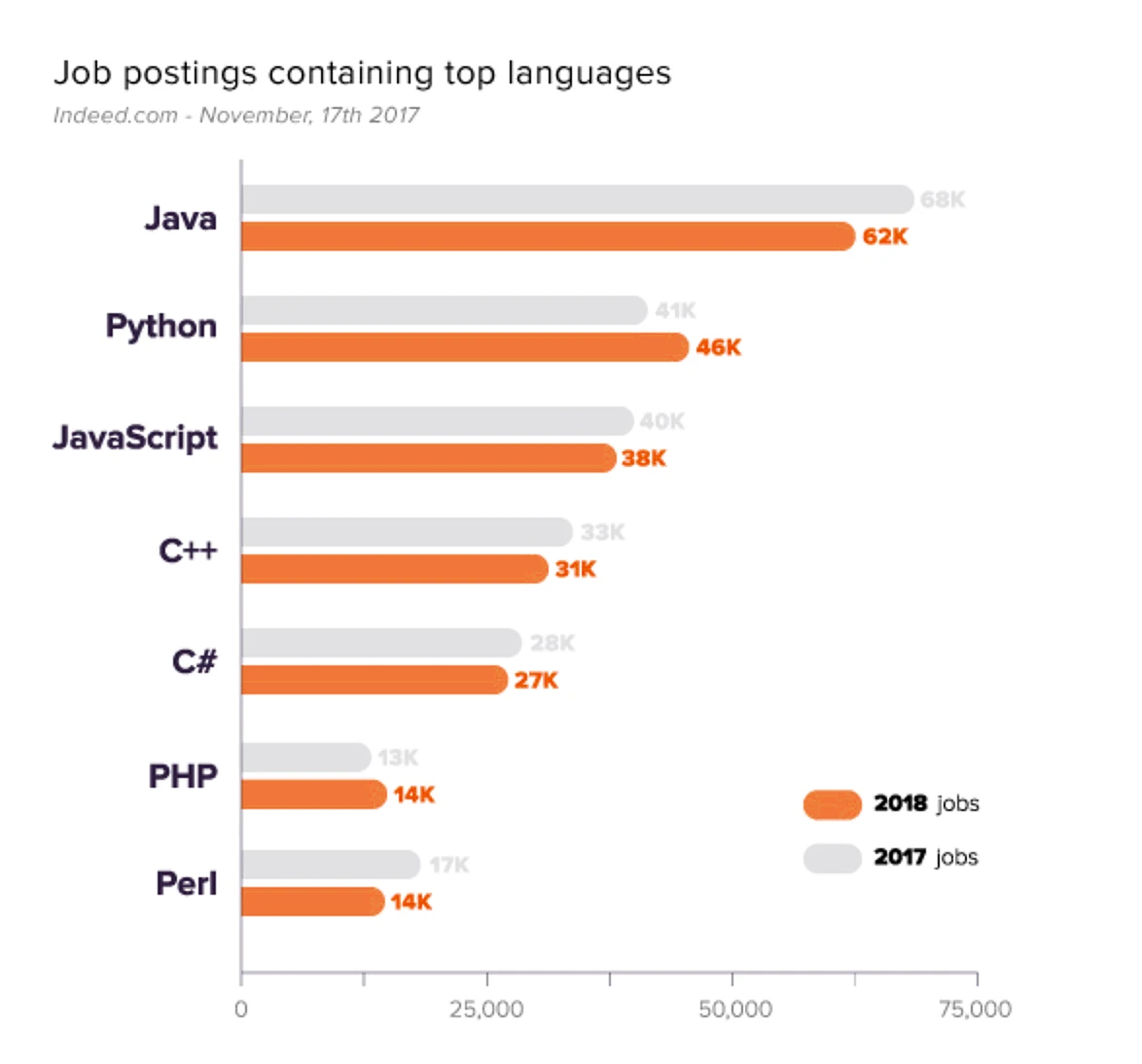
Image Source: http://www.codingdojo.com/blog/7-most-in-demand-programming-languages-of-2018/
In conclusion, C# in 2018 will continue to remain in high demand owing to its versatility and popularity. If you take the time to master this language in 2018, you will be rewarded with excellent salary opportunities and good demand. If you’re interested in learning C#, consider HyperionDev’s 3-month C# Programming Essentials course.
Web Development
Should I Learn HTML & CSS?
HTML & CSS are frequently used in web development. In this blog piece, we explore various reasons why you should learn HTML and CSS in 2018.
HTML and CSS are frequently used for web development. They form a core part of a Full Stack Web Developer course along with other programming languages or frameworks like Django, JavaScript, etc. Besides web development, they also have other uses. So should you learn HTML and CSS? Read on to find out.
HTML and CSS: What Do They Do?
HTML (Hyper Text Markup Language) tells your browser how to display text and images in a webpage. You use tags to represent the various elements, determining the placement of paragraphs, headings, data tables, embedded images and video.
Here’s some HTML. Can you work out how this would look?
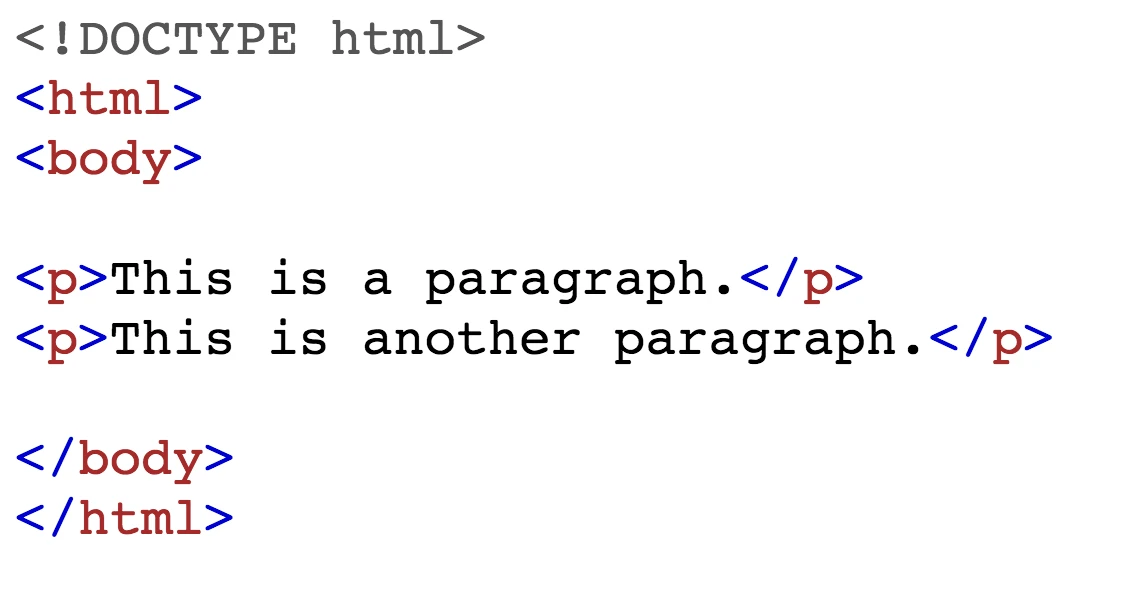
Image Source: https://www.w3schools.com/html/tryit.asp?filename=tryhtml_basic_paragraphs
[What do these HTML tags mean?
Body – defines the main content of the website
P – indicates a paragraph]
CSS, or Cascading Style Sheets, on the other hand, adds styling, such as fonts, colours or layouts to your website. It’s not a markup language, like HTML, or a programming language, but a style sheet language. For example, CSS lets you write code to make all the headings on your page blue; you would only need a single instruction for that instead of hand coding each heading separately. In other words, HTML allows you to build the structure of your website, while CSS allows that structure to come alive.
See if you can recognise the CSS in this example.
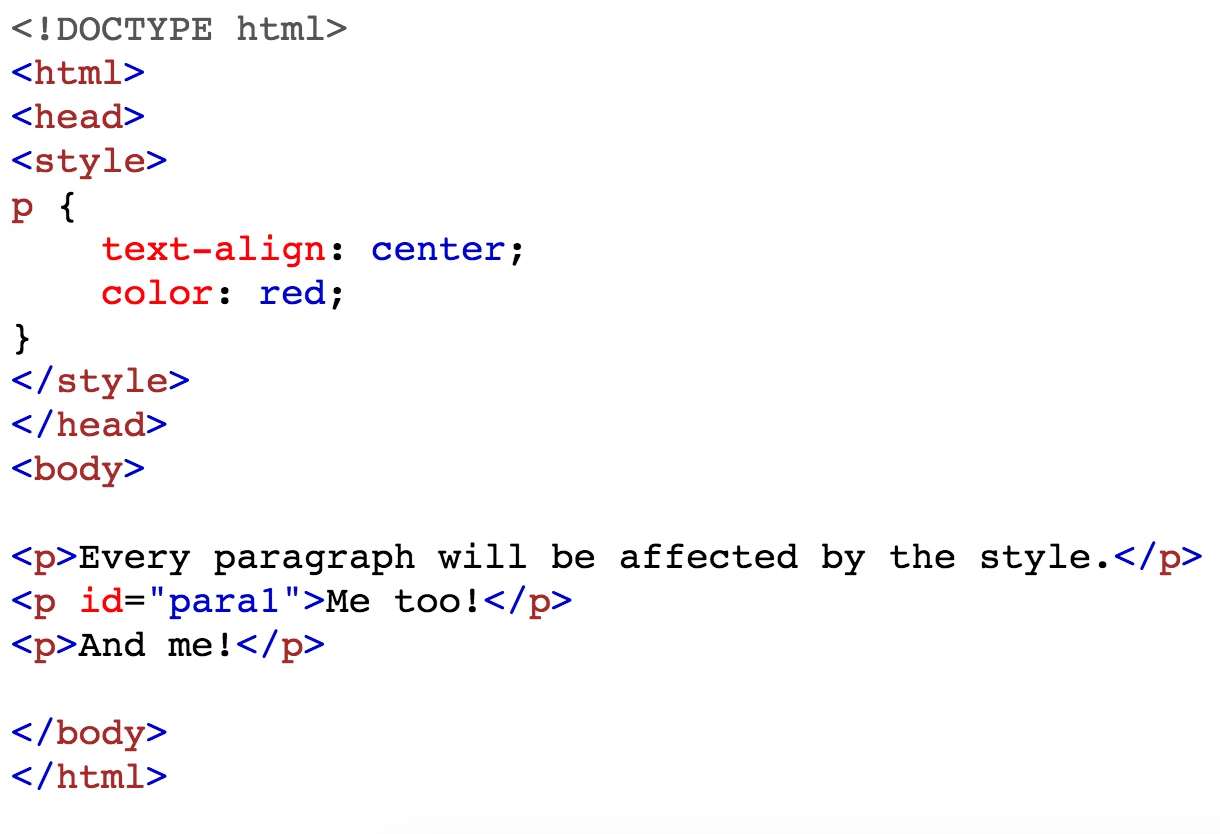
Image Source: https://www.w3schools.com/css/tryit.asp?filename=trycss_syntax_element
In this example, the the code in red refers to the CSS.
Are HTML and CSS commonly used?
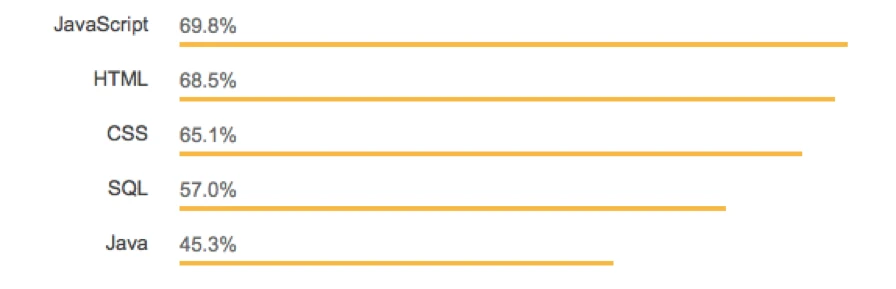
Both HTML and CSS are frequently used in the developer world. Check out this graph, which shows commonly used programming languages, from the 2018 Stack Overflow Developer Survey.
Reasons to Learn HTML and CSS
Consider these advantages when deciding if you should learn HTML and CSS.
- It’s widely used and supported by all browsers.
- HTML is an easy language to learn and use. From there, you can move on to learn other languages like Python.
- You can do some cool and unusual stuff. For example, let’s say you want to format your blog post or email. With some HTML knowledge, you can tweak formatting that you don’t like and personalise the aspects you do like. You can also customise emails – for example, centering all your images or playing around with headings.
- Essentially, a working knowledge of HTML is useful not only for web developers but also for marketing specialists, designers and content creators, because these jobs frequently require you to optimise landing pages and web pages. To get the best results, a working knowledge of HTML is ideal.
- Although Flash and JavaScript have been used for years for creating web-based animation, this is falling away. CSS animation has stepped in to fill the gap. With CSS3, you can change the appearance and / or the behaviour of an element in multiple keyframes. Check out CodePen to create something cool with HTML and CSS.
- If you know some HTML and CSS, you can fiddle around with the developer tools on modern browsers. These give you deep access into the browser’s workings. To access DevTools on Chrome, go to the top right of your browser window and select Tools > Developer Tools. Right click on any element and select Inspect Element.
Before deciding whether you should learn HTML and CSS, what are the expected salaries for these two languages? As an HTML and CSS developer in the United States, you can anticipate an annual average salary of $60,602, according to PayScale. The upper range is $92,432.
In closing, learning HTML and CSS seems like an excellent place to start in your web development career. Think about enrolling for the free Full Stack Web Developer trial via HyperionDev. You’ll cover basic HTML and CSS. This will give you an excellent sense of the two languages. Judging by their popularity, earning potential and cool features, the answer to the question, ‘Should you learn HTML and CSS’, is a resounding ‘yes’.

Career Advice
5 Ways to Prepare for a Coding Bootcamp
It's always best to prepare and plan ahead when doing anything in life and that includes your online coding bootcamp! We explore 5 ways you can technically and mentally prepare for a coding bootcamp.
Amy, 31, made the decision to change careers and become a software engineer at the beginning of 2018. ‘I’d had enough of my old job in corporate training and I wanted to do something new. However, I could only afford to study online and part-time, because I needed to carry on earning a salary. That’s why I chose the flexibility of an online coding bootcamp.’ Although Amy knew this was the right decision, she was keen to prepare for her bootcamp before it began. ‘It’s a new way of learning,’ she explains, ‘online, part-time and it’s programming! I needed to do everything I could to get up to speed before hitting the runway.’ So, how can you best prepare for a coding bootcamp? Here are five strategies to become bootcamp-fit before the action starts warming up.
1. Plan, plan, plan
Organise your schedule before your course starts. Most online coding bootcamps require 5-30 hours per week. Decide how you’re going to slot these hours into your week and then actually draw up the timetable.
Download some apps to make you productive during your ‘learning times’. Be Focused, for example, makes you get more done by breaking up projects into tasks and then scheduling breaks, so you’re forced to work for a certain number of minutes before checking your phone. It utilises what’s known as the Pomodoro Technique, which is a time management method, to break work into 25 minute intervals with short breaks between.
2. Get Technically Fit
The ideal way to prepare for a coding bootcamp is to develop some technical expertise before you start. You wouldn’t rock up at a marathon before training beforehand, right? The same thinking applies here. Use free resources online to read about the programming languages you’re going to be studying and to learn the basics.
Try Coursera, a large online course library, where courses are free. You pay if you want to get the certificate. Many topics, including coding and computer science, are taught. Or try edX, an open-source higher education program under the auspices of MIT and Harvard. Courses include Java, C# and Python, among many others. Remember, though, these courses are more of a taster and are primarily video-based, so you won’t cover much of the actual practicality of coding.
You could also try a free coding bootcamp trial offered by a number of online institutions including HyperionDev. Or sign up with an open-source community like freeCodeCamp to brush up on some beginner coding skills. The thing to remember is that most people sign up for bootcamps, because they anticipate needing mentoring when they get stuck. However, picking up some initial basics on your own is an excellent way to prepare for a coding bootcamp.
3. Get Mental
Programming can be tricky. The Footnotes, a career portal website, outlines the four psychological stages of learning to code including:
The Honeymoon: This is the first magical introduction to code.
The Cliff of Confusion: You’re getting a little stuck and need help. If you’re on a bootcamp, you’ll make good use of your mentor during this phase.
The Desert of Despair: This is a fairly long and lonely stage. You’re sitting alone and you’re really stuck. Again, this is the time to speak to your mentor to guide you through this hellish desert.
The Upswing: Things are now starting to come together. Enjoy it. You’ll build even more confidence with practise. Eventually, you’ll have great pride in the work you do and the code you write.
Prepare for a coding bootcamp by understanding your upcoming mental journey.
4. Bookmark Resources
There are many developer resources out there that programmers use when they get stuck. A good place to start is Stack Overflow, which attracts over 50 million developers on a monthly basis. You can ask your programming questions there, and you are almost guaranteed to have an avid user answer your question soon. Reddit Programming is also a good spot to bookmark and check out prior to your bootcamp. You could also look at Experts Exchange, a paid site, and Quora, which is a Q&A sites on any topic. You will find that the developer and programming world has an incredible community of support through resources and forums like these.
5. Start Trying on Your New Identity
You’re a programmer now. Act like one. Get going on GitHub, where you can host and review code, manage projects, and build software alongside millions of other developers. Add your existing code to share with prospective employers or start new projects to keep yourself relevant. GitHub accounts are free, and it’s the best place to swap ideas and code with other programmers online.
In addition, start a blog about your programming journey. You’ll be practising your web development skills as well. Update your LinkedIn account – developer demand is high; employers will be knocking on your door soon.
In closing, there are many ways to prepare for a coding bootcamp. The bottom line is that when the starting gun goes off and your bootcamp begins, you want to feel fit and ready. That way, you’ll cross the finishing line without breaking too much of a sweat. To find out more about various bootcamps offered by HyperionDev, check out their courses here.
Web Development
C++ Language Trends in 2018
C++ is a widely used programming language in the developer industry, due to its scripting capabilities for applications and its high efficiency as a language. We explore all trends surrounding C++ in 2018.
You’ve probably heard of C++ (pronounced see-plus-plus), but how popular is this programming language? And should you be learning it this year? Created back in 1985, C++ literally means ‘increased C’ (technically, it’s the C language but with classes added), which indicates its evolution from the C language. So, should you be learning C++ in 2018?
Despite the popularity of other programming languages like Java (interestingly, C++ tends to execute faster than Java), C++ can still hold its own as a widely used language for scripting with many applications including:
- Games: C++ is frequently used in the the development of gaming engines. The science fiction game Doom 3 uses C++, so too Unreal Engine, a suite of integrated tools for game developers to design and build games,simulations, and visualisations.
- Graphic User Interface (GUI) applications: Many common applications, including Image Reader, Photoshop and Illustrator, are scripted in C++.
- Web Browsers: Although C++ is limited for scripting websites (PHP and Java tend to be preferred for web development), it is still used when speed and reliability are needed. A part of Google’s back-end is coded in C++, for example.
- Advanced Computation and Graphics: C++ can build apps that need real-time physical simulations, high performance image processing and mobile sensor applications.
- Operating Systems: C++ forms a vital part of multiple operating systems including Apple’s OS and some versions of Windows.
- Banking and trading applications: This includes some apps used by Bloomberg and Reuters.
As you can see, C++ has a wide range of uses. It’s regarded as a highly efficient and flexible language, according to an article in Medium, and here’s the good news: you don’t need to know another programming language before learning C++ in 2018. Although having said this, the feeling is that C++ is fairly tricky for newbie developers to pick up, because it’s close to C, which is a lower-level language (i.e. close to machine language). Watch this YouTube video to find our more about the relative difficulty of learning C++.
Let’s look now at some anticipated trends for C++ in 2018.
Popularity of C++ in 2018
The TIOBE index looks at the popularity of various programming languages. This is determined by looking at the following variables: number of skilled engineers in a particular language world-wide, courses offered in that language and third party vendors. This information is combined with popular search engine results for the different languages on Google, Bing, Yahoo!, Wikipedia, Amazon, YouTube, etc., For April 2018, same as April 2017, C++ was ranked as the 3rd most popular language.
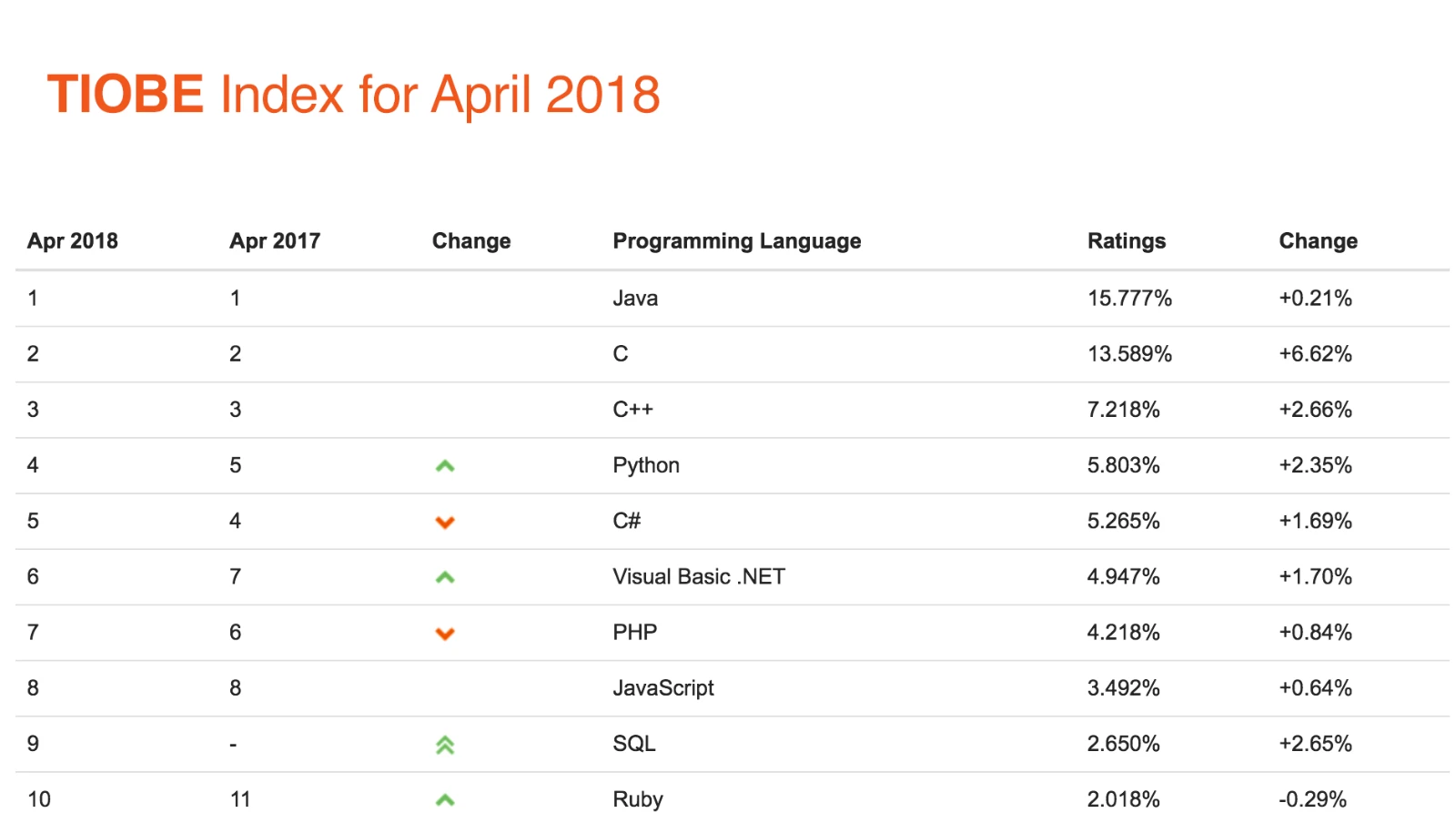
Source: https://www.tiobe.com/tiobe-index/
This is substantiated by the PYPL, Popularity of Programming Language Index, which looks at how often language tutorials are searched on Google. C++ is at #6, according to data from May 2018. The PYPL index is useful for helping you decide which language to study or to use in a new project. Here are their top six most popular languages:
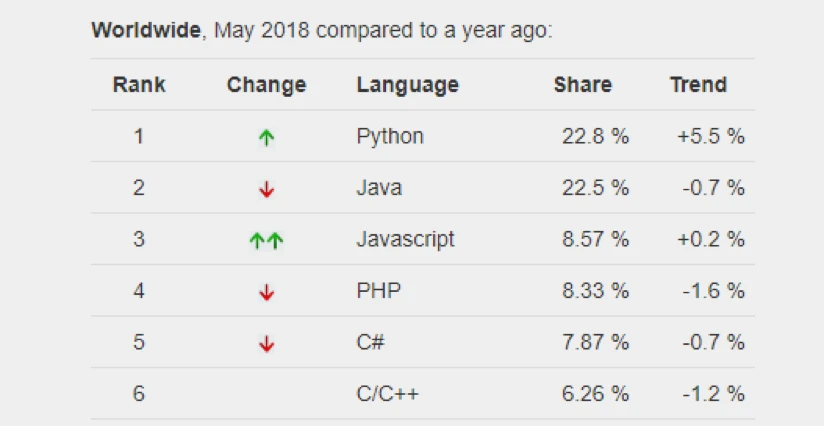
Source: http://pypl.github.io/PYPL.html
Why should you learn C++ in 2018?
According to an article in Medium, there are many good reasons to learn C++. Some of these include:
- Learning to worry about memory management
- Understanding the difference between compiler, linker and loader
- Learning meta-programming
- Discriminating between compile time and run time
- Learning how compilers make optimizations
- Diving deeper into generic programming
And here’s another one: C++ is a very powerful and fast language, according to responses on Quora.
There is a good deal of demand from developers themselves to learn C++. This year’s 2018 Stack Overflow Developer Survey, based on responses from 101,592 developers, found that when it comes to languages that are wanted – i.e. developers are not yet using that language, but they are very keen to learn it – C++ came in at #7.
Here’s a graph showing the seven most wanted programming languages, according to the 2018 Stack Overflow Developer Survey.
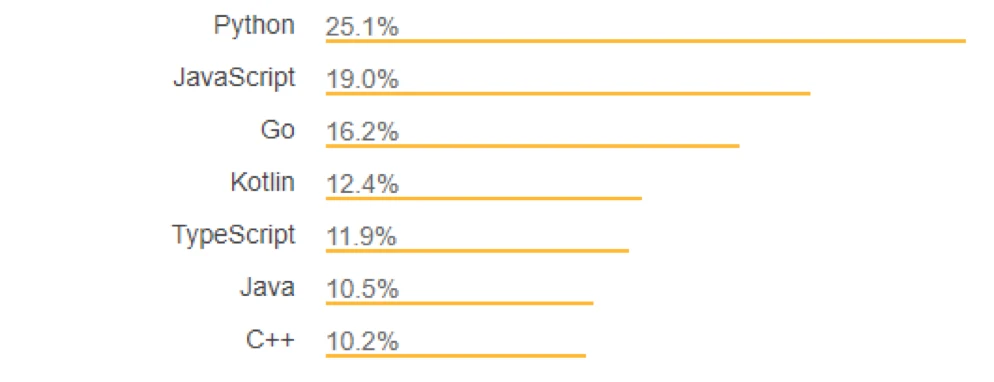
Image Source: https://insights.stackoverflow.com/survey/2018#most-loved-dreaded-and-wanted
C++ has essentially maintained its high popularity, year-on-year – it has neither ascended nor descended the various popularity indexes. Moving on, let’s now discuss other trends including salary expectation for C++ developers in 2018.
Salary Expectations for C++ Developers in 2018
According to Glassdoor, the average C++ developer salary, as of April 2018 in the United States, was $92,381. The range extended from $66,000 to a high of $138,000 per annum. This is even slightly higher than Python, where the average developer in the US receives $92,000 per annum.
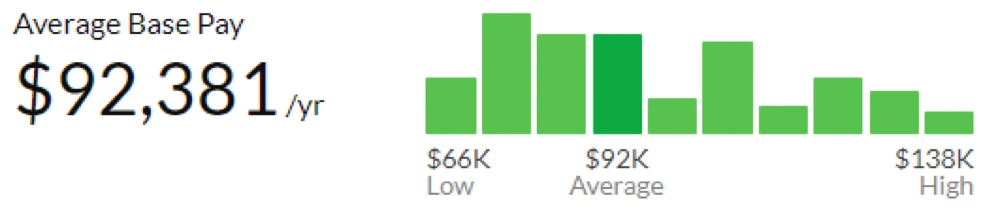
Image Source: https://www.glassdoor.com/Salaries/c-developer-salary-SRCH_KO0,11.htm
Demand for C++ Developers in 2018
One way to calculate developer demand is to analyse job postings data. CodingDojo looked at the 7 most popular job posting ads on Indeed.com. C++ comes in at #4.
Image Source: http://www.codingdojo.com/blog/7-most-in-demand-programming-languages-of-2018/
In conclusion, C++ in 2018 will continue to remain in high demand owing to its performance, reliability, and the wide variety of contexts in which it can be used. If you take the time to master this language in 2018, you will be rewarded with excellent salary opportunities and high demand. If you’re interested in learning C++, consider HyperionDev’s online short course.

Career Advice
Emigrating from South Africa? Learn Coding
2018 is set to bring a new record of South Africans emigrating to other countries. However, many South Africans may find issues finding the appropriate visa for their move. Upskilling or switching into software development careers may the best answer for you. Read our blog piece to find out more.
More people than ever before are emigrating from South Africa, says The South African. 2018 is set to bring a new record. One way to measure this is to look at the number of people selling their houses and why they are doing so. The 4th quarter 2017 FNB Estate Agent Survey found a huge uptick, 7.4% (moved up from 2% in 2013), of house sales occurred for reasons of emigration. The most popular destinations for those emigrating from South Africa included the UK, Australia, New Zealand and the US.
If you’re moving to another part of the world, the skills you learnt in South Africa may not be the same skills that are in-demand throughout the rest of the world. So, if you are emigrating, what skills should you be learning? It seems that coding or programming skills are in high demand all over the world, no matter where you learnt them.
Emigrating from South Africa: To the UK
A popular destination for South Africans is the United Kingdom. The good news is that across Britain a number of businesses are short of employees in key sectors, explains Business Tech. Coupled with this, UK unemployment is at a historic 42-year low of 4.3%, and Brexit has led to a fall in net migration. So for those emigrating from South Africa, what skills are in high demand in the UK?
‘The UK Shortage Occupation List details the jobs for which there is a shortage of workers in the UK,’ explains Sable International emigration consultant Philip Gamble. There are 16 jobs on the list, including programmers and software development professionals. If your job is on the list, it’s far easier to find a job in the UK and get the relevant work permit, which in this case would allow you to work in the UK for just over five years – after which you can apply for ILR (Indefinite Leave to Remain). If your job is not on the list, it may be worth your time to learn how to code and switch careers into software engineering. Find out more about what software engineers do here.
Emigrating from South Africa: To Down Under
It’s not surprising that Australia or New Zealand could exert a strong pull for South Africans wanting to emigrate. The annual Human Development report, published in 2017 by the United Nations, looked at approximately 200 countries across a range of categories, including life expectancy, education, gender equality and financial wealth. Australia ranked in the top 5.
And New Zealand is also looking great. The BBC published a recent list of the top six countries believed to be best governed. New Zealand was included in this list due to its political stability, fundamental rights and lack of violence or terrorism.
Although Australia has slashed their Skilled Occupation list, the good news is that there are still more than 400 occupations that are in high demand. These include: Web Developer, Software Engineer and Software and Applications Programmers, among many other programming disciplines.
New Zealand distinguishes their skills shortages between long-term and immediate skills shortages. A long-term skill shortage includes both international and local shortages in this occupation. A Junior Software Engineer, as well as a Web Developer, are both on the long-term skill shortage list. You can search for other occupations here.
Emigrating from South Africa: To the USA
The United States is the third most popular destination for South Africans between 2006 and 2016, states StatsSA. Here’s a graph showing the top 10 overseas destinations, not including Africa, for those emigrating from South Africa.
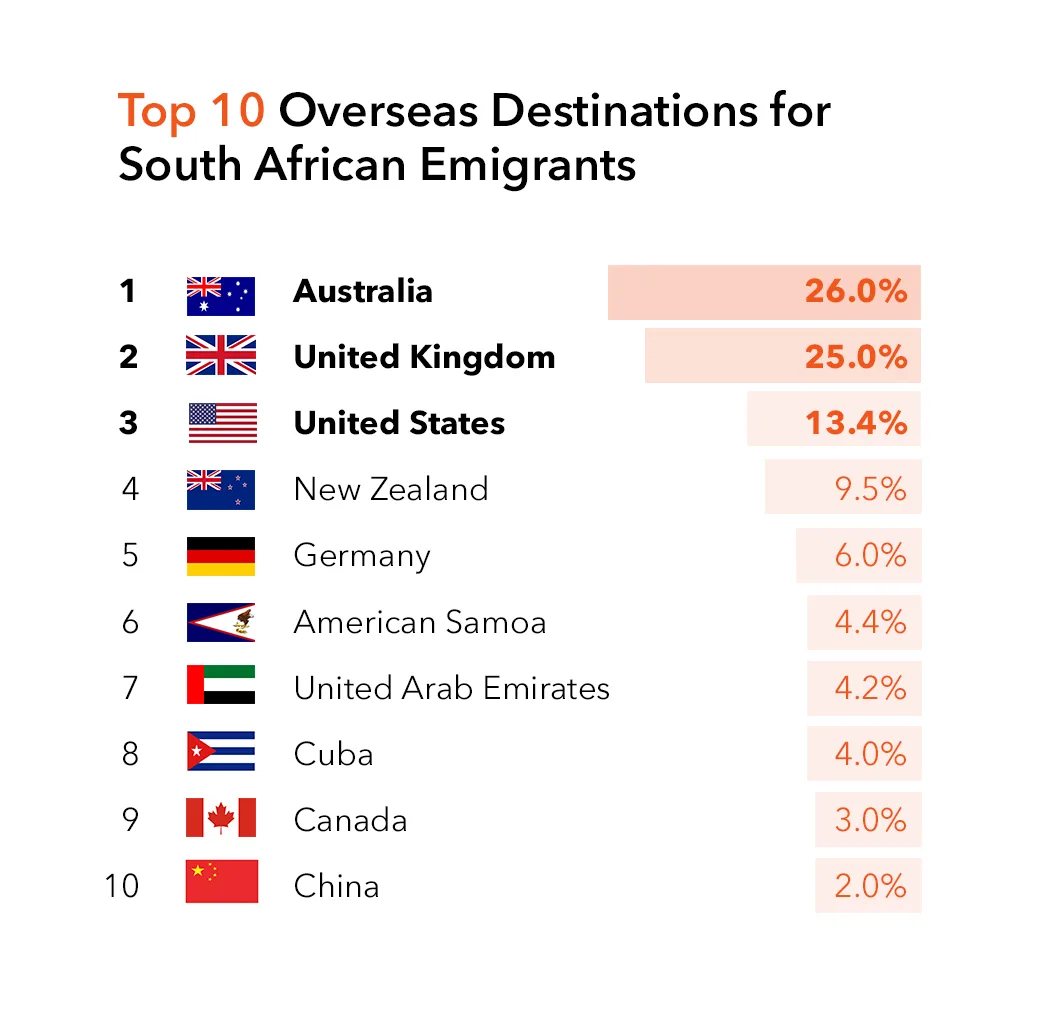
IT and computer professionals are designated as speciality occupations that can receive a US visa. Remember, there are many different visa types and requirement in the US, so it makes sense to consult with a professional, because it can be a bit of a minefield.
Conclusion
If you are keen on emigrating from South Africa, there are lots of exciting options out there if you have software development skills. If you don’t already have this experience, a programming bootcamp will stand you in a good stead for a wide variety of new, stimulating countries.

Career Advice
Battle of the Cities: Cape Town versus Joburg developer salaries in 2018
Cape Town and Johannesburg are South Africa's two major cities. But how do these cities compare when one looks at developer salaries? We explore the differences in demand and salaries for developers across years of experience and top programming languages, taking into account cost of living of both cities.
South Africans love comparing their two major cities; now even CNN has taken to comparing Cape Town with Joburg: the natural beauty of the Mother City with the pulsating buzz of the former gold mining town. On CNN, Laurice Taitz, publisher and editor of Johannesburg In Your Pocket City Guide, says: ‘A friend of mine summed it up perfectly. If Joburg and Cape Town were on a dating website, Cape Town would be the blonde in the bikini and Joburg would be the one with the really great personality.’ But how do these two great cities compare when one looks at developer demand and developer salaries. Cape Town versus Joburg developer salaries in 2018: who comes out tops?
Cape Town Ahead for Junior Developers
OfferZen, a recruitment company, has conducted research into Cape Town and Joburg developer demand in 2018 and found some interesting stats. In Cape Town, entry level salaries are on average 14% higher than their Northern cousins. Joburgers starting out in the developer profession can expect to earn about R22k per month, while developers in Cape Town earn R25k per month on average. Good news for those residing in the Mother City! Here’s a graph comparing Cape Town versus Joburg developer salaries in 2018 by years of experience.
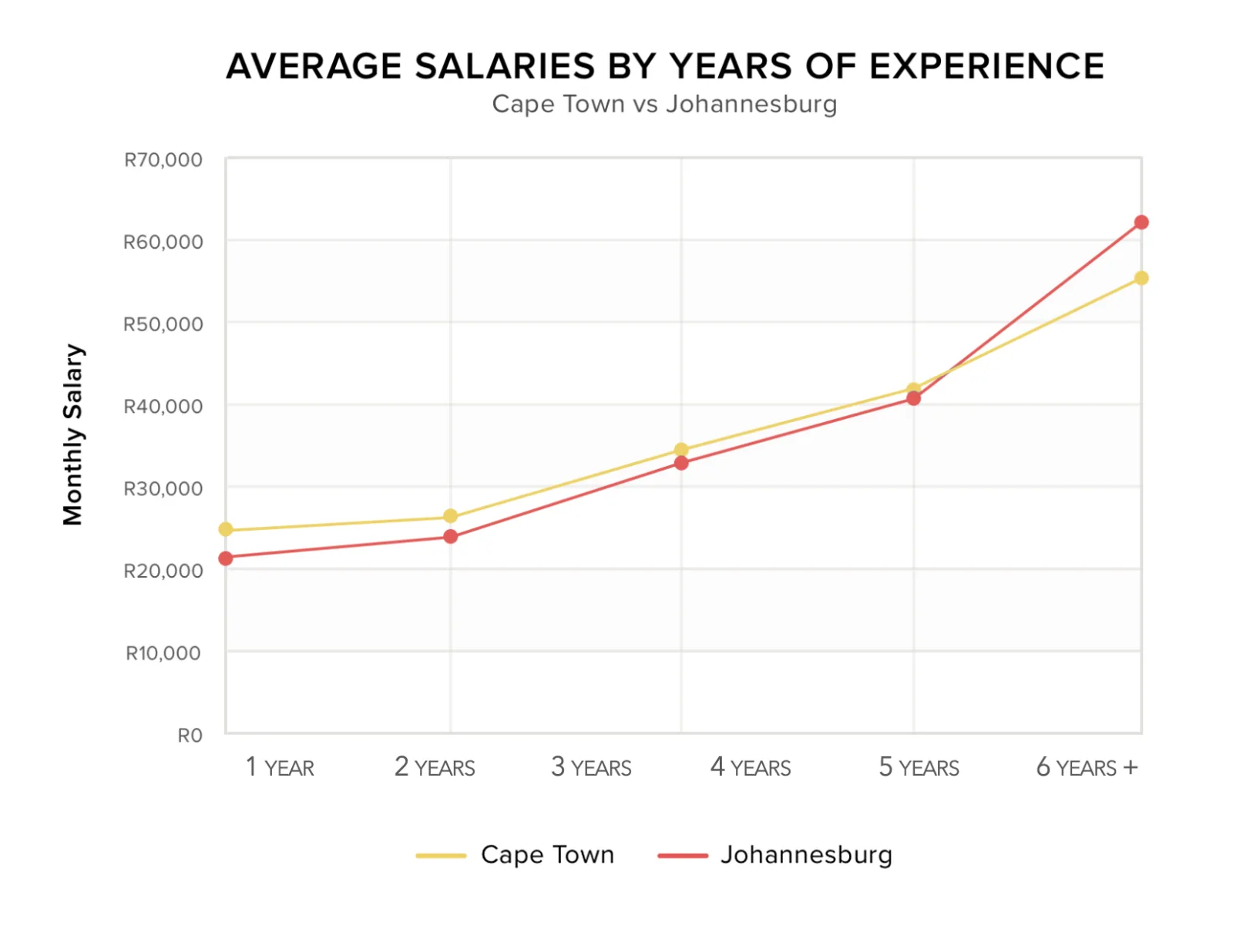
Image Source: https://www.offerzen.com/blog/developer-salaries-cape-town-vs-johannesburg-2018
Why is this the case? Here’s a potential explanation. Despite Cape Town being known as Silicon Cape due to high number of start-ups (and having, for example, its own EdTech incubator, Injini), there are many more developers in Joburg than Cape Town: approximately 30 000 to 10 000. This high supply in Joburg leads to fierce competition from companies like Amazon.
Joburg Developer Demand in 2018: Getting Ahead
However, when it comes to experience and Cape Town versus Joburg developer salaries in 2018, Joburg developers take the lead as far as money goes. Salaries increase similarly for both South African cities up to the 4-6 year mark; however, at this point, Joburgers race ahead. With more than 6 years of experience, the average monthly salary for Joburg developers is R61,240, whereas Cape Town developers with the same number of years of experience earn on average R54,750 per month. One potential reason for this is the high number of large financial institutions in Joburg.
Image Source: https://www.offerzen.com/blog/developer-salaries-cape-town-vs-johannesburg-2018
But bear in mind the cost of living in either of these cities- to maintain the same standard of living, you would need R36,788 in Cape Town and R34,000 in Joburg, states Numbeo, a large database of user-contributed data. Rent prices, for example, are 54,17% higher in Cape Town than Joburg; similarly restaurant prices are 6,31% higher in Cape Town than up North.
Top Programming Languages by City
When it comes to programming languages, there is a high demand in both cities for the following languages:
If one examines the trend a little more closely, there is a lot more demand for .NET in Joburg than in Cape Town. On the other hand, Cape Town currently has ‘high demand for UX Designers, Python, and PHP developers,’ states co-founder Philip Joubert from OfferZen in My Broadband.
Conclusion
In conclusion, whether you are in Cape Town or Joburg, it is clear that software engineers and developers earn some of the highest salaries in the country. CareerJunction’s latest salary review, as discussed in My Broadband, states that ‘salary offerings for software developers fall under the top 25 highest salaries, based on an analysis of 116 occupational fields.’ The cost to company on average for intermediate software developers is between R33,352 and R43,523, whereas senior software developers earn an average salary of between R41,726 and R53,253 per month. Not bad!
To find out more about potential programming careers, check out HyperionDev’s online, six-month bootcamps, including Software Engineering, Mobile Development and Full Stack Web Development.
Web Development
JavaScript Trends in 2018
What are JavaScript trends in 2018? Did you know 95% of our websites are run on JavaScript? The widely-used programming language is often used to make web applications more interactive. In this piece, we explore why this language is so popular, along with industry stats, such as job demand and salary expectations.
In 2018, career growth is probably one of your key goals. With this in mind, should you be learning JavaScript? Also known as JS, JavaScript, is used to make web applications more interactive, rather just just being static, plain pages. It’s used by 94,5% of all websites. And here’s the kicker: you can use JavaScript for both client-side scripts, which integrate seamlessly into HTML, and for server-side code by using a cross-platform runtime engine like Node,js. So what JavaScript trends can we expect in 2018?
Popularity of JavaScript in 2018
The TIOBE index looks at the popularity of various programming languages. This is determined by looking at the following variables: number of skilled engineers in a particular language world-wide, courses offered in that language and third party vendors. This information is combined with popular search engine results for the different languages on Google, Bing, Yahoo!, Wikipedia, Amazon, YouTube, etc., For April 2018, same as April 2017, JavaScript was ranked as the 8th most popular language.
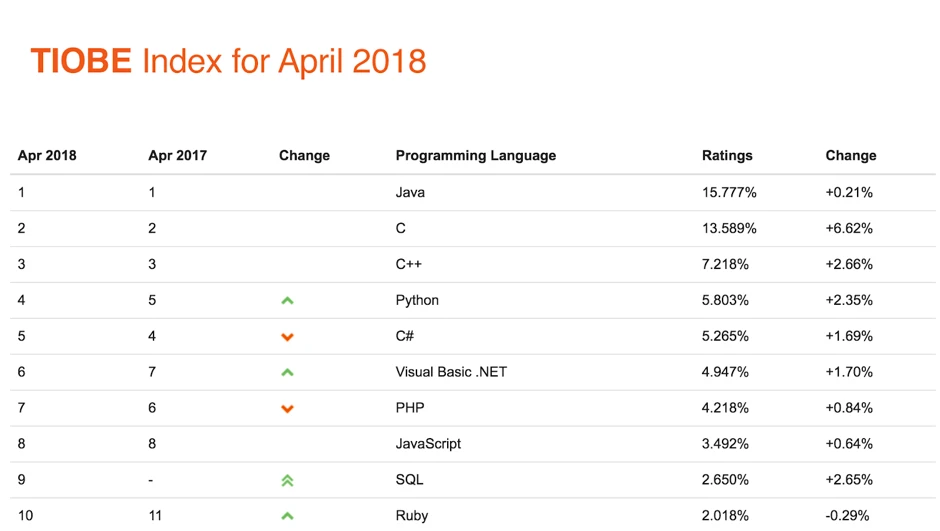
Source: https://www.tiobe.com/tiobe-index/
This is substantiated by the PYPL, Popularity of Programming Language Index, which looks at how often language tutorials are searched on Google. JavaScript inches up to third in this survey, according to data from March 2018. The PYPL index is useful for helping you decide which language to study or to use in a new project. Here are their top five most popular languages:
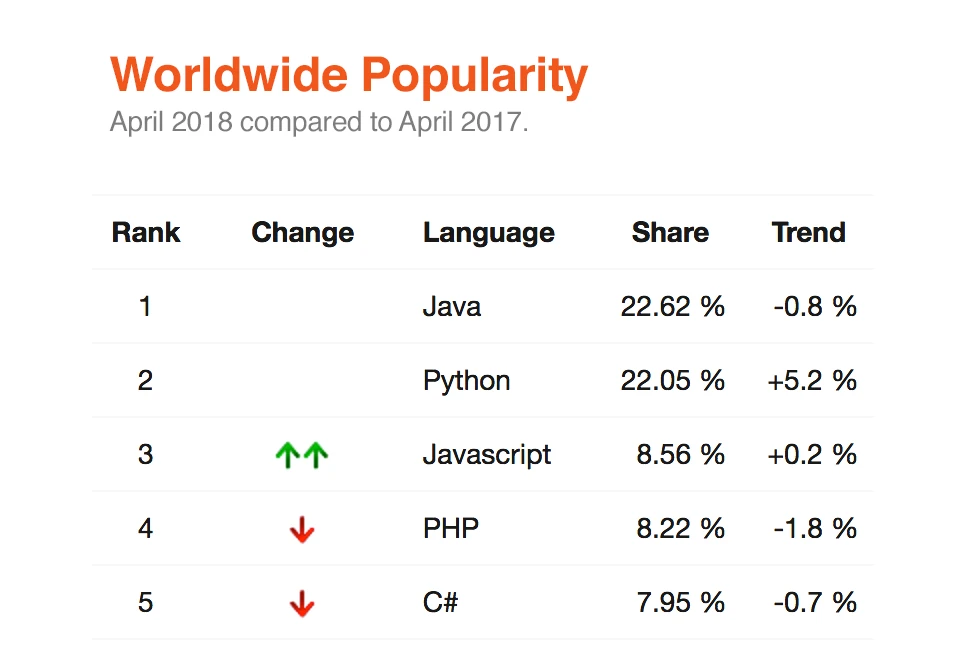
Source: http://pypl.github.io/PYPL.html
And in case you needed any more convincing to learn Javascript in 2018? The State of the Developer Nation report, which analyses more than 21,700 developers in 169 countries, found that JavaScript is the most popular programming language, used by 9.7 million developers. This was 2.4 million more developers than the second most-popular language.
Why is JavaScript such a popular language?
According to Mashable, if you’re thinking of picking up a programming language, you can’t go wrong with JavaScript for these reasons.
- JavaScript is comparable to English in the sense that it’s universally recognised. It’s also everywhere on every platform imaginable, including browsers, mobile and desktop application, IoT device, etc.
- It’s a great foundational language for newbies. Script languages are generally easier to learn than compiled languages like C++, states Business News Daily.
- Many of the world’s top websites and apps – including Paypal, Netflix, LinkedIn and Uber – all run on JavaScript, or more precisely Node.js, the JavaScript environment that executes the code.
- There is great demand to learn JavaScript from developers themselves! This year’s 2018 Stack Overflow Developer Survey, based on responses from 101,592 developers, found that when it comes to languages that are wanted – i.e. developers are not yet using that language, but they are very keen to learn it – JavaScript came in at #2, with 19% of all respondents wanting to learn this language.
Here’s a graph showing the five most wanted programming languages, according to the 2018 Stack Overflow Developer Survey.
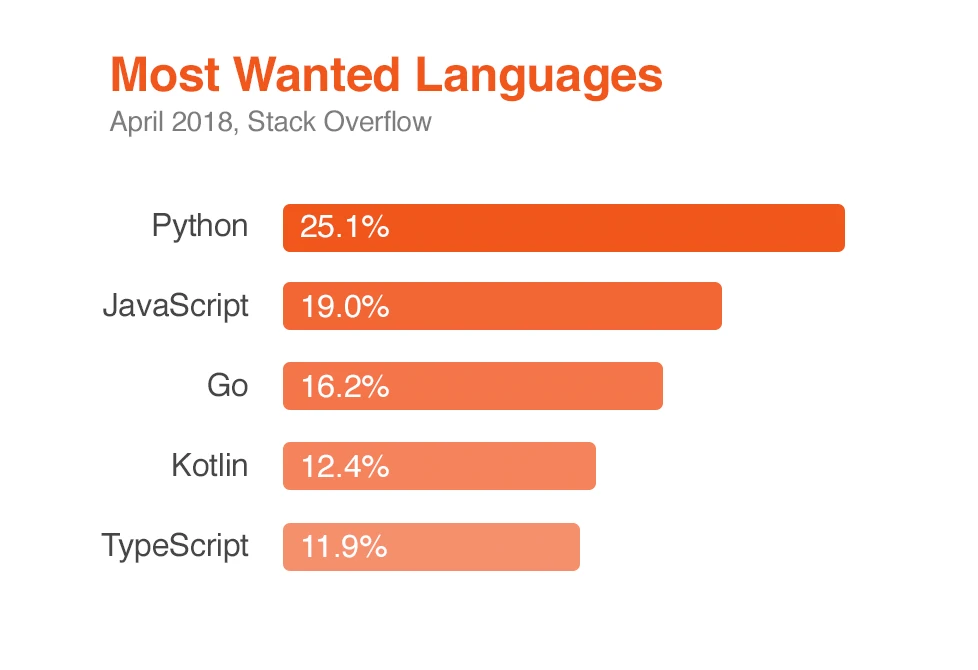
Source: https://insights.stackoverflow.com/survey/2018#most-loved-dreaded-and-wanted
It’s clear that JavaScript is one of the most popular languages this year, but let’s discuss other JavaScript trends in 2018 including demand for JavaScript developers, salary expectations and other important factors.
Salary Expectations for JavaScript Developers in 2018
According to Glassdoor, the average JavaScript developer salary, as of March 2018, was $72,500. The range extended from $51,000 to a high of $120 000 per annum. Python, however, comes in above this. The average Python developer in the US receives $92,000 per annum. You can read more about why you should consider learning Python in 2018. When it comes to Java, the median annual developer salary, according to Salary.com, as of March 2018 in the US, is $89,603. The range is between $74,844 and $101,025.
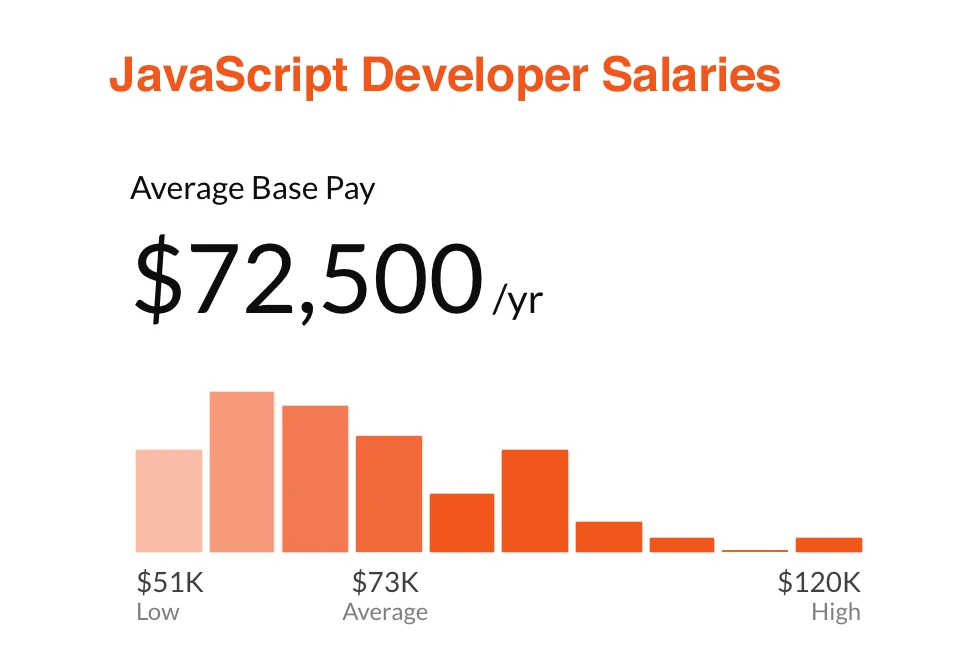
Source: https://www.glassdoor.com/Salaries/javascript-developer-salary-SRCH_KO0,20.htm
Demand for JavaScript Developers in 2018
One way to calculate developer demand is to analyse job postings data. CodingDojo looked at the 7 most popular job posting ads on Indeed.com. JavaScript comes in at number three, although the number of job postings have decreased by 2000 from 2017.
Source: http://www.codingdojo.com/blog/7-most-in-demand-programming-languages-of-2018/
In conclusion, in 2018, JavaScript should continue to enjoy its prominence as far as popularity, developer demand and high salaries are concerned. If career growth is your aspiration for 2018, JavaScript is an excellent initial coding language to learn. If you’re keen to learn JavaScript, consider doing a Full Stack Web Development Bootcamp, which includes studying both JavaScript and Node.js.
Career Advice
Java Programming Trends for 2018
Java Trends for 2018 - Java is still the most popular language in 2018. This article looks at the demand for java developers, salary expectations, and other important factors.
In 2018, career growth is probably one of your key goals. And you’ve heard of Java, the go-to language for millions of software developers. Because things change fast in programming industry, it’s useful to stay up-to-date. With this in mind, what are the projected Java trends for 2018?
The TIOBE index looks at the popularity of various programming languages. This is determined by looking at the following variables: number of skilled engineers in a particular language world-wide, courses offered in that language and third party vendors. This information is combined with popular search engine results for the different languages on Google, Bing, Yahoo!, Wikipedia, Amazon, YouTube, etc. For April 2018, same as April 2017, Java was ranked as the most popular language.
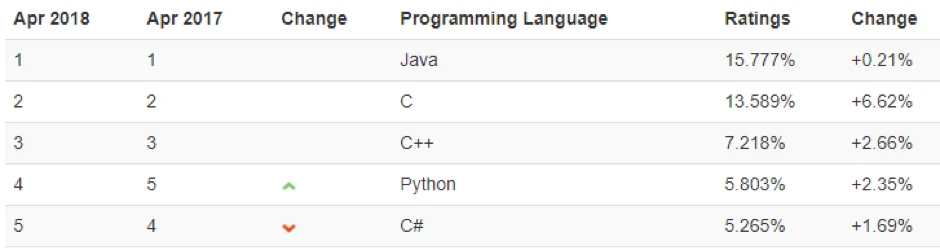
Source: https://www.tiobe.com/tiobe-index/
This is substantiated by the PYPL, Popularity of Programming Language Index, which looks at how often language tutorials are searched on Google. Java comes out on top again, according to data from March 2018. The PYPL index is useful for helping you decide which language to study or to use in a new project. Here are their top five most popular languages:
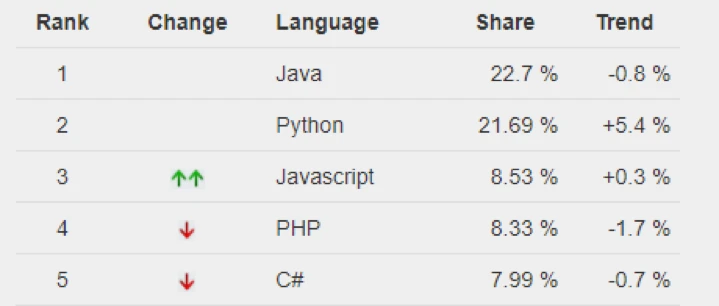
Source: http://pypl.github.io/PYPL.html
Why is Java such a popular language?
There are a number of reasons for Java’s continued popularity, according to Technotification, including:
- The language is over 20 years old and used by billions of devices and millions of developers.
- Java is run on many hardware and operating systems though the Java Virtual Machine.
- There is continued support from Oracle, one of the world’s most popular database management systems.
- Many Fortune 500 companies, up to 90%, are using Java as their server-side programming language.
- There is an excellent Java community and documentation.
Although Java might be the most popular language this year, let’s look at other Java trends in 2018 including demand for java developers, salary expectations, and other important factors.
Salary Expectations for Java Developers in 2018
According to Salary.com, the median annual Java developer salary, as of March 2018 in the US, is $89,603. The range is between $74,844 and $101,025. This data comes from thousands of HR departments and refers to companies of varying sizes, and across a wide range of industries.
Here you can see a graph showing the percentage of people earning more or less than the median expected for Java developers in 2018 in the US. As referenced below, 25% of Java developers earn more than $101,025 per annum.
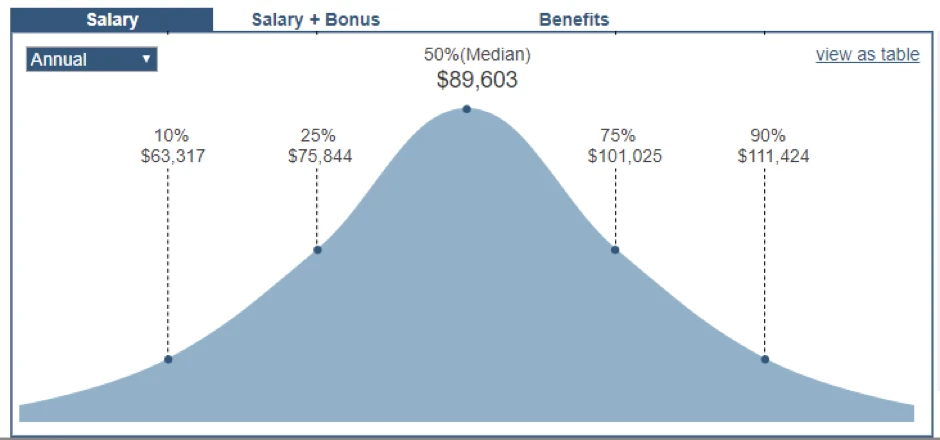
Source: https://www1.salary.com/Java-Developer-salaries.html
Demand for Java Developers in 2018
Forbes notes their 13 top tech skills for 2018. ‘Mobile application developers will continue to be in high demand, just as they have been the past few years,’ states the piece. In addition, this demand is likely to rise in 2018. Competent app developers will need to know multiple programming languages, including Java, HTML5, Objective-C, C++, C#, Python and Swift.
CodingDojo, which analysed job postings data from the job website Indeed.com, substantiates these findings by noting that job postings in 2018 are still highest for Java. Even though Java decreased in popularity by about 6000 job postings between 2017 and 2018, the language is still ‘extremely well-established’, they stated.
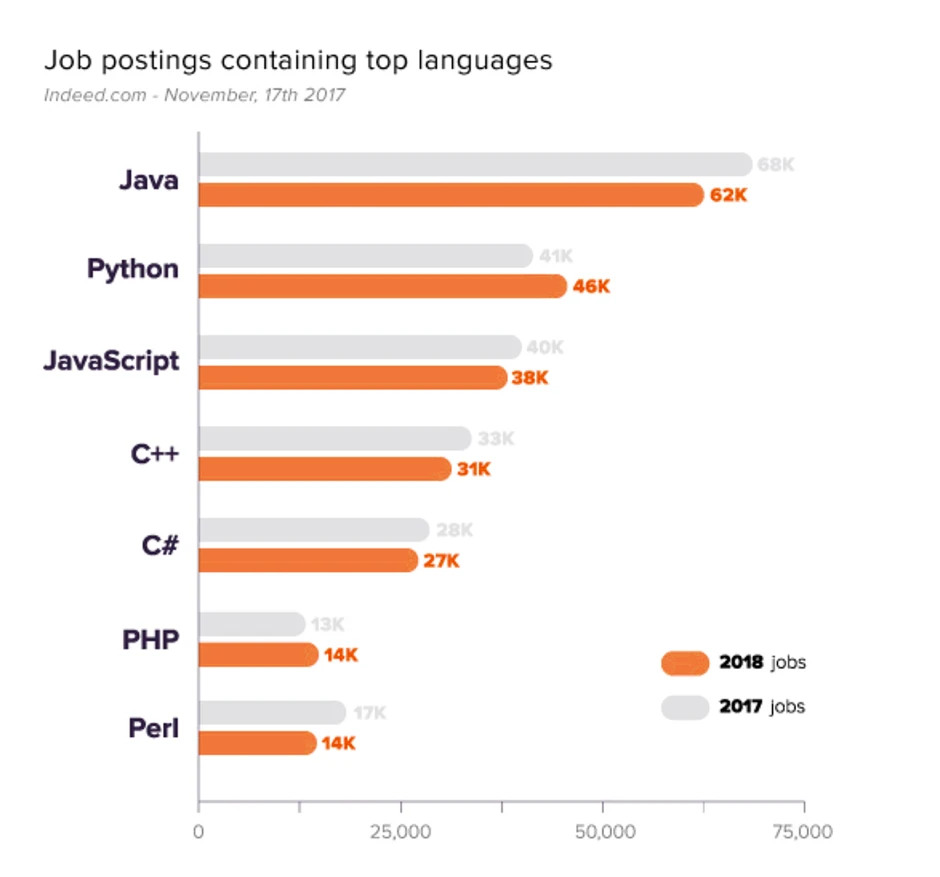
Source: http://www.codingdojo.com/blog/7-most-in-demand-programming-languages-of-2018/
In conclusion, in 2018, Java should continue to enjoy its prominence as far as popularity, developer demand and high salaries are concerned. However, other programming languages are nipping at its heels. Consider, for example, Python which has a solid claim to being the fastest-growing language in high-income countries like the US, UK, Germany and Canada, according to this Stack Overflow blog post. Nevertheless, if career growth is your aspiration for 2018, Java is an excellent programming language to learn. If you’re keen to learn Java, consider doing either a Software Engineering bootcamp or a Mobile Developer Bootcamp, both offer Java. Read more about key differences between Mobile Development and Software Engineering.

Tutorials
Setting up a GPU for Accelerated Cloud Computing
In this tutorial, we will be looking into setting up a GPU for cloud computing – what it is, why we might want to use it, and how to set it up.This tutorial is based on using Amazon Web Services.
Introduction
In this tutorial we will be looking into accelerated cloud computing – what it is, why we might want to use it, and how to set it up. All code for this tutorial is provided, but we will assume some familiarity with basic shell commands.
Cloud computing in general refers to using compute power, storage, applications and/or resources through a remote platform, which you can access on-demand and scale to your personal requirements. Using cloud computing service providers means we don’t need to deal with this kind of infrastructure or maintenance ourselves, and can instead focus on how to best utilise the extra compute capacity for our needs. There are certain tasks where accelerated computing, using GPUs rather than CPUs, is a more efficient approach in terms of time and cost. This is often the case with tasks that are massively parallel, meaning the work can be distributed in parts to execute simultaneously. We will be setting up our GPU for one example of such a task: deep learning.
There are a number of different cloud service providers, including Microsoft, Google, Oracle, and IBM. We will be using the market-leader, Amazon, to set up our GPU with Amazon Web Services (AWS).
Account Setup
To sign up for an account with AWS, we need to head to this link and fill in all our details. We will then arrive at the AWS Console – the dashboard showing all available services and tools.
Before we can get going with our GPU setup, we first need to request a service limit increase. AWS accounts are initialised with a limit of 0 instances for certain configurations, and one of those is the p2.xlarge instance which we require. So, from the main dashboard click on EC2 instances and then limits:
On this page you need to scroll down until you reach the ‘Running On-Demand p2.xlarge instances’ row of the table. Here you should click ‘Request limit increase’.
If you do not see p2.xlarge as an option – don’t worry. There are many different server farms used by Amazon all around the globe, and not all of them support GPUs. You have to select a region to associate your account with, which is usually the closest one to your personal location. The list below states which regions currently support GPU instances, so change your region settings (at the top right of the screen, next to your account name) to one of the below locations. Selecting the closest one to your actual location will reduce latency.
- US East (Ohio)
- US East (N. Virginia)
- US West (Oregon)
- Asia Pacific (Seoul)
- Asia Pacific (Sydney)
- Asia Pacific (Tokyo)
- Asia Pacific (Singapore)
- Asia Pacific (Mumbai)
- China (Beijing)
- Europe (Ireland)
- Europe (Frankfurt)
Once we have clicked ‘Request Limit Increase’ for the p2.xlarge instance, we can fill out the form details as follows:
Any reasonable example can be entered for the use-case, such as ‘deep learning’. Once submitted, the response time for our request can vary, but we will receive an email update once it has been accepted.
Security Keys
We also need to configure some security settings for our account, so head back to the main dashboard by clicking on the AWS logo at the top left.
From the main dashboard, scroll down to the subsection titled ‘Security, Identity, & Compliance’ and in this column click on ‘IAM’ which stands for ‘Identity and Access Management’. Then on the left hand side click on ‘Users’, and then the blue ‘Add User’ button.
Here we create a username for ourselves, and select to give both programmatic access and AWS management console access to this user. We can choose the password details depending on personal preference.
To set the permissions for this user, we want to attach existing policies directly. Here we select ‘Administrator Access’ which should be the first row of the table, and continue to the final review stage.
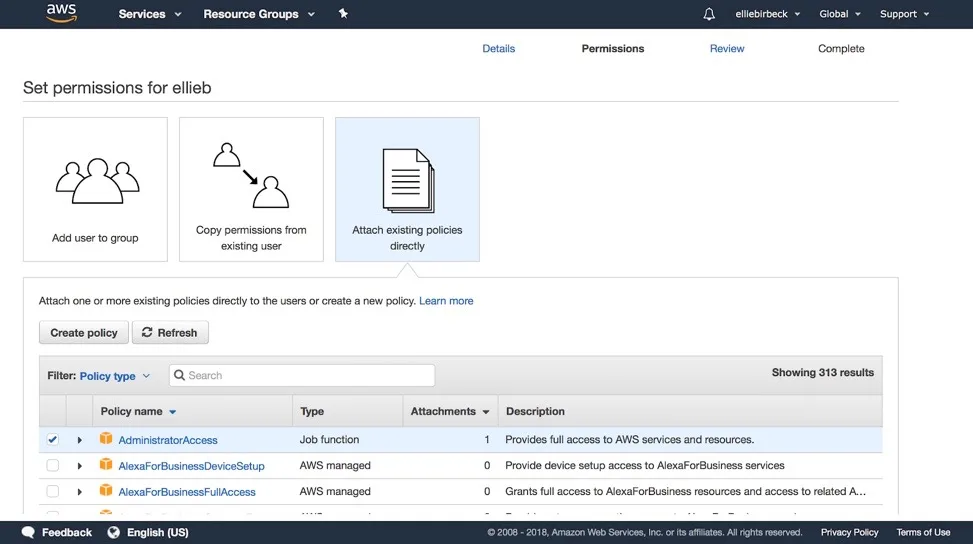
After confirming the details, our administrator user is now created. Two key pieces of information will be displayed at this stage: the Access Key ID and the Secret Access Key. You should save both of these for later steps in our setup.
Command Line Interface
So far, we have been exploring what is known as the AWS Console – the web-based user interface displayed as a dashboard. We can also access AWS through their Command Line Interface (CLI). The AWS CLI is Python-based, so it can be installed using the package manager pip. Let’s open up our terminal to check whether pip is installed (and if not, install it here), and then execute the following command:
Next we need to configure the CLI with the correct settings for our account:
The CLI will ask us for our Access Key ID (which you should have noted down earlier), along with the region name, and output format. For region name, choose the one corresponding to your selected region earlier (ours is ‘eu-west-1a’ for Ireland), and for output format use ‘text’.
Our CLI is now configured to the correct user settings.
The amount of tools and services available through AWS is vast, so naturally the CLI has many possible commands. A full reference point for navigating your way around is available here, but we will be mostly using the Console for our setup.
Elastic Compute Cloud
The main AWS product that we will be using in this tutorial is known as the Elastic Compute Cloud (or EC2). EC2 is a service that allows us to configure and use virtual servers in the cloud, extending our compute capacity beyond our own personal machines.
Each instance we choose to set up can be configured in a number of different ways, and there is also the option to use Amazon Machine Images (AMIs) to speed this process up. AMIs are pre-configured setups with popular libraries, frameworks, drivers, and other options included for us.
To set up our first instance, head to the EC2 dashboard and click the large blue ‘Launch instance’ button. This takes us to the first stage of setting up our instance – selecting the AMI. Here you could choose to set up with your own AMI using the ‘My AMIs’ option on the left hand side, but we will be using one of the Deep Learning AMIs which are pre-configured with everything we need.
We want to select ‘Deep Learning AMI (Ubuntu)’:

As stated, this comes with some useful frameworks such as Keras and TensorFlow. Other settings for this configuration include EBS (Elastic Block Storage), which provides persistent storage for our instance, and HVM (Hardware Virtual Machine) virtualization which is fully virtualized rather than the lighter PV (Paravirtual). Other options such as Microsoft or Linux over Ubuntu are available if you would prefer.
At the next stage we will select the p2.xlarge instance:
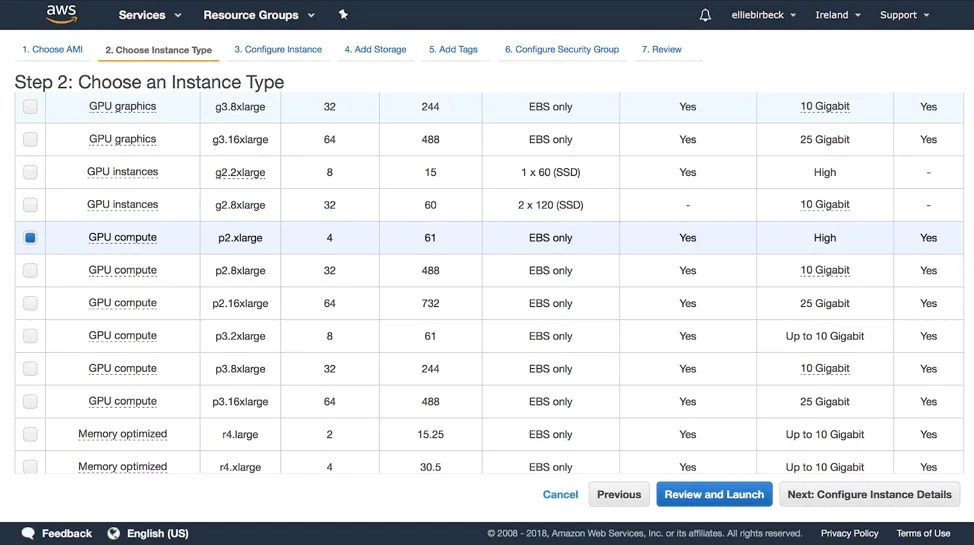
And then we are ready to ‘Review and Launch’.
SSH Key Pair
Once you have clicked the button to launch your instance, you should get a popup window prompting you to assign a key pair to the instance. This is referring to a public key stored with AWS and a private key stored on your personal machine, which we will now create. The key pair is used as a security measure, to authorise access to the instance.
Select ‘Create a new key pair’, and name it anything you like, such as ‘GPU-key’. Download the key and ensure it is saved with the file extension ‘.pem’.
Now we can go to the EC2 dashboard and view our instances by selecting ‘Running Instances’. Make a note of the Instance ID and Public DNS name displayed here. Initially the instance state will be displayed as ‘pending’, and after a short while it will update to ‘running’. Our instance is now ready to use!
Using Instance
Now let’s go to our back to our terminal and use the CLI to navigate to the directory where our private key is stored. For security, we will first make sure that the file permissions on our private key are actually private:
And now we are ready to SSH into our running GPU instance:
Make sure the .pem file for our key is the correct filename, and that the user_name@public_dns_name uses your own details. The username section will be ‘ubuntu’ if you followed our exact configuration and selected the Ubuntu AMI, but other options include ‘ec2-user’ for Linux, RHEL, and Fedora, or ‘centos’ for CentOS. The DNS name is what you should have noted earlier from the instance page.
Once executed, we should get an authenticity warning to which we can respond ‘yes’.
The terminal should now display a welcome entry:
If you see:
Then use:
…to restart the system, and then SSH back in again.
Deep Learning
Now lets see how we can perform some tasks that would actually require the compute power of a GPU, such as deep learning. Here we will activate the specific environment we want to use, which for this example use case is the last option with Python 3.
We want to be able to run some code with a Jupyter notebook, so we first need to open a port for this on our instance’s firewall. From the EC2 dashboard scroll down to the ‘Network & Security’ section and click on ‘Security Groups’:
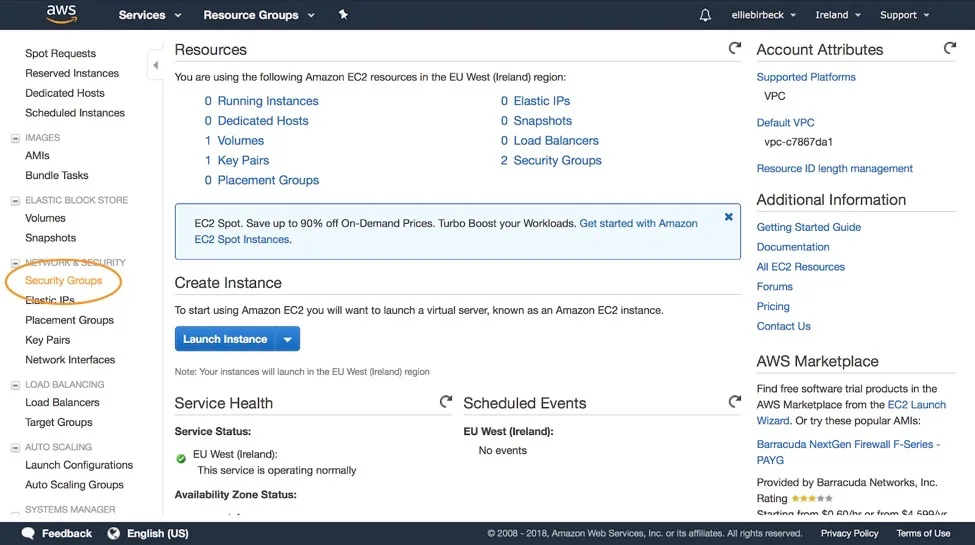
From the list of security groups, select the one with name ‘launch-wizard-1’, then click on the ‘Inbound’ tab, and the ‘Edit’ button:
Here we want to add a new rule with the following specifications:
Next we will be configuring our Jupyter server by updating the config file and creating a Secure Sockets Layer (SSL) to establish an encrypted link between our server and the browser we will use to access the notebook.
Back in the terminal, execute the following commands (making sure we are still SSHed into the running instance):
This generates an RSA private key and saves it to ‘cert.key’. Next we can create a password for logging into our Jupyter notebook server from the browser:
We will be presented with a hash of our password similar to this:
Save this hash, and exit the iPython terminal (with the command ‘exit’).
Then open the config file and add the following to the end of the file:
We are finally almost ready to start using our notebook. In the current terminal, lets get our notebook up and running:
And then in a separate terminal, we need to use the following command to forward all requests on a local port (8080, or any local unused port of our choice) to the port of our GPU instance (8888):
Now if we open up a browser and head to http://127.0.0.1:8080 we will see the Jupyter login page where we can use the password created earlier to securely gain access.
Once logged in, we are now ready to run some example code using the Jupyter notebook! If you are new to deep learning you can find some examples of projects to step through by clicking on the tutorials link, or you may have some of your own personal code that you would like to run on the GPU. But please note, doing anything time-consuming here will begin to charge your account. The fees are $0.90 per hour (pro-rata) for the exact configuration we used in this tutorial, but larger instances will cost more.
Here’s an example of the Hello TensorFlow tutorial available:
Analysing GPU performance
Once the GPU is put to use and some code is running, we can check up on its performance – determine which programs are executing, how much memory is being used etc. We will use the NVIDIA System Management Interface to take a look at these statistics.
In the CLI, run:
We are presented with an interface similar to the one below, which provides details such as whether the nvidia driver is running successfully, what processes are using the GPU, how much memory is being used, and the fan temperature, etc.
Increasing Compute Power
When more compute power is required, there are two approaches to consider. The first is referred to as ‘scaling up’ and involves upgrading to a larger, more powerful instance (the largest AWS currently offers is p2.16xlarge with 16 GPUs). The alternative approach of ‘scaling out’ involves creating a cluster of instances and distributing the workload among them. There are different advantages and disadvantages to each method. For example, 8 p2.xlarge instances and 1 p2.8xlarge instance provide the same compute power. With 8 instances running, the likelihood of an instance failing is higher than with 1 instance, however the impact of 1 failure out of 8 is much less than the impact of our 1 and only instance failing.
We will not step through the process of adding further instances or increasing our current instance in this tutorial, but doing so is as simple as repeating the steps taken so far. If you want to scale up, just select a more powerful instance, such as p2.8xlarge, when you are configuring the new instance. To scale out, just repeat our exact steps multiple times, creating new instances of the same configuration. In both cases, you will first need to request a further service limit increase.
Cloud Storage
AWS has a huge span of tools and services, but one other worth mentioning in relation to GPU usage is their storage service. Often if we are executing compute-heavy tasks such as deep learning, we may be reading to and writing from large stores of data. Our running instance already has some amount of storage (our configuration has 50GiB), but this lives and dies with the instance. We can copy files to and from our instance using two commands.
To transfer a file to our instance:
And back in the other direction, from the instance to our machine:
But for a more persistent method, we can store data separately in the cloud, using Amazon’s Simple Storage Service (also known as S3). This storage system refers to uploaded objects as ‘buckets’. Here we can save an example csv file as a bucket called ‘mybucket’.
Storing our data separately from the instance means it is accessible from multiple instances (and other sources), and is still accessible when the instance is not running.
Shutting down
The final step (and perhaps the most important step) for this post is to shut down your instance. As the GPU instances incur hourly charges, we don’t want to accidentally leave one running overnight! You can set up billing alerts here if you are worried you might forget.
To shut down an instance head to the EC2 instances dashboard, select the instance, and then Actions > Instance State > Stop.
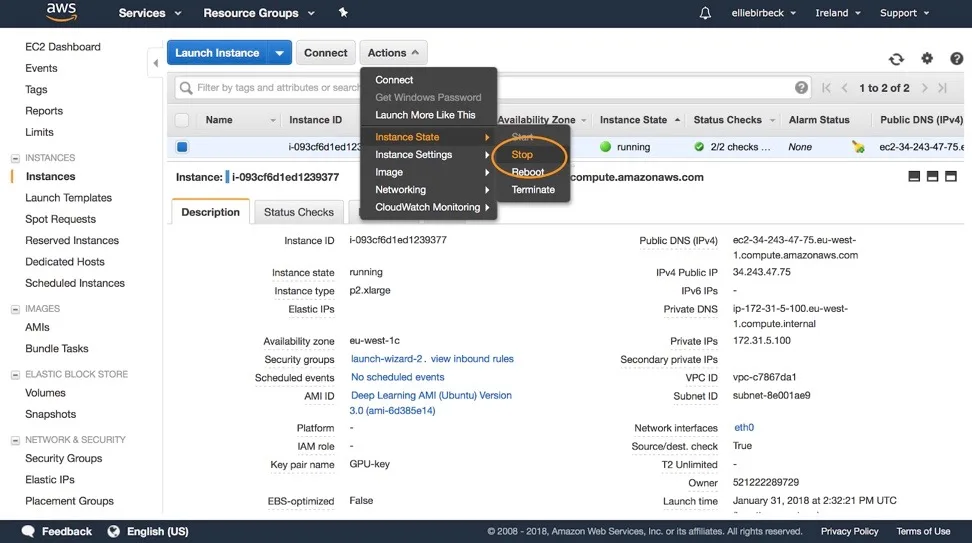
Conclusion
We have now successfully set up, launched, and shut down an instance of a GPU in the cloud, and can easily restart our configured instance any time we would like to access the accelerated compute power or resources it provides.
Deep learning is just one example of a task which may require such power, but many other compute-heavy tasks such as graphics rendering, or bitcoin mining, can be executed much more efficiently with this approach.
If you are interested in using the AWS cloud computing services for smaller-scale tasks that do not require a GPU, it is worth mentioning that other instances can be configured for free, using CPUs and with less memory and processing power.

Career Advice
Is Paying for a Coding Bootcamp Worth It?
Is paying for a coding bootcamp worth it? Here are some benefits of studying programming part-time and online. Issues discussed include time, flexibility, placement rates, daily mentorship and affordability.
If you’re interested in attending a coding bootcamp to become a developer but you can’t manage full-time, should you consider a part-time online bootcamp instead? Probably. Here are some benefits of studying programming online and part-time.
1. Time
Time, as they say, is money: the sooner you get up and running, the quicker you start earning a developer salary. A degree, on average, takes three years. However, you can potentially complete a part-time online bootcamp within six months.
In the US, according to Indeed, web developers can expect to make an average annual salary of $78,631 (this estimate is based on 53,019 anonymously-submitted salaries to the site). Studying for two-and-a-half extra years will result in a loss of $196,577, and that’s without taking into account the effect of salary increases! You want to get up and running with your new skills as soon as possible.
2. Flexibility
One of the biggest benefits of online learning relates to flexibility. You get to fit in your work around your other obligations. This means that you can carry on working and earning money while studying. You can schedule your studying and calls with your personal mentor for evenings or weekends. It’s a really big advantage to maintain your monthly income while enhancing or changing your career. It also means your risk is much lower and once you’ve gained the skills, you can start applying for other jobs while still being employed.
Flexibility holds a major appeal for non-traditional students. According to a report from the American Council on Education, which was quoted in Ed Tech magazine, non-traditional students tend to be older than 25, working full-time and, financially independent, with some of them likely to be parents. In essence, they are early- to mid-career adults seeking career growth or change – and they are the ones who value flexibility the most.
3. Affordability
When it comes to cost, there is obviously a wide range. A face-to-face bootcamp in the US costs in the region of $9,000 to $21,000, with an average of $11,451. For a 4-year computer science degree, the average cost is $157,760. You can enroll at an online coding bootcamp for as little as $3000. Of course a self-guided or Massive Open Online Course (MOOC) is likely to be cheaper, but the depth of content is probably not sufficient for a career change. However, if you’re keen to develop a targeted new skill (and not necessarily a career change), for example honing your Excel skills, a MOOC might be the way to go.
Despite the cost of an online course, you are likely to reap the rewards. After surveying reports from 73 qualifying coding schools, Course Report found that 80% of graduates were employed in a job that utilised the technical skills they learnt in a bootcamp. The average salary increase was 50,5%, which equated to $23,724 extra per annum. The average post-bootcamp salary was $70,698.
4. Daily Support or Mentorship
One of the key advantages of online bootcamps, and what sets it apart from face-to-face instruction, is the ability to support the learning via mentors. ‘Mentorship,’ says Chris Myers, a start-up founder and CEO of a financial management solutions company, ‘is the best path to career success, hands down.’
Coding mentors are particularly helpful, because they:
- Teach coding best practice – a mentor helps you avoid common stumbling blocks and learn best industry practices.
- Constructive feedback – mentor feedback should be specific, timely, understanding and positive.The faster you receive feedback on your code submissions, the better.
- Individual attention – Mentorship is 1:1 personalised feedback. This is very different from massive lectures or classes, where one can quickly lose track of what the lecturer is saying.
5. Placement Rates
Coding bootcamps, and this includes online and face-to-face programs, are viable options for filling the tech shortage. A 2017 survey, conducted by Indeed, found that 72% of employers think graduates from bootcamps are ‘just as prepared’ as degree holders to be high performers. In fact, 12% of employers think bootcamp graduates are more prepared and more likely to be high performers than those with computer science degrees.
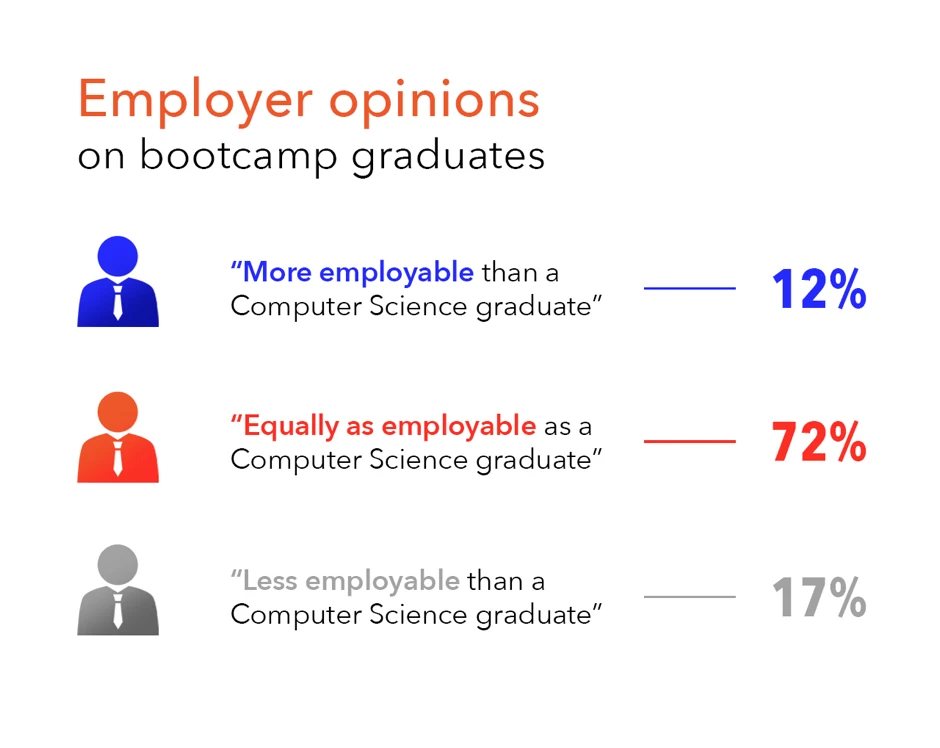
Source: http://blog.indeed.com/2017/05/02/what-employers-think-about-coding-bootcamp/
Check out HyperionDev Success stories to see how students have been placed after completing a coding bootcamp.
It’s clear that the advantages of a part time online bootcamp – including compactness, affordability, flexibility, mentorship and high placement rates – are truly powerful. Almost everyone finds some of those benefits especially attractive. Which of them are most appealing to you?

Student Success Stories
HyperionDev Grad of the Week: Lawrence Mardon
Student success stories - read about HyperionDev graduate of the week Lawrence Mardon. He went from being a Mechanical Engineer to becoming a Software Engineer.
After completing his university degree, Lawrence wanted to move past mechanical engineering and towards learning how to write better software to solve real-world problems. He says, “HyperionDev, with their excellent guidance and structure, resulted in my learning, in a few months, what would have taken more than a year on my own.” He is now a Software Engineer at Andile Solutions.
Tell us about yourself and your current occupation.
Hi there, my name is Lawrence Mardon. I’m 24 and I live in Centurion, Pretoria. During the course of my Software Engineering bootcamp with HyperionDev, I was the Co-Founder and Director of LJ Maintenance Masters, a renovation and maintenance company. At the moment, I am a software engineer at Andile Solutions.
Why did you decide on this course?
During my final year of mechanical engineering, I had to write an algorithm in Python, which could detect bearing faults using sound signal analysis of sound waves. Complicated stuff! After being exposed to coding for the first time, my passion and interest in Software Engineering developed rapidly.
I enrolled on a course at HyperionDev to learn how to write better software. I also wanted to understand what software engineering entails. I can definitely see myself moving beyond pure mechanical engineering toward solving real-world problems using innovative and creative software engineering solutions.
Has the course helped you achieve your new career goals and objectives?
Absolutely. Software Engineering can be overwhelming with the different frameworks, libraries, technologies, jargon, etc. Even though I was exposed to programming during my studies, I still found it a formidable field. However, HyperionDev, with their excellent guidance and structure, resulted in my learning, in a few months, what would have taken more than a year on my own.
I now feel totally ready and confident to enter the Software Engineering field. HyperionDev’s career guidance also helped me a lot with finding a job.
Tell us about your experience of the 1:1 mentorship.
Studying Software Engineering long-distance can be very lonely, but it helps to know that when you’re really stuck with a problem someone will help you.
What parts of the course did you enjoy the most?
I loved the machine learning part of the course. I’ve always enjoyed working with data, so learning new data processing tools and writing my own k-means algorithm was really fun. The K-means algorithm is one of the last tasks on the Data Science section of the bootcamp. It’s pretty technical, but it’s an algorithm commonly used for cluster analysis in data mining.
What advice would you give to people wanting to shift careers to become developers?
Read the following book while doing the HyperonDev Software Engineering course:
How to Become an Expert Software Engineer (and Get Any Job You Want): A Programmer’s Guide to the Secret Art of Free and Open Source Software Development by Marcus Tomlinson.
Find out more about HyperionDev’s Software Engineering course and start your free trial today.
Career Advice
Stack Overflow Developer Survey 2018: Key Findings
Stack Overflow Developer Survey 2018 - find out the key findings from 2018's Stack Overflow Developer Survey. Find out about the top languages, how developers feel about their jobs, and much more.
This year’s 2018 Stack Overflow Developer Survey analysed responses from 101,592 developers from 183 countries around the world. It’s the 8th year of the survey and the largest pool of respondents ever. In this post, we explore the 5 key findings and some interesting stats that arose from the survey, such as common education paths and developers’ favorite and least favorite technologies.
5 Key Findings
Here are the five takeaway findings from this year’s survey.
- Developers working in the fields of DevOps and Machine Learning get paid the highest salaries. Opportunities in the languages and frameworks of these two fields are on the rise.
- 87% of developers are at least, in part, self-taught. Most have taught themselves a new language, framework, or tool outside of any formal education. Online education is more common (48,6%) than full-time face-to-face learning (10,5%).
- There is optimism about the possibilities offered by artificial intelligence (AI), but a lack of agreement about the dangers.
- Python is becoming increasingly popular as a programming language: it has overtaken C# this year.
- There are gender differences when it comes to assessing prospective jobs. For women, the most important thing is company culture and professional development opportunities. Men, however, look at compensation, and the particular technologies that form part of the job.
Profile of Respondents
Geographically, the respondents come from all over the world: the largest contingent are in the US (20,65%), followed by India (13,95%). However, many countries are represented including Germany (6,57%), the UK (6,32%), and France (2,61%).
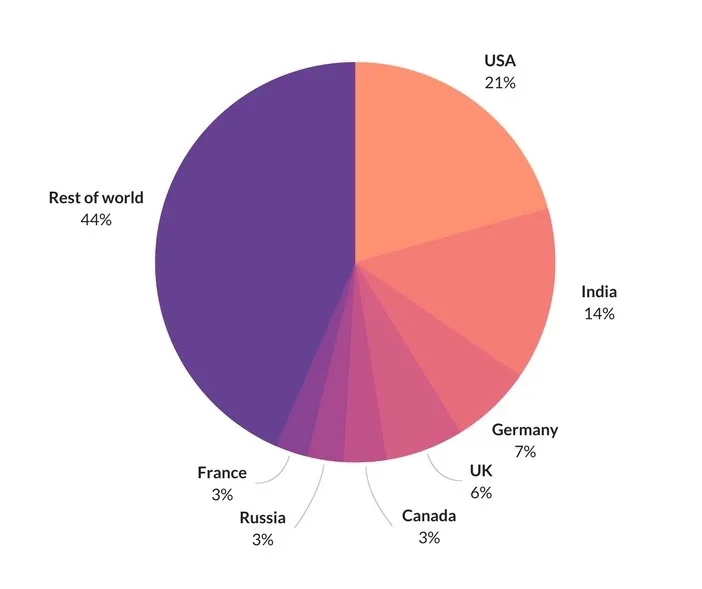
As far as potential jobs go, approximately 60% of respondents are back-end developers and about 48% work as full-stack developers, but a wide variety of jobs are represented including mobile developers, database administrators, games or graphics developers, DevOps specialists, etc.
Experience levels varied between respondents. However, a full third learnt to code only within the last five years. More than 50% have five years or less of professional programming experience.
Education
Only 46% of respondents have a Bachelor’s degree, and it is fairly common to find accomplished programmers who haven’t completed a formal degree.
The one thing that is consistent among developers is that they tend to be lifelong learners. Outside of any formal education, 87% of them have taught themselves a new language, framework or tool. As far as online courses go, 48,6% have completed such a course. Approximately 25% have taken part in a hackathon, a day-long coding competition where computer programmers come together to code, design, and build something, whether it’s a website or a mobile app.
Lifelong learners
Developers are lifelong learners; almost 87% of all developers say they have taught themselves a new language, framework, or tool outside of their formal education. Among professional developers, almost half say they have taken an online course like a MOOC, and about a quarter have participated in a hackathon.
Here’s a graph showing how professional programmers have educated themselves:
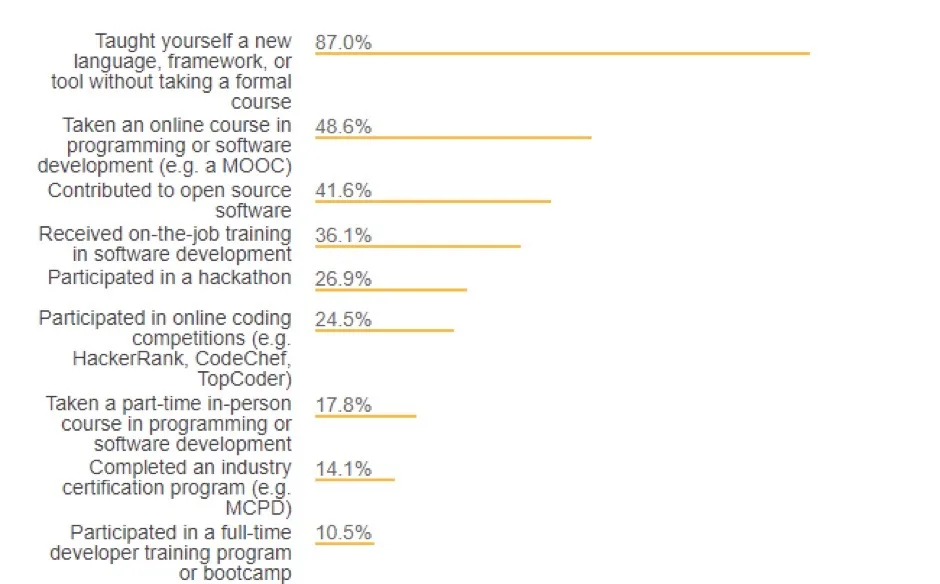
Source: https://insights.stackoverflow.com/survey/2018#developer-profile-other-types-of-education
Bootcamps
Interestingly, if one compares online courses with bootcamps, which tend to take place in a specific location face-to face, it seems online education is more common – 48,6% have taken up online courses versus 10,5% for full-time physical developer training bootcamps.
Although bootcamps are seen as a way for people new to the industry to gain entry in a short period of time, they are also very appealing for those already in the industry: almost 50% of those surveyed who attended a coding bootcamp already had jobs as developers. Their reasons for enrolling on a bootcamp included the desire to learn new areas of technology and to update their current skills. About 82% of respondents who attended a bootcamp found work within six months of finishing their course.
Here’s a graph showing how long it took programmers to find a job after attending a bootcamp:
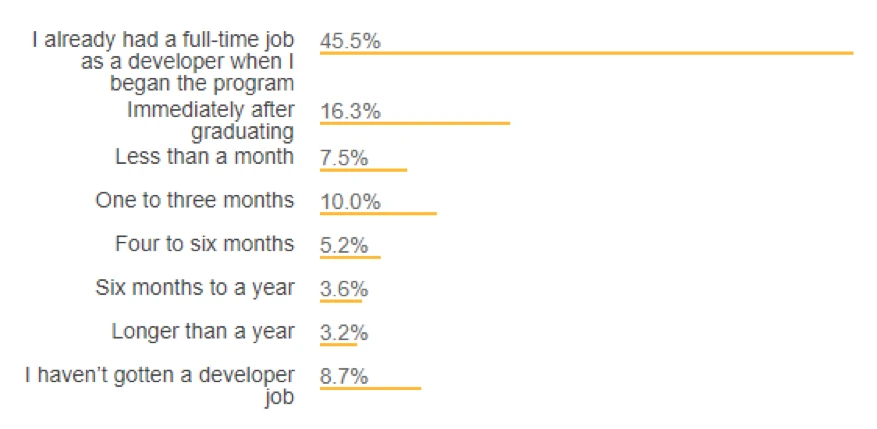
Technology
It’s always fascinating to see which technologies are most in-demand and which are dreaded. JavaScript is the programming language that is most commonly used. This has remained unchanged for six years in a row! Second up is HTML, followed by CSS.
Python is on the up: last year it overtook PHP and this year it has surpassed C#. Python, says David Robinson on the Stack Overflow blog, has ‘a solid claim to being the fastest-growing major programming language.’ The top three programming languages, plus Python, form part of HyperionDev’s Full Stack Web Developer course.
Here’s a graph of the most popular programming, scripting and markup languages:
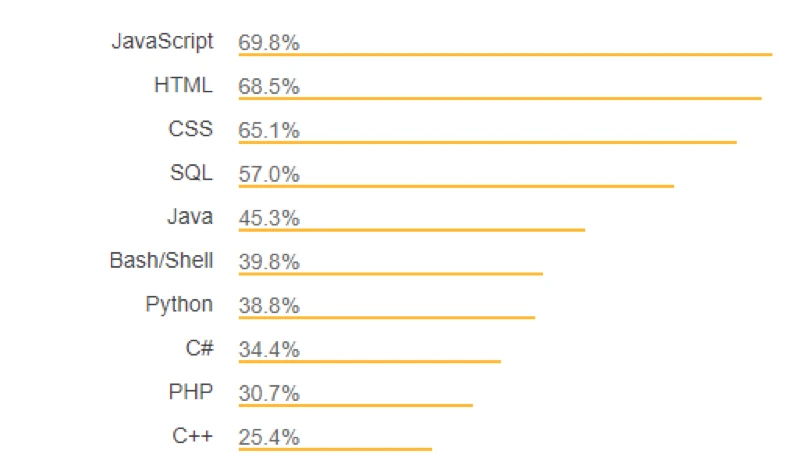
Source: https://insights.stackoverflow.com/survey/2018#technology-programming-scripting-and-markup-languages
When it comes to frameworks, libraries and tools, the technologies used most frequently are Node.js and Angular JS, while React and .Net Core remain integral to developers. Unsurprisingly, MySQL and SQL Server, same as last year, maintain their top spots for most commonly used databases.
Most Loved, Dreaded and Wanted
What does love mean for a developer? It means that he or she wants to continue working with a particular language. The most loved programming language for 2018 is Rust, an open-source, low-level language, ideally suited for systems, which runs blazingly fast. Kotlin is the second most loved language and Python comes in at third.
The most dreaded languages are those that developers have no interest in carrying on using, even if they are currently working with them. Visual Basic 6 tops the list – for the third year in a row! Cobol and CoffeeScript come second and third respectively.
When it comes to languages that are wanted – i.e. developers are not yet using that language, but they are very keen to learn it – Python cames in at #1 for the second year in a row. This is followed by JavaScript: 19% of all respondents want to learn this language.
The Top Five: Love, Dreaded, Wanted
Five Top Loved Languages
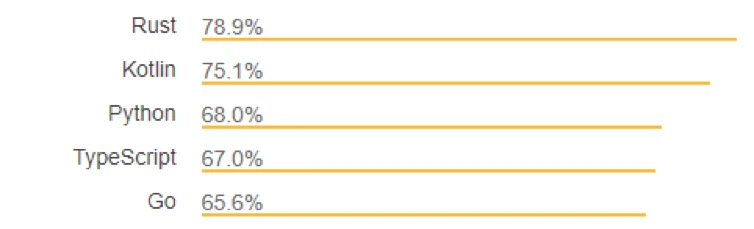
Five Top Dreaded Languages
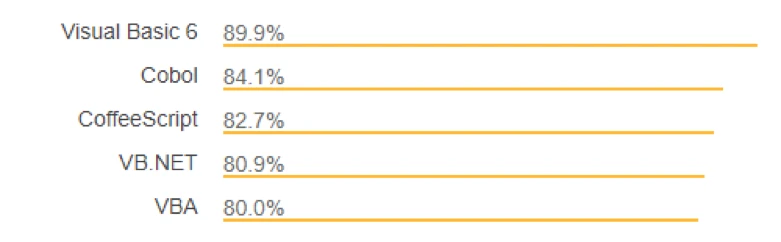
Five Top Wanted Languages
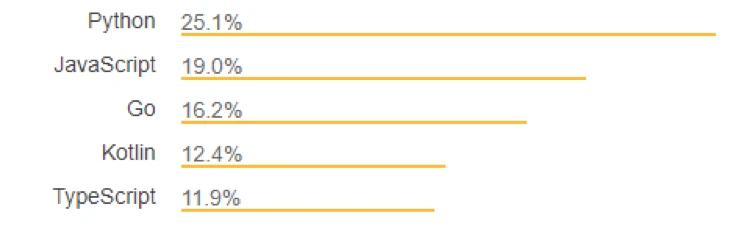
Source: https://insights.stackoverflow.com/survey/2018#technology-most-loved-dreaded-and-wanted-languages
Top-Paying Technologies
Which languages are associated with the highest salaries? Globally, F#, Ocami, Clojure and Groovy have median salaries above $70 000 USD, and are the highest. The F# Software Foundation can tell you more about this computer language.
However, in the US the top-paying salaries are for developers who know Erlang ($115 000 per annum) and Scala ($115 000 per annum). Among more common programming languages, the top US earners are developers conversant in Java ($100 000 per annum), C ($98 000 per annum), JavaScript ($98 000 per annum) and Python ($98 000 per annum).
The average salary in the US, for non-programmers, is much lower – almost half of what developers make on average! For those between the ages of 20 and 24, the average salary per annum is $27 456. Older people fare slightly better: between the ages of 25 and 34, you can expect an average salary of $39 416 and those between 35 and 44 earn, on average, $49 400. The best annual salary, $50 024, is earned by 45 to 54 year-olds.
How Do Developers Feel About the Future of AI
Developers were asked what they found dangerous and exciting about the future of AI. When it came to danger, there wasn’t much consensus. Each of the following factors were considered equivalently dangerous: algorithms making important decisions, AI moving ahead of human intelligence, evolving decisions of ‘fairness’ when it came to algorithmic versus human decisions, and increasing automation of jobs. As far as excitement went, 40,8% of developers noted the increasing automation of jobs.
Although most developers could identify dangerous aspects when thinking about the future of AI, there was still a general degree of optimism about what AI offers the world, with almost three quarters of developers stating that they were more excited than worried.
Employment
When it come number of developers employed, the stats look very positive: over 90% of developers are, at least part-time, employed.

Source: https://insights.stackoverflow.com/survey/2018#work-employment-status
Company Type and Size
Developers are employed in a very wide range of industries. However, most developers, approximately 38%, work in web development, information technology or SaaS (Software as a service, including software development. Other industries include: financial technology (8,7%), cloud based solutions (7,1%), data and analytics (5,7%), consulting (5,3%), etc.
Interestingly, developers working in certain industries, such as consulting and healthcare, tend to have more years of coding experience. Compared with web development or eCommerce, developers in the consulting and healthcare industries are twice as likely to have more than 20 years experience.
Although companies vary in size, US developers tend to work in larger companies than elsewhere in the world. Also, more experienced developers are more likely to work in larger companies.
Here’s a graph showing the percentage of developers in different-sized companies:
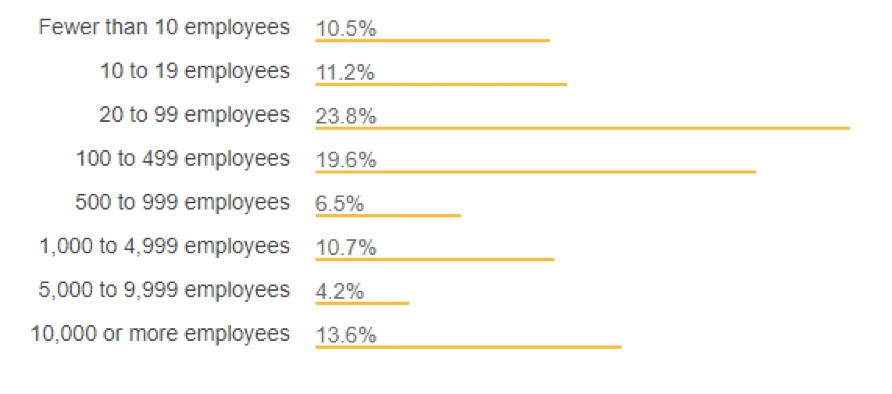
Source: https://insights.stackoverflow.com/survey/2018#work-company-size
The Five-Year Plan
If programmers are asked where they would like to be in five years time, just more than 50% are keen to remain in their current role, or, alternatively, another technical role. About 25% want to start their own company, but this sentiment is more likely to be expressed by developers younger than 25. Only 2,8% would like to work in a field completely unrelated to software development.
How Do Developers Feel About Their Jobs?
Some interesting results emerge here. These are the trends:
- Developers experience greater satisfaction with their career than their current job.
- Job satisfaction is significantly lower in financial services and IT.
- The highest career satisfaction is experienced by older developers, aged 50 or higher, and those with 20-30 years experience.
- Job satisfaction, on the other hand, peaks for developers between 35 and 44 years of age.
Last Job Change

As you can see, frequent job changes are the norm for software developers.
Assessing Potential Jobs
When assessing potential jobs, 28,3% of developers focus on the compensation and benefits offered. The languages, frameworks and other technologies involved in the work are also strongly considered, as well as opportunities for professional development. Low priority consideration include the diversity of the organisation and the financial performance or funding status of the company.
Salary by Developer Type
As far as salaries go, Engineering managers, at $137 000 per annum, earn the highest in the US. Coming close on their heels are DevOps specialists, who earn $110 000 per annum and back-end developers at $102 000 per year. Back-end developers draw with data scientists or machine learning specialists.
Here’s a graph showing the different salaries for various types of developers:
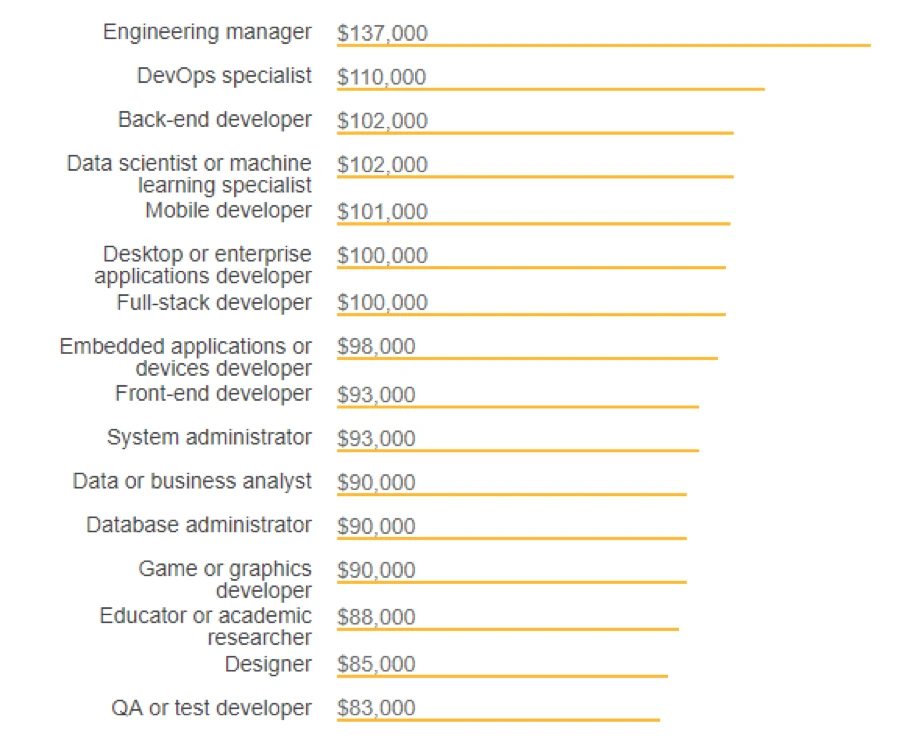
Source: https://insights.stackoverflow.com/survey/2018#work-salary-by-developer-type
In conclusion, the Stack Overflow Developer Survey 2018 reveals many interesting findings. Perhaps of greatest relevance to developers and those wanting to enter this field is that learning never stops. Developers are lifelong learners. Also worth noting is that developers are, by and large, satisfied in their chosen field. It’s clear that developers are in an exciting career that offers a great deal of change and stimulation.

Career Advice
Earning Money While Learning Full Stack Web Development
Earning money from web development - start earning money from web development while studying part-time for a Full Stack Web Development bootcamp,
The great thing about a part-time online programming course is that you can start earning money from web development almost from the word GO. Let’s say you’ve signed up for a Full Stack Web Development bootcamp, now’s the time to earn some spare cash on the side.
Here are some strategies to keep in mind:
1. Don’t work for free
Of course you’re keen to get some work under your belt and perhaps you’ve been offered exposure or a byline. Don’t do it! There are a number of problems when it comes to working for free. For example, you may not get honest feedback when it comes to your work. People are likely to feel bad about criticising work they received as a favour. But worse, freebies are not always valued.
Says multi-million dollar business owner Ramit Sethi on Business Insider, who is also the author of the book, Your Move: The Underdog’s Guide to Building Your Business, ‘Understand that people value what they pay for. You’re not doing them a disservice by charging them.’
2. Set up a portfolio as soon as possible
In this case, your website will be your portfolio. Here’s your chance to show off your expanding web development skills.
Creative Bloq offers these tips for setting up a killer website portfolio:
- Make sure your site is original. Don’t copy anyone else’s.
- Ensure there is space on the homepage telling people how to get hold of you. Include a variety of ways of contacting you.
- Include something personal. You should probably have a headshot photograph as well.
- For Search Engine Optimisation (SEO), include fresh, original content. Your Google ranking will be higher as well. You may want to think about starting a blog.
- Include any examples of work you have done. Your website is essentially your portfolio for earning money from a web development career.
- Think about the kind of niche or industry you want to service. Ensure your language is appropriate for these industries – e.g. language usage can be funkier for creative-type industries, and more formal for banks or financial services.
The Hard Refresh states that a portfolio is an opportunity to include the following:
- Who you are
- What kind of work you do
- How you carry out your work
- Who you want to work with
- Where you want to go next
3. Networking
Ever seen the movie Six Degrees of Separation? Basically, you want to mine your contacts – and then your contacts’ contacts. Grab coffees, connect on LinkedIn and set up meetings. Start with family and friends, but then expand outwards, like the ripples created by a stone thrown into a still pond. Something is likely to develop, whether it’s a new business contact or even a job interview.
The thing is, people like doing business with people they know or have heard about. Use this to your advantage. Have a business card ready and don’t be afraid of the soft sales talk.
You can start handing out business cards as soon as you start studying. Remember, networking takes some time to gain traction.
4. Show, don’t tell
Sign up for GitHub, where you can host and review code, manage projects, and build software alongside millions of other developers. Add your existing code to share with prospective employers or start new projects to keep yourself relevant. GitHub accounts are free, and it’s the best place to swap ideas and code with other programmers online. You can also blog or guest blog on GitHub. Just think – guest content writer can be another achievement added to your portfolio!
To earn money from web development, you need to convince people that you are a credible developer who will get the work done. GitHub gives you another opportunity, besides your portfolio, to show what you can do.
5. Finders, keepers – losers, weepers
When it comes to networking, you may think that you should avoid the competition – i.e. other web developers, but this is a short-sighted approach to take. In fact, other developers, in the same industry as you, are likely to be excellent referrers of work. It’s possible they have too much work and would be happy to refer some of it your way. Or maybe there are certain jobs they’re not keen to take on. The point is, they are in contact with potential clients and upcoming projects, and can be vital reference points in helping you to start earning money from web development.
In addition, meet other professional at hackathons, via online groups like LinkedIn or Google+, or sites such as Digital Point.
6. References
Get testimonials. Here’s something you might not know. People obtain testimonials and references by asking for them. Don’t be shy. When you’ve finished work for someone, ask him or her to write you a quick review. Then put it up on your site. If you really want to make it easier for a potential reference writer, offer to write the review yourself. You’ll be surprised how many times people will take you up on this.
The bottom line is that you can start earning money from web development almost immediately. You don’t need to wait until you have finished studying. Employ these strategies right from the beginning and you’ll be gratified by how quickly your bank balance grows.
If you’re interested in becoming a full-stack web developer, HyperionDev offers an online, part-time six-month course. You’ll cover HTML, CSS, Javascript, Node.js, MongoDB, Express, React, Python, and Django, as well as a lot more. Download the syllabus here.

Career Advice
Web, Mobile Or Software Development: Choosing The Right Career Path
Web, mobile or software development - choosing the right career path. The technology industry is arguably the fastest growing career choice in most developing nations. Each year companies release a new phone, software, or other gadget.
Students entering technology development training often find it difficult to choose between the three fastest-growing specialties.
The technology industry is arguably the fastest growing career choice in most developing nations. Each year companies release a new phone, software, or other gadget. Developers are the experts who help us stay up-to-date and fix those pesky bugs our phone keeps reporting.
But students often have a difficult time choosing between web, mobile or software development career paths. All three offer high income rewards and are growing faster than most career paths. We’ve collected data about benefits, future outlook, and job expectations to help students choose the path best suited for their interests and abilities.
Web Development Career Path
Web development is an umbrella term for experts who create webpages and applications. These professionals are responsible for making the Internet user-friendly. They collect and create web content, plan website layout and navigation, code the actual web pages, and test/upgrade sites for optimum performance. Students should have advanced fluency in programming languages such as HTML, JavaScript and CSS, PHP, Microsoft .Net Visual Basic, and Java.
Web developers subspecialize by earning certifications in MySQL, Microsoft SQL Server, IBM, and Oracle. Companies contract or hire web developers to optimize online content for search browsers (SEO), ensure content is compatible for multiple browsers, and create user-friendly layouts.
Web Development Outlook
Web developers can expect a high growth potential in this industry. The U.S. Bureau of Labor Statistics estimates around 130,000 jobs added with a 15 percent growth over the course of the next ten years:
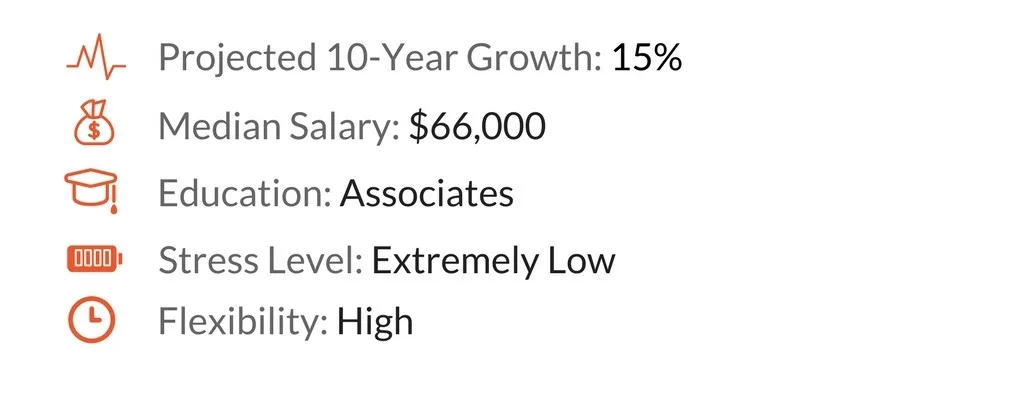
Mobile And Software Development Career Path
Experts agree that mobile developers have the best employment opportunities. Internet and software users rely on their smartphones for all communication, entertainment, education, and Internet resources. Learning to develop mobile apps and optimize online content for mobile devices is a great career tool to have.
Mobile developers are a subspecialty of system software development. They build mobile operating systems, application packages, and company-specific tools. Developers constantly update these systems to function smoothly with other third-party apps, operating systems, and core systems. Flexibility and research is the cornerstone of this industry.
As computers grow and change each year, the software that these computers are built on will also change. Companies select software developers to analyze users’ needs and create software that will help consumers optimize their digital life. Software developers test and update current software packages, recommend updates, and map the crucial interactions between hardware and other software.
One critical aspect of this career path is learning to anticipate consumer needs and understand how they will use the software. This includes identifying core functionality, user requirements, and competitor’s potential solutions.
Mobile and Software Development Outlook
Software and mobile developers are ranked together and will enjoy similar benefits. The U.S. Bureau of Labor Statistics estimates the nation will add more than 300,000 jobs over the next ten years with a 24 percent annual growth.
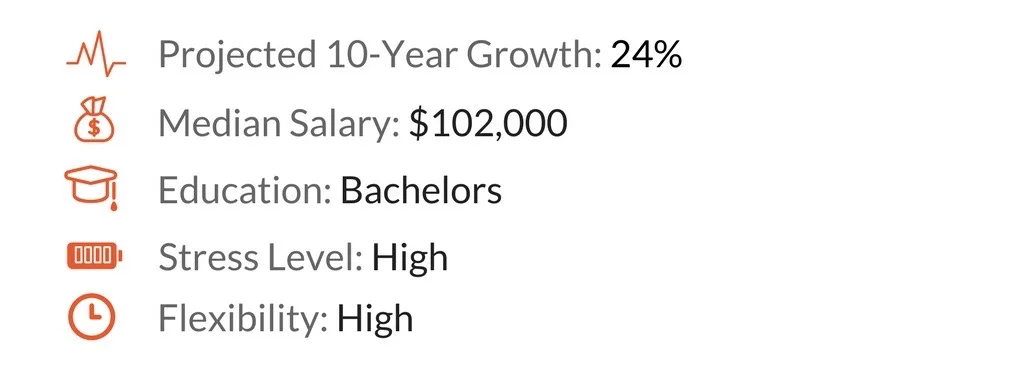
In conclusion, if you’re considering a career change, a move to study web, mobile or software development would have multiple benefits. Statistics show that jobs in these fields are in demand and, importantly, growing. In addition, each of these fields offers a variety of career options, which translates into highly stimulating and diverse job opportunities for suitable candidates.
Hyperion was founded with an ambition to scale human-led education in programming. We believe that machines can’t match humans and learning to code is best achieved by having a coding educator review your code on a day-by-day basis. We developed our technology boot camp to help students learn to code.

Student Success Stories
HyperionDev Success Story: Ismail
Student success story - Ismail Adat from IT support to Web Developer. Read about the latest HyperionDev coding bootcamp success story.
Ismail was working in IT support when he decided he wanted to take his basic tech skills to the next level. The Web Essentials course that Ismail completed gave him the confidence to be able to fulfil his current day-to-day responsibilities, fuelling his everlasting passion for technology and how it can create an impact in the world. Read more about what Ismail has to say about his HyperionDev course, his mentorship experience and what he’s up to today.
Tell us a bit about yourself and your current occupation
I’m just an ordinary player in the game of life. However, I’ve always been fascinated by technology and how powerfully it influences our lives on a daily basis. I’m keen to develop programs and solutions that benefit others. Currently, I am part of a Web Development team that offers solutions and services to clients.
Why did you decide on this course?
I wanted to learn the basics of coding. I took a Web Essentials Bootcamp, though I see HyperionDev now offers a Full Stack Web Developer course. I love learning and trying new things.
Has the course helped you achieve your new career goals and objectives?
Absolutely. The course content was very much in line with what I do now in my day job. It’s also helped me tremendously with my freelance work. Even the basic stuff helped me a lot – for example, I had to make a simple contact form using PhP for work.
Tell us about your experience of the 1:1 mentorship at HyperionDev
The mentoring relationship is very different from a lecturing situation, which is essentially passive. The lecturer communicates the information, but the student does not necessarily grasp the concepts. With a 1:1 mentorship, the mentor communicates with the student every step of the way. This means that the student’s weak areas can be bolstered and he or she can advance much quicker. I can personally vouch for the mentorship process at HyperionDev.
What part of the course did you enjoy the most?
I honestly can’t answer that question. Overall, I found the entire Bootcamp really helpful. I love being part of something where I’m learning new things.
How did you hear about HyperionDev?
I came across HyperionDev on a website while I was searching for a study programme. I needed to consider if I wanted to study part-time or full-time. Because I was simultaneously working, it made more sense to do something flexible and online.
What advice would you give to people wanting to change careers to become developers?
Because the world is constantly changing, it is essential to always be learning something new!
Still have questions?
Contact our Admissions Team, and a real person will get back to you.